NihontoWatch Mon

NihontoWatch

Market
Encyclopedia
Kantei
NihontoWatch Mon

NihontoWatch

Market
Encyclopedia
Kantei

Description

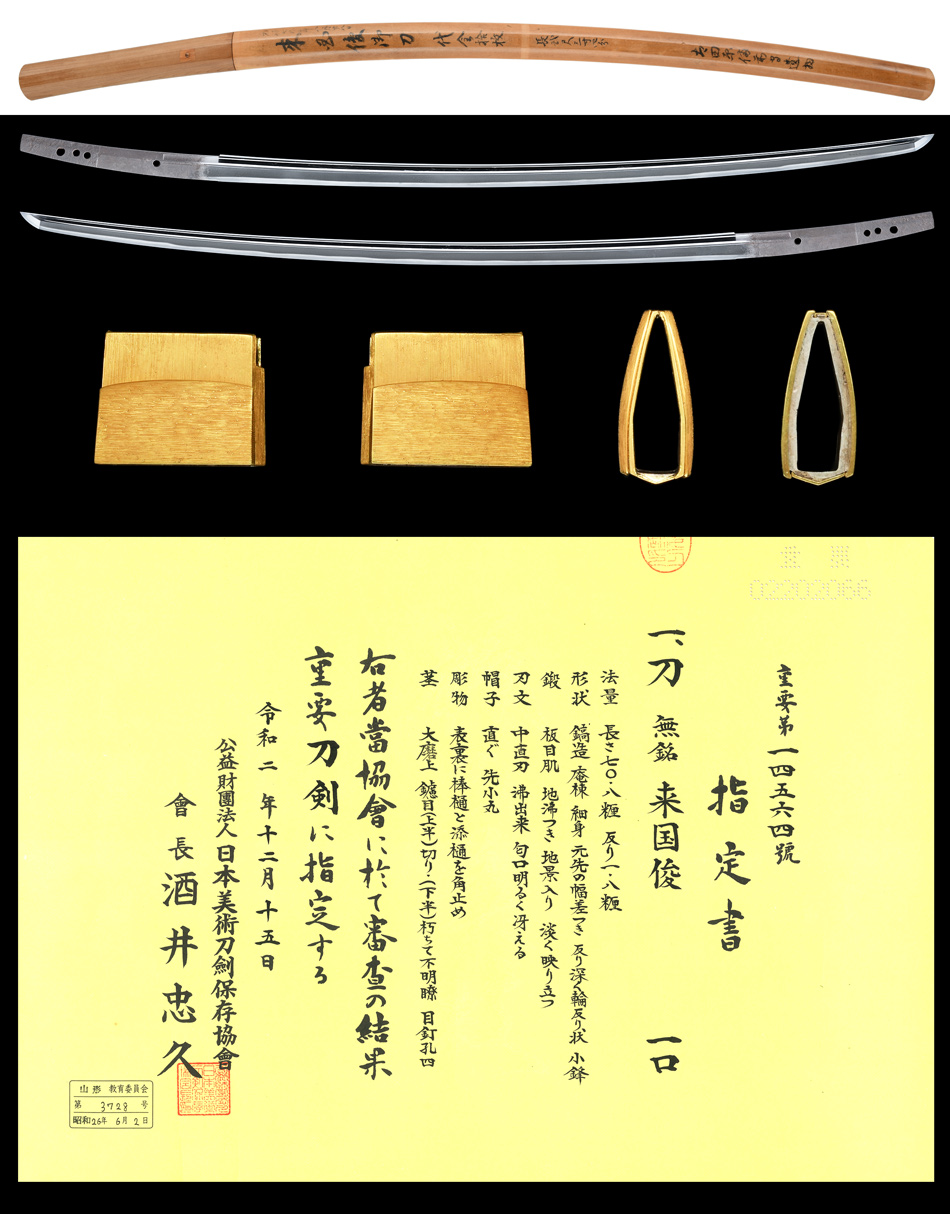
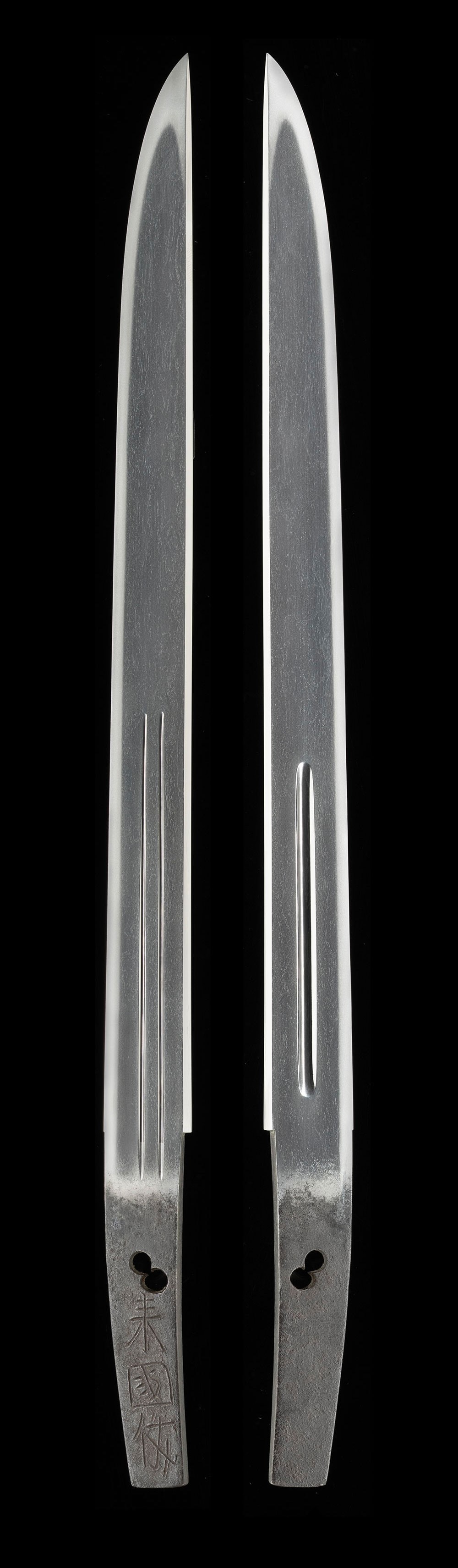
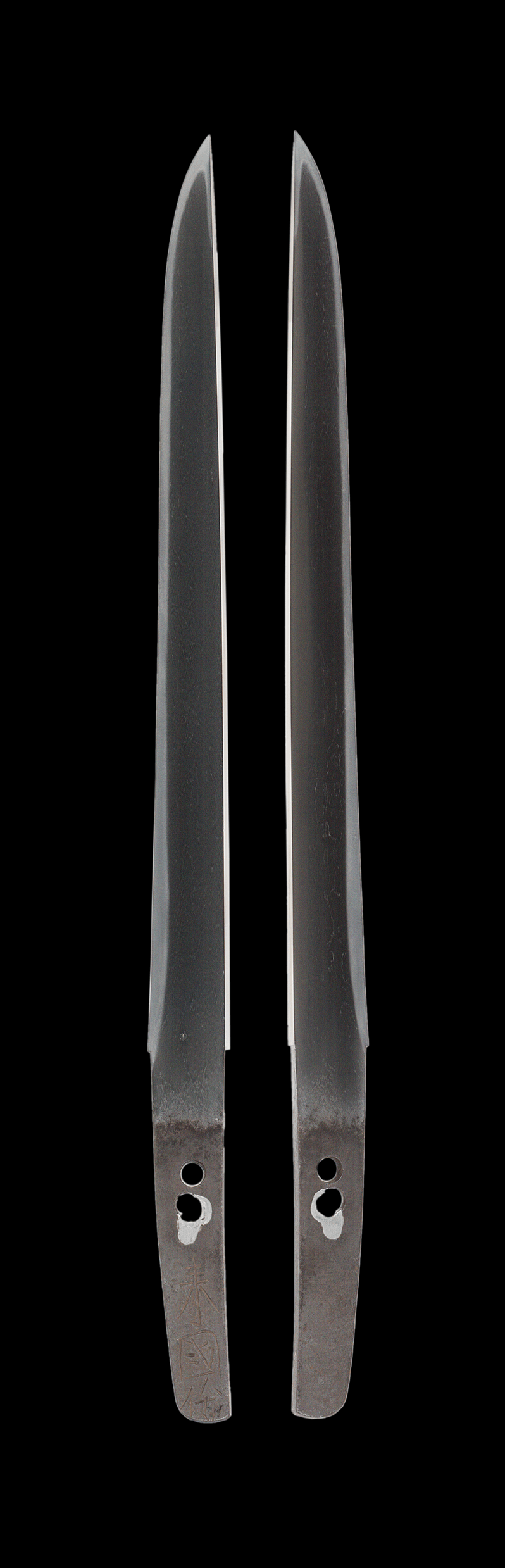
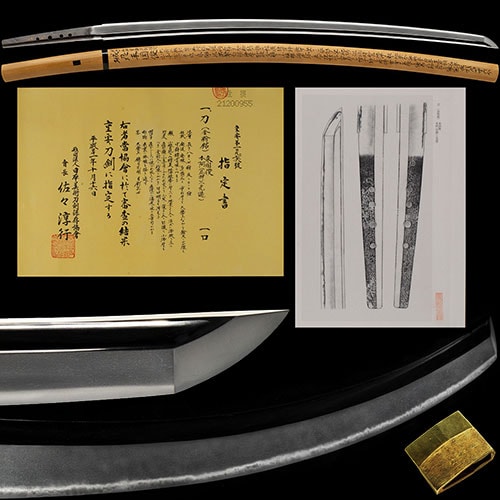
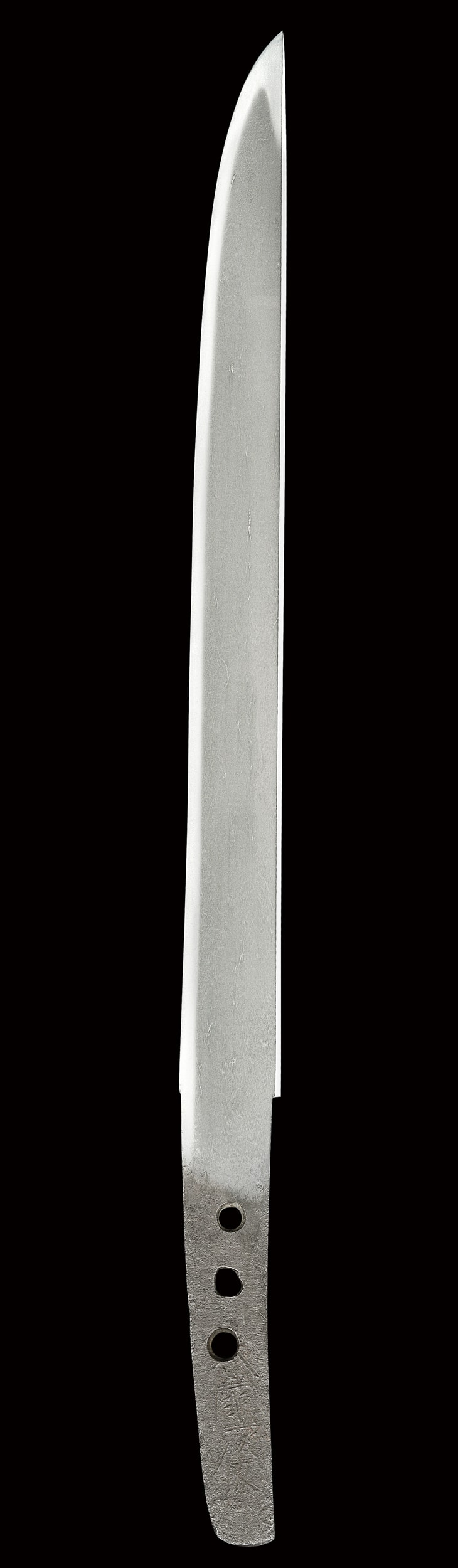
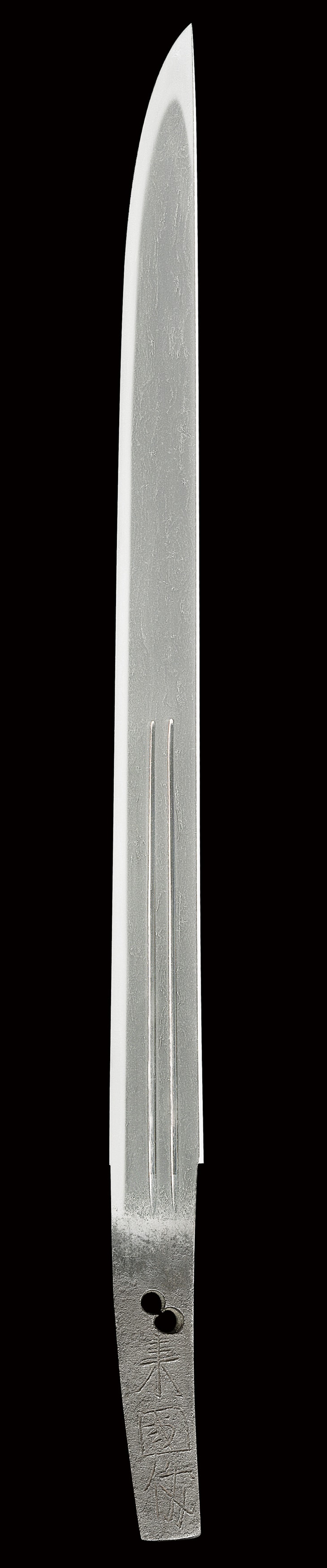
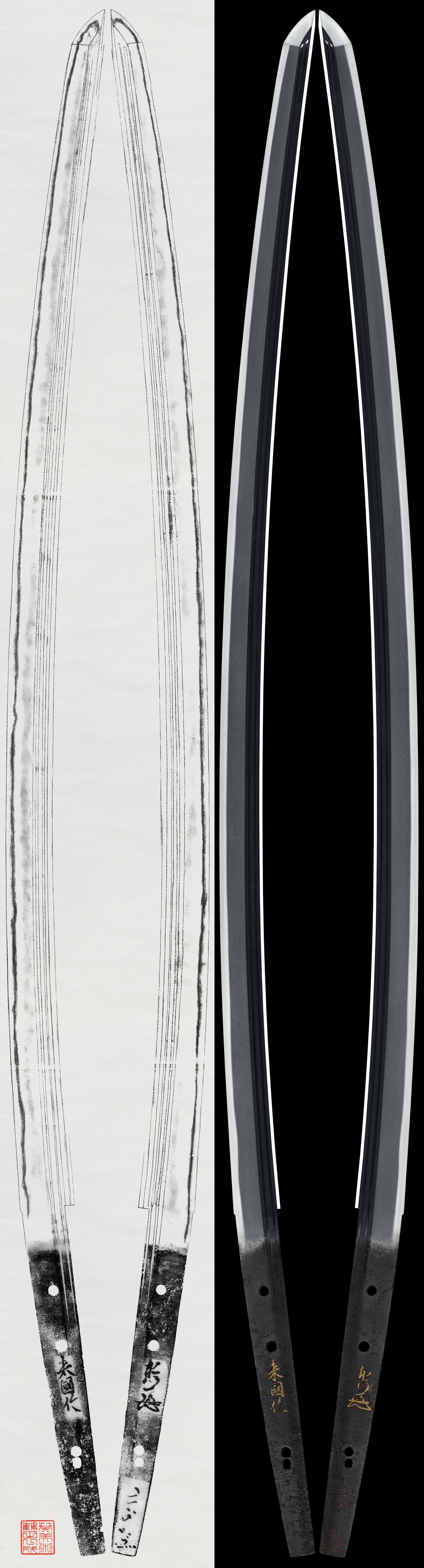
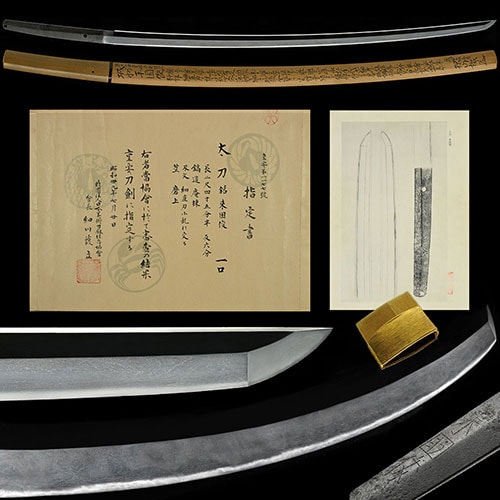
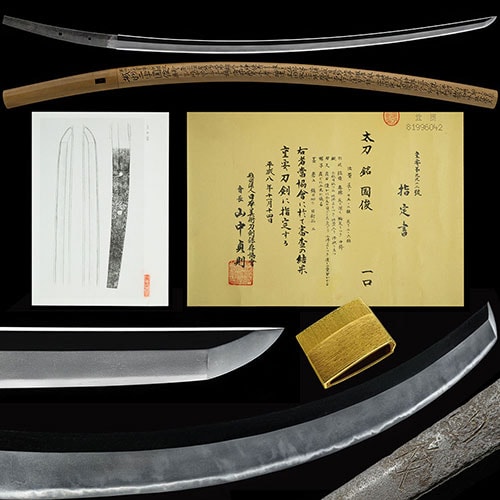
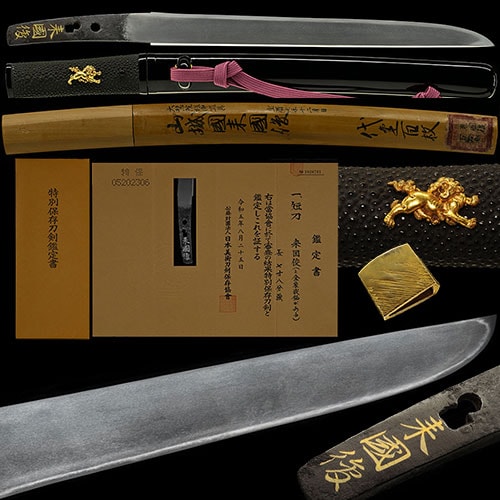
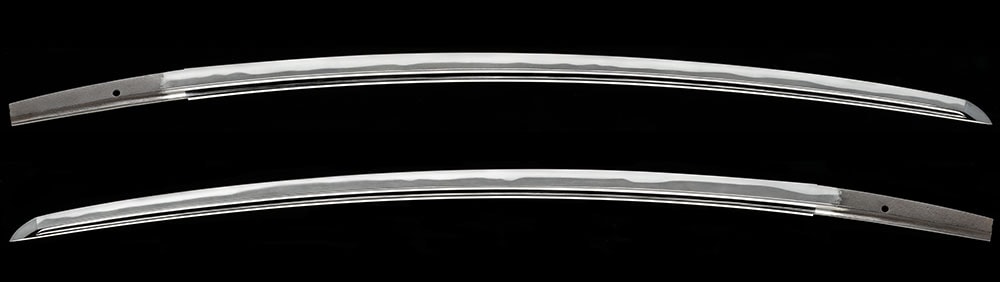
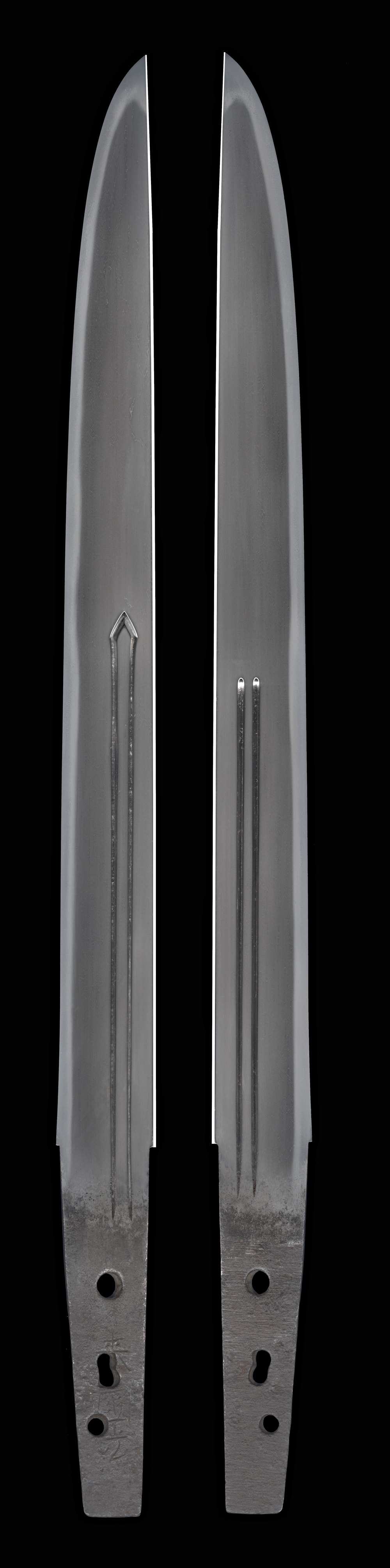
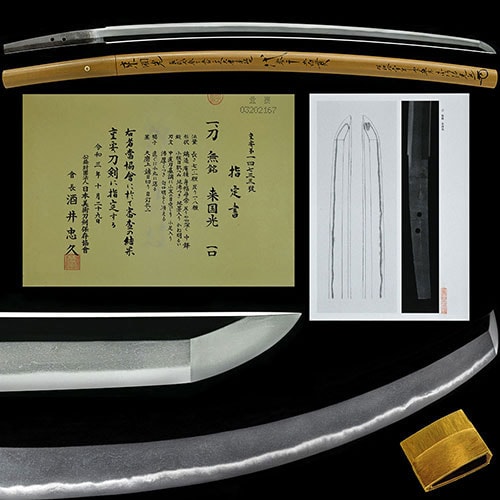
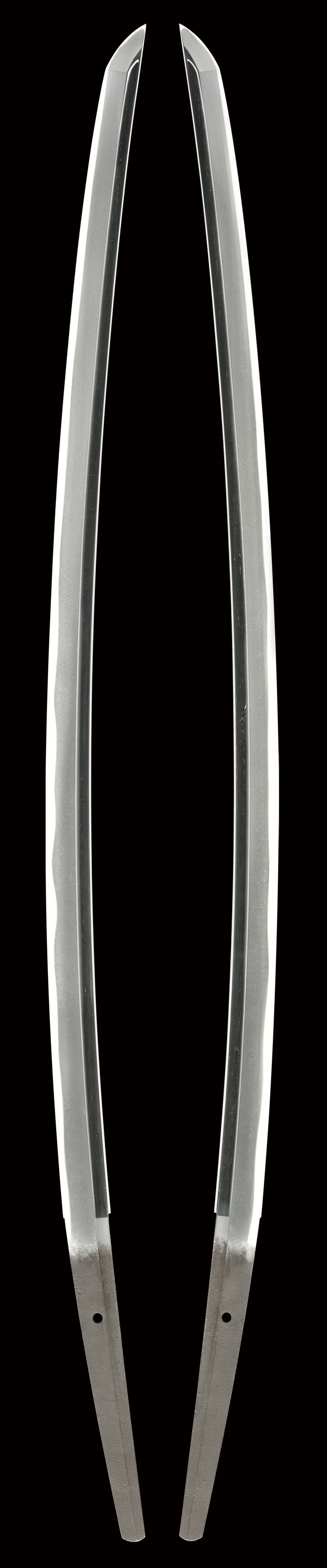
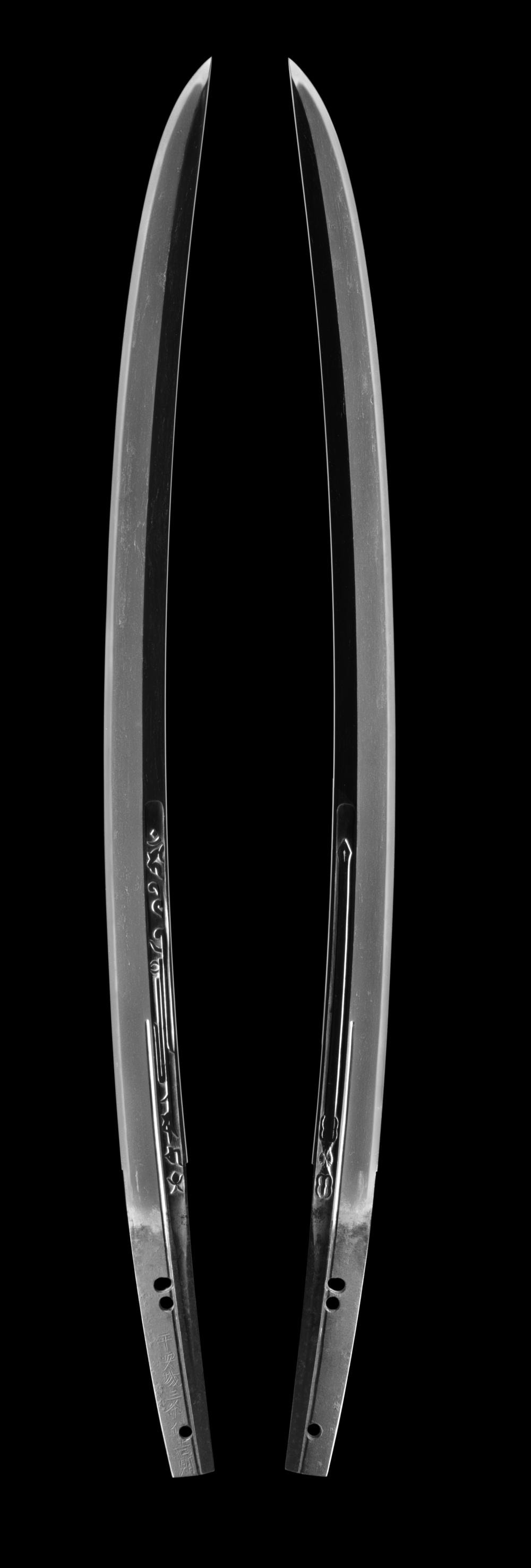
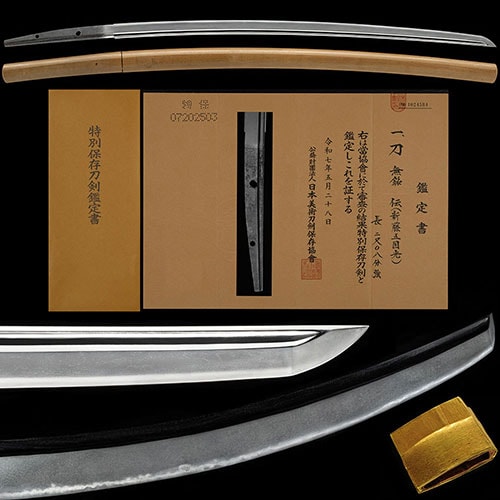
This is a katana attributed to Rai Kunitoshi from the late Kamakura period. The blade features a straight temper line (choku-ba) and is designated as a Juyo Token by the NBTHK. It has a detailed history, including being listed in the 'Okoshimono Account Book' of the Tokugawa family.

NBTHK Setsumei

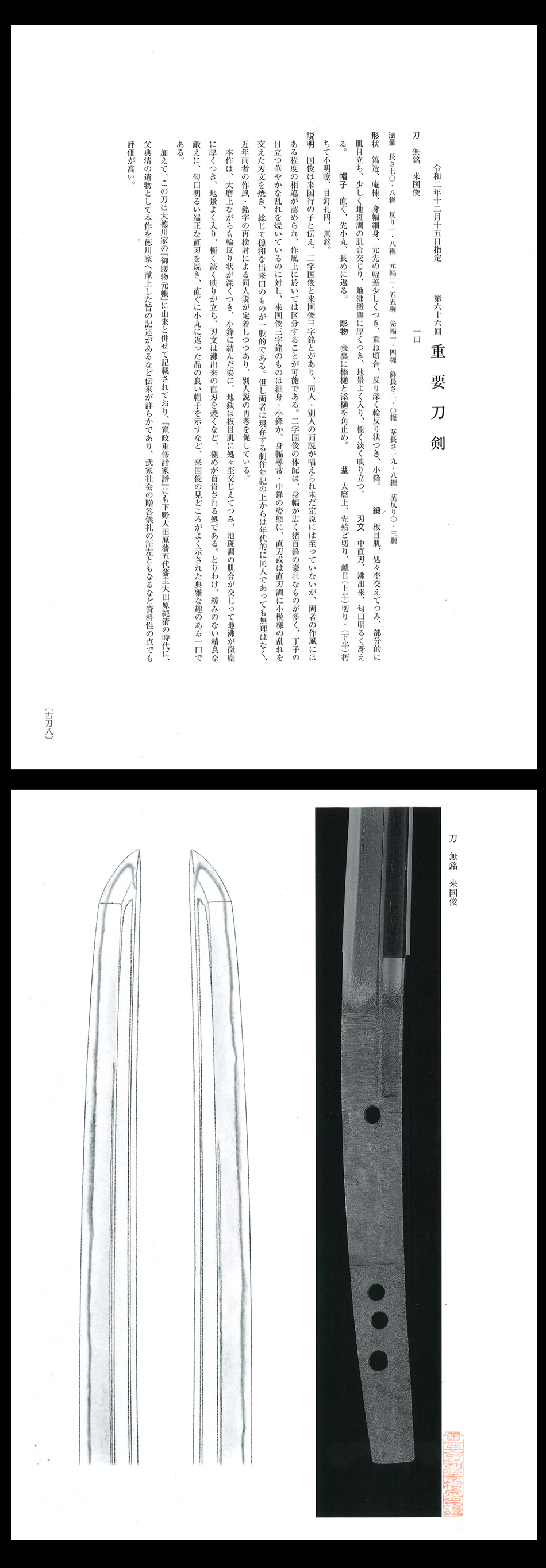
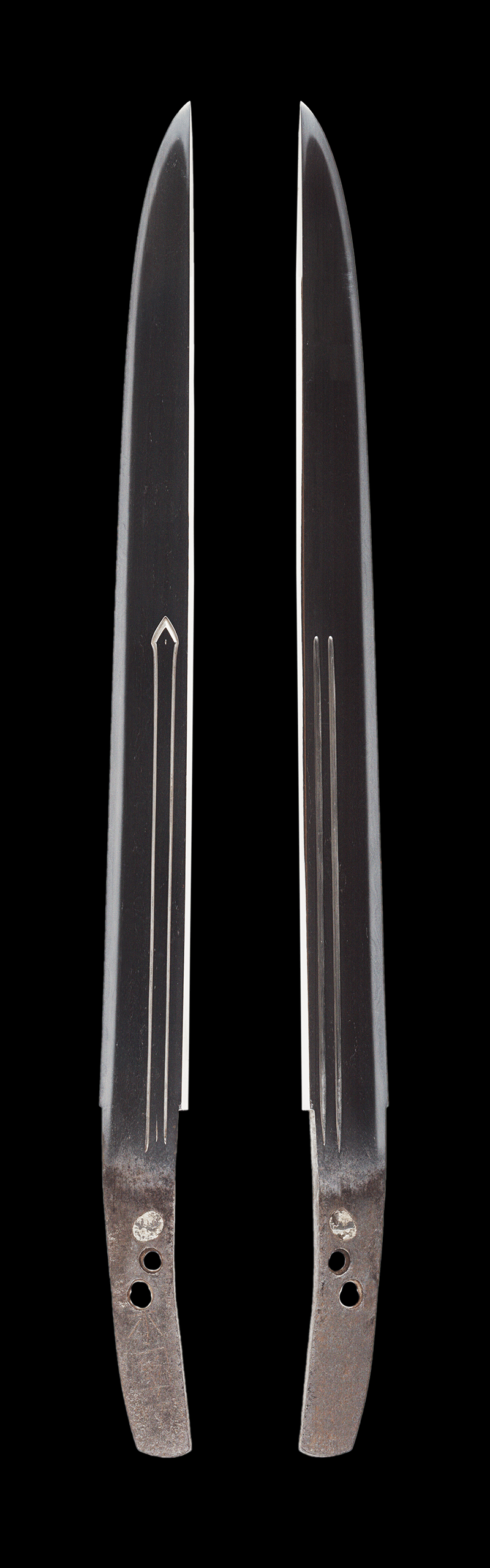
Juyo-Token, 66th Session — Designated December 15, 2020 Katana, mumei: Rai Kunitoshi (来国俊) Measurements Nagasa 70.8 cm, sori 1.8 cm, motohaba 2.55 cm, sakihaba 1.4 cm, kissaki-nagasa 2.0 cm, nakago-nagasa 19.8 cm, nakago-sori 0.3 cm Description Keijo: shinogi-zukuri, iori-mune; slender mihaba with little difference between base and tip widths; moderate kasane; deep, rounded (wazori-like) curvature; ko-kissaki. Kitae: itame-hada, densely forged with areas of mokume; in places the grain stands out; some jifu-like areas appear; ji-nie adheres finely and rather thickly; chikei is well formed; an extremely faint utsuri appears. Hamon: chu-suguha, nie-deki; the nioiguchi is bright and clear (saeru). Boshi: straight, turning back in ko-maru with a rather long kaeri. Horimono: on both sides, bo-hi with accompanying soe-hi, terminated in kaku-dome. Nakago: o-suriage, the tip almost cut off; file marks: upper half kiri, lower half obliterated by corrosion/wear; four mekugi-ana; unsigned. Artisan Rai Kunitoshi (来国俊) Era Late Kamakura period Explanation Kunitoshi is traditionally transmitted as a son of Rai Kuniyuki. Extant works are found bearing both a two-character signature “Kunitoshi” and a three-character signature “Rai Kunitoshi”; whether these represent the same individual or two different smiths has long been argued, and no definitive conclusion has yet been reached. Nevertheless, a certain degree of difference can be recognized in their manner, making stylistic distinction possible. Works of the two-character Kunitoshi frequently show a wide build and powerful ikubi-kissaki, and often display flamboyant, noticeably chōji-influenced midare. By contrast, those signed “Rai Kunitoshi” in three characters tend either toward a slender form with ko-kissaki, or a standard-width form with chu-kissaki; they commonly temper suguha, or suguha-based hamon with small patterned undulations, and in general exhibit a calm and gentle workmanship. However, when one considers the production dates that survive among extant examples, it is not unreasonable to regard the two as chronologically compatible with a single maker. In recent years, reexamination of both workmanship and signature forms has increasingly established the “same-person” theory, prompting renewed reconsideration of the “different-person” position. This blade, though o-suriage, preserves a deeply rounded curvature and a form concluding in ko-kissaki. The jihada is itame mixed with areas of mokume, showing some jifu-like features; fine ji-nie adheres rather thickly, with chikei well entering, and an extremely faint utsuri appearing. The hamon is a nie-deki suguha. These characteristics are such that the attribution is readily affirmed. In particular, the tight and excellent forging without looseness, the bright and orderly suguha with clear nioiguchi, and the refined boshi that turns back straight into ko-maru together display the key points of Rai Kunitoshi well; it is a work of elegant taste. In addition, this katana is recorded together with its provenance in the Tokugawa house’s “Okoshimono Motochō” (Register of the Shogunal Waist-Swords). Moreover, the Kansei Chōshū Shokafu records that, during the time of Ōtawara Sumikiyo, fifth lord of the Ōtawara domain in Shimotsuke Province, this sword was presented to the Tokugawa house as an heirloom of his father Norikiyo. Its transmission is thus clearly documented, and it stands as evidence of gift-giving protocol within the warrior society—factors that also elevate its value as historical source material.

NihontoWatch MonNihontoWatch
MarketEncyclopediaKantei
Swords›Yamashiro-den›Rai›Kunitoshi›Katana: Mumei Rai Kunitoshi - Juyo Token
katanaJūyō
Rai Kunitoshi

Katana: Mumei Rai Kunitoshi - Juyo Token

mumei · Kamakura · nagasa 70.8cm · sori 1.8cm

SOLD
Rai Kunitoshi — 1 of 4
Rai Kunitoshi — 2 of 4
Rai Kunitoshi — 3 of 4
Rai Kunitoshi — 4 of 4
1 / 4
1 / 4
Rai Kunitoshi — 1 of 4Rai Kunitoshi — 2 of 4Rai Kunitoshi — 3 of 4Rai Kunitoshi — 4 of 4
Measurements & details
Smith
Rai Kunitoshi
Type
Katana
School
Rai
Period
Around 1288–1319(Shoo)
Province
Yamashiro
Signature
Unsigned(66% of this smith's designated works are signed)
Measurements
Nagasa 70.8cmSori 1.8cmMotohaba 2.55cmSakihaba 1.4cm
Description

This is a katana attributed to Rai Kunitoshi from the late Kamakura period. The blade features a straight temper line (choku-ba) and is designated as a Juyo Token by the NBTHK. It has a detailed history, including being listed in the 'Okoshimono Account Book' of the Tokugawa family.

NBTHK Zufu Commentary

Juyo #66

AI translation — may contain errors

-, 66th Session — Designated December 15, 2020

, : Kunitoshi (来国俊)

Measurements 70.8 cm, 1.8 cm, 2.55 cm, 1.4 cm, 2.0 cm, 19.8 cm, 0.3 cm

Description Keijo: , ; slender with little difference between base and tip widths; moderate ; deep, rounded (-like) curvature; . : , densely forged with areas of ; in places the grain stands out; some -like areas appear; adheres finely and rather thickly; is well formed; an extremely faint appears. : , ; the is bright and clear (). : straight, turning back in with a rather long . : on both sides, with accompanying , terminated in . : , the tip almost cut off; file marks: upper half , lower half obliterated by corrosion/wear; four ; unsigned.

Artisan Kunitoshi (来国俊)

Era Late period

Explanation Kunitoshi is traditionally transmitted as a son of Kuniyuki. Extant works are found bearing both a two-character signature “Kunitoshi” and a three-character signature “ Kunitoshi”; whether these represent the individual or two different smiths has long been argued, and no definitive conclusion has yet been reached. Nevertheless, a certain degree of difference can be recognized in their manner, making stylistic distinction possible. Works of the two-character Kunitoshi frequently show a wide build and powerful , and often display flamboyant, noticeably -influenced . By contrast, those signed “ Kunitoshi” in three characters tend either toward a slender form with , or a standard-width form with ; they commonly temper , or -based with small patterned undulations, and in general exhibit a calm and gentle workmanship. However, when one considers the production dates that survive among extant examples, it is not unreasonable to regard the two as chronologically compatible with a single maker. In recent years, reexamination of both workmanship and signature forms has increasingly established the “-person” theory, prompting renewed reconsideration of the “different-person” position.

This blade, though , preserves a deeply rounded curvature and a form concluding in . The is mixed with areas of , showing some -like features; fine adheres rather thickly, with well entering, and an extremely faint appearing. The is a . These characteristics are such that the attribution is readily affirmed. In particular, the tight and excellent forging without looseness, the bright and orderly with clear , and the refined that turns back straight into together display the key points of Kunitoshi well; it is a work of elegant taste.

In addition, this is recorded together with its provenance in the Tokugawa house’s “Okoshimono Motochō” (Register of the Shogunal Waist-Swords). Moreover, the Kansei Chōshū Shokafu records that, during the time of Ōtawara Sumikiyo, fifth lord of the Ōtawara domain in Shimotsuke Province, this sword was presented to the Tokugawa house as an heirloom of his father Norikiyo. Its transmission is thus clearly documented, and it stands as evidence of gift-giving protocol within the warrior society—factors that also elevate its value as historical source material.

About the maker

Kunitoshi

國俊

Rai (Yamashiro) · Yamashiro · around 1288-1319

Fujishiro Sai-jo saku · Tōken Taikan top 1%

7 pieces on the market now

›

The published sources open Rai Kunitoshi's record with a single settled fact: he was "the first smith of the Rai line to crown his name with the character Rai, and all who followed took the practice from him"[[c:1]]. Traditionally the son of Rai Kuniyuki, he worked in Kyoto at the close of the Kamakura period. Dated blades open in the Shoo and Einin eras, fall silent for a time, then resume in Showa and continue through Bunpo, Gen'o and Genko; a tachi of Showa 4 (1315) in the Tokugawa Art Museum bears the age inscription seventy-five (七十五歳), and a work of Genko 1 (1321), cut at eighty-two, stands near the end of his production. This run of dated pieces is the backbone of the late Kamakura Rai chronology.

His hand is the Rai mainline at its most refined. The tachi are slender or of standard width with a pronounced taper, the curvature koshi-zori, turning to a rounded wa-zori on shortened blades, and the point small or medium. On this body he burns a chu-suguha or hoso-suguha in ko-nie with ko-choji and ko-gunome mixed in; ashi and yo enter well, at times slanting toward the nakago in the Kyoto manner the published sources call kyo-sakaashi. Nijuba appears in places, fine kinsuji and sunagashi run through the ha, and the nioiguchi is tight and bright; the boshi turns in a calm ko-maru, the tip lightly swept. The judgment the published sources attach to the whole is consistent: "a refined and calm manner that is Kyoto work through and through"[[c:2]].

The jigane carries as much of the attribution as the hamon: a tightly knit ko-itame with thick, often dust-fine ji-nie, fine chikei, and a nie-utsuri standing clearly over it; one Juyo appraisal adds that "the refinement of the jigane in particular deserves special mention"[[c:3]]. Here and there the larger, softer patches the texts call Rai-hada (来肌) intrude, and on tanto the hada may flow toward masame in places, both accepted as marks of the school rather than flaws. The packed ko-itame, the fine nie over it and the standing utsuri are what the appraisals return to whenever an unsigned blade is settled on his name.

Nearly half of his published record is tanto: the sources state again and again that where the two-character Kunitoshi left a single example, the meibutsu Aizen Kunitoshi, Rai Kunitoshi left many. These are hira-zukuri and mitsu-mune, of standard width or slightly elongated, with the quiet uchi-zori of the late Kamakura period; the suguha may take a shallow notare, the kaeri of the ko-maru boshi often runs down long, and the hamachi is frequently hardened in. Carving is habitual, a katana-hi with a slender koshi-bi or suken set beside it, or bonji over gomabashi, the added side groove being a practice "peculiar to Rai work"[[c:4]]. Suguha rules him, yet a small choji group stands at the opposite limit. Its representative is a National Treasure tachi, and a kodachi raised at the 27th Tokubetsu Juyo session, slender, high in koshi-zori, mixing large-lobed choji with the nie thick in the ha, is called "the most flamboyant range of work in his oeuvre"[[c:5]], "just evoking Niji Kunitoshi"[[c:6]]. That evocation is the heart of the school's classic question, whether the two-character Kunitoshi and the three-character Rai Kunitoshi are one smith or two. The combined dated works run from Koan 1 (1278) to Genko 1 (1321), some forty years and no strain for a single career, and counted back from the age inscription of seventy-five, the lone dated Niji blade falls at age thirty-eight. In recent years, the sources write, re-examination of the workmanship and the signature forms has brought the same-smith view toward acceptance, prompting a rethink of the two-smith position, and the choji blades above are read as key material on his side of the divide. The signatures hold further scholarship: the Gen'o pieces turn cursive enough that the notes weigh his old age against a second generation; rare works add the Minamoto surname; and on a Genko 2 folded-signature katana once worn by Shimazu Narinobu, the character kuni is cut in the manner of his pupil Rai Kunitsugu, read as one of the rare cases of the pupil signing in the master's name, the third such example known.

The contrast with Niji Kunitoshi is the standing formula of his appraisals: against a grand body with ikubi point and a flamboyant choji-dominated midare, the three-character works set a slender or standard build, a suguha or suguha with small-patterned midare, and a gentle effect overall, so the two hands can be told apart even while the one-smith question stays open. His other neighbors lie within the school. At its quietest his hoso-suguha "can at first glance be mistaken for Ryokai"[[c:7]], and his calmest, largest tanto are read first toward Rai Kunimitsu before the dignity of the work, "a grade higher"[[c:8]], settles the attribution on Kunitoshi. His pupils Rai Kunimitsu and Rai Kunitsugu carried the school through the end of Kamakura, and the line between master and pupils is fine enough that the meibutsu Yuki Rai Kunitoshi, a tanto recorded in the Meibutsucho, is itself said at first sight to suggest Kunimitsu and Kunitsugu.

For a master of this rank he is unusually approachable. Fujishiro grades him Sai-jo saku; five of his blades are National Treasures and eleven are Important Cultural Properties, with twenty-one Tokubetsu Juyo and one hundred forty-three Juyo beneath them, one hundred sixty-four blades across those two tiers. Signed work is abundant, one hundred thirty-four signed against ninety-one unsigned here, which is why his chronology can be written at all. Ten blades are locked in the National Treasure and Important Cultural Property tiers and will never trade, among them the kodachi of Futarasan Shrine at Nikko; the Tokugawa Art Museum holds the age-75 tachi, and other works rest with the Tokyo National Museum, the Nezu Museum, the Sano Art Museum and the Kurokawa Institute. Sixty-one blades carry recorded provenance: Toyotomi Hideyoshi, the shoguns Tokugawa Hidetada and Iemitsu, the Owari and Kishu Tokugawa, the Maeda, the Uesugi, the Shimazu of Kagoshima and the Sanada of Matsushiro. Yet thirty-six works are recorded in private hands and many more sit in the tradeable Juyo tiers, so a suguha tanto or tachi by Rai Kunitoshi, late Kamakura Yamashiro work in its purest form, remains a goal a serious collector can actually reach; the choji blades and the dated pieces stand effectively beyond the market.

Historical importance

Where Kunitoshi stands among comparable artisans: across all of nihontō, and within tradition, era, and period. The tiers (Foremost · Leading · Major · Notable) weigh official designations from the NBTHK and Japan's Agency for Cultural Affairs, together with historical honors of lasting repute such as the Sansaku and Meibutsu-chō.

随一
Foremost
屈指
Leading
有数
Major
著名
Notable

Select a lens to see how it's measured.

Designation record
196 designated works
Kokuhō (National Treasure)
4
Jūyō Bunkazai
8
Jūyō Bijutsuhin
19
Gyobutsu (Imperial)
3
Tokubetsu Jūyō
21
Jūyō
141
7 works by Kunitoshi on the market→
Kunitoshi — full profileRai (Yamashiro) school

Dated Works

Years he was demonstrably active, proven by signed-and-dated blades

Active period
1290–1319Editorial estimate: 1288–1319
7 of 120 designated works carry a date
1290
1300
1310
1320
About the school

Rai

来

Yamashiro-den · Yamashiro

44 pieces on the market now

›

A calm, lustrous steel is the first thing the connoisseur's eye is meant to settle on with the Rai school: a finely forged ko-itame (小板目) worked until it is dense and refined, over which the ji-nie lies thickly in minute particles, fine chikei (地景) enter, and a nie-utsuri rises in the ji. This bright, refined jihada, the surface the trade reads as Rai-hada when its softer, looser patches intrude, is the constant beneath every manner the house produced. The school took shape in Kyoto in the mid-Kamakura period around the workshop of Rai Kuniyuki (來國行), the de facto founder of the line, whose chronology is reckoned from the Koan 1 (1278) tachi of his transmitted son. From Kuniyuki the Yamashiro-den tradition of late Kamakura was built, carried by Niji Kunitoshi, the two-character 國俊, traditionally his son and the nearest of the house to his hand; by the three-character Rai Kunitoshi, the first to crown his name with the character Rai, a practice all who followed took from him; and onward through Rai Kunimitsu (來國光), Rai Kunitsugu (來國次) and the lesser names Kunizane, Tomokuni, Kunihide and Mitsukane into the early Nanbokucho period. Whether the two Kunitoshi are one smith or two remains the classic open question of the school, argued from a span of dated work running about forty years from Koan 1 to Genko 1 (1321). What unites the house is a temper of restraint and activity at once, its life carried in the nie rather than in the height of the pattern. Against Kuniyuki's wide, suguha-toned ha and against the refined chu- or hoso-suguha of the three-character line, the smiths mix ko-choji, ko-gunome and small midare; ashi and yo enter densely, often as the Kyoto-style kyo-sakaashi (京逆足) that slants back toward the nakago, the opposite of the Bizen direction; the nioiguchi runs deep and bright, ko-nie attaches thickly, and kinsuji and sunagashi move through the body of the ha. The boshi is the school's most misjudged trait: a ko-maru drawn out by hakikake, the brushed nie of the point continuing the work of the ji below, often falling into midare-komi with a pointing tip. Muneyaki along the back recurs often enough that the records name it a habit of the Rai hand, and carving in the groove, suken or gomabashi with an added side hi, is a practice the texts call peculiar to Rai work. The strength of the nie within the ha, the utsuri rising as a nie-utsuri, and the kyo-sakaashi are precisely the marks that part Niji Kunitoshi's choji-dominant midare, which the old books said resembles the Bizen Ichimonji, from the Ichimonji itself.

Where the early masters keep this calm Kyoto register, the late line bends toward Soshu-den: Kunitsugu, counted among the Ten Brilliant Pupils of Masamune and named Kamakura-Rai, shows the strongest nie of ji and ha in the whole school, a notare mixed with gunome the earlier Rai never had. For a collector the house style is the recognition tool. An unsigned, o-suriage katana settles to Rai when the packed ko-itame, the fine nie over it, the standing utsuri and the kyo-sakaashi read together; the named smith is then fixed by degree. Niji Kunitoshi and the three-character Kunitoshi, both graded Sai-jo saku by Fujishiro, anchor the canon, the latter unusually approachable because his signed work is abundant and roughly half of it tanto, late Yamashiro work in its purest form. Kunimitsu, the most prolific and most versatile of the house, gives the impression of surpassing his father in force; Kunitsugu, graded Jo-jo saku, is the Soshu-facing edge whose signed tachi are scarce. Mitsukane, the Chudo Rai who withdrew to forge on Mt. Hiei, stands apart as the strong pole, his ji-nie laid thicker than Kunitoshi's or Kunimitsu's and likened upward to Awataguchi Yoshimitsu; the smaller Kunizane, Tomokuni and Kunihide carry the jigane a step into the Nanbokucho. The provenance roll is of the first rank, with blades worn by Ieyasu and held beside the Honjo Masamune, meibutsu such as the Aizen Kunitoshi, the Torikai Kunitsugu and the Midare-Mitsukane, and descent through the Owari and Kishu Tokugawa, the Maeda, Uesugi and Shimazu houses. Much sits locked as National Treasure and patrimony, yet the Juyo tier of the major names, and the whole record of the minor hands, remains a goal a serious collector can actually reach. Learn more →

24 recorded smiths1011 designated works
Leading smiths
SmithEraDesignated
Kuniyuki國行1259-1260125
Kunitoshi國俊1278-128879
Kunitsugu國次1311-132765
Kunimitsu國光1326-1351259
Kunitoshi國俊1288-1319196
Explore the Rai school →

Historical context

Power sat in Kamakura, but taste was still made in Kyōto. The Awataguchi school’s pear-skin steel became a byword for perfection, and the Rai line supplied dignified tachi to the court, senior warriors, and the great temples alike.

Yamashiro in the Kamakura period →

✓N.B.T.H.K Jūyō
Seller
W
World Seiyudo
Established 2008 · 18 yrs on the market
🇯🇵Ships from Japan
›
✓Verified dealerworld-seiyudo.com
✓Ships worldwide✓English supportWire transferPayPalCredit card
Return policy

No cooling-off period or returns; refund only if the purchased sword is proven fake, capped at purchase price (excludes commission sales, accessories, auction items).

View all of World Seiyudo’s listings→View this item on the dealer’s site→

More works by Rai Kunitoshi

View all →
Choshuya
Jūyō
Tanto - Jūyō - by Rai Kunitoshi - Rai KunitoshiTanto - Jūyō - by Rai Kunitoshi - Rai Kunitoshi

Tantō

ByRai Kunitoshi
Ask
Choshuya
Tokuho
Tanto - Tokuho - by Rai Kunitoshi - Rai KunitoshiTanto - Tokuho - by Rai Kunitoshi - Rai Kunitoshi

Tantō

ByRai Kunitoshi
¥4,300,000
Eirakudo
Tokuho
Katana - Tokuho - by Rai Kunitoshi - Rai Kunitoshi Katana Tokubetsu Hozon TokenKatana - Tokuho - by Rai Kunitoshi - Rai Kunitoshi Katana Tokubetsu Hozon Token

Katana

ByRai Kunitoshi
¥3,000,000
Eirakudo
Jūyō
Tanto - Jūyō - by Rai Kunitoshi - Rai Kunitoshi Tanto - Juyo TokenTanto - Jūyō - by Rai Kunitoshi - Rai Kunitoshi Tanto - Juyo Token

Tantō

ByRai Kunitoshi
Ask
Choshuya
Tanto - by Rai Kunitoshi - Japanese Sword for Sale | Ginza Choshuya | Signed Rai Kunitoshi (O-wazamono), 1746Tanto - by Rai Kunitoshi - Japanese Sword for Sale | Ginza Choshuya | Signed Rai Kunitoshi (O-wazamono), 1746

Tantō

ByRai Kunitoshi
Ask
Iida Koendo
Jūyō
Tanto - Jūyō - by Rai Kunitoshi - Rai Kunitoshi TantoTanto - Jūyō - by Rai Kunitoshi - Rai Kunitoshi Tanto

Tantō

ByRai Kunitoshi
¥11,000,000
Iida Koendo
Tokuho
Tanto - Tokuho - by Rai Kunitoshi - Rai KunitoshiTanto - Tokuho - by Rai Kunitoshi - Rai Kunitoshi

Tantō

ByRai Kunitoshi
¥7,700,000

Previously sold by Rai Kunitoshi

Eirakudo
Jūyō
Katana - Jūyō - by Rai Kunitoshi - Rai Kunitoshi - Juyo TokenKatana - Jūyō - by Rai Kunitoshi - Rai Kunitoshi - Juyo Token
Sold

Katana

ByRai Kunitoshi
SOLD
Samurai Nippon
Tanto - by Rai Kunitoshi - Rai KunitoshiTanto - by Rai Kunitoshi - Rai Kunitoshi
Sold

Tantō

ByRai Kunitoshi
SOLD
World Seiyudo
Tokuho
Katana - Tokuho - by Rai Kunitoshi - Rai Kunitoshi - Tokubetsu Hozon Token, O-wazamonoKatana - Tokuho - by Rai Kunitoshi - Rai Kunitoshi - Tokubetsu Hozon Token, O-wazamono
Sold

Katana

ByRai Kunitoshi
SOLD
Samurai Nippon
Tanto - by Rai Kunitoshi - Rai KunitoshiTanto - by Rai Kunitoshi - Rai Kunitoshi
Sold

Tantō

ByRai Kunitoshi
SOLD
Aoi Art
Tokujū
Katana - Tokuju - by Rai Kunitoshi - Rai Kunitoshi with Golden Inscription by Hon'amiKatana - Tokuju - by Rai Kunitoshi - Rai Kunitoshi with Golden Inscription by Hon'ami
Sold

Katana

ByRai Kunitoshi
SOLD
Iida Koendo
Jūyō
Tanto - Jūyō - by Rai Kunitoshi - Koto: Rai KunitoshiTanto - Jūyō - by Rai Kunitoshi - Koto: Rai Kunitoshi
Sold

Tantō

ByRai Kunitoshi
SOLD
Eirakudo
Tokuho
Tanto - Tokuho - by Rai Kunitoshi - Rai Kunitoshi Tanto Tokubetsu Hozon TokenTanto - Tokuho - by Rai Kunitoshi - Rai Kunitoshi Tanto Tokubetsu Hozon Token
Sold

Tantō

ByRai Kunitoshi
SOLD
Eirakudo
Jūyō
Tachi - Jūyō - by Rai Kunitoshi - Rai Kunitoshi - Juyo TokenTachi - Jūyō - by Rai Kunitoshi - Rai Kunitoshi - Juyo Token
Sold

Tachi

ByRai Kunitoshi
SOLD

More from the Rai school

View all →
Yazawa Shokai
Tokuho
Tachi - Tokuho - by Rai Kuniyuki - Consignment: Rai Kuniyuki Mid-Kamakura Period, Blade Length 69.7cm, Sori 1.9cm, in Shirasaya with Tachi KoshiraeTachi - Tokuho - by Rai Kuniyuki - Consignment: Rai Kuniyuki Mid-Kamakura Period, Blade Length 69.7cm, Sori 1.9cm, in Shirasaya with Tachi Koshirae

Tachi

ByRai Kuniyuki
¥3,000,000
Eirakudo
Jūyō
Katana - Jūyō - by Rai Kunimitsu - Rai Kunimitsu - Juyo TokenKatana - Jūyō - by Rai Kunimitsu - Rai Kunimitsu - Juyo Token

Katana

ByRai Kunimitsu
¥7,800,000
Nipponto
Jūyō
Katana - Jūyō - by Rai Kuniyuki - Kuniyuki (Yamashiro Kyoto Rai School Founder) (From Baron Sugiyama Shigemaru Family)Katana - Jūyō - by Rai Kuniyuki - Kuniyuki (Yamashiro Kyoto Rai School Founder) (From Baron Sugiyama Shigemaru Family)

Katana

ByRai Kuniyuki
Ask
Nipponto
Jūyō
Katana - Jūyō - by Rai Kunitsugu - Rai Kunitsugu (Listed in Kantou Hibi Sho Zoku 2)Katana - Jūyō - by Rai Kunitsugu - Rai Kunitsugu (Listed in Kantou Hibi Sho Zoku 2)

Katana

ByRai Kunitsugu
Ask
Bushido Antique Japanese Swords
Tokuho
Katana - Tokuho - by Rai Kunitsugu - Rai Kunitsugu DaitoKatana - Tokuho - by Rai Kunitsugu - Rai Kunitsugu Daito

Katana

ByRai Kunitsugu
¥35,000
Eirakudo
Jūyō
Tanto - Jūyō - by Rai Kunimitsu - Rai Kunimitsu Tanto - Juyo TokenTanto - Jūyō - by Rai Kunimitsu - Rai Kunimitsu Tanto - Juyo Token

Tantō

ByRai Kunimitsu
Ask
Toyuukai
Tokuho
Tachi - Tokuho - by Rai School - Rai KunisueTachi - Tokuho - by Rai School - Rai Kunisue

Tachi

ByRai School
¥2,200,000
Iida Koendo
Tokuho
Tanto - Tokuho - by Rai Kunimitsu - Rai KunimitsuTanto - Tokuho - by Rai Kunimitsu - Rai Kunimitsu

Tantō

ByRai Kunimitsu
¥7,700,000

More from the Yamashiro tradition

View all →
Samurai Nippon
Tokujū
Katana - Tokuju - by Awataguchi Kuniyoshi - Mumei (Attributed to Awataguchi Kuniyoshi)Katana - Tokuju - by Awataguchi Kuniyoshi - Mumei (Attributed to Awataguchi Kuniyoshi)

Katana

ByAwataguchi Kuniyoshi
Ask
Eirakudo
Tokuho
Katana - Tokuho - by Nobukuni School - Nobukuni - Tokubetsu Hozon TokenKatana - Tokuho - by Nobukuni School - Nobukuni - Tokubetsu Hozon Token

Katana

ByNobukuni School
¥1,200,000
Katanahanbai
Hozon
Tanto - Hozon - by Heianjo Nagayoshi - Heianjo NagayoshiTanto - Hozon - by Heianjo Nagayoshi - Heianjo Nagayoshi

Tantō

ByHeianjo Nagayoshi
¥1,350,000
Eirakudo
Jūyō
Tachi - Jūyō - by Ayanokoji Sadatoshi - Sadatoshi Tachi - Juyo TokenTachi - Jūyō - by Ayanokoji Sadatoshi - Sadatoshi Tachi - Juyo Token

Tachi

ByAyanokoji Sadatoshi
¥7,700,000
Choshuya
Tokuho
Katana - Tokuho - by Enju Kunitoki - Kinpun mei Kunitoki, Hon'a (Koson oshigata)Katana - Tokuho - by Enju Kunitoki - Kinpun mei Kunitoki, Hon'a (Koson oshigata)

Katana

ByEnju Kunitoki
¥2,700,000
Eirakudo
Tokuho
Katana - Tokuho - by Shintogo Kunimitsu - Shintogo Kunimitsu Katana - Tokubetsu Hozon TokenKatana - Tokuho - by Shintogo Kunimitsu - Shintogo Kunimitsu Katana - Tokubetsu Hozon Token

Katana

ByShintogo Kunimitsu
¥7,500,000
Aoi Art
Jūyō
Wakizashi - Jūyō - by Nobukuni - Mumei (Nobukuni)Wakizashi - Jūyō - by Nobukuni - Mumei (Nobukuni)

Wakizashi

ByNobukuni
Starting Bid¥2,900,000
Nihonto.com
Jūyō
Wakizashi - Jūyō - by Nobukuni - Juyo Token Wakizashi by Shikibu no Jo NobukuniWakizashi - Jūyō - by Nobukuni - Juyo Token Wakizashi by Shikibu no Jo Nobukuni

Wakizashi

ByNobukuni
¥47,750

Swords

  • Katana
  • Wakizashi
  • Tantō
  • Tachi
  • Naginata
  • Yari

Fittings

  • Tsuba
  • Fuchi-Kashira
  • Kozuka
  • Menuki

Armor

  • Kabuto
  • Samurai Armor

By Certification

  • Tokujū
  • Jūyō
  • Tokuho
  • Hozon

Resources

  • Dealer Directory
  • Artist Directory
  • The Daily Kantei
  • Glossary
  • Browse All
Nihontowatch© 2026
TermsPrivacyCookiesAbout

Description

This is a katana attributed to Rai Kunitoshi from the late Kamakura period. The blade features a straight temper line (choku-ba) and is designated as a Juyo Token by the NBTHK. It has a detailed history, including being listed in the 'Okoshimono Account Book' of the Tokugawa family.

NBTHK Setsumei

Juyo-Token, 66th Session — Designated December 15, 2020 Katana, mumei: Rai Kunitoshi (来国俊) Measurements Nagasa 70.8 cm, sori 1.8 cm, motohaba 2.55 cm, sakihaba 1.4 cm, kissaki-nagasa 2.0 cm, nakago-nagasa 19.8 cm, nakago-sori 0.3 cm Description Keijo: shinogi-zukuri, iori-mune; slender mihaba with little difference between base and tip widths; moderate kasane; deep, rounded (wazori-like) curvature; ko-kissaki. Kitae: itame-hada, densely forged with areas of mokume; in places the grain stands out; some jifu-like areas appear; ji-nie adheres finely and rather thickly; chikei is well formed; an extremely faint utsuri appears. Hamon: chu-suguha, nie-deki; the nioiguchi is bright and clear (saeru). Boshi: straight, turning back in ko-maru with a rather long kaeri. Horimono: on both sides, bo-hi with accompanying soe-hi, terminated in kaku-dome. Nakago: o-suriage, the tip almost cut off; file marks: upper half kiri, lower half obliterated by corrosion/wear; four mekugi-ana; unsigned. Artisan Rai Kunitoshi (来国俊) Era Late Kamakura period Explanation Kunitoshi is traditionally transmitted as a son of Rai Kuniyuki. Extant works are found bearing both a two-character signature “Kunitoshi” and a three-character signature “Rai Kunitoshi”; whether these represent the same individual or two different smiths has long been argued, and no definitive conclusion has yet been reached. Nevertheless, a certain degree of difference can be recognized in their manner, making stylistic distinction possible. Works of the two-character Kunitoshi frequently show a wide build and powerful ikubi-kissaki, and often display flamboyant, noticeably chōji-influenced midare. By contrast, those signed “Rai Kunitoshi” in three characters tend either toward a slender form with ko-kissaki, or a standard-width form with chu-kissaki; they commonly temper suguha, or suguha-based hamon with small patterned undulations, and in general exhibit a calm and gentle workmanship. However, when one considers the production dates that survive among extant examples, it is not unreasonable to regard the two as chronologically compatible with a single maker. In recent years, reexamination of both workmanship and signature forms has increasingly established the “same-person” theory, prompting renewed reconsideration of the “different-person” position. This blade, though o-suriage, preserves a deeply rounded curvature and a form concluding in ko-kissaki. The jihada is itame mixed with areas of mokume, showing some jifu-like features; fine ji-nie adheres rather thickly, with chikei well entering, and an extremely faint utsuri appearing. The hamon is a nie-deki suguha. These characteristics are such that the attribution is readily affirmed. In particular, the tight and excellent forging without looseness, the bright and orderly suguha with clear nioiguchi, and the refined boshi that turns back straight into ko-maru together display the key points of Rai Kunitoshi well; it is a work of elegant taste. In addition, this katana is recorded together with its provenance in the Tokugawa house’s “Okoshimono Motochō” (Register of the Shogunal Waist-Swords). Moreover, the Kansei Chōshū Shokafu records that, during the time of Ōtawara Sumikiyo, fifth lord of the Ōtawara domain in Shimotsuke Province, this sword was presented to the Tokugawa house as an heirloom of his father Norikiyo. Its transmission is thus clearly documented, and it stands as evidence of gift-giving protocol within the warrior society—factors that also elevate its value as historical source material.

NihontoWatch MonNihontoWatch
MarketEncyclopediaKantei
Swords›Yamashiro-den›Rai›Kunitoshi›Katana: Mumei Rai Kunitoshi - Juyo Token
katanaJūyō
Rai Kunitoshi

Katana: Mumei Rai Kunitoshi - Juyo Token

mumei · Kamakura · nagasa 70.8cm · sori 1.8cm

SOLD
Rai Kunitoshi — 1 of 4
Rai Kunitoshi — 2 of 4
Rai Kunitoshi — 3 of 4
Rai Kunitoshi — 4 of 4
1 / 4
1 / 4
Rai Kunitoshi — 1 of 4Rai Kunitoshi — 2 of 4Rai Kunitoshi — 3 of 4Rai Kunitoshi — 4 of 4
Measurements & details
Smith
Rai Kunitoshi
Type
Katana
School
Rai
Period
Around 1288–1319(Shoo)
Province
Yamashiro
Signature
Unsigned(66% of this smith's designated works are signed)
Measurements
Nagasa 70.8cmSori 1.8cmMotohaba 2.55cmSakihaba 1.4cm
Description

This is a katana attributed to Rai Kunitoshi from the late Kamakura period. The blade features a straight temper line (choku-ba) and is designated as a Juyo Token by the NBTHK. It has a detailed history, including being listed in the 'Okoshimono Account Book' of the Tokugawa family.

NBTHK Zufu Commentary

Juyo #66

AI translation — may contain errors

-, 66th Session — Designated December 15, 2020

, : Kunitoshi (来国俊)

Measurements 70.8 cm, 1.8 cm, 2.55 cm, 1.4 cm, 2.0 cm, 19.8 cm, 0.3 cm

Description Keijo: , ; slender with little difference between base and tip widths; moderate ; deep, rounded (-like) curvature; . : , densely forged with areas of ; in places the grain stands out; some -like areas appear; adheres finely and rather thickly; is well formed; an extremely faint appears. : , ; the is bright and clear (). : straight, turning back in with a rather long . : on both sides, with accompanying , terminated in . : , the tip almost cut off; file marks: upper half , lower half obliterated by corrosion/wear; four ; unsigned.

Artisan Kunitoshi (来国俊)

Era Late period

Explanation Kunitoshi is traditionally transmitted as a son of Kuniyuki. Extant works are found bearing both a two-character signature “Kunitoshi” and a three-character signature “ Kunitoshi”; whether these represent the individual or two different smiths has long been argued, and no definitive conclusion has yet been reached. Nevertheless, a certain degree of difference can be recognized in their manner, making stylistic distinction possible. Works of the two-character Kunitoshi frequently show a wide build and powerful , and often display flamboyant, noticeably -influenced . By contrast, those signed “ Kunitoshi” in three characters tend either toward a slender form with , or a standard-width form with ; they commonly temper , or -based with small patterned undulations, and in general exhibit a calm and gentle workmanship. However, when one considers the production dates that survive among extant examples, it is not unreasonable to regard the two as chronologically compatible with a single maker. In recent years, reexamination of both workmanship and signature forms has increasingly established the “-person” theory, prompting renewed reconsideration of the “different-person” position.

This blade, though , preserves a deeply rounded curvature and a form concluding in . The is mixed with areas of , showing some -like features; fine adheres rather thickly, with well entering, and an extremely faint appearing. The is a . These characteristics are such that the attribution is readily affirmed. In particular, the tight and excellent forging without looseness, the bright and orderly with clear , and the refined that turns back straight into together display the key points of Kunitoshi well; it is a work of elegant taste.

In addition, this is recorded together with its provenance in the Tokugawa house’s “Okoshimono Motochō” (Register of the Shogunal Waist-Swords). Moreover, the Kansei Chōshū Shokafu records that, during the time of Ōtawara Sumikiyo, fifth lord of the Ōtawara domain in Shimotsuke Province, this sword was presented to the Tokugawa house as an heirloom of his father Norikiyo. Its transmission is thus clearly documented, and it stands as evidence of gift-giving protocol within the warrior society—factors that also elevate its value as historical source material.

About the maker

Kunitoshi

國俊

Rai (Yamashiro) · Yamashiro · around 1288-1319

Fujishiro Sai-jo saku · Tōken Taikan top 1%

7 pieces on the market now

›

The published sources open Rai Kunitoshi's record with a single settled fact: he was "the first smith of the Rai line to crown his name with the character Rai, and all who followed took the practice from him"[[c:1]]. Traditionally the son of Rai Kuniyuki, he worked in Kyoto at the close of the Kamakura period. Dated blades open in the Shoo and Einin eras, fall silent for a time, then resume in Showa and continue through Bunpo, Gen'o and Genko; a tachi of Showa 4 (1315) in the Tokugawa Art Museum bears the age inscription seventy-five (七十五歳), and a work of Genko 1 (1321), cut at eighty-two, stands near the end of his production. This run of dated pieces is the backbone of the late Kamakura Rai chronology.

His hand is the Rai mainline at its most refined. The tachi are slender or of standard width with a pronounced taper, the curvature koshi-zori, turning to a rounded wa-zori on shortened blades, and the point small or medium. On this body he burns a chu-suguha or hoso-suguha in ko-nie with ko-choji and ko-gunome mixed in; ashi and yo enter well, at times slanting toward the nakago in the Kyoto manner the published sources call kyo-sakaashi. Nijuba appears in places, fine kinsuji and sunagashi run through the ha, and the nioiguchi is tight and bright; the boshi turns in a calm ko-maru, the tip lightly swept. The judgment the published sources attach to the whole is consistent: "a refined and calm manner that is Kyoto work through and through"[[c:2]].

The jigane carries as much of the attribution as the hamon: a tightly knit ko-itame with thick, often dust-fine ji-nie, fine chikei, and a nie-utsuri standing clearly over it; one Juyo appraisal adds that "the refinement of the jigane in particular deserves special mention"[[c:3]]. Here and there the larger, softer patches the texts call Rai-hada (来肌) intrude, and on tanto the hada may flow toward masame in places, both accepted as marks of the school rather than flaws. The packed ko-itame, the fine nie over it and the standing utsuri are what the appraisals return to whenever an unsigned blade is settled on his name.

Nearly half of his published record is tanto: the sources state again and again that where the two-character Kunitoshi left a single example, the meibutsu Aizen Kunitoshi, Rai Kunitoshi left many. These are hira-zukuri and mitsu-mune, of standard width or slightly elongated, with the quiet uchi-zori of the late Kamakura period; the suguha may take a shallow notare, the kaeri of the ko-maru boshi often runs down long, and the hamachi is frequently hardened in. Carving is habitual, a katana-hi with a slender koshi-bi or suken set beside it, or bonji over gomabashi, the added side groove being a practice "peculiar to Rai work"[[c:4]]. Suguha rules him, yet a small choji group stands at the opposite limit. Its representative is a National Treasure tachi, and a kodachi raised at the 27th Tokubetsu Juyo session, slender, high in koshi-zori, mixing large-lobed choji with the nie thick in the ha, is called "the most flamboyant range of work in his oeuvre"[[c:5]], "just evoking Niji Kunitoshi"[[c:6]]. That evocation is the heart of the school's classic question, whether the two-character Kunitoshi and the three-character Rai Kunitoshi are one smith or two. The combined dated works run from Koan 1 (1278) to Genko 1 (1321), some forty years and no strain for a single career, and counted back from the age inscription of seventy-five, the lone dated Niji blade falls at age thirty-eight. In recent years, the sources write, re-examination of the workmanship and the signature forms has brought the same-smith view toward acceptance, prompting a rethink of the two-smith position, and the choji blades above are read as key material on his side of the divide. The signatures hold further scholarship: the Gen'o pieces turn cursive enough that the notes weigh his old age against a second generation; rare works add the Minamoto surname; and on a Genko 2 folded-signature katana once worn by Shimazu Narinobu, the character kuni is cut in the manner of his pupil Rai Kunitsugu, read as one of the rare cases of the pupil signing in the master's name, the third such example known.

The contrast with Niji Kunitoshi is the standing formula of his appraisals: against a grand body with ikubi point and a flamboyant choji-dominated midare, the three-character works set a slender or standard build, a suguha or suguha with small-patterned midare, and a gentle effect overall, so the two hands can be told apart even while the one-smith question stays open. His other neighbors lie within the school. At its quietest his hoso-suguha "can at first glance be mistaken for Ryokai"[[c:7]], and his calmest, largest tanto are read first toward Rai Kunimitsu before the dignity of the work, "a grade higher"[[c:8]], settles the attribution on Kunitoshi. His pupils Rai Kunimitsu and Rai Kunitsugu carried the school through the end of Kamakura, and the line between master and pupils is fine enough that the meibutsu Yuki Rai Kunitoshi, a tanto recorded in the Meibutsucho, is itself said at first sight to suggest Kunimitsu and Kunitsugu.

For a master of this rank he is unusually approachable. Fujishiro grades him Sai-jo saku; five of his blades are National Treasures and eleven are Important Cultural Properties, with twenty-one Tokubetsu Juyo and one hundred forty-three Juyo beneath them, one hundred sixty-four blades across those two tiers. Signed work is abundant, one hundred thirty-four signed against ninety-one unsigned here, which is why his chronology can be written at all. Ten blades are locked in the National Treasure and Important Cultural Property tiers and will never trade, among them the kodachi of Futarasan Shrine at Nikko; the Tokugawa Art Museum holds the age-75 tachi, and other works rest with the Tokyo National Museum, the Nezu Museum, the Sano Art Museum and the Kurokawa Institute. Sixty-one blades carry recorded provenance: Toyotomi Hideyoshi, the shoguns Tokugawa Hidetada and Iemitsu, the Owari and Kishu Tokugawa, the Maeda, the Uesugi, the Shimazu of Kagoshima and the Sanada of Matsushiro. Yet thirty-six works are recorded in private hands and many more sit in the tradeable Juyo tiers, so a suguha tanto or tachi by Rai Kunitoshi, late Kamakura Yamashiro work in its purest form, remains a goal a serious collector can actually reach; the choji blades and the dated pieces stand effectively beyond the market.

Historical importance

Where Kunitoshi stands among comparable artisans: across all of nihontō, and within tradition, era, and period. The tiers (Foremost · Leading · Major · Notable) weigh official designations from the NBTHK and Japan's Agency for Cultural Affairs, together with historical honors of lasting repute such as the Sansaku and Meibutsu-chō.

随一
Foremost
屈指
Leading
有数
Major
著名
Notable

Select a lens to see how it's measured.

Designation record
196 designated works
Kokuhō (National Treasure)
4
Jūyō Bunkazai
8
Jūyō Bijutsuhin
19
Gyobutsu (Imperial)
3
Tokubetsu Jūyō
21
Jūyō
141
7 works by Kunitoshi on the market→
Kunitoshi — full profileRai (Yamashiro) school

Dated Works

Years he was demonstrably active, proven by signed-and-dated blades

Active period
1290–1319Editorial estimate: 1288–1319
7 of 120 designated works carry a date
1290
1300
1310
1320
About the school

Rai

来

Yamashiro-den · Yamashiro

44 pieces on the market now

›

A calm, lustrous steel is the first thing the connoisseur's eye is meant to settle on with the Rai school: a finely forged ko-itame (小板目) worked until it is dense and refined, over which the ji-nie lies thickly in minute particles, fine chikei (地景) enter, and a nie-utsuri rises in the ji. This bright, refined jihada, the surface the trade reads as Rai-hada when its softer, looser patches intrude, is the constant beneath every manner the house produced. The school took shape in Kyoto in the mid-Kamakura period around the workshop of Rai Kuniyuki (來國行), the de facto founder of the line, whose chronology is reckoned from the Koan 1 (1278) tachi of his transmitted son. From Kuniyuki the Yamashiro-den tradition of late Kamakura was built, carried by Niji Kunitoshi, the two-character 國俊, traditionally his son and the nearest of the house to his hand; by the three-character Rai Kunitoshi, the first to crown his name with the character Rai, a practice all who followed took from him; and onward through Rai Kunimitsu (來國光), Rai Kunitsugu (來國次) and the lesser names Kunizane, Tomokuni, Kunihide and Mitsukane into the early Nanbokucho period. Whether the two Kunitoshi are one smith or two remains the classic open question of the school, argued from a span of dated work running about forty years from Koan 1 to Genko 1 (1321). What unites the house is a temper of restraint and activity at once, its life carried in the nie rather than in the height of the pattern. Against Kuniyuki's wide, suguha-toned ha and against the refined chu- or hoso-suguha of the three-character line, the smiths mix ko-choji, ko-gunome and small midare; ashi and yo enter densely, often as the Kyoto-style kyo-sakaashi (京逆足) that slants back toward the nakago, the opposite of the Bizen direction; the nioiguchi runs deep and bright, ko-nie attaches thickly, and kinsuji and sunagashi move through the body of the ha. The boshi is the school's most misjudged trait: a ko-maru drawn out by hakikake, the brushed nie of the point continuing the work of the ji below, often falling into midare-komi with a pointing tip. Muneyaki along the back recurs often enough that the records name it a habit of the Rai hand, and carving in the groove, suken or gomabashi with an added side hi, is a practice the texts call peculiar to Rai work. The strength of the nie within the ha, the utsuri rising as a nie-utsuri, and the kyo-sakaashi are precisely the marks that part Niji Kunitoshi's choji-dominant midare, which the old books said resembles the Bizen Ichimonji, from the Ichimonji itself.

Where the early masters keep this calm Kyoto register, the late line bends toward Soshu-den: Kunitsugu, counted among the Ten Brilliant Pupils of Masamune and named Kamakura-Rai, shows the strongest nie of ji and ha in the whole school, a notare mixed with gunome the earlier Rai never had. For a collector the house style is the recognition tool. An unsigned, o-suriage katana settles to Rai when the packed ko-itame, the fine nie over it, the standing utsuri and the kyo-sakaashi read together; the named smith is then fixed by degree. Niji Kunitoshi and the three-character Kunitoshi, both graded Sai-jo saku by Fujishiro, anchor the canon, the latter unusually approachable because his signed work is abundant and roughly half of it tanto, late Yamashiro work in its purest form. Kunimitsu, the most prolific and most versatile of the house, gives the impression of surpassing his father in force; Kunitsugu, graded Jo-jo saku, is the Soshu-facing edge whose signed tachi are scarce. Mitsukane, the Chudo Rai who withdrew to forge on Mt. Hiei, stands apart as the strong pole, his ji-nie laid thicker than Kunitoshi's or Kunimitsu's and likened upward to Awataguchi Yoshimitsu; the smaller Kunizane, Tomokuni and Kunihide carry the jigane a step into the Nanbokucho. The provenance roll is of the first rank, with blades worn by Ieyasu and held beside the Honjo Masamune, meibutsu such as the Aizen Kunitoshi, the Torikai Kunitsugu and the Midare-Mitsukane, and descent through the Owari and Kishu Tokugawa, the Maeda, Uesugi and Shimazu houses. Much sits locked as National Treasure and patrimony, yet the Juyo tier of the major names, and the whole record of the minor hands, remains a goal a serious collector can actually reach. Learn more →

24 recorded smiths1011 designated works
Leading smiths
SmithEraDesignated
Kuniyuki國行1259-1260125
Kunitoshi國俊1278-128879
Kunitsugu國次1311-132765
Kunimitsu國光1326-1351259
Kunitoshi國俊1288-1319196
Explore the Rai school →

Historical context

Power sat in Kamakura, but taste was still made in Kyōto. The Awataguchi school’s pear-skin steel became a byword for perfection, and the Rai line supplied dignified tachi to the court, senior warriors, and the great temples alike.

Yamashiro in the Kamakura period →

✓N.B.T.H.K Jūyō
Seller
W
World Seiyudo
Established 2008 · 18 yrs on the market
🇯🇵Ships from Japan
›
✓Verified dealerworld-seiyudo.com
✓Ships worldwide✓English supportWire transferPayPalCredit card
Return policy

No cooling-off period or returns; refund only if the purchased sword is proven fake, capped at purchase price (excludes commission sales, accessories, auction items).

View all of World Seiyudo’s listings→View this item on the dealer’s site→

More works by Rai Kunitoshi

View all →
Choshuya
Jūyō
Tanto - Jūyō - by Rai Kunitoshi - Rai KunitoshiTanto - Jūyō - by Rai Kunitoshi - Rai Kunitoshi

Tantō

ByRai Kunitoshi
Ask
Choshuya
Tokuho
Tanto - Tokuho - by Rai Kunitoshi - Rai KunitoshiTanto - Tokuho - by Rai Kunitoshi - Rai Kunitoshi

Tantō

ByRai Kunitoshi
¥4,300,000
Eirakudo
Tokuho
Katana - Tokuho - by Rai Kunitoshi - Rai Kunitoshi Katana Tokubetsu Hozon TokenKatana - Tokuho - by Rai Kunitoshi - Rai Kunitoshi Katana Tokubetsu Hozon Token

Katana

ByRai Kunitoshi
¥3,000,000
Eirakudo
Jūyō
Tanto - Jūyō - by Rai Kunitoshi - Rai Kunitoshi Tanto - Juyo TokenTanto - Jūyō - by Rai Kunitoshi - Rai Kunitoshi Tanto - Juyo Token

Tantō

ByRai Kunitoshi
Ask
Choshuya
Tanto - by Rai Kunitoshi - Japanese Sword for Sale | Ginza Choshuya | Signed Rai Kunitoshi (O-wazamono), 1746Tanto - by Rai Kunitoshi - Japanese Sword for Sale | Ginza Choshuya | Signed Rai Kunitoshi (O-wazamono), 1746

Tantō

ByRai Kunitoshi
Ask
Iida Koendo
Jūyō
Tanto - Jūyō - by Rai Kunitoshi - Rai Kunitoshi TantoTanto - Jūyō - by Rai Kunitoshi - Rai Kunitoshi Tanto

Tantō

ByRai Kunitoshi
¥11,000,000
Iida Koendo
Tokuho
Tanto - Tokuho - by Rai Kunitoshi - Rai KunitoshiTanto - Tokuho - by Rai Kunitoshi - Rai Kunitoshi

Tantō

ByRai Kunitoshi
¥7,700,000

Previously sold by Rai Kunitoshi

Eirakudo
Jūyō
Katana - Jūyō - by Rai Kunitoshi - Rai Kunitoshi - Juyo TokenKatana - Jūyō - by Rai Kunitoshi - Rai Kunitoshi - Juyo Token
Sold

Katana

ByRai Kunitoshi
SOLD
Samurai Nippon
Tanto - by Rai Kunitoshi - Rai KunitoshiTanto - by Rai Kunitoshi - Rai Kunitoshi
Sold

Tantō

ByRai Kunitoshi
SOLD
World Seiyudo
Tokuho
Katana - Tokuho - by Rai Kunitoshi - Rai Kunitoshi - Tokubetsu Hozon Token, O-wazamonoKatana - Tokuho - by Rai Kunitoshi - Rai Kunitoshi - Tokubetsu Hozon Token, O-wazamono
Sold

Katana

ByRai Kunitoshi
SOLD
Samurai Nippon
Tanto - by Rai Kunitoshi - Rai KunitoshiTanto - by Rai Kunitoshi - Rai Kunitoshi
Sold

Tantō

ByRai Kunitoshi
SOLD
Aoi Art
Tokujū
Katana - Tokuju - by Rai Kunitoshi - Rai Kunitoshi with Golden Inscription by Hon'amiKatana - Tokuju - by Rai Kunitoshi - Rai Kunitoshi with Golden Inscription by Hon'ami
Sold

Katana

ByRai Kunitoshi
SOLD
Iida Koendo
Jūyō
Tanto - Jūyō - by Rai Kunitoshi - Koto: Rai KunitoshiTanto - Jūyō - by Rai Kunitoshi - Koto: Rai Kunitoshi
Sold

Tantō

ByRai Kunitoshi
SOLD
Eirakudo
Tokuho
Tanto - Tokuho - by Rai Kunitoshi - Rai Kunitoshi Tanto Tokubetsu Hozon TokenTanto - Tokuho - by Rai Kunitoshi - Rai Kunitoshi Tanto Tokubetsu Hozon Token
Sold

Tantō

ByRai Kunitoshi
SOLD
Eirakudo
Jūyō
Tachi - Jūyō - by Rai Kunitoshi - Rai Kunitoshi - Juyo TokenTachi - Jūyō - by Rai Kunitoshi - Rai Kunitoshi - Juyo Token
Sold

Tachi

ByRai Kunitoshi
SOLD

More from the Rai school

View all →
Yazawa Shokai
Tokuho
Tachi - Tokuho - by Rai Kuniyuki - Consignment: Rai Kuniyuki Mid-Kamakura Period, Blade Length 69.7cm, Sori 1.9cm, in Shirasaya with Tachi KoshiraeTachi - Tokuho - by Rai Kuniyuki - Consignment: Rai Kuniyuki Mid-Kamakura Period, Blade Length 69.7cm, Sori 1.9cm, in Shirasaya with Tachi Koshirae

Tachi

ByRai Kuniyuki
¥3,000,000
Eirakudo
Jūyō
Katana - Jūyō - by Rai Kunimitsu - Rai Kunimitsu - Juyo TokenKatana - Jūyō - by Rai Kunimitsu - Rai Kunimitsu - Juyo Token

Katana

ByRai Kunimitsu
¥7,800,000
Nipponto
Jūyō
Katana - Jūyō - by Rai Kuniyuki - Kuniyuki (Yamashiro Kyoto Rai School Founder) (From Baron Sugiyama Shigemaru Family)Katana - Jūyō - by Rai Kuniyuki - Kuniyuki (Yamashiro Kyoto Rai School Founder) (From Baron Sugiyama Shigemaru Family)

Katana

ByRai Kuniyuki
Ask
Nipponto
Jūyō
Katana - Jūyō - by Rai Kunitsugu - Rai Kunitsugu (Listed in Kantou Hibi Sho Zoku 2)Katana - Jūyō - by Rai Kunitsugu - Rai Kunitsugu (Listed in Kantou Hibi Sho Zoku 2)

Katana

ByRai Kunitsugu
Ask
Bushido Antique Japanese Swords
Tokuho
Katana - Tokuho - by Rai Kunitsugu - Rai Kunitsugu DaitoKatana - Tokuho - by Rai Kunitsugu - Rai Kunitsugu Daito

Katana

ByRai Kunitsugu
¥35,000
Eirakudo
Jūyō
Tanto - Jūyō - by Rai Kunimitsu - Rai Kunimitsu Tanto - Juyo TokenTanto - Jūyō - by Rai Kunimitsu - Rai Kunimitsu Tanto - Juyo Token

Tantō

ByRai Kunimitsu
Ask
Toyuukai
Tokuho
Tachi - Tokuho - by Rai School - Rai KunisueTachi - Tokuho - by Rai School - Rai Kunisue

Tachi

ByRai School
¥2,200,000
Iida Koendo
Tokuho
Tanto - Tokuho - by Rai Kunimitsu - Rai KunimitsuTanto - Tokuho - by Rai Kunimitsu - Rai Kunimitsu

Tantō

ByRai Kunimitsu
¥7,700,000

More from the Yamashiro tradition

View all →
Samurai Nippon
Tokujū
Katana - Tokuju - by Awataguchi Kuniyoshi - Mumei (Attributed to Awataguchi Kuniyoshi)Katana - Tokuju - by Awataguchi Kuniyoshi - Mumei (Attributed to Awataguchi Kuniyoshi)

Katana

ByAwataguchi Kuniyoshi
Ask
Eirakudo
Tokuho
Katana - Tokuho - by Nobukuni School - Nobukuni - Tokubetsu Hozon TokenKatana - Tokuho - by Nobukuni School - Nobukuni - Tokubetsu Hozon Token

Katana

ByNobukuni School
¥1,200,000
Katanahanbai
Hozon
Tanto - Hozon - by Heianjo Nagayoshi - Heianjo NagayoshiTanto - Hozon - by Heianjo Nagayoshi - Heianjo Nagayoshi

Tantō

ByHeianjo Nagayoshi
¥1,350,000
Eirakudo
Jūyō
Tachi - Jūyō - by Ayanokoji Sadatoshi - Sadatoshi Tachi - Juyo TokenTachi - Jūyō - by Ayanokoji Sadatoshi - Sadatoshi Tachi - Juyo Token

Tachi

ByAyanokoji Sadatoshi
¥7,700,000
Choshuya
Tokuho
Katana - Tokuho - by Enju Kunitoki - Kinpun mei Kunitoki, Hon'a (Koson oshigata)Katana - Tokuho - by Enju Kunitoki - Kinpun mei Kunitoki, Hon'a (Koson oshigata)

Katana

ByEnju Kunitoki
¥2,700,000
Eirakudo
Tokuho
Katana - Tokuho - by Shintogo Kunimitsu - Shintogo Kunimitsu Katana - Tokubetsu Hozon TokenKatana - Tokuho - by Shintogo Kunimitsu - Shintogo Kunimitsu Katana - Tokubetsu Hozon Token

Katana

ByShintogo Kunimitsu
¥7,500,000
Aoi Art
Jūyō
Wakizashi - Jūyō - by Nobukuni - Mumei (Nobukuni)Wakizashi - Jūyō - by Nobukuni - Mumei (Nobukuni)

Wakizashi

ByNobukuni
Starting Bid¥2,900,000
Nihonto.com
Jūyō
Wakizashi - Jūyō - by Nobukuni - Juyo Token Wakizashi by Shikibu no Jo NobukuniWakizashi - Jūyō - by Nobukuni - Juyo Token Wakizashi by Shikibu no Jo Nobukuni

Wakizashi

ByNobukuni
¥47,750

Swords

  • Katana
  • Wakizashi
  • Tantō
  • Tachi
  • Naginata
  • Yari

Fittings

  • Tsuba
  • Fuchi-Kashira
  • Kozuka
  • Menuki

Armor

  • Kabuto
  • Samurai Armor

By Certification

  • Tokujū
  • Jūyō
  • Tokuho
  • Hozon

Resources

  • Dealer Directory
  • Artist Directory
  • The Daily Kantei
  • Glossary
  • Browse All
Nihontowatch© 2026
TermsPrivacyCookiesAbout
NihontoWatch Mon

NihontoWatch

Market
Encyclopedia
Kantei
NihontoWatch Mon

NihontoWatch

Market
Encyclopedia
Kantei