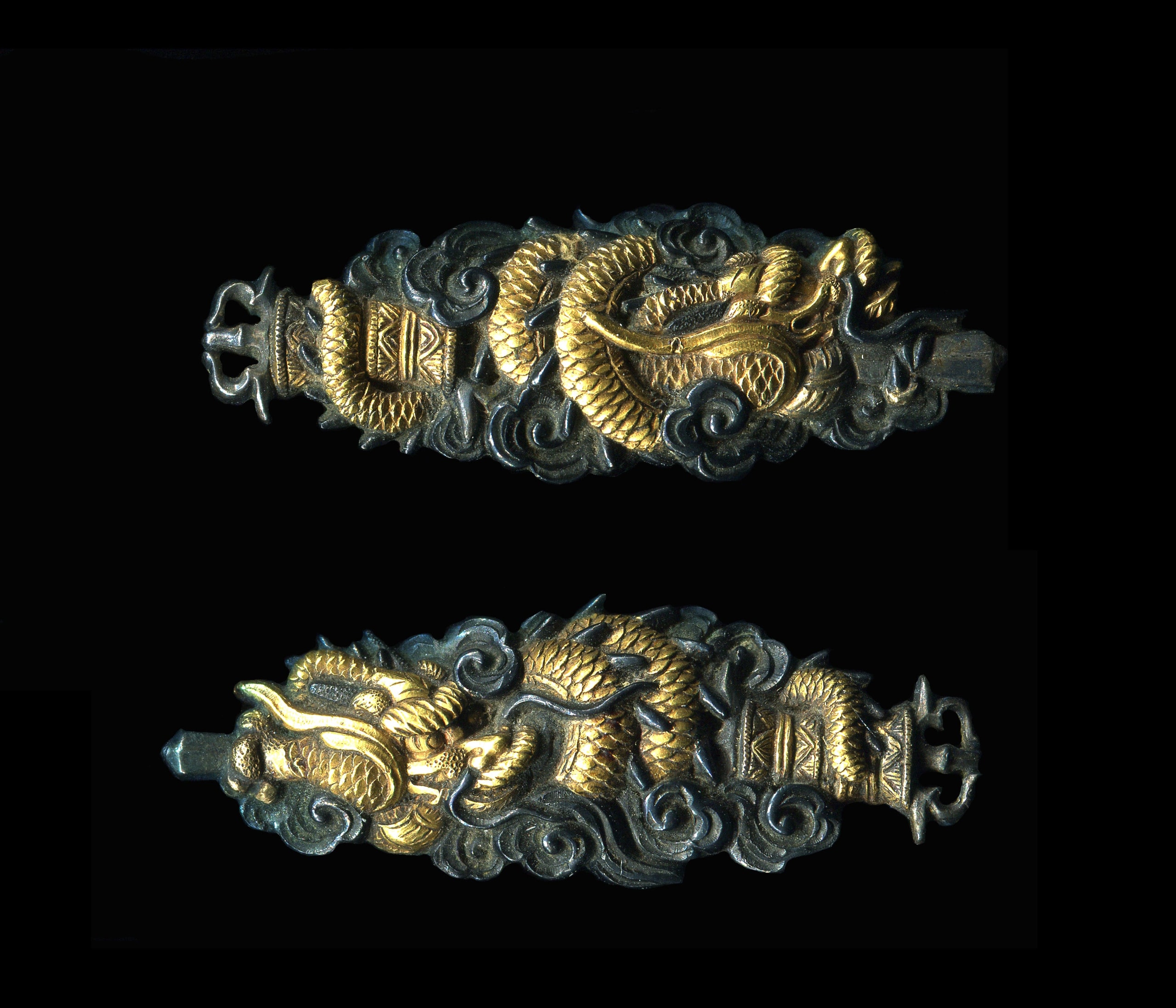
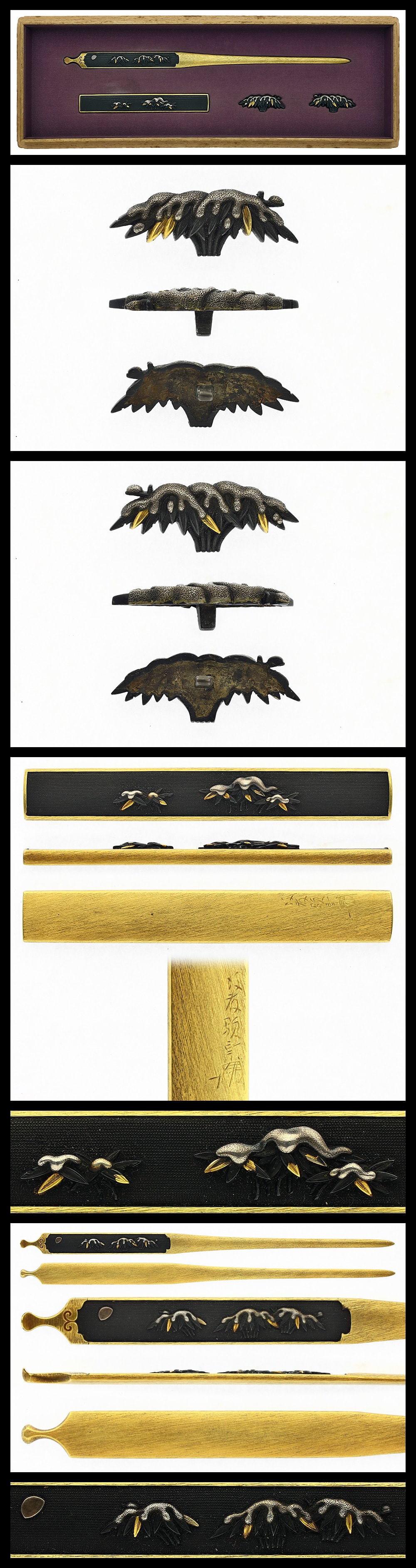
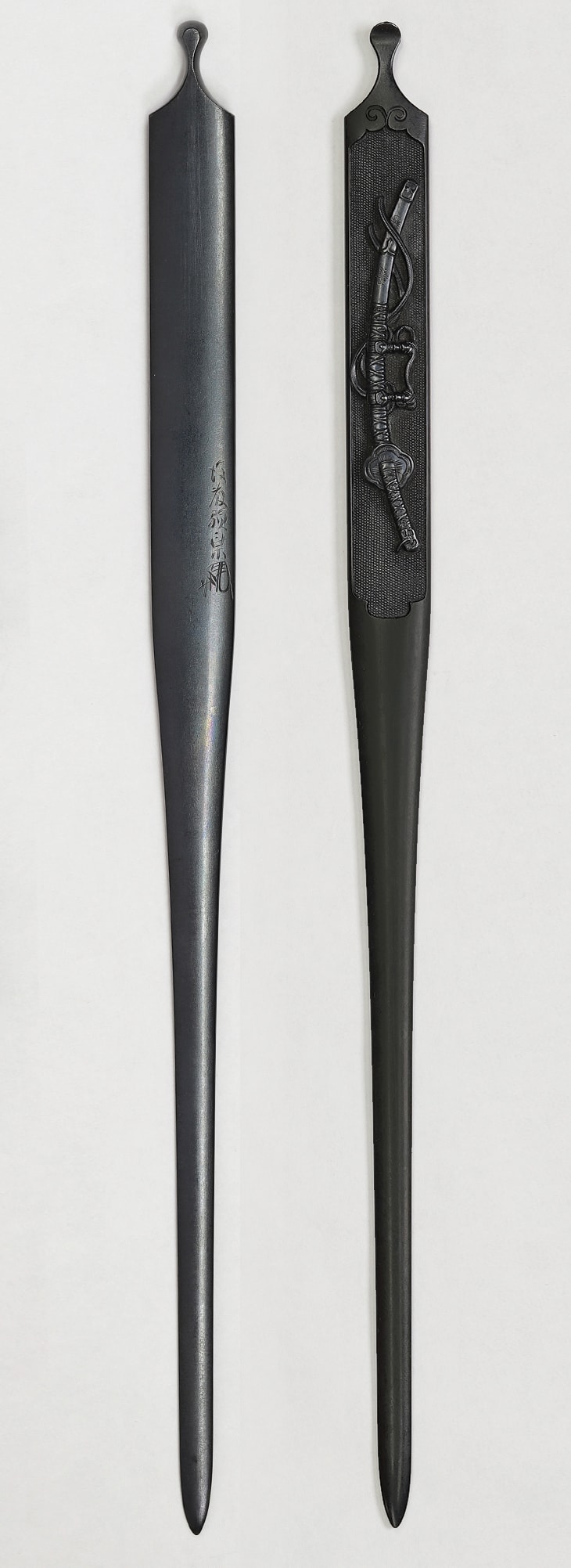
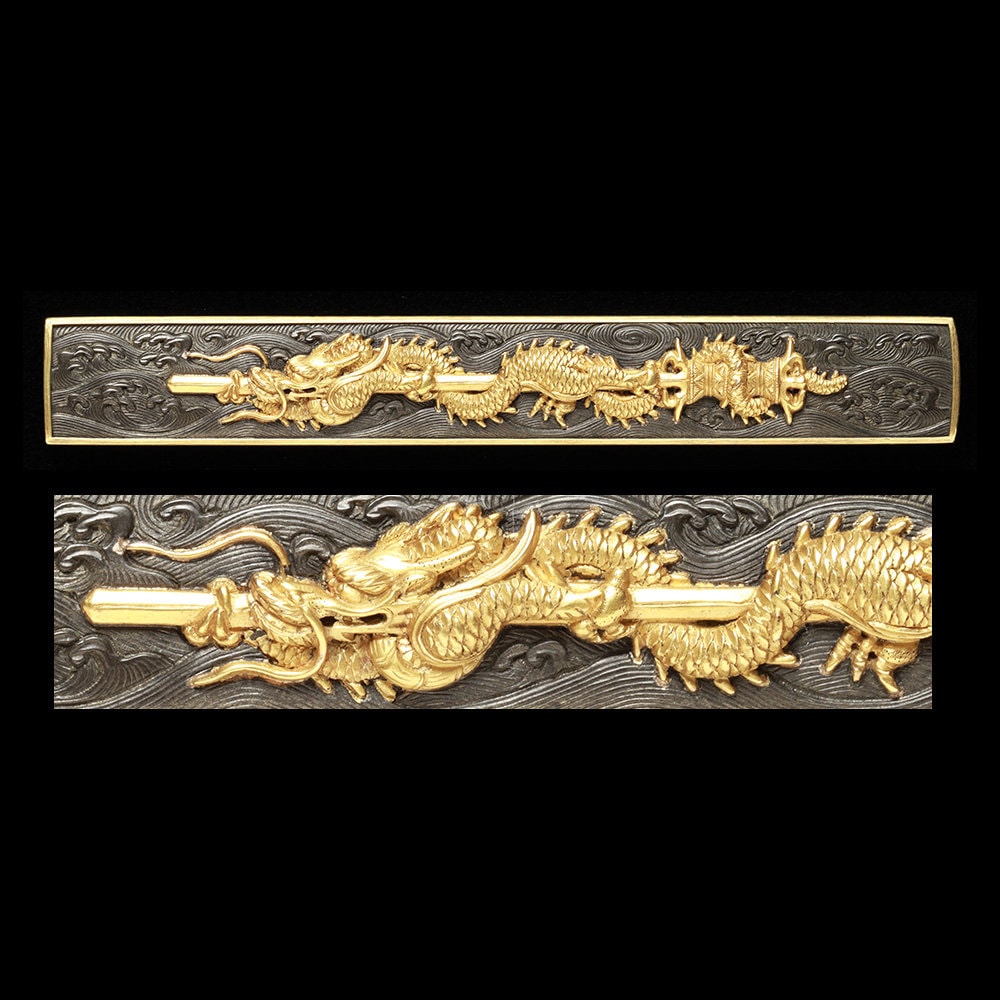
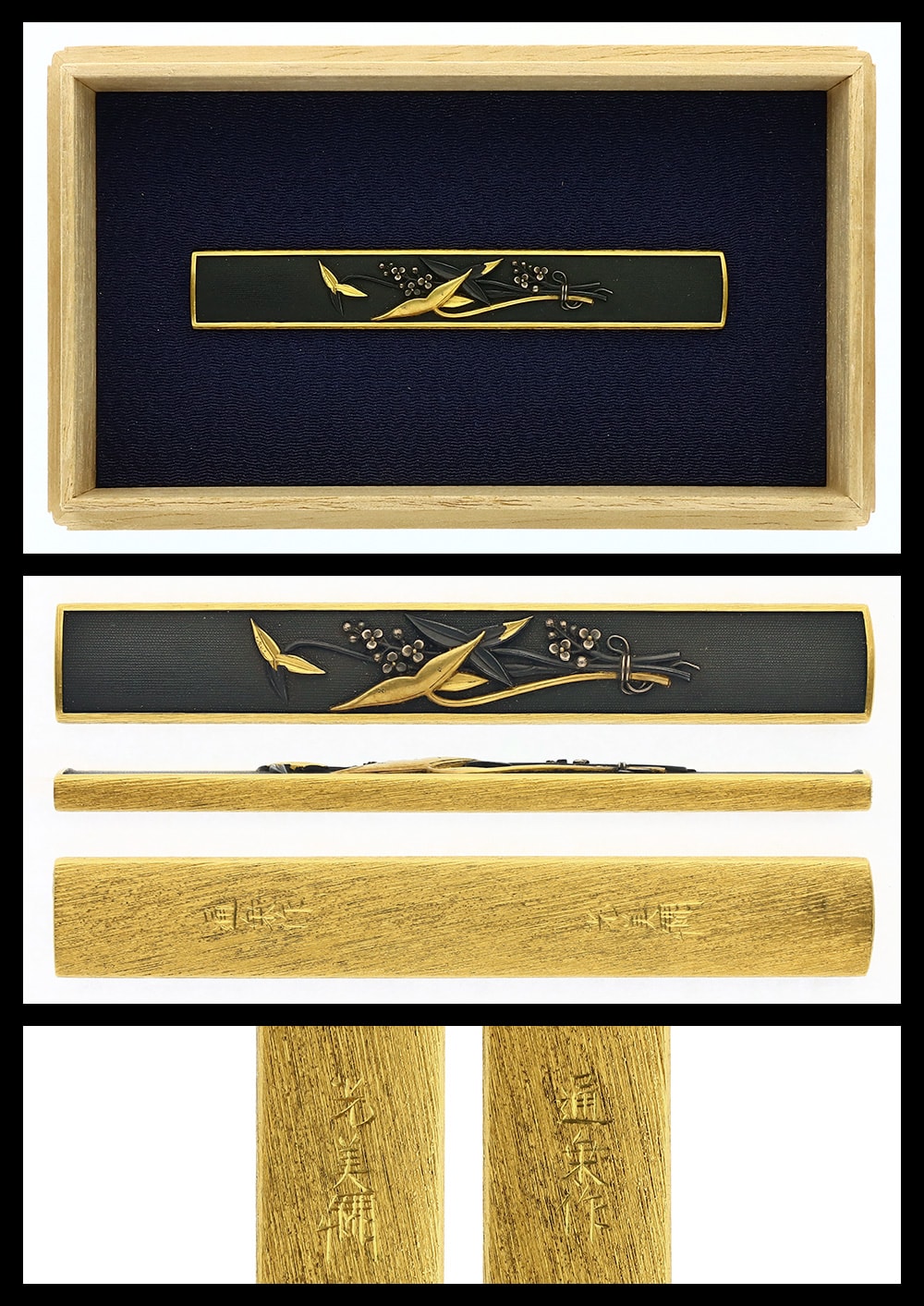
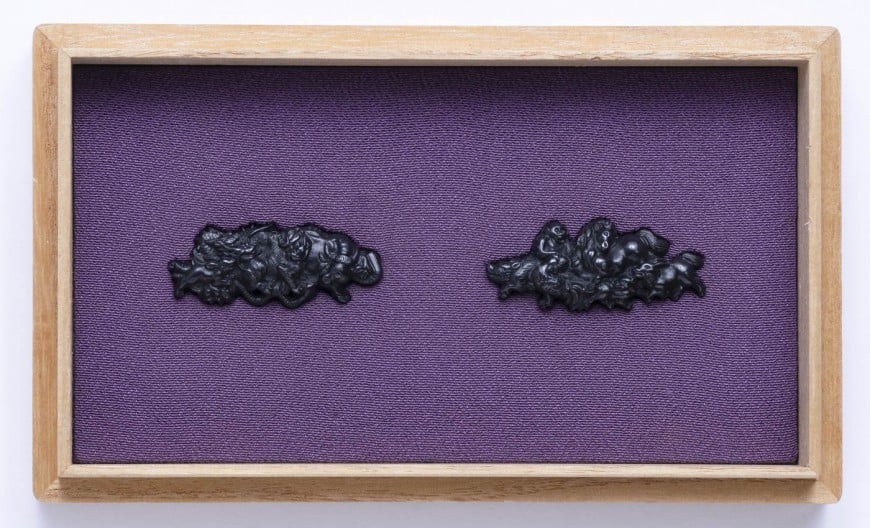
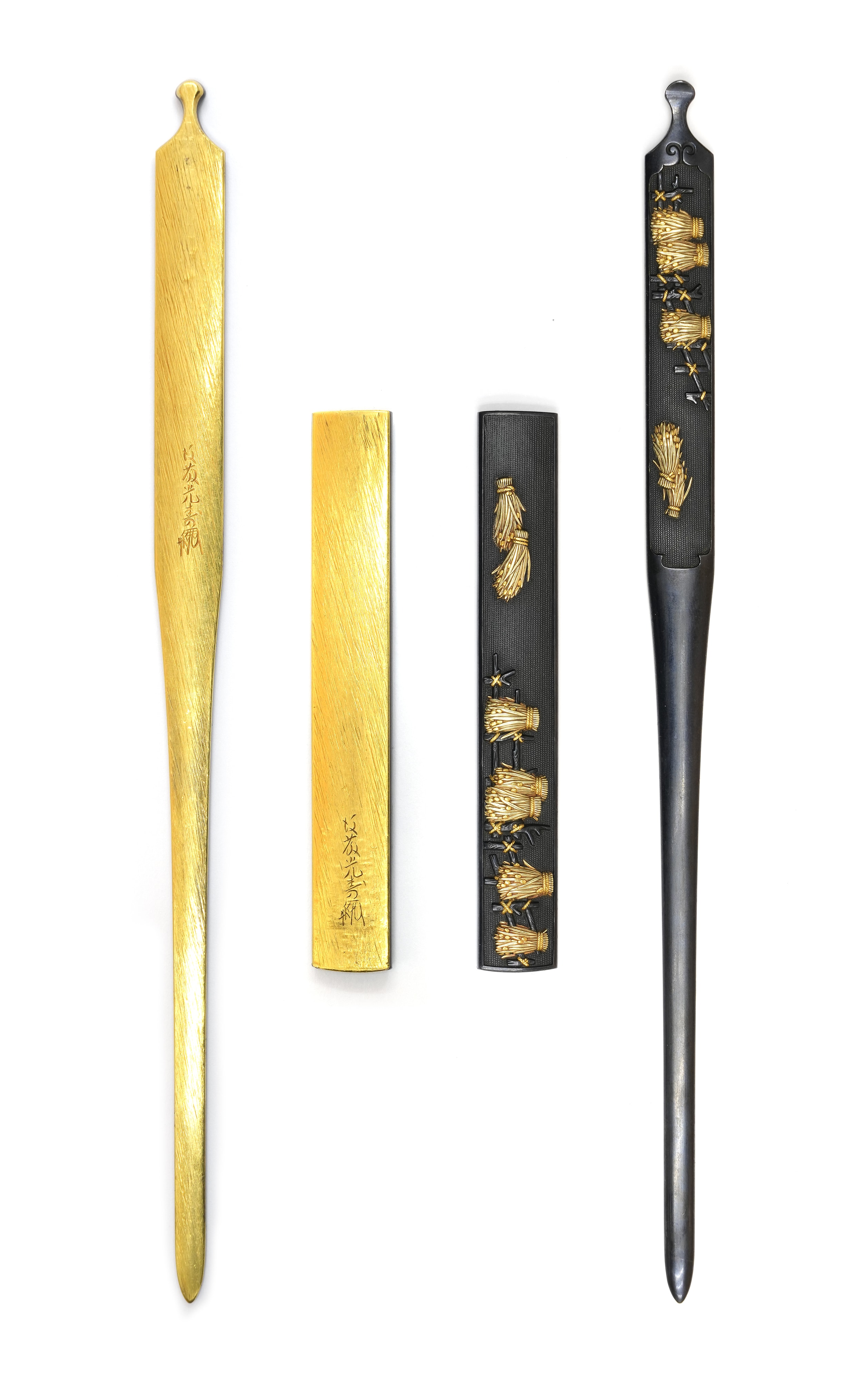
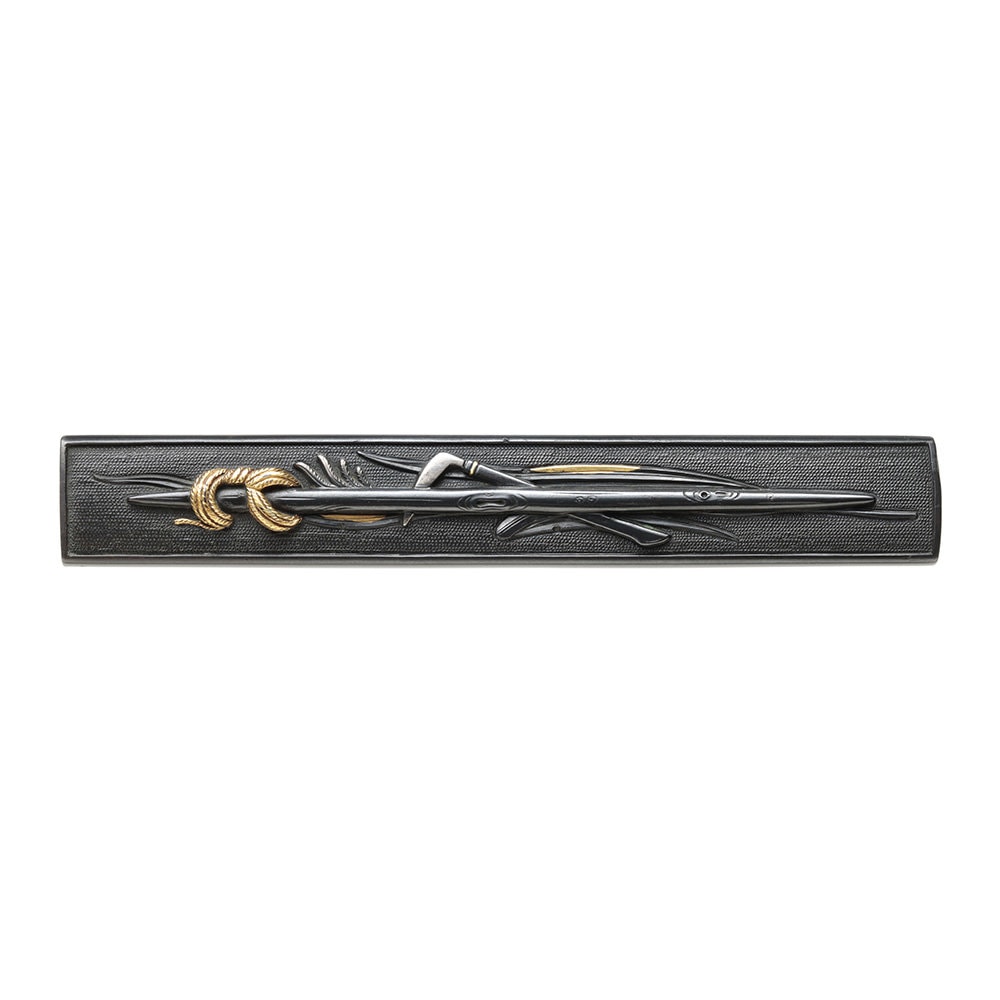
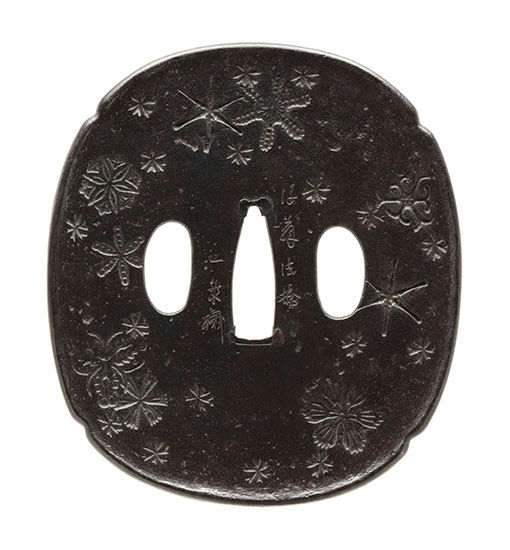
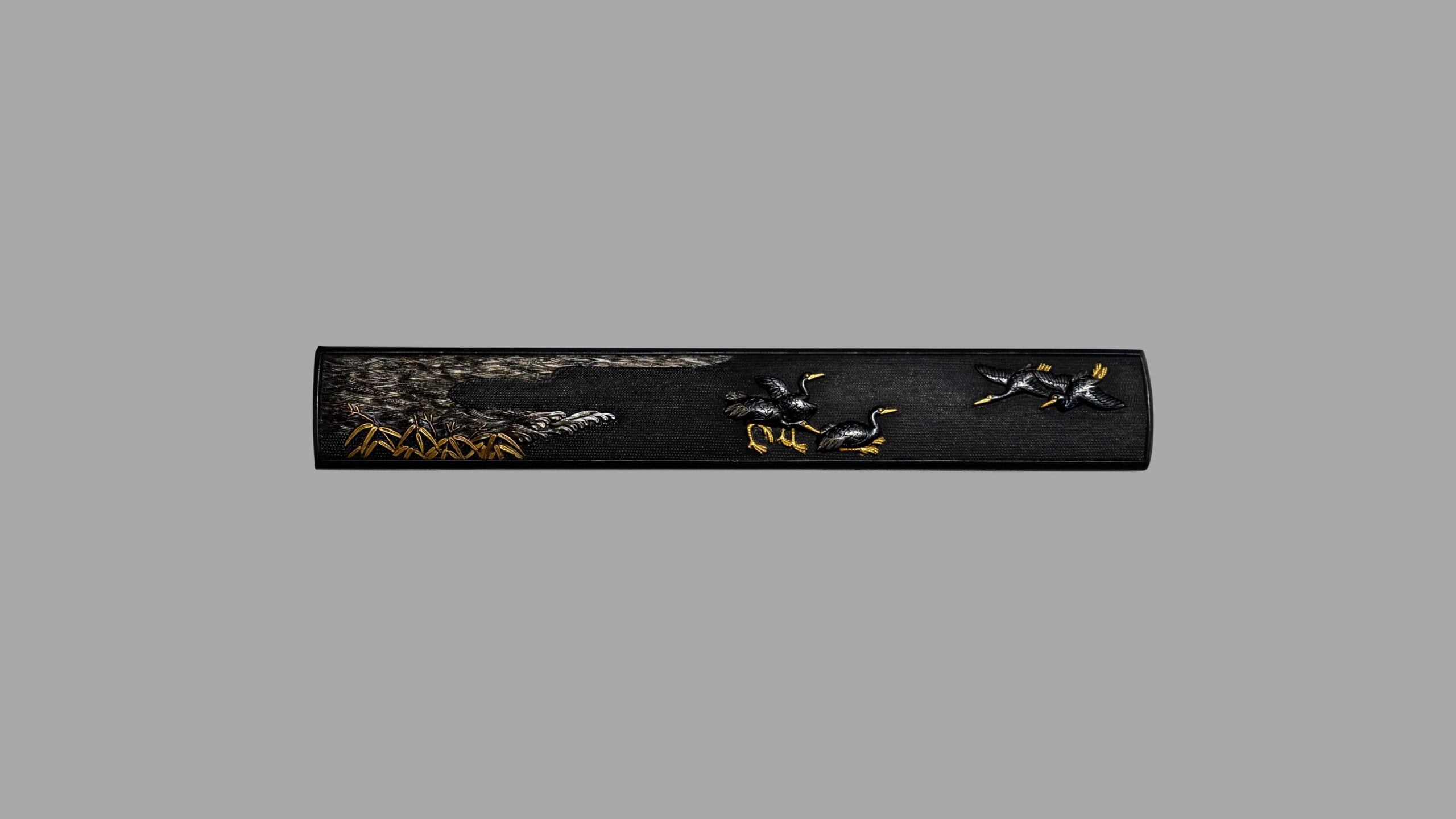
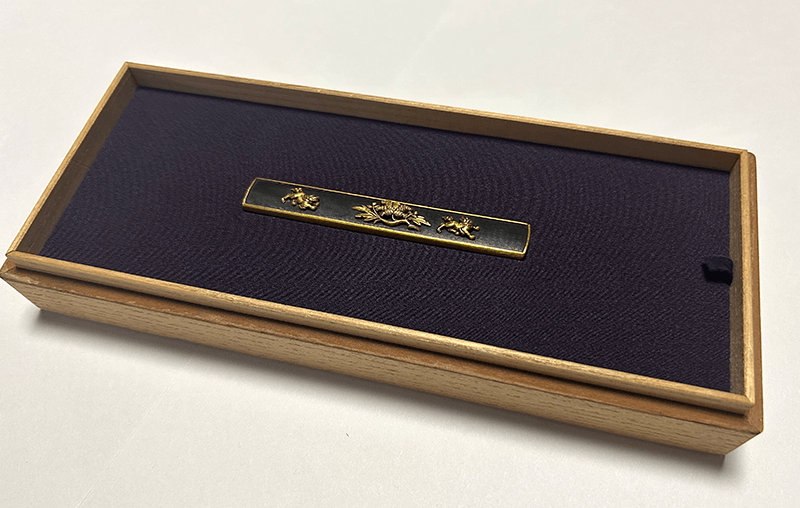
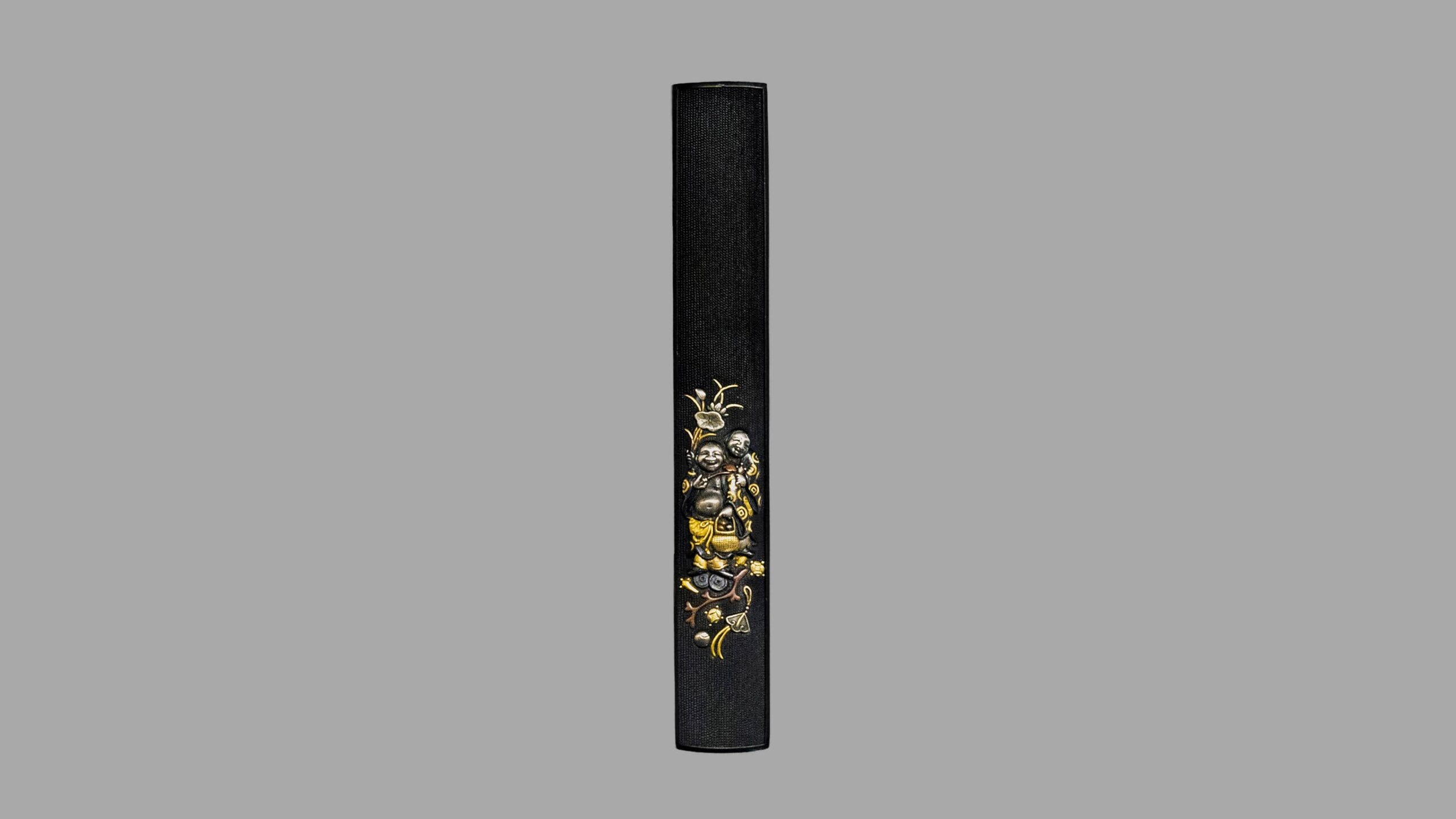
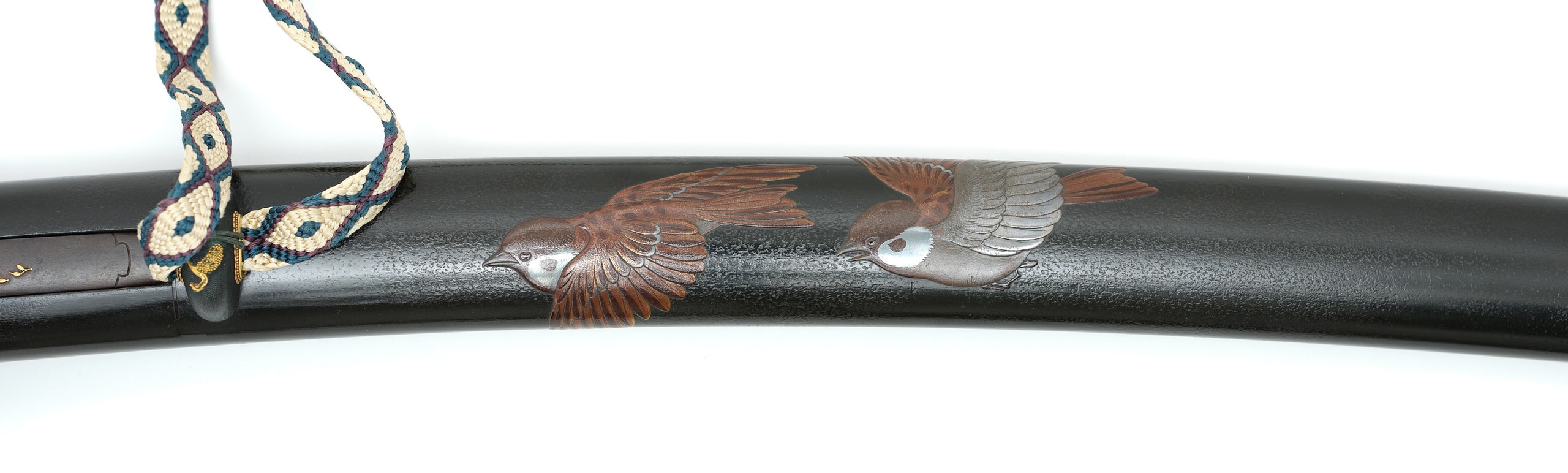
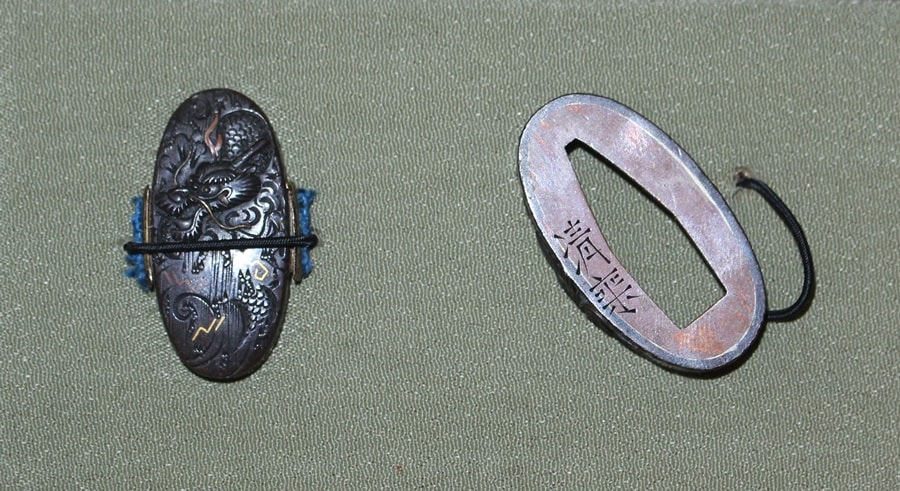
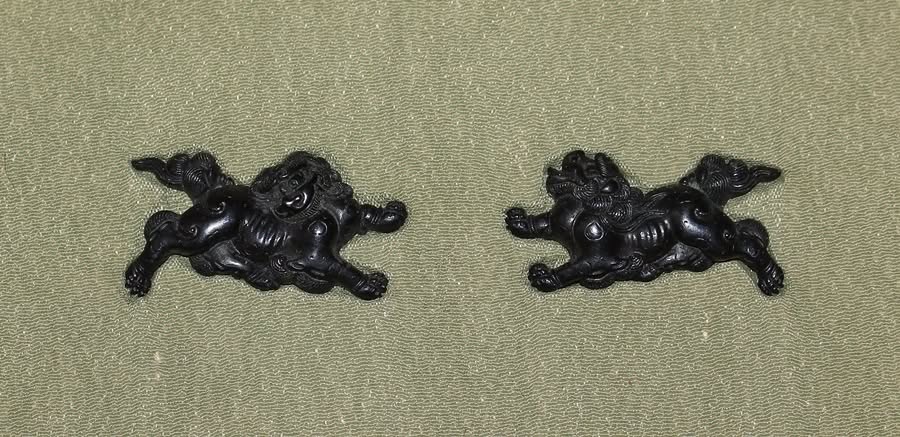
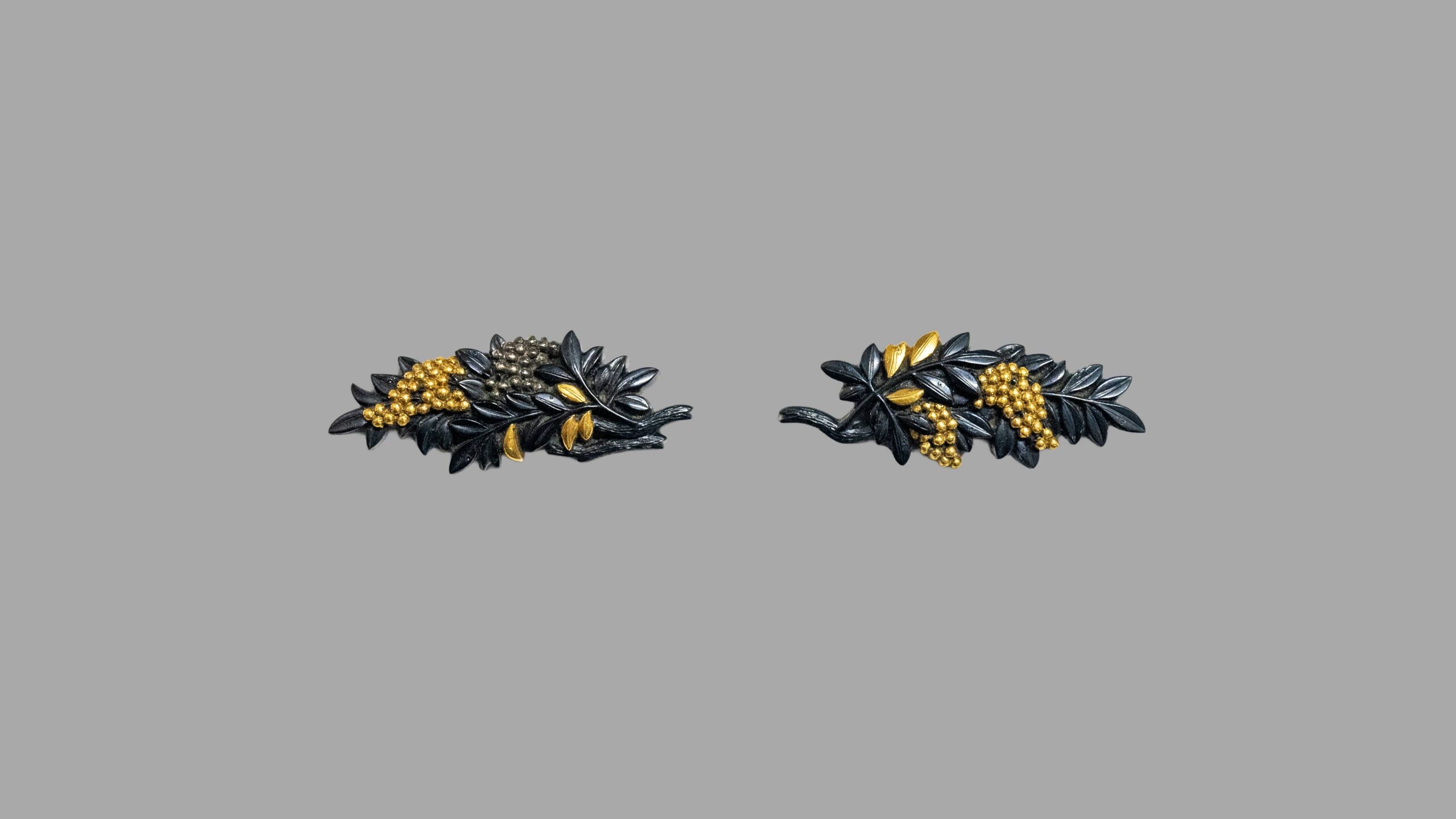
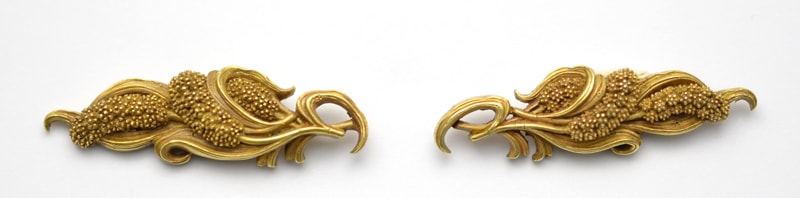
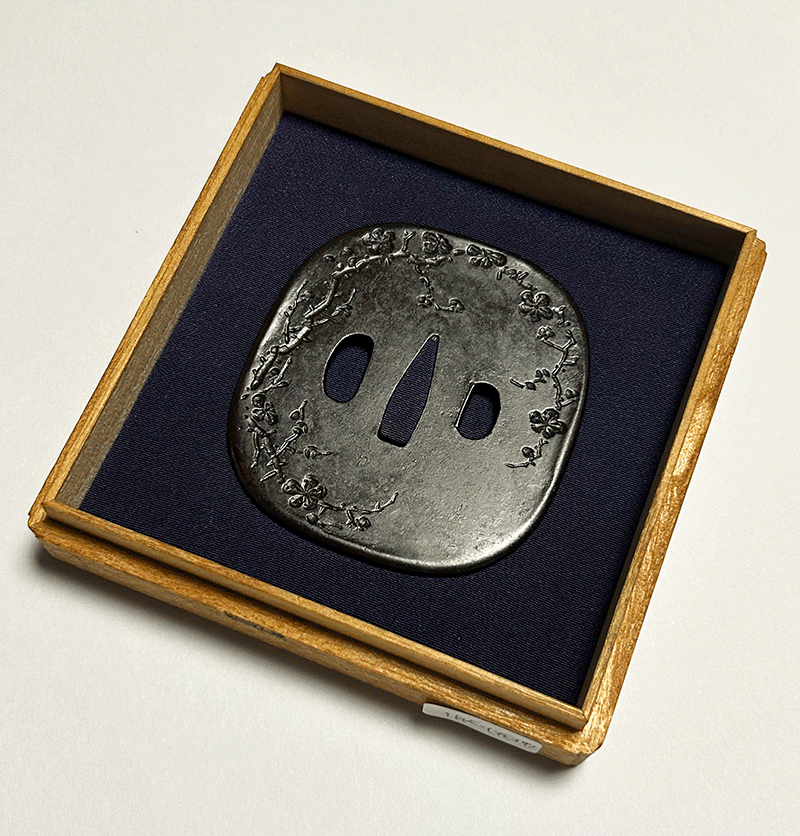
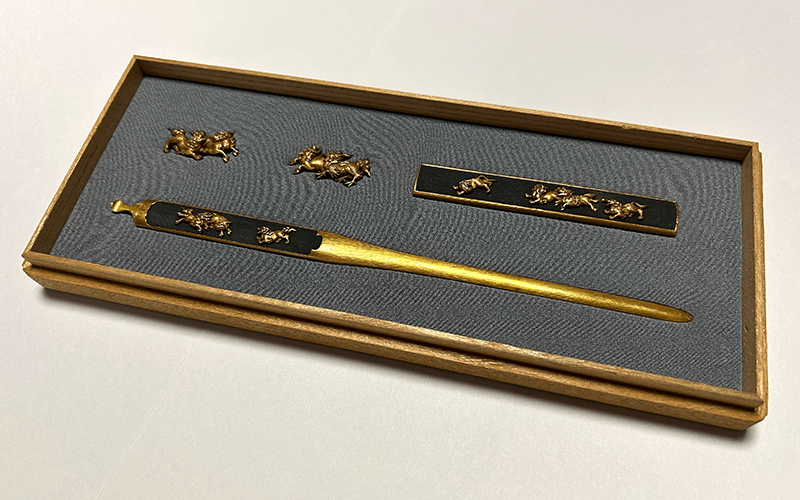
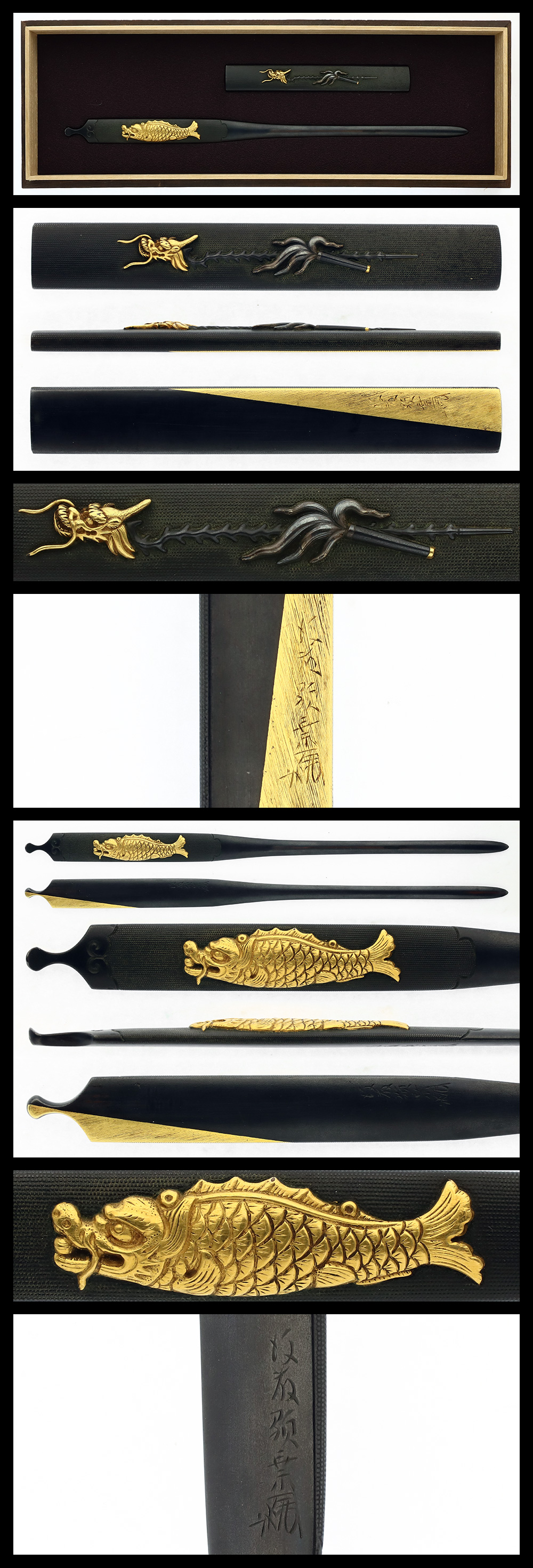
This is a set of Kogai and Kozuka by Goto Kenjo, the 7th-generation head metalsmith of the main Goto family lineage. It features a finely textured shakudō nanako ground with high-relief carvings of a gyoban (wooden fish gong) on the kōgai and a dragon monk’s staff and hossu (Buddhist fly whisk) on the kozuka, all enhanced with vivid gold inlay. These motifs represent ritual implements used in Zen Buddhism, and the piece is accompanied by the 67th NBTHK Juyo Certificate.
後藤家七代目顕乗は、五代目徳乗の三男で、天正十四年の生まれである。幼名を寅市、俗名は源一郎、諱は光経といった。成長してからは 別家、理兵衛家を起こし、理兵衛正継と改名した。元和三年、兄栄乗が病没したが、この時、栄乗の嫡男源四郎は早世し、次男の源七(光重)は 既に十八歳の青年になっていた。しかし、如何なる理由によるのか、顕乗が宗家七代目を継承して源七郎を後見し、宗家の業務を遂行している。 また加賀前田家からも招聘を受け、従兄弟にあたる覚乗と隔年で加賀に赴き、後年の加賀後藤興隆の端緒を開いたことでも知られる。 本作は、禅宗系の寺院に由来する景物を表現した後藤顕乗自身銘の二所である。笄にみる「魚板」は打ち鳴らして行事や法要、あるいは修行僧 の食事の合図等にも使われるもの。口にくわえている玉は心中に宿す「貪瞋・癡」(むさぼり・いかり・おろかさ)の三毒。この音を聞いた修行 僧達がその三毒を浄化する意志を促すとも伝えられる。そうして悟りの域に達した修行者に印可状として、小柄に描かれる「龍杖払子」の図柄を 渡すのである。江戸時代中期、白隠慧鶴の印可状が著名。 肌理の細かい赤銅魚子地に丁寧な高彫と色絵が映える。端整であり、とりわけ金の色絵が鮮やかであり、加賀後藤の息吹を伝える洒落た二所 であり、かつ品格が高い。
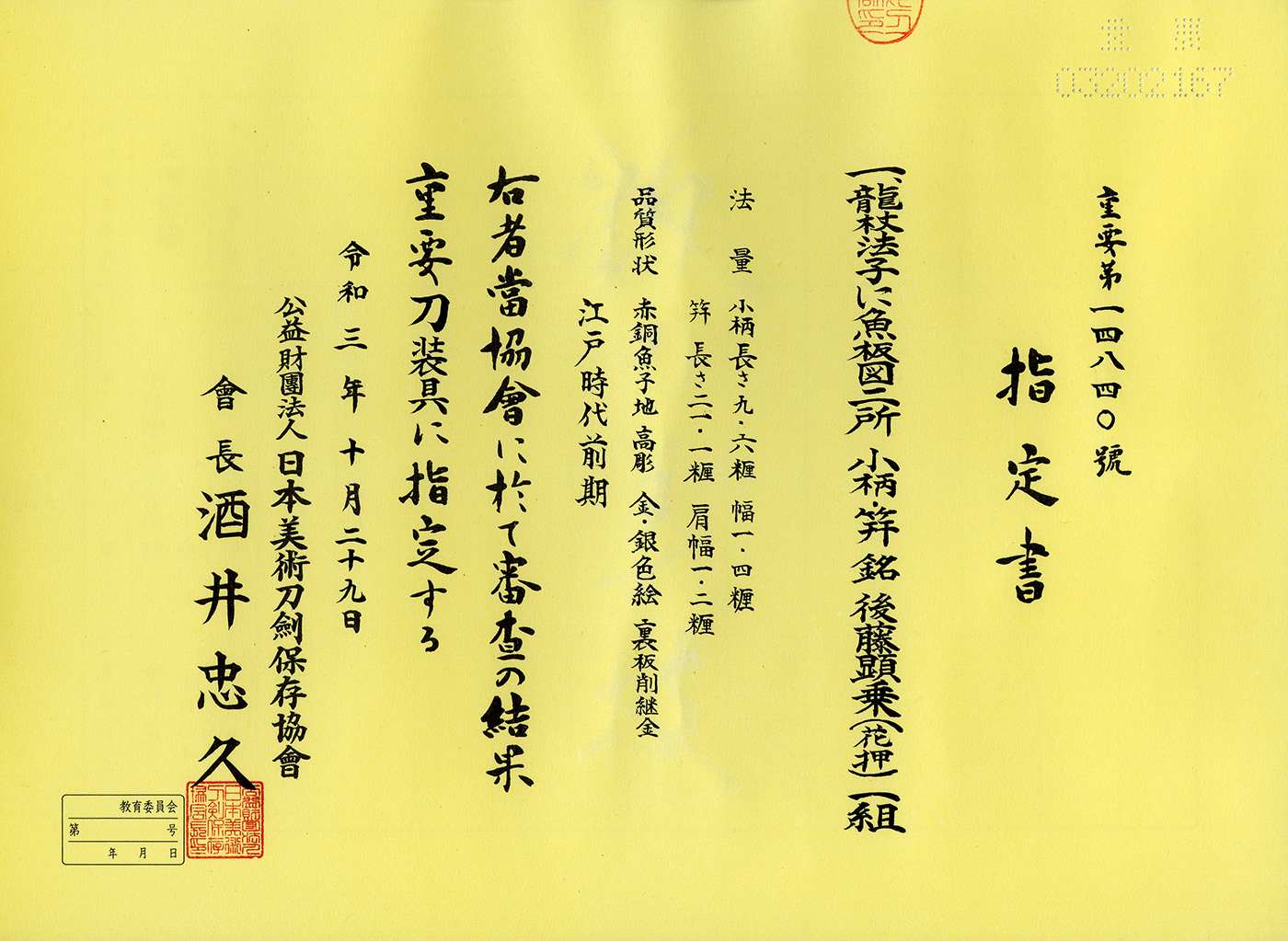
Certificate reading — 銘 後藤顕乗(花押)
 NihontoWatch
mei · Goto · Early Edo (1586-1663)
Goto Kenjo
Early Edo (1586-1663)
Signed
Jūyō #67 (NBTHK)
Iebori · Yamashiro · around 1586-1663
2 pieces on the market now
Goto Kenjo, the seventh-generation head of the Goto mainline (soke), was the third son of the fifth master Tokujo and was born in Tensho 14 (1586). His childhood name was Toraichi; his common name was Gen'ichiro; and his personal name (imina) was Mitsutsune. Upon reaching maturity he established a separate branch, founding the Rihei house, and changed his name to Rihei Masatsugu. In Genna 3 (1617), his elder brother Eijo, the sixth-generation head, died of illness. Although Eijo's second son Genshichiro (Mitsushige) had already reached the age of eighteen, Kenjo nonetheless succeeded as the seventh head of the main house, acting as guardian to Genshichiro and carrying out the duties of the family headship. Around Kan'ei 4--5 (1627--1628), Kenjo arranged for Mitsushige to succeed as the eighth master, Sokujo. Thereafter, Kenjo was invited by the Maeda lords of Kaga, and together with his cousin Kakujo he traveled to Kaga in alternating years, laying the foundations for the later flourishing of the Kaga-Goto tradition. Since olden times the finest exponents of the Goto house have been termed Yuko-ken, and among them Kenjo in particular has been praised as a restorer of the house's fortunes.
Kenjo's chisel work is described as both forceful and possessed of dignity, owing to his precise command of the tagane. His preferred medium is shakudo nanako-ji with gold crests (kinmon), the canonical Goto ground treatment, though he also produced works of striking sumptuousness in solid gold (kinmuku). His takabori is characteristically deep and animated, conveying strong movement, while his menuki employ rounded relief (yobori) with long tangs and chikaragane executed as four gold elements in accordance with house conventions. The NBTHK repeatedly observes that his forms are taut and tightly composed, filled with power and communicating a palpable tension. In figural subjects -- dragons, lions, monkeys, cranes, tigers and leopards -- the modeling is compact yet ample, with each creature rendered in a distinct pose displaying superbly convincing movement. On kozuka employing shibuichi nanako-ji or the distinctive korotsugi construction with gold joining, the setsumei note an especially sharp and sensitive atmosphere, while his use of shakudo inlay to render stripe and spot patterning on tigers and leopards is singled out for meticulous articulation. The overall spirit of his work is characterized as shosha -- austere and urbane -- giving off an elegant, tasteful quality that clearly distinguishes it from the manner of the first six generations of the Goto mainline.
The NBTHK has designated Kenjo's works across a broad range of subjects -- from the Goto house's prescribed okitemono motifs such as the Kurikara dragon and shishi, to literary and Buddhist themes including Zen implements, Hotei, Idaten, and Ebisu and Daikoku -- and consistently finds in them an elevated dignity through which the traditional beauty of the Goto lineage is fully manifested. Works bearing Kenjo's own signature are few; the setsumei state that known examples of signed mitokoromono number fewer than five, rendering such pieces especially precious documentary references. Several of his surviving works carry authentication inscriptions (kiwame) by his biological son Teijo or the eighth master Sokujo Mitsushige, conferring credibility equivalent to an autograph signature. That his solid-gold Kurikara mitokoromono -- appraised at the extraordinary sum of 250 kan -- was produced by studying a masterpiece by the founding ancestor Yujo, yet expresses with elevated dignity the sumptuous beauty of the Momoyama period, encapsulates the judgment that recurs throughout the designation records: Kenjo stands as a figure in whom the true strengths of the Goto house are fully manifested, a restorer whose work communicates at once the orthodox conventions of the lineage and a distinctive personal refinement.
Where Goto Kenjo stands among comparable artisans: across all of nihontō, and within tradition, era, and period. The tiers (Foremost · Leading · Major · Notable) weigh official designations from the NBTHK and Japan's Agency for Cultural Affairs, together with historical honors of lasting repute such as the Sansaku and Meibutsu-chō.
Select a lens to see how it's measured.
Iebori · Yamashiro
Phase: Goto Main Line後藤宗家· 1573–1900
317 pieces on the market now
| Smith | Era | Designated |
|---|---|---|
| Goto Joshin後藤乗真 | 1512-1562 | 68 |
| Goto Yujo後藤祐乗 | 1440-1512 | 41 |
| Goto Kenjo後藤顕乗 | 1586-1663 | 46 |
| Goto Sojo後藤宗乗 | 1461-1538 | 55 |
| Goto Eijo後藤栄乗 | 1577-1617 | 35 |
A blade of top-grade workmanship and condition, formally judged to rank with a nationally recognized Important Art Object (Jūyō Bijutsuhin). Awarded only at the NBTHK’s competitive annual examination.
Of Japan’s roughly 2.5 million registered swords, only 12,307 (about 1 in 203) have ever attained Jūyō.
The NBTHK (Nihon Bijutsu Tōken Hozon Kyōkai, the Society for the Preservation of Japanese Art Swords) is a public-interest incorporated foundation founded in 1948 and supervised by Japan’s Agency for Cultural Affairs (Bunkachō); it is based at the Japanese Sword Museum in Tokyo. Its expert panels physically examine each submitted work (shinsa) and issue a certificate (kanteishō) ranking it by artistic and historical merit. NBTHK papers are the most widely recognized standard of authentication for Japanese swords and fittings.
NBTHK official siteIf you wish to return an item, please notify us within 3 days of receipt. After this period we cannot accept cancellations. Please ship the return to us within 5 business days. Cancellation is conditional on the item being kept in the same condition as at the time of sale, so please handle it with care.
This is a set of Kogai and Kozuka by Goto Kenjo, the 7th-generation head metalsmith of the main Goto family lineage. It features a finely textured shakudō nanako ground with high-relief carvings of a gyoban (wooden fish gong) on the kōgai and a dragon monk’s staff and hossu (Buddhist fly whisk) on the kozuka, all enhanced with vivid gold inlay. These motifs represent ritual implements used in Zen Buddhism, and the piece is accompanied by the 67th NBTHK Juyo Certificate.
後藤家七代目顕乗は、五代目徳乗の三男で、天正十四年の生まれである。幼名を寅市、俗名は源一郎、諱は光経といった。成長してからは 別家、理兵衛家を起こし、理兵衛正継と改名した。元和三年、兄栄乗が病没したが、この時、栄乗の嫡男源四郎は早世し、次男の源七(光重)は 既に十八歳の青年になっていた。しかし、如何なる理由によるのか、顕乗が宗家七代目を継承して源七郎を後見し、宗家の業務を遂行している。 また加賀前田家からも招聘を受け、従兄弟にあたる覚乗と隔年で加賀に赴き、後年の加賀後藤興隆の端緒を開いたことでも知られる。 本作は、禅宗系の寺院に由来する景物を表現した後藤顕乗自身銘の二所である。笄にみる「魚板」は打ち鳴らして行事や法要、あるいは修行僧 の食事の合図等にも使われるもの。口にくわえている玉は心中に宿す「貪瞋・癡」(むさぼり・いかり・おろかさ)の三毒。この音を聞いた修行 僧達がその三毒を浄化する意志を促すとも伝えられる。そうして悟りの域に達した修行者に印可状として、小柄に描かれる「龍杖払子」の図柄を 渡すのである。江戸時代中期、白隠慧鶴の印可状が著名。 肌理の細かい赤銅魚子地に丁寧な高彫と色絵が映える。端整であり、とりわけ金の色絵が鮮やかであり、加賀後藤の息吹を伝える洒落た二所 であり、かつ品格が高い。
Certificate reading — 銘 後藤顕乗(花押)
NihontoWatchmei · Goto · Early Edo (1586-1663)
Goto Kenjo
Early Edo (1586-1663)
Signed
Jūyō #67 (NBTHK)
Iebori · Yamashiro · around 1586-1663
2 pieces on the market now
Goto Kenjo, the seventh-generation head of the Goto mainline (soke), was the third son of the fifth master Tokujo and was born in Tensho 14 (1586). His childhood name was Toraichi; his common name was Gen'ichiro; and his personal name (imina) was Mitsutsune. Upon reaching maturity he established a separate branch, founding the Rihei house, and changed his name to Rihei Masatsugu. In Genna 3 (1617), his elder brother Eijo, the sixth-generation head, died of illness. Although Eijo's second son Genshichiro (Mitsushige) had already reached the age of eighteen, Kenjo nonetheless succeeded as the seventh head of the main house, acting as guardian to Genshichiro and carrying out the duties of the family headship. Around Kan'ei 4--5 (1627--1628), Kenjo arranged for Mitsushige to succeed as the eighth master, Sokujo. Thereafter, Kenjo was invited by the Maeda lords of Kaga, and together with his cousin Kakujo he traveled to Kaga in alternating years, laying the foundations for the later flourishing of the Kaga-Goto tradition. Since olden times the finest exponents of the Goto house have been termed Yuko-ken, and among them Kenjo in particular has been praised as a restorer of the house's fortunes.
Kenjo's chisel work is described as both forceful and possessed of dignity, owing to his precise command of the tagane. His preferred medium is shakudo nanako-ji with gold crests (kinmon), the canonical Goto ground treatment, though he also produced works of striking sumptuousness in solid gold (kinmuku). His takabori is characteristically deep and animated, conveying strong movement, while his menuki employ rounded relief (yobori) with long tangs and chikaragane executed as four gold elements in accordance with house conventions. The NBTHK repeatedly observes that his forms are taut and tightly composed, filled with power and communicating a palpable tension. In figural subjects -- dragons, lions, monkeys, cranes, tigers and leopards -- the modeling is compact yet ample, with each creature rendered in a distinct pose displaying superbly convincing movement. On kozuka employing shibuichi nanako-ji or the distinctive korotsugi construction with gold joining, the setsumei note an especially sharp and sensitive atmosphere, while his use of shakudo inlay to render stripe and spot patterning on tigers and leopards is singled out for meticulous articulation. The overall spirit of his work is characterized as shosha -- austere and urbane -- giving off an elegant, tasteful quality that clearly distinguishes it from the manner of the first six generations of the Goto mainline.
The NBTHK has designated Kenjo's works across a broad range of subjects -- from the Goto house's prescribed okitemono motifs such as the Kurikara dragon and shishi, to literary and Buddhist themes including Zen implements, Hotei, Idaten, and Ebisu and Daikoku -- and consistently finds in them an elevated dignity through which the traditional beauty of the Goto lineage is fully manifested. Works bearing Kenjo's own signature are few; the setsumei state that known examples of signed mitokoromono number fewer than five, rendering such pieces especially precious documentary references. Several of his surviving works carry authentication inscriptions (kiwame) by his biological son Teijo or the eighth master Sokujo Mitsushige, conferring credibility equivalent to an autograph signature. That his solid-gold Kurikara mitokoromono -- appraised at the extraordinary sum of 250 kan -- was produced by studying a masterpiece by the founding ancestor Yujo, yet expresses with elevated dignity the sumptuous beauty of the Momoyama period, encapsulates the judgment that recurs throughout the designation records: Kenjo stands as a figure in whom the true strengths of the Goto house are fully manifested, a restorer whose work communicates at once the orthodox conventions of the lineage and a distinctive personal refinement.
Where Goto Kenjo stands among comparable artisans: across all of nihontō, and within tradition, era, and period. The tiers (Foremost · Leading · Major · Notable) weigh official designations from the NBTHK and Japan's Agency for Cultural Affairs, together with historical honors of lasting repute such as the Sansaku and Meibutsu-chō.
Select a lens to see how it's measured.
Iebori · Yamashiro
Phase: Goto Main Line後藤宗家· 1573–1900
317 pieces on the market now
| Smith | Era | Designated |
|---|---|---|
| Goto Joshin後藤乗真 | 1512-1562 | 68 |
| Goto Yujo後藤祐乗 | 1440-1512 | 41 |
| Goto Kenjo後藤顕乗 | 1586-1663 | 46 |
| Goto Sojo後藤宗乗 | 1461-1538 | 55 |
| Goto Eijo後藤栄乗 | 1577-1617 | 35 |
A blade of top-grade workmanship and condition, formally judged to rank with a nationally recognized Important Art Object (Jūyō Bijutsuhin). Awarded only at the NBTHK’s competitive annual examination.
Of Japan’s roughly 2.5 million registered swords, only 12,307 (about 1 in 203) have ever attained Jūyō.
The NBTHK (Nihon Bijutsu Tōken Hozon Kyōkai, the Society for the Preservation of Japanese Art Swords) is a public-interest incorporated foundation founded in 1948 and supervised by Japan’s Agency for Cultural Affairs (Bunkachō); it is based at the Japanese Sword Museum in Tokyo. Its expert panels physically examine each submitted work (shinsa) and issue a certificate (kanteishō) ranking it by artistic and historical merit. NBTHK papers are the most widely recognized standard of authentication for Japanese swords and fittings.
NBTHK official siteIf you wish to return an item, please notify us within 3 days of receipt. After this period we cannot accept cancellations. Please ship the return to us within 5 business days. Cancellation is conditional on the item being kept in the same condition as at the time of sale, so please handle it with care.