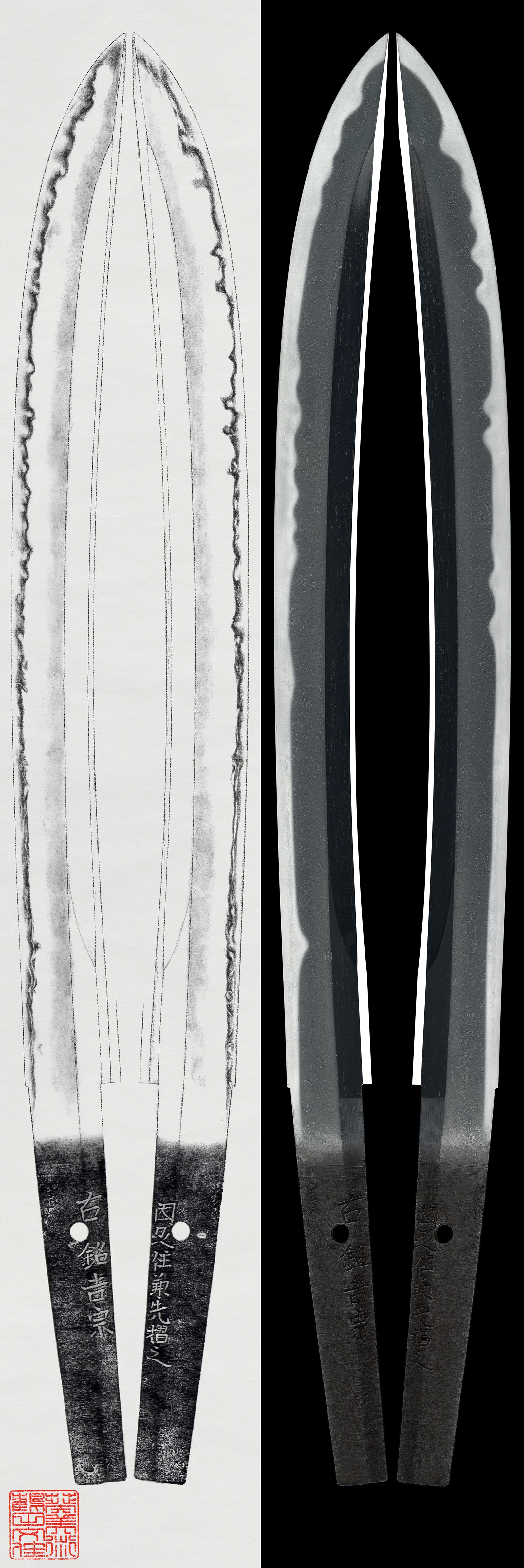
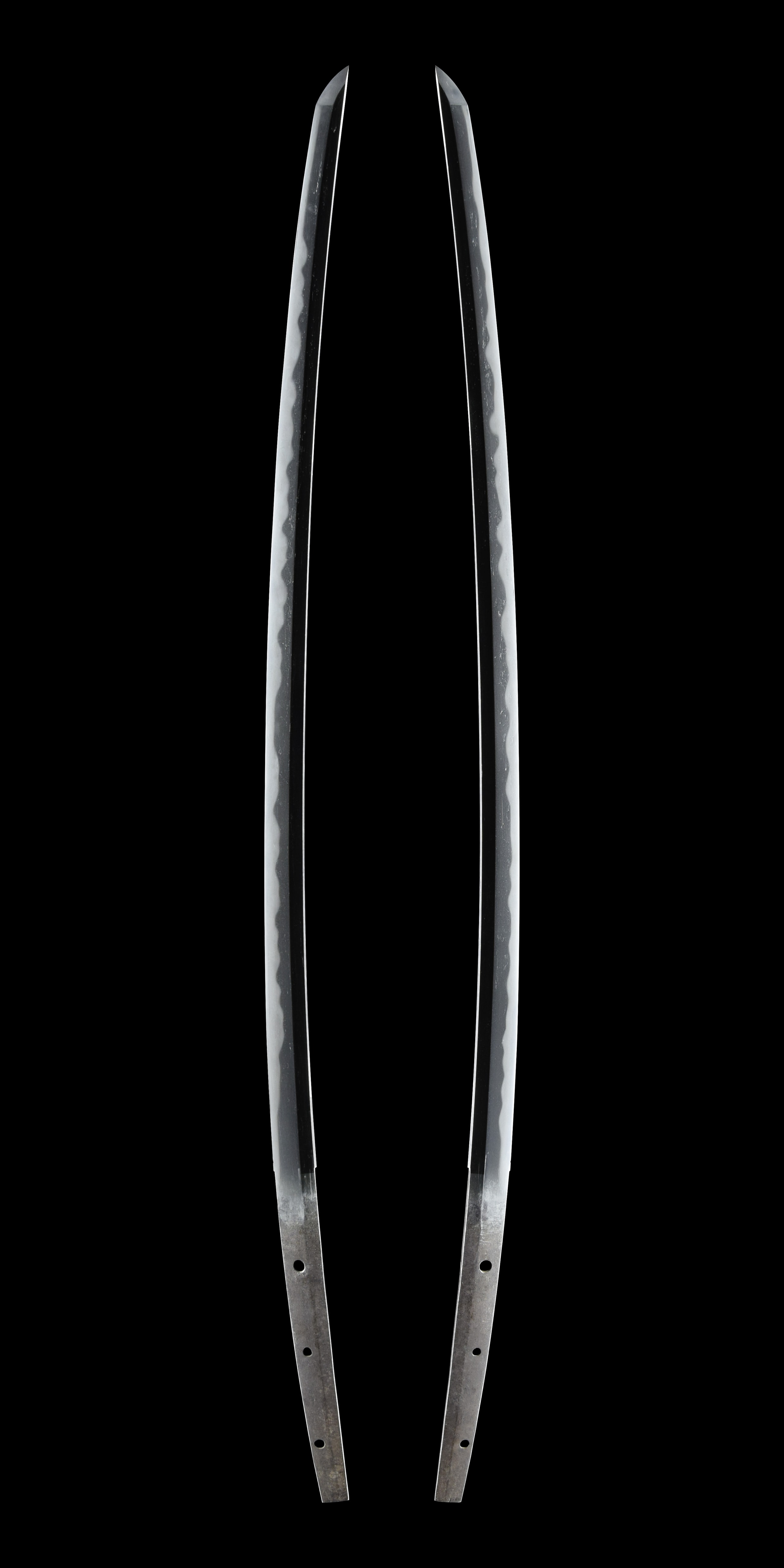
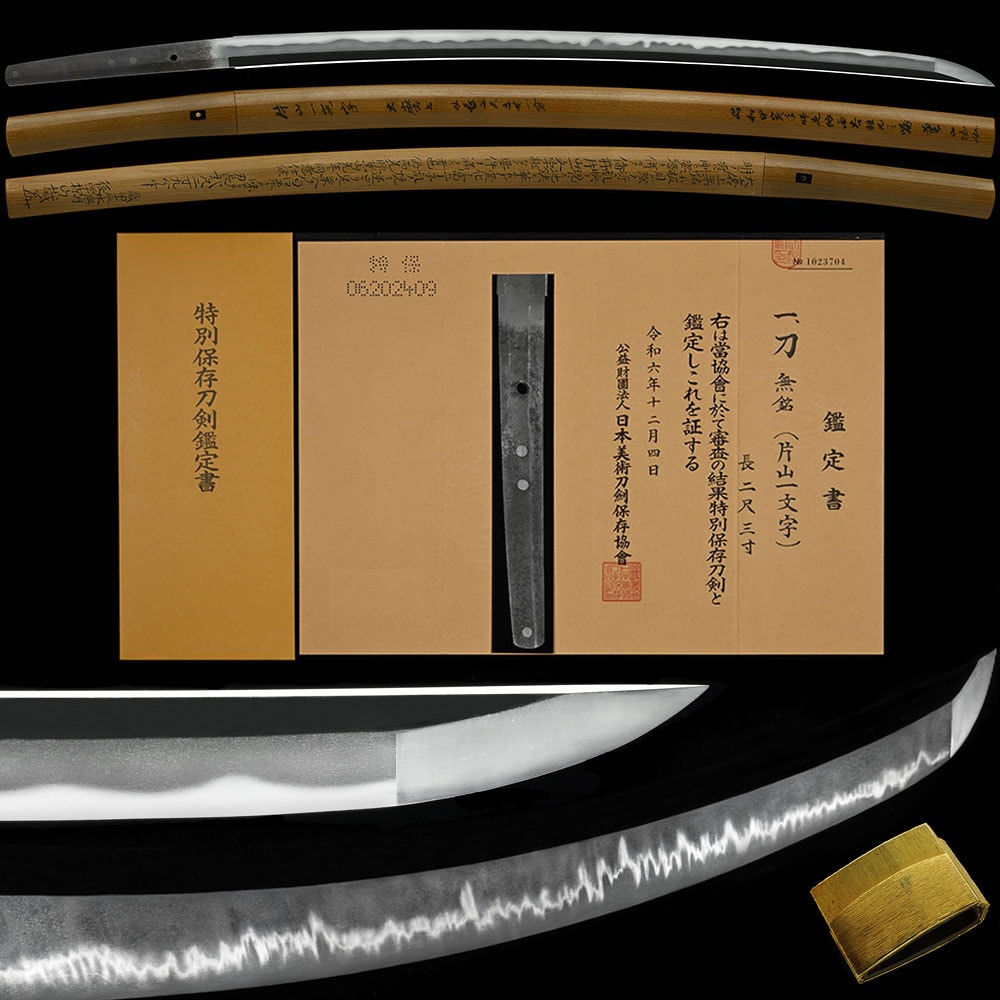
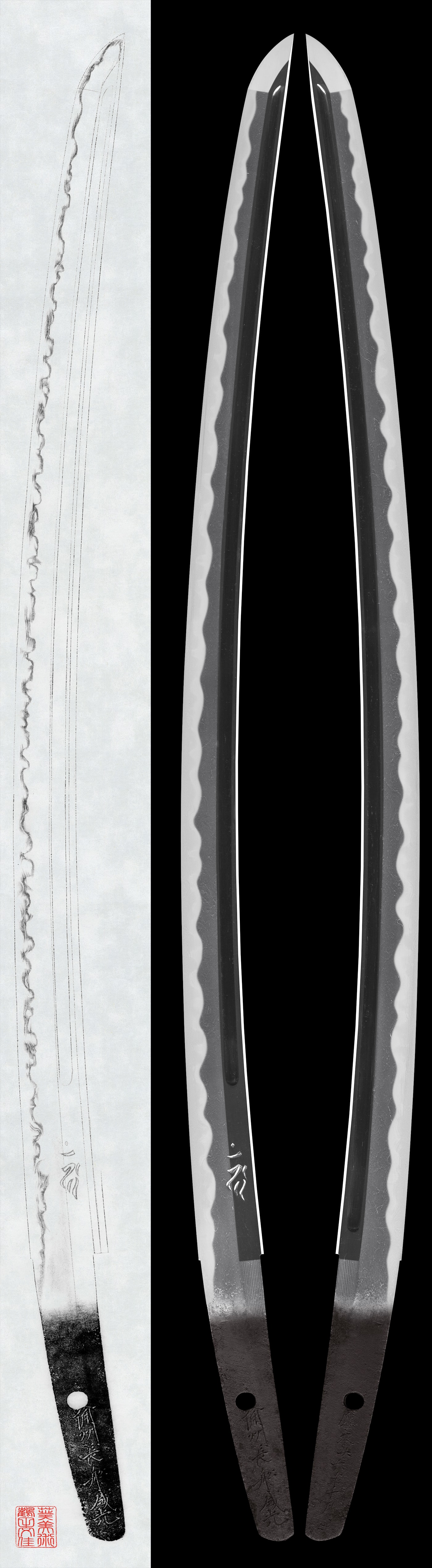
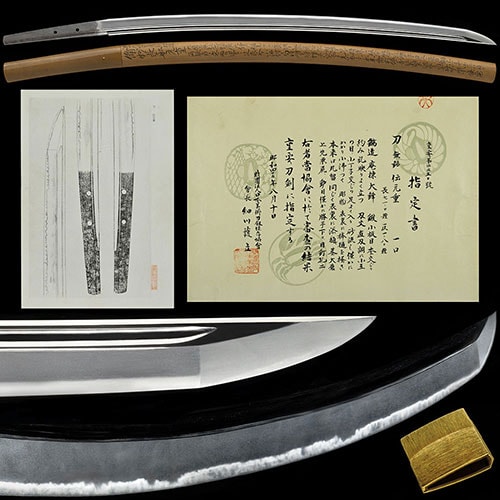
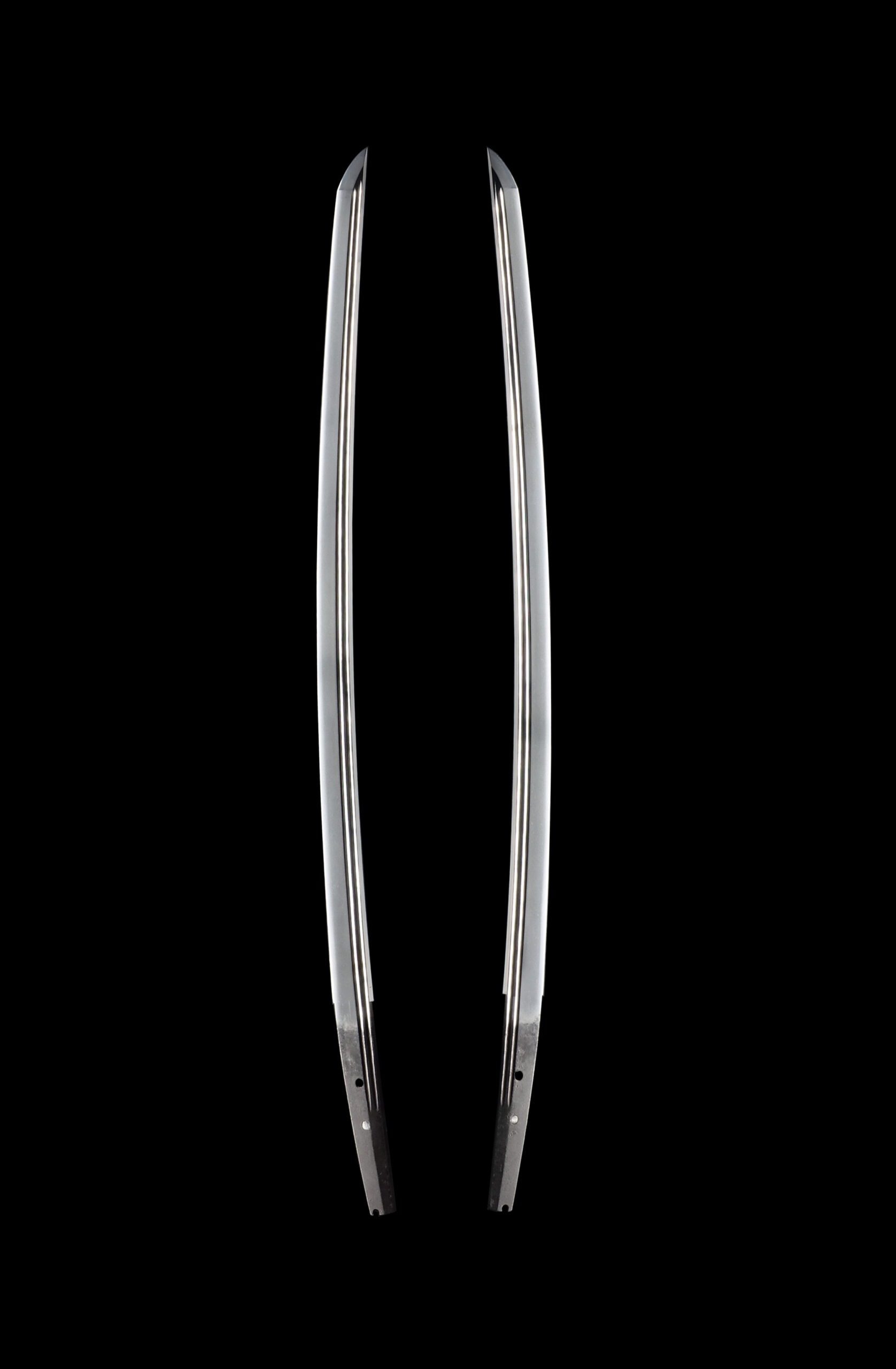
Yoshimochi worked in the Fukuoka school of about the middle of the period, and the reference works on signatures record him as the son of the Fukuoka smith Sukeyoshi, placing him around the Bun'ei era (1264-1275). The school Norimune founded was the flamboyant wing of , its name taken from the single character its smiths cut above the signature, and within it Yoshimochi is the quiet hand. The published sources return to one verdict across his blades: that many of his surviving works show a calmer manner in which the rise and fall of the is not conspicuous, and they name this restraint as the individuality of his workmanship. He is graded Jo-jo by Fujishiro.
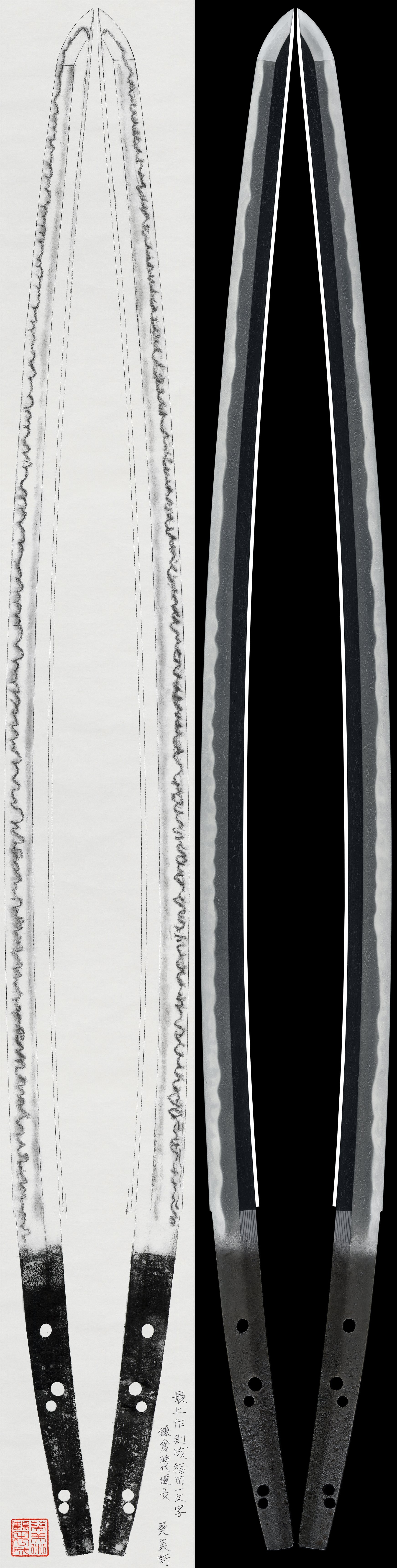
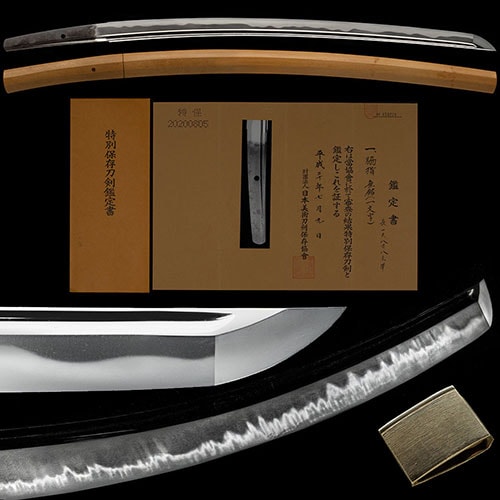
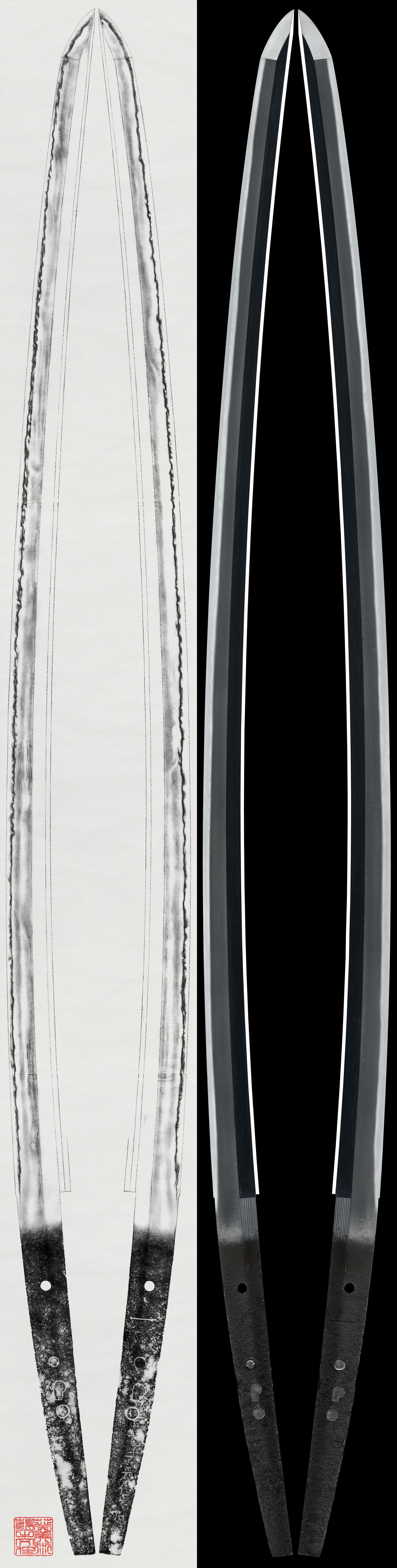
His characteristic temper is a small-patterned worked low to the edge. The published descriptions build it from mixed with and , the showing little overall undulation so that the whole reads as a gentle, small-scale variation; and enter freely, adheres, and fine and run through. On a number of blades the base itself is -toned, the small set into a straight rather than rising in the tall heads of mainstream Fukuoka, and on one the records the temper as "-based, mixed with , and " giving "overall a gentle and restrained manner." This is the trait the sources point to when they call his subdued: the calm lies in the , not in a bare or quiet .
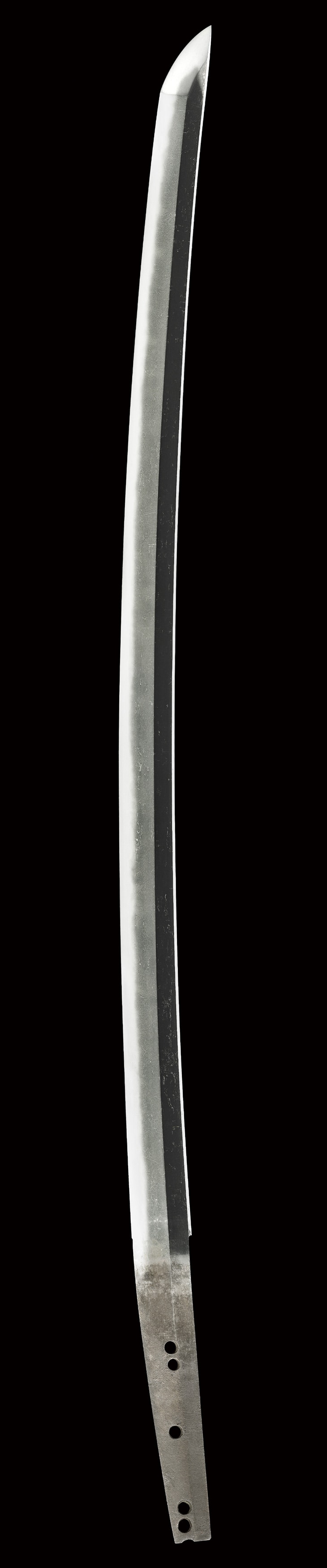
The forging is mixed with , well refined, with fine gathering and entering delicately and often. Over that the school's rich stands clearly, the published sources calling it on the best pieces vivid and sharply defined; one shows a straight -form in the lower half passing into above. The runs tight and bright, deep, and the goes straight into a small round turnback, at times with a faint at the point. So the reflection that places him squarely in is kept at full strength while the temper above it is held back, and his individuality is read against that rich rather than from any thinness of it.
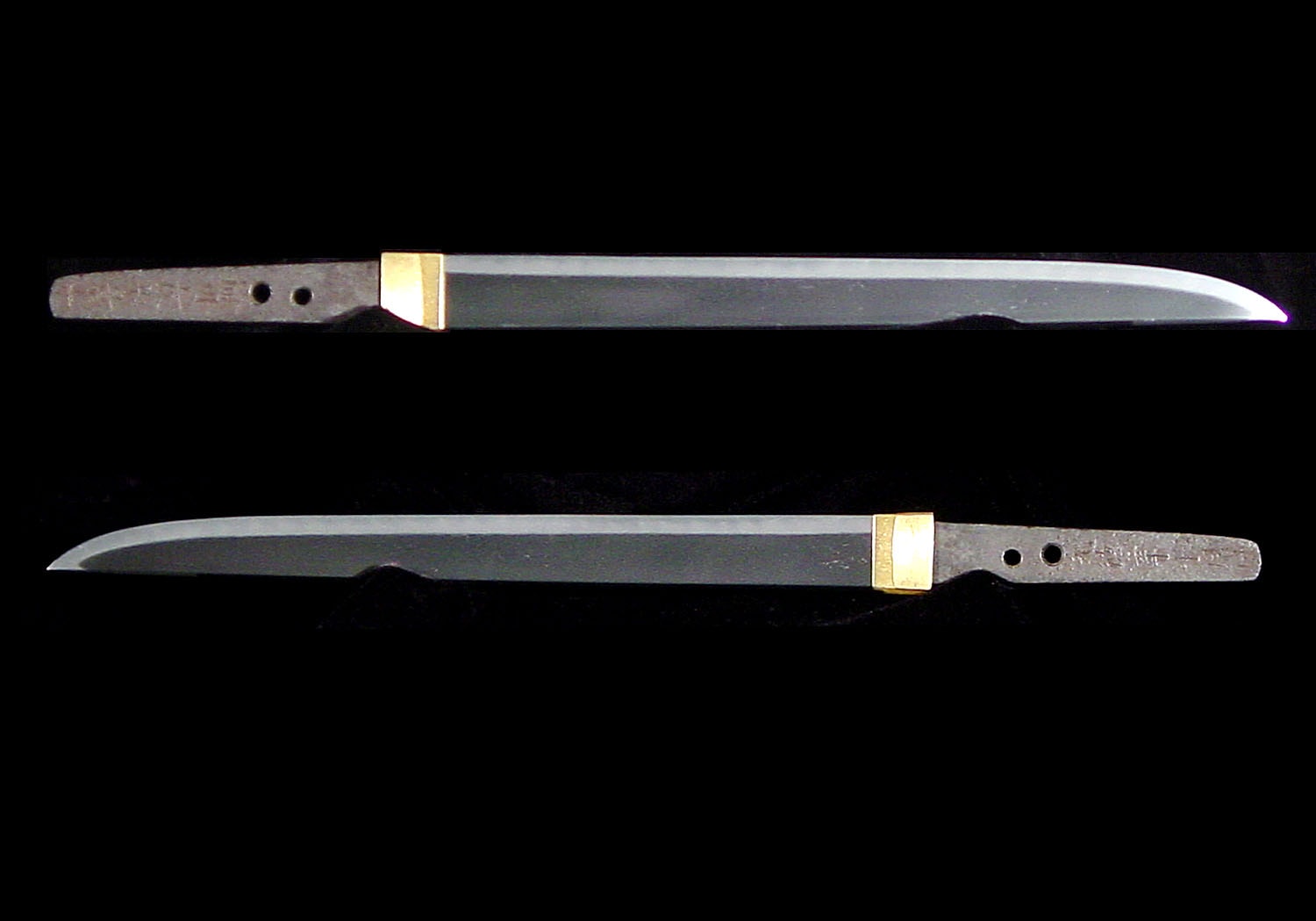
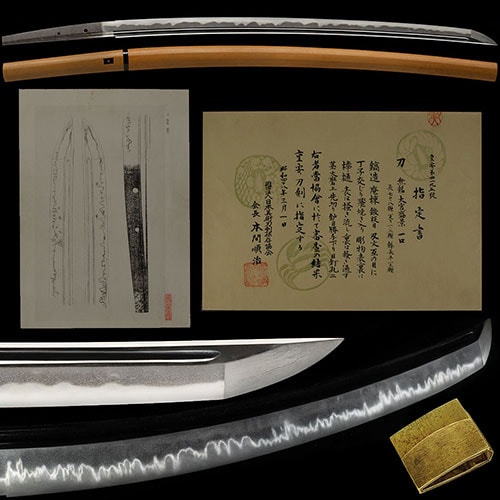
The sources draw a clear exception to the calm hand. A minority of his works are flamboyant, the named example being the preserved at Taiseki-, an Important Cultural Property, and of commanding presence, with tightly packed , prominent and a temper. The showy register governs the Hatajima , which Kochu appraised as Yoshimochi with an dated Hoei 7 (1710); set against his signed work, its , the early designation records, "is conspicuously large in pattern and flamboyant", though period and lineage are not in doubt. The Owari Tokugawa carries the showy mode furthest, its wide and mixing the tadpole-headed clove, "a flamboyant work with a wide and kaeruko mixed in". His signature is consistent and small. The published sources name a vertically elongated two-character , the character (用) running long, as typical, and add that the signature is always a small one.
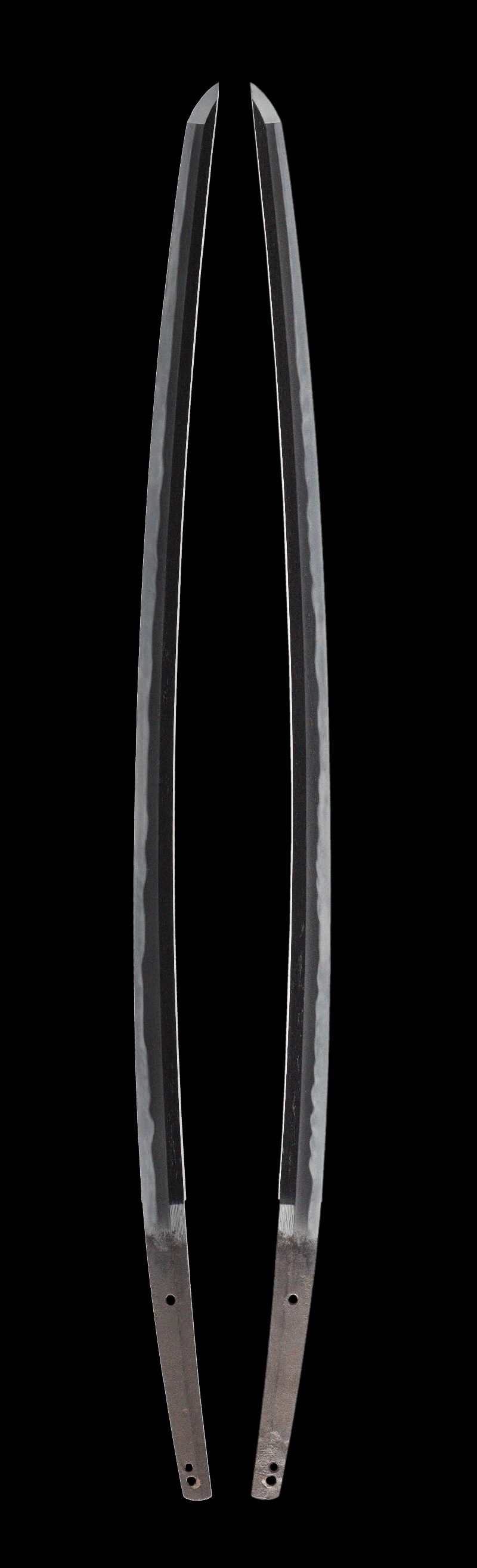
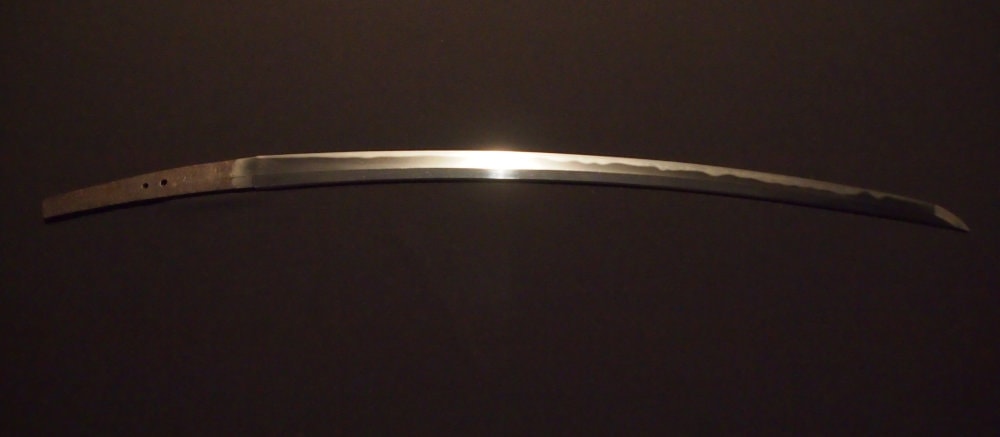
Within the school Yoshimochi works beside the brilliant Fukuoka of Yoshifusa and Norikane as its restrained voice; the published sources set his subdued small against the showier mainstream by naming Taiseki- as the flamboyant pole his ordinary blades fall short of. His own keep deep -zori and a slender build with marked , the silhouette the records repeatedly call elegant. The dating is debated within the corpus. The line of descent from Sukeyoshi places him about Bun'ei, but one judge holds that too early, reasoning from the work itself that he is "probably to be regarded as active in the period as Nagamitsu and related makers". Either way the published sources accept the attribution where it is , as on the Sekiguchi , whose and well-defined they find consistent with his hand.
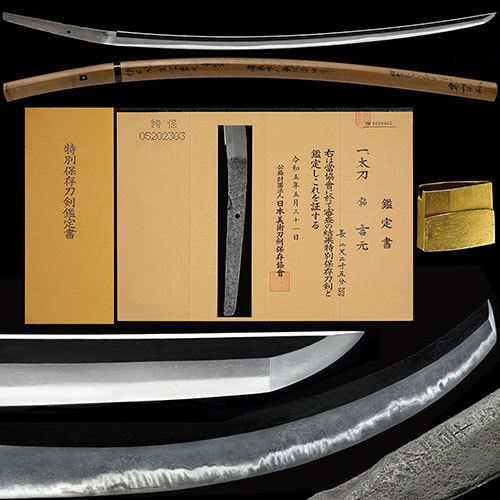
In Fujishiro's grading he is Jo-jo . The designation record behind his name is small but high: one Important Cultural Property, two of his blades raised to and five more to , ten works on official record in all, against which a private collector should weigh the published note that signed Yoshimochi are "probably fewer than ten" and that most of those are subdued small- pieces. The provenance recorded against his blades runs through the great houses: the Tokugawa Reimeikai Foundation, the Owari Tokugawa family, who received the as a betrothal gift for Princess Haru, daughter of Asano Yukinaga, the Mori family, and Mitsui Takayasu, who held the Bijutsuhin at its 1939 designation. Of recorded whereabouts two are in institutional hands, the Sano Art Museum and the Tokugawa Art Museum, with one in a private collection. With no National Treasures and the Important Cultural Property held as patrimony, what may realistically be encountered is one of the or , a signed example of the calm Fukuoka hand, and these come to market only rarely, a notable event when one does.