NihontoWatch MonNihontoWatch
Market
Encyclopedia
Kantei
NihontoWatch MonNihontoWatch
Market
Encyclopedia
Kantei

Description

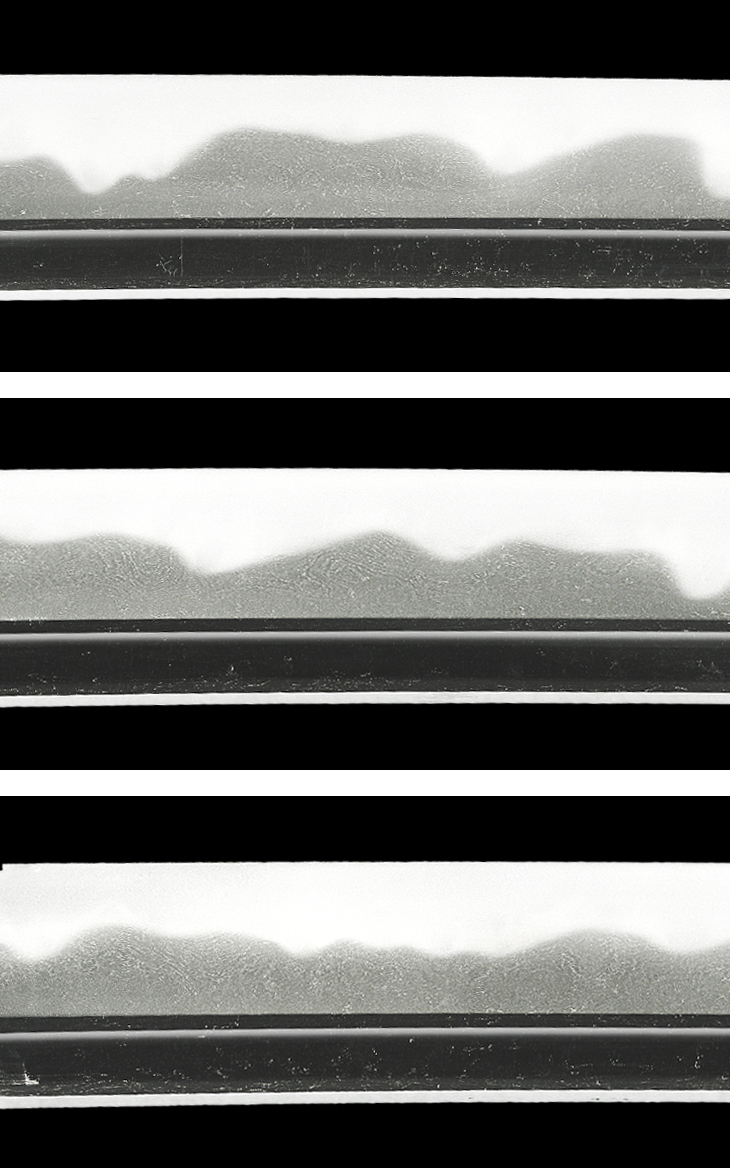
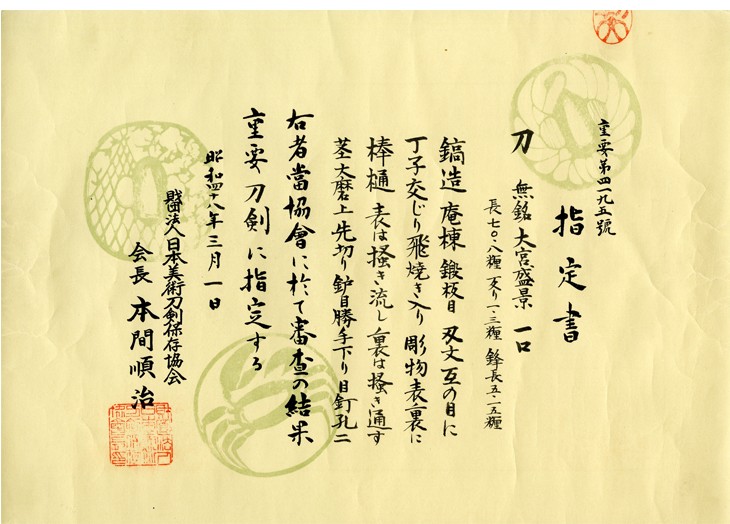
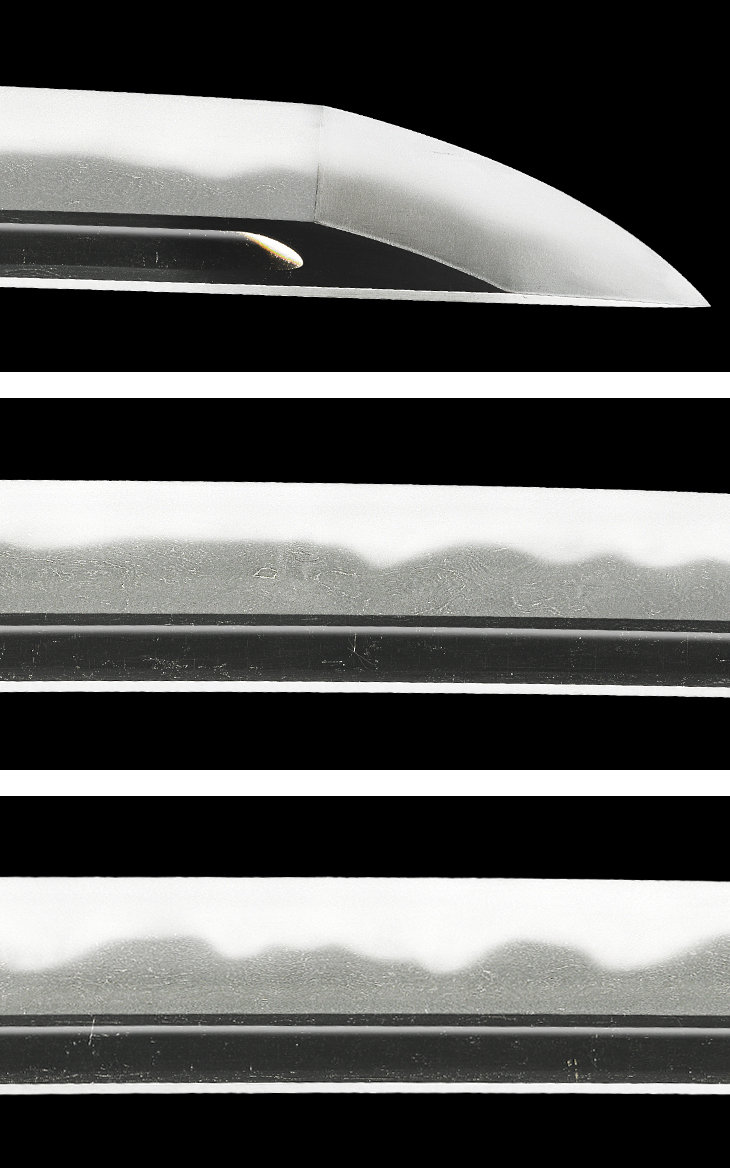
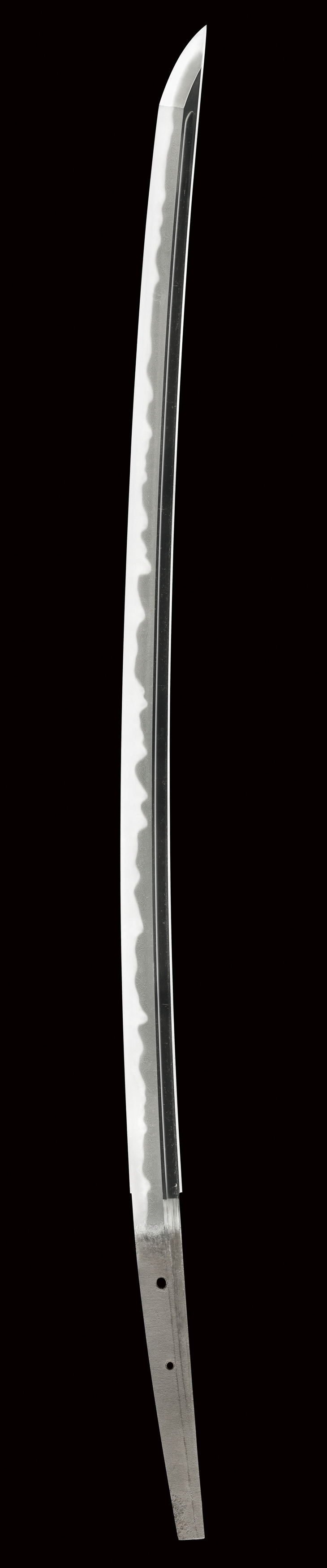
This is a mumei Katana attributed to Ohmiya Morikage, a representative smith of the Soden Bizen school during the mid-Nanbokucho period. It is designated as the 21st Juyo Token by the NBTHK. The blade features a magnificent form with a dynamic gunome-choji midare hamon, well-forged jitetsu with itame, mokume, and flowing grain, and numerous tobiyaki.

NBTHK Setsumei

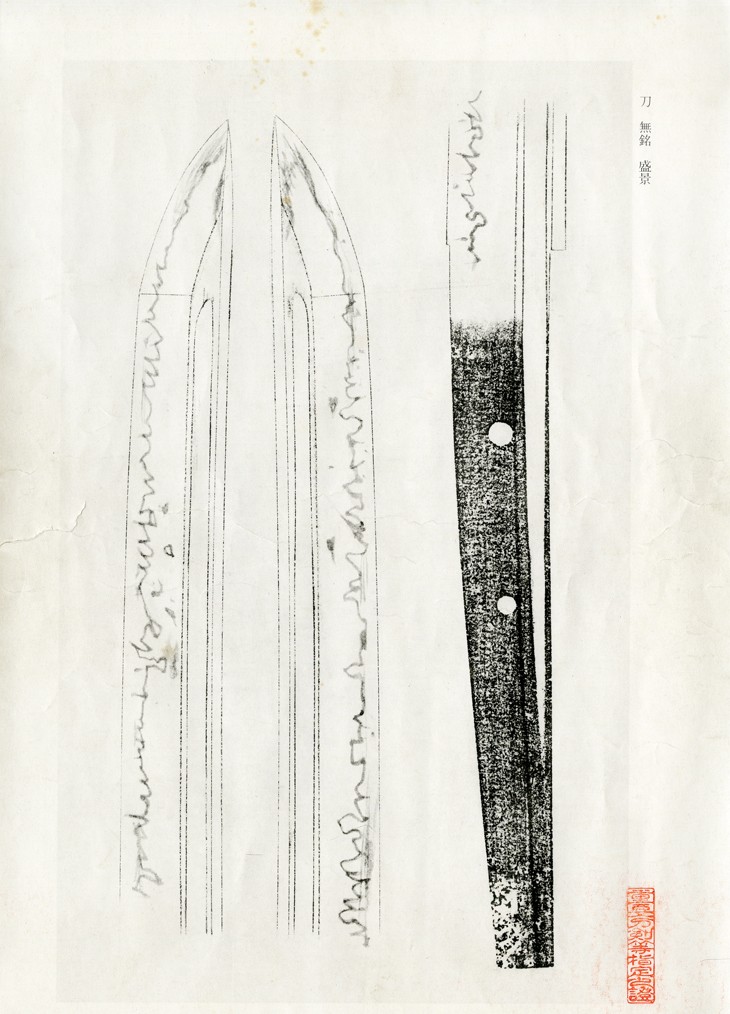
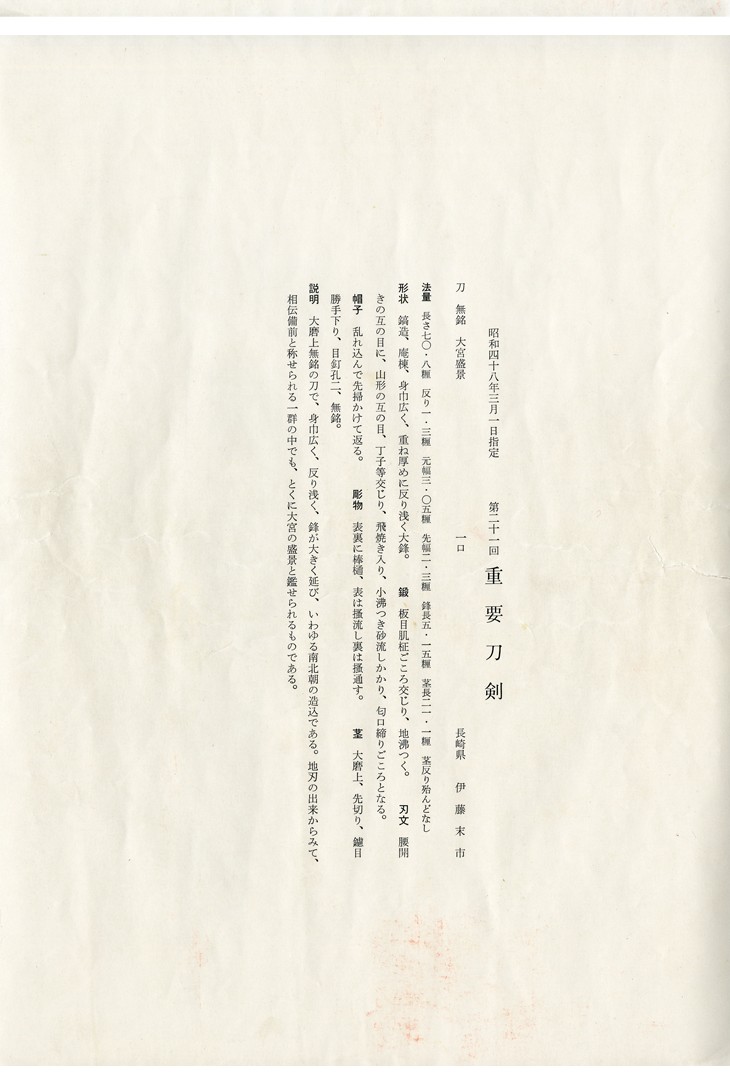
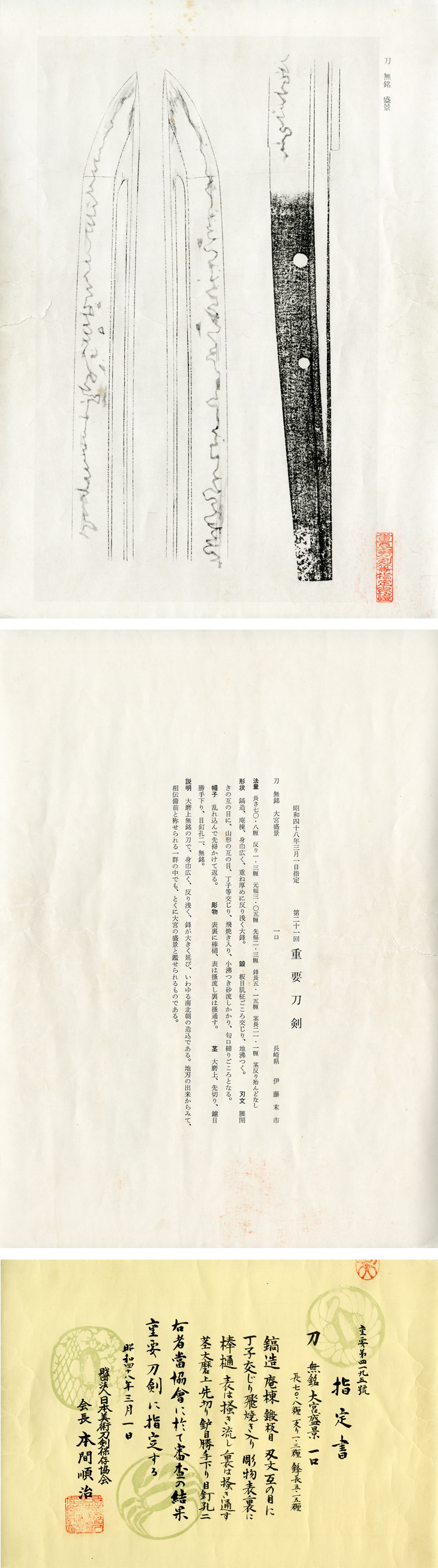
Jūyō-Tōken, 21st Session — Designated March 1, 1973 Katana, mumei: Ōmiya Morikage (大宮盛景) Measurements Nagasa 70.8 cm, sori 1.3 cm, motohaba 3.05 cm, sakihaba 2.3 cm, kissaki-nagasa 5.15 cm, nakago-nagasa 21.1 cm, nakago-sori almost none Description Keijō: Shinogi-zukuri, iori-mune; wide mihaba, somewhat thick kasane; shallow sori and ō-kissaki. Kitae: Itame-hada with masame-tendency mixed in; ji-nie adheres. Hamon: Koshi-biraki gunome mixed with mountain-shaped gunome and chōji; tobiyaki appears; ko-nie attaches and sunagashi runs; the nioiguchi shows a tight tendency (shimarigokoro). Bōshi: Midare-komi; at the point it becomes hakikake and turns back. Horimono: Bō-hi on both sides; on the omote it is kaki-nagashi, and on the ura it is kaki-tōshi. Nakago: Greatly shortened (ō-suriage), tip cut off (sakikiri); file marks katte-sagari; two mekugi-ana; unsigned. Artisan Ōmiya Morikage (大宮盛景) Era Nanbokuchō period Explanation This is a katana that has been greatly shortened and is unsigned. It is wide in the body, has shallow curvature, and displays a large, extended point—features that constitute the so-called Nanbokuchō-period construction. Judging from the workmanship of the jitetsu and hamon, it belongs to the group referred to as Sōden-Bizen; and within that cluster, it is appraised in particular as the work of Ōmiya Morikage.

NihontoWatch MonNihontoWatch
MarketEncyclopediaKantei
Swords›Bizen-den›Omiya›Morikage›Katana: Ohmiya Morikage (Mumei)
katanaJūyō
Omiya Morikage

Katana: Ohmiya Morikage (Mumei)

mumei · Ohmiya · Nanbokucho · nagasa 70.8cm · sori 1.3cm

¥4,300,000
Visit seller website →
Omiya Morikage (盛景) · Ohmiya · Nanbokucho3 works for sale · median ask ¥4,300,000 →
KatanaJūyō
Could you name the smith from the blade alone? Today’s kantei →
Omiya Morikage — 1 of 6
Omiya Morikage — 2 of 6
Omiya Morikage — 3 of 6
Omiya Morikage — 4 of 6
Omiya Morikage — 5 of 6
Omiya Morikage — 6 of 6
1 / 6
1 / 6
Omiya Morikage — 1 of 6Omiya Morikage — 2 of 6Omiya Morikage — 3 of 6Omiya Morikage — 4 of 6Omiya Morikage — 5 of 6Omiya Morikage — 6 of 6
Omiya Morikage (盛景) · Ohmiya · Nanbokucho3 works for sale · median ask ¥4,300,000 →
KatanaJūyō
Could you name the smith from the blade alone? Today’s kantei →
Measurements & details
Smith
Omiya Morikage
Type
Katana
School
Omiya
Period
Around 1356–1390(Enbun ND)
Province
Bizen
Signature
Unsigned(35% of this smith's designated works are signed)
Measurements
Nagasa 70.8cmSori 1.3cmMotohaba 3.21cmSakihaba 2.44cmKasane 0.78cm
Description

This is a mumei Katana attributed to Ohmiya Morikage, a representative smith of the Soden Bizen school during the mid-Nanbokucho period. It is designated as the 21st Juyo Token by the NBTHK. The blade features a magnificent form with a dynamic gunome-choji midare hamon, well-forged jitetsu with itame, mokume, and flowing grain, and numerous tobiyaki.

NBTHK Zufu Commentary

Juyo #21

AI translation — may contain errors

-, 21st Session — Designated March 1, 1973

, : Morikage (大宮盛景)

Measurements 70.8 cm, 1.3 cm, 3.05 cm, 2.3 cm, 5.15 cm, 21.1 cm, almost none

Description Keijō: , ; wide , somewhat thick ; shallow and . : with -tendency mixed in; adheres. : mixed with mountain-shaped and ; appears; attaches and runs; the shows a tight tendency (). : ; at the point it becomes and turns back. : on both sides; on the it is kaki-nagashi, and on the it is . : Greatly shortened (), tip cut off (); file marks ; two ; unsigned.

Artisan Morikage (大宮盛景)

Era period

Explanation This is a that has been greatly shortened and is unsigned. It is wide in the body, has shallow curvature, and displays a large, extended point—features that constitute the so-called -period construction. Judging from the workmanship of the and , it belongs to the group referred to as Sōden-Bizen; and within that cluster, it is appraised in particular as the work of Morikage.

About the maker

Morikage

盛景

Bizen Osafune Ōmiya group (Sōden-Bizen) · Bizen · around 1356-1390

Fujishiro Jo-jo saku · Tōken Taikan top 18%

3 pieces on the market now

›

Morikage worked at Osafune in Bizen through the height of the Nanbokuchō period, cutting long, dated signatures such as Bishū Osafune Morikage on tachi, naginata and tantō across the Ōan, Jōji, Eiwa and Kakei years. He is the central figure of the Bizen Ōmiya group, a line traced in the published sources to the remote ancestor Kunimori, who is said to have moved to Bizen from Inokuma Ōmiya in Yamashiro Province in the Kamakura period. Works by the early Ōmiya smiths Kunimori and Sukemori are extremely rare, and within the Nanbokuchō group it is Morikage who left by far the largest body of work and the highest reputation. The NBTHK's published commentary states it plainly, that among the smiths of the line in this period "Morikage left the largest number of works and is also the most skilled"[[c:1]]. His Fujishiro grade is Jō-jō saku.

His characteristic hand is a Sōden-Bizen temper built not on the clove-flower of mainstream Osafune but on a ko-notare base. Into that undulating line he sets gunome, angular elements and a pointed tendency, with ashi and yō entering well, ko-nie adhering, and fine sunagashi and kinsuji running through the ha. The published sources read the temper as distinctly his own. On a converted-naginata of Tokubetsu Jūyō rank they note that the notare does not become broadly undulating in the manner of Kanemitsu but keeps short foothills and somewhat angular crests, features that, they say, clearly articulate Morikage's individual character. A quiet tell recurs across his work: the nioiguchi tends to a subdued shizumi rather than the bright, showy temper of the leading Osafune names of his day.

The jigane is the constant beneath that range. Over a standing itame mixed with mokume, the grain often opening, he lays a fine ji-nie, chikei entering finely, patches of jifu in the steel, and a Bizen midare-utsuri that stands on his signed and unsigned blades alike. The strength of the nie in both ji and ha is what the judges call the mark of Sōden-Bizen in his work. The bōshi runs midare-komi, finishing in a pointed or small-round turnback with hakikake, and the carvings range from a plain bō-hi through futasuji-hi to bonji and a sankō-ken on the finest pieces.

What the published sources stress above all is the breadth of his range. They describe it as wide, encompassing work in which notare predominates, a florid and changeful midare with chōji and gunome mixed in, work centred on angular gunome, and even a suguha in an Aoe manner. The dated, signed pieces are the spine of this picture, since they fix his hand to specific years from the Ōan era onward, while the suguha register stands at its quiet extreme. Of one signed tachi of Eiwa 2 the commentary remarks that, at a glance, it presents "exactly the kind of suguha manner that calls Aoe and the Unrui smiths to mind"[[c:2]], holding it among the very best of his output and a blade that makes his diversity readily understood. A modern scholarly question hangs over the name itself: on shared workmanship and the reverse-chisel forms of his signature characters, the published sources record a theory, now widely entertained, that this long-signature Morikage may belong instead to an Osafune collateral line connected to Chikakage and Yoshikage, and that the smiths who cut bold, large two-character signatures may be the true Ōmiya hands. The matter is left open for further study.

The larger face of his surviving record is the o-suriage mumei katana attributed to him. These are wide-bodied, the sori shallow and the kissaki extended in the archetypal Nanbokuchō shape, the hamon a ko-notare mixed with gunome and at times small chōji. The published sources affirm them as unmistakable Sōden-Bizen, then place Morikage by contrast: his bright midare-utsuri and subdued, chōji-mixed temper hold him apart from Kanemitsu, whose temper is broader, and from the box-shaped large midare of the Chōgi group. Yet the kinship to Chōgi is real and acknowledged. The commentary on one Tokubetsu Jūyō katana, noting how the Ōmiya line tends to be overshadowed by Kanemitsu and Chōgi, says outright that "his workmanship resembles Chōgi and stands beside it"[[c:3]]. He belongs, in short, to the front rank of Nanbokuchō Sōden-Bizen, a maker whose attribution rests on era, school and these careful distinctions rather than on a single flamboyant trait.

For the collector Morikage is an attainable name among the great Nanbokuchō hands, though one to be met with patience. He has no National Treasures; his designated record runs instead through two Important Cultural Properties, three Tokubetsu Jūyō and a long Jūyō roll, ninety blades in the Tokubetsu Jūyō and Jūyō tiers in all, with one further Jūyō Bijutsuhin from the prewar designations. His provenance is that of the daimyō houses, his blades carried in the Nabeshima of Hizen, the Uesugi, the Date and the Hisamatsu-Matsudaira, with one piece recorded in Imperial keeping. The published commentary singles out individual works in the strongest terms, calling one converted naginata "an outstanding example among his works of that form"[[c:4]]. Because most designated blades stay in long-held collections, a signed and dated Ōmiya Morikage comes to light only from time to time, and a privately held one is a notable thing for a collector to encounter, a securely documented witness to the broad and skilled hand at the centre of the Ōmiya school.

Historical importance

Where Morikage stands among comparable artisans: across all of nihontō, and within tradition, era, and period. The tiers (Foremost · Leading · Major · Notable) weigh official designations from the NBTHK and Japan's Agency for Cultural Affairs, together with historical honors of lasting repute such as the Sansaku and Meibutsu-chō.

随一
Foremost
屈指
Leading
有数
Major
著名
Notable

Select a lens to see how it's measured.

Designation record
92 designated works
Jūyō Bunkazai
2
Jūyō Bijutsuhin
1
Gyobutsu (Imperial)
1
Tokubetsu Jūyō
3
Jūyō
85
3 works by Morikage on the market→
Morikage — full profileBizen Osafune Ōmiya group (Sōden-Bizen) school

Dated Works

Years he was demonstrably active, proven by signed-and-dated blades

Active period
1362–1390Editorial estimate: 1356–1390
18 of 30 designated works carry a date
1360
1370
1380
1390

Study this maker →

About the school

Omiya

大宮

Bizen-den · Bizen

8 pieces on the market now

›

The Omiya school (大宮) of Bizen traces its name and its blood to Kyoto, not to the Bizen heartland where it eventually settled. The published sources follow the line back to a remote ancestor, Kunimori, who is said to have left Inokuma Omiya in Yamashiro province and moved into Bizen during the Kamakura period, around the Bun'o years. With him the group carried a Yamashiro sensibility into the province of choji, and that transplanted origin remains the key to everything the school later became. Works by the earliest Omiya hands, Kunimori and Sukemori, survive in extremely small numbers, so the line first comes clearly into view at the close of the Kamakura period and then flowers through the height of the Nanbokucho era. Several names recur across these generations, among them Morishige, whose name passed down successive smiths from the late Kamakura into the Muromachi period; but the figure who left by far the largest body of work, and the highest reputation[[c:1]], is Morikage, who worked at Osafune and cut long, dated signatures such as Bishu Osafune Morikage across the Oan, Joji, Eiwa and Kakei years. What binds these smiths into a recognizable group is a particular blend, a temper that reads as Soden-Bizen yet is built differently from the clove-flower of mainstream Osafune. The jigane is the constant beneath the range: a standing itame mixed with mokume, the grain tending to open, with fine ji-nie, chikei entering, patches of jifu in the steel, and a Bizen midare-utsuri that rises on signed and mumei blades alike. Upon that ground the school sets a midare in which gunome, choji and an angular, pointed tendency intermingle, with ashi and yo entering well, nioi deepening to ko-nie, and fine sunagashi and kinsuji running through the ha. The recurring tells are a Yamashiro-tinged ji carrying that strong nie, and a boshi running midare-komi to a small round or a pointed turnback with hakikake. Within this shared vocabulary the hands diverge.

Morikage tends to a ko-notare base with somewhat angular crests and a subdued, shizumi nioiguchi rather than a showy temper, while his range stretches from that quiet register to a suguha the commentary likens to Aoe and the Unrui smiths[[c:2]]. Morishige favors a bold, opened-waist gunome, the koshi-hiraki pattern mixed with choji into flamboyant undulations. The breadth itself is a school trait, the published sources describing the Omiya saku-iki as wide, taking in notare-dominant work, florid choji-gunome midare, angular gunome, and the Aoe-manner suguha at its quiet edge. To kantei an Omiya blade is to read this fusion of Yamashiro-den refinement and Bizen-den flamboyance, then to separate it from its larger Osafune neighbors. The bright midare-utsuri and the nie-strong ji hold the school apart from Kanemitsu, whose temper undulates more broadly, and from the box-shaped large midare of Chogi, though the kinship to Chogi is real and acknowledged in the commentary, which places Morikage's workmanship beside it[[c:3]]. The school is often overshadowed by those two names, which makes the distinguishing read the more useful: the standing itame with its utsuri, the angular pointed elements, and the comparatively restrained nioiguchi. Morikage stands at the front rank of Nanbokucho Soden-Bizen and carries a Jo-jo saku grade in Fujishiro; his provenance runs through the daimyo houses, the Nabeshima of Hizen, the Uesugi, the Date and the Hisamatsu-Matsudaira, with a piece recorded in Imperial keeping. A modern scholarly question hangs over the name itself, the published sources recording a theory, now widely entertained, that the long-signature Morikage may belong to an Osafune collateral line connected to Chikakage and Yoshikage, and that the smiths who cut bold, large two-character signatures may be the true Omiya hands; the matter is left open. By the late Muromachi the distinctive Omiya traits fade, the Shinkuro generation of Morishige showing no difference from the general Sue-Bizen type, evidence that the subsidiary line was at last absorbed into the dominant Osafune school, a trajectory that gives the group its documentary value for the study of how Bizen's lesser lineages were drawn into the mainstream. Learn more →

16 recorded smiths141 designated works
Leading smiths
SmithEraDesignated
Morikage盛景1356-139092
Morikage盛景1299-13025
Nobuhide延秀1302-13030
Norifusa則房1199-12010
Morishige盛重1394-14282
Explore the Omiya school →

Historical context

Bizen in the Nanbokuchō period

›

Sixty years of war between two courts drove blades long and broad, and Osafune met the demand: Kanemitsu and Chōgi led forges serving the provincial warriors who did the fighting, while Sōshū influence arrived with the armies to create Sōden-Bizen.

Bizen in the Nanbokuchō period →

NBTHK Certificate
Jūyō Tōken重要刀剣
Important Sword
›

A blade of top-grade workmanship and condition, formally judged to rank with a nationally recognized Important Art Object (Jūyō Bijutsuhin). Awarded only at the NBTHK’s competitive annual examination.

Of Japan’s roughly 2.5 million registered swords, only 12,307 (about 1 in 203) have ever attained Jūyō.

About the NBTHK›

The NBTHK (Nihon Bijutsu Tōken Hozon Kyōkai, the Society for the Preservation of Japanese Art Swords) is a public-interest incorporated foundation founded in 1948 and supervised by Japan’s Agency for Cultural Affairs (Bunkachō); it is based at the Japanese Sword Museum in Tokyo. Its expert panels physically examine each submitted work (shinsa) and issue a certificate (kanteishō) ranking it by artistic and historical merit. NBTHK papers are the most widely recognized standard of authentication for Japanese swords and fittings.

NBTHK official site→
Seller
S
Samurai Nippon
Established 1977 · 49 yrs on the market
🇯🇵Ships from Japan
›
✓Verified dealersamurai-nippon.net
Settles in JPY
✓Ships worldwide✓English supportWire transferPayPalCredit card
Return policy

For one-of-a-kind items such as swords, sword fittings, and antiques, please contact us about a return within 3 days of the item's arrival and ship it back within 8 days. Refunds are issued the same day the returned item arrives.

View all of Samurai Nippon’s listings→View this item on the dealer’s site→

More works by Omiya Morikage

View all →
Eirakudo
Jūyō
Katana - Jūyō - by Omiya Morikage - Ohmiya Morikage - Juyo TokenKatana - Jūyō - by Omiya Morikage - Ohmiya Morikage - Juyo Token

Katana

ByOmiya Morikage
¥4,000,000
Nihontocraft
Jūyō
Katana - Jūyō - by Omiya Morikage - Bishu Osafune Morikage - 68th Juyo TokenKatana - Jūyō - by Omiya Morikage - Bishu Osafune Morikage - 68th Juyo Token

Katana

ByOmiya Morikage
¥46,000

Previously sold by Omiya Morikage

View all →
Choshuya
Wakizashi - by Omiya Morikage - Mumei Omiya Morikage - Kiritsuke-mei "Namu Amida Butsu"Wakizashi - by Omiya Morikage - Mumei Omiya Morikage - Kiritsuke-mei "Namu Amida Butsu"
Sold

Wakizashi

ByOmiya Morikage
SOLD
World Seiyudo
Tokuho
Katana - Tokuho - by Omiya Morikage - Mumei (Osafune Morikage) - Tokubetsu Hozon TokenKatana - Tokuho - by Omiya Morikage - Mumei (Osafune Morikage) - Tokubetsu Hozon Token
Sold

Katana

ByOmiya Morikage
SOLD
World Seiyudo
Tokuho
Katana - Tokuho - by Omiya Morikage - Mumei (attributed to Osafune Morikage) - Tokubetsu Hozon TokenKatana - Tokuho - by Omiya Morikage - Mumei (attributed to Osafune Morikage) - Tokubetsu Hozon Token
Sold

Katana

ByOmiya Morikage
SOLD
World Seiyudo
Tokuho
Wakizashi - Tokuho - by Omiya Morikage - Osafune Morikage - Tokubetsu Hozon TokenWakizashi - Tokuho - by Omiya Morikage - Osafune Morikage - Tokubetsu Hozon Token
Sold

Wakizashi

ByOmiya Morikage
SOLD
Nipponto
Tokuho
Tanto - Tokuho - by Omiya Morikage - Tokubetsu Hozon Tanto by Morikage of Bishu Osafune, dated Enbun 5Tanto - Tokuho - by Omiya Morikage - Tokubetsu Hozon Tanto by Morikage of Bishu Osafune, dated Enbun 5
Sold

Tantō

ByOmiya Morikage
SOLD
Nihonto US
Jūyō
Katana - Jūyō - by Omiya Morikage - Omiya Morikage - Juyo TokenKatana - Jūyō - by Omiya Morikage - Omiya Morikage - Juyo Token
Sold

Katana

ByOmiya Morikage
SOLD
World Seiyudo
Jūyō
Katana - Jūyō - by Omiya Morikage - Omiya Morikage (Yoki-wazamono) - Juyo TokenKatana - Jūyō - by Omiya Morikage - Omiya Morikage (Yoki-wazamono) - Juyo Token
Sold

Katana

ByOmiya Morikage
SOLD
Unique Japan
Tokuho
Katana - Tokuho - by Omiya Morikage - Ômiya MorikageKatana - Tokuho - by Omiya Morikage - Ômiya Morikage
Sold

Katana

ByOmiya Morikage
SOLD

More from the Omiya school

View all →
Toushin
Tokuho
Katana - Tokuho - by Omiya School - Mumei (Attributed to Omiya) - 2-1019Katana - Tokuho - by Omiya School - Mumei (Attributed to Omiya) - 2-1019

Katana

ByOmiya School
¥2,750,000
Nosyudo
Hozon
Wakizashi - Hozon - by Omiya Morishige - Mumei (attributed to Osafune Morishige) / 60.4cmWakizashi - Hozon - by Omiya Morishige - Mumei (attributed to Osafune Morishige) / 60.4cm

Wakizashi

ByOmiya Morishige
¥1,200,000
Aoi Art
Tokuho
Katana - Tokuho - by Omiya Morishige - Mumei (Unsigned) Osafune MorishigeKatana - Tokuho - by Omiya Morishige - Mumei (Unsigned) Osafune Morishige

Katana

ByOmiya Morishige
¥2,000,000
Touken Matsumoto
Hozon
Katana - Hozon - by Omiya Morishige - Mumei (Osafune Morishige)Katana - Hozon - by Omiya Morishige - Mumei (Osafune Morishige)

Katana

ByOmiya Morishige
¥1,200,000
Katana Ando
脇差Photos not published
Wakizashi - by Omiya Morishige - Wakizashi, Bishu Osafune Morishige, Oei 6th Year 2nd Month Day

Wakizashi

ByOmiya Morishige
¥450,000

More from the Bizen tradition

View all →
Eirakudo
Tokuho
Katana - Tokuho - by Katayama Ichimonji School - Katayama Ichimonji - Tokubetsu Hozon TokenKatana - Tokuho - by Katayama Ichimonji School - Katayama Ichimonji - Tokubetsu Hozon Token

Katana

ByKatayama Ichimonji School
¥4,500,000
Aoi Art
Jūyō
Jūyō - by Ichimonji School - Naginata-Naoshi Katana: Mumei (Ichimonji)Jūyō - by Ichimonji School - Naginata-Naoshi Katana: Mumei (Ichimonji)

Naginata-Naoshi Katana: Mumei (Ichimonji)

ByIchimonji School
Starting Bid¥9,500,000
Aoi Art
Tokuho
Katana - Tokuho - by Osafune Shigezane - Mumei (Osafune Shigezane)Katana - Tokuho - by Osafune Shigezane - Mumei (Osafune Shigezane)

Katana

ByOsafune Shigezane
Starting Bid¥1,650,000
Aoi Art
Jūyō Bijutsuhin
Daisho - Jubi - by Osafune Nagamitsu - Dai Sho: Katana (Important Art Object) Mumei (Den Nagamitsu) / Wakizashi Mumei (Sekishu Naotsuna)Daisho - Jubi - by Osafune Nagamitsu - Dai Sho: Katana (Important Art Object) Mumei (Den Nagamitsu) / Wakizashi Mumei (Sekishu Naotsuna)

Daishō

ByOsafune Nagamitsu
Ask
Tsuruginoya
Jūyō
Katana - Jūyō - by Fukuoka Ichimonji School - Mumei Fukuoka IchimonjiKatana - Jūyō - by Fukuoka Ichimonji School - Mumei Fukuoka Ichimonji

Katana

ByFukuoka Ichimonji School
Ask
Aoi Art
Tokuho
Tanto - Tokuho - by Sukesada - Bizen Kuni Ju Osafune Yozaemon-no-jo Sukesada, Dated: A lucky day in the second month of Daiei 5 (1525)Tanto - Tokuho - by Sukesada - Bizen Kuni Ju Osafune Yozaemon-no-jo Sukesada, Dated: A lucky day in the second month of Daiei 5 (1525)

Tantō

BySukesada
Starting Bid¥1,850,000
World Seiyudo
Jūyō
Katana - Jūyō - by Kozori Moromitsu - Bishu-Osafune Moromitsu with NBTHK Juyo Token and Tokubetsu Hozon TosoguKatana - Jūyō - by Kozori Moromitsu - Bishu-Osafune Moromitsu with NBTHK Juyo Token and Tokubetsu Hozon Tosogu

Katana

ByKozori Moromitsu
¥9,500,000
Nihonto.com
Jūyō
Tanto - Jūyō - by Osafune Kagemitsu - Juyo Tanto by Bizen KagemitsuTanto - Jūyō - by Osafune Kagemitsu - Juyo Tanto by Bizen Kagemitsu

Tantō

ByOsafune Kagemitsu
¥89,500

Swords

  • Katana
  • Wakizashi
  • Tantō
  • Tachi
  • Naginata
  • Yari
  • Japanese Swords
  • Samurai Swords

Fittings

  • Tsuba
  • Fuchi-Kashira
  • Kozuka
  • Menuki
  • Sword Guards (Tsuba)

Armor

  • Kabuto
  • Samurai Armor
  • All Samurai Armor

By Certification

  • Tokujū
  • Jūyō
  • Tokuho
  • Hozon

Resources

  • Dealer Directory
  • Artist Directory
  • The Daily Kantei
  • Glossary
  • Browse All
Nihontowatch© 2026
TermsPrivacyCookiesAbout

¥4,300,000

View on Samurai Nippon

Description

This is a mumei Katana attributed to Ohmiya Morikage, a representative smith of the Soden Bizen school during the mid-Nanbokucho period. It is designated as the 21st Juyo Token by the NBTHK. The blade features a magnificent form with a dynamic gunome-choji midare hamon, well-forged jitetsu with itame, mokume, and flowing grain, and numerous tobiyaki.

NBTHK Setsumei

Jūyō-Tōken, 21st Session — Designated March 1, 1973 Katana, mumei: Ōmiya Morikage (大宮盛景) Measurements Nagasa 70.8 cm, sori 1.3 cm, motohaba 3.05 cm, sakihaba 2.3 cm, kissaki-nagasa 5.15 cm, nakago-nagasa 21.1 cm, nakago-sori almost none Description Keijō: Shinogi-zukuri, iori-mune; wide mihaba, somewhat thick kasane; shallow sori and ō-kissaki. Kitae: Itame-hada with masame-tendency mixed in; ji-nie adheres. Hamon: Koshi-biraki gunome mixed with mountain-shaped gunome and chōji; tobiyaki appears; ko-nie attaches and sunagashi runs; the nioiguchi shows a tight tendency (shimarigokoro). Bōshi: Midare-komi; at the point it becomes hakikake and turns back. Horimono: Bō-hi on both sides; on the omote it is kaki-nagashi, and on the ura it is kaki-tōshi. Nakago: Greatly shortened (ō-suriage), tip cut off (sakikiri); file marks katte-sagari; two mekugi-ana; unsigned. Artisan Ōmiya Morikage (大宮盛景) Era Nanbokuchō period Explanation This is a katana that has been greatly shortened and is unsigned. It is wide in the body, has shallow curvature, and displays a large, extended point—features that constitute the so-called Nanbokuchō-period construction. Judging from the workmanship of the jitetsu and hamon, it belongs to the group referred to as Sōden-Bizen; and within that cluster, it is appraised in particular as the work of Ōmiya Morikage.

NihontoWatch MonNihontoWatch
MarketEncyclopediaKantei
Swords›Bizen-den›Omiya›Morikage›Katana: Ohmiya Morikage (Mumei)
katanaJūyō
Omiya Morikage

Katana: Ohmiya Morikage (Mumei)

mumei · Ohmiya · Nanbokucho · nagasa 70.8cm · sori 1.3cm

¥4,300,000
Visit seller website →
Omiya Morikage (盛景) · Ohmiya · Nanbokucho3 works for sale · median ask ¥4,300,000 →
KatanaJūyō
Could you name the smith from the blade alone? Today’s kantei →
Omiya Morikage — 1 of 6
Omiya Morikage — 2 of 6
Omiya Morikage — 3 of 6
Omiya Morikage — 4 of 6
Omiya Morikage — 5 of 6
Omiya Morikage — 6 of 6
1 / 6
1 / 6
Omiya Morikage — 1 of 6Omiya Morikage — 2 of 6Omiya Morikage — 3 of 6Omiya Morikage — 4 of 6Omiya Morikage — 5 of 6Omiya Morikage — 6 of 6
Omiya Morikage (盛景) · Ohmiya · Nanbokucho3 works for sale · median ask ¥4,300,000 →
KatanaJūyō
Could you name the smith from the blade alone? Today’s kantei →
Measurements & details
Smith
Omiya Morikage
Type
Katana
School
Omiya
Period
Around 1356–1390(Enbun ND)
Province
Bizen
Signature
Unsigned(35% of this smith's designated works are signed)
Measurements
Nagasa 70.8cmSori 1.3cmMotohaba 3.21cmSakihaba 2.44cmKasane 0.78cm
Description

This is a mumei Katana attributed to Ohmiya Morikage, a representative smith of the Soden Bizen school during the mid-Nanbokucho period. It is designated as the 21st Juyo Token by the NBTHK. The blade features a magnificent form with a dynamic gunome-choji midare hamon, well-forged jitetsu with itame, mokume, and flowing grain, and numerous tobiyaki.

NBTHK Zufu Commentary

Juyo #21

AI translation — may contain errors

-, 21st Session — Designated March 1, 1973

, : Morikage (大宮盛景)

Measurements 70.8 cm, 1.3 cm, 3.05 cm, 2.3 cm, 5.15 cm, 21.1 cm, almost none

Description Keijō: , ; wide , somewhat thick ; shallow and . : with -tendency mixed in; adheres. : mixed with mountain-shaped and ; appears; attaches and runs; the shows a tight tendency (). : ; at the point it becomes and turns back. : on both sides; on the it is kaki-nagashi, and on the it is . : Greatly shortened (), tip cut off (); file marks ; two ; unsigned.

Artisan Morikage (大宮盛景)

Era period

Explanation This is a that has been greatly shortened and is unsigned. It is wide in the body, has shallow curvature, and displays a large, extended point—features that constitute the so-called -period construction. Judging from the workmanship of the and , it belongs to the group referred to as Sōden-Bizen; and within that cluster, it is appraised in particular as the work of Morikage.

About the maker

Morikage

盛景

Bizen Osafune Ōmiya group (Sōden-Bizen) · Bizen · around 1356-1390

Fujishiro Jo-jo saku · Tōken Taikan top 18%

3 pieces on the market now

›

Morikage worked at Osafune in Bizen through the height of the Nanbokuchō period, cutting long, dated signatures such as Bishū Osafune Morikage on tachi, naginata and tantō across the Ōan, Jōji, Eiwa and Kakei years. He is the central figure of the Bizen Ōmiya group, a line traced in the published sources to the remote ancestor Kunimori, who is said to have moved to Bizen from Inokuma Ōmiya in Yamashiro Province in the Kamakura period. Works by the early Ōmiya smiths Kunimori and Sukemori are extremely rare, and within the Nanbokuchō group it is Morikage who left by far the largest body of work and the highest reputation. The NBTHK's published commentary states it plainly, that among the smiths of the line in this period "Morikage left the largest number of works and is also the most skilled"[[c:1]]. His Fujishiro grade is Jō-jō saku.

His characteristic hand is a Sōden-Bizen temper built not on the clove-flower of mainstream Osafune but on a ko-notare base. Into that undulating line he sets gunome, angular elements and a pointed tendency, with ashi and yō entering well, ko-nie adhering, and fine sunagashi and kinsuji running through the ha. The published sources read the temper as distinctly his own. On a converted-naginata of Tokubetsu Jūyō rank they note that the notare does not become broadly undulating in the manner of Kanemitsu but keeps short foothills and somewhat angular crests, features that, they say, clearly articulate Morikage's individual character. A quiet tell recurs across his work: the nioiguchi tends to a subdued shizumi rather than the bright, showy temper of the leading Osafune names of his day.

The jigane is the constant beneath that range. Over a standing itame mixed with mokume, the grain often opening, he lays a fine ji-nie, chikei entering finely, patches of jifu in the steel, and a Bizen midare-utsuri that stands on his signed and unsigned blades alike. The strength of the nie in both ji and ha is what the judges call the mark of Sōden-Bizen in his work. The bōshi runs midare-komi, finishing in a pointed or small-round turnback with hakikake, and the carvings range from a plain bō-hi through futasuji-hi to bonji and a sankō-ken on the finest pieces.

What the published sources stress above all is the breadth of his range. They describe it as wide, encompassing work in which notare predominates, a florid and changeful midare with chōji and gunome mixed in, work centred on angular gunome, and even a suguha in an Aoe manner. The dated, signed pieces are the spine of this picture, since they fix his hand to specific years from the Ōan era onward, while the suguha register stands at its quiet extreme. Of one signed tachi of Eiwa 2 the commentary remarks that, at a glance, it presents "exactly the kind of suguha manner that calls Aoe and the Unrui smiths to mind"[[c:2]], holding it among the very best of his output and a blade that makes his diversity readily understood. A modern scholarly question hangs over the name itself: on shared workmanship and the reverse-chisel forms of his signature characters, the published sources record a theory, now widely entertained, that this long-signature Morikage may belong instead to an Osafune collateral line connected to Chikakage and Yoshikage, and that the smiths who cut bold, large two-character signatures may be the true Ōmiya hands. The matter is left open for further study.

The larger face of his surviving record is the o-suriage mumei katana attributed to him. These are wide-bodied, the sori shallow and the kissaki extended in the archetypal Nanbokuchō shape, the hamon a ko-notare mixed with gunome and at times small chōji. The published sources affirm them as unmistakable Sōden-Bizen, then place Morikage by contrast: his bright midare-utsuri and subdued, chōji-mixed temper hold him apart from Kanemitsu, whose temper is broader, and from the box-shaped large midare of the Chōgi group. Yet the kinship to Chōgi is real and acknowledged. The commentary on one Tokubetsu Jūyō katana, noting how the Ōmiya line tends to be overshadowed by Kanemitsu and Chōgi, says outright that "his workmanship resembles Chōgi and stands beside it"[[c:3]]. He belongs, in short, to the front rank of Nanbokuchō Sōden-Bizen, a maker whose attribution rests on era, school and these careful distinctions rather than on a single flamboyant trait.

For the collector Morikage is an attainable name among the great Nanbokuchō hands, though one to be met with patience. He has no National Treasures; his designated record runs instead through two Important Cultural Properties, three Tokubetsu Jūyō and a long Jūyō roll, ninety blades in the Tokubetsu Jūyō and Jūyō tiers in all, with one further Jūyō Bijutsuhin from the prewar designations. His provenance is that of the daimyō houses, his blades carried in the Nabeshima of Hizen, the Uesugi, the Date and the Hisamatsu-Matsudaira, with one piece recorded in Imperial keeping. The published commentary singles out individual works in the strongest terms, calling one converted naginata "an outstanding example among his works of that form"[[c:4]]. Because most designated blades stay in long-held collections, a signed and dated Ōmiya Morikage comes to light only from time to time, and a privately held one is a notable thing for a collector to encounter, a securely documented witness to the broad and skilled hand at the centre of the Ōmiya school.
Historical importance

Where Morikage stands among comparable artisans: across all of nihontō, and within tradition, era, and period. The tiers (Foremost · Leading · Major · Notable) weigh official designations from the NBTHK and Japan's Agency for Cultural Affairs, together with historical honors of lasting repute such as the Sansaku and Meibutsu-chō.

随一
Foremost
屈指
Leading
有数
Major
著名
Notable

Select a lens to see how it's measured.

Designation record
92 designated works
Jūyō Bunkazai
2
Jūyō Bijutsuhin
1
Gyobutsu (Imperial)
1
Tokubetsu Jūyō
3
Jūyō
85
3 works by Morikage on the market→
Morikage — full profileBizen Osafune Ōmiya group (Sōden-Bizen) school

Dated Works

Years he was demonstrably active, proven by signed-and-dated blades

Active period
1362–1390Editorial estimate: 1356–1390
18 of 30 designated works carry a date
1360
1370
1380
1390

Study this maker →

About the school

Omiya

大宮

Bizen-den · Bizen

8 pieces on the market now

›

The Omiya school (大宮) of Bizen traces its name and its blood to Kyoto, not to the Bizen heartland where it eventually settled. The published sources follow the line back to a remote ancestor, Kunimori, who is said to have left Inokuma Omiya in Yamashiro province and moved into Bizen during the Kamakura period, around the Bun'o years. With him the group carried a Yamashiro sensibility into the province of choji, and that transplanted origin remains the key to everything the school later became. Works by the earliest Omiya hands, Kunimori and Sukemori, survive in extremely small numbers, so the line first comes clearly into view at the close of the Kamakura period and then flowers through the height of the Nanbokucho era. Several names recur across these generations, among them Morishige, whose name passed down successive smiths from the late Kamakura into the Muromachi period; but the figure who left by far the largest body of work, and the highest reputation[[c:1]], is Morikage, who worked at Osafune and cut long, dated signatures such as Bishu Osafune Morikage across the Oan, Joji, Eiwa and Kakei years. What binds these smiths into a recognizable group is a particular blend, a temper that reads as Soden-Bizen yet is built differently from the clove-flower of mainstream Osafune. The jigane is the constant beneath the range: a standing itame mixed with mokume, the grain tending to open, with fine ji-nie, chikei entering, patches of jifu in the steel, and a Bizen midare-utsuri that rises on signed and mumei blades alike. Upon that ground the school sets a midare in which gunome, choji and an angular, pointed tendency intermingle, with ashi and yo entering well, nioi deepening to ko-nie, and fine sunagashi and kinsuji running through the ha. The recurring tells are a Yamashiro-tinged ji carrying that strong nie, and a boshi running midare-komi to a small round or a pointed turnback with hakikake. Within this shared vocabulary the hands diverge.

Morikage tends to a ko-notare base with somewhat angular crests and a subdued, shizumi nioiguchi rather than a showy temper, while his range stretches from that quiet register to a suguha the commentary likens to Aoe and the Unrui smiths[[c:2]]. Morishige favors a bold, opened-waist gunome, the koshi-hiraki pattern mixed with choji into flamboyant undulations. The breadth itself is a school trait, the published sources describing the Omiya saku-iki as wide, taking in notare-dominant work, florid choji-gunome midare, angular gunome, and the Aoe-manner suguha at its quiet edge. To kantei an Omiya blade is to read this fusion of Yamashiro-den refinement and Bizen-den flamboyance, then to separate it from its larger Osafune neighbors. The bright midare-utsuri and the nie-strong ji hold the school apart from Kanemitsu, whose temper undulates more broadly, and from the box-shaped large midare of Chogi, though the kinship to Chogi is real and acknowledged in the commentary, which places Morikage's workmanship beside it[[c:3]]. The school is often overshadowed by those two names, which makes the distinguishing read the more useful: the standing itame with its utsuri, the angular pointed elements, and the comparatively restrained nioiguchi. Morikage stands at the front rank of Nanbokucho Soden-Bizen and carries a Jo-jo saku grade in Fujishiro; his provenance runs through the daimyo houses, the Nabeshima of Hizen, the Uesugi, the Date and the Hisamatsu-Matsudaira, with a piece recorded in Imperial keeping. A modern scholarly question hangs over the name itself, the published sources recording a theory, now widely entertained, that the long-signature Morikage may belong to an Osafune collateral line connected to Chikakage and Yoshikage, and that the smiths who cut bold, large two-character signatures may be the true Omiya hands; the matter is left open. By the late Muromachi the distinctive Omiya traits fade, the Shinkuro generation of Morishige showing no difference from the general Sue-Bizen type, evidence that the subsidiary line was at last absorbed into the dominant Osafune school, a trajectory that gives the group its documentary value for the study of how Bizen's lesser lineages were drawn into the mainstream. Learn more →

16 recorded smiths141 designated works
Leading smiths
SmithEraDesignated
Morikage盛景1356-139092
Morikage盛景1299-13025
Nobuhide延秀1302-13030
Norifusa則房1199-12010
Morishige盛重1394-14282
Explore the Omiya school →

Historical context

Bizen in the Nanbokuchō period

›

Sixty years of war between two courts drove blades long and broad, and Osafune met the demand: Kanemitsu and Chōgi led forges serving the provincial warriors who did the fighting, while Sōshū influence arrived with the armies to create Sōden-Bizen.

Bizen in the Nanbokuchō period →

NBTHK Certificate
Jūyō Tōken重要刀剣
Important Sword
›

A blade of top-grade workmanship and condition, formally judged to rank with a nationally recognized Important Art Object (Jūyō Bijutsuhin). Awarded only at the NBTHK’s competitive annual examination.

Of Japan’s roughly 2.5 million registered swords, only 12,307 (about 1 in 203) have ever attained Jūyō.

About the NBTHK›

The NBTHK (Nihon Bijutsu Tōken Hozon Kyōkai, the Society for the Preservation of Japanese Art Swords) is a public-interest incorporated foundation founded in 1948 and supervised by Japan’s Agency for Cultural Affairs (Bunkachō); it is based at the Japanese Sword Museum in Tokyo. Its expert panels physically examine each submitted work (shinsa) and issue a certificate (kanteishō) ranking it by artistic and historical merit. NBTHK papers are the most widely recognized standard of authentication for Japanese swords and fittings.

NBTHK official site→
Seller
S
Samurai Nippon
Established 1977 · 49 yrs on the market
🇯🇵Ships from Japan
›
✓Verified dealersamurai-nippon.net
Settles in JPY
✓Ships worldwide✓English supportWire transferPayPalCredit card
Return policy

For one-of-a-kind items such as swords, sword fittings, and antiques, please contact us about a return within 3 days of the item's arrival and ship it back within 8 days. Refunds are issued the same day the returned item arrives.

View all of Samurai Nippon’s listings→View this item on the dealer’s site→

More works by Omiya Morikage

View all →
Eirakudo
Jūyō
Katana - Jūyō - by Omiya Morikage - Ohmiya Morikage - Juyo TokenKatana - Jūyō - by Omiya Morikage - Ohmiya Morikage - Juyo Token

Katana

ByOmiya Morikage
¥4,000,000
Nihontocraft
Jūyō
Katana - Jūyō - by Omiya Morikage - Bishu Osafune Morikage - 68th Juyo TokenKatana - Jūyō - by Omiya Morikage - Bishu Osafune Morikage - 68th Juyo Token

Katana

ByOmiya Morikage
¥46,000

Previously sold by Omiya Morikage

View all →
Choshuya
Wakizashi - by Omiya Morikage - Mumei Omiya Morikage - Kiritsuke-mei "Namu Amida Butsu"Wakizashi - by Omiya Morikage - Mumei Omiya Morikage - Kiritsuke-mei "Namu Amida Butsu"
Sold

Wakizashi

ByOmiya Morikage
SOLD
World Seiyudo
Tokuho
Katana - Tokuho - by Omiya Morikage - Mumei (Osafune Morikage) - Tokubetsu Hozon TokenKatana - Tokuho - by Omiya Morikage - Mumei (Osafune Morikage) - Tokubetsu Hozon Token
Sold

Katana

ByOmiya Morikage
SOLD
World Seiyudo
Tokuho
Katana - Tokuho - by Omiya Morikage - Mumei (attributed to Osafune Morikage) - Tokubetsu Hozon TokenKatana - Tokuho - by Omiya Morikage - Mumei (attributed to Osafune Morikage) - Tokubetsu Hozon Token
Sold

Katana

ByOmiya Morikage
SOLD
World Seiyudo
Tokuho
Wakizashi - Tokuho - by Omiya Morikage - Osafune Morikage - Tokubetsu Hozon TokenWakizashi - Tokuho - by Omiya Morikage - Osafune Morikage - Tokubetsu Hozon Token
Sold

Wakizashi

ByOmiya Morikage
SOLD
Nipponto
Tokuho
Tanto - Tokuho - by Omiya Morikage - Tokubetsu Hozon Tanto by Morikage of Bishu Osafune, dated Enbun 5Tanto - Tokuho - by Omiya Morikage - Tokubetsu Hozon Tanto by Morikage of Bishu Osafune, dated Enbun 5
Sold

Tantō

ByOmiya Morikage
SOLD
Nihonto US
Jūyō
Katana - Jūyō - by Omiya Morikage - Omiya Morikage - Juyo TokenKatana - Jūyō - by Omiya Morikage - Omiya Morikage - Juyo Token
Sold

Katana

ByOmiya Morikage
SOLD
World Seiyudo
Jūyō
Katana - Jūyō - by Omiya Morikage - Omiya Morikage (Yoki-wazamono) - Juyo TokenKatana - Jūyō - by Omiya Morikage - Omiya Morikage (Yoki-wazamono) - Juyo Token
Sold

Katana

ByOmiya Morikage
SOLD
Unique Japan
Tokuho
Katana - Tokuho - by Omiya Morikage - Ômiya MorikageKatana - Tokuho - by Omiya Morikage - Ômiya Morikage
Sold

Katana

ByOmiya Morikage
SOLD

More from the Omiya school

View all →
Toushin
Tokuho
Katana - Tokuho - by Omiya School - Mumei (Attributed to Omiya) - 2-1019Katana - Tokuho - by Omiya School - Mumei (Attributed to Omiya) - 2-1019

Katana

ByOmiya School
¥2,750,000
Nosyudo
Hozon
Wakizashi - Hozon - by Omiya Morishige - Mumei (attributed to Osafune Morishige) / 60.4cmWakizashi - Hozon - by Omiya Morishige - Mumei (attributed to Osafune Morishige) / 60.4cm

Wakizashi

ByOmiya Morishige
¥1,200,000
Aoi Art
Tokuho
Katana - Tokuho - by Omiya Morishige - Mumei (Unsigned) Osafune MorishigeKatana - Tokuho - by Omiya Morishige - Mumei (Unsigned) Osafune Morishige

Katana

ByOmiya Morishige
¥2,000,000
Touken Matsumoto
Hozon
Katana - Hozon - by Omiya Morishige - Mumei (Osafune Morishige)Katana - Hozon - by Omiya Morishige - Mumei (Osafune Morishige)

Katana

ByOmiya Morishige
¥1,200,000
Katana Ando
脇差Photos not published
Wakizashi - by Omiya Morishige - Wakizashi, Bishu Osafune Morishige, Oei 6th Year 2nd Month Day

Wakizashi

ByOmiya Morishige
¥450,000

More from the Bizen tradition

View all →
Eirakudo
Tokuho
Katana - Tokuho - by Katayama Ichimonji School - Katayama Ichimonji - Tokubetsu Hozon TokenKatana - Tokuho - by Katayama Ichimonji School - Katayama Ichimonji - Tokubetsu Hozon Token

Katana

ByKatayama Ichimonji School
¥4,500,000
Aoi Art
Jūyō
Jūyō - by Ichimonji School - Naginata-Naoshi Katana: Mumei (Ichimonji)Jūyō - by Ichimonji School - Naginata-Naoshi Katana: Mumei (Ichimonji)

Naginata-Naoshi Katana: Mumei (Ichimonji)

ByIchimonji School
Starting Bid¥9,500,000
Aoi Art
Tokuho
Katana - Tokuho - by Osafune Shigezane - Mumei (Osafune Shigezane)Katana - Tokuho - by Osafune Shigezane - Mumei (Osafune Shigezane)

Katana

ByOsafune Shigezane
Starting Bid¥1,650,000
Aoi Art
Jūyō Bijutsuhin
Daisho - Jubi - by Osafune Nagamitsu - Dai Sho: Katana (Important Art Object) Mumei (Den Nagamitsu) / Wakizashi Mumei (Sekishu Naotsuna)Daisho - Jubi - by Osafune Nagamitsu - Dai Sho: Katana (Important Art Object) Mumei (Den Nagamitsu) / Wakizashi Mumei (Sekishu Naotsuna)

Daishō

ByOsafune Nagamitsu
Ask
Tsuruginoya
Jūyō
Katana - Jūyō - by Fukuoka Ichimonji School - Mumei Fukuoka IchimonjiKatana - Jūyō - by Fukuoka Ichimonji School - Mumei Fukuoka Ichimonji

Katana

ByFukuoka Ichimonji School
Ask
Aoi Art
Tokuho
Tanto - Tokuho - by Sukesada - Bizen Kuni Ju Osafune Yozaemon-no-jo Sukesada, Dated: A lucky day in the second month of Daiei 5 (1525)Tanto - Tokuho - by Sukesada - Bizen Kuni Ju Osafune Yozaemon-no-jo Sukesada, Dated: A lucky day in the second month of Daiei 5 (1525)

Tantō

BySukesada
Starting Bid¥1,850,000
World Seiyudo
Jūyō
Katana - Jūyō - by Kozori Moromitsu - Bishu-Osafune Moromitsu with NBTHK Juyo Token and Tokubetsu Hozon TosoguKatana - Jūyō - by Kozori Moromitsu - Bishu-Osafune Moromitsu with NBTHK Juyo Token and Tokubetsu Hozon Tosogu

Katana

ByKozori Moromitsu
¥9,500,000
Nihonto.com
Jūyō
Tanto - Jūyō - by Osafune Kagemitsu - Juyo Tanto by Bizen KagemitsuTanto - Jūyō - by Osafune Kagemitsu - Juyo Tanto by Bizen Kagemitsu

Tantō

ByOsafune Kagemitsu
¥89,500

Swords

  • Katana
  • Wakizashi
  • Tantō
  • Tachi
  • Naginata
  • Yari
  • Japanese Swords
  • Samurai Swords

Fittings

  • Tsuba
  • Fuchi-Kashira
  • Kozuka
  • Menuki
  • Sword Guards (Tsuba)

Armor

  • Kabuto
  • Samurai Armor
  • All Samurai Armor

By Certification

  • Tokujū
  • Jūyō
  • Tokuho
  • Hozon

Resources

  • Dealer Directory
  • Artist Directory
  • The Daily Kantei
  • Glossary
  • Browse All
Nihontowatch© 2026
TermsPrivacyCookiesAbout

¥4,300,000

View on Samurai Nippon
NihontoWatch MonNihontoWatch
Market
Encyclopedia
Kantei
NihontoWatch MonNihontoWatch
Market
Encyclopedia
Kantei