NihontoWatch MonNihontoWatchBETA
MarketEncyclopedia
NihontoWatch Mon

NihontoWatchBETA

Market
Encyclopedia
Overview·Kantei·Designations·Provenance·Blade Forms·Signatures·Lineage·School
OverviewKanteiDesignationsProvenanceBlade FormsSignaturesLineageSchool
  1. Schools
  2. Omiya
  3. Morikage

Omiya Morikage

盛景

Jūyō
Vol. 41, No. 100 · Katana

Omiya Morikage

盛景

6 ranked works

ProvinceBizenEraShoan (1299–1302)PeriodKamakuraSchoolOmiyaTraditionBizen-denToko Taikan750(top 15%)TypeSwordsmithCodeMOR638
6Jūyō Tōken

Overview

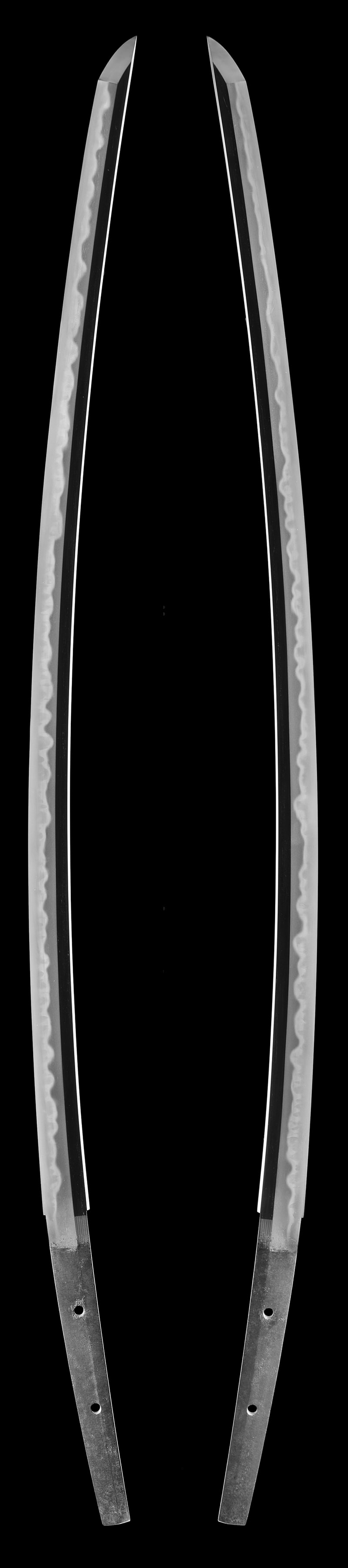
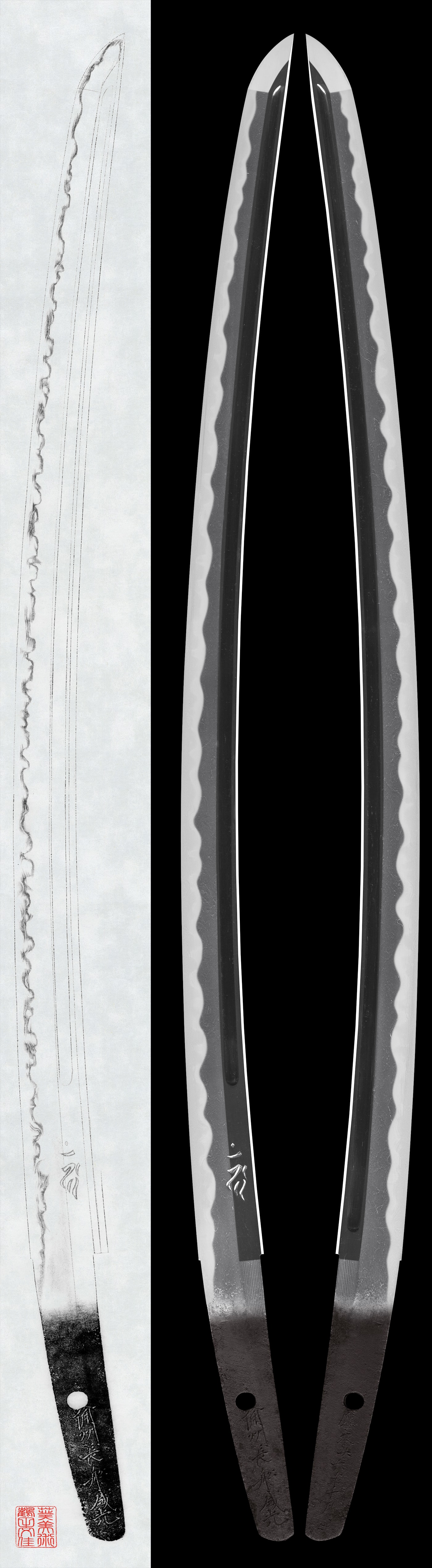
The earliest blade gathered under this Morikage attribution is a signed the published sources read as no later than the close of the period, the oldest-dating work of the Morikage, of which the surviving examples are held extremely few. The commentary states it directly, calling the piece "the most time-ascending work among those of the line's Morikage" (大宮派の盛景の作として最も時代の溯るものである), and adds that its and "also differ from the later -school and -name works" (地刃も後代の同派及び同名作とは異なる), closing that it is "of remarkable documentary value" (資料的にも頗る貴重である). Morikage is the representative smith of the group, a line the published sources trace to the remote ancestor Kunimori, said to have moved to from Inokuma in Yamashiro. On this short but distinguished record of six designated blades, signed and , the signed anchors the line's history while the rest carries it forward into the height.

His characteristic hand is a Sōden-Bizen temper read not as the clove-flower of mainstream but as a -bearing whose elements shift from blade to blade. The most-cited manner is a mixed with and a pointed tendency, and entering, adhering, fine running through the . On the wide-bodied the judges read this temper, a kuzure mixed with , as one in which, though unsigned, "Morikage's manner is well discerned" (無銘ながら盛景の一作風がよく窺われるものである), and they call the heavy, imposing build forceful in the hand. A pointed-blade tendency recurs across the range, running through the and surfacing again at the florid extreme, a quiet tell that sets the hand apart from the -dominant mainstream of his day.

The is the constant beneath that range, and on this code it is written from the standing . Over an mixed with , the grain tending to open and stand, he lays a and , with a rising on the signed and the alike. The signed keeps the older, finer measure, a with , set and the standing, its temper a with and intermingled, the bright and clear with , entering thickly and appearing here and there, the turning to a small round. On the later wide-bodied work the stands but the grain opens further, with and patches of , and the runs to a small round or a pointed tendency with . A is most often carried through both faces.

What the published sources stress is the breadth of the range. They describe Morikage's -iki as wide, taking in -dominant work, a changeful florid with and mixed in, work centred on angular , and a in an manner. The florid extreme is well seen on one unsigned whose temper is broad and -prevalent, as the main motif with and a pointed tendency lively and undulating, the heads of the tempered so high that part of them reach the -line, and there the commentary says "the group's character is well shown" (大宮派の特色がよく現れている), holding the blade sound in both and and of fine workmanship. The converted gathers the many-kinded temper of his middle range, , and pointed elements intermingled, of which the judges remark that "Morikage's points of interest are well displayed" (盛景の見どころがよく表示されている). A modern scholarly question hangs over the name itself: on shared workmanship and the reverse-chisel forms of his signature characters, the published sources record a theory, now widely entertained, that the long-signature Morikage may belong instead to an collateral line connected to Chikakage and Yoshikage, and that the smiths who cut bold, large two-character signatures may be the true hands. The matter is left open for further study.

The other face of this record is the attributed to him. These are wide-bodied, the shallow and the extended in the archetypal shape, the temper a kuzure or a mixed with and small , the attribution resting on era, school and the standing with its rather than on a single flamboyant trait. The published sources affirm them as Morikage by these features and place him by contrast, holding his bright and -mixed, sometimes subdued temper apart from the leading names. On the -signed , where the stands with and the runs to a with conspicuous , they call its thick in and frequent in , bright and clear, "the best-forged among his works" (同作中でも鍛えのよい一口である), so that the kinship to the front rank of Sōden-Bizen is read off the forging rather than asserted.

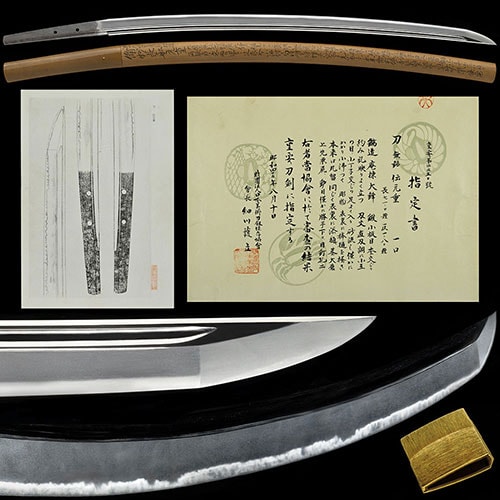
For the collector this Morikage is a thin but securely documented presence. The six blades gathered under the code are all at , signed and together, with no National Treasures and no Important Cultural Properties on this record. Its weight lies in the signed the commentary calls the oldest-dating Morikage and of remarkable documentary value, a blade carried in the Hisamatsu-Matsudaira house, the line of the Matsuyama . Because such designated blades stay in long-held collections and the signed early work is, by the judges' own account, of extremely few surviving examples, an Morikage of this rank comes to light only from time to time, and a privately held one is a notable thing for a collector to encounter, a securely documented witness to the broad and skilled hand at the head of the school and to its earliest dated reach into the late period.

Kantei

one broad-ranged Ōmiya hand read across registers: a signed late-Kamakura tachi that is the line's earliest dated work, a Nanbokuchō prime of nie-kuzure and gunome-midare over a midare-utsuri ji, and a florid wide-tempered chōji, all attributed by era, school and the reverse-chisel signature

Morikage is the representative smith of the group, a line the published sources trace to the remote ancestor Kunimori, said to have moved to from Inokuma in Yamashiro. This Morikage code is distinguished by its earliest piece, a signed the reads as no later than the close of the period and the oldest-dating work of the Morikage, surviving examples of which are held extremely few. His characteristic is a standing mixed with , with , and a , over which he tempers a -bearing whose elements range widely: a mixed with a pointed tendency, a florid wide-tempered on his showiest work, and the -dominant manner the published sources place at the center of his range. The runs to a small-round or pointed turnback with , a most often carved through. The published sources describe his range as broad, taking in -dominant work, and mixed in changeful , work centered on angular , and an -like , and record a modern theory that the long-signature Morikage may belong to an collateral line of Chikakage and Yoshikage, prompting re-examination of the old account.

Diagnostic discriminators

the published sources place a nie-kuzure manner mixed with gunome at the center of his range, a Sōden-Bizen temper set apart from the chōji-dominant Osafune mainstream of his day

a pointed-blade tendency runs through his gunome-midare and even his florid chōji, recurring as a quiet tell across registers alongside fine sunagashi and ko-nie

Observation by phase

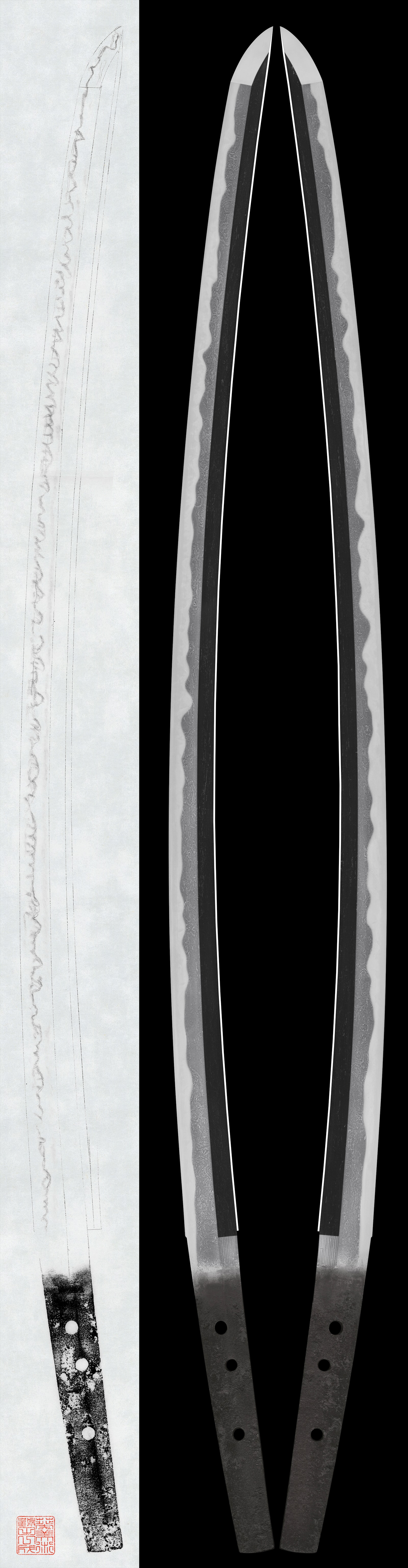
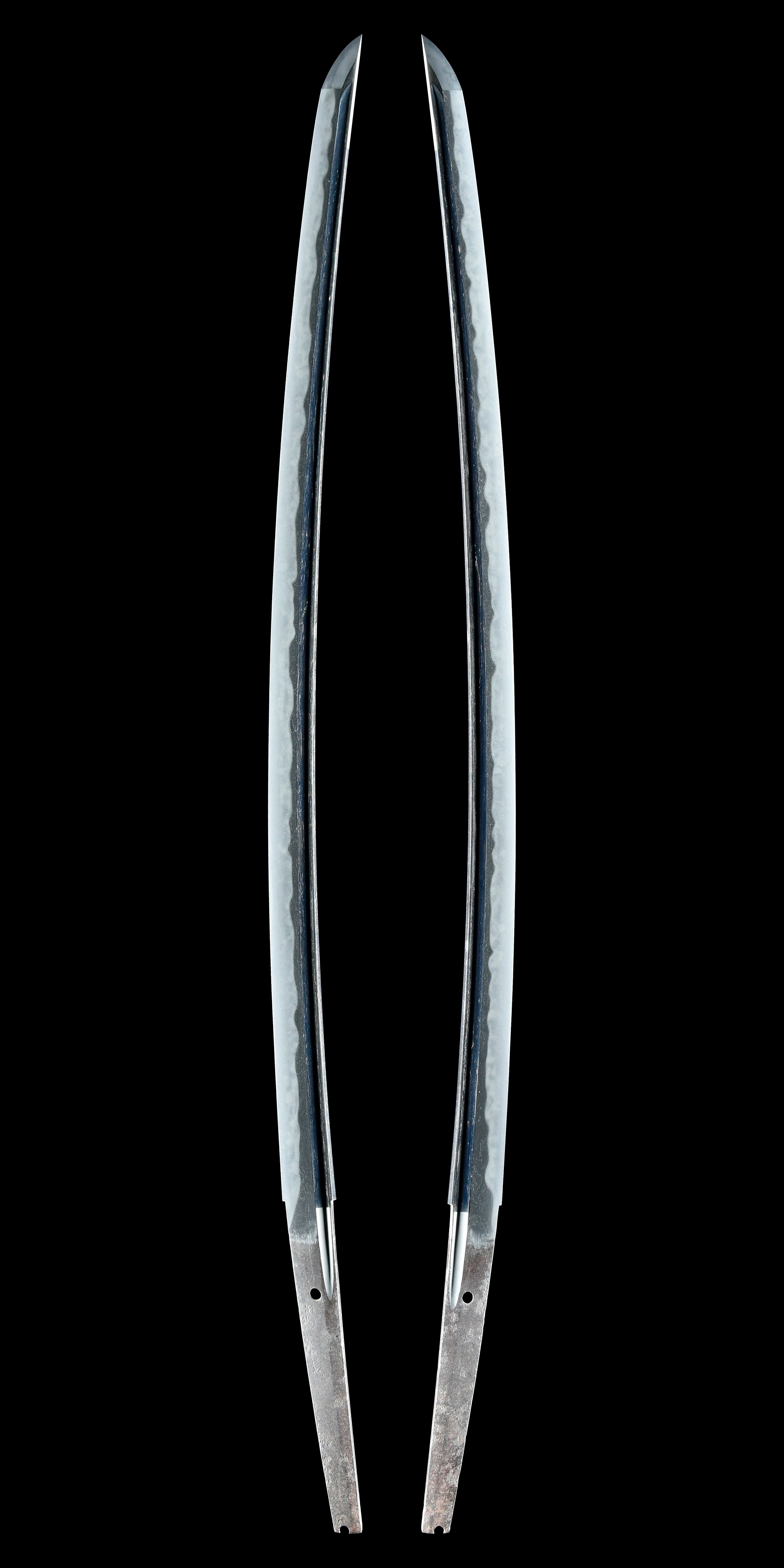
The signed late-Kamakura tachi (the line's earliest work)

The earliest face of this code is a signed the published sources read as no later than the close of the period, the oldest-dating work of the Morikage, of which surviving examples are held extremely few. Over a mixed with that tends to stand, adheres and a rises. The temper is a with and mixed in, the tending bright and clear with , entering thickly and appearing here and there, the turning in to a small round. The published sources note that both and differ from the later -school and -name works, and call the piece of remarkable documentary value. The two-character signature is cut with a bold, thick, large chisel near the tip of the .

Jigane 地鉄
Hamon 刃文
Bōshi 帽子

Nanbokuchō prime: nie-kuzure and gunome-midare (his characteristic hand)

His most-cited manner is a wide-bodied , the shallow and the extended, attributed to him as Sōden-Bizen. Over an mixed with , the grain tending to stand, adheres, enters and a rises. The temper is a mixed with and a pointed tendency, and entering, adhering, fine running through, the turning to a small round or a pointed tendency. The published sources read this mixed with as well exhibiting one of Morikage's manners, and call the wide-bodied, heavy-in-hand build imposing, its and kept in sound condition. A is carried through on both faces.

Sugata 姿
Jigane 地鉄
Hamon 刃文
Bōshi 帽子

Florid wide-tempered chōji-midare (the showy register)

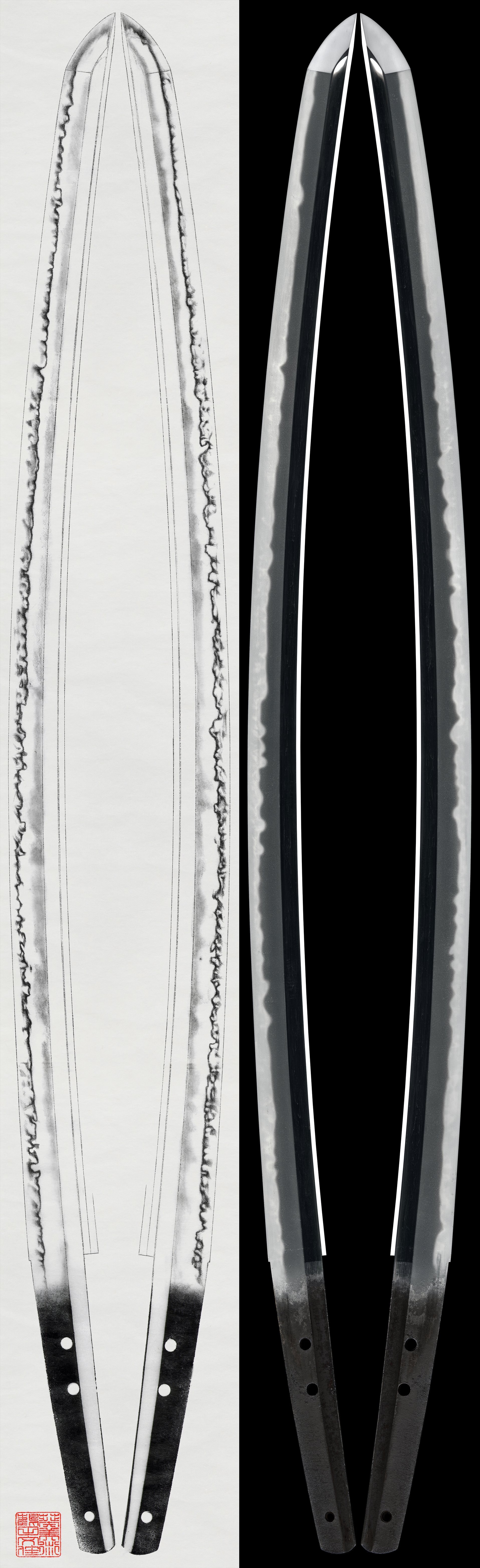
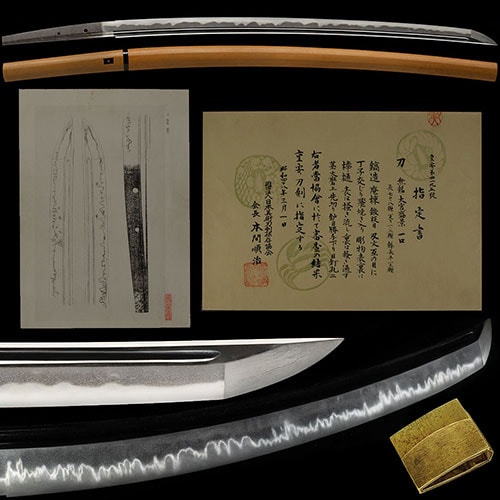
A distinctly showy register runs through his work: a wide-tempered -dominant . On the unsigned of this kind, over an mixed with -grain, set well and entering, a rises, and he tempers a broad, -prevalent as the main motif, and a pointed tendency mixed in, lively and undulating, and entering, adhering, applied. The published sources say the temper is so high that part of the -heads reach the -line, the lively set off well against the wide build, the piece sound in both and and of fine workmanship. They read these features as clearly exhibiting the group's character.

Sugata 姿
Jigane 地鉄
Hamon 刃文
Bōshi 帽子
Scholarship

The published sources set the Ōmiya line's origin with the remote ancestor Kunimori, who moved to Bizen from Inokuma Ōmiya in Yamashiro, and long treated the long-signature Morikage as its representative smith. In recent years, on shared workmanship and the reverse-chisel forms of his signature characters, a new theory holds that this Morikage is an Osafune collateral smith of the Chikakage and Yoshikage line, and that the smiths who cut bold large two-character signatures may be the true Ōmiya hands, prompting re-examination of the conventional view.

The published sources describe Morikage's range as broad, taking in nie-kuzure-dominant work, a changeful florid midare with chōji and gunome mixed in, work centered on angular gunome, and an Aoe-like suguha. On the converted naginata they read his many-kinded temper, chōji, ko-gunome, and pointed elements intermingled, as clearly exhibiting his points of interest, and call the heavy wide-kissaki build forceful.

Designations

Kokuhō—
Jūyō Bunkazai—
Jūyō Bijutsuhin—
Gyobutsu—
Tokubetsu Jūyō—
Jūyō Tōken6

Elite Standing

0.04 across 6 designated works

Top 23% among smiths

Provenance

1 documented provenance across certified works by Morikage

Provenance Standing

0 works held in elite collections across 1 documented provenances

Top 61% among smiths

Raw score: 1.94 / 10

Blade Forms

Distribution across 6 ranked works

Signatures

Signature types across 6 ranked works

Currently Available

Lineage

Morikage
Student
  1. 1.Kageyori景依5designated

Omiya School

Other artisans of the Omiya school

  1. 1.Morikage盛景3 for sale94designated
  2. 2.Morokage師景1designated
  3. 3.Morikage盛景1 for sale1designated
  4. 4.Morishige盛重1designated
  5. 5.Morishige盛重1 for sale1designated
  6. 6.Morishige盛重1designated
  7. 7.Nobuhide延秀1designated
  8. 8.Iemitsu家光1designated
  9. 9.Sukemori助盛1designated
  10. 10.Moritsugu盛繼3designated
  11. 11.Morishige盛重2 for sale2designated
  12. 12.Nobuzane信眞1designated