NihontoWatch MonNihontoWatchBETA
MarketEncyclopedia
NihontoWatch Mon

NihontoWatchBETA

Market
Encyclopedia
Overview·Kantei·Designations·Provenance·Blade Forms·Signatures·Lineage·School
OverviewKanteiDesignationsProvenanceBlade FormsSignaturesLineageSchool
  1. Schools
  2. Omiya
  3. Morikage

Omiya Morikage

盛景

Tokujū
Vol. 18, No. 55 · Tachi

Omiya Morikage

盛景

94 ranked works

ProvinceBizenEraEnbun (1356–1361)PeriodNanbokuchōSchoolOmiyaTraditionBizen-denGeneration1stFujishiroJo-jo sakuToko Taikan650(top 18%)TypeSwordsmithCodeMOR639
2Jūyō Bunkazai
1Jūyō Bijutsuhin
1Gyobutsu
3Tokubetsu Jūyō87Jūyō Tōken

Overview

Morikage worked at in through the height of the period, cutting long, dated signatures such as Bishū Morikage on , and across the , Jōji, Eiwa and Kakei years. He is the central figure of the group, a line traced in the published sources to the remote ancestor Kunimori, who is said to have moved to from Inokuma in Yamashiro Province in the period. Works by the early smiths Kunimori and Sukemori are extremely rare, and within the group it is Morikage who left by far the largest body of work and the highest reputation. The 's published commentary states it plainly, that among the smiths of the line in this period "Morikage left the largest number of works and is also the most skilled" (南北朝時代の同派中では盛景が最も作品が多く上手でもある). His Fujishiro grade is Jō-jō .

His characteristic hand is a Sōden-Bizen temper built not on the clove-flower of mainstream but on a base. Into that undulating line he sets , angular elements and a pointed tendency, with and entering well, adhering, and fine and running through the . The published sources read the temper as distinctly his own. On a converted- of rank they note that the does not become broadly undulating in the manner of Kanemitsu but keeps short foothills and somewhat angular crests, features that, they say, clearly articulate Morikage's individual character. A quiet tell recurs across his work: the tends to a subdued rather than the bright, showy temper of the leading names of his day.

The is the constant beneath that range. Over a standing mixed with , the grain often opening, he lays a fine , entering finely, patches of in the steel, and a that stands on his signed and unsigned blades alike. The strength of the in both and is what the judges call the mark of Sōden-Bizen in his work. The runs , finishing in a pointed or small-round turnback with , and the carvings range from a plain through to and a on the finest pieces.

What the published sources stress above all is the breadth of his range. They describe it as wide, encompassing work in which predominates, a florid and changeful with and mixed in, work centred on angular , and even a in an manner. The dated, signed pieces are the spine of this picture, since they fix his hand to specific years from the era onward, while the register stands at its quiet extreme. Of one signed of Eiwa 2 the commentary remarks that, at a glance, it presents "exactly the kind of manner that calls and the Unrui smiths to mind" (正に青江や雲類を想わせる直刃の作柄), holding it among the very best of his output and a blade that makes his diversity readily understood. A modern scholarly question hangs over the name itself: on shared workmanship and the reverse-chisel forms of his signature characters, the published sources record a theory, now widely entertained, that this long-signature Morikage may belong instead to an collateral line connected to Chikakage and Yoshikage, and that the smiths who cut bold, large two-character signatures may be the true hands. The matter is left open for further study.

The larger face of his surviving record is the attributed to him. These are wide-bodied, the shallow and the extended in the archetypal shape, the a mixed with and at times small . The published sources affirm them as unmistakable Sōden-Bizen, then place Morikage by contrast: his bright and subdued, -mixed temper hold him apart from Kanemitsu, whose temper is broader, and from the box-shaped large of the Chōgi group. Yet the kinship to Chōgi is real and acknowledged. The commentary on one , noting how the line tends to be overshadowed by Kanemitsu and Chōgi, says outright that "his workmanship resembles Chōgi and stands beside it" (作風は長義に似て並ぶ程である). He belongs, in short, to the front rank of Sōden-Bizen, a maker whose attribution rests on era, school and these careful distinctions rather than on a single flamboyant trait.

For the collector Morikage is an attainable name among the great hands, though one to be met with patience. He has no National Treasures; his designated record runs instead through two Important Cultural Properties, three and a long roll, ninety blades in the and tiers in all, with one further Jūyō Bijutsuhin from the prewar designations. His provenance is that of the houses, his blades carried in the Nabeshima of , the Uesugi, the Date and the Hisamatsu-Matsudaira, with one piece recorded in Imperial keeping. The published commentary singles out individual works in the strongest terms, calling one converted "an outstanding example among his works of that form" (同作薙刀中出色の一口). Because most designated blades stay in long-held collections, a signed and dated Morikage comes to light only from time to time, and a privately held one is a notable thing for a collector to encounter, a securely documented witness to the broad and skilled hand at the centre of the school.
Kantei

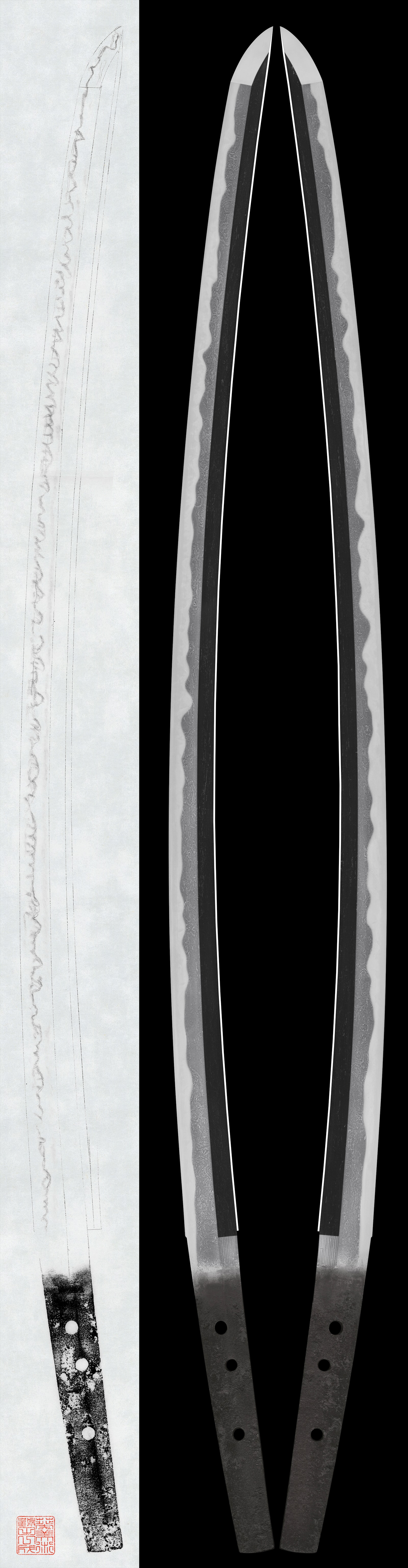
one broad-ranged Sōden-Bizen hand read across its registers: a ko-notare-based prime over a standing itame with midare-utsuri, a florid choji-and-gunome midare, and an Aoe-like suguha, set against the o-suriage mumei katana attributed to him from era and school

Morikage is the most prolific and most highly regarded smith of the group in the period, working at around the Enbun through Kakei eras and signing long dated signatures such as Bishū Morikage. The group is traditionally traced to the remote ancestor Kunimori, who is said to have moved to from Inokuma in Yamashiro, and Morikage has long been treated as its representative hand. His recognized core is a Sōden-Bizen manner over a standing mixed with , the grain tending to open, with , and a , on which he sets a -based temper mixed with , angular and pointed elements, and well in, and a that tends to a subdued , fine and throughout, the running to a pointed or small-round turnback. His range is wide: -dominant work, a florid -and-, work centered on angular , and even an -like . The published sources say his hand resembles Chōgi and stands beside it, while differing from Kanemitsu in a more subdued temper, and note a modern theory that the long-signature Morikage may belong to an collateral line of Chikakage and Yoshikage. The other face of his record is the attributed to him as mid- Sōden-Bizen.

Diagnostic discriminators

his characteristic temper is a ko-notare base rather than the chōji-dominant Osafune mainstream; the published sources read its foothills as short and its crests as somewhat angular, unlike the broadly undulating notare of Kanemitsu

unique vs Kanemitsu / Chōgi bright clear nioiguchi

Observation by phase

Ko-notare-based Sōden-Bizen (his characteristic hand)

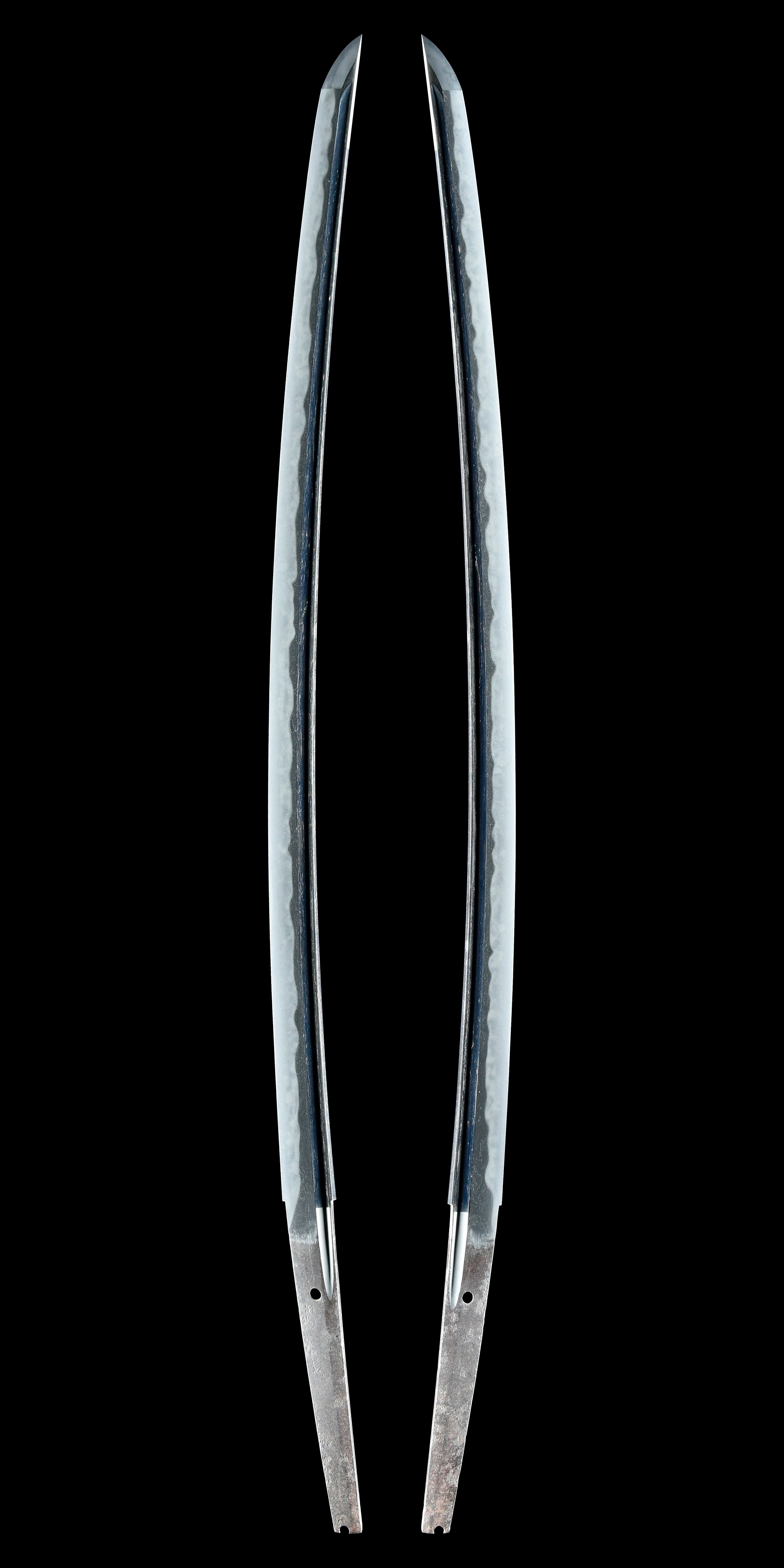
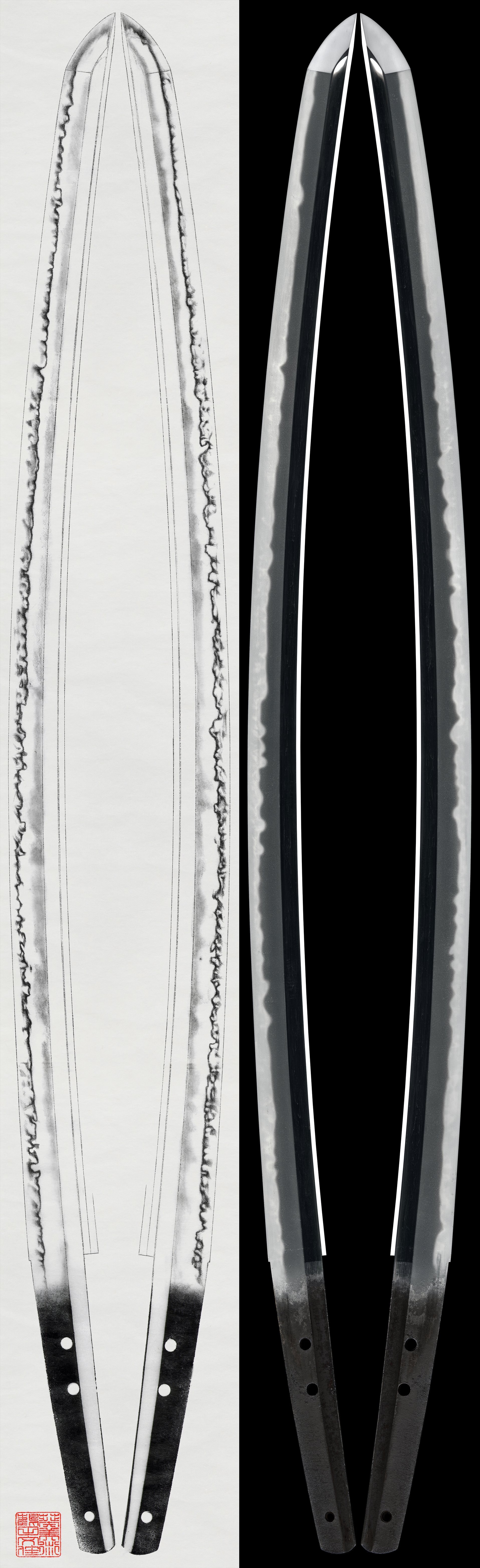
His characteristic and most-cited manner is a Sōden-Bizen temper built on . Over a standing mixed with , the grain often opening, he lays , and a , then tempers a base into which , angular elements and a pointed tendency are mixed, and entering well, adhering, the tending to a subdued , with fine and running through. The is , finishing in a pointed or small-round turnback with . The published sources call the strength of in both and the mark of Sōden-Bizen, and on the converted- they read the not as broadly undulating like Kanemitsu but short in the foothills with somewhat angular crests, saying these features clearly articulate Morikage's individual character. Carvings range from a plain to , and a on the finest pieces.

Sugata 姿
Jigane 地鉄
Hamon 刃文
Bōshi 帽子

Aoe-like suguha (the quiet register)

A distinct quiet register runs through his work: a -based temper that the published sources liken to and the Unrui smiths. On the signed of Eiwa 2, over an with and a standing-grain tendency, fine densely set, entering finely, patches of in the and a standing, he tempers a base with a feeling, and entering, the tight with , fine and applied and the tending to . At a glance, the published sources say, it presents exactly the kind of manner that calls and Unrui to mind, and they hold it among the very best of his output, a blade that makes his stylistic diversity readily understood.

Jigane 地鉄
Hamon 刃文
Bōshi 帽子

The o-suriage mumei katana (attribution from era and school)

The larger face of his surviving record is the attributed to him. These are wide-bodied, the shallow and the extended in the archetypal shape, over a large mixed with that stands overall, with and . The temper is a mixed with , in places small , entering, the tending to a subdued with , running through, the turning back with a pointed tendency, a carved through. The published sources affirm these as unmistakable Sōden-Bizen, but distinguish Morikage from Kanemitsu by a more subdued temper with intermingled and from the large box-shaped of the Chōgi group, so the attribution rests on era, school and these contrasts rather than on a single personal tell.

Sugata 姿
Jigane 地鉄
Hamon 刃文
Bōshi 帽子
Scholarship

The published sources set the Ōmiya line's origin with the remote ancestor Kunimori, who moved to Bizen from Inokuma Ōmiya in Yamashiro, and long treated the long-signature Morikage as its representative smith. In recent years, on shared workmanship and the reverse-chisel forms of his signature characters, a new theory holds that this Morikage is an Osafune collateral smith of the Chikakage and Yoshikage line, and that the smiths who cut bold large two-character signatures may be the true Ōmiya hands, prompting re-examination of the conventional view.

The published sources describe Morikage's range as broad, encompassing notare-dominant work, a florid changeful midare with chōji and gunome mixed in, work centered on angular gunome, and an Aoe-like suguha, and on one signed tachi they say it presents at a glance the suguha manner that calls Aoe and the Unrui smiths to mind.

Designations

Kokuhō—
Jūyō Bunkazai2
Jūyō Bijutsuhin1
Gyobutsu1
Tokubetsu Jūyō3
Jūyō Tōken87

Elite Standing

0.28 across 94 designated works

Top 9% among smiths

Provenance

9 documented provenances across certified works by Morikage

Provenance Standing

4 works held in elite collections across 9 documented provenances

Top 13% among smiths

Raw score: 2.28 / 10

Blade Forms

Distribution across 94 ranked works

Signatures

Signature types across 94 ranked works

Currently Available

Lineage

Morikage
Students (3)
  1. 1.Yoshikage義景3 for sale67designated
  2. 2.Morokage師景1designated
  3. 3.Morikage盛景1 for sale1designated

Omiya School

Other artisans of the Omiya school

  1. 1.Morikage盛景6designated
  2. 2.Morokage師景1designated
  3. 3.Morikage盛景1 for sale1designated
  4. 4.Morishige盛重1designated
  5. 5.Morishige盛重1 for sale1designated
  6. 6.Morishige盛重1designated
  7. 7.Nobuhide延秀1designated
  8. 8.Iemitsu家光1designated
  9. 9.Sukemori助盛1designated
  10. 10.Moritsugu盛繼3designated
  11. 11.Morishige盛重2 for sale2designated
  12. 12.Nobuzane信眞1designated