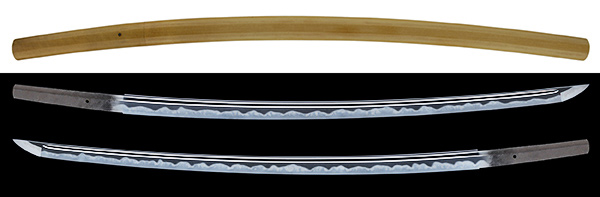
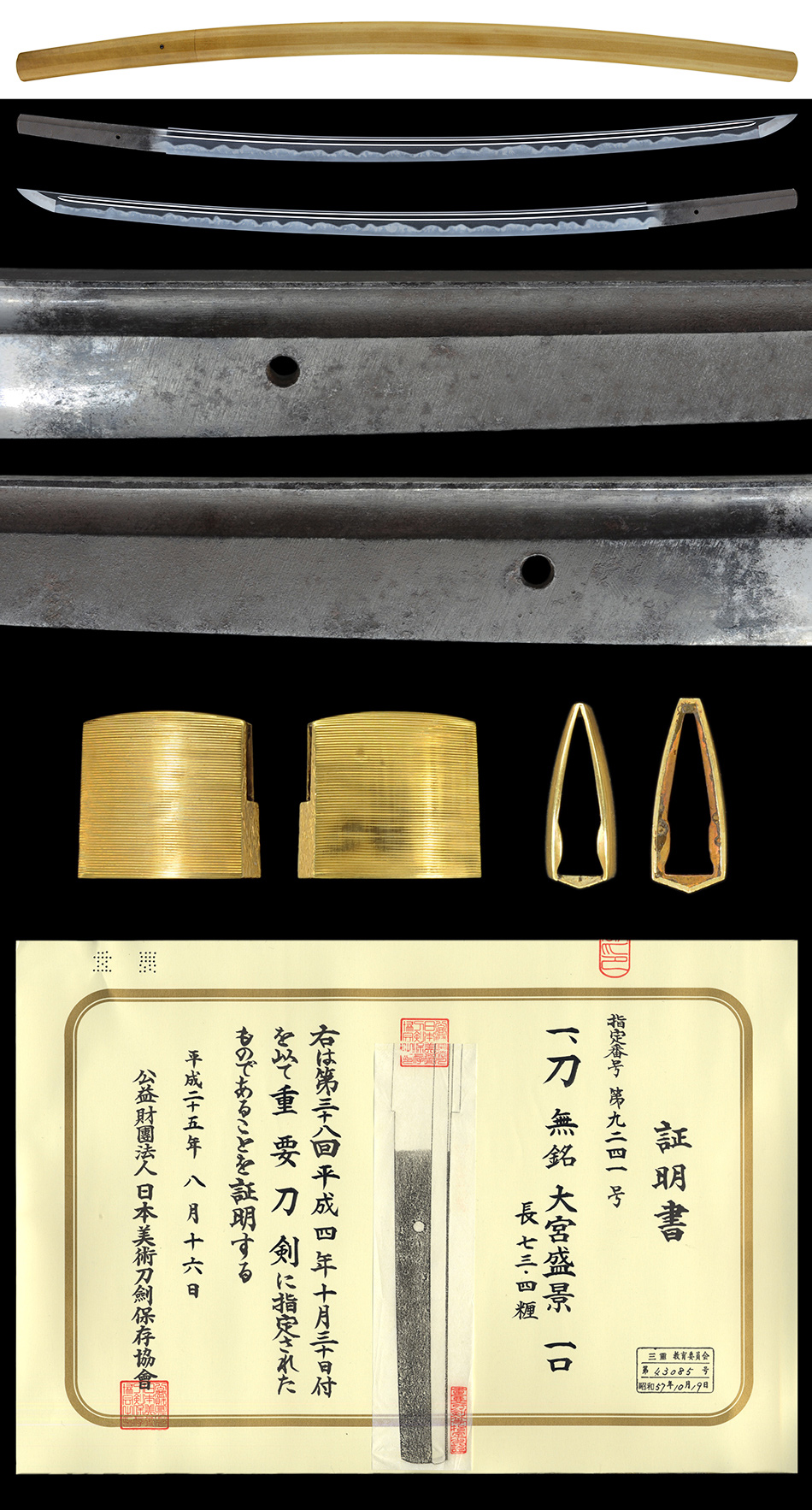
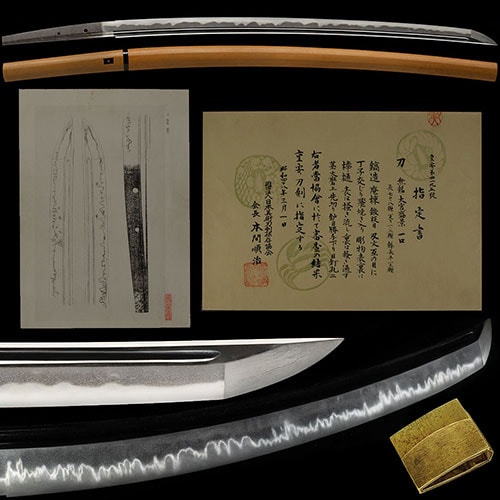
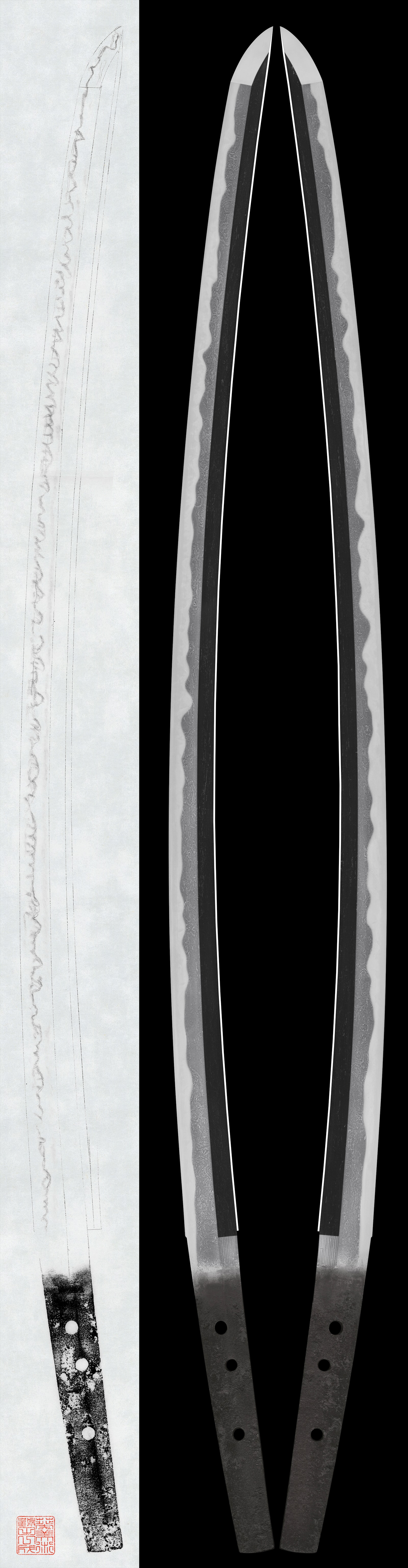
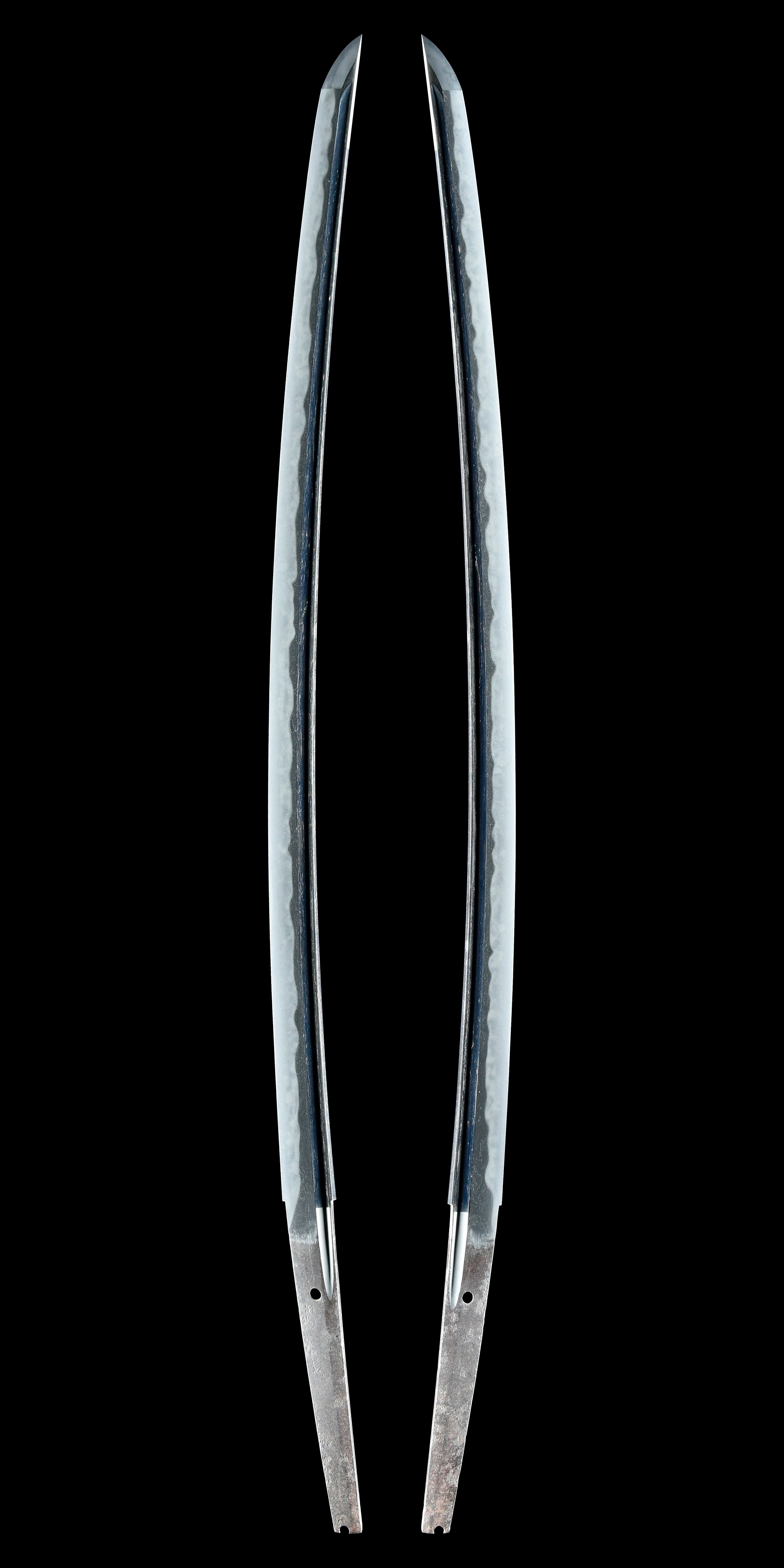
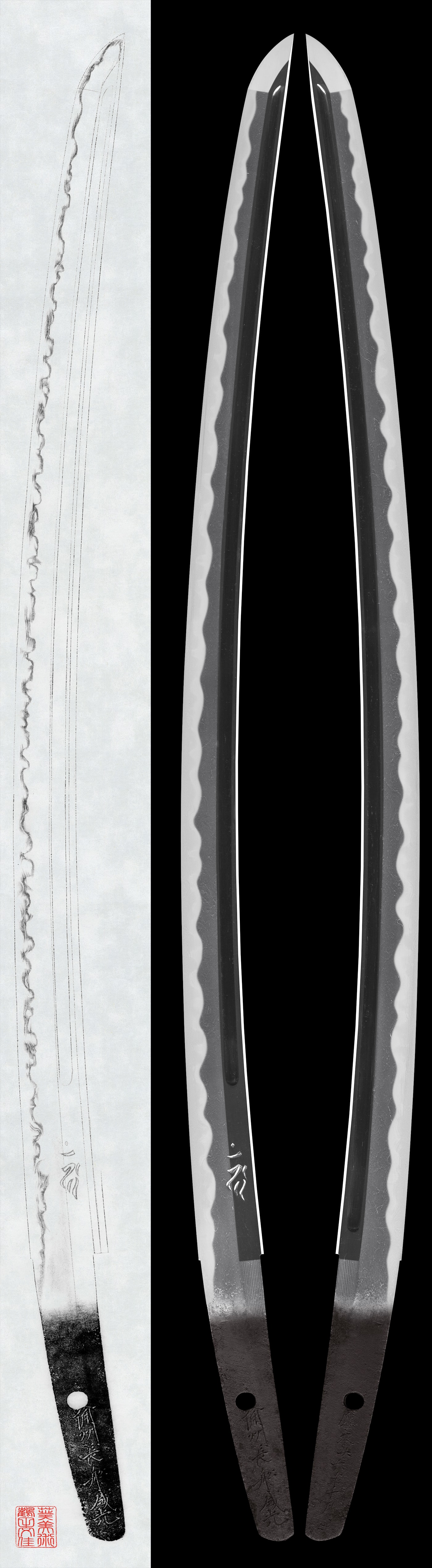
Morikage worked at Osafune in Bizen through the height of the Nanbokuchō period, cutting long, dated signatures such as Bishū Osafune Morikage on tachi, naginata and tantō across the Ōan, Jōji, Eiwa and Kakei years. He is the central figure of the Bizen Ōmiya group, a line traced in the published sources to the remote ancestor Kunimori, who is said to have moved to Bizen from Inokuma Ōmiya in Yamashiro Province in the Kamakura period. Works by the early Ōmiya smiths Kunimori and Sukemori are extremely rare, and within the Nanbokuchō group it is Morikage who left by far the largest body of work and the highest reputation. The NBTHK's published commentary states it plainly, that among the smiths of the line in this period "Morikage left the largest number of works and is also the most skilled"[[c:1]]. His Fujishiro grade is Jō-jō saku.
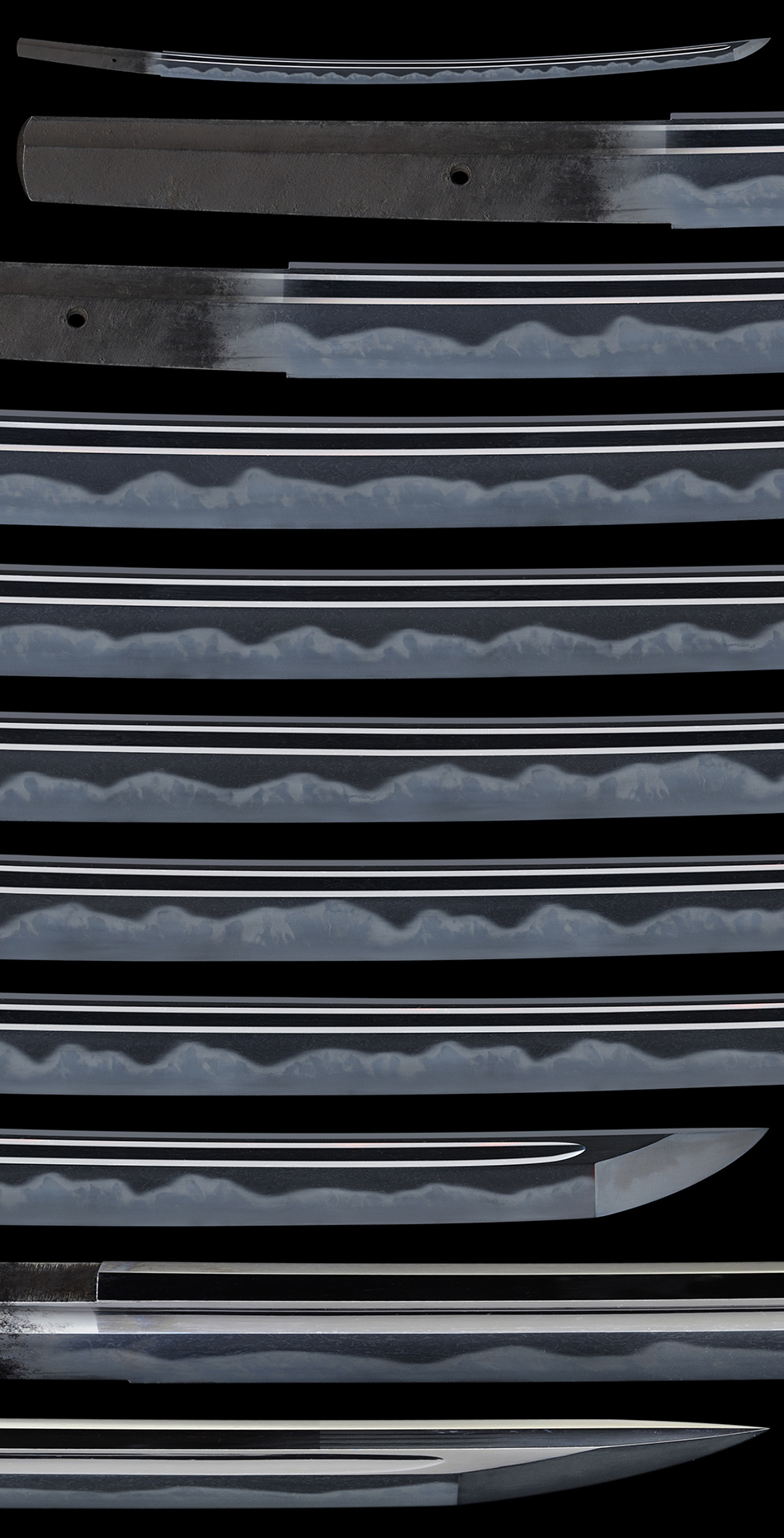
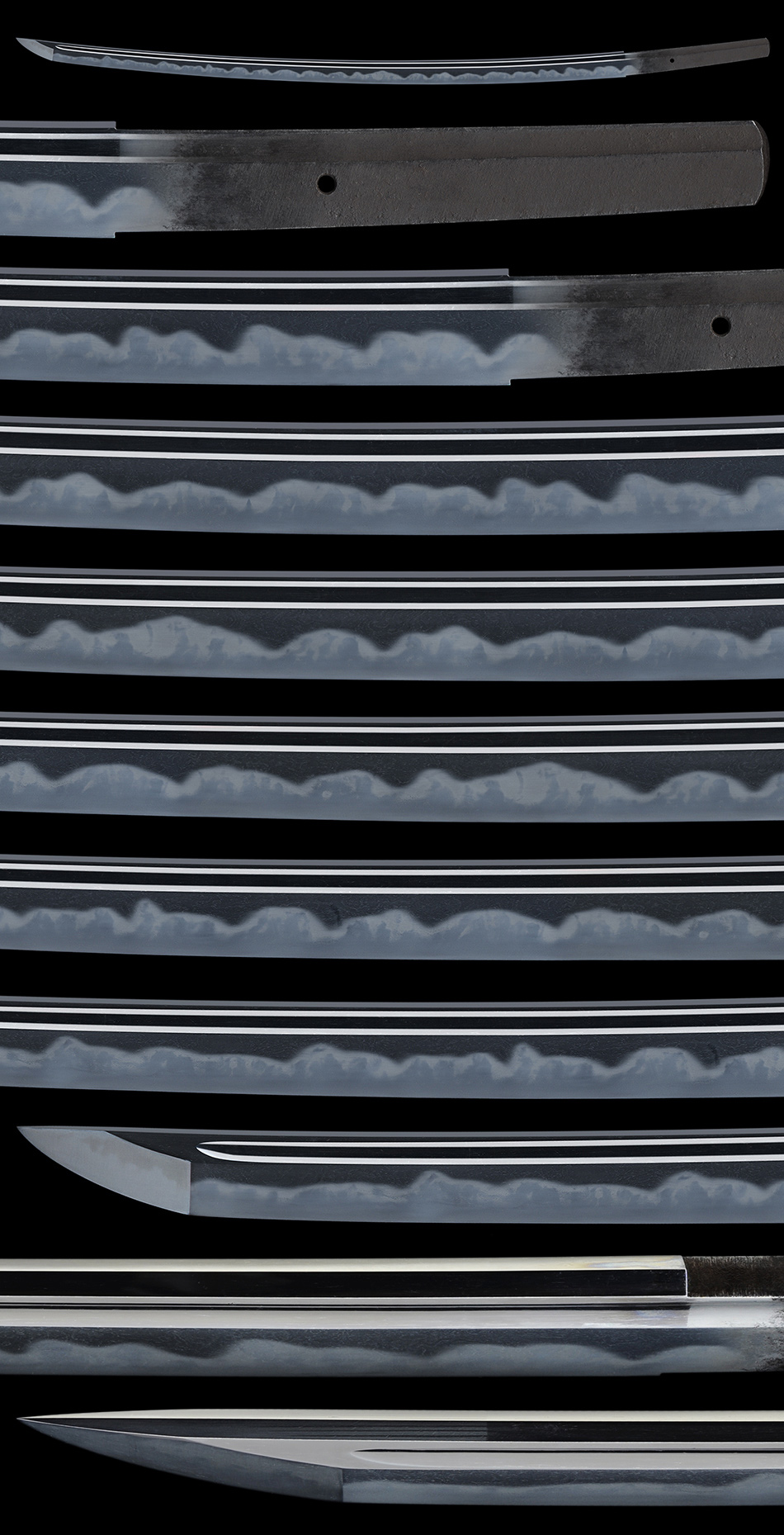
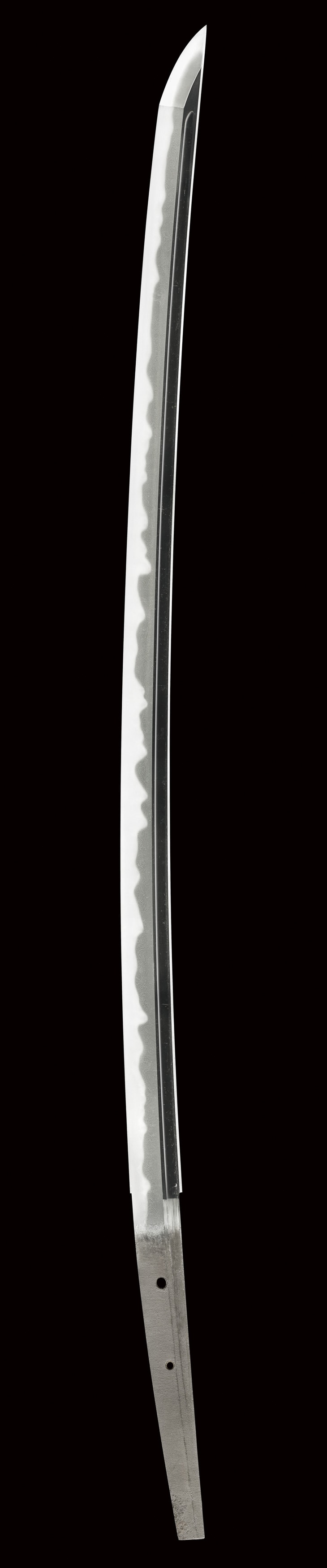
His characteristic hand is a Sōden-Bizen temper built not on the clove-flower of mainstream Osafune but on a ko-notare base. Into that undulating line he sets gunome, angular elements and a pointed tendency, with ashi and yō entering well, ko-nie adhering, and fine sunagashi and kinsuji running through the ha. The published sources read the temper as distinctly his own. On a converted-naginata of Tokubetsu Jūyō rank they note that the notare does not become broadly undulating in the manner of Kanemitsu but keeps short foothills and somewhat angular crests, features that, they say, clearly articulate Morikage's individual character. A quiet tell recurs across his work: the nioiguchi tends to a subdued shizumi rather than the bright, showy temper of the leading Osafune names of his day.
The jigane is the constant beneath that range. Over a standing itame mixed with mokume, the grain often opening, he lays a fine ji-nie, chikei entering finely, patches of jifu in the steel, and a Bizen midare-utsuri that stands on his signed and unsigned blades alike. The strength of the nie in both ji and ha is what the judges call the mark of Sōden-Bizen in his work. The bōshi runs midare-komi, finishing in a pointed or small-round turnback with hakikake, and the carvings range from a plain bō-hi through futasuji-hi to bonji and a sankō-ken on the finest pieces.
What the published sources stress above all is the breadth of his range. They describe it as wide, encompassing work in which notare predominates, a florid and changeful midare with chōji and gunome mixed in, work centred on angular gunome, and even a suguha in an Aoe manner. The dated, signed pieces are the spine of this picture, since they fix his hand to specific years from the Ōan era onward, while the suguha register stands at its quiet extreme. Of one signed tachi of Eiwa 2 the commentary remarks that, at a glance, it presents "exactly the kind of suguha manner that calls Aoe and the Unrui smiths to mind"[[c:2]], holding it among the very best of his output and a blade that makes his diversity readily understood. A modern scholarly question hangs over the name itself: on shared workmanship and the reverse-chisel forms of his signature characters, the published sources record a theory, now widely entertained, that this long-signature Morikage may belong instead to an Osafune collateral line connected to Chikakage and Yoshikage, and that the smiths who cut bold, large two-character signatures may be the true Ōmiya hands. The matter is left open for further study.
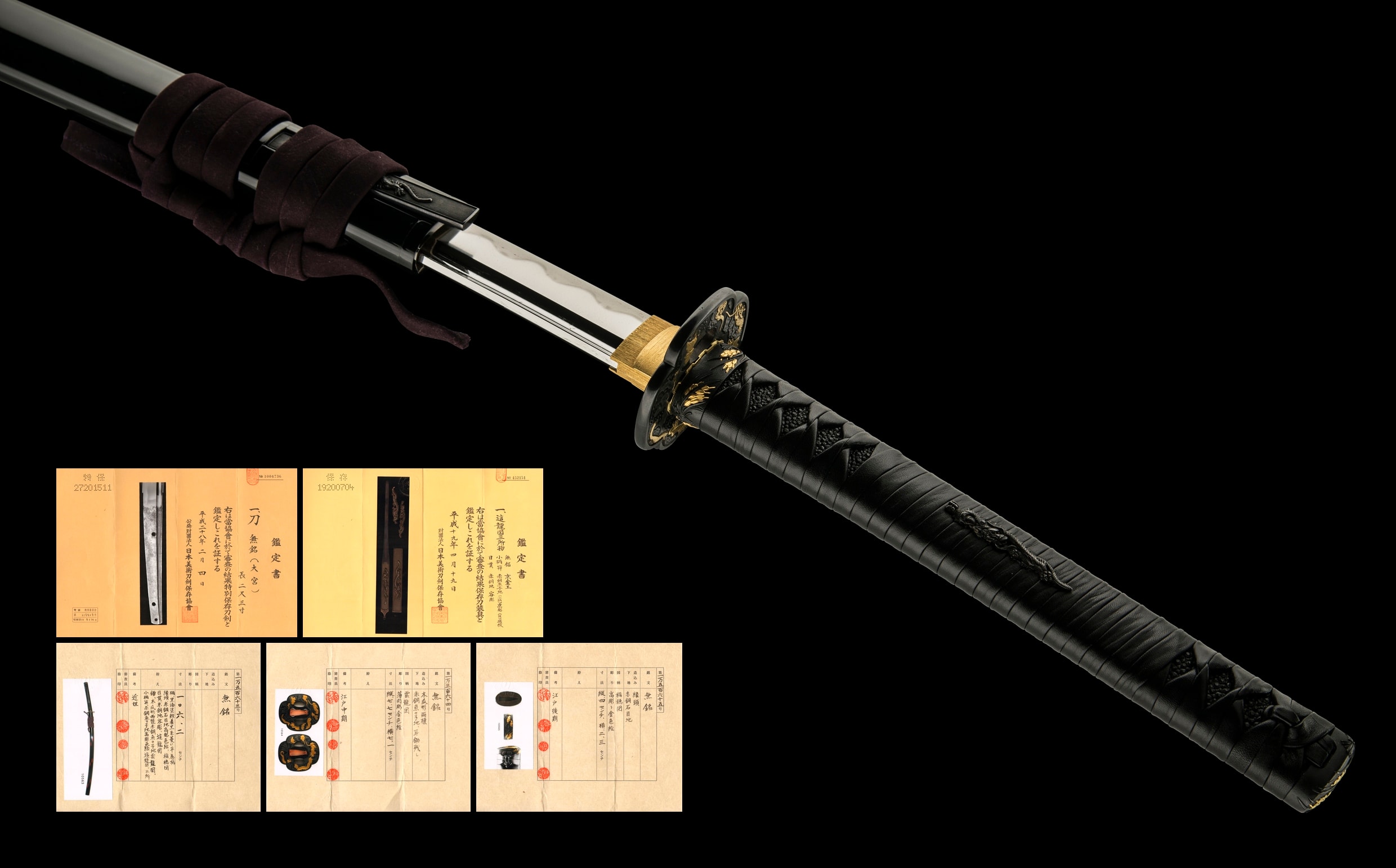
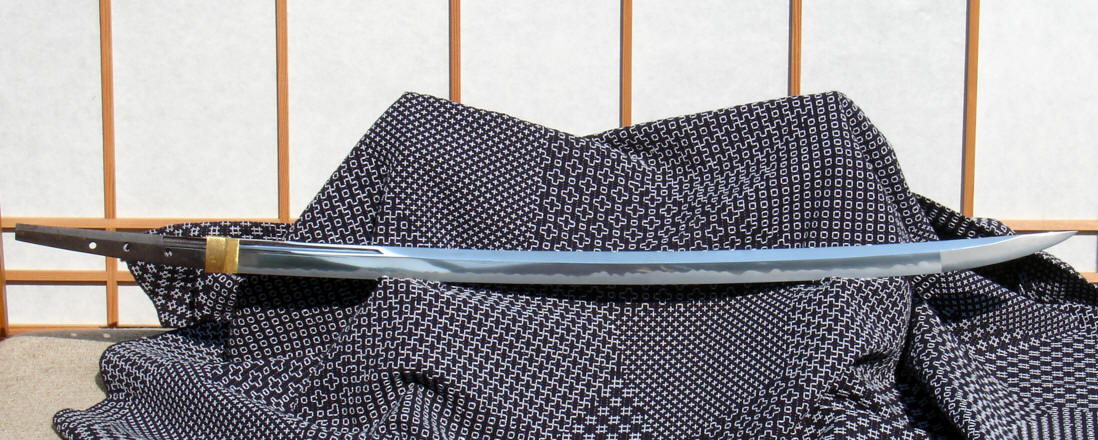
The larger face of his surviving record is the o-suriage mumei katana attributed to him. These are wide-bodied, the sori shallow and the kissaki extended in the archetypal Nanbokuchō shape, the hamon a ko-notare mixed with gunome and at times small chōji. The published sources affirm them as unmistakable Sōden-Bizen, then place Morikage by contrast: his bright midare-utsuri and subdued, chōji-mixed temper hold him apart from Kanemitsu, whose temper is broader, and from the box-shaped large midare of the Chōgi group. Yet the kinship to Chōgi is real and acknowledged. The commentary on one Tokubetsu Jūyō katana, noting how the Ōmiya line tends to be overshadowed by Kanemitsu and Chōgi, says outright that "his workmanship resembles Chōgi and stands beside it"[[c:3]]. He belongs, in short, to the front rank of Nanbokuchō Sōden-Bizen, a maker whose attribution rests on era, school and these careful distinctions rather than on a single flamboyant trait.
For the collector Morikage is an attainable name among the great Nanbokuchō hands, though one to be met with patience. He has no National Treasures; his designated record runs instead through two Important Cultural Properties, three Tokubetsu Jūyō and a long Jūyō roll, ninety blades in the Tokubetsu Jūyō and Jūyō tiers in all, with one further Jūyō Bijutsuhin from the prewar designations. His provenance is that of the daimyō houses, his blades carried in the Nabeshima of Hizen, the Uesugi, the Date and the Hisamatsu-Matsudaira, with one piece recorded in Imperial keeping. The published commentary singles out individual works in the strongest terms, calling one converted naginata "an outstanding example among his works of that form"[[c:4]]. Because most designated blades stay in long-held collections, a signed and dated Ōmiya Morikage comes to light only from time to time, and a privately held one is a notable thing for a collector to encounter, a securely documented witness to the broad and skilled hand at the centre of the Ōmiya school.