Sengoku Seki was an industry: smiths organized under their tutelary Kasuga shrine, arming the war bands of central Japan. Magoroku Kanemoto’s sanbonsugi and the finest Kanesada work prove quality survived inside mass production.
 NihontoWatchNihontoWatch
室町末期から新刀期にかけて、美濃には大道を名のる鍛冶が数工おります。 中でも陸奥守大道は有名で、経眼する年紀には天正2、4、13、18年があります。美濃国志津三郎兼氏九代の孫と称し、初銘を兼道と切りはじめ関の地で鍛刀する、永禄12年正親町天皇より「大」の字を賜り、「大兼道」と銘し、その後陸奥守を受領し「大道」と改銘する。 また大道は三品派の祖として三品四兄弟の父としても広く知られております。長兄が伊賀守金道、次兄が和泉守来金道、三男が京初代丹波守吉道、四男が越中守正俊です。 さて、本作ですが元先差がつかず、平づくり庵棟、反りもころあい地は板目肌立ち、峯と刃先は柾目心です。 匂いがちな刃中は砂流し、葉良く働き切先は直ぐに中丸で返っています。 刀身は古研ぎの為、多少眠くヒケ、スレ等も少しありますが、鑑賞には十分な状態です。 拵えは全くの新規作成です。 特筆すべきは、本漆の乾き石目特色塗です。これだけでもかなり値段が張ります。 色は暗紫色(赤ワインのような色合い)で本漆の為経年で落ち着いた色に変化していくので楽しみです。 居合稽古の前差しとして、又はお茶会など和装時に差すのも良いでしょう。 別途、三万円にて研ぎ上げ致します。
NihontoWatchOffered by Token Hasegawa
This piece has sold
Get an email when a new Seki Daido piece hits the market.
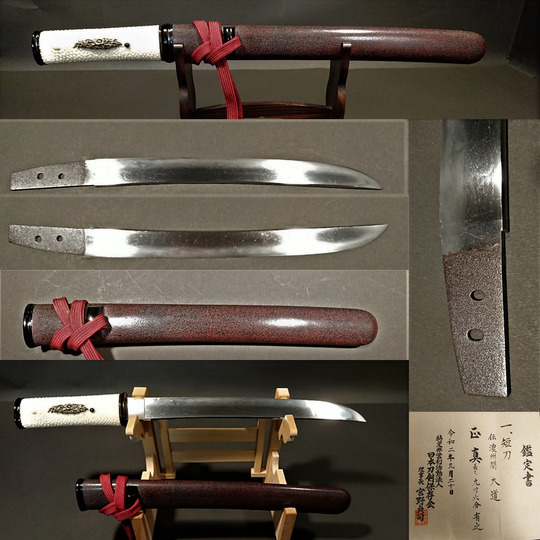
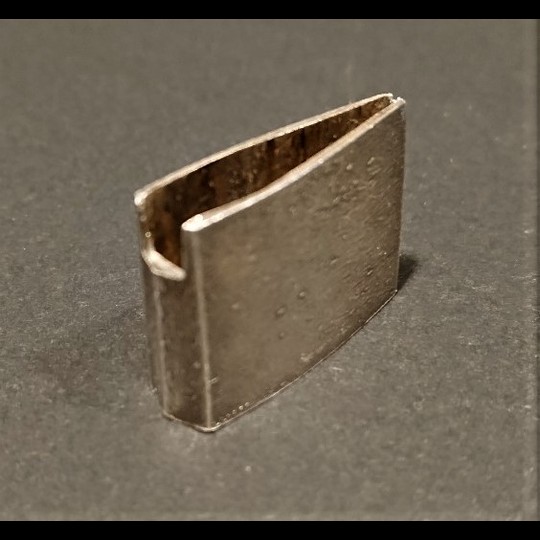
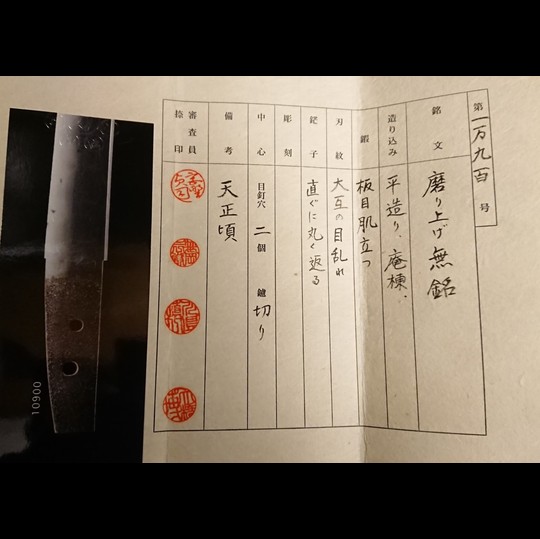
As written by the shop
Mino-den · Mino · around 1573-1592
2 pieces on the market now
From the end of the Muromachi period into the early Shintō era, several Mino swordsmiths bore the name Daidō. The most prominent among them was Mutsu no Kami Daidō, whose signed and dated works survive from the Tenshō era, with recorded dates including Tenshō 2 (1574), 4 (1576), 13, and 18 (1590). Other smiths of the name carried various court titles -- Izu no Kami, Mikawa no Kami, Kawachi no Kami, and Shinano no Kami -- while still others signed without titles as "Seki-jū Daidō," "Gifu-jū Daidō," or "Heianjō-jū Daidō." Among the Mino smiths of this period, Mutsu no Kami Daidō is regarded as particularly highly skilled, "standing alongside Wakasa no Kami Ujifusa."
Daidō's forging typically shows ko-itame mixed with masame, with fine ji-nie well applied. His hamon is characteristically an ō-notare-based ko-gunome-midare, or a shallow notare mixed with ko-gunome, hakoba, and togari-ba; the nioiguchi is consistently described as tight and clear, showing lively variation, with ko-ashi and yō and adhering ko-nie. His bōshi tends toward midare-komi, turning back in a Jizō-like manner or with a pointed tendency. His sugata favors wide mihaba with imposing, dignified constructions, and he produced both katana and wakizashi in hira-zukuri. The carvings found on certain works -- including renderings of "Namu Myōhō Renge Kyō" and Kurikara -- are noted as "superb."
The NBTHK consistently describes Daidō's workmanship in jigane and hamon as "excellent," with blades that are kenzen and of especially fine quality among his oeuvre. His technical ability is characterized as "extraordinary," and the dated inscriptions on his works -- particularly the Minamoto surname and Tenshō-era dates -- are valued as significant documentary records of late-Muromachi swordsmithing in Mino Province.
Where Daido stands among comparable artisans: across all of nihontō, and within tradition, era, and period. The tiers (Foremost · Leading · Major · Notable) weigh official designations from the NBTHK and Japan's Agency for Cultural Affairs, together with historical honors of lasting repute such as the Sansaku and Meibutsu-chō.
Select a lens to see how it's measured.
Years he was demonstrably active, proven by signed-and-dated blades
Mino-den · Mino
129 pieces on the market now
Seki (関), in Mino Province, grew from two roots set down in the Nanbokuchō period and rose to become the great center of mass sword production in the late medieval age. The published sources trace the wellspring of Mino swordmaking to Kinju (whose name the commentary also reads Kaneshige), counted since antiquity among the Masamune Jittetsu, the ten disciples of Sōshū Masamune, and to Kaneuji of the Shizu line; the Kokon Meizukushi records Kinju as a native of Tsuruga in Echizen who "crossed over to Seki and resided there," carrying the Sōshū-den manner east. Beneath that Sagami inheritance lay a Yamato foundation, legible in the Tegai descent of the Seki Zensada line through Kaneyoshi, so that the Mino-den the Seki workshops forged stands as a fusion of Yamato grain and Sōshū activity in nie. From this Nanbokuchō founding the name multiplied across the Muromachi period into Sue-Seki, the last and largest body of the tradition; its representative masters at the close of the old-sword age were Magoroku Kanemoto, famed for the sanbonsugi, and Izumi no Kami Kanesada, the smith called Nosada, while the Kanefusa, Ujifusa and Daidō hands worked beside them and the move of Wakasa no Kami Ujifusa to Kiyosu carried the Mino body to the threshold of Owari shintō. A common Mino vocabulary binds the Seki body, however widely its members range. The forging is an itame that stands and runs to masame, often mixed with mokume and nagare, over which rises the cool whitish shirake-utsuri of Mino steel rather than the bright midare-utsuri of Bizen; this pale, standing jigane is the constant tell the judges read first, present alike on Kinju's Nanbokuchō katana, Kaneyoshi's Ōei tachi and Nosada's late-Muromachi blades. Over it the smiths temper gunome into which the pointed togariba of Mino enters, with ko-nie clinging to a tight nioiguchi, ashi and yō, and sunagashi streaming through; the bōshi answers in midare-komi turning to a pointed or jizō-cast ko-maru swept with hakikake. From this shared grammar the individual hands diverge.
Kanemoto fixed the regular three-cedar sanbonsugi of pointed teeth; Kanefusa devised the rounded-head, constricted-waist "Kanefusa midare"; Kinju and the early founders held a calmer, rounder gunome away from the restless Shizu line, their work laid with thicker ji-nie and dry, standing grain. The late masters carried the manner to a higher finish: Nosada wove togariba among rounder forms for a broader temper than Kanemoto's one-sided file, and turned at times to a slender Rai-styled suguha with a hidden gunome; Kaneyoshi held instead to a cool ito-suguha, the disciplined Yamato face of late Seki, lightly broken with ko-gunome. A collector seeks Seki because it is the connoisseur's ground for reading Mino-den across a vast body of signed and attributed work. The kantei runs through the jigane first: the standing, masame-leaning itame and the whitish shirake separate a Seki blade from Bizen and Yamashiro, after which the pointed togariba, the dry nie, and the pointed or jizō bōshi confirm the province; the discriminations the judges draw, Kinju held apart from Shizu by his rounder gunome, Nosada parted from Kanemoto by his breadth, give the eye its anchors. Within the school the standing of the best members is settled: Magoroku Kanemoto for the sanbonsugi, Nosada whom the swordbooks call simply "an excellent master" and the most accomplished of the several Kanesada hands, and the early Kinju as a rare and precious founding name, his record running through the Jūyō tier with the signed pieces few and the long blades attributed den. Signature works carry real provenance: a Kinju tantō presented to the Tokugawa shogunal house in 1679, a Nosada katana borne by a chief retainer of the Kii Tokugawa and a tachi forged for the father of Takeda Shingen, a Kaneyoshi tachi transmitted in the Chikuzen Kuroda family. Beyond connoisseurship, Seki's blades earned a battlefield reputation for cutting; the full hiraniku and stout build of the Sue-Seki katana, made to sever, set the wazamono standing that made Mino the working sword of its age. Learn more →
| Smith | Era | Designated |
|---|---|---|
| Kinju金重 | 1340-1346 | 42 |
| Kaneyuki金行 | 1350-1352 | 10 |
| Kanekore兼之 | 1504-1555 | 7 |
| Kanenori兼法 | 1579-1615 | 5 |
| Nagasada永貞 | 1862-1866 | 5 |
Mino in the Muromachi period
Sengoku Seki was an industry: smiths organized under their tutelary Kasuga shrine, arming the war bands of central Japan. Magoroku Kanemoto’s sanbonsugi and the finest Kanesada work prove quality survived inside mass production.