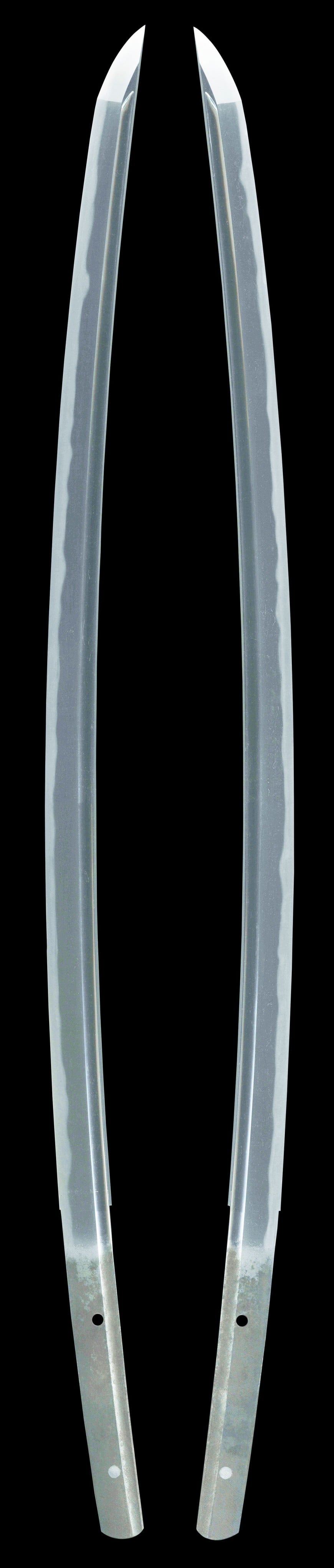
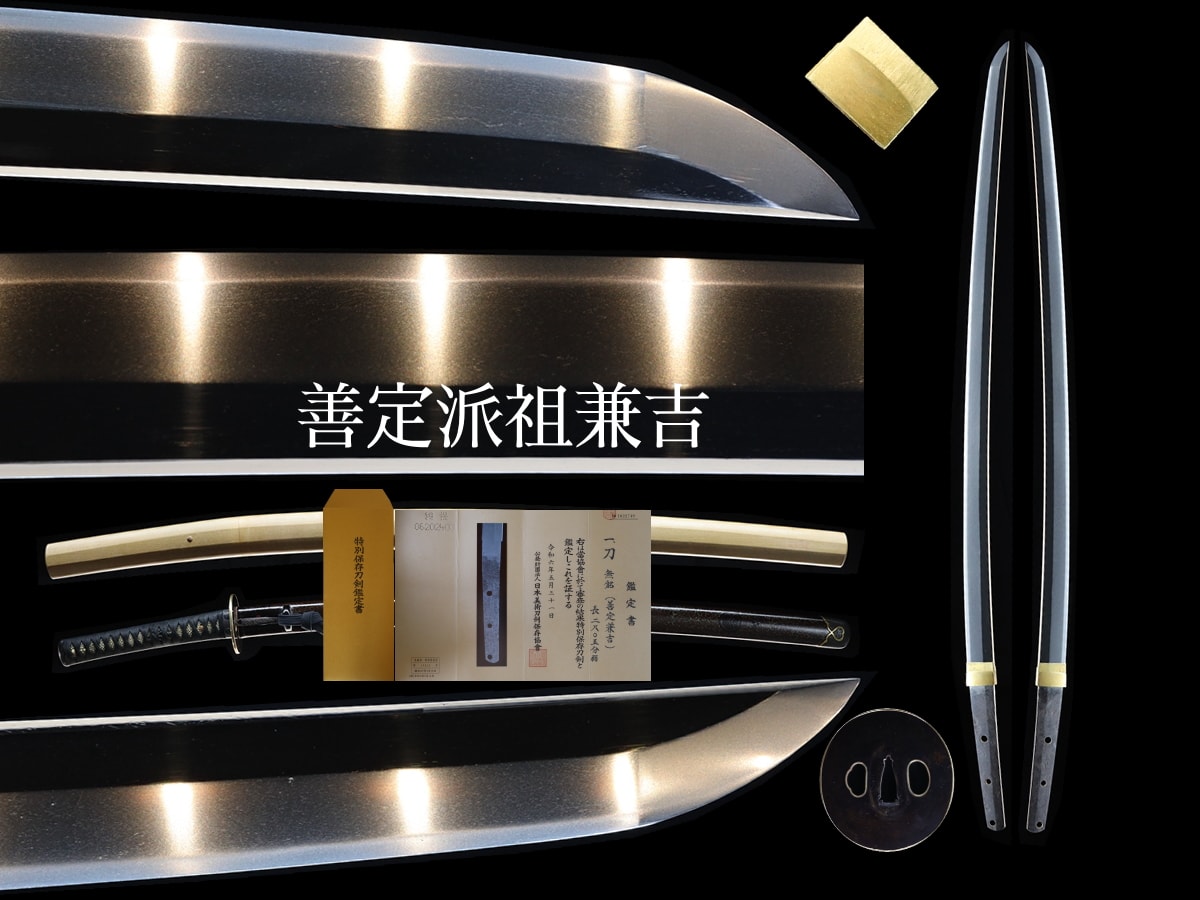
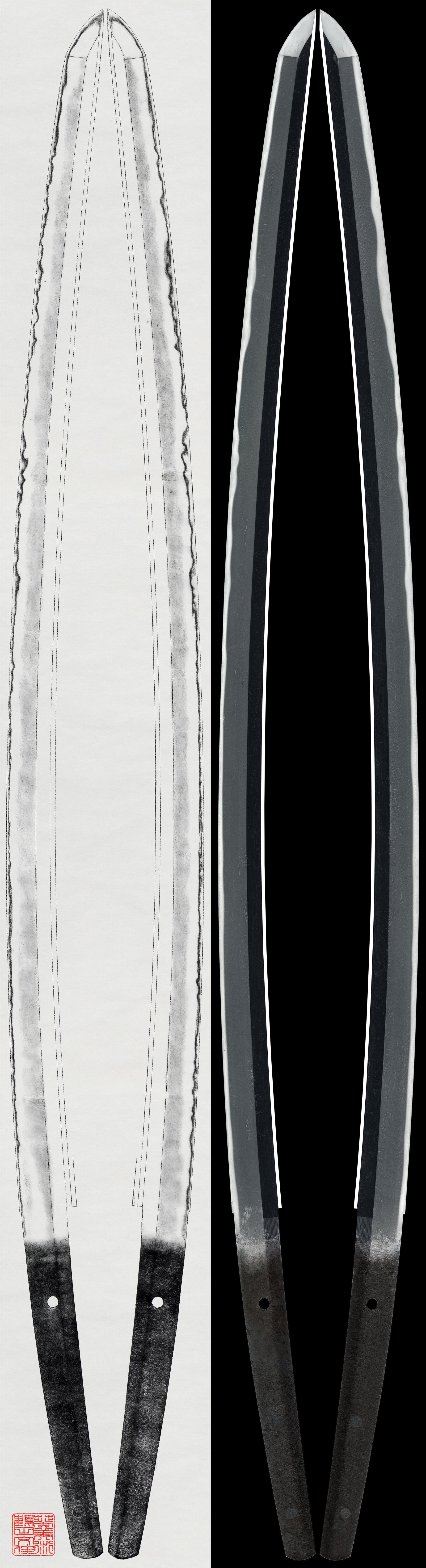
Kaneyuki of is known entirely through unsigned blades, nine of which have passed between 1963 and 2018, the earliest a greatly shortened once a of more than three , the most recent a wide, imposing of the shape. Not one of his works carries a date, and securely signed examples are so rare that the published sources treat them as all but absent; the smith is reached only through attribution. He was a disciple of the first-generation Kaneshige, named in the references as either Kaneshige's younger brother or his son, and the references place the two of them, with Kaneuji, at the head of swordmaking, calling Kaneshige one who "together with Kaneuji became a fountainhead of smithing." The sources, citing the Kokon Meizukushi, describe Kaneshige as a man of "the Buddhist name Dōa, a native and resident of Tsuruga in , an outstanding master who crossed into Seki and settled there," and from the Kōzan they recover two of his dated Jōji 2 (1363), the only fixed point for the group's active period. Kaneyuki belongs, then, to the founding generation of Seki, before the mainstream of the later smiths took shape.
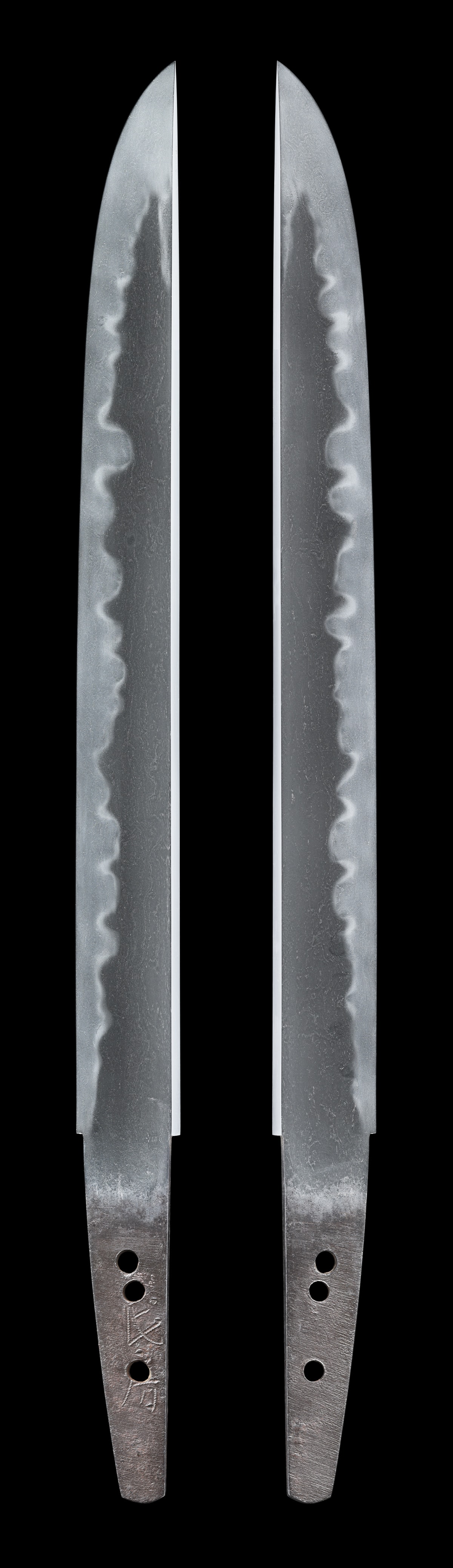
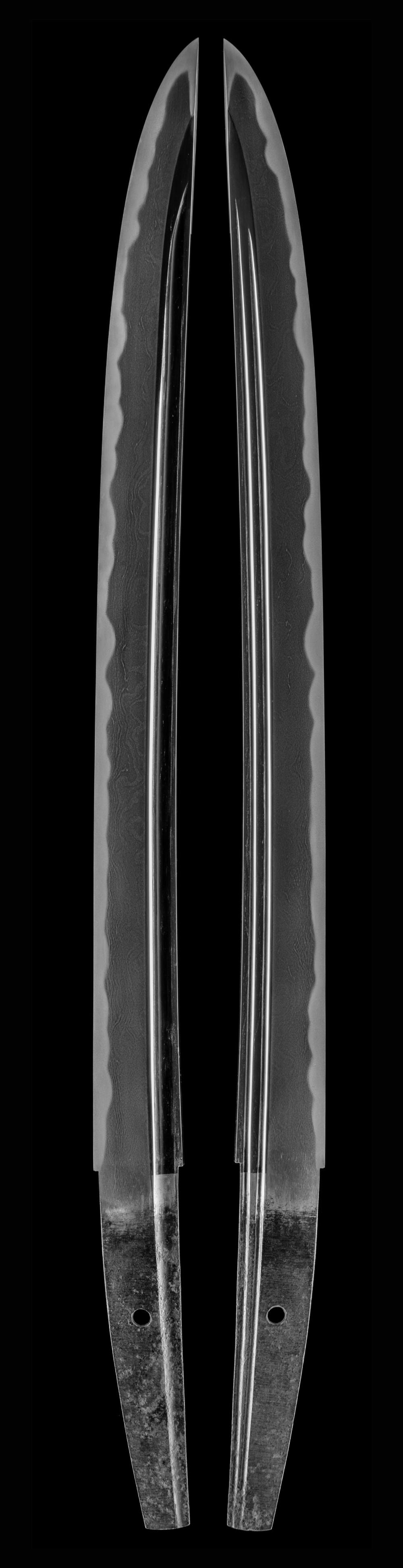
The hand that the references reconstruct for him is a - manner deliberately held apart from the line. Over an that flows and stands, and on several blades inclines openly to , he tempers round-headed and , mixed with and a low and linked in a comparatively calm sequence. The published sources name this directly: blades long appraised as Kaneshige or Kaneyuki "emphasize round-headed and as the main theme" and as a rule "show a comparatively gentle manner of tempering." Across the temper run , and fine , the clear, with entering and the fraying in places into . The answers the and , sweeping in to a small , here and there entering . It is a quiet, controlled by standards, and the references make that calm a positive trait of the group rather than a limitation.
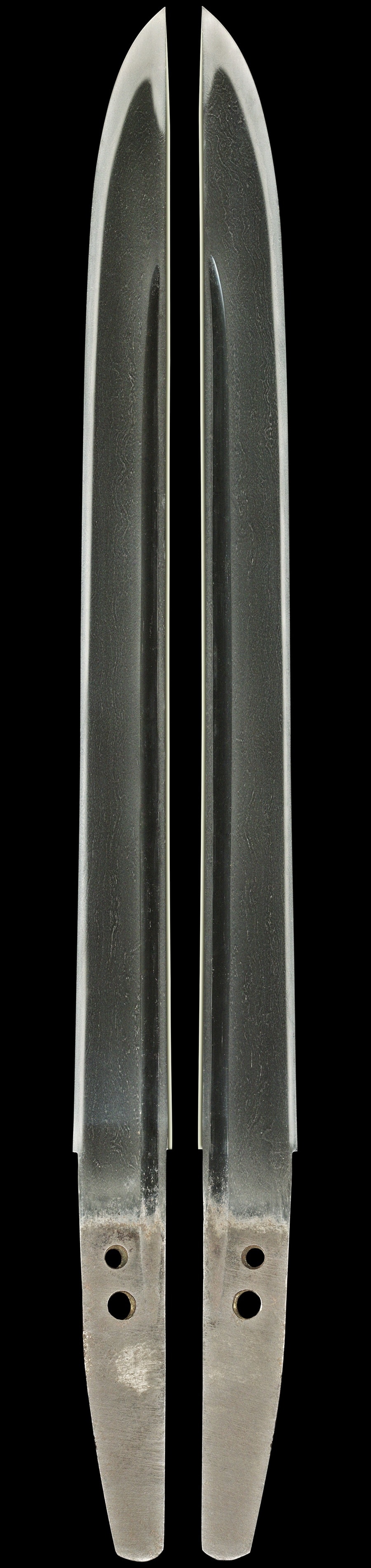
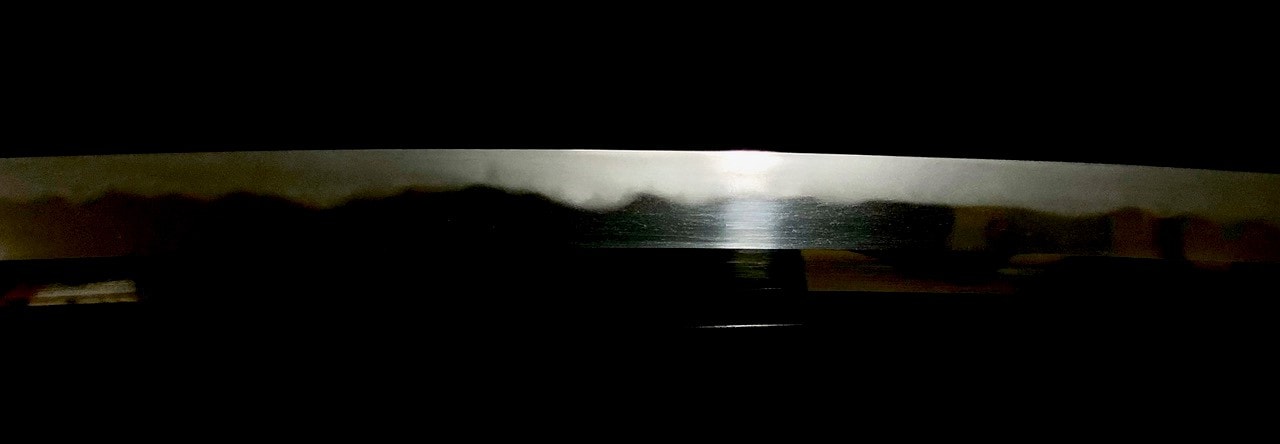
The carries the rest of the recognition. The flowing, standing that inclines to is what the published sources hold up as the appreciation point shared across the Kaneshige group, and it is on this that an unsigned blade is sorted to Kaneyuki rather than to . adheres throughout, and where a reflection appears it is the dim of the -, not the bright of ; the two early show a faint whitish , while on the broad late the brightens to thick, fine with frequent and a faint plain , one showing a -like effect. Running through all of it is what the references call a "northern-provinces temperament" read in the forging, a slightly rustic flavor they attribute to Kaneshige's origin carried into steel, and a they judge frankly as of a rougher make than Kaneshige's, with a that does not reach his. The honesty of that judgment is part of the attribution: Kaneyuki is the calmer, plainer hand of the founding Seki generation.
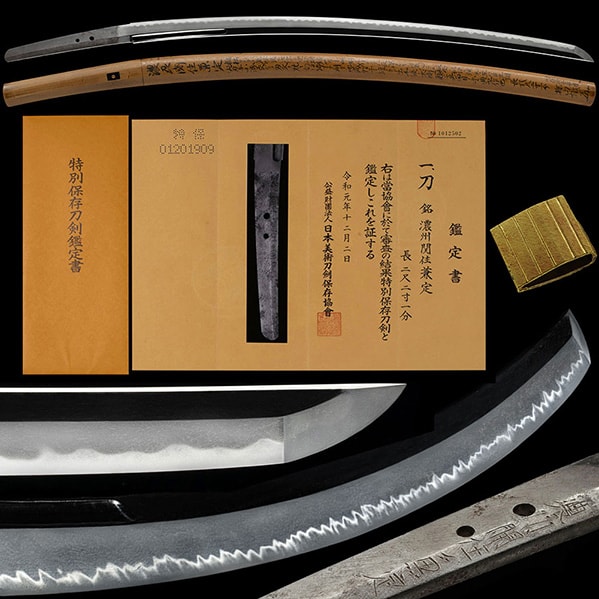
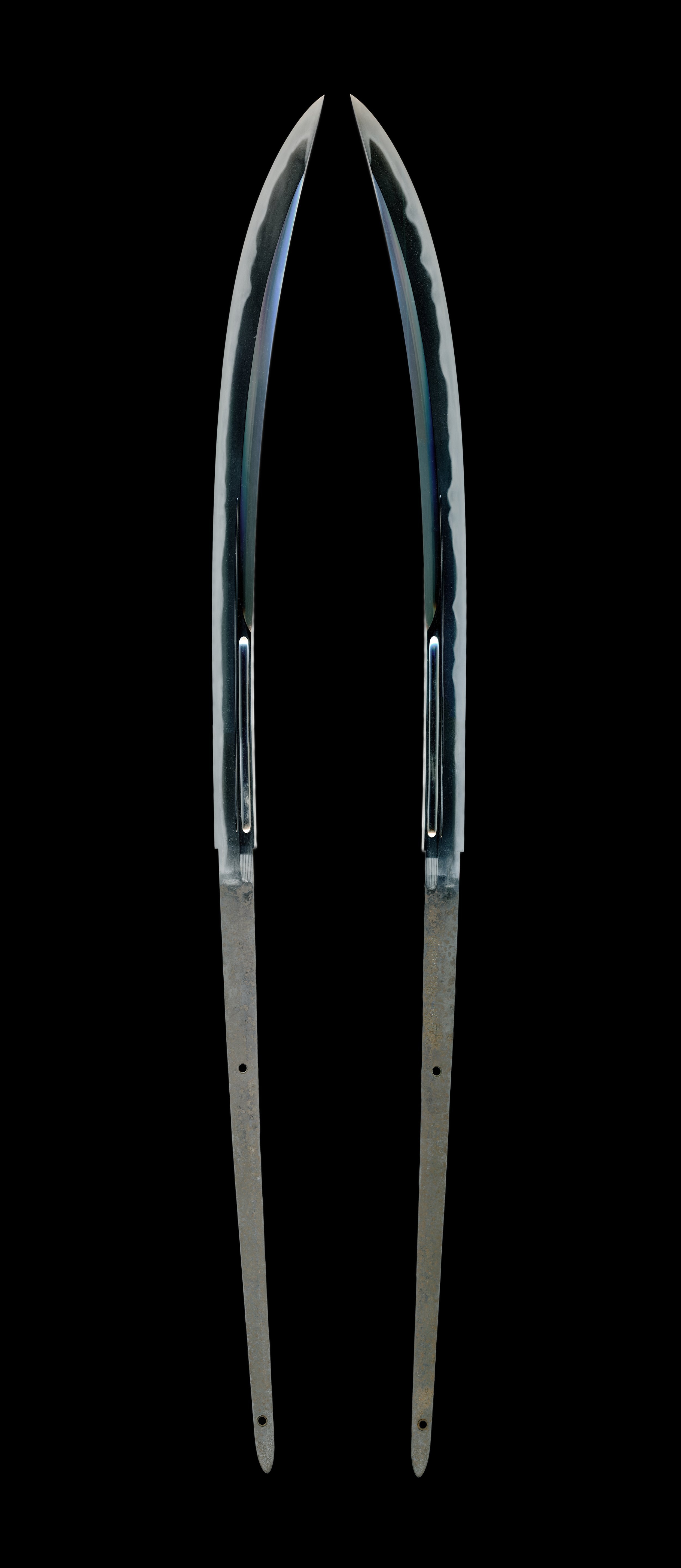
The designated work divides less by date than by form. The bulk of it is greatly shortened, unsigned and , originally and of wide , shallow and large , the silhouette in full; on these the calm round-headed and the -leaning read most plainly, and the late wide of the 48th and 64th sessions are the brightest and most tightly forged, the references calling them sound in and and superior examples of his appraised work. Apart from these stands the one piece that keeps its original tang, an , slightly elongated and thin in , on which the temper is a regular with run frequently, and which alone carries in the religious idiom the smiths favored, a sankō-hilted on one face and a with on the other. The published sources read this regular , beside the linked round-headed , as one of the two typical of blades attributed to Kaneyuki without signature.
What keeps Kaneyuki distinct is set entirely against the line he is most easily confused with. Both are - of the moment, and the references frame the appraisal as a contrast held steadily across his record: while connected to Kaneshige's manner, his blades "differ in character from the works of the group," the calmer round-headed and the standing, -leaning standing against the more restless . The references call one of his a clear instance of "Kaneyuki's typical workmanship," and another a on which "the appreciation points of the Kaneshige school are conspicuously shown," so that the school's character is read off his own blades rather than borrowed. His hand thereby became one of the recognized templates against which unsigned blades are sorted, a sub-current of the broad Seki and Naoe- stream that fed the later mainstream of the Kanesada and Kanemoto smiths.
Kaneyuki's record is modest in scale and entirely unsigned: nine designated works on record, all in the rank across a span of more than half a century, with no National Treasure, no Important Cultural Property and no among them, and a designation factor that places him in the long tail of the index rather than near its head. The published sources nonetheless judge the best of these blades sound in both and and call them superior examples of the appraisals of this smith, the praise measured rather than effusive, which suits a smith reached only by elimination. No provenance is recorded for his blades, and no institution holds one on the public record, so the honest picture is of a quiet name held in private collections and seen at designation, the swords passing between collectors rather than resting in museums. A Kaneyuki does come to market, since none of his work is held as patrimony, but rarely, and when it does it is the calm, -leaning - hand and the round-headed , not a signature, that identify it. For a collector who values the founding generation of Seki over the famous names that followed, an unsigned Kaneyuki of sound and , sorted from the line by exactly the traits the references name, is a quietly rewarding thing to encounter.