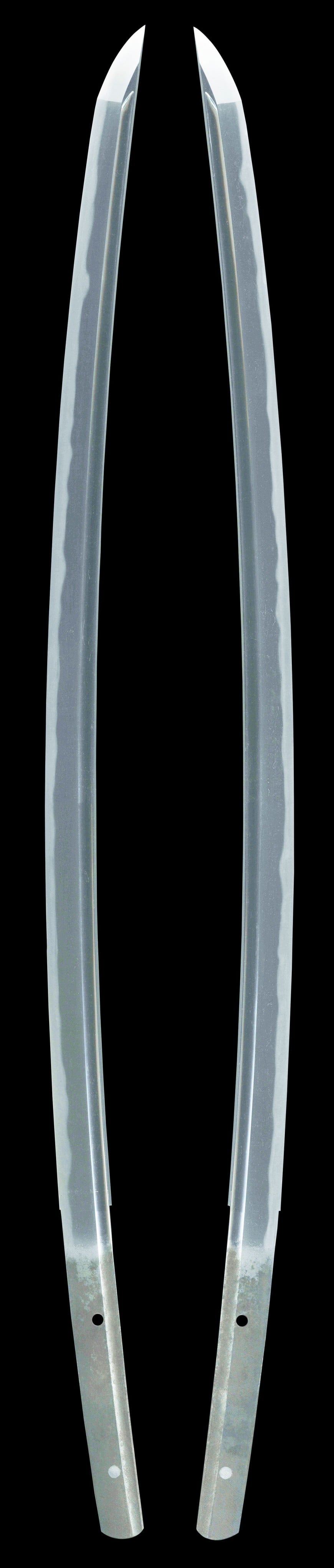
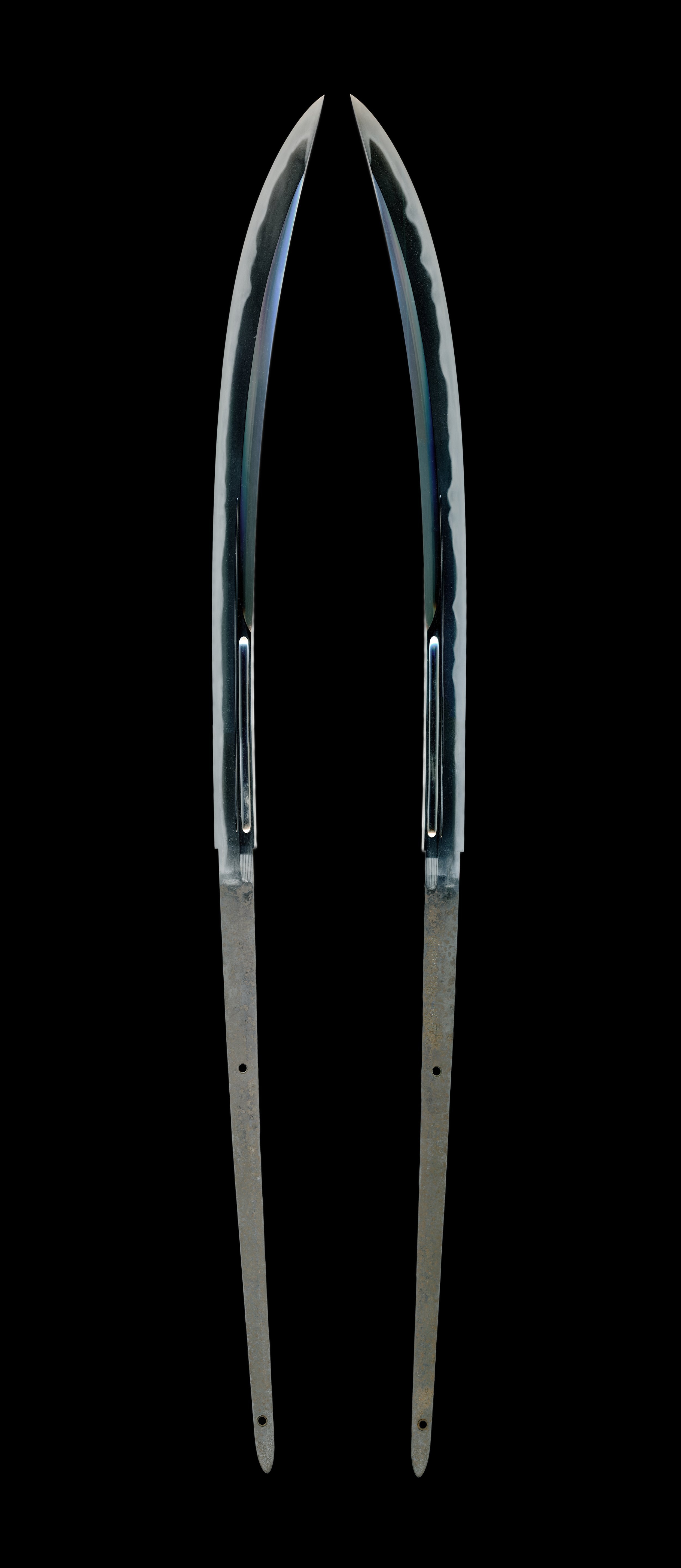
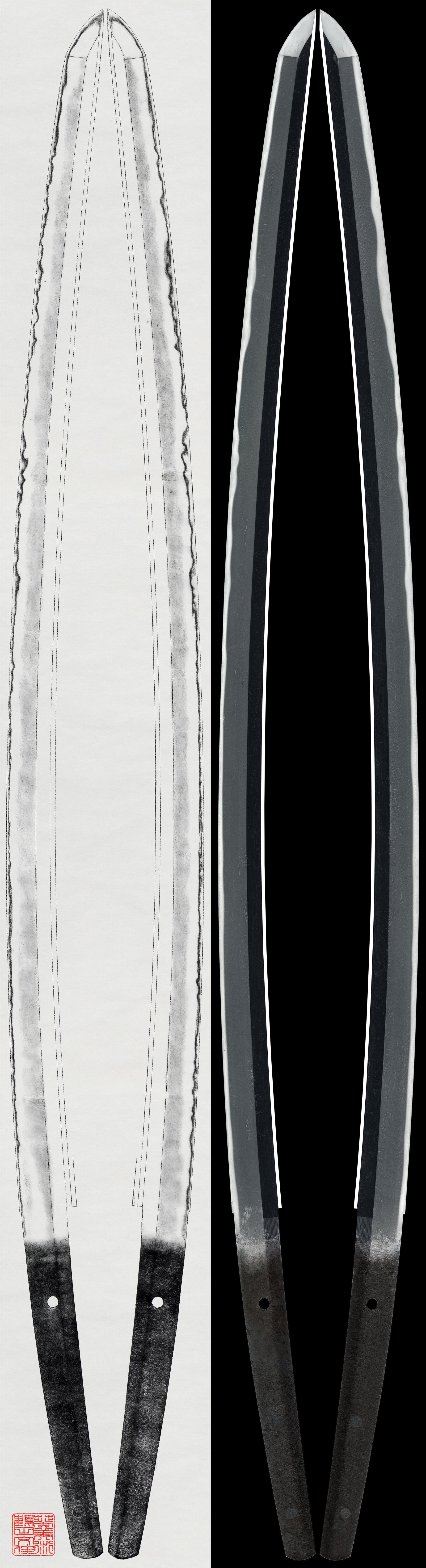
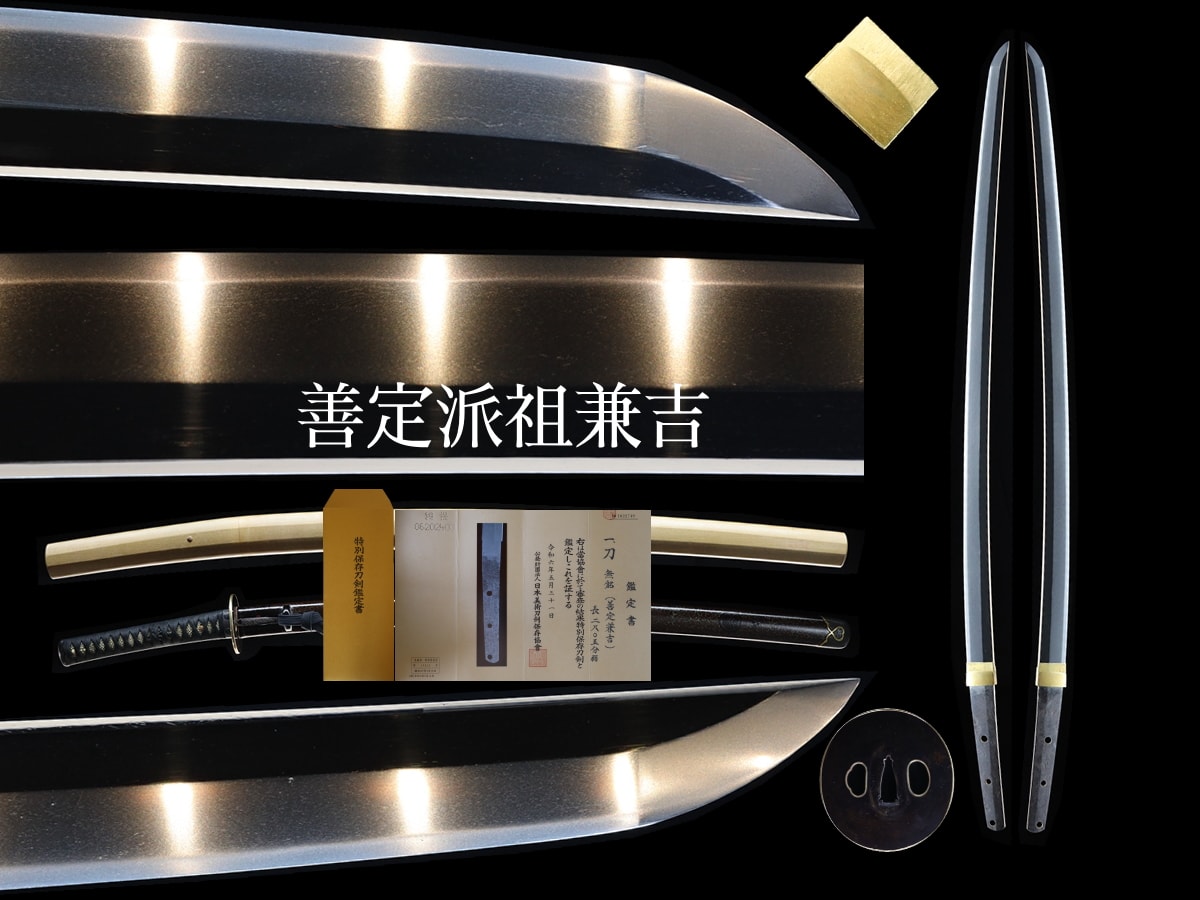
Kinju, whose name the published commentary reads as Kaneshige, is counted since antiquity among the Masamune Jittetsu, the ten great disciples of Masamune, and stands with Kaneuji at the headwaters of the tradition. The published sources, citing the Kokon Meizukushi, give his Buddhist name as Dōa and his origin as Tsuruga in Province, recording that 'his Buddhist name was Dōa; a resident of Tsuruga in , an excellent master craftsman; he crossed over to Seki and resided there'. Together with Kaneuji he is named the source of the smiths, 'a founder, alongside Kaneuji, of the wellspring of swordsmithing'. The Kōzan preserves two dated to Jōji 2 (1363), which fix his activity, and his securely signed pieces do not go back before that period, so the published record treats his direct tie to Masamune as a matter of tradition rather than proof.
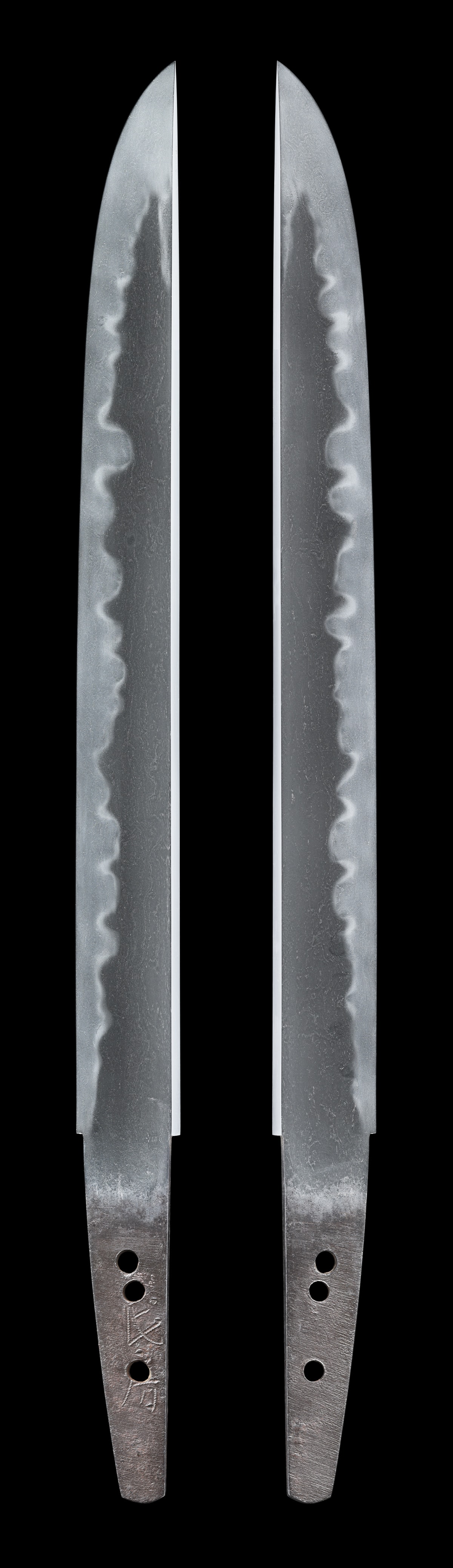
His hand is read as - held apart from the group, and the distinction the judges draw is precise. Where the work runs to pointed , Kaneshige tempers a calm line of whose heads are round, set in a linked series: the published sources describe it as a temper 'in which, rather than pointed , rounded-headed run in a linked sequence', accompanied by , the whole 'calmer in overall impression than the group'. Over that quieter he lays a shallow or a -toned base mixed with small and, on the , -like ; enter, the tends to brightness, and fine and run through the temper with and - gathering along the . This activity in is the inheritance carried into steel, and the published commentary names it a key point of appreciation in his work.
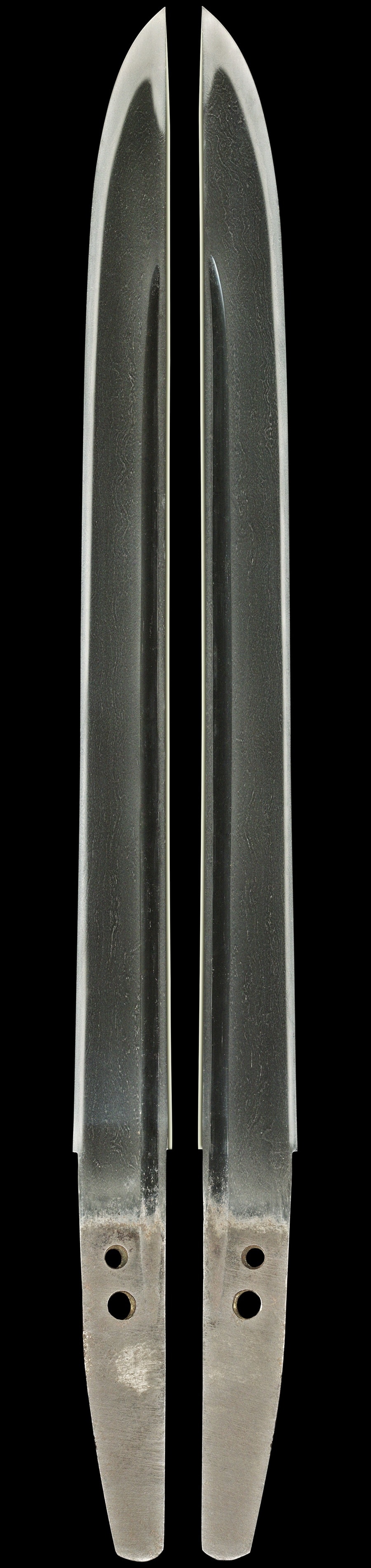
The is the constant tell. He forges an mixed with and that stands somewhat more than the and runs toward near the edge, the steel laid with thick and worked with frequent , and on the long blades a whitish often rises into an -like aspect. Where the forging tightens it becomes a compact , as on the one signed , with fine densely set; where it opens it stands a little, the grain showing on the surface. The answers the temper, running to a small round or a -toned point and swept into , sometimes with entering the turnback. Across both his registers the and its standing grain, more than any single feature of the edge, is what the judges read first.
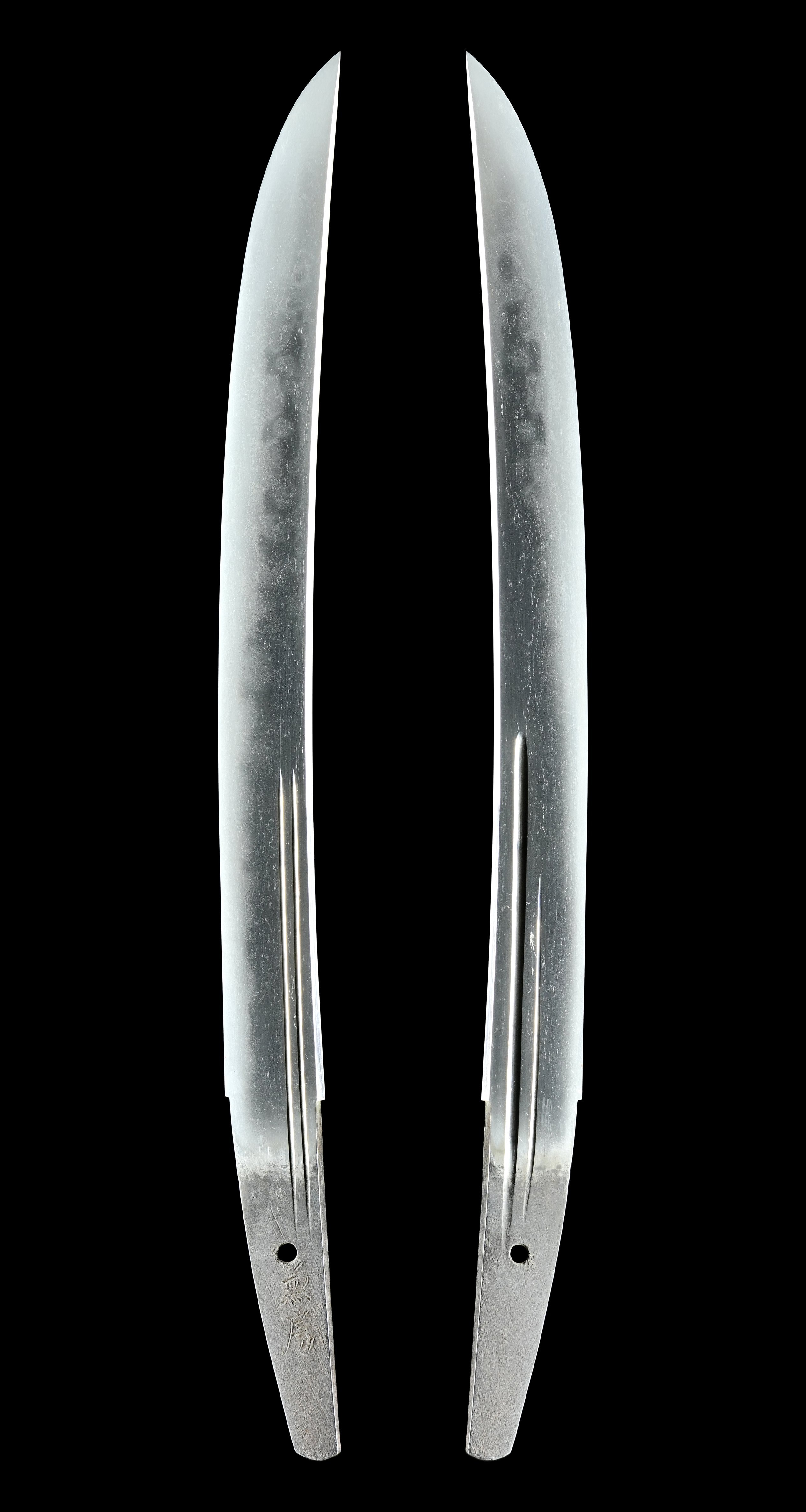
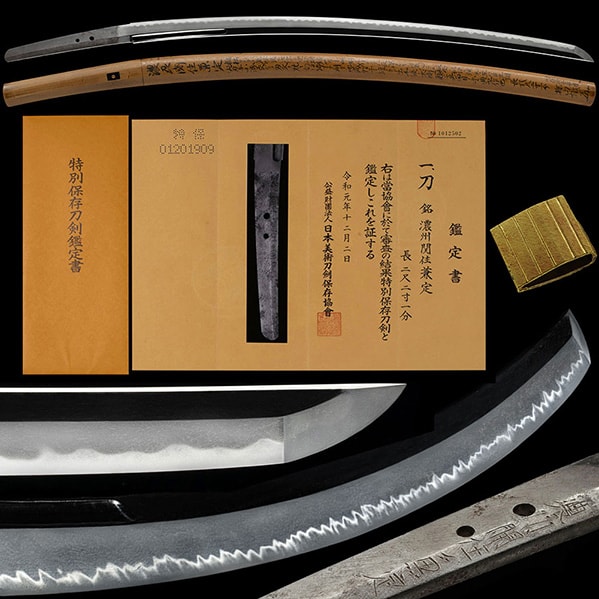
Two faces divide his record. The first is the research base: a small number of , two-character signed and , wide in body with thin , several elongated in the Enbun-Jōji proportion, and one rediscovered signed , but holding its , that runs a continuous from base to point. These signed pieces are not uniform in manner: some are a quiet , some a linked , and the published sources note that a few run to a -like full temper, evidence that the manner of the name is varied. At the base of the he carves a devotional program, and a , a raised , paired , and on one a four-pillar dai-dangu motif read as a symbol of Fudō. The second face is the larger one, the and judged Kaneshige, wide and imposing in the form, whose attribution rests on era and school where no single decisive tell settles it. Of the rediscovered signed the published sources stress the weight of the find, 'the significance of confirming this work as a signed by Kaneshige is therefore considerable', for until then his long blades were known only as attributions.
What sets Kaneshige apart within is exactly what the judges name. He is held away from the group by the quieter, rounder and the more standing grain, the published commentary repeatedly affirming that his work 'differs in character from that of the group' while remaining unmistakably - of the . He is the founder beside Kaneuji rather than a follower, the smith whose calmer, -laden manner gave the Seki tradition one of its two roots; the workshops of Seki carried that - hand forward into the , when the province became one of the great centers of sword production. The published record also notes a second-generation Kaneshige to whom certain are attributed, so the name continues past the founder.
For the collector he is a rare and early name. Fujishiro grades him Jō-jō . He has no National Treasures and no Important Cultural Properties; his record runs instead entirely through the tier, forty-five blades on official record, the great majority judged Kaneshige and only a handful the precious signed , and the single signed that anchor study of the name. His blades are preserved in long-held collections and institutions, the Kyoto National Museum among them, and his provenance reaches the Tokugawa shogunal house: one signed was presented to the shogun's family in 1679 to mark the birth of the heir Tokumatsu, passing through the hatamoto Soga Nakasuke. Because almost nothing of his survives signed and the long blades trade only at the upper level, a signed Kaneshige is among the rarer things a collector of - could hope to encounter, coming to light only seldom and, when it does, standing as a document of how the tradition began.