Unification closed the mass market, and Seki’s smiths moved to where the new money was: the Mishina line to Kyōto with court titles, Daidō smiths to castle towns across the provinces. Mino became the great technical ancestor of the Shintō age.
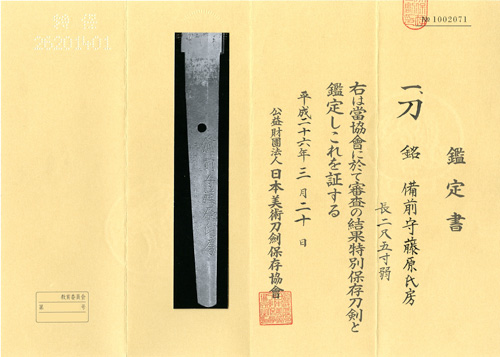
Blade construction: Shinogi-zukuri with Iori mune. The blade is elongated, with a wide base, thick in Kasane (blade thickness), and moderate curvature, giving it a robust and substantial feel impression holding on hands. Forging Pattern (hada): Itame-hada (wood grain pattern) with partial areas of flowing patterns. The steel surface is enriched with thick Ii-nie (steel particles) and vibrant chikei (lines of hardened steel), resulting in a resilient and robust forging. Hamon (Blade Tempering Pattern): A wide, straight Suguha with slight ko-midare (small undulations), exhibiting subtle wavy elements. Small gunome (rounded patterns) are mixed in, with frequent Ashi (downward streaks) entering the hamon. The blade edge is marked by thick clusters of Ko-nie, with floating YOU (spots of tempered steel) in the quenching area, creating a bright appearance. Boshi : The temper continues straight high Suguha that transits into a high almost whole quenching "Ichimai" and returns deeply into the Mune. Tang (Nakago): Ubu (unaltered). The tang end is shaped in a Ha-agari Kurijiri style, with slanting left (katte-sagari) Yasurime. The blade notch (ha-machi) is deep, and the tang is gradually tapered and creates in a ship-bottom Funa-gata style. There is a single Mekugi-ana (peg hole). The front side bears a long, elegant signature reading “Bizen-no-Kami Fujiwara UJIFUSA”備前守藤原氏房 positioned near the back ridge of Mune below the Mekugi-ana. The smith Bizen-no-Kami Ujifusa 備前守氏房 was the heir of the second-generation Hida-no-Kami Ujifusa 飛騨守氏房(note). Born in Kiyosu in 1595 (Bunroku 4), he was first known by the childhood name Isechiyo 伊勢千代 and later took the name Chōjirō 長次郎. On the 22nd day, in the 8th month 1621 (Gen'na 7) at the age of 27, he received the title of Bizen-no-Kami 備前守 and began signing blades as Bizen-no-Kami Fujiwara Ujifusa 備前守藤原氏房 or simply Bizen-no-Kami Ujifusa 備前守氏房. He exclusively served as a retained craftsman for Tokugawa Yoshinao 徳川義直, the lord of Owari. In the 1st month in 1631 (Kan’ei 8), at the age of 37, he succeeded his father, Hida-no-Kami Ujifusa 飛騨守氏房, as the head of the family. By the spring of 1634 (Kan’ei 11), he retired at age 40 and adopted the signature Bizen-no-Kami Ujifusa Nyudō 備前守氏房入道. He passed on the family legacy to his son, Sankurō 三九郎, who became the 4th-generation Hida-no-Kami Ujifusa 飛騨守氏房. Bizen-no-Kami Ujifusa 備前守氏房 passed away on October 25, 1666 (Kanbun 6) at the age of 72. This sublime sword is a work of Bizen-no-Kami Ujifusa 備前守氏房, crafted during his matured years from 1631 to 1634 (Kan’ei 8 - 11). With an extended length of approximately 2 shaku 5 sun (75.7 cm), thick in Kasane, heavy on both hands and a well-harmonized curvature, it features a medium tip (chu-kissaki) and brimmed with both power and refinement. The structure aligns with the robust styles popular during the Kan’ei era. The forging displays Itame-hada mixed with Masame-hada, with fine Ji-nie covering the surface. Chikei lines lengthwise and crosswise, revealing the robust character of the steel. The Hamon, with its bright and clear edge, is defined by thick clusters of Ko-nie and a dynamic presence of Ko-gunome and Ashi. The clear, frosty Nioi particles in the tempered area add an elegant, serene quality. The deeply tempered bōshi, returning in an Ichimai style, reflects inspiration from earlier masterpieces, particularly the Gō Yoshihiro 郷義弘. The Nakago remains in excellent condition, with an excellent taste of patina. Its tapered shape caters to the slender grip preferences of Owari samurai. The robust signature, starting below the Mekugi-ana and boldly inscribed, demonstrates masterful chisel work. The character "原" (hara) in "Fujiwara" is notably styled with the fourth stroke extending into the second, such handwriting also observed in the works from the later period of his father, Hida-no-Kami Fujiwara Ujifusa 飛騨守藤原氏房. This blade exemplifies the craftsmanship and artistic ambition of Bizen-no-Kami Ujifusa 備前守氏房 while fully matured of his career. Silver foiled single layer Habaki collar, preserved in a Shirasaya plain wood mounting (note) Hida-no-kami UJIFUSA 飛騨守氏房, real name of initially Kawamura Isechiyo 河村伊勢千代, later changed to Kawamura Heijur? 河村平十郎, was born in the 10th year of Eiroku(1567). His father Wakasa-no-kami Ujifusa 若狭守氏房 won the praise from the daimyo Oda Nobunaga 織田信長 to exclusively belong to him. In the 5th year of Tensho (1577), Hida-no-kami Ujifusa 飛騨守氏房 moved to Azuchi castle town in Oumi province along with his father Wakasa-no-kami Ujifusa 若狭守氏房 to work exclusively as a page of Oda Nobutaka 織田信孝 who is the 3 rd son of Oda Nobunaga. After the Incident at Honnō-ji (本能寺の変, Honnō-ji no Hen) referred to the forced suicide in the 21th day, the sixth month, the 10 th year of Tensho (1582) of Oda Nobunaga, UJIFUSAs parent and son returned to his home town Gifu with Oda Nobutaka's help then again came back to Kiyosu castle town under the support of Sakuma Masakatsu 佐久間正勝. After his father Wakasa-no-kami Ujifusa passed away in the 11 th day, the 5 th month, 18 th year of Tensho (1590), he learned from his uncle Nobutaka 信高 of 1 st generation and officially enjoyed Hida-no-kami 飛騨守 title in the 11 th day, the 5 th month, 20 th year of Tensho (1592). On after Nagoya castle relocation in 1610, he moved from Kiyosu to Kaji town, in Nagoya (now in 3 chome Marunouchi,Naka-ku) then was in retirement 1631 to yield his position as head of the Ujifusa to his eldest son - the 3 rd generation Bizen-no-kami Ujifusa 備前守氏房. Hida-no-kami Ujifusa 飛騨守氏房 was passed away in the same year in 1631, was 65 years old. reference : Iwata Atou, Owari Toko-fu, Nagoya citry Board of Education, 1984
Offered by Sanmei
5 on the market


Owari-Seki (Mino-derived Owari shinto; retained by the Owari Tokugawa) · Owari · around 1596-1615
Fujishiro Jo saku · Tōken Taikan top 26%
5 pieces on the market now
Hida no Kami Fujiwara Ujifusa was the son of Wakasa no Kami Ujifusa, born at Seki in Mino and first called Kawamura Isechiyo, later Heijuro. Most of the published sources give his birth as Eiroku 10, though one entry places it in Tenbun 10. They follow his career closely. He served Oda Nobutaka as a page and became a ronin after his lord's death, then served under Sakuma Masakatsu in Owari, moved to Kiyosu and began forging from about Tensho 17. In Tensho 19, when the Kampaku Toyotomi Hidetsugu became lord of Kiyosu, Ujifusa, Masatsune and Nobutaka were received at Jurakudai and each presented a sword, and Ujifusa was granted the title Hida no Kami. About Keicho 15 or 16 he moved to Nagoya and served Tokugawa Yoshinao as a retained smith, then passed the headship to Bizen no Kami Ujifusa in Kan'ei 8 and died that year at sixty-five. Three generations bore the name, the first Hida no Kami, the second Bizen no Kami and the third again Hida no Kami, and this code is the first.
His characteristic hand is a broad, generous notare. On a wide-bodied katana with shallow sori and a large kissaki, the shape the published sources call "the typical sugata of Keicho shinto"[[c:1]], he tempers an o-notare as the main tone, mixing gunome and small notare, with ashi and yo entering and ko-nie well attached, and patches of mura-nie and yubashiri along the line. The same broad manner runs across his naginata and his sun-nobi hira-zukuri wakizashi. Of one such wakizashi the sources write that it "fully and without reserve displays this smith's forte"[[c:2]]. On a dated Keicho 11 katana the same open notare mixed with gunome is named a typical work.
The jigane of that broad work is most often a standing one: an itame that tends to rise, at times a large itame or a coarse zanguri jigane, mixed with mokume and flowing toward masame along the shinogi-ji, with ji-nie. His finest katana, however, are forged differently. Two of them show a well-packed ko-itame with ji-nie, and over it a ko-midare or small notare mixed with gunome and pointed teeth. The published sources call one the white eyebrow of his work, the piece that "most clearly shows the Shizu style"[[c:3]] of his native Mino, and the other an excellent work that shows the same Shizu manner. The boshi over his blades is tempered deep, turning in notare-komi to a ko-maru or o-maru with a long return and hakikake. On his tanto and several other blades it rises instead in tsukiage to a pointed tip, the boshi of the Sanpin manner.
Within the one hand the published sources draw out two further faces. The first is his most numerous, the wide, shallow-curved, large-pointed body that recalls a greatly shortened Nanbokucho blade, though the judges point to the sakizori that fixes it as Keicho work. Among such pieces, they note, some look at first sight like the work of Muramasa. The second is rare, and the sources twice call it unusual for him: a chu-suguha worked with small gunome, abundant ko-ashi, hotsure and fine activity over a well-forged jigane, the boshi deep and pointed. On these blades the judges read a private aspiration to the great Soshu masters, naming Go and Samonji, and find "an archaic flavour as though he had privately studied the superior Sagami smiths"[[c:4]]. A Keicho 7 tanto with the Sanpin boshi recalls Echizen Yasutsugu at first sight, yet its larger notare and stronger, uneven nie are read as Ujifusa's own.
What sets him apart is the combination the judges keep returning to. He is a Seki smith by descent, and the standing, flowing jigane with masame along the shinogi-ji, the pointed Sanpin boshi and the Shizu manner of his best katana all carry that Mino root. The wide, powerful Keicho-shinto body, the deep nie and the reach toward Soshu in his suguha work mark the Owari smith who served the Tokugawa. Carving is uncommon on his blades beyond the bo-hi of the katana and the naginata-hi of the naginata, and the sources call it unusual when one sun-nobi hira-zukuri blade carries an inscription with Daruma carved in relief.
For the collector he is a well-documented founder rather than a rarity of legend. Fujishiro grades him Jo saku. He has no National Treasures and no Important Cultural Properties. His record runs through the Juyo tier, where sixteen of his works are held, all signed, among them katana, wakizashi, a tanto and naginata of the first generation. Several bear Keicho-era dates that the published sources prize as "good material for the study of Hida no Kami Ujifusa"[[c:5]], and they note that signatures with Fujiwara Ason are uncommon. Provenance for his work is little recorded, so it is best described simply as held in private hands. A signed first-generation Ujifusa, broad and vigorous with its long signature, comes to market only from time to time, and a dated example is the one a student of Owari shinto would most wish to encounter.
Where Ujifusa stands among comparable artisans: across all of nihontō, and within tradition, era, and period. The tiers (Foremost · Leading · Major · Notable) weigh official designations from the NBTHK and Japan's Agency for Cultural Affairs, together with historical honors of lasting repute such as the Sansaku and Meibutsu-chō.
Select a lens to see how it's measured.
Years he was demonstrably active, proven by signed-and-dated blades
Mino-den · Owari
16 pieces on the market now
Rooted in Owari province at the boundary between the kotō and shintō eras, the Ujifusa line carried Mino-den forging into the late Momoyama and early Edo decades, working under the Tokugawa establishment of Owari at Nagoya. The setsumei here cover several hands of the group. Wakasa no Kami Ujifusa and Hida no Kami Ujifusa stand as the reference points against which the others are read. Echigo no Kami Fujiwara Ujitsune, recorded in the Meikan and the Mino-tō Taikan as the second son of Wakasa no Kami Ujifusa, first signed Ujishige, received the Echigo no Kami title in Genna 6 (1620), and died at Nagoya in Meireki 2 (1656). Ujisada, who took the court title Izumo no Kami and signed Sakon Shōshō and Sakon Gonshōshō, is transmitted as a son of the first-generation Ujifusa and younger brother of the second-generation Wakasa no Kami Ujifusa; one of his tantō carries a date of Tenshō 5 (1577). The shared hand begins in the kitae: a dense itame mixed with mokume and nagare-hada, carrying ji-nie and, in the fuller work, fine chikei. The temper draws on the Mino-den vocabulary, a notare mixed with gunome, ko-gunome in tsure, large gunome, and pointed togari-leaning forms, the notare often taking angular turns (kado-gakari).
Ko-ashi and yō enter; nie attaches, at times slightly coarse and unevenly applied, with kinsuji and sunagashi in the lower body and tobiyaki and muneyaki scattered through, so that some blades verge on hitatsura and minayaki. The nioiguchi can incline toward shizumi. The bōshi is tempered deeply and far down (yakisage) with hakikake, the point sometimes drawn into a sanpin-style sharpness on one face and an ō-maru on the other. Ujitsune's signed katana reads as a near-textbook gathering of these traits; Ujisada's tantō tightens the nioiguchi (shimarigokoro) toward his master's manner. For kantei, the angular notare, the patchy nie, the shizumi-inclined nioiguchi, and the sanpin-pointed bōshi with long yakisage mark the Wakasa no Kami group; the larger work adds broad mihaba, ō-kissaki, and thick kasane. Carving belongs to the record: a "grass" kurikara and gomabashi with rendai appear on Ujisada's tantō. The Ujitsune katana, by a smith the setsumei call a scant producer, is named his representative work, holding coherence across a great nagasa. Learn more →
| Smith | Era | Designated |
|---|---|---|
| Ujifusa氏房 | 1596-1615 | 16 |
| Ujifusa氏房 | 1571-1592 | 9 |
| Ujifusa氏房 | 1624-1644 | 0 |
| Ujitsune氏恒 | 1596-1615 | 1 |
| Ujisada氏貞 | 1558-1592 | 7 |
Mino in the Momoyama period
Unification closed the mass market, and Seki’s smiths moved to where the new money was: the Mishina line to Kyōto with court titles, Daidō smiths to castle towns across the provinces. Mino became the great technical ancestor of the Shintō age.
A Hozon-certified blade judged to show notably superior workmanship and a better state of preservation. The bar is higher: re-tempered blades and most unsigned Muromachi/Edo works are excluded.
The NBTHK (Nihon Bijutsu Tōken Hozon Kyōkai, the Society for the Preservation of Japanese Art Swords) is a public-interest incorporated foundation founded in 1948 and supervised by Japan’s Agency for Cultural Affairs (Bunkachō); it is based at the Japanese Sword Museum in Tokyo. Its expert panels physically examine each submitted work (shinsa) and issue a certificate (kanteishō) ranking it by artistic and historical merit. NBTHK papers are the most widely recognized standard of authentication for Japanese swords and fittings.
NBTHK official siteFor a return, please contact us within 7 days of the item's arrival. If specification changes such as dimensions were made at the customer's request, a return cannot be accepted. Shipping and transfer fees are the customer's responsibility.
¥1,350,000
Certificate reading — 銘 備前守藤原氏房