Unification closed the mass market, and Seki’s smiths moved to where the new money was: the Mishina line to Kyōto with court titles, Daidō smiths to castle towns across the provinces. Mino became the great technical ancestor of the Shintō age.
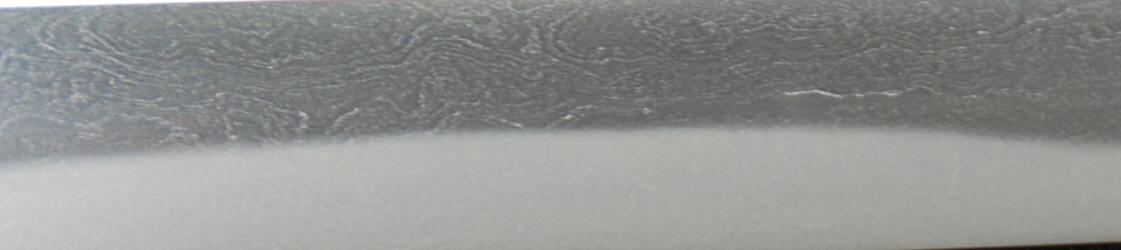
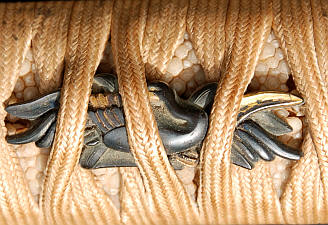
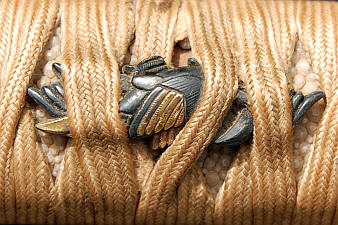
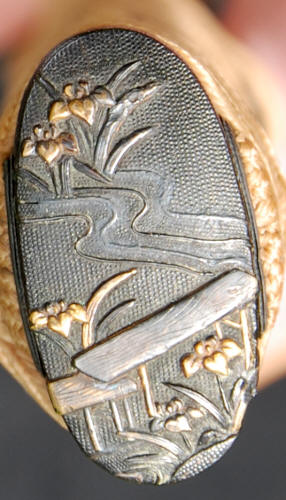
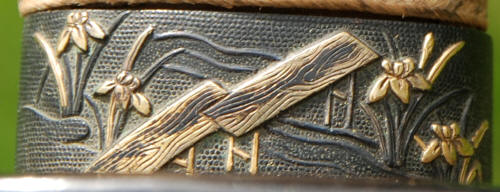
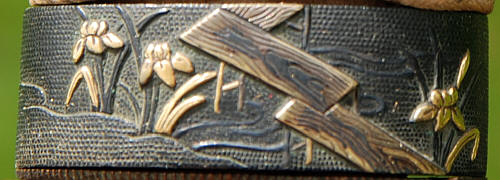
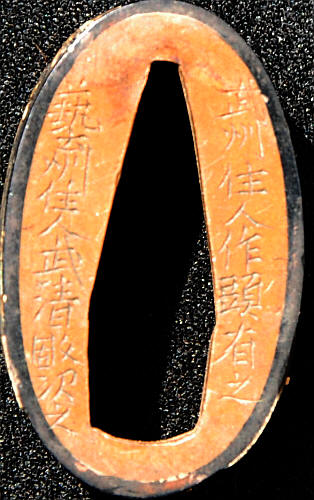
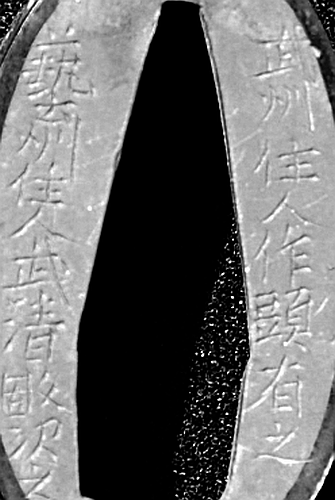
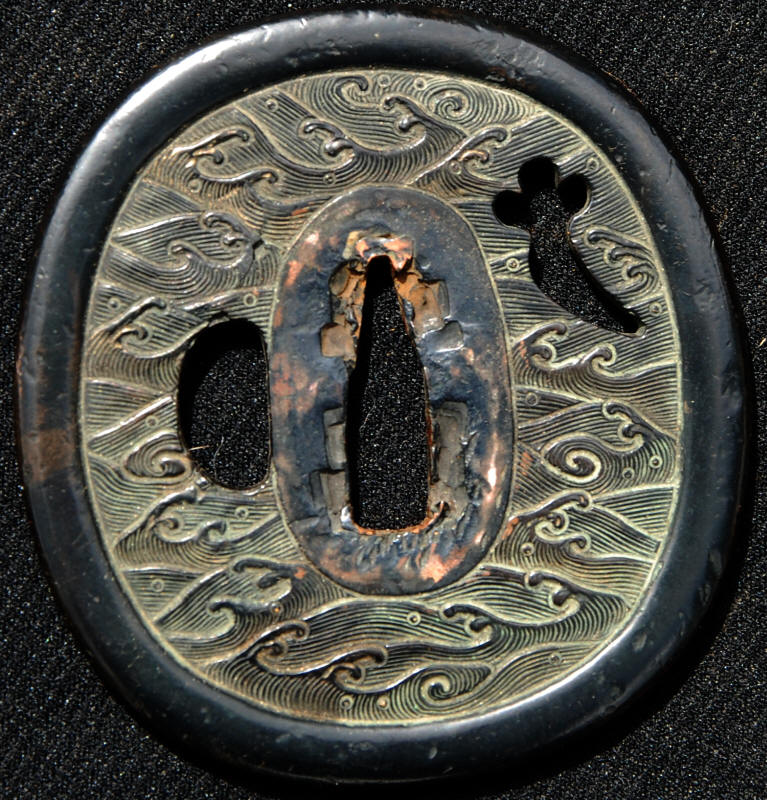
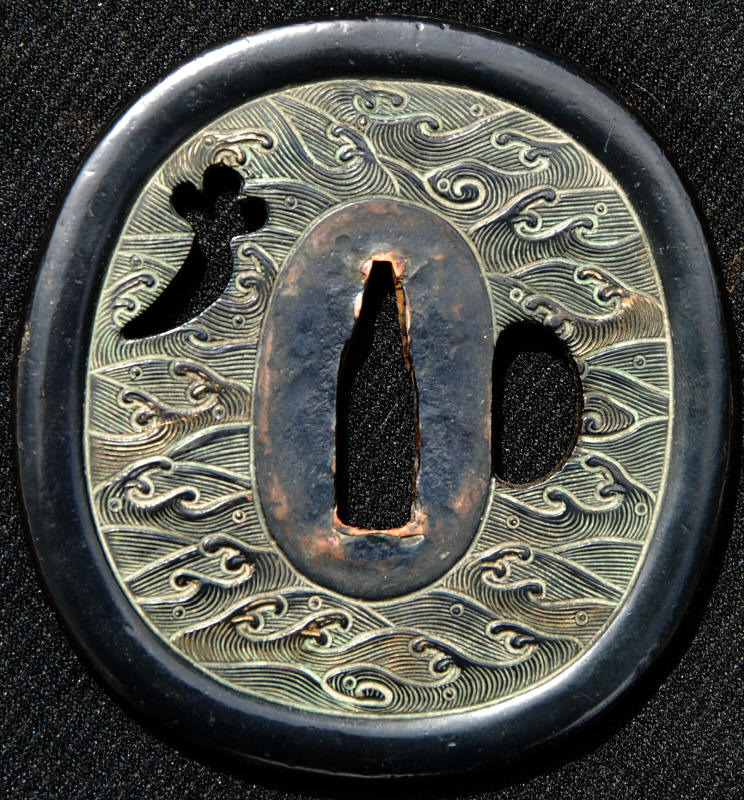
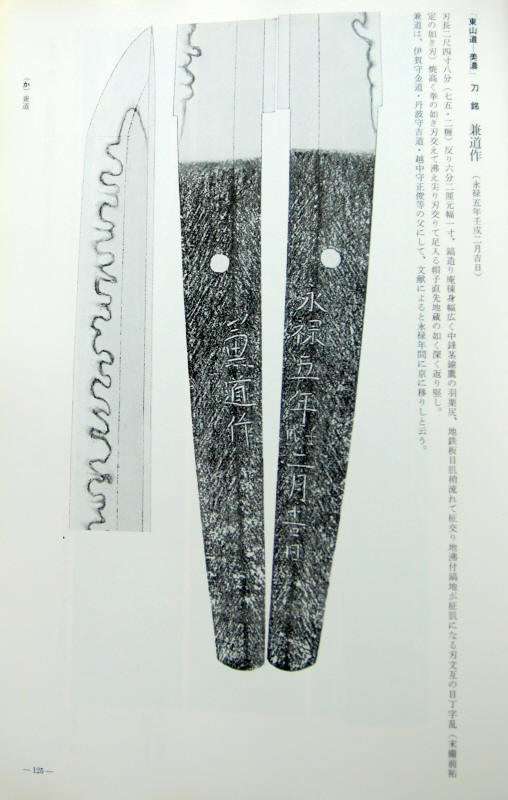
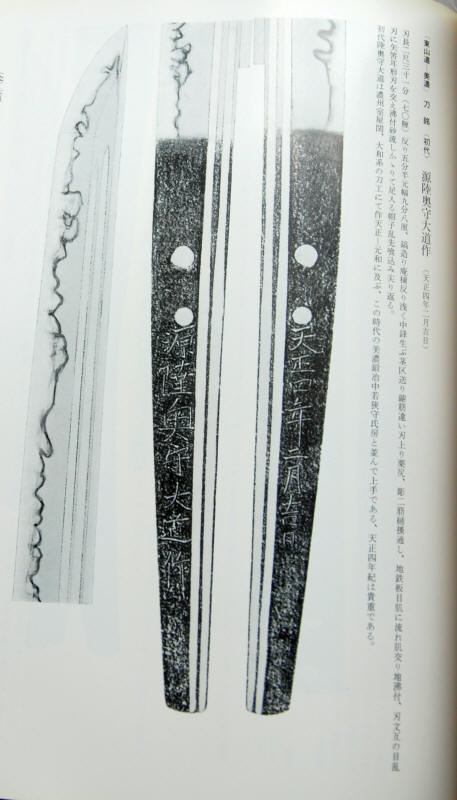
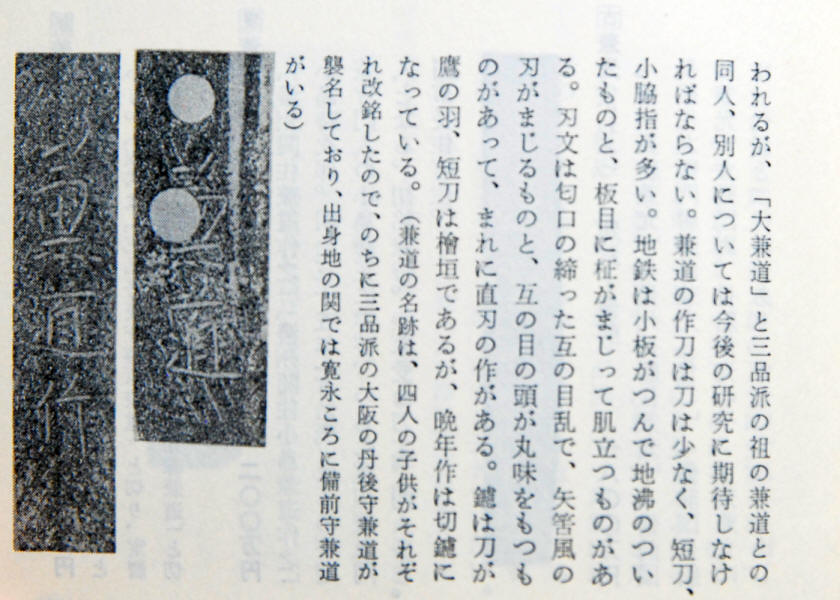
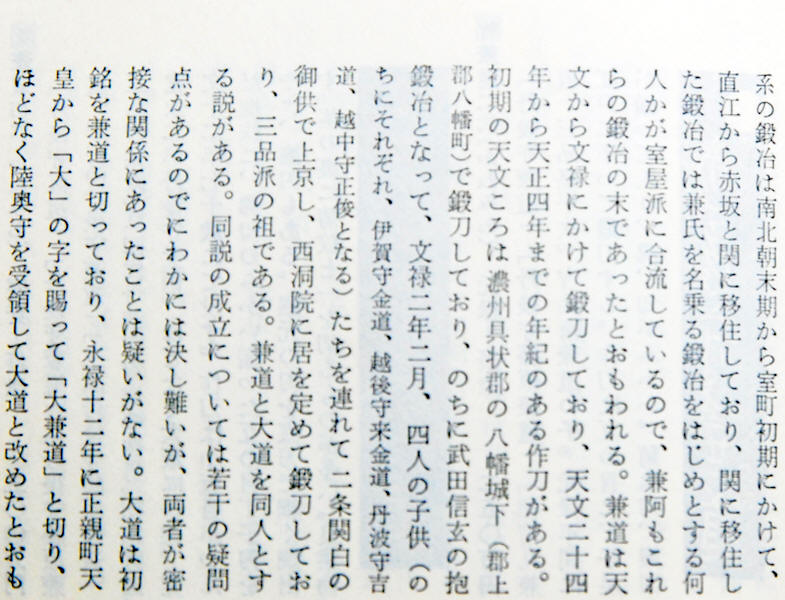
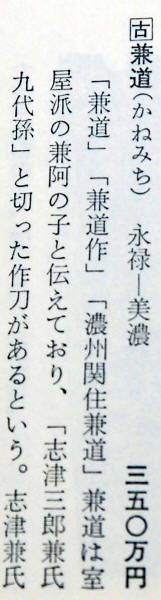
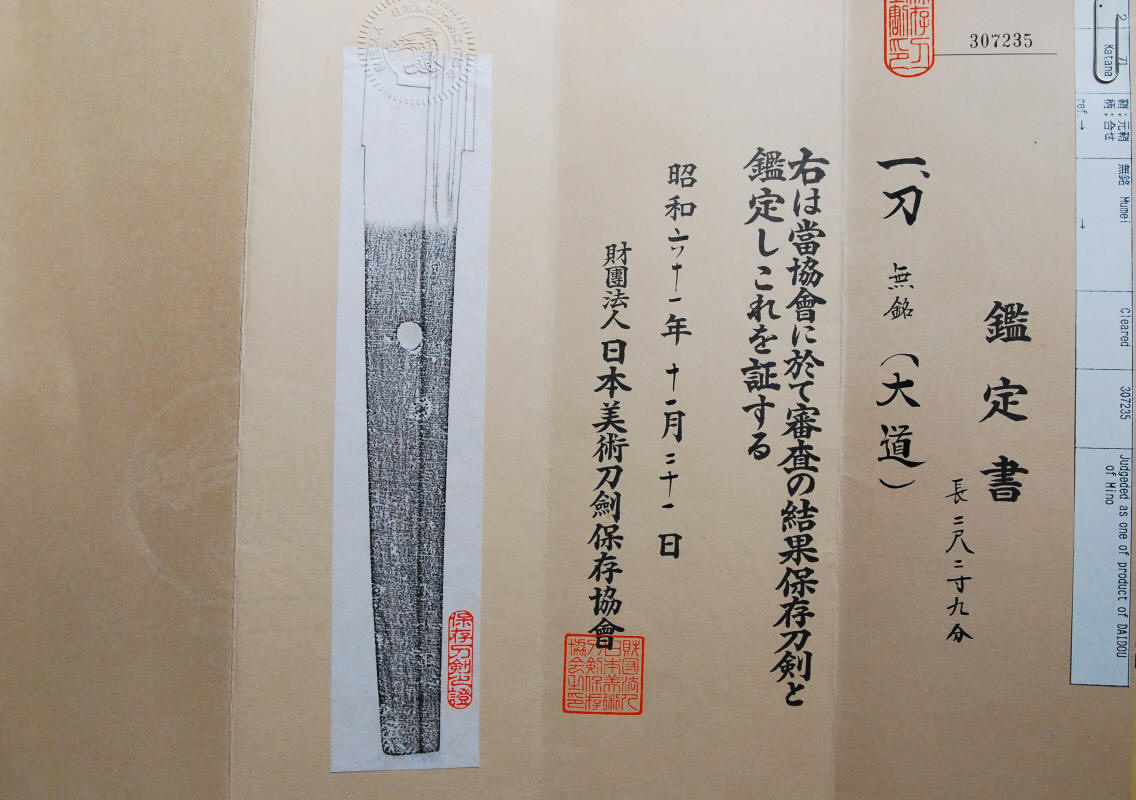
A mumei katana attributed to Mutsu no Kami Daido. Hawatare: 2 shaku 2 sun 9 bu (69.39 cm or 27.32"). Motohaba: 3.126 cm. Sakihaba: 2.685 cm, Kasane: 4.69 mm. Shinogizukure, slight sakizori, iroi mune, o-kissaki. Nie deki notare ko-midare, , kinsuji, nado. hakikaki komaru boshi with hakikaki and a long kaeri Mokume hada packed with ha nie, shiraki, nado. Fresh polish, old shirasaya copper habaki. NBTHK kanteisho. Rated with a double circle in Nihonto Meikan, rated Josaku in Nihon Toko Jiten - Shinto-Hen, and valued at 3,500,000 yen in Toko Taikan by Tokuno. NBTHK Hozon. Accompanying koshirae, shakudo nanako fuchi-kashira of plank bridge, stream and water lilies. signed, Left side: Geishu junin Takekiyo (unknown kanji - perhaps a combination of two kanji, because he ran out of soace) tsugu kore (a resident of Geishu [modern Aki province] I like this) Right side: Bushu junin saku Kashira ari kore, (While in Bushu I made this kashira). Ref. Hayne s Nihon Toso Kinko Dai Jiten H 09385.0. The menuki are large well detailed shakudo and gold plants. The tsuba is a large Goami school shakudo of waves in keibori, and a sukashi ginger root, 8.39 cm x 6,826 cm 4,71 mm at the round mimi the web is 3 mm. I associate these dimensions with early Momoyama. The saya is an orange red associated with the southern provinces, perhaps Choshu. Kanemichi was the founder of the Mishina school, which had its roots in Sue Seki of Mino. There are two juyo swords dated Temmon 16 (1547) and Eiroku 4 (1562). His four sons, Iga no Kami Kinmichi, Rai Kinmichi, Tamba no Kami Yoshimichi, Etchu no Kami Masatoshi moved to Kyoto. In Tensho 2 (1574) Kanemichi received the title, Mutsu no Kami. In Eiroku 12, (1569) he was requested to make a sword for the emperor, Ogimachi and in appreciation, was granted the use of the character Dai or O, and started signing O-Kanemichi. Later he dropped the Kane kanji, and became Omichi, or Daido. He worked in the Mino tradition, and emulated the works of Shizu Saburo Kaneuji. He was the personal sword smith to Oda Nobunaga, one of the three unifiers of Japan, the other two being Toyotomi Hideyoshi and Tokugawa Iyeyasu. He later moved to Kyoto, where with his sons, became known as Kyoto Gokaji. It seems probable that the Mishina group was favored by the Tokugawa, and they were given this title, because Umetada Myoju's and Horikawa Kunihiro's loyalties had been with the Toyotomi. Geishu junin Takekiyo (unknown kanji) tsugu kore / Bushu junin saku kashira ari kore Classic Goami design. Momoyama jidai or earlier. Earlier signature as Kanemichi Mature Daaido Ssgnature Toko Taikan gives a history of Kanemichi up through taking the name Daido
Offered by Nihonto US
This piece has sold
Get an email when a new Seki Daido piece hits the market.


Mino-den · Mino · around 1573-1592
2 pieces on the market now
From the end of the Muromachi period into the early Shintō era, several Mino swordsmiths bore the name Daidō. The most prominent among them was Mutsu no Kami Daidō, whose signed and dated works survive from the Tenshō era, with recorded dates including Tenshō 2 (1574), 4 (1576), 13, and 18 (1590). Other smiths of the name carried various court titles -- Izu no Kami, Mikawa no Kami, Kawachi no Kami, and Shinano no Kami -- while still others signed without titles as "Seki-jū Daidō," "Gifu-jū Daidō," or "Heianjō-jū Daidō." Among the Mino smiths of this period, Mutsu no Kami Daidō is regarded as particularly highly skilled, "standing alongside Wakasa no Kami Ujifusa."
Daidō's forging typically shows ko-itame mixed with masame, with fine ji-nie well applied. His hamon is characteristically an ō-notare-based ko-gunome-midare, or a shallow notare mixed with ko-gunome, hakoba, and togari-ba; the nioiguchi is consistently described as tight and clear, showing lively variation, with ko-ashi and yō and adhering ko-nie. His bōshi tends toward midare-komi, turning back in a Jizō-like manner or with a pointed tendency. His sugata favors wide mihaba with imposing, dignified constructions, and he produced both katana and wakizashi in hira-zukuri. The carvings found on certain works -- including renderings of "Namu Myōhō Renge Kyō" and Kurikara -- are noted as "superb."
The NBTHK consistently describes Daidō's workmanship in jigane and hamon as "excellent," with blades that are kenzen and of especially fine quality among his oeuvre. His technical ability is characterized as "extraordinary," and the dated inscriptions on his works -- particularly the Minamoto surname and Tenshō-era dates -- are valued as significant documentary records of late-Muromachi swordsmithing in Mino Province.
Where Daido stands among comparable artisans: across all of nihontō, and within tradition, era, and period. The tiers (Foremost · Leading · Major · Notable) weigh official designations from the NBTHK and Japan's Agency for Cultural Affairs, together with historical honors of lasting repute such as the Sansaku and Meibutsu-chō.
Select a lens to see how it's measured.
Years he was demonstrably active, proven by signed-and-dated blades
Mino-den · Mino
129 pieces on the market now
Seki (関), in Mino Province, grew from two roots set down in the Nanbokuchō period and rose to become the great center of mass sword production in the late medieval age. The published sources trace the wellspring of Mino swordmaking to Kinju (whose name the commentary also reads Kaneshige), counted since antiquity among the Masamune Jittetsu, the ten disciples of Sōshū Masamune, and to Kaneuji of the Shizu line; the Kokon Meizukushi records Kinju as a native of Tsuruga in Echizen who "crossed over to Seki and resided there," carrying the Sōshū-den manner east. Beneath that Sagami inheritance lay a Yamato foundation, legible in the Tegai descent of the Seki Zensada line through Kaneyoshi, so that the Mino-den the Seki workshops forged stands as a fusion of Yamato grain and Sōshū activity in nie. From this Nanbokuchō founding the name multiplied across the Muromachi period into Sue-Seki, the last and largest body of the tradition; its representative masters at the close of the old-sword age were Magoroku Kanemoto, famed for the sanbonsugi, and Izumi no Kami Kanesada, the smith called Nosada, while the Kanefusa, Ujifusa and Daidō hands worked beside them and the move of Wakasa no Kami Ujifusa to Kiyosu carried the Mino body to the threshold of Owari shintō. A common Mino vocabulary binds the Seki body, however widely its members range. The forging is an itame that stands and runs to masame, often mixed with mokume and nagare, over which rises the cool whitish shirake-utsuri of Mino steel rather than the bright midare-utsuri of Bizen; this pale, standing jigane is the constant tell the judges read first, present alike on Kinju's Nanbokuchō katana, Kaneyoshi's Ōei tachi and Nosada's late-Muromachi blades. Over it the smiths temper gunome into which the pointed togariba of Mino enters, with ko-nie clinging to a tight nioiguchi, ashi and yō, and sunagashi streaming through; the bōshi answers in midare-komi turning to a pointed or jizō-cast ko-maru swept with hakikake. From this shared grammar the individual hands diverge.
Kanemoto fixed the regular three-cedar sanbonsugi of pointed teeth; Kanefusa devised the rounded-head, constricted-waist "Kanefusa midare"; Kinju and the early founders held a calmer, rounder gunome away from the restless Shizu line, their work laid with thicker ji-nie and dry, standing grain. The late masters carried the manner to a higher finish: Nosada wove togariba among rounder forms for a broader temper than Kanemoto's one-sided file, and turned at times to a slender Rai-styled suguha with a hidden gunome; Kaneyoshi held instead to a cool ito-suguha, the disciplined Yamato face of late Seki, lightly broken with ko-gunome. A collector seeks Seki because it is the connoisseur's ground for reading Mino-den across a vast body of signed and attributed work. The kantei runs through the jigane first: the standing, masame-leaning itame and the whitish shirake separate a Seki blade from Bizen and Yamashiro, after which the pointed togariba, the dry nie, and the pointed or jizō bōshi confirm the province; the discriminations the judges draw, Kinju held apart from Shizu by his rounder gunome, Nosada parted from Kanemoto by his breadth, give the eye its anchors. Within the school the standing of the best members is settled: Magoroku Kanemoto for the sanbonsugi, Nosada whom the swordbooks call simply "an excellent master" and the most accomplished of the several Kanesada hands, and the early Kinju as a rare and precious founding name, his record running through the Jūyō tier with the signed pieces few and the long blades attributed den. Signature works carry real provenance: a Kinju tantō presented to the Tokugawa shogunal house in 1679, a Nosada katana borne by a chief retainer of the Kii Tokugawa and a tachi forged for the father of Takeda Shingen, a Kaneyoshi tachi transmitted in the Chikuzen Kuroda family. Beyond connoisseurship, Seki's blades earned a battlefield reputation for cutting; the full hiraniku and stout build of the Sue-Seki katana, made to sever, set the wazamono standing that made Mino the working sword of its age. Learn more →
| Smith | Era | Designated |
|---|---|---|
| Kinju金重 | 1340-1346 | 42 |
| Kaneyuki金行 | 1350-1352 | 10 |
| Kanekore兼之 | 1504-1555 | 7 |
| Kanenori兼法 | 1579-1615 | 5 |
| Nagasada永貞 | 1862-1866 | 5 |
Mino in the Momoyama period
Unification closed the mass market, and Seki’s smiths moved to where the new money was: the Mishina line to Kyōto with court titles, Daidō smiths to castle towns across the provinces. Mino became the great technical ancestor of the Shintō age.
Certifies a genuine blade worth preserving: a signature confirmed correct, or, if unsigned, an era, province, and school that the NBTHK can reliably identify.
The NBTHK (Nihon Bijutsu Tōken Hozon Kyōkai, the Society for the Preservation of Japanese Art Swords) is a public-interest incorporated foundation founded in 1948 and supervised by Japan’s Agency for Cultural Affairs (Bunkachō); it is based at the Japanese Sword Museum in Tokyo. Its expert panels physically examine each submitted work (shinsa) and issue a certificate (kanteishō) ranking it by artistic and historical merit. NBTHK papers are the most widely recognized standard of authentication for Japanese swords and fittings.
NBTHK official siteThree day, no penalty, inspection on every item. Returns must be in the same condition as shipped. Actual costs will be charged on returned items. No restocking fee. If you did not like the item is a good enough reason for return.