 NihontoWatchNihontoWatch
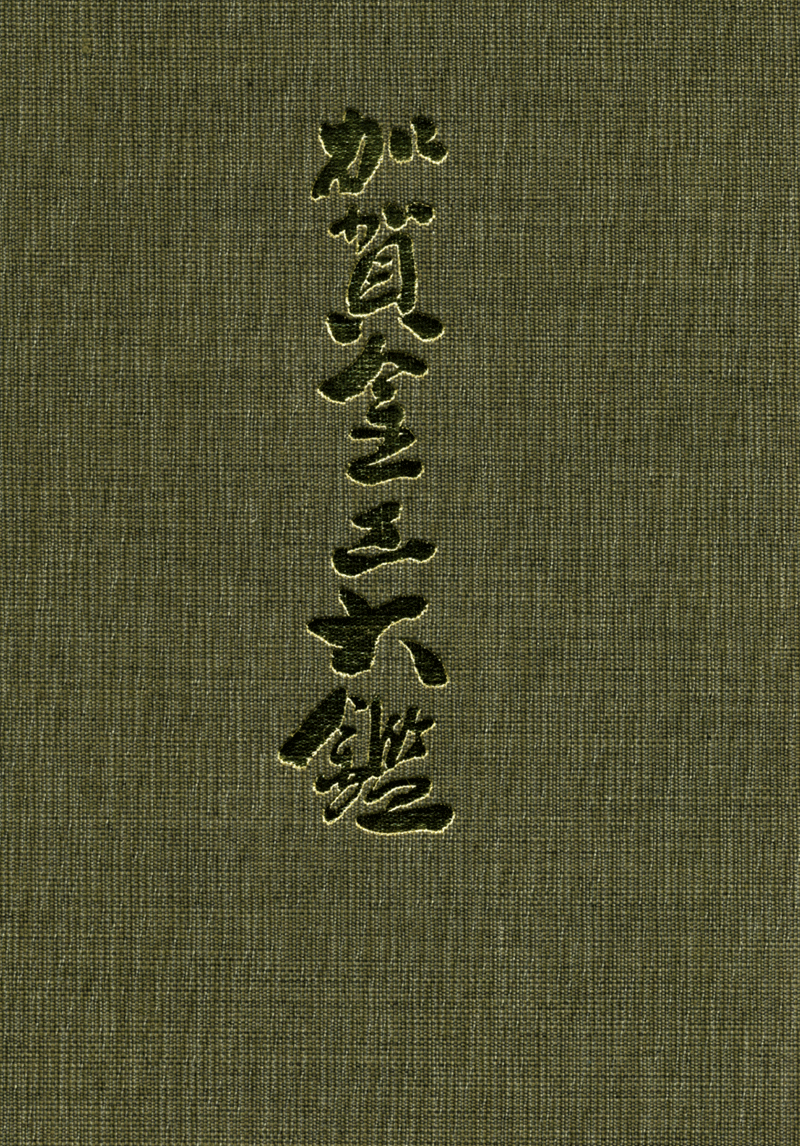
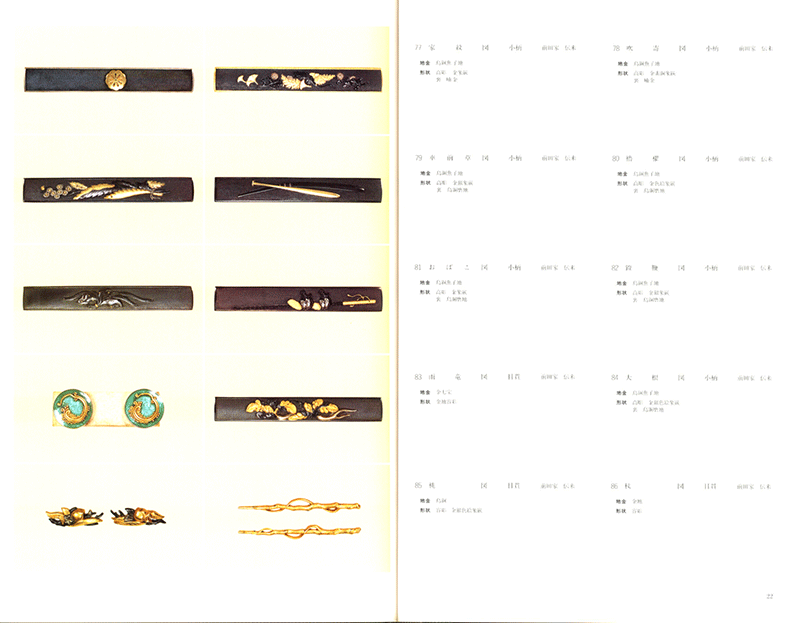
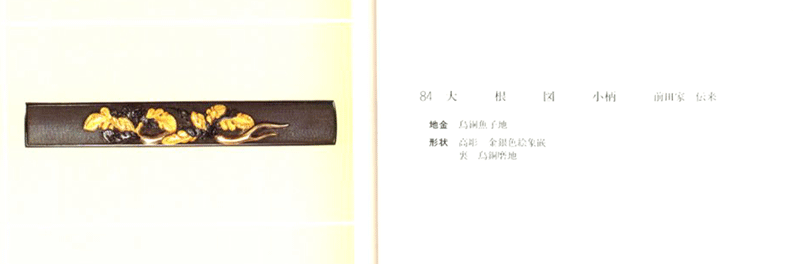
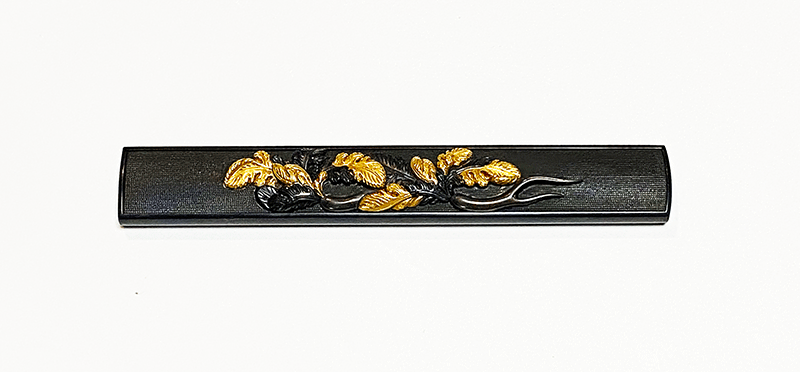
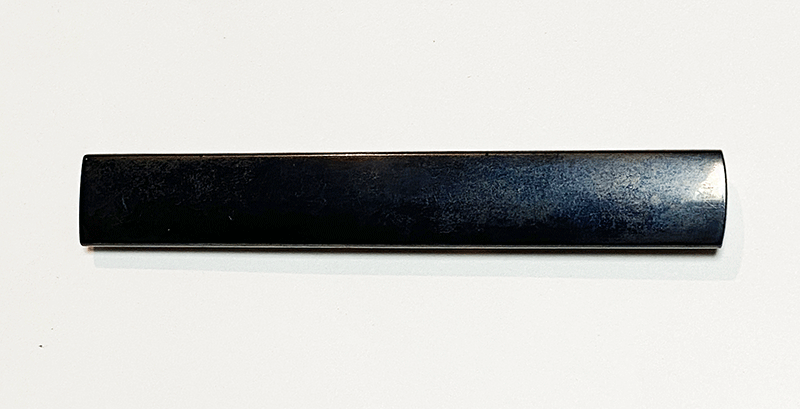
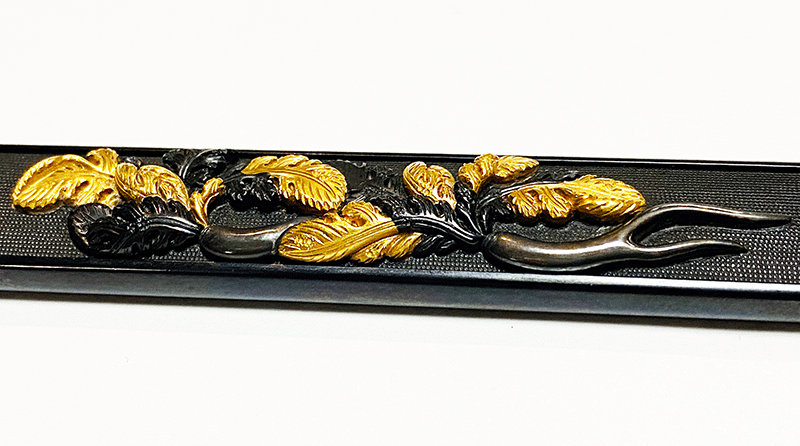
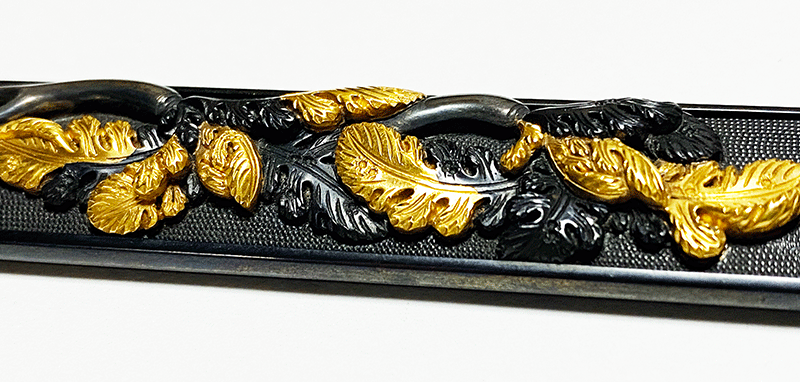
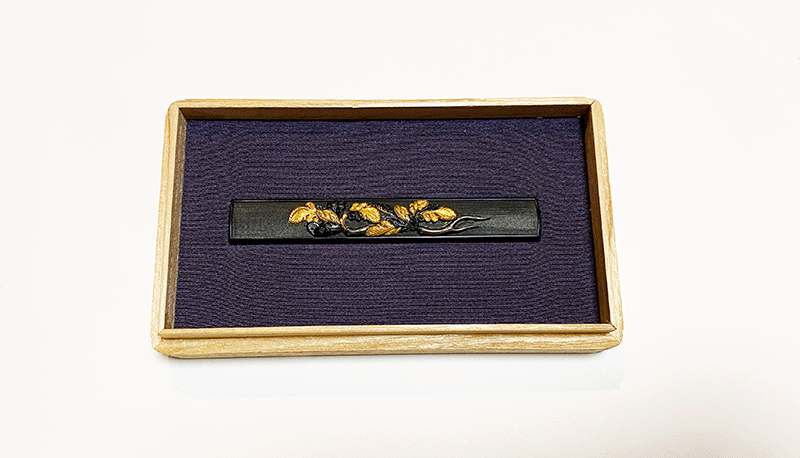
A kozuka designated as Tokubetsu Hozon Tosogu, attributed as the work of the 12th head of the Goto main family, Jujo Mitsumasa. Goto Jujo Mitsumasa was born in Genroku 2 as the legitimate son of the 11th head of the Goto main family, Tsujo Mitsuhisa; his childhood name was Kameichi, and he later took the name Mitsuyuki. In Kyoho 5, 11th month, upon the occasion of his father Mitsuhisa taking the name Tsujo and retiring, he succeeded to the family headship, took the name Shirobei Mitsumasa, and became the 12th generation head of the Goto main family. This work is published in the Kaga Kinko Taikan and is a superior piece said to have been handed down through the Maeda family; the high-quality jet-black shakudo is beautiful, the nanako are arranged in an orderly fashion, and the carving is particularly high, large enough to almost spill out from the frame. The style, finished magnificently using various iroe, can truly be said to reflect the tastes of Lord Maeda. In addition to the high level of perfection, the condition is a transmitted item in perfect condition without a single atari, appearing to be an unused object.
NihontoWatchOffered by Iida Koendo

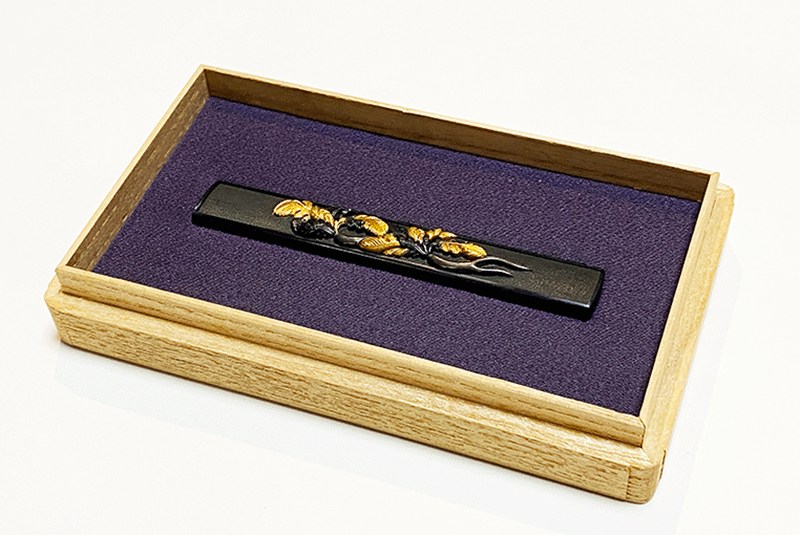
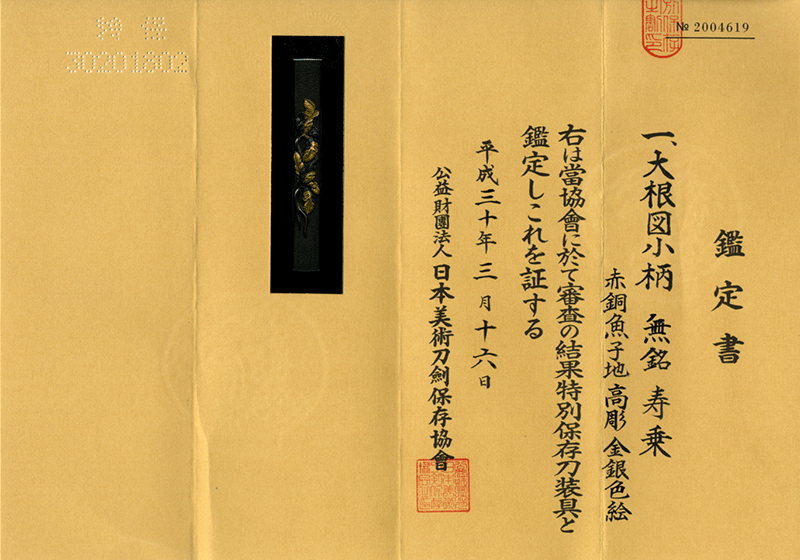
Goto Jujo
Edo
Signed
Tokuho (NBTHK)
Machine translation from the shop's Japanese · may contain errors ·
Iebori · Yamashiro · around 1700-1762
3 pieces on the market now
Goto Jujo, given name Mitsumasa (光理), was the twelfth head of the Goto main line. He was born in Genroku 2 (1689), the eldest son of the eleventh head Tsujo Mitsuhisa, with the childhood name Kameichi, later Mitsuyuki. In the eleventh month of Kyoho 5 (1720), when his father took the name Tsujo and retired, he succeeded to the house and took the name Shirobei Mitsumasa. One record adds that he died of illness in the second month of Kanpo 2 (1742), at fifty-four. The Goto were the house of iebori, the official carving of the shogunal household, and the published sources place him within its mid-Edo generations as a head who looked back to the early masters of the line.
That backward look is the point they make about his manner. Among the Goto heads of the mid-Edo period and after, they write, he succeeded with many works in the old manner of house carving[[c:1]]. A self-signed mitokoromono of long-tailed birds is described as carved in "an old-fashioned, solid manner"[[c:2]], showing the house style "to the full, with dignity and elevated tone"[[c:3]]. His material is the canonical one of the house: kozuka and kogai of shakudo nanako-ji with gold crest work and a gold-covered reverse, and menuki in solid gold, carved in full sculptural katachibori.
Five pieces now stand under his name. The first is a kirin mitokoromono signed Goto Mitsumasa with his kao, the menuki unsigned but given to him. A single kirin, the auspicious beast said in China to appear before a sage, is set as a gold crest on each part, each in a different pose. The commentary writes that his work is called archaic and that this kirin recalls "the Goto works of an earlier age"[[c:4]], with a calm, dignified bearing. The second is the long-tailed bird set, signed on the kozuka and kogai, with an origami of Meiwa 5 (1768) by his son Mitsutaka. The third is a coiled-dragon set, unsigned and attributed to him by the same son with a gold signature and an origami of An'ei 3 (1774). Its gold is laid thick and generous, the roots and reinforcing pieces finished with care, and the published sources call it "a fine set with a formality like a model of the Goto house"[[c:5]].
The fourth, a turtle-in-flowing-water set, is attributed to him by the fifteenth head Shinjo Mitsuyoshi. Here the gold iroe is used only for the flowing water and the dew, set against the deep black of the shakudo for contrast, and the record calls it a fine piece handed down in the main Tokugawa house. The fifth piece stands apart: a Momoyama-period kozuka of the two immortals Hi Chobo and Cho Hakubo, which is not his own work but an earlier head's crest that he appraised as Kojo's, inscribing his name Mitsumasa beside it and issuing an origami of Kyoho 14 (1729) valuing it at one hundred kan.
The appraisals by his son matter to the record. Of the long-tailed bird set the commentary says that a son judging his father's work is the most certain of appraisals[[c:6]], and of the coiled-dragon set that such a judgment carries the same weight as the maker's own signature[[c:7]]. His self-signature, on two of the five pieces, therefore sits beside the son's appraisals as the documentary basis of his work, while his own name on the Kojo kozuka marks him as a certifying head of the house rather than its maker.
His record is five works designated Juyo, two of them self-signed. With so small a body of work, each set is a document of the Goto main line in the mid-Edo period, and a Jujo mitokoromono reaches a collector only rarely.
Where Goto Jujo stands among comparable artisans: across all of nihontō, and within tradition, era, and period. The tiers (Foremost · Leading · Major · Notable) weigh official designations from the NBTHK and Japan's Agency for Cultural Affairs, together with historical honors of lasting repute such as the Sansaku and Meibutsu-chō.
Select a lens to see how it's measured.
Iebori · Yamashiro
Phase: Goto Main Line後藤宗家· 1573–1900
315 pieces on the market now
| Smith | Era | Designated |
|---|---|---|
| Goto Joshin後藤乗真 | 1512-1562 | 68 |
| Goto Yujo後藤祐乗 | 1440-1512 | 41 |
| Goto Sojo後藤宗乗 | 1461-1538 | 56 |
| Goto Kenjo後藤顕乗 | 1586-1663 | 46 |
| Goto Teijo後藤程乗 | 1603-1673 | 42 |
A Hozon-certified fitting of notably superior craftsmanship and condition, often with signature or workmanship of high reference value.
The NBTHK (Nihon Bijutsu Tōken Hozon Kyōkai, the Society for the Preservation of Japanese Art Swords) is a public-interest incorporated foundation founded in 1948 and supervised by Japan’s Agency for Cultural Affairs (Bunkachō); it is based at the Japanese Sword Museum in Tokyo. Its expert panels physically examine each submitted work (shinsa) and issue a certificate (kanteishō) ranking it by artistic and historical merit. NBTHK papers are the most widely recognized standard of authentication for Japanese swords and fittings.
NBTHK official siteFor returns at the customer's convenience, please notify us within two days of the item's arrival. Items that have been altered cannot be accepted. Return shipping is at the customer's expense. Costs other than the item price (bank transfer fees, cash-on-delivery fees, etc.) cannot be refunded. Items delivered overseas cannot be returned or refunded.