 NihontoWatchNihontoWatch
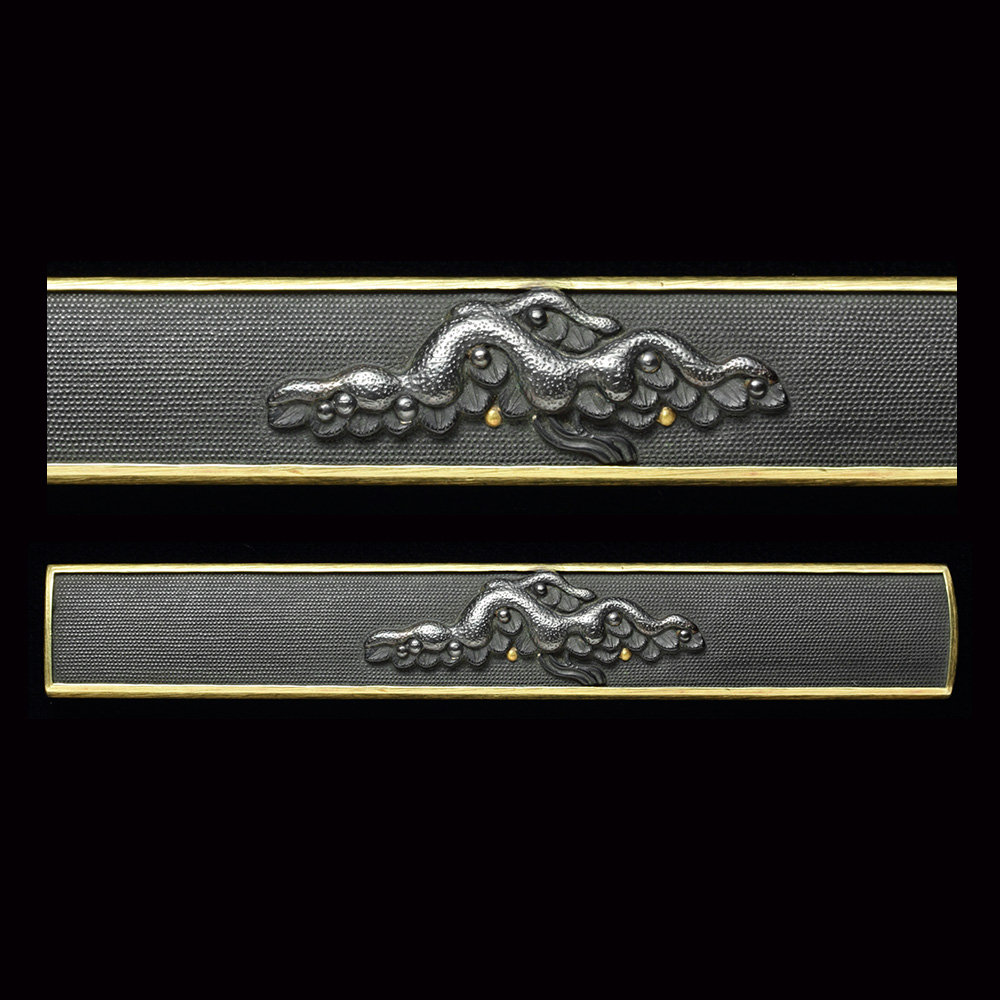
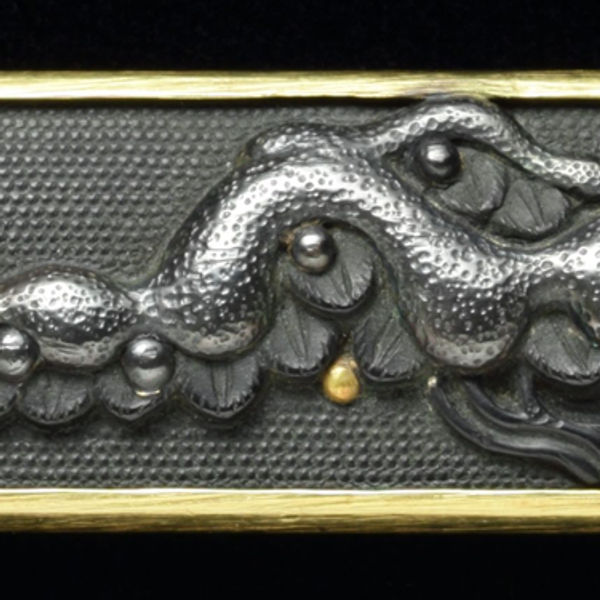
A high-quality kozuka (note) engraved with a precious jishin-mei by the 12th generation of the Goto main line, Jujo Mitsumasa. Mitsumasa was the legitimate son of the previous generation Tsujo and was born in Genroku 2. He inherited the family headship in Kyoho 7, and in addition to the traditional Goto family style, he left behind creative works such as a yawning tiger and a thrush resting its wings alongside a plow. This kozuka takes its theme from the yabu-koji (spearflower) covered in snow, which was favored as a New Year's decoration. It depicts the appearance of snowmelt dripping under the pure air and gentle sunlight, with the characteristic red berries carved in kin-iroe beneath the shade of the leaves. The snow is gin-iroe that has blackened over time, possessing a unique strong luster that also overflows with a sense of purity. Note: The original kinran wrapping paper decorated with chrysanthemums from the time of manufacture is included, and the origami wrapping over it is inscribed in ink with "Jujo saku, Yuki Yabu-koji, Ura-bori ari".
NihontoWatchOffered by Choshuya
This piece has sold
Get an email when a new Goto Jujo piece hits the market.
Goto Jujo
Edo
Musashi
Signed
Tokuho (NBTHK)
As written by the shop
Machine translation from the shop's Japanese · may contain errors ·
Iebori · Yamashiro · around 1700-1762
3 pieces on the market now
Goto Jujo, given name Mitsumasa (光理), was the twelfth head of the Goto main line. He was born in Genroku 2 (1689), the eldest son of the eleventh head Tsujo Mitsuhisa, with the childhood name Kameichi, later Mitsuyuki. In the eleventh month of Kyoho 5 (1720), when his father took the name Tsujo and retired, he succeeded to the house and took the name Shirobei Mitsumasa. One record adds that he died of illness in the second month of Kanpo 2 (1742), at fifty-four. The Goto were the house of iebori, the official carving of the shogunal household, and the published sources place him within its mid-Edo generations as a head who looked back to the early masters of the line.
That backward look is the point they make about his manner. Among the Goto heads of the mid-Edo period and after, they write, he succeeded with many works in the old manner of house carving[[c:1]]. A self-signed mitokoromono of long-tailed birds is described as carved in "an old-fashioned, solid manner"[[c:2]], showing the house style "to the full, with dignity and elevated tone"[[c:3]]. His material is the canonical one of the house: kozuka and kogai of shakudo nanako-ji with gold crest work and a gold-covered reverse, and menuki in solid gold, carved in full sculptural katachibori.
Five pieces now stand under his name. The first is a kirin mitokoromono signed Goto Mitsumasa with his kao, the menuki unsigned but given to him. A single kirin, the auspicious beast said in China to appear before a sage, is set as a gold crest on each part, each in a different pose. The commentary writes that his work is called archaic and that this kirin recalls "the Goto works of an earlier age"[[c:4]], with a calm, dignified bearing. The second is the long-tailed bird set, signed on the kozuka and kogai, with an origami of Meiwa 5 (1768) by his son Mitsutaka. The third is a coiled-dragon set, unsigned and attributed to him by the same son with a gold signature and an origami of An'ei 3 (1774). Its gold is laid thick and generous, the roots and reinforcing pieces finished with care, and the published sources call it "a fine set with a formality like a model of the Goto house"[[c:5]].
The fourth, a turtle-in-flowing-water set, is attributed to him by the fifteenth head Shinjo Mitsuyoshi. Here the gold iroe is used only for the flowing water and the dew, set against the deep black of the shakudo for contrast, and the record calls it a fine piece handed down in the main Tokugawa house. The fifth piece stands apart: a Momoyama-period kozuka of the two immortals Hi Chobo and Cho Hakubo, which is not his own work but an earlier head's crest that he appraised as Kojo's, inscribing his name Mitsumasa beside it and issuing an origami of Kyoho 14 (1729) valuing it at one hundred kan.
The appraisals by his son matter to the record. Of the long-tailed bird set the commentary says that a son judging his father's work is the most certain of appraisals[[c:6]], and of the coiled-dragon set that such a judgment carries the same weight as the maker's own signature[[c:7]]. His self-signature, on two of the five pieces, therefore sits beside the son's appraisals as the documentary basis of his work, while his own name on the Kojo kozuka marks him as a certifying head of the house rather than its maker.
His record is five works designated Juyo, two of them self-signed. With so small a body of work, each set is a document of the Goto main line in the mid-Edo period, and a Jujo mitokoromono reaches a collector only rarely.
Where Goto Jujo stands among comparable artisans: across all of nihontō, and within tradition, era, and period. The tiers (Foremost · Leading · Major · Notable) weigh official designations from the NBTHK and Japan's Agency for Cultural Affairs, together with historical honors of lasting repute such as the Sansaku and Meibutsu-chō.
Select a lens to see how it's measured.
Iebori · Yamashiro
Phase: Goto Main Line後藤宗家· 1573–1900
317 pieces on the market now
| Smith | Era | Designated |
|---|---|---|
| Goto Joshin後藤乗真 | 1512-1562 | 68 |
| Goto Yujo後藤祐乗 | 1440-1512 | 41 |
| Goto Kenjo後藤顕乗 | 1586-1663 | 46 |
| Goto Sojo後藤宗乗 | 1461-1538 | 56 |
| Goto Teijo後藤程乗 | 1603-1673 | 42 |
A Hozon-certified fitting of notably superior craftsmanship and condition, often with signature or workmanship of high reference value.
The NBTHK (Nihon Bijutsu Tōken Hozon Kyōkai, the Society for the Preservation of Japanese Art Swords) is a public-interest incorporated foundation founded in 1948 and supervised by Japan’s Agency for Cultural Affairs (Bunkachō); it is based at the Japanese Sword Museum in Tokyo. Its expert panels physically examine each submitted work (shinsa) and issue a certificate (kanteishō) ranking it by artistic and historical merit. NBTHK papers are the most widely recognized standard of authentication for Japanese swords and fittings.
NBTHK official siteIf, due to our fault, the item differs significantly from its proper condition, the item may be returned. Cooling-off is within one week of the item's arrival.