NihontoWatch Mon

NihontoWatch

MarketAuctions
Encyclopedia
NihontoWatch Mon

NihontoWatch

MarketAuctions
Encyclopedia

Description

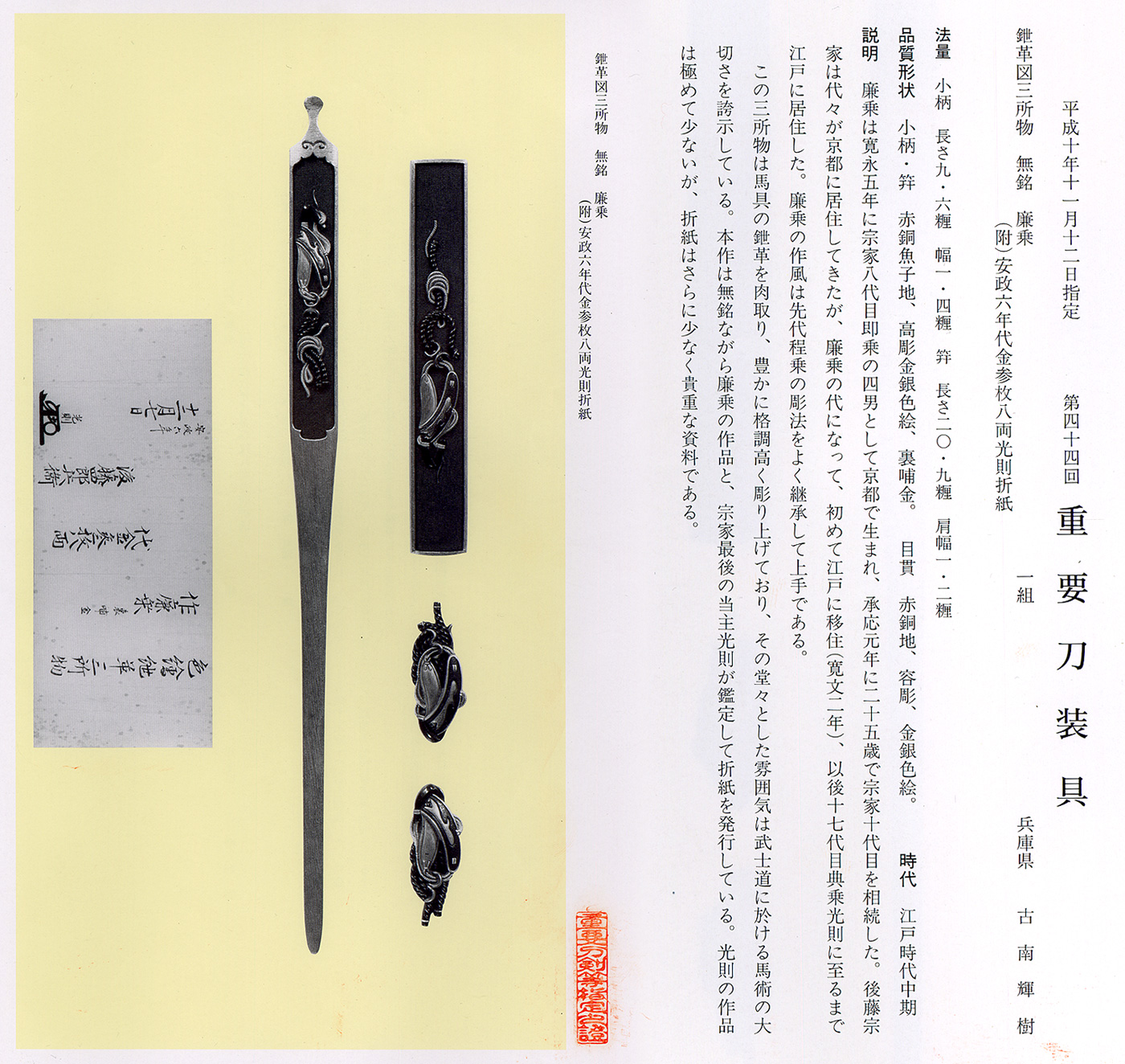
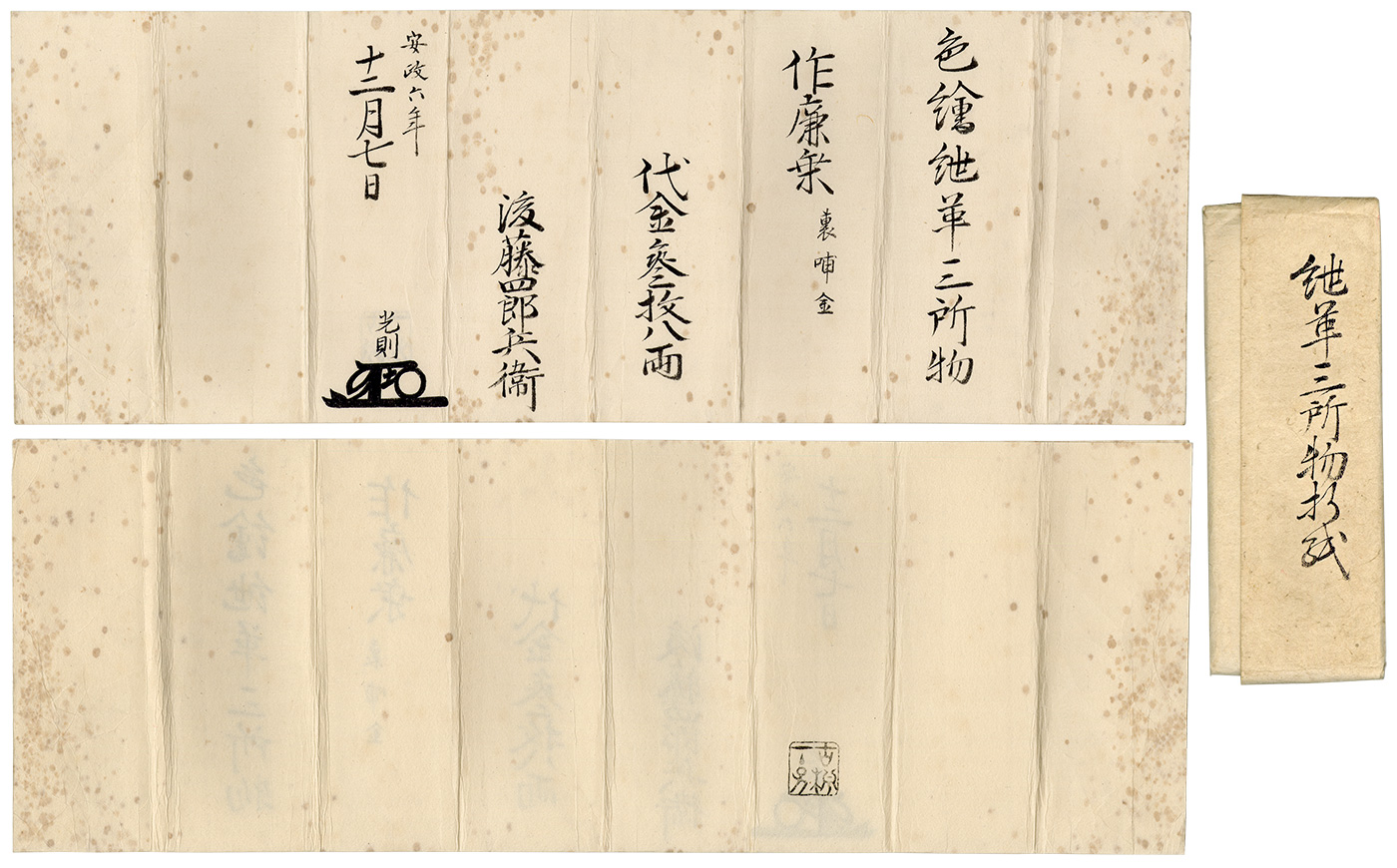
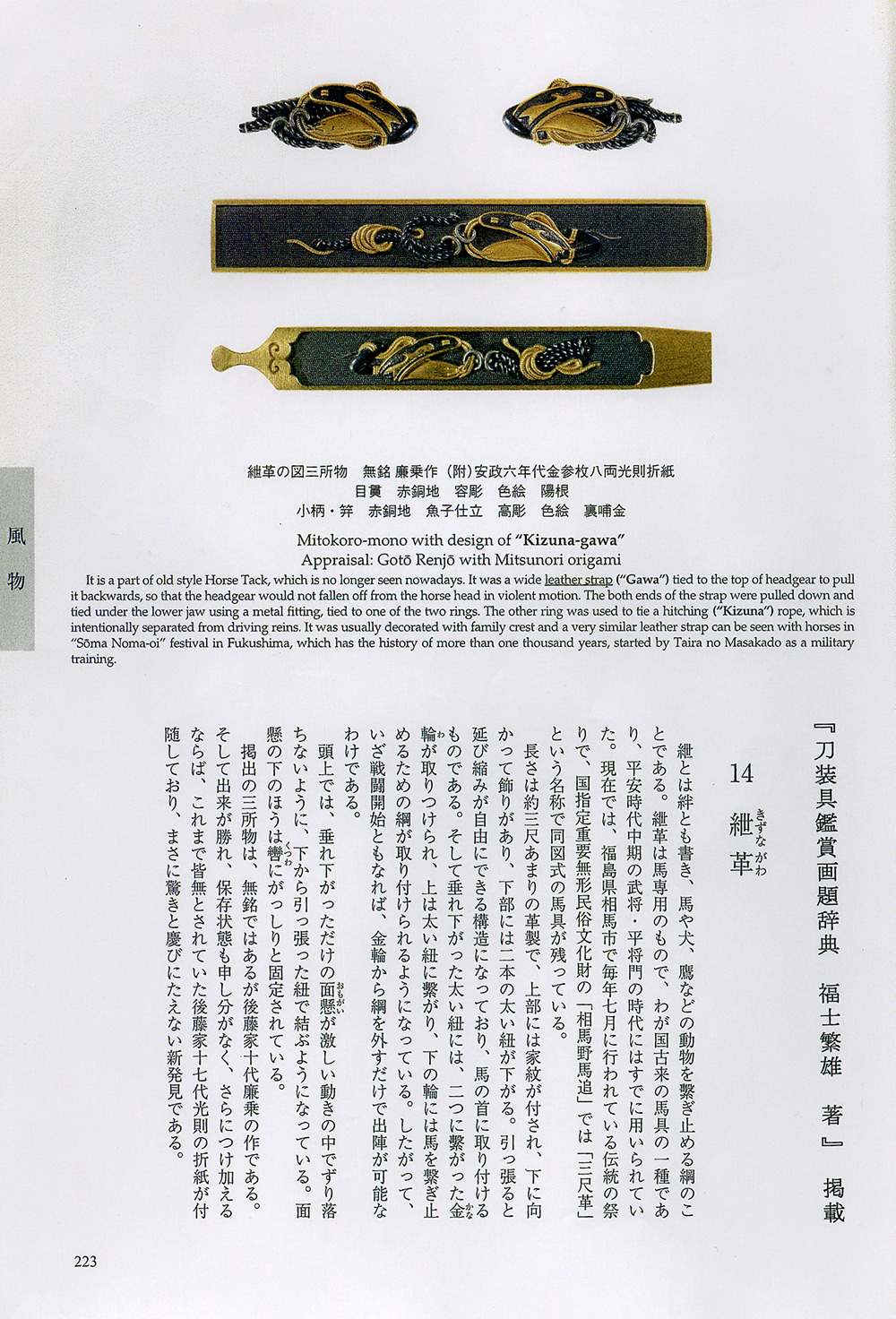
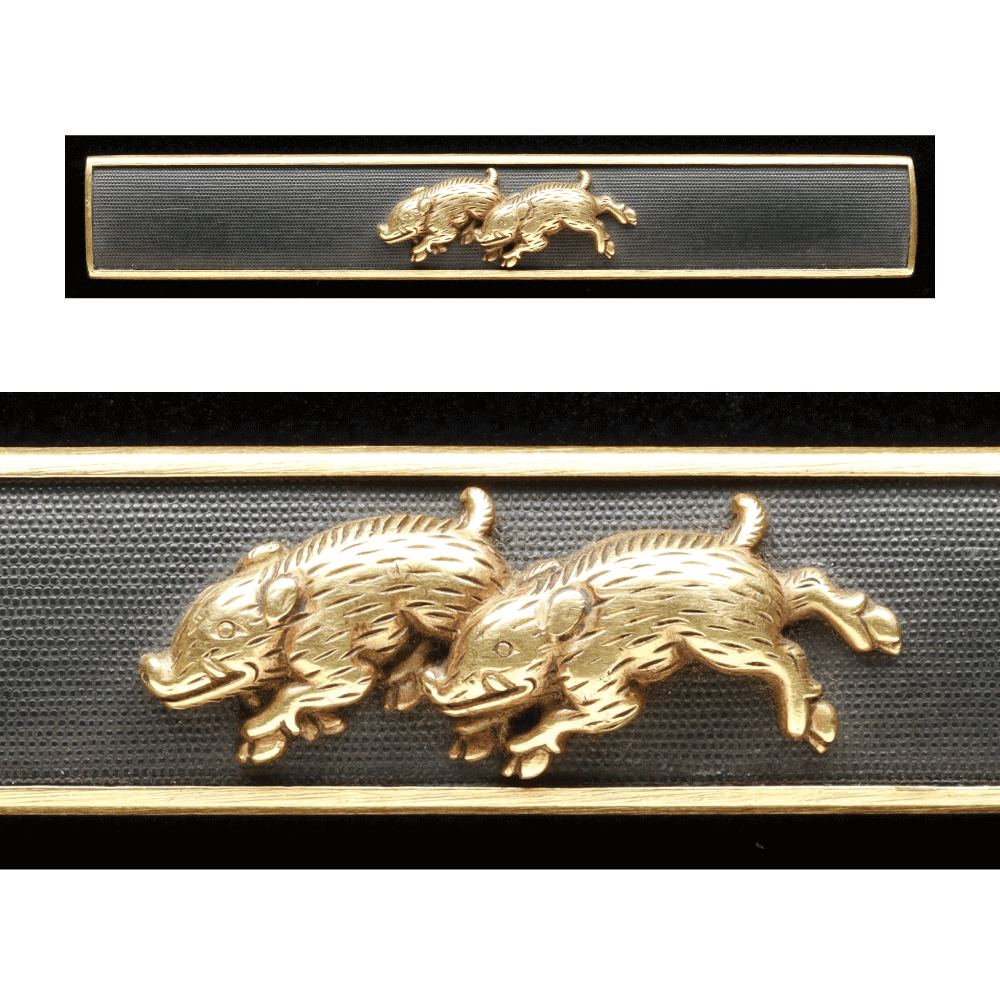
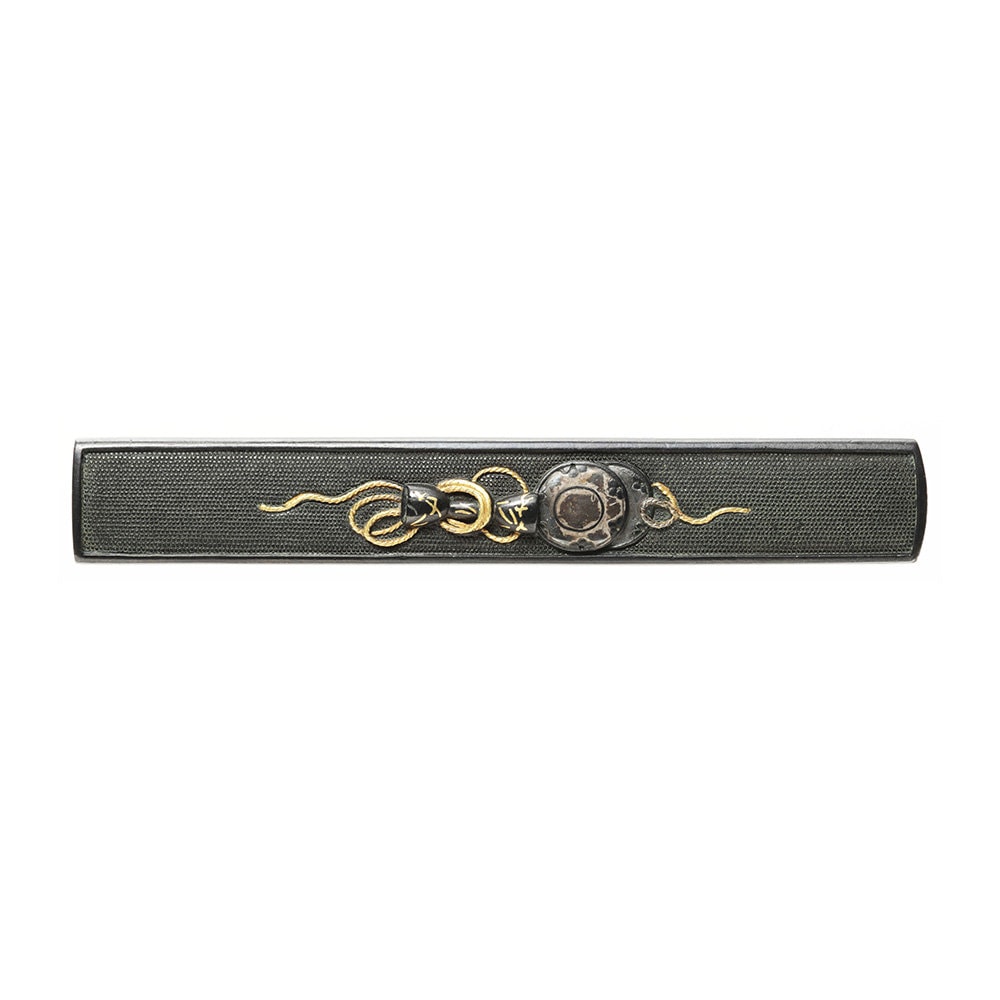
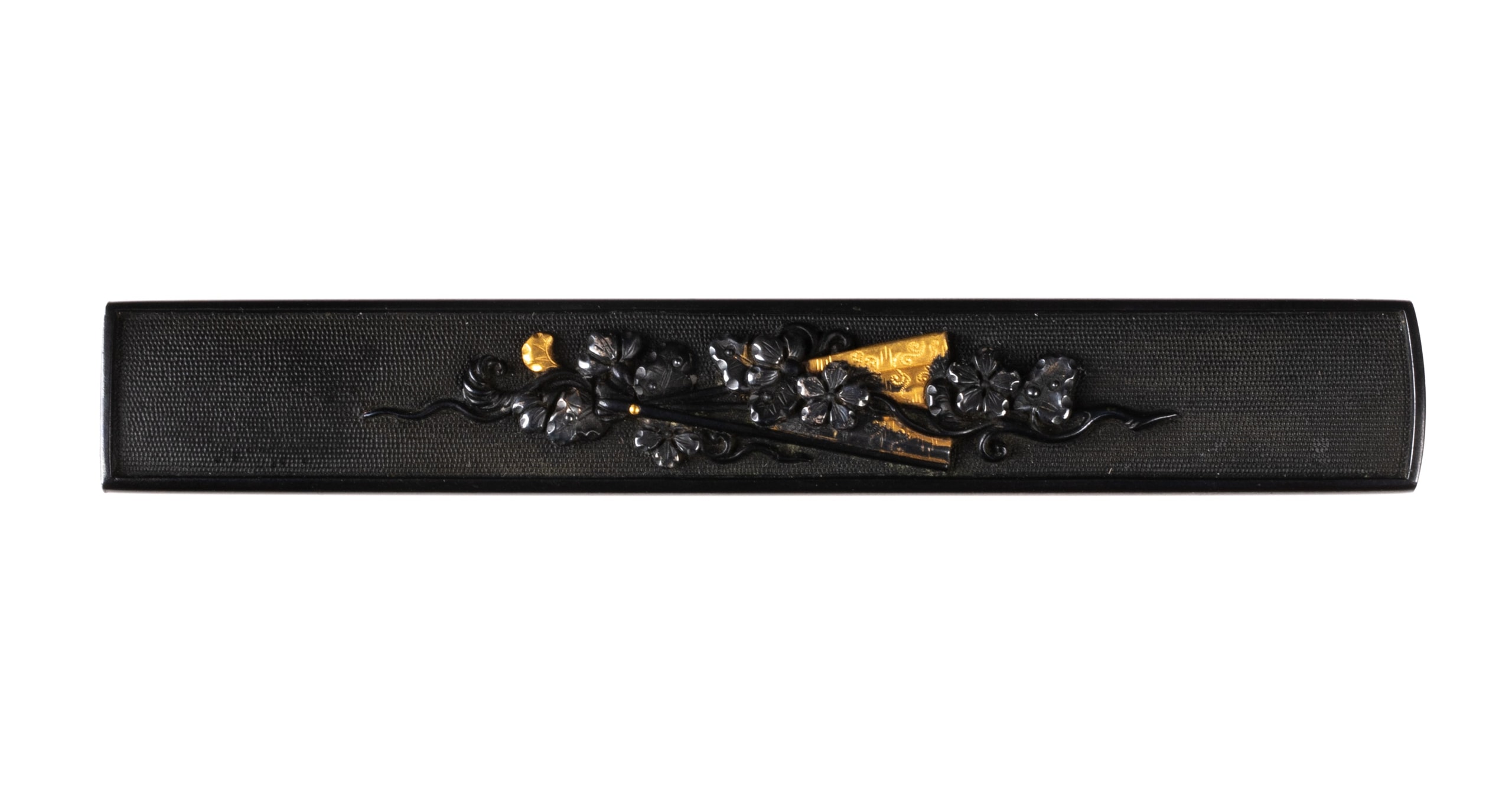
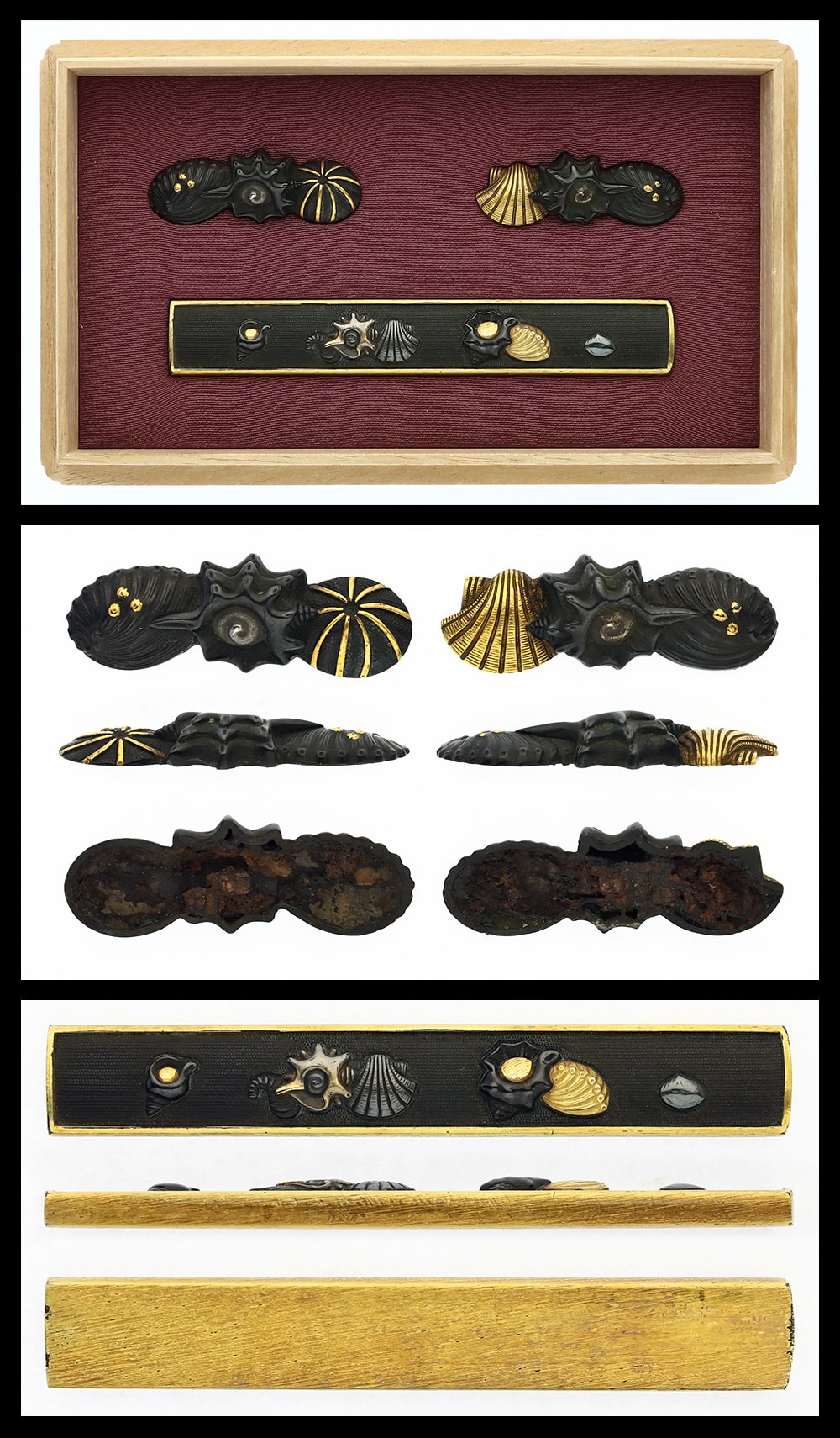
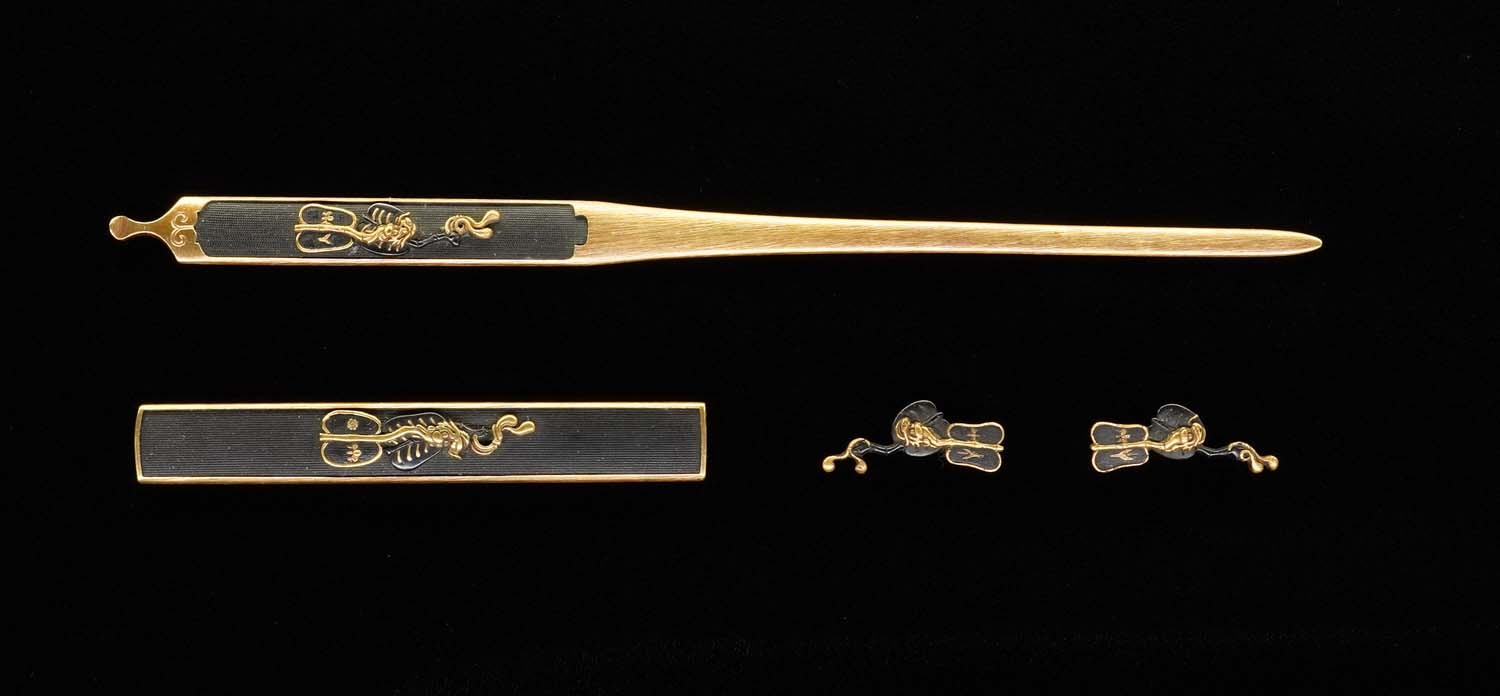
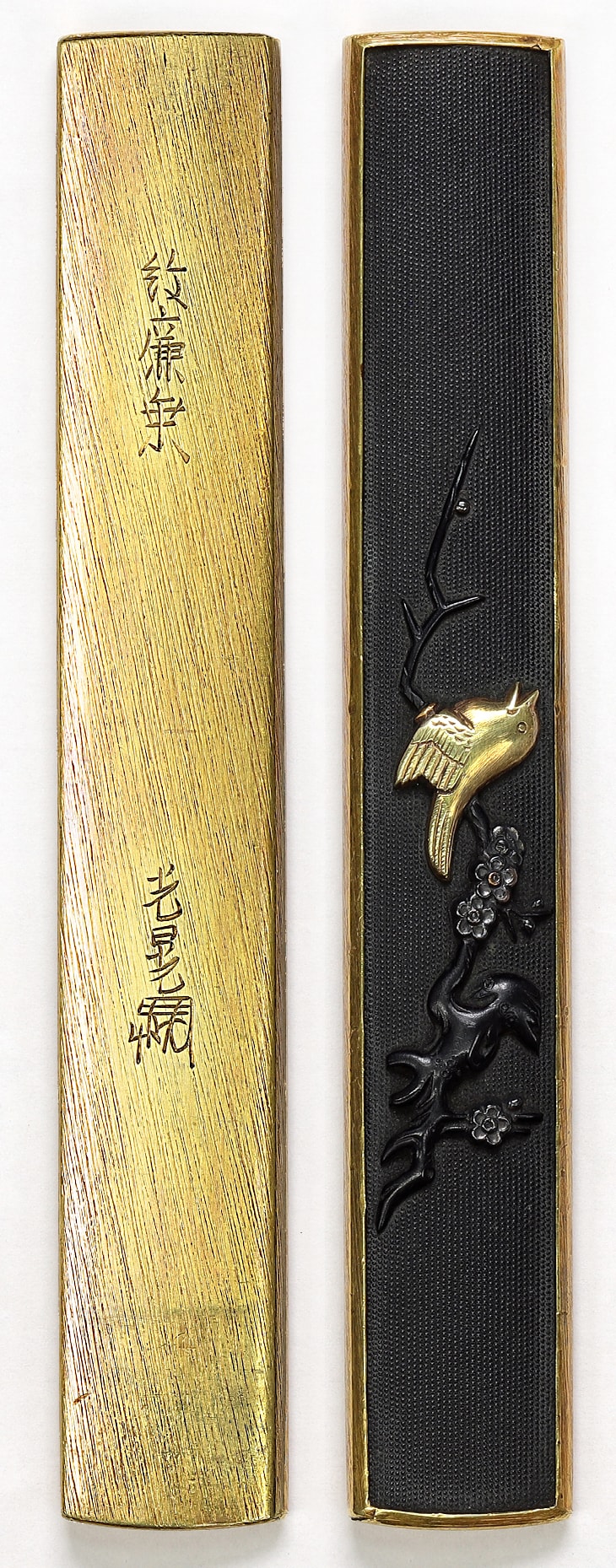
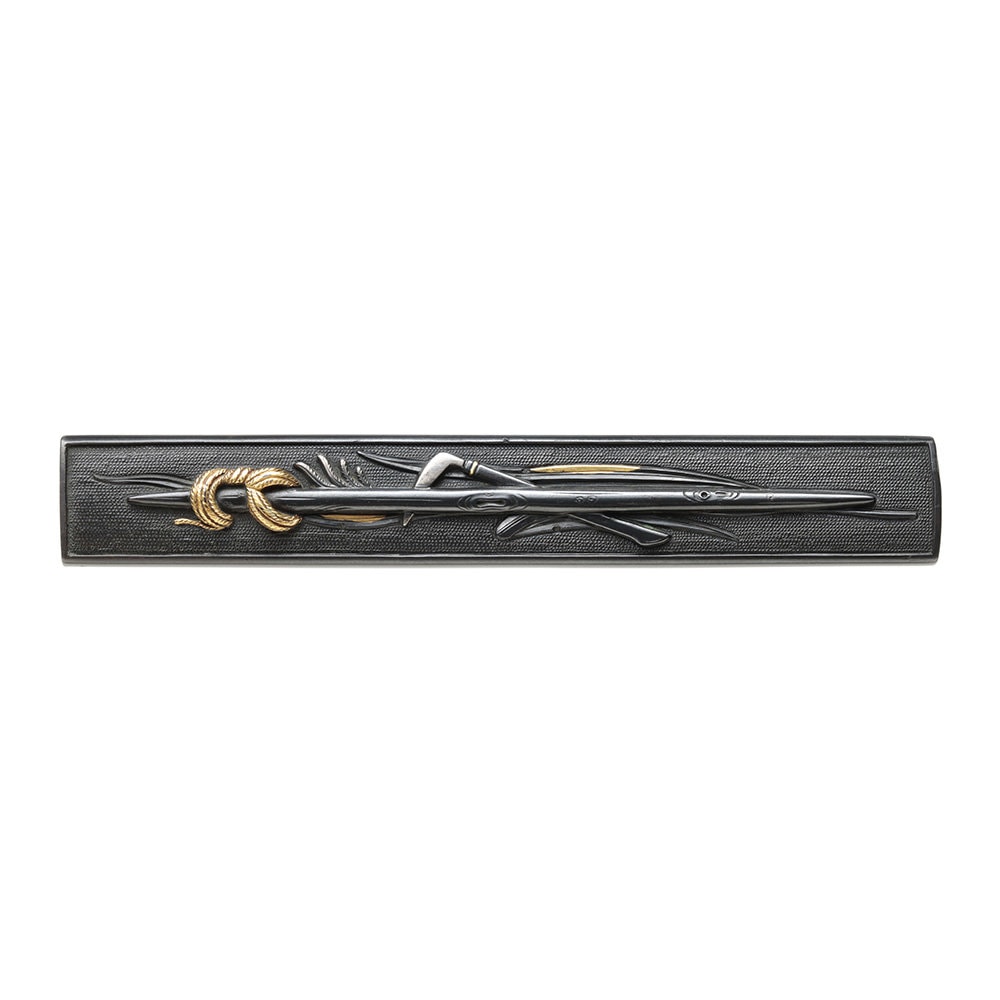
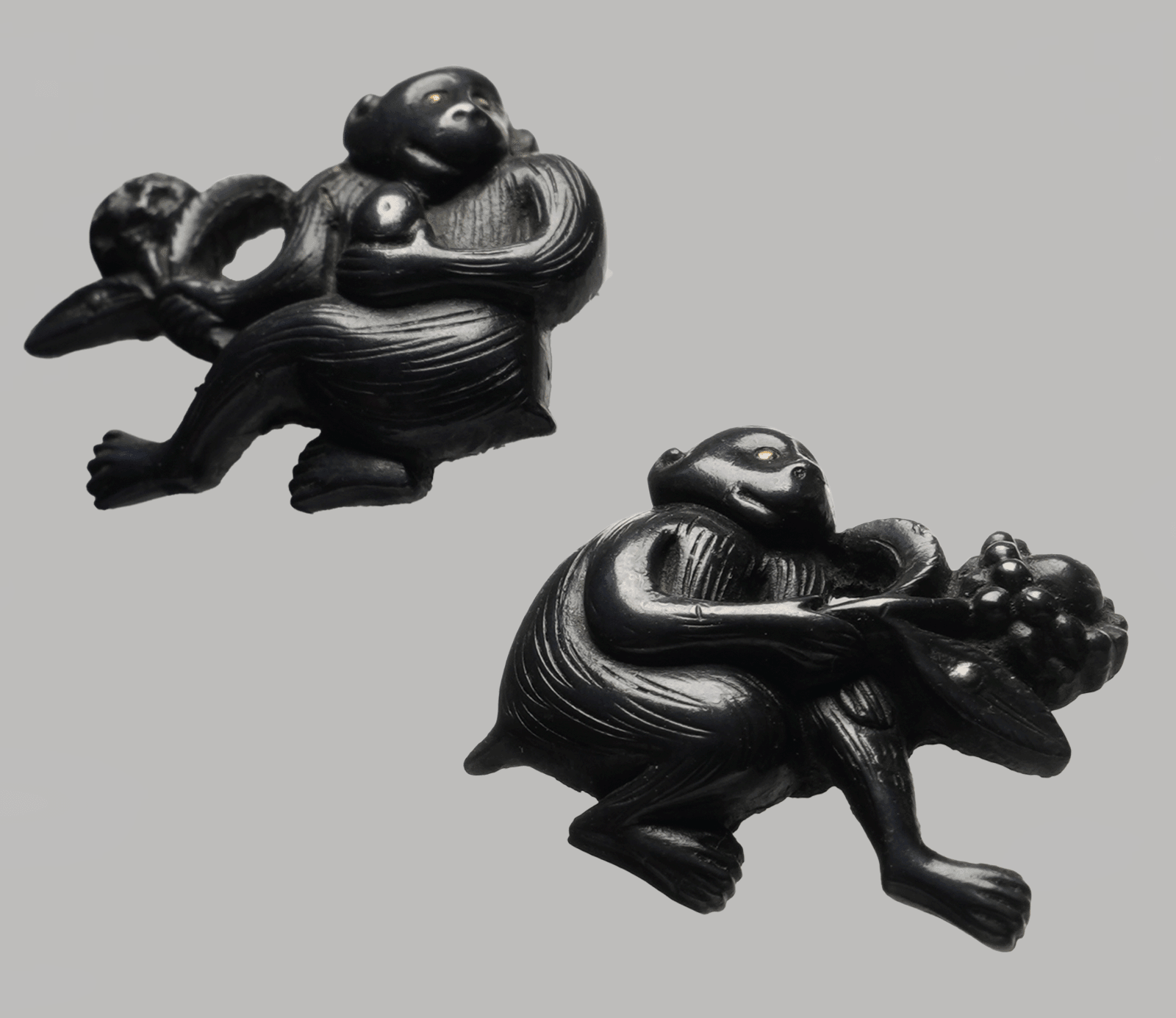
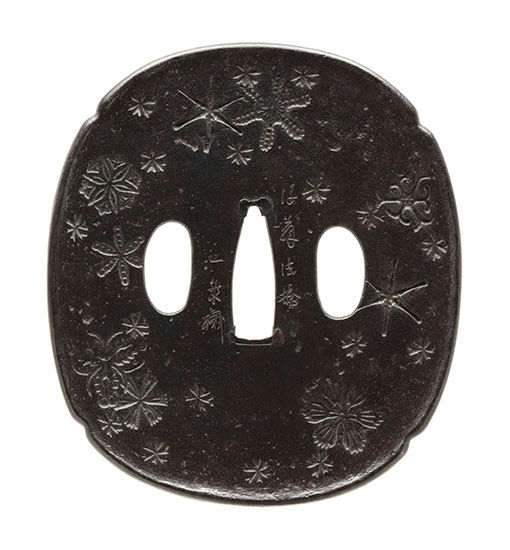
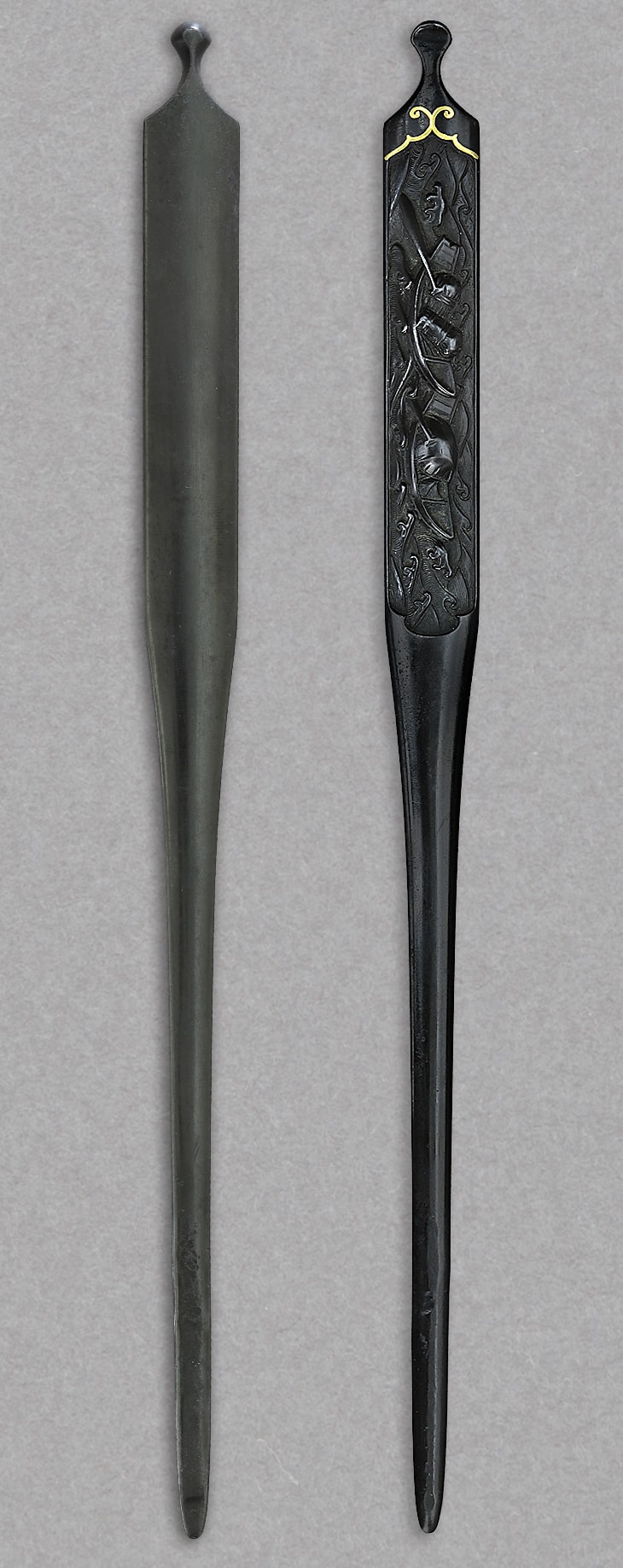
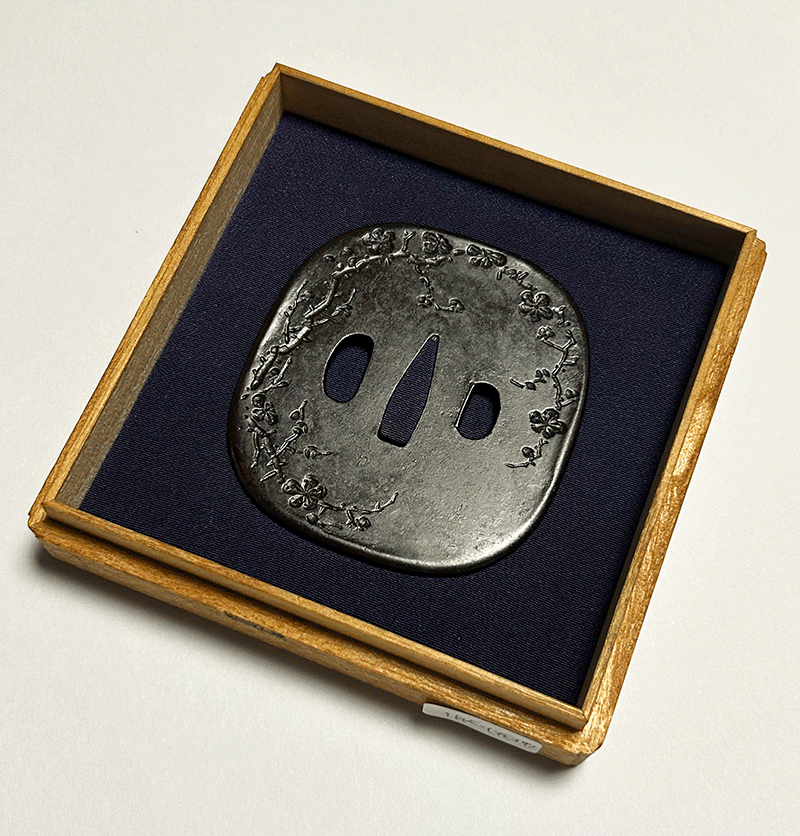
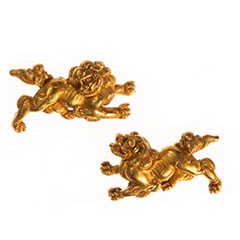
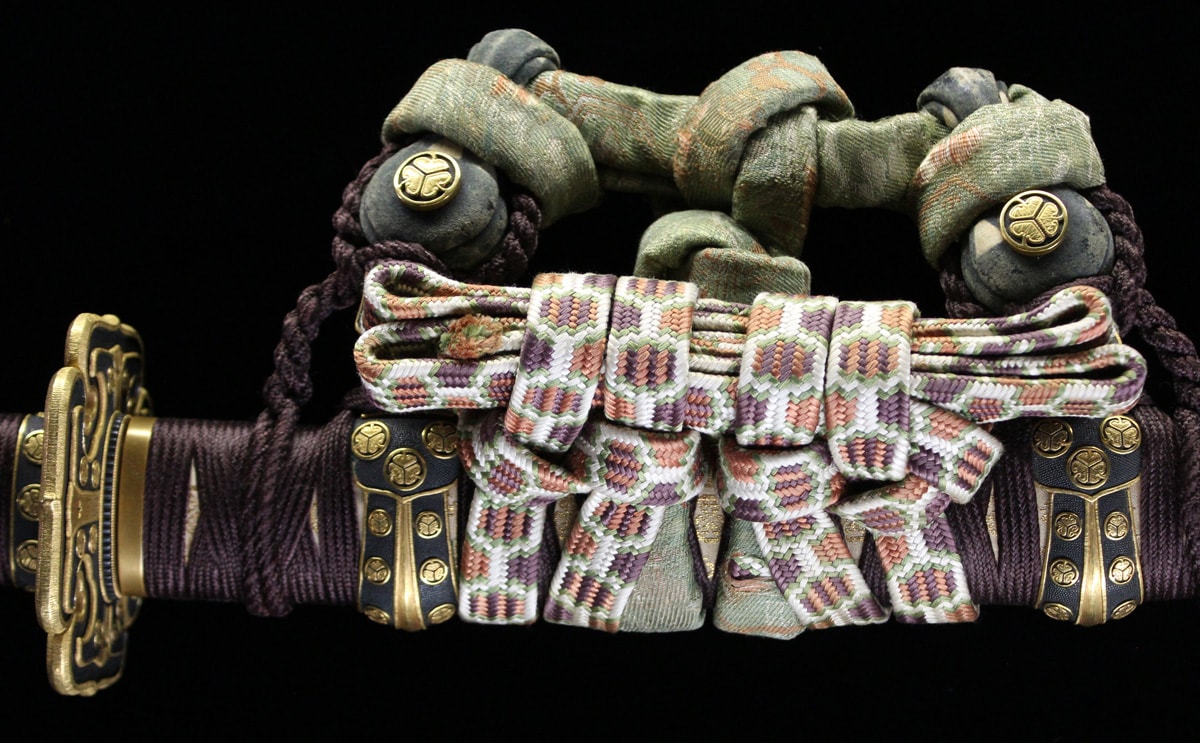
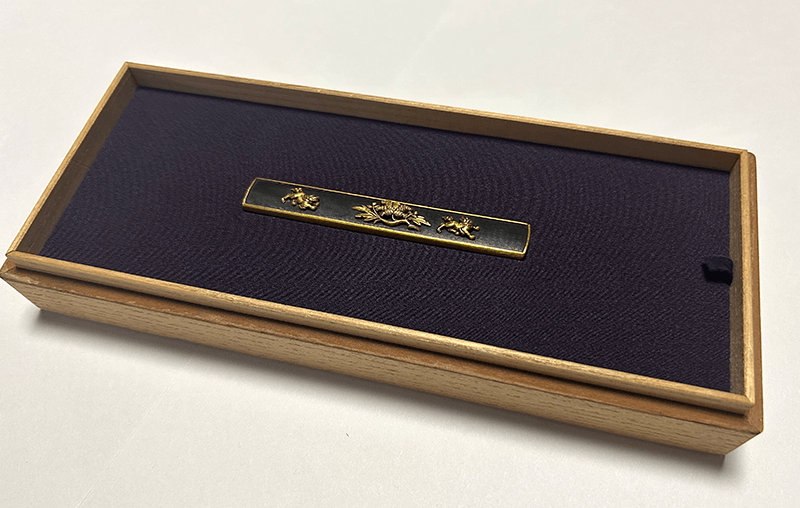
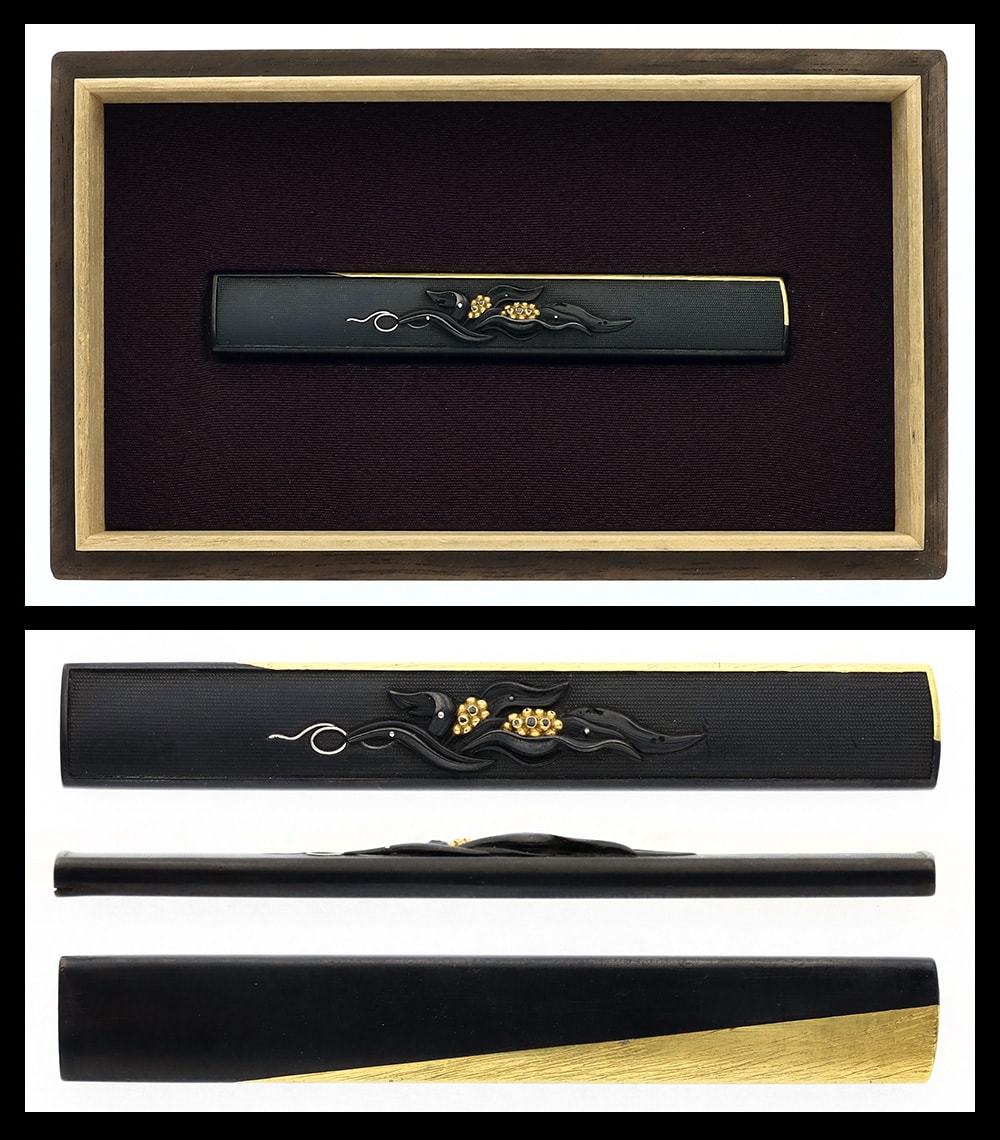
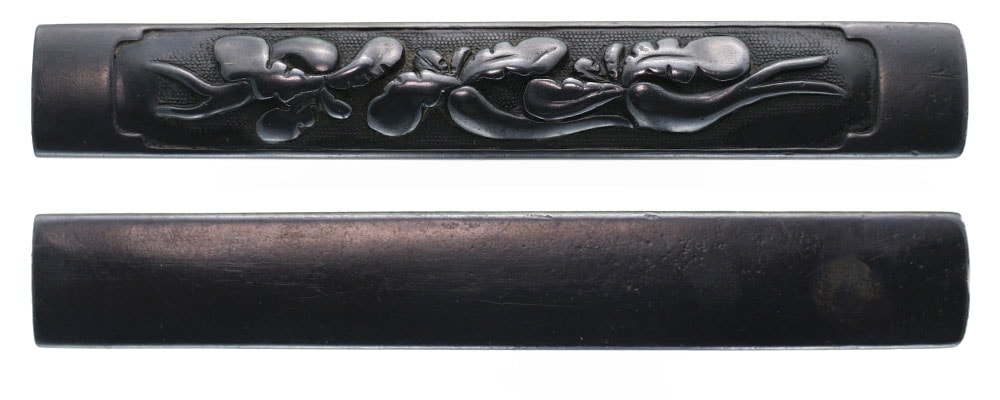
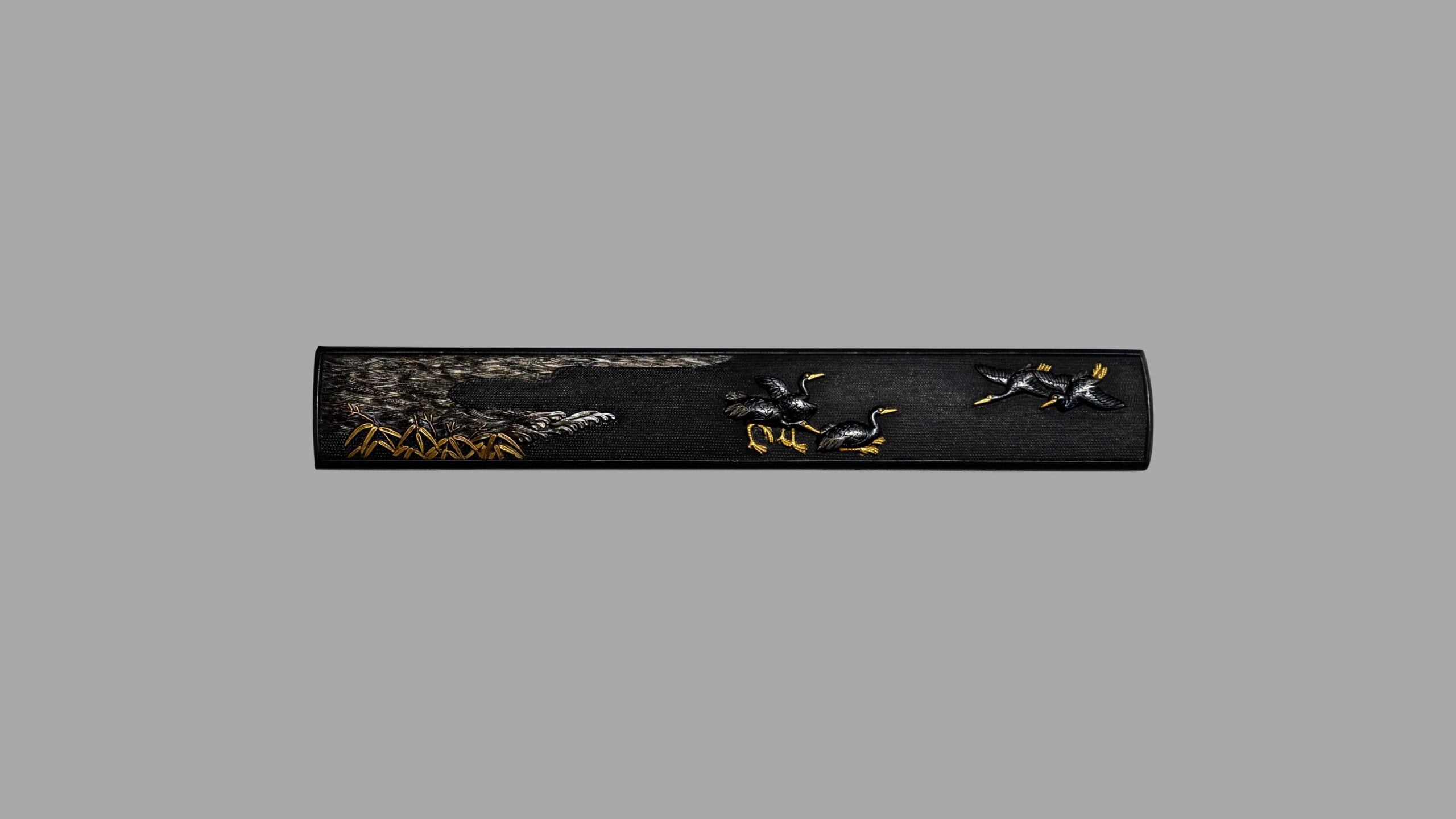
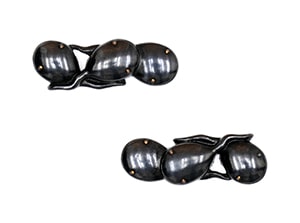
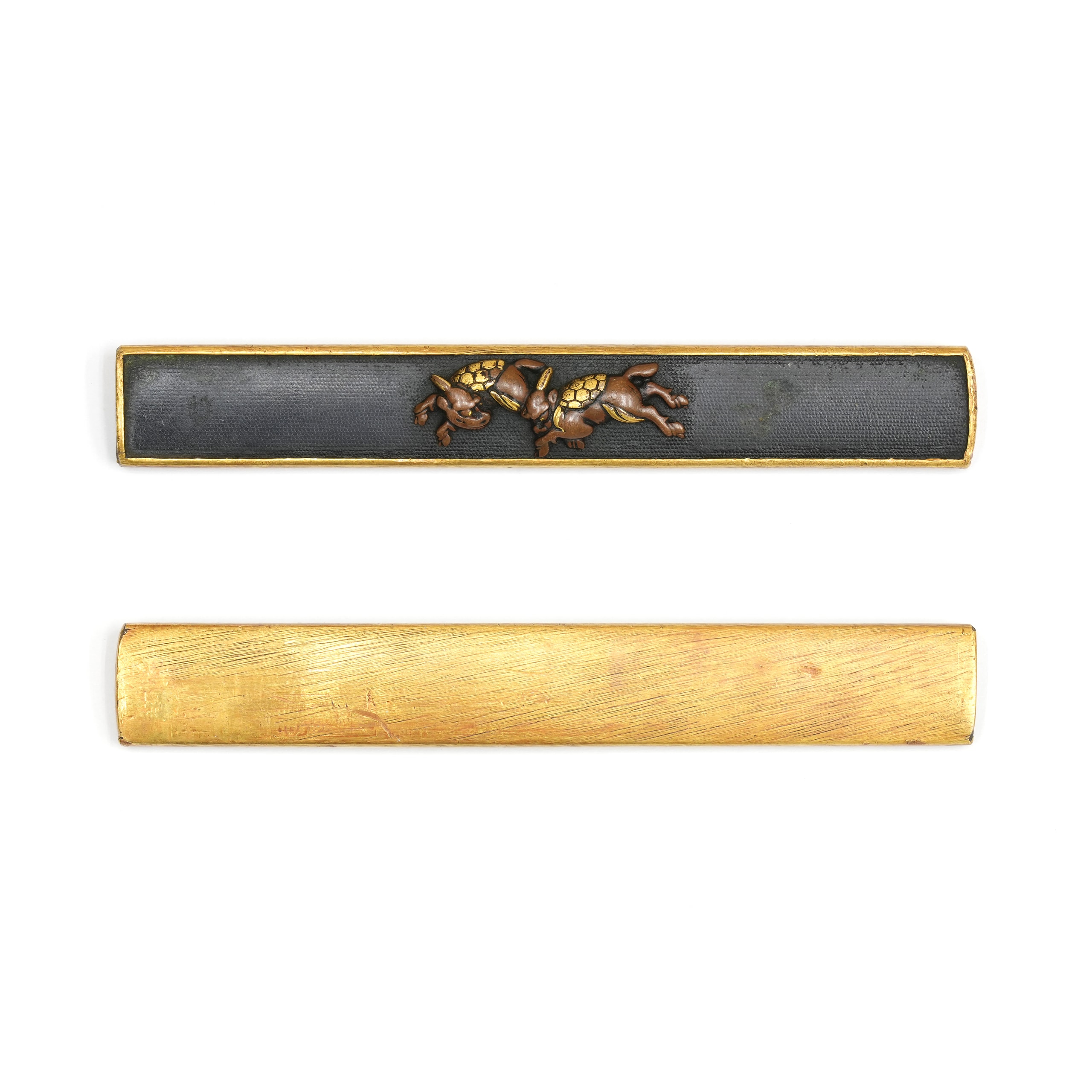
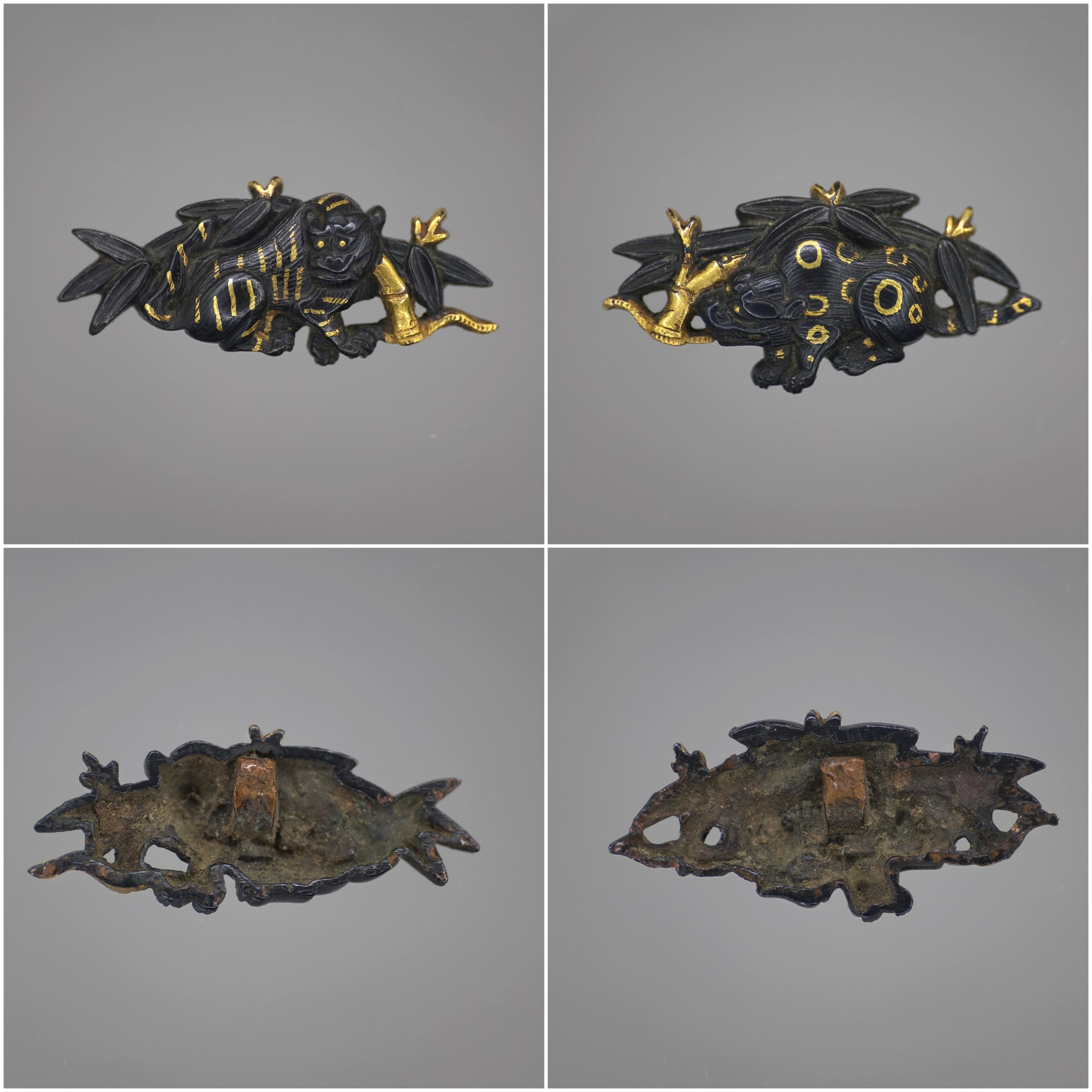
This is a mitokoromono set (kogai, kozuka, menuki) attributed to Renjō, the 10th head of the Gotō main family, from the Edo Period. It features a kizukawa (horse harness leather straps) motif, intricately carved in shakudō with gold and silver inlay. The set comes with an extremely rare origami certificate issued by the final Gotō head, Mitsunori, and is designated as the 44th NBTHK Juyo Tosogu.

NBTHK Setsumei

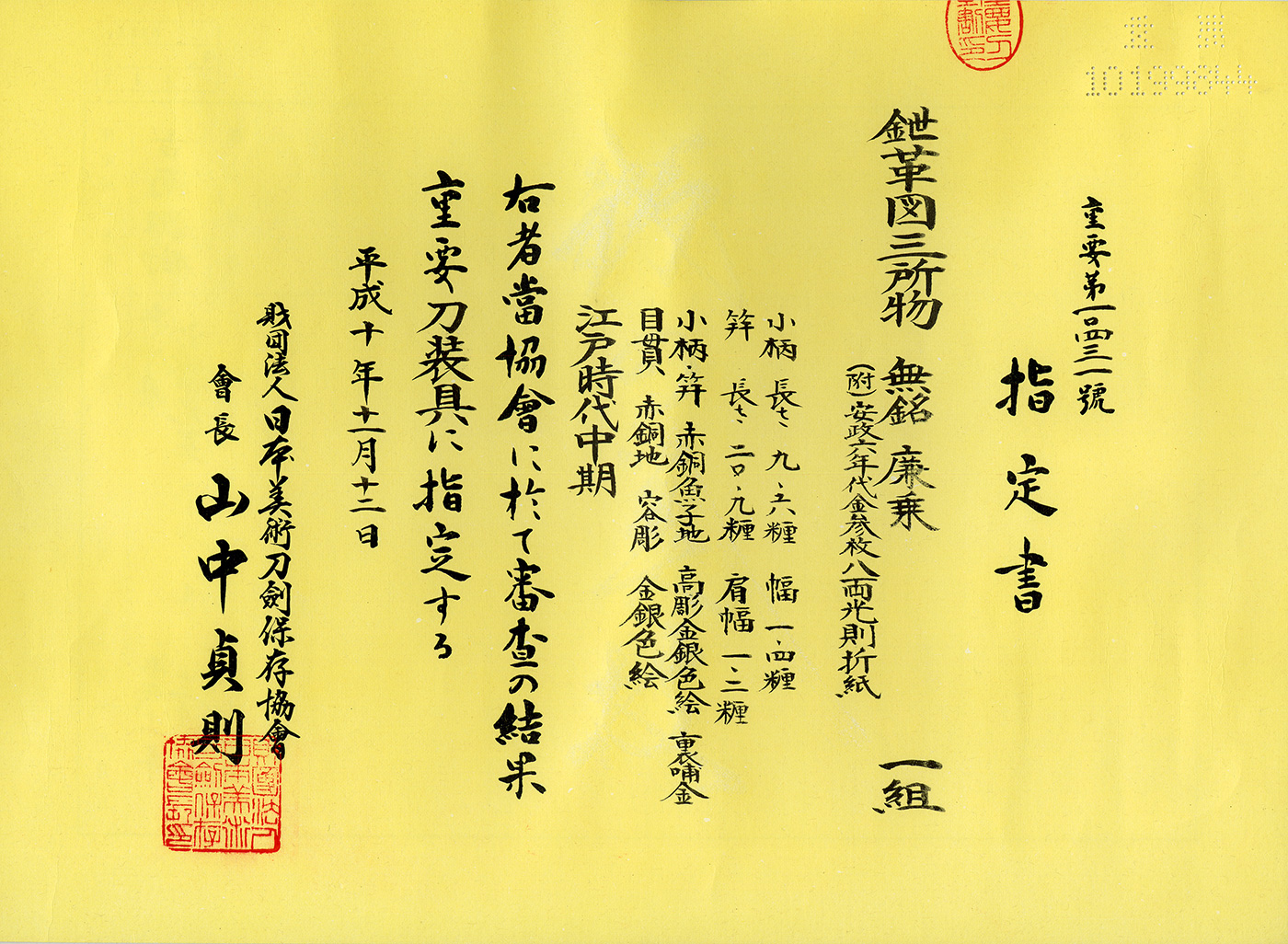
Jūyō-Tōsōgu, 44th Session — Designated November 12, 1998 Sanshōmono, mumei: Gotō Renjō (後藤廉乗) Measurements - Kozuka: length 9.6 cm; width 1.4 cm - Kogai: length 20.9 cm; shoulder width: (not stated) Description Form: sanshōmono comprising kozuka, kogai, and a pair of menuki Material: - Kozuka and kogai: shakudō with nanako-ji; reverse gilt (kin’ura) - Menuki: shakudō ground Design: “Kiri-kawa” (leather coverings for gimlets/awls used among horse trappings) Decoration: - Kozuka and kogai: takabori with gold and silver iroe - Menuki: nikubori with gold and silver iroe Signature: unsigned (mumei) Accompanying document: an origami by Mitsunori dated Ansei 6 (1859), with valuation “daikin sanmai hachi-ryō” (三枚八両) Artisan Gotō mainline — attributed to Gotō Renjō (後藤廉乗) Era Mid Edo period Explanation Renjō was born in Kyoto in Kan’ei 5 (1628) as the fourth son of Sokujō, the eighth head of the Gotō mainline. In Jōō 1 (1652), at the age of twenty-five, he succeeded to become the tenth head of the mainline. The Gotō mainline had, generation after generation, resided in Kyoto; however, in Renjō’s time the family moved to Edo for the first time (Kanbun 2 ), and thereafter remained in Edo down to Mitsunori, the seventeenth head (Tenshō-in Mitsunori). Renjō’s manner of work admirably inherits the carving methods of his predecessor Teijō, and he is highly accomplished. This sanshōmono takes as its motif kiri-kawa from horse trappings, rendered with fully rounded modeling and carved in a rich and dignified manner. Its imposing presence proclaims the importance of horsemanship within the ethos of the warrior. Although the pieces are unsigned, they are identified as Renjō’s work, and an origami was issued after appraisal by Mitsunori, the last head of the mainline. Works by Mitsunori are exceedingly few, and such origami are rarer still—making this a precious documentary resource.

Certificate Reading

Certificate reading — 無銘(廉乗)

NihontoWatch MonNihontoWatch
MarketAuctionsEncyclopedia
Fittings›Iebori›Goto›Goto Main Line›Goto Renjo›Matched Mounting Set (Kogai, Kozuka, Menuki): Kizukawa Motif (44th Important Koshirae Fitting Designation) With Origami
mitokoromonoJūyō
Goto Renjo

Matched Mounting Set (Kogai, Kozuka, Menuki): Kizukawa Motif (44th Important Koshirae Fitting Designation) With Origami

mumei · Gotō · Edo

¥2,800,000
Visit seller website →
Goto Renjo — 1 of 5
Goto Renjo — 2 of 5
Goto Renjo — 3 of 5
Goto Renjo — 4 of 5
Goto Renjo — 5 of 5
1 / 5
1 / 5
Goto Renjo — 1 of 5Goto Renjo — 2 of 5Goto Renjo — 3 of 5Goto Renjo — 4 of 5Goto Renjo — 5 of 5
Measurements & details
Maker

Goto Renjo

Era

Edo

Signature

Unsigned

Papers

Jūyō #44 (NBTHK)

Description

This is a mitokoromono set (kogai, kozuka, menuki) attributed to Renjō, the 10th head of the Gotō main family, from the Edo Period. It features a kizukawa (horse harness leather straps) motif, intricately carved in shakudō with gold and silver inlay. The set comes with an extremely rare origami certificate issued by the final Gotō head, Mitsunori, and is designated as the 44th NBTHK Juyo Tosogu.

NBTHK Zufu Commentary

Juyo #44

AI translation — may contain errors

-Tōsōgu, 44th Session — Designated November 12, 1998

, : Gotō Renjō (後藤廉乗)

Measurements

  • : length 9.6 cm; width 1.4 cm
  • : length 20.9 cm; shoulder width: (not stated)

Description Form: comprising , , and a pair of Material:

  • and : with ; reverse gilt (’)
  • : ground Design: “-kawa” (leather coverings for gimlets/awls used among horse trappings) Decoration:
  • and : with gold and silver
  • : nikubori with gold and silver Signature: unsigned () Accompanying document: an by Mitsunori dated Ansei 6 (1859), with valuation “ sanmai hachi-ryō” (三枚八両)

Artisan Gotō mainline — attributed to Gotō Renjō (後藤廉乗)

Era Mid period

Explanation Renjō was born in Kyoto in ’ei 5 (1628) as the fourth son of Sokujō, the eighth head of the Gotō mainline. In Jōō 1 (1652), at the age of twenty-five, he succeeded to become the tenth head of the mainline. The Gotō mainline had, generation after generation, resided in Kyoto; however, in Renjō’s time the family moved to for the first time ( 2 [1662]), and thereafter remained in down to Mitsunori, the seventeenth head (Tenshō-in Mitsunori). Renjō’s manner of work admirably inherits the carving methods of his predecessor Teijō, and he is highly accomplished.

This takes as its motif -kawa from horse trappings, rendered with fully rounded modeling and carved in a rich and dignified manner. Its imposing presence proclaims the importance of horsemanship within the ethos of the warrior.

Although the pieces are unsigned, they are identified as Renjō’s work, and an was issued after appraisal by Mitsunori, the last head of the mainline. Works by Mitsunori are exceedingly few, and such are rarer still—making this a precious documentary resource.

About the maker

Goto Renjo

後藤廉乗

Iebori · Yamashiro · around 1627-1708

7 pieces on the market now

›

Gotō Renjō, the tenth master of the Gotō mainline (sōke), was born in Kyoto in Kan'ei 5 (1628) as the fourth son of the eighth master, Sokujō. His childhood name was Kameichi and his common name Genshirō. In Shōhō 2 (1645), at eighteen, he succeeded to the hereditary appellation Shirōbei and took the art name Mitsutomo; in Jōō 1 (1652), at twenty-five, he inherited leadership as tenth head of the mainline house. Because his father died while he was still young, he received guidance from his uncle Michinori. The Gotō mainline had for generations resided in Kyoto; however, by shogunal order Renjō moved to Edo for the first time in Kanbun 2 (1662), and thereafter the mainline remained in Edo through the seventeenth master, Tenjō Mitsunori. In Tenna 3 (1683), at fifty-six, he took the tonsure and adopted the name Renjō. In Genroku 10 (1697) he transferred the headship to his adopted heir Mitsuhisa, the eleventh master also known as Tsūjō, and retired to Kyoto, where he died at the age of eighty-two in Hōei 5 (1708). His signed works span roughly forty-five years, an astonishingly long period among the successive Gotō masters; many pieces bear the name Kōryo, while works signed "Renjō" are comparatively few.

Renjō's manner of work skillfully carries forward the carving methods of his predecessor Teijō, and works by his hand can be so close in feeling that they could be mistaken for Teijō's own production. Yet he also introduced fresh effects, employing shibuichi as a new ground metal and producing works featuring kebori (fine-line engraving). In addition to the hereditary Gotō subjects of lions and dragons, he excelled in figure composition and was particularly renowned for warrior subjects, capturing with precision the instantaneous movements of combatants. The Gotō house was especially known for a boldly conceived, painterly realism (sha'i) that conveys immediacy within a weighty overall presence, and Renjō's works fully capture that intent. His deeply worked takabori is full and richly modeled, the chisel-work delicate even in the smallest passages, and the color scheme of the inlaid and iroe details is strikingly clear[[c:2]]. Across mitokoromono and sanshōmono sets, the figures vary in pose while maintaining the elevated dignity characteristic of Gotō work. In accordance with the house-carving regulations (iebori), his kozuka and kōgai are executed in shakudō nanako-ji with gold crests and gold-backed reverses, while menuki are rendered in solid gold with modeled carving, always brought to completion in a manner that conveys the formality and prestige of the Gotō house.

The NBTHK has consistently recognized Renjō's output as work of the highest caliber within the mainline tradition. His pieces are described as possessing "lively movement and high dignity," with the "superior technique of Renjō fully displayed without reserve." Whether depicting celebrated Genpei battle scenes, the ceremonial figures of Okina and Sanbasō, or the paired tiger-and-leopard motif rendered with affectionate naturalism, his compositions are "executed in accordance with the Gotō house's established conventions, and the workmanship is outstanding." The surety of the carving and the scrupulous application of iroe are qualities seen in the better works of the Gotō, and Renjō's hand is further confirmed by authentication inscriptions and origami from successive later masters. His production also extends to matched daishō tsuba -- works by the Gotō in this format being few, and matched pairs rarer still -- and to heraldic fittings of daimyō grade bearing the maru-ni-mitsu-aoi crest, demonstrating both versatility and the institutional authority of his position. Renjō stands as a pivotal figure in the mainline succession: the master who carried the house from Kyoto to Edo and, across nearly half a century of signed production, sustained the forceful yet refined spirit of Gotō metalwork at its most accomplished.


Historical importance

Where Goto Renjo stands among comparable artisans: across all of nihontō, and within tradition, era, and period. The tiers (Foremost · Leading · Major · Notable) weigh official designations from the NBTHK and Japan's Agency for Cultural Affairs, together with historical honors of lasting repute such as the Sansaku and Meibutsu-chō.

随一
Foremost
屈指
Leading
有数
Major
著名
Notable

Select a lens to see how it's measured.

Designation record
35 designated works
Tokubetsu Jūyō
1
Jūyō
34
7 works by Goto Renjo on the market→
Goto Renjo — full profileIebori school
About the school

Goto

後藤

Iebori · Yamashiro

Phase: Goto Main Line後藤宗家· 1573–1900

312 pieces on the market now

›
61 recorded smiths775 designated works
Leading smiths
SmithEraDesignated
Goto Joshin後藤乗真1512-156268
Goto Yujo後藤祐乗1440-151241
Goto Kenjo後藤顕乗1586-166346
Goto Sojo後藤宗乗1461-153855
Goto Eijo後藤栄乗1577-161735
Explore the Goto school →
NBTHK Certificate
Jūyō Tōken重要刀剣
Important Sword
›

A blade of top-grade workmanship and condition, formally judged to rank with a nationally recognized Important Art Object (Jūyō Bijutsuhin). Awarded only at the NBTHK’s competitive annual examination.

Of Japan’s roughly 2.5 million registered swords, only 12,307 (about 1 in 203) have ever attained Jūyō.

Unsigned (attr. Goto Renjo)
As written on the certificate
About the NBTHK›

The NBTHK (Nihon Bijutsu Tōken Hozon Kyōkai, the Society for the Preservation of Japanese Art Swords) is a public-interest incorporated foundation founded in 1948 and supervised by Japan’s Agency for Cultural Affairs (Bunkachō); it is based at the Japanese Sword Museum in Tokyo. Its expert panels physically examine each submitted work (shinsa) and issue a certificate (kanteishō) ranking it by artistic and historical merit. NBTHK papers are the most widely recognized standard of authentication for Japanese swords and fittings.

NBTHK official site→
Seller
A
Aoi Art
🇯🇵Ships from Japan
›
✓Verified dealeraoijapan.com
Settles in JPY
✓Ships worldwide✓English supportWire transferPayPalCredit card
Return policy

If you wish to return an item, please notify us within 3 days of receipt. After this period we cannot accept cancellations. Please ship the return to us within 5 business days. Cancellation is conditional on the item being kept in the same condition as at the time of sale, so please handle it with care.

View all of Aoi Art’s listings→View this item on the dealer’s site→

More works by Goto Renjo

View all →
Choshuya
Tokuho
Kozuka - Tokuho - by Goto Renjo - Kozuka with Tiger and Leopard Design, Signed Goto Mitsutomo (Kao) [10th Generation]Kozuka - Tokuho - by Goto Renjo - Kozuka with Tiger and Leopard Design, Signed Goto Mitsutomo (Kao) [10th Generation]

Kozuka

ByGoto Renjo
¥600,000
Choshuya
Tokuho
Kozuka - Tokuho - by Goto Renjo - Drum Design by Goto Renjo (10th Gen.) with KaoKozuka - Tokuho - by Goto Renjo - Drum Design by Goto Renjo (10th Gen.) with Kao

Kozuka

ByGoto Renjo
¥500,000
Aoi Art
Hozon
Mitokoromono - Hozon - by Goto Renjo - Set of Tosogu (Kozuka and Menuki): Shell MotifMitokoromono - Hozon - by Goto Renjo - Set of Tosogu (Kozuka and Menuki): Shell Motif

Mitokoromono

ByGoto Renjo
¥260,000
Toushin
Kogai - by Goto Renjo - Kogai: Biwa and Flower Design - Goto MitsutonmoKogai - by Goto Renjo - Kogai: Biwa and Flower Design - Goto Mitsutonmo

Kōgai

ByGoto Renjo
¥66,000
Eirakudo
Hozon
Tosogu - Hozon - by Goto Renjo - Goto 10th Generation Renjo, Shell Design Kozuka, Hozon TosoguTosogu - Hozon - by Goto Renjo - Goto 10th Generation Renjo, Shell Design Kozuka, Hozon Tosogu

Tosogu

ByGoto Renjo
Ask
Choshuya
Menuki - by Goto Renjo - Boatman Design - Mumei, Goto RenjoMenuki - by Goto Renjo - Boatman Design - Mumei, Goto Renjo

Menuki

ByGoto Renjo
Ask

Previously sold by Goto Renjo

Japanese Sword Books and Tsuba
Tokuho
Kozuka - Tokuho - by Goto Renjo - Kozuka & Kogai: Tokubetsu Hozon paper to Goto RenjoKozuka - Tokuho - by Goto Renjo - Kozuka & Kogai: Tokubetsu Hozon paper to Goto Renjo
Sold

Kozuka

ByGoto Renjo
SOLD
Eirakudo
Hozon
Kozuka - Hozon - by Goto Renjo - Renjo Kozuka with Bird Stabbing Design, Hozon TosoguKozuka - Hozon - by Goto Renjo - Renjo Kozuka with Bird Stabbing Design, Hozon Tosogu
Sold

Kozuka

ByGoto Renjo
SOLD
Samurai Nippon
by Goto Renjo - Plum and Warbler Designby Goto Renjo - Plum and Warbler Design
Sold

Plum and Warbler Design

ByGoto Renjo
SOLD
Samurai Nippon
by Goto Renjo - Omoto (Rohdea japonica) Designby Goto Renjo - Omoto (Rohdea japonica) Design
Sold

Omoto (Rohdea japonica) Design

ByGoto Renjo
SOLD
Samurai Nippon
by Goto Renjo - Released Oxby Goto Renjo - Released Ox
Sold

Released Ox

ByGoto Renjo
SOLD
Soryu
Hozon
Kozuka - Hozon - by Goto Renjo - Attributed to Gotō Renjō - Genji Monogatari ThemeKozuka - Hozon - by Goto Renjo - Attributed to Gotō Renjō - Genji Monogatari Theme
Sold

Kozuka

ByGoto Renjo
SOLD
Aoi Art
Tosogu - by Goto Renjo - Signature: Mumei (Unsigned) (Renjo)Tosogu - by Goto Renjo - Signature: Mumei (Unsigned) (Renjo)
Sold

Tosogu

ByGoto Renjo
SOLD
Samurai Nippon
by Goto Renjo - Cho Ryo Zuby Goto Renjo - Cho Ryo Zu
Sold

Cho Ryo Zu

ByGoto Renjo
SOLD

More Goto Main Line works

View all →
Aoi Art
Tokuho
Kozuka - Tokuho - by Goto Tsujo - MitsuyoshiKozuka - Tokuho - by Goto Tsujo - Mitsuyoshi

Kozuka

ByGoto Tsujo
Starting Bid¥500,000
Aoi Art
Jūyō
Futatokoro - Jūyō - by Goto Kenjo - Nitokoro: Goto KenjoFutatokoro - Jūyō - by Goto Kenjo - Nitokoro: Goto Kenjo

Futatokoromono

ByGoto Kenjo
Starting Bid¥2,650,000
Nihontocraft
Jūyō
Mitokoromono - Jūyō - by Goto Hojo - Goto Hojo MitokoromonoMitokoromono - Jūyō - by Goto Hojo - Goto Hojo Mitokoromono

Mitokoromono

ByGoto Hojo
¥27,000
Token-Net
Jūyō
Fuchi-Kashira - Jūyō - by Goto Eijo - Futatokoro: Family Crest Scattered, Mumei EijoFuchi-Kashira - Jūyō - by Goto Eijo - Futatokoro: Family Crest Scattered, Mumei Eijo

Fuchi-Kashira

ByGoto Eijo
¥3,800,000
Soryu
Hozon
Fuchi-Kashira - Hozon - by Goto Teijo - Fuchikashira signed "Teijo Saku Mitsuyoshi" with NBTHK Hozon TosoguFuchi-Kashira - Hozon - by Goto Teijo - Fuchikashira signed "Teijo Saku Mitsuyoshi" with NBTHK Hozon Tosogu

Fuchi-Kashira

ByGoto Teijo
¥2,800
Tetsugendo
Tokuho
Mitokoromono - Tokuho - by Goto Kenjo - Goto Mainline Mitokoromono attributed to Goto KenjoMitokoromono - Tokuho - by Goto Kenjo - Goto Mainline Mitokoromono attributed to Goto Kenjo

Mitokoromono

ByGoto Kenjo
¥12,000
Tsuba Info
Hozon
Kozuka - Hozon - by Goto Eijo - A Goto Kozuka by EijoKozuka - Hozon - by Goto Eijo - A Goto Kozuka by Eijo

Kozuka

ByGoto Eijo
Ask
Nihontocraft
Tokuho
Kozuka - Tokuho - by Goto Eijo - Goto Eijo KozukaKozuka - Tokuho - by Goto Eijo - Goto Eijo Kozuka

Kozuka

ByGoto Eijo
¥3,850

More from the Goto school

View all →
Ginza Seikodo
Tokuho
Futatokoro - Tokuho - by Goto Ichijo - Fuchi-Kashira: Goto Hokyo Ichijo - Cranes in Flight motifFutatokoro - Tokuho - by Goto Ichijo - Fuchi-Kashira: Goto Hokyo Ichijo - Cranes in Flight motif

Futatokoromono

ByGoto Ichijo
¥1,900,000
Touken Matsumoto
Tokuho
Kogai - Tokuho - by Goto School - Kogai: Dancing Cranes DesignKogai - Tokuho - by Goto School - Kogai: Dancing Cranes Design

Kōgai

ByGoto School
¥250,000
Aoi Art
Tokuho
Mitokoromono - Tokuho - by Goto Ichijo - Nitokoro mono (matched pair of Kogai and Kozuka): Kijuo IchijoMitokoromono - Tokuho - by Goto Ichijo - Nitokoro mono (matched pair of Kogai and Kozuka): Kijuo Ichijo

Mitokoromono

ByGoto Ichijo
¥1,250,000
Touken Matsumoto
Hozon
Fuchi-Kashira - Hozon - by Goto School - Fuchi-Kashira: Flower and Bird DesignFuchi-Kashira - Hozon - by Goto School - Fuchi-Kashira: Flower and Bird Design

Fuchi-Kashira

ByGoto School
¥300,000
Yamasiroya
Tokujū
Koshirae - Tokuju - by Kaga-Goto Etsujo - Tachi Koshirae: Gold Nashiji Aoi-mon Scattered Gold Shell Maki-e Saya Itomaki Tachi Koshirae / Tsuba (Signed) Goto Etsujo (Kao)Koshirae - Tokuju - by Kaga-Goto Etsujo - Tachi Koshirae: Gold Nashiji Aoi-mon Scattered Gold Shell Maki-e Saya Itomaki Tachi Koshirae / Tsuba (Signed) Goto Etsujo (Kao)

Koshirae

ByKaga-Goto Etsujo
Ask
Iida Koendo
Tokuho
Tsuba - Tokuho - by Goto Ichijo - Tosogu: HakuoTsuba - Tokuho - by Goto Ichijo - Tosogu: Hakuo

Tsuba

ByGoto Ichijo
¥1,320,000
Mandarin Mansion
Tokuho
Koshirae - Tokuho - by Araki Tomei - Araki Tomei wakizashi koshiraeKoshirae - Tokuho - by Araki Tomei - Araki Tomei wakizashi koshirae

Koshirae

ByAraki Tomei
Ask
Katanahanbai
Tokuho
Futatokoro - Tokuho - by Goto Ichijo - Goto IchijoFutatokoro - Tokuho - by Goto Ichijo - Goto Ichijo

Futatokoromono

ByGoto Ichijo
¥2,200,000

More from the Iebori tradition

View all →
Aoi Art
Hozon
Tsuba - Hozon - by Yasuda School - Unsigned (Yasuda)Tsuba - Hozon - by Yasuda School - Unsigned (Yasuda)

Tsuba

ByYasuda School
Starting Bid¥150,000
Ginza Seikodo
Tokuho
Menuki - Tokuho - by Waki-Goto Tojo - Warikibata Mei Goto Tojo (kao)Menuki - Tokuho - by Waki-Goto Tojo - Warikibata Mei Goto Tojo (kao)

Menuki

ByWaki-Goto Tojo
¥650,000
Ginza Seikodo
Jūyō
Kozuka - Jūyō - by Ichijo Ikkin - Funada Ikkin kaoKozuka - Jūyō - by Ichijo Ikkin - Funada Ikkin kao

Kozuka

ByIchijo Ikkin
Ask
Katanahanbai
Tokuho
Menuki - Tokuho - by Araki Tomei - Araki Tomei - Millet Ear Design with Tanzaku MeiMenuki - Tokuho - by Araki Tomei - Araki Tomei - Millet Ear Design with Tanzaku Mei

Menuki

ByAraki Tomei
¥2,200,000
Katanahanbai
Tokuho
Menuki - Tokuho - by Ko-Goto School - Solid Gold Crawling Dragon Menuki, KogotoMenuki - Tokuho - by Ko-Goto School - Solid Gold Crawling Dragon Menuki, Kogoto

Menuki

ByKo-Goto School
¥750,000
Aoi Art
Hozon
Kozuka - Hozon - by Goto School - Teijo, MitsumoriKozuka - Hozon - by Goto School - Teijo, Mitsumori

Kozuka

ByGoto School
¥365,000
Token-Net
Jūyō
Mitokoromono - Jūyō - by Goto Yoshihide - Kozuka and Kogai signed Sonobe Yoshihide (with Kao), Menuki unsigned YoshihideMitokoromono - Jūyō - by Goto Yoshihide - Kozuka and Kogai signed Sonobe Yoshihide (with Kao), Menuki unsigned Yoshihide

Mitokoromono

ByGoto Yoshihide
¥4,800,000
Aoi Art
Jūyō
Mitokoromono - Jūyō - by Goto School - Set of Tosogu: Kozuka, Kōgai, MenukiMitokoromono - Jūyō - by Goto School - Set of Tosogu: Kozuka, Kōgai, Menuki

Mitokoromono

ByGoto School
¥2,500,000

Swords

  • Katana
  • Wakizashi
  • Tantō
  • Tachi
  • Naginata
  • Yari

Fittings

  • Tsuba
  • Fuchi-Kashira
  • Kozuka
  • Menuki

By Certification

  • Tokujū
  • Jūyō
  • Tokuho
  • Hozon

Resources

  • Dealer Directory
  • Artist Directory
  • Glossary
  • Browse All
Nihontowatch© 2026
TermsPrivacyCookiesAbout

Description

This is a mitokoromono set (kogai, kozuka, menuki) attributed to Renjō, the 10th head of the Gotō main family, from the Edo Period. It features a kizukawa (horse harness leather straps) motif, intricately carved in shakudō with gold and silver inlay. The set comes with an extremely rare origami certificate issued by the final Gotō head, Mitsunori, and is designated as the 44th NBTHK Juyo Tosogu.

NBTHK Setsumei

Jūyō-Tōsōgu, 44th Session — Designated November 12, 1998 Sanshōmono, mumei: Gotō Renjō (後藤廉乗) Measurements - Kozuka: length 9.6 cm; width 1.4 cm - Kogai: length 20.9 cm; shoulder width: (not stated) Description Form: sanshōmono comprising kozuka, kogai, and a pair of menuki Material: - Kozuka and kogai: shakudō with nanako-ji; reverse gilt (kin’ura) - Menuki: shakudō ground Design: “Kiri-kawa” (leather coverings for gimlets/awls used among horse trappings) Decoration: - Kozuka and kogai: takabori with gold and silver iroe - Menuki: nikubori with gold and silver iroe Signature: unsigned (mumei) Accompanying document: an origami by Mitsunori dated Ansei 6 (1859), with valuation “daikin sanmai hachi-ryō” (三枚八両) Artisan Gotō mainline — attributed to Gotō Renjō (後藤廉乗) Era Mid Edo period Explanation Renjō was born in Kyoto in Kan’ei 5 (1628) as the fourth son of Sokujō, the eighth head of the Gotō mainline. In Jōō 1 (1652), at the age of twenty-five, he succeeded to become the tenth head of the mainline. The Gotō mainline had, generation after generation, resided in Kyoto; however, in Renjō’s time the family moved to Edo for the first time (Kanbun 2 ), and thereafter remained in Edo down to Mitsunori, the seventeenth head (Tenshō-in Mitsunori). Renjō’s manner of work admirably inherits the carving methods of his predecessor Teijō, and he is highly accomplished. This sanshōmono takes as its motif kiri-kawa from horse trappings, rendered with fully rounded modeling and carved in a rich and dignified manner. Its imposing presence proclaims the importance of horsemanship within the ethos of the warrior. Although the pieces are unsigned, they are identified as Renjō’s work, and an origami was issued after appraisal by Mitsunori, the last head of the mainline. Works by Mitsunori are exceedingly few, and such origami are rarer still—making this a precious documentary resource.

Certificate Reading

Certificate reading — 無銘(廉乗)

NihontoWatch MonNihontoWatch
MarketAuctionsEncyclopedia
Fittings›Iebori›Goto›Goto Main Line›Goto Renjo›Matched Mounting Set (Kogai, Kozuka, Menuki): Kizukawa Motif (44th Important Koshirae Fitting Designation) With Origami
mitokoromonoJūyō
Goto Renjo

Matched Mounting Set (Kogai, Kozuka, Menuki): Kizukawa Motif (44th Important Koshirae Fitting Designation) With Origami

mumei · Gotō · Edo

¥2,800,000
Visit seller website →
Goto Renjo — 1 of 5
Goto Renjo — 2 of 5
Goto Renjo — 3 of 5
Goto Renjo — 4 of 5
Goto Renjo — 5 of 5
1 / 5
1 / 5
Goto Renjo — 1 of 5Goto Renjo — 2 of 5Goto Renjo — 3 of 5Goto Renjo — 4 of 5Goto Renjo — 5 of 5
Measurements & details
Maker

Goto Renjo

Era

Edo

Signature

Unsigned

Papers

Jūyō #44 (NBTHK)

Description

This is a mitokoromono set (kogai, kozuka, menuki) attributed to Renjō, the 10th head of the Gotō main family, from the Edo Period. It features a kizukawa (horse harness leather straps) motif, intricately carved in shakudō with gold and silver inlay. The set comes with an extremely rare origami certificate issued by the final Gotō head, Mitsunori, and is designated as the 44th NBTHK Juyo Tosogu.

NBTHK Zufu Commentary

Juyo #44

AI translation — may contain errors

-Tōsōgu, 44th Session — Designated November 12, 1998

, : Gotō Renjō (後藤廉乗)

Measurements

  • : length 9.6 cm; width 1.4 cm
  • : length 20.9 cm; shoulder width: (not stated)

Description Form: comprising , , and a pair of Material:

  • and : with ; reverse gilt (’)
  • : ground Design: “-kawa” (leather coverings for gimlets/awls used among horse trappings) Decoration:
  • and : with gold and silver
  • : nikubori with gold and silver Signature: unsigned () Accompanying document: an by Mitsunori dated Ansei 6 (1859), with valuation “ sanmai hachi-ryō” (三枚八両)

Artisan Gotō mainline — attributed to Gotō Renjō (後藤廉乗)

Era Mid period

Explanation Renjō was born in Kyoto in ’ei 5 (1628) as the fourth son of Sokujō, the eighth head of the Gotō mainline. In Jōō 1 (1652), at the age of twenty-five, he succeeded to become the tenth head of the mainline. The Gotō mainline had, generation after generation, resided in Kyoto; however, in Renjō’s time the family moved to for the first time ( 2 [1662]), and thereafter remained in down to Mitsunori, the seventeenth head (Tenshō-in Mitsunori). Renjō’s manner of work admirably inherits the carving methods of his predecessor Teijō, and he is highly accomplished.

This takes as its motif -kawa from horse trappings, rendered with fully rounded modeling and carved in a rich and dignified manner. Its imposing presence proclaims the importance of horsemanship within the ethos of the warrior.

Although the pieces are unsigned, they are identified as Renjō’s work, and an was issued after appraisal by Mitsunori, the last head of the mainline. Works by Mitsunori are exceedingly few, and such are rarer still—making this a precious documentary resource.

About the maker

Goto Renjo

後藤廉乗

Iebori · Yamashiro · around 1627-1708

7 pieces on the market now

›

Gotō Renjō, the tenth master of the Gotō mainline (sōke), was born in Kyoto in Kan'ei 5 (1628) as the fourth son of the eighth master, Sokujō. His childhood name was Kameichi and his common name Genshirō. In Shōhō 2 (1645), at eighteen, he succeeded to the hereditary appellation Shirōbei and took the art name Mitsutomo; in Jōō 1 (1652), at twenty-five, he inherited leadership as tenth head of the mainline house. Because his father died while he was still young, he received guidance from his uncle Michinori. The Gotō mainline had for generations resided in Kyoto; however, by shogunal order Renjō moved to Edo for the first time in Kanbun 2 (1662), and thereafter the mainline remained in Edo through the seventeenth master, Tenjō Mitsunori. In Tenna 3 (1683), at fifty-six, he took the tonsure and adopted the name Renjō. In Genroku 10 (1697) he transferred the headship to his adopted heir Mitsuhisa, the eleventh master also known as Tsūjō, and retired to Kyoto, where he died at the age of eighty-two in Hōei 5 (1708). His signed works span roughly forty-five years, an astonishingly long period among the successive Gotō masters; many pieces bear the name Kōryo, while works signed "Renjō" are comparatively few.

Renjō's manner of work skillfully carries forward the carving methods of his predecessor Teijō, and works by his hand can be so close in feeling that they could be mistaken for Teijō's own production. Yet he also introduced fresh effects, employing shibuichi as a new ground metal and producing works featuring kebori (fine-line engraving). In addition to the hereditary Gotō subjects of lions and dragons, he excelled in figure composition and was particularly renowned for warrior subjects, capturing with precision the instantaneous movements of combatants. The Gotō house was especially known for a boldly conceived, painterly realism (sha'i) that conveys immediacy within a weighty overall presence, and Renjō's works fully capture that intent. His deeply worked takabori is full and richly modeled, the chisel-work delicate even in the smallest passages, and the color scheme of the inlaid and iroe details is strikingly clear[[c:2]]. Across mitokoromono and sanshōmono sets, the figures vary in pose while maintaining the elevated dignity characteristic of Gotō work. In accordance with the house-carving regulations (iebori), his kozuka and kōgai are executed in shakudō nanako-ji with gold crests and gold-backed reverses, while menuki are rendered in solid gold with modeled carving, always brought to completion in a manner that conveys the formality and prestige of the Gotō house.

The NBTHK has consistently recognized Renjō's output as work of the highest caliber within the mainline tradition. His pieces are described as possessing "lively movement and high dignity," with the "superior technique of Renjō fully displayed without reserve." Whether depicting celebrated Genpei battle scenes, the ceremonial figures of Okina and Sanbasō, or the paired tiger-and-leopard motif rendered with affectionate naturalism, his compositions are "executed in accordance with the Gotō house's established conventions, and the workmanship is outstanding." The surety of the carving and the scrupulous application of iroe are qualities seen in the better works of the Gotō, and Renjō's hand is further confirmed by authentication inscriptions and origami from successive later masters. His production also extends to matched daishō tsuba -- works by the Gotō in this format being few, and matched pairs rarer still -- and to heraldic fittings of daimyō grade bearing the maru-ni-mitsu-aoi crest, demonstrating both versatility and the institutional authority of his position. Renjō stands as a pivotal figure in the mainline succession: the master who carried the house from Kyoto to Edo and, across nearly half a century of signed production, sustained the forceful yet refined spirit of Gotō metalwork at its most accomplished.
Historical importance

Where Goto Renjo stands among comparable artisans: across all of nihontō, and within tradition, era, and period. The tiers (Foremost · Leading · Major · Notable) weigh official designations from the NBTHK and Japan's Agency for Cultural Affairs, together with historical honors of lasting repute such as the Sansaku and Meibutsu-chō.

随一
Foremost
屈指
Leading
有数
Major
著名
Notable

Select a lens to see how it's measured.

Designation record
35 designated works
Tokubetsu Jūyō
1
Jūyō
34
7 works by Goto Renjo on the market→
Goto Renjo — full profileIebori school
About the school

Goto

後藤

Iebori · Yamashiro

Phase: Goto Main Line後藤宗家· 1573–1900

312 pieces on the market now

›
61 recorded smiths775 designated works
Leading smiths
SmithEraDesignated
Goto Joshin後藤乗真1512-156268
Goto Yujo後藤祐乗1440-151241
Goto Kenjo後藤顕乗1586-166346
Goto Sojo後藤宗乗1461-153855
Goto Eijo後藤栄乗1577-161735
Explore the Goto school →
NBTHK Certificate
Jūyō Tōken重要刀剣
Important Sword
›

A blade of top-grade workmanship and condition, formally judged to rank with a nationally recognized Important Art Object (Jūyō Bijutsuhin). Awarded only at the NBTHK’s competitive annual examination.

Of Japan’s roughly 2.5 million registered swords, only 12,307 (about 1 in 203) have ever attained Jūyō.

Unsigned (attr. Goto Renjo)
As written on the certificate
About the NBTHK›

The NBTHK (Nihon Bijutsu Tōken Hozon Kyōkai, the Society for the Preservation of Japanese Art Swords) is a public-interest incorporated foundation founded in 1948 and supervised by Japan’s Agency for Cultural Affairs (Bunkachō); it is based at the Japanese Sword Museum in Tokyo. Its expert panels physically examine each submitted work (shinsa) and issue a certificate (kanteishō) ranking it by artistic and historical merit. NBTHK papers are the most widely recognized standard of authentication for Japanese swords and fittings.

NBTHK official site→
Seller
A
Aoi Art
🇯🇵Ships from Japan
›
✓Verified dealeraoijapan.com
Settles in JPY
✓Ships worldwide✓English supportWire transferPayPalCredit card
Return policy

If you wish to return an item, please notify us within 3 days of receipt. After this period we cannot accept cancellations. Please ship the return to us within 5 business days. Cancellation is conditional on the item being kept in the same condition as at the time of sale, so please handle it with care.

View all of Aoi Art’s listings→View this item on the dealer’s site→

More works by Goto Renjo

View all →
Choshuya
Tokuho
Kozuka - Tokuho - by Goto Renjo - Kozuka with Tiger and Leopard Design, Signed Goto Mitsutomo (Kao) [10th Generation]Kozuka - Tokuho - by Goto Renjo - Kozuka with Tiger and Leopard Design, Signed Goto Mitsutomo (Kao) [10th Generation]

Kozuka

ByGoto Renjo
¥600,000
Choshuya
Tokuho
Kozuka - Tokuho - by Goto Renjo - Drum Design by Goto Renjo (10th Gen.) with KaoKozuka - Tokuho - by Goto Renjo - Drum Design by Goto Renjo (10th Gen.) with Kao

Kozuka

ByGoto Renjo
¥500,000
Aoi Art
Hozon
Mitokoromono - Hozon - by Goto Renjo - Set of Tosogu (Kozuka and Menuki): Shell MotifMitokoromono - Hozon - by Goto Renjo - Set of Tosogu (Kozuka and Menuki): Shell Motif

Mitokoromono

ByGoto Renjo
¥260,000
Toushin
Kogai - by Goto Renjo - Kogai: Biwa and Flower Design - Goto MitsutonmoKogai - by Goto Renjo - Kogai: Biwa and Flower Design - Goto Mitsutonmo

Kōgai

ByGoto Renjo
¥66,000
Eirakudo
Hozon
Tosogu - Hozon - by Goto Renjo - Goto 10th Generation Renjo, Shell Design Kozuka, Hozon TosoguTosogu - Hozon - by Goto Renjo - Goto 10th Generation Renjo, Shell Design Kozuka, Hozon Tosogu

Tosogu

ByGoto Renjo
Ask
Choshuya
Menuki - by Goto Renjo - Boatman Design - Mumei, Goto RenjoMenuki - by Goto Renjo - Boatman Design - Mumei, Goto Renjo

Menuki

ByGoto Renjo
Ask

Previously sold by Goto Renjo

Japanese Sword Books and Tsuba
Tokuho
Kozuka - Tokuho - by Goto Renjo - Kozuka & Kogai: Tokubetsu Hozon paper to Goto RenjoKozuka - Tokuho - by Goto Renjo - Kozuka & Kogai: Tokubetsu Hozon paper to Goto Renjo
Sold

Kozuka

ByGoto Renjo
SOLD
Eirakudo
Hozon
Kozuka - Hozon - by Goto Renjo - Renjo Kozuka with Bird Stabbing Design, Hozon TosoguKozuka - Hozon - by Goto Renjo - Renjo Kozuka with Bird Stabbing Design, Hozon Tosogu
Sold

Kozuka

ByGoto Renjo
SOLD
Samurai Nippon
by Goto Renjo - Plum and Warbler Designby Goto Renjo - Plum and Warbler Design
Sold

Plum and Warbler Design

ByGoto Renjo
SOLD
Samurai Nippon
by Goto Renjo - Omoto (Rohdea japonica) Designby Goto Renjo - Omoto (Rohdea japonica) Design
Sold

Omoto (Rohdea japonica) Design

ByGoto Renjo
SOLD
Samurai Nippon
by Goto Renjo - Released Oxby Goto Renjo - Released Ox
Sold

Released Ox

ByGoto Renjo
SOLD
Soryu
Hozon
Kozuka - Hozon - by Goto Renjo - Attributed to Gotō Renjō - Genji Monogatari ThemeKozuka - Hozon - by Goto Renjo - Attributed to Gotō Renjō - Genji Monogatari Theme
Sold

Kozuka

ByGoto Renjo
SOLD
Aoi Art
Tosogu - by Goto Renjo - Signature: Mumei (Unsigned) (Renjo)Tosogu - by Goto Renjo - Signature: Mumei (Unsigned) (Renjo)
Sold

Tosogu

ByGoto Renjo
SOLD
Samurai Nippon
by Goto Renjo - Cho Ryo Zuby Goto Renjo - Cho Ryo Zu
Sold

Cho Ryo Zu

ByGoto Renjo
SOLD

More Goto Main Line works

View all →
Aoi Art
Tokuho
Kozuka - Tokuho - by Goto Tsujo - MitsuyoshiKozuka - Tokuho - by Goto Tsujo - Mitsuyoshi

Kozuka

ByGoto Tsujo
Starting Bid¥500,000
Aoi Art
Jūyō
Futatokoro - Jūyō - by Goto Kenjo - Nitokoro: Goto KenjoFutatokoro - Jūyō - by Goto Kenjo - Nitokoro: Goto Kenjo

Futatokoromono

ByGoto Kenjo
Starting Bid¥2,650,000
Nihontocraft
Jūyō
Mitokoromono - Jūyō - by Goto Hojo - Goto Hojo MitokoromonoMitokoromono - Jūyō - by Goto Hojo - Goto Hojo Mitokoromono

Mitokoromono

ByGoto Hojo
¥27,000
Token-Net
Jūyō
Fuchi-Kashira - Jūyō - by Goto Eijo - Futatokoro: Family Crest Scattered, Mumei EijoFuchi-Kashira - Jūyō - by Goto Eijo - Futatokoro: Family Crest Scattered, Mumei Eijo

Fuchi-Kashira

ByGoto Eijo
¥3,800,000
Soryu
Hozon
Fuchi-Kashira - Hozon - by Goto Teijo - Fuchikashira signed "Teijo Saku Mitsuyoshi" with NBTHK Hozon TosoguFuchi-Kashira - Hozon - by Goto Teijo - Fuchikashira signed "Teijo Saku Mitsuyoshi" with NBTHK Hozon Tosogu

Fuchi-Kashira

ByGoto Teijo
¥2,800
Tetsugendo
Tokuho
Mitokoromono - Tokuho - by Goto Kenjo - Goto Mainline Mitokoromono attributed to Goto KenjoMitokoromono - Tokuho - by Goto Kenjo - Goto Mainline Mitokoromono attributed to Goto Kenjo

Mitokoromono

ByGoto Kenjo
¥12,000
Tsuba Info
Hozon
Kozuka - Hozon - by Goto Eijo - A Goto Kozuka by EijoKozuka - Hozon - by Goto Eijo - A Goto Kozuka by Eijo

Kozuka

ByGoto Eijo
Ask
Nihontocraft
Tokuho
Kozuka - Tokuho - by Goto Eijo - Goto Eijo KozukaKozuka - Tokuho - by Goto Eijo - Goto Eijo Kozuka

Kozuka

ByGoto Eijo
¥3,850

More from the Goto school

View all →
Ginza Seikodo
Tokuho
Futatokoro - Tokuho - by Goto Ichijo - Fuchi-Kashira: Goto Hokyo Ichijo - Cranes in Flight motifFutatokoro - Tokuho - by Goto Ichijo - Fuchi-Kashira: Goto Hokyo Ichijo - Cranes in Flight motif

Futatokoromono

ByGoto Ichijo
¥1,900,000
Touken Matsumoto
Tokuho
Kogai - Tokuho - by Goto School - Kogai: Dancing Cranes DesignKogai - Tokuho - by Goto School - Kogai: Dancing Cranes Design

Kōgai

ByGoto School
¥250,000
Aoi Art
Tokuho
Mitokoromono - Tokuho - by Goto Ichijo - Nitokoro mono (matched pair of Kogai and Kozuka): Kijuo IchijoMitokoromono - Tokuho - by Goto Ichijo - Nitokoro mono (matched pair of Kogai and Kozuka): Kijuo Ichijo

Mitokoromono

ByGoto Ichijo
¥1,250,000
Touken Matsumoto
Hozon
Fuchi-Kashira - Hozon - by Goto School - Fuchi-Kashira: Flower and Bird DesignFuchi-Kashira - Hozon - by Goto School - Fuchi-Kashira: Flower and Bird Design

Fuchi-Kashira

ByGoto School
¥300,000
Yamasiroya
Tokujū
Koshirae - Tokuju - by Kaga-Goto Etsujo - Tachi Koshirae: Gold Nashiji Aoi-mon Scattered Gold Shell Maki-e Saya Itomaki Tachi Koshirae / Tsuba (Signed) Goto Etsujo (Kao)Koshirae - Tokuju - by Kaga-Goto Etsujo - Tachi Koshirae: Gold Nashiji Aoi-mon Scattered Gold Shell Maki-e Saya Itomaki Tachi Koshirae / Tsuba (Signed) Goto Etsujo (Kao)

Koshirae

ByKaga-Goto Etsujo
Ask
Iida Koendo
Tokuho
Tsuba - Tokuho - by Goto Ichijo - Tosogu: HakuoTsuba - Tokuho - by Goto Ichijo - Tosogu: Hakuo

Tsuba

ByGoto Ichijo
¥1,320,000
Mandarin Mansion
Tokuho
Koshirae - Tokuho - by Araki Tomei - Araki Tomei wakizashi koshiraeKoshirae - Tokuho - by Araki Tomei - Araki Tomei wakizashi koshirae

Koshirae

ByAraki Tomei
Ask
Katanahanbai
Tokuho
Futatokoro - Tokuho - by Goto Ichijo - Goto IchijoFutatokoro - Tokuho - by Goto Ichijo - Goto Ichijo

Futatokoromono

ByGoto Ichijo
¥2,200,000

More from the Iebori tradition

View all →
Aoi Art
Hozon
Tsuba - Hozon - by Yasuda School - Unsigned (Yasuda)Tsuba - Hozon - by Yasuda School - Unsigned (Yasuda)

Tsuba

ByYasuda School
Starting Bid¥150,000
Ginza Seikodo
Tokuho
Menuki - Tokuho - by Waki-Goto Tojo - Warikibata Mei Goto Tojo (kao)Menuki - Tokuho - by Waki-Goto Tojo - Warikibata Mei Goto Tojo (kao)

Menuki

ByWaki-Goto Tojo
¥650,000
Ginza Seikodo
Jūyō
Kozuka - Jūyō - by Ichijo Ikkin - Funada Ikkin kaoKozuka - Jūyō - by Ichijo Ikkin - Funada Ikkin kao

Kozuka

ByIchijo Ikkin
Ask
Katanahanbai
Tokuho
Menuki - Tokuho - by Araki Tomei - Araki Tomei - Millet Ear Design with Tanzaku MeiMenuki - Tokuho - by Araki Tomei - Araki Tomei - Millet Ear Design with Tanzaku Mei

Menuki

ByAraki Tomei
¥2,200,000
Katanahanbai
Tokuho
Menuki - Tokuho - by Ko-Goto School - Solid Gold Crawling Dragon Menuki, KogotoMenuki - Tokuho - by Ko-Goto School - Solid Gold Crawling Dragon Menuki, Kogoto

Menuki

ByKo-Goto School
¥750,000
Aoi Art
Hozon
Kozuka - Hozon - by Goto School - Teijo, MitsumoriKozuka - Hozon - by Goto School - Teijo, Mitsumori

Kozuka

ByGoto School
¥365,000
Token-Net
Jūyō
Mitokoromono - Jūyō - by Goto Yoshihide - Kozuka and Kogai signed Sonobe Yoshihide (with Kao), Menuki unsigned YoshihideMitokoromono - Jūyō - by Goto Yoshihide - Kozuka and Kogai signed Sonobe Yoshihide (with Kao), Menuki unsigned Yoshihide

Mitokoromono

ByGoto Yoshihide
¥4,800,000
Aoi Art
Jūyō
Mitokoromono - Jūyō - by Goto School - Set of Tosogu: Kozuka, Kōgai, MenukiMitokoromono - Jūyō - by Goto School - Set of Tosogu: Kozuka, Kōgai, Menuki

Mitokoromono

ByGoto School
¥2,500,000

Swords

  • Katana
  • Wakizashi
  • Tantō
  • Tachi
  • Naginata
  • Yari

Fittings

  • Tsuba
  • Fuchi-Kashira
  • Kozuka
  • Menuki

By Certification

  • Tokujū
  • Jūyō
  • Tokuho
  • Hozon

Resources

  • Dealer Directory
  • Artist Directory
  • Glossary
  • Browse All
Nihontowatch© 2026
TermsPrivacyCookiesAbout
NihontoWatch Mon

NihontoWatch

MarketAuctions
Encyclopedia
NihontoWatch Mon

NihontoWatch

MarketAuctions
Encyclopedia