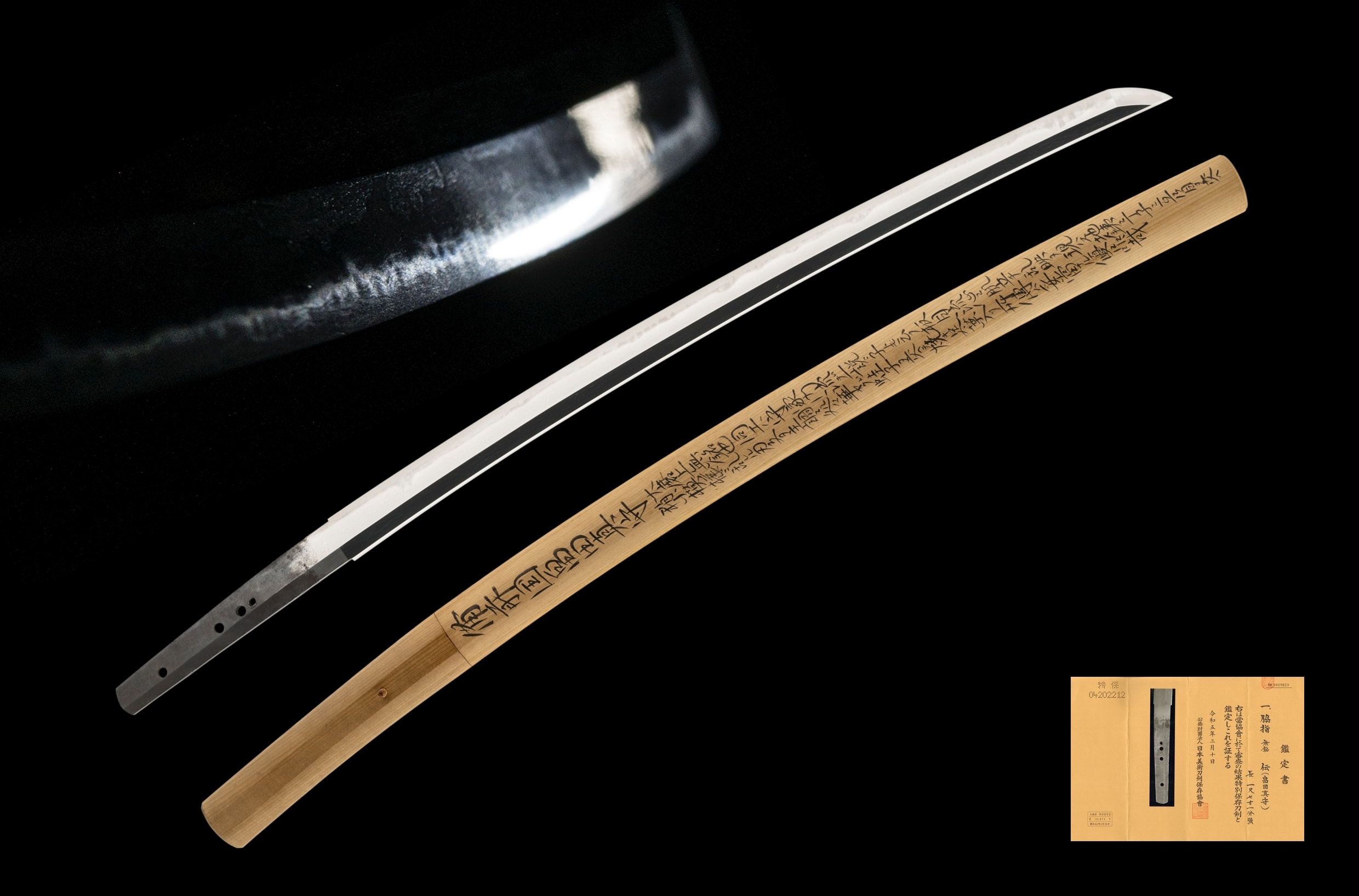
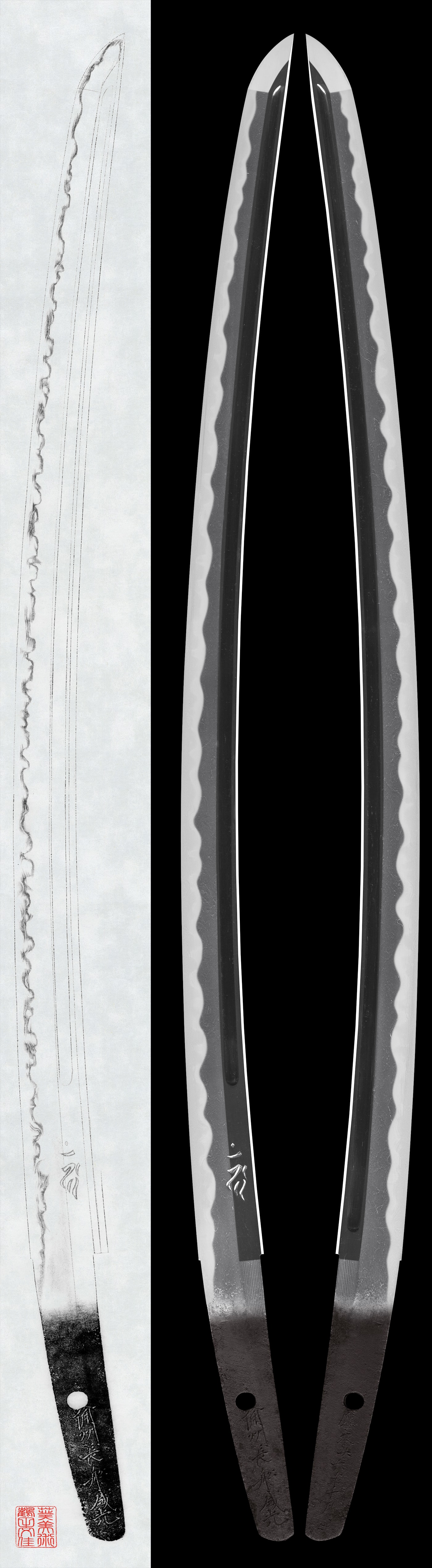
Mitsumori of the Hatakeda group is a smith of late-Kamakura Bizen, placed by the published reference works around the Shoo era (1288-93). The Jubi-designated Hotta-family tachi carries the judgment plainly: "this Mitsumori is thought to correspond to the smith recorded in the sword-signature books as a Hatakeda-school artisan working around Shoo (1288-93)"[[c:1]]頃の畠田派の刀工とあるもの). The published sources are candid that beyond this his genealogy is not fixed; the meikan record neither his dates nor his line clearly. What anchors him instead is his manner. From his rare signed blades, the NBTHK writes, the brilliant choji-midare in which kaeruko-choji is especially conspicuous readily suggests affiliation with the Moriie line, and the way he cuts his signature corresponds to it as well. He is judged close in particular to the second-generation Moriie, and the few signed pieces hold the attribution of the many unsigned ones in place.
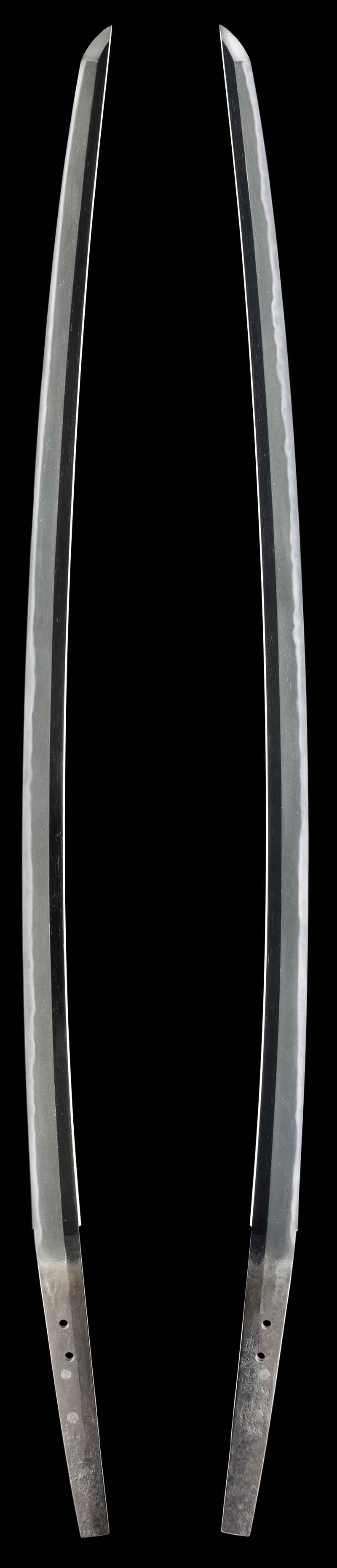
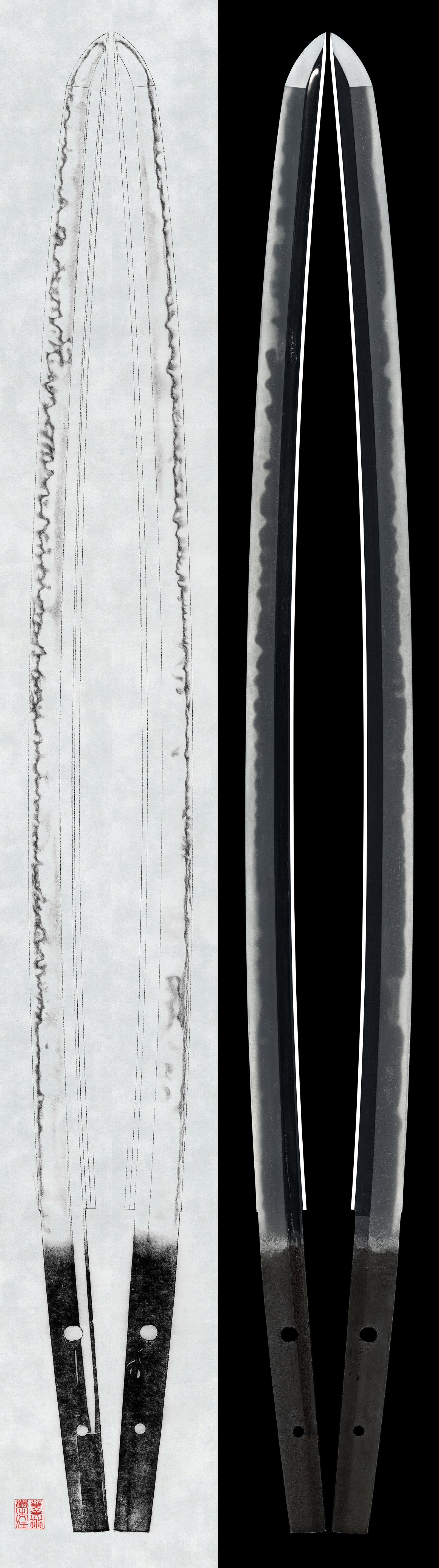
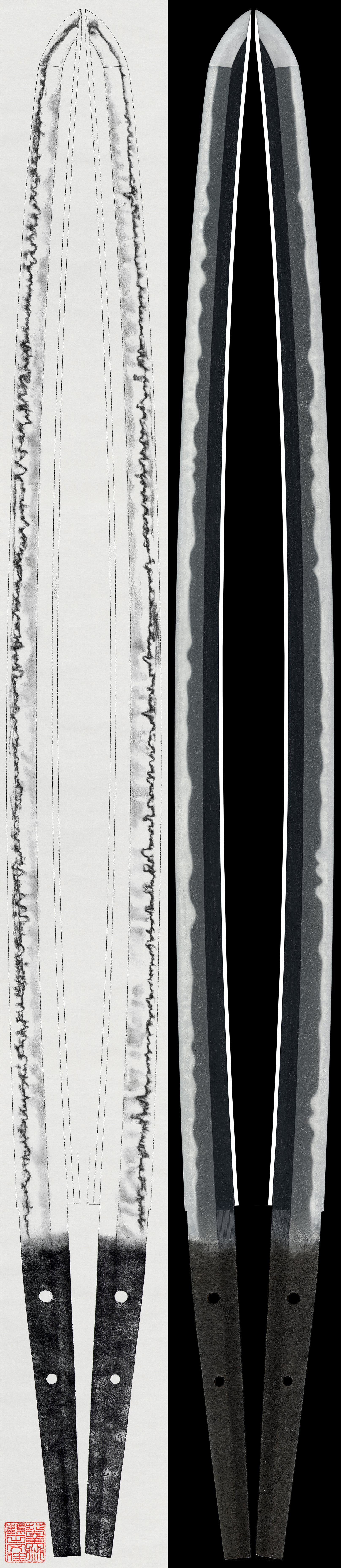
His characteristic hand is a flamboyant, nioi-based choji-midare led by kawazuko-choji, the tadpole-headed clove that is the Hatakeda tell. It rises over an itame mixed with mokume that tends to stand in the grain, with abundant ashi and yo working into a temper that varies in height and packs into a dense midare. The recurring smith-level sentence in the published commentary fixes the family idiom in one image: the two representative signed works, the Hotta-family tachi and the Akimoto-family orikaeshi-mei wakizashi, "both temper a wide yakihaba of nioi-deki choji-midare, showing a splendid and ornate manner"[[c:2]]. The mumei blades read down from that, their choji mixed with gunome and pointed teeth, ko-nie adhering and the nioiguchi bright; on the 50th-session katana the NBTHK records that the hamon "clearly manifests his distinctive features" and the bright nioiguchi carries a superior result.
The jigane is an itame with mokume, in places flowing and standing in the grain, on which fine ji-nie gathers in dust-like mijin and delicate chikei enter. Across it a vivid midare-utsuri stands, named first in nearly every entry and, with the standing grain, the surest thing the published sources point to. The 14th-session tachi, the earliest in the record, sets the note at once: "the itame tends to flow and stand in the grain, and a vivid midare-utsuri appears"[[c:3]]. Within the ha, fine kinsuji and sunagashi run, and on the busier blades tobiyaki are scattered along the yakigashira; the boshi runs midare-komi, turning with a pointed tendency and hakikake, or settling in ko-maru. The nioiguchi tends at times toward a slight urumi, a soft, moist quality, yet on the best of them it is bright and clear.
Two registers divide the corpus. The signed register is the most flamboyant: on a closely forged ko-itame the temper widens into a nioi-based choji-midare carrying fukuro-choji, kawazuko-choji and juka-choji together, the nioi deep and the nioiguchi bright and clear, with ashi and yo active. The signature is a large, strongly individual two-character mei cut in a fine chisel, and on the shortened blades it survives as a gaku-mei, the inlaid plaque, or an orikaeshi-mei, the folded-back skin of the tang. The published commentary notes of one such piece that it is "cut with a fine chisel yet in a large, bold manner, as is usual for this smith." The prime register is the o-suriage mumei attribution: greatly shortened blades whose make and temper fit his signed work so closely that, in the recurring phrase, the appraisal of Mitsumori is drawn from the aspect of the yakiba and the workmanship as a whole. The 24th-session katana states the reasoning openly, that "the brilliant choji-midare in which kaeruko-choji is conspicuous accords with the Moriie line, and the manner of signing answers to it too"[[c:4]].
Within the Hatakeda group he stands beside his fellow Sanemori, the two read off the same idiom of wide nioi-based clove with kaeruko-choji and a bright midare-utsuri, the manner that runs the school toward the Osafune mainstream. The published sources draw his distinction not by contrast but by what his own blades carry: the kaeruko-choji dense in his temper where the old Ko-Bizen hands have none, a midare-utsuri that stands on nearly every blade, and an itame read a shade more openly than his Hatakeda fellow's. On the 42nd-session tachi the NBTHK writes that the choji, with the tadpole-style clove mixed in over a jigane in which the midare-utsuri stands, "well expresses the characteristic features of this smith"[[c:5]], and even where the lower character of the signature is lost under a mekugi-ana, the calligraphy of the surviving "光" and the workmanship leave no doubt of his hand.
Mitsumori is Jo-jo saku in Fujishiro's grading. Ten of his blades are designated Juyo and two more are Juyo Bijutsuhin, those two the representative signed works the published sources cite, the Hotta-family tachi and the Akimoto-family orikaeshi-mei wakizashi. The Hotta tachi is recorded in the Kozan Oshigata and descended through the Tokugawa shogunal house; both Jubi pieces are now held by the Tokyo National Museum, and one of the signed Juyo tachi is, in the NBTHK's words, "of note as one of the few signed works of Mitsumori"[[c:6]]. The provenance recorded against his blades runs through the Hotta and Akimoto houses, the Tokugawa shogunal family, the Akimoto family and the Imperial Family. The two museum-held Jubi pieces are patrimony that does not trade; of the rest, ten stand in the Juyo tier and the signed examples are scarce, so a Mitsumori reaching open hands is uncommon, a blade a collector may encounter from time to time and with patience rather than at will.