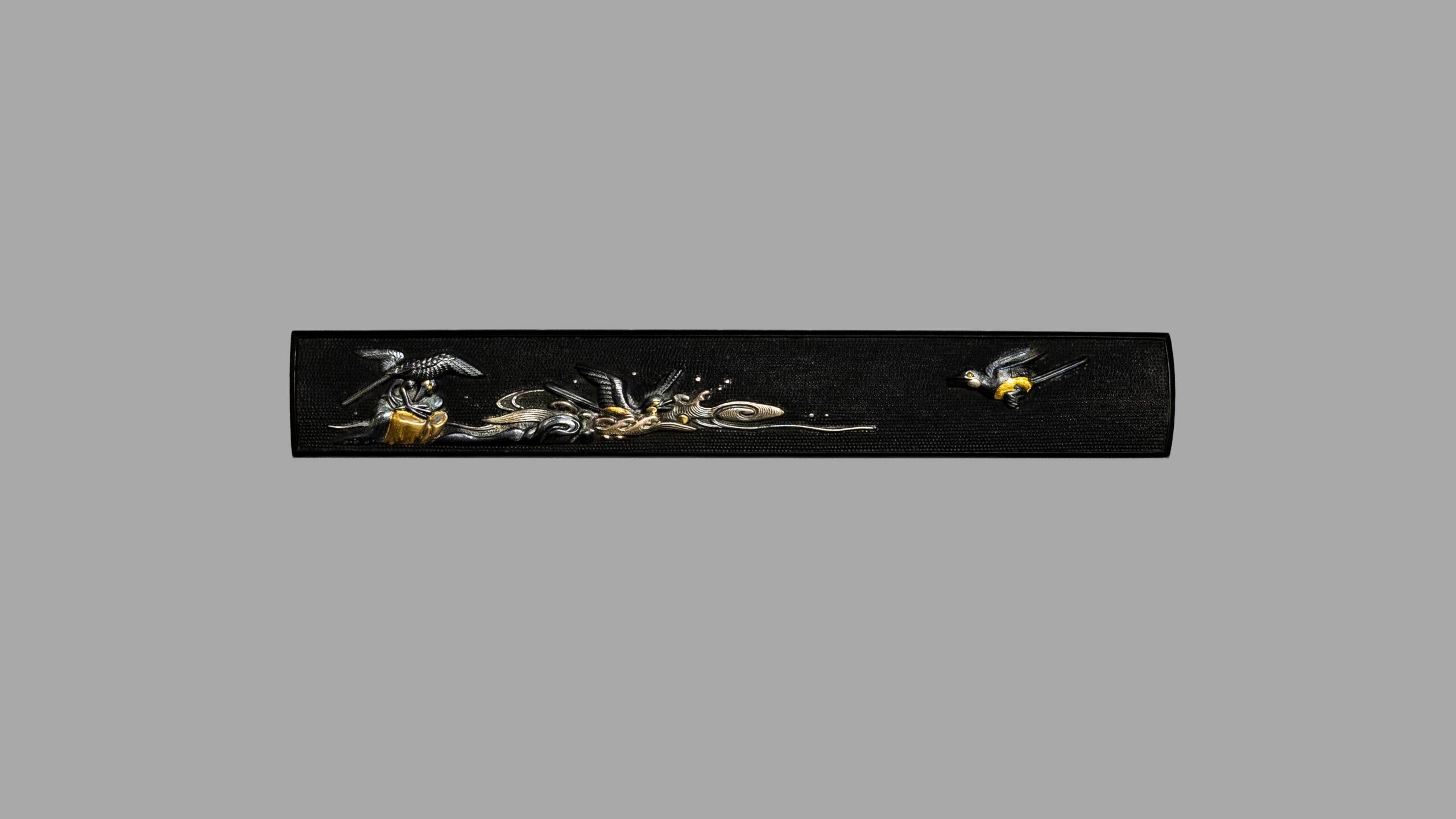
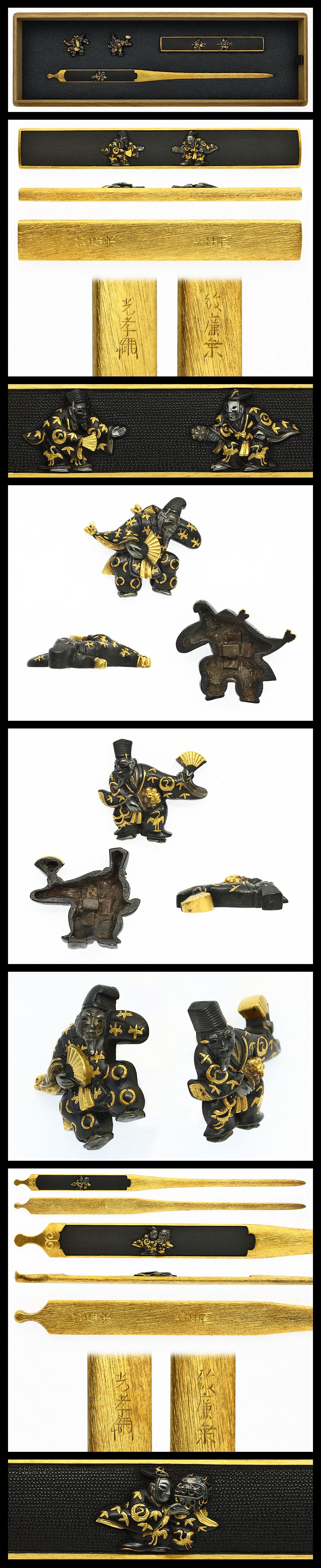
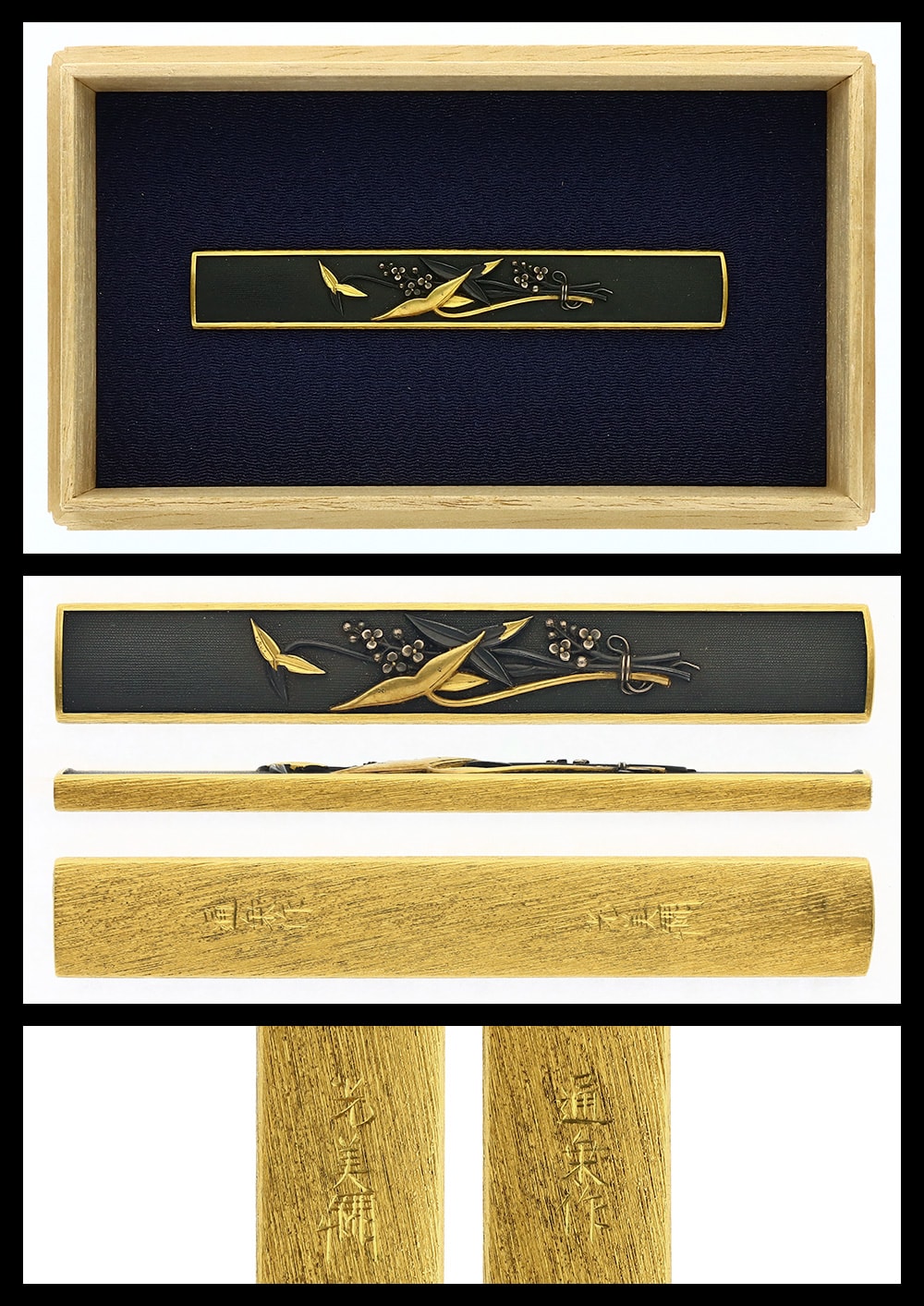
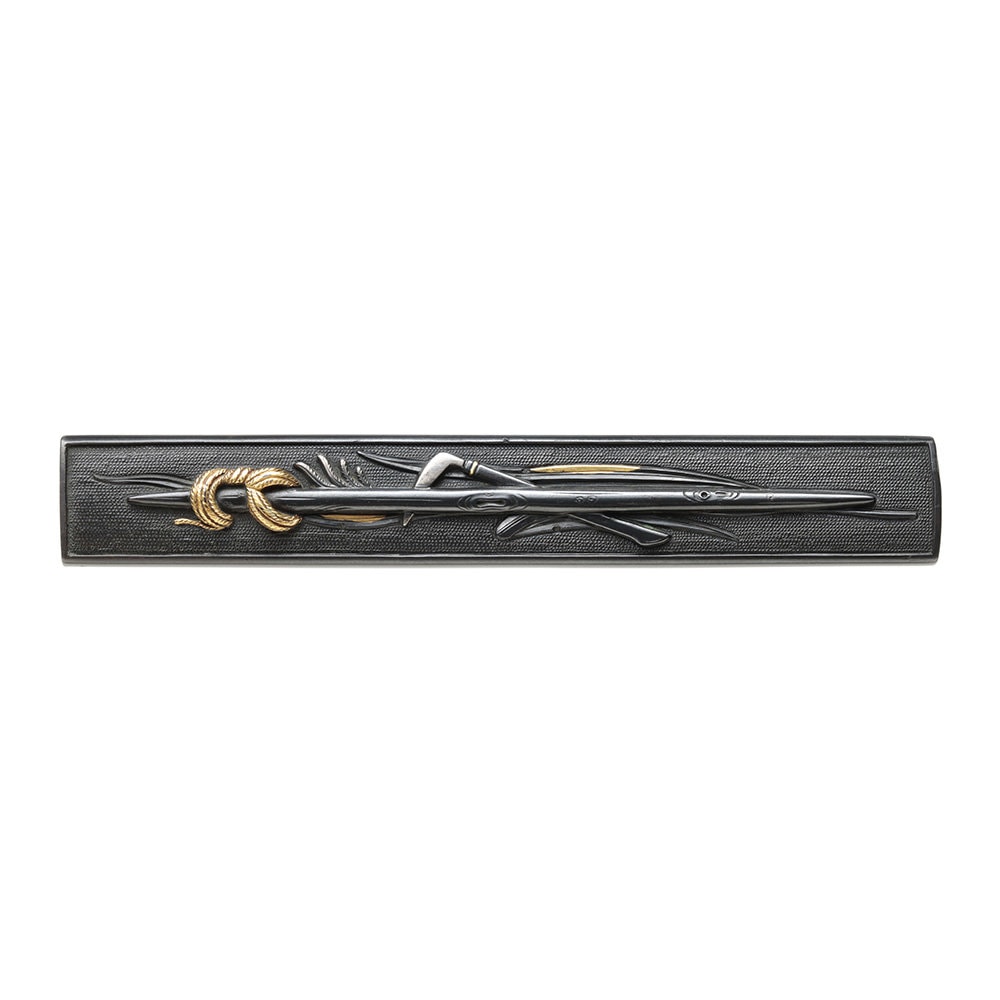
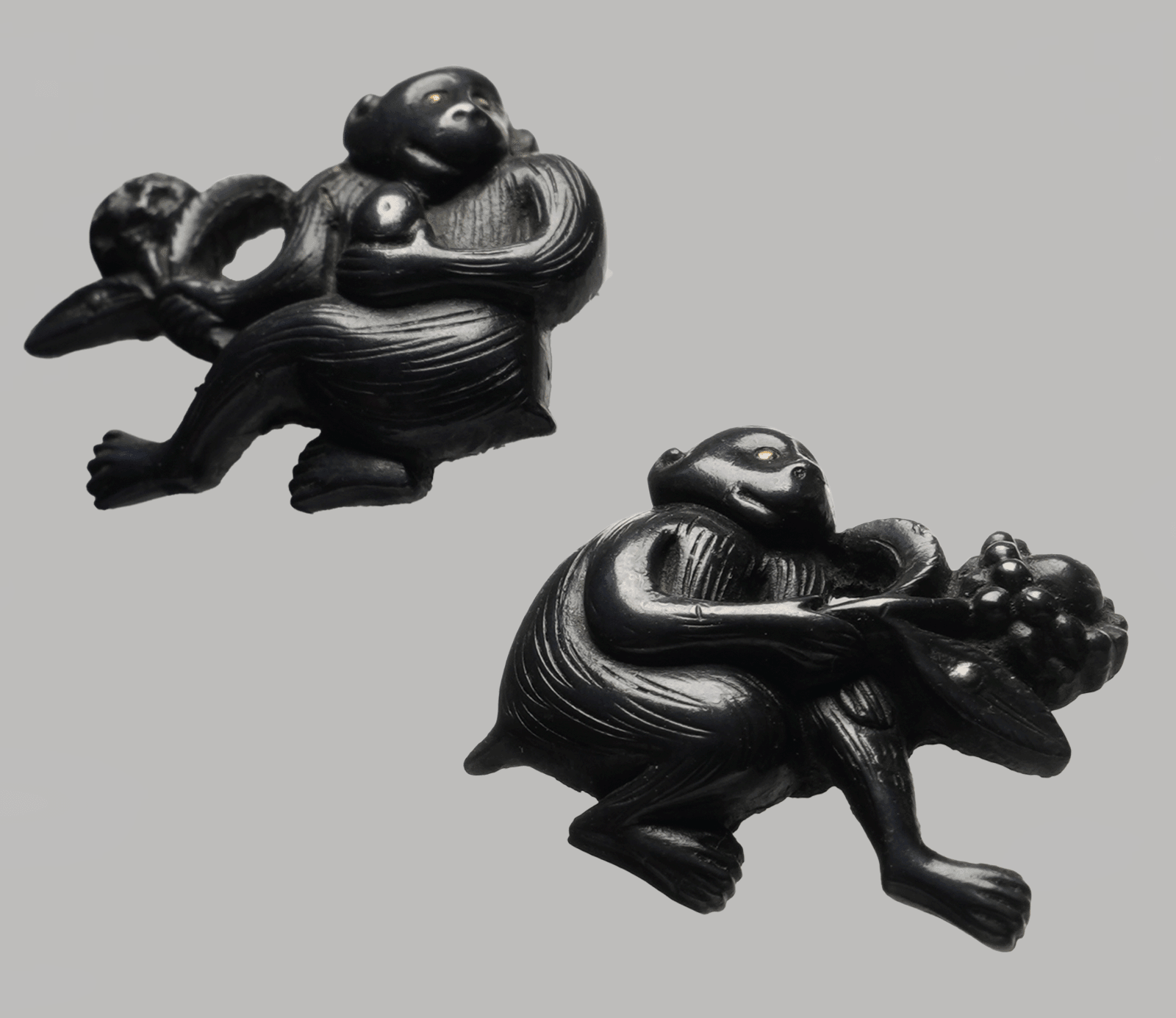
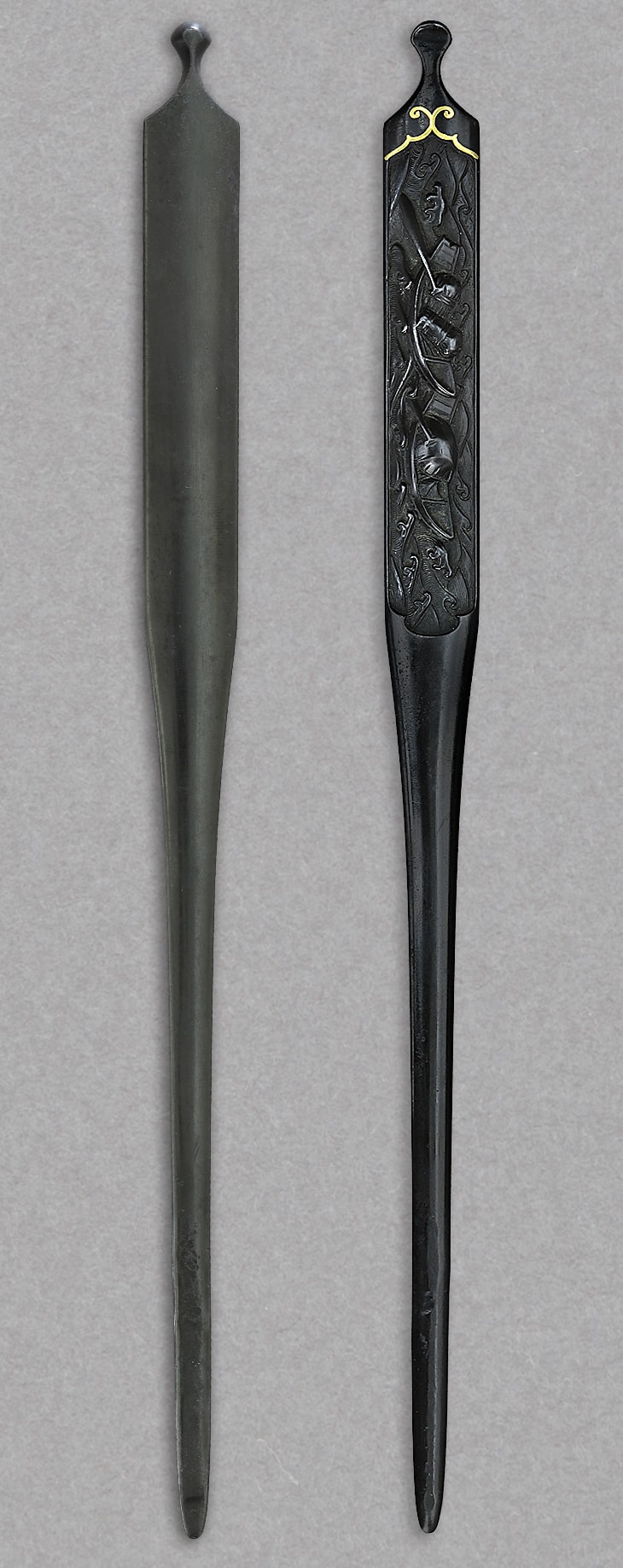
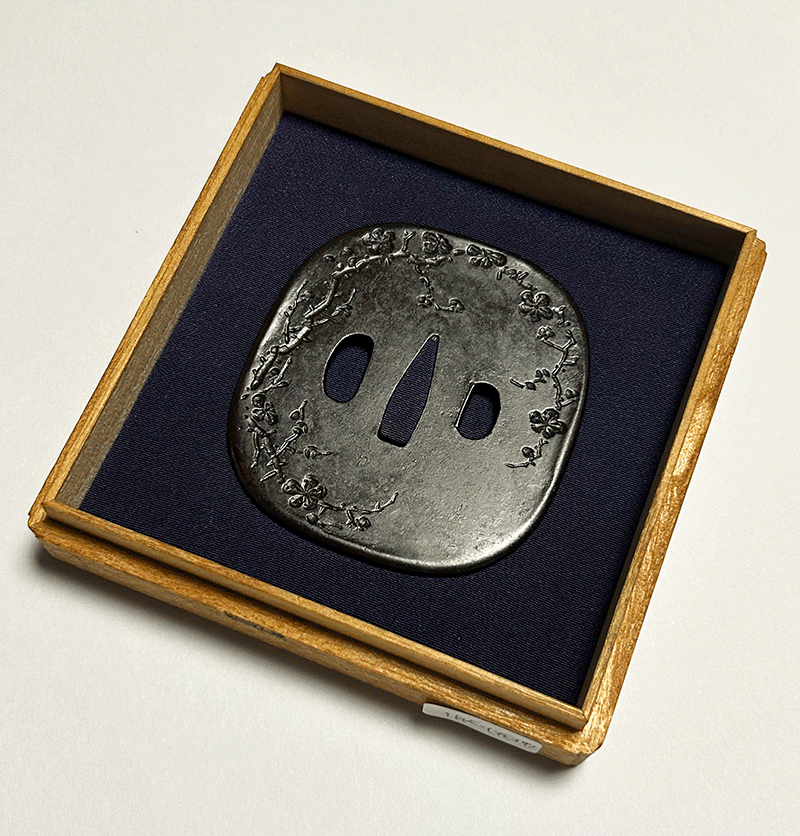
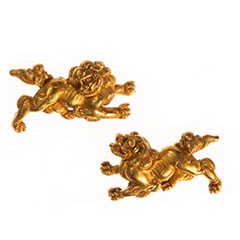
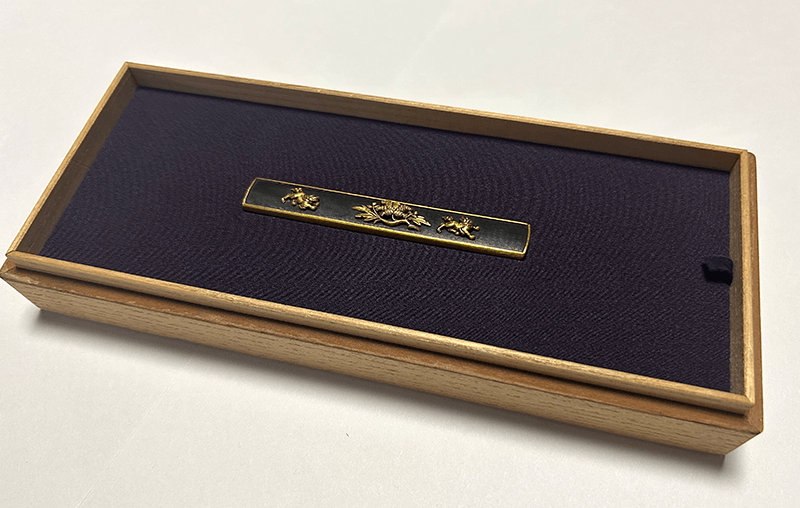
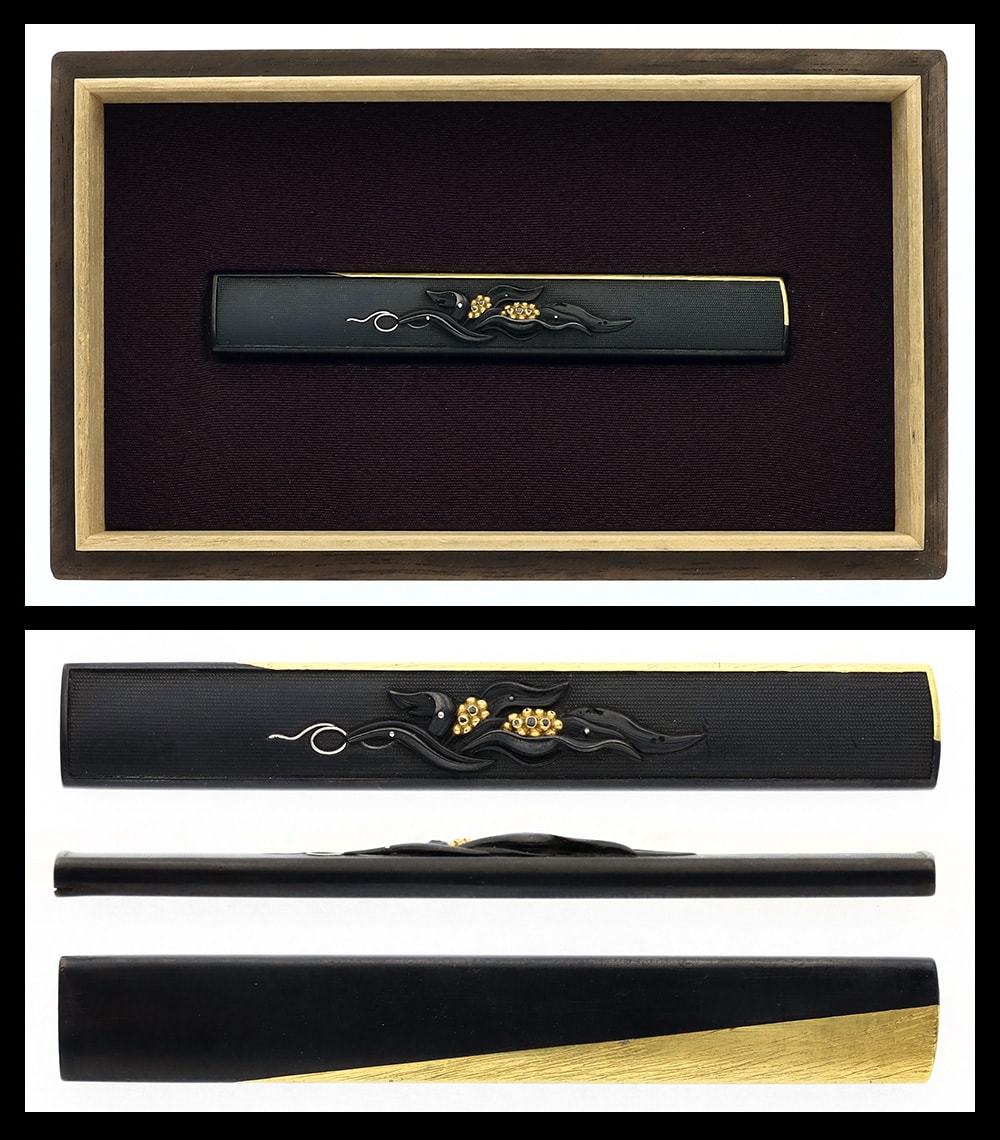
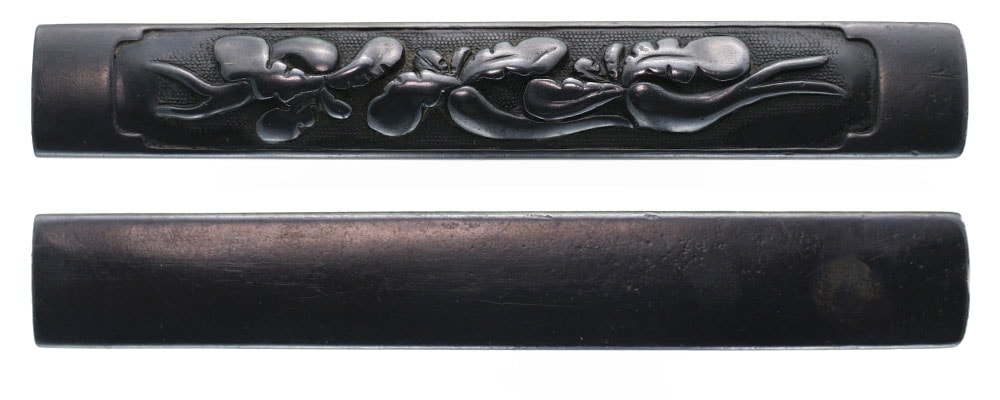
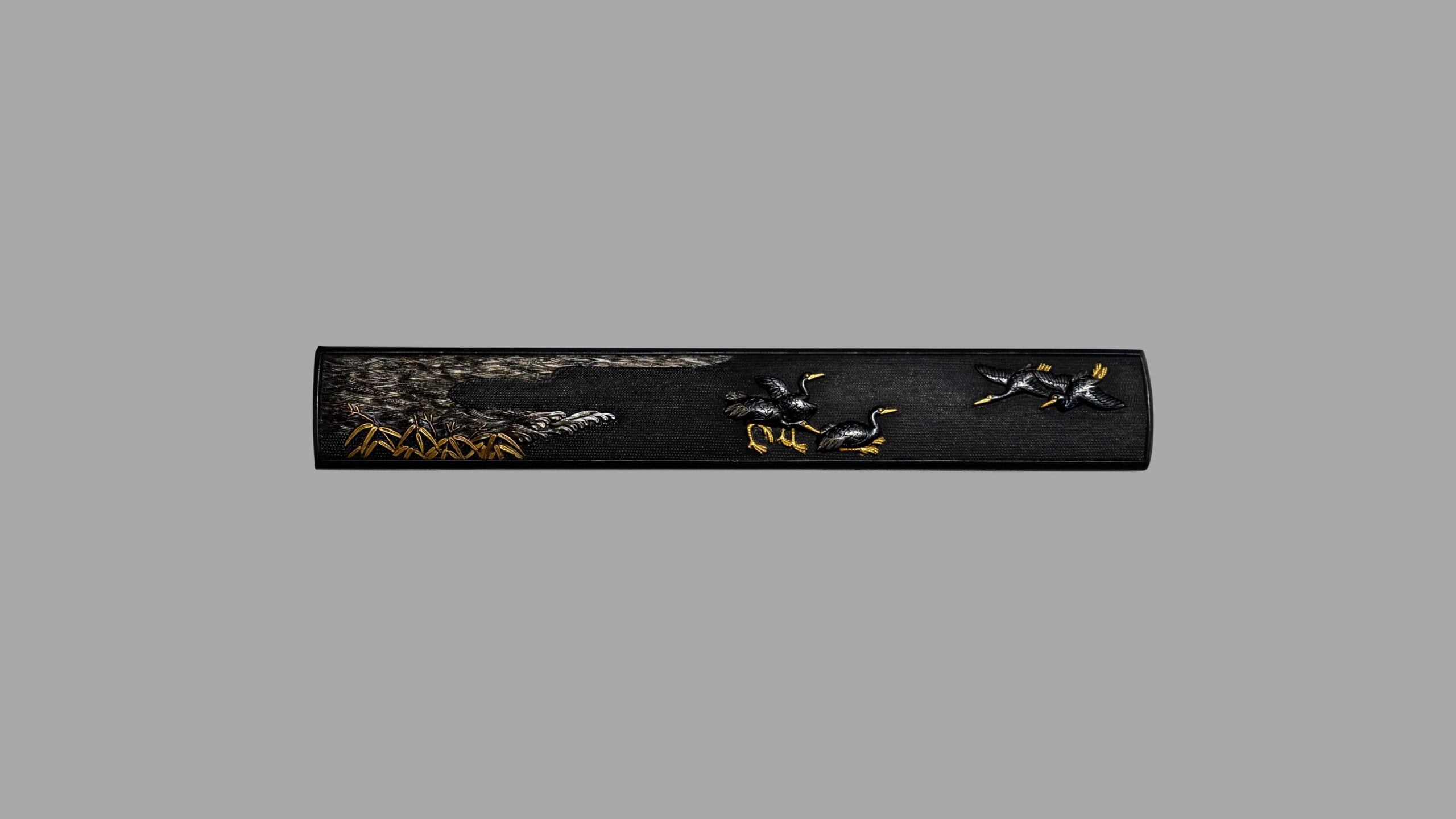
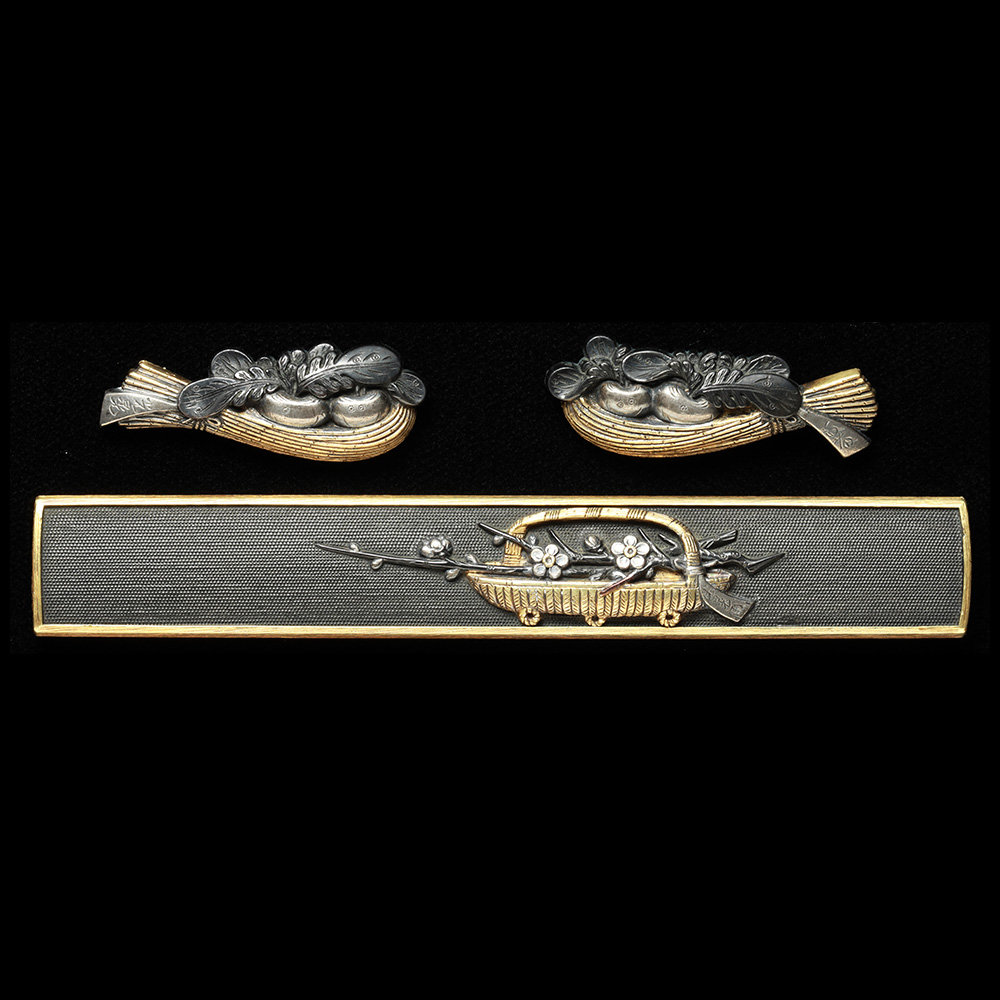
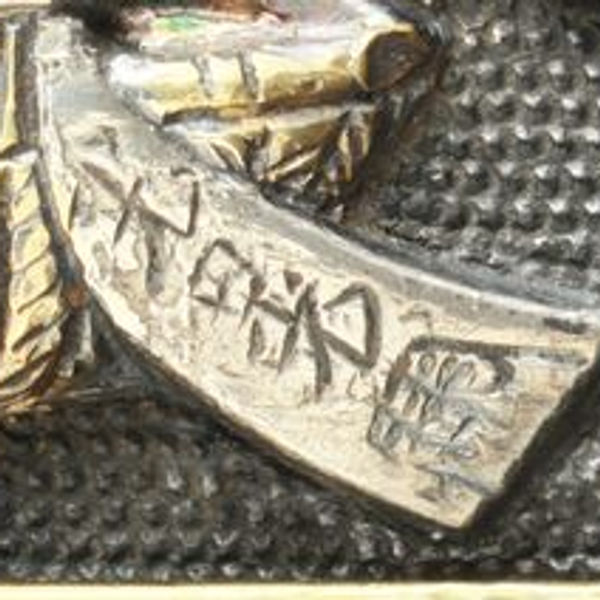
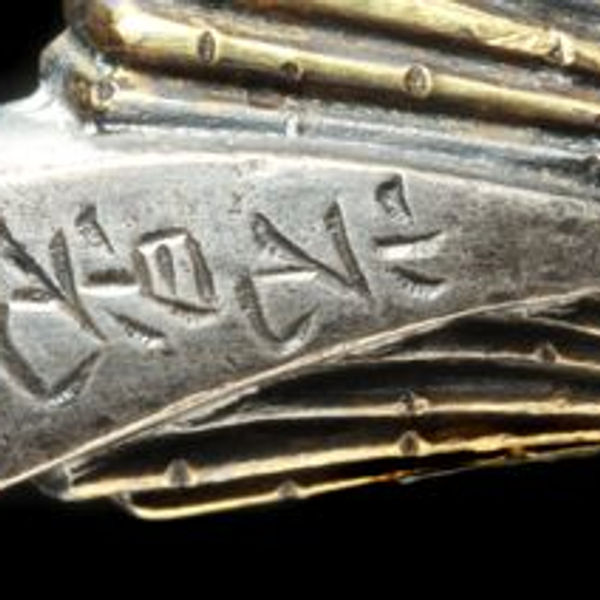
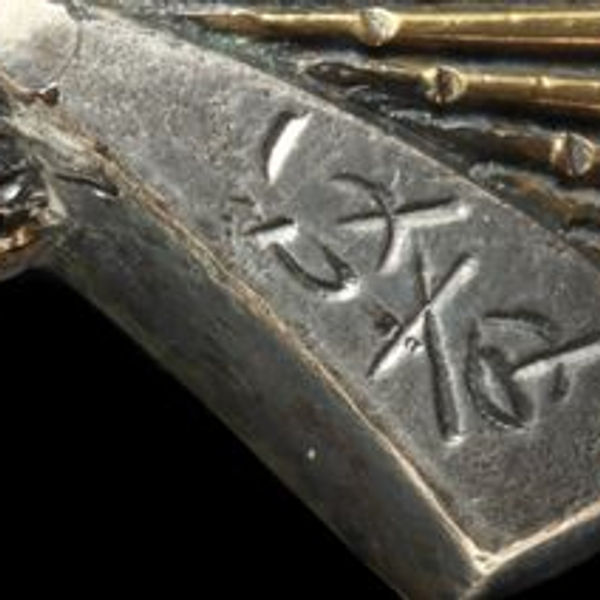
This is a futatokoromono set featuring a kozuka and menuki. The kozuka is signed Mitsuakira (with Kao) and the menuki is signed Goto Mitsuakira. The set depicts a flower basket with plum branches and turnips, crafted in shakudo nanako ground with high relief carving and iroe (colored metals).
 NihontoWatch
mei · Goto · Edo
Goto Hojo
Edo
Signed
Tokuho (NBTHK)
Iebori · Yamashiro · around 1816-1856
1 piece on the market now
Goto Mitsuaki was born in Bunka 13 (1816) as the third son of Goto Mitsuyoshi, the fifteenth head of the Goto main line, who bore the art name Shinjo. In the seventh month of Tempo 6 (1835), upon his father's retirement at the age of fifty-six, Mitsuaki succeeded to the family headship, assumed the hereditary name Shirobei Mitsuaki, and became the sixteenth and penultimate master of the Goto soke. He died in the sixth month of Ansei 3 (1856) at the age of forty-one, having served as head for twenty-one years. His childhood name was Mitsutoshi; his common names included Shinjiro and later Gennojo. According to his own records, in Tempo 8 (1837) he manufactured Tempo five-ryo gold coin issues and produced 1,887 pieces of oban large gold plates by shogunal order. Mitsuaki is universally regarded in NBTHK evaluations as possessing the finest technical skill among the successive generations from the twelfth master onward, a judgment repeated with striking consistency across his designated works.
Mitsuaki's oeuvre is dominated by mitokoromono and mitsudogu sets executed in the canonical Goto iebori idiom: shakudo nanako-ji grounds, takabori with gold and silver iroe, and kin'ura gold-foil backing on the reverse. His chromatic planning is noted for its deliberate sophistication; beyond painstaking gold and silver iroe, he introduced suaka to impart what the NBTHK characterizes as a rustic, natural accent (yashu), and on occasion employed hiiro-do, a scarlet copper rarely seen within the Goto tradition. His menuki are carved in nikubori or yobori with wari-giwa hashi-mei split signatures, and the kozuka and kogai bear his full inscription "Goto Shirobei Fujiwara Mitsuaki" with kao. His signature conventions are handled with notable sophistication, with the long form reserved for especially careful, deliberate productions. Thematic range encompasses court bugaku implements, falconry accoutrements, seasonal festivals (sekku), salt-making landscapes, four-seasons flowers with shikishi papers, Sanbaso ritual dance figures, zodiac animals, and auspicious subjects such as Fukurokuju and Jurojin. The NBTHK further observes a strong influence from machibori aesthetics in the arrangement of figures and the expression of open space, suggesting the emergence of a new style of official Goto carving after the family's residence in Edo had been formally established. His works are known for their rich, dense manner, yet individual sets are distinguished by extraordinarily meticulous treatment in monochrome black or by dignified, refined overall unity.
Across the body of designated works, the NBTHK consistently applies such evaluative phrases as "elevated dignity," "lofty refinement," and "workmanship that may rightly be called a masterpiece." Mitsuaki's production is characterized as spirited and bracing, betraying not the slightest hint of the approaching conclusion of the unbroken Got line, which would end after only one more generation. His carving evokes "high mountains and deep valleys" in the Got family manner, and his chisel work is described as outstandingly accomplished. The daisho koshirae commissioned by the Sannohe family, executed with court bugaku themes scattered across every fitting, each bearing kinzogan-mei, is singled out as a celebrated piece in which one can directly appreciate his technical excellence, with lacquer work conveying a deep, weighty presence and the set as a whole displaying workmanship of the highest order. That Mitsuaki could sustain this standard across both intimate mitokoromono and grand ensemble mountings confirms the NBTHK's recurring assessment: he represents the summit of Goto mainline craftsmanship in its final era, an artist whose technical command and refined sensibility gave the soke tradition its last full measure of creative authority.
Where Goto Hojo stands among comparable artisans: across all of nihontō, and within tradition, era, and period. The tiers (Foremost · Leading · Major · Notable) weigh official designations from the NBTHK and Japan's Agency for Cultural Affairs, together with historical honors of lasting repute such as the Sansaku and Meibutsu-chō.
Select a lens to see how it's measured.
Iebori · Yamashiro
Phase: Goto Main Line後藤宗家· 1573–1900
325 pieces on the market now
| Smith | Era | Designated |
|---|---|---|
| Goto Joshin後藤乗真 | 1512-1562 | 68 |
| Goto Yujo後藤祐乗 | 1440-1512 | 41 |
| Goto Kenjo後藤顕乗 | 1586-1663 | 46 |
| Goto Sojo後藤宗乗 | 1461-1538 | 55 |
| Goto Eijo後藤栄乗 | 1577-1617 | 35 |
A Hozon-certified fitting of notably superior craftsmanship and condition, often with signature or workmanship of high reference value.
The NBTHK (Nihon Bijutsu Tōken Hozon Kyōkai, the Society for the Preservation of Japanese Art Swords) is a public-interest incorporated foundation founded in 1948 and supervised by Japan’s Agency for Cultural Affairs (Bunkachō); it is based at the Japanese Sword Museum in Tokyo. Its expert panels physically examine each submitted work (shinsa) and issue a certificate (kanteishō) ranking it by artistic and historical merit. NBTHK papers are the most widely recognized standard of authentication for Japanese swords and fittings.
NBTHK official siteIf, due to our fault, the item differs significantly from its proper condition, the item may be returned. Cooling-off is within one week of the item's arrival.
This is a futatokoromono set featuring a kozuka and menuki. The kozuka is signed Mitsuakira (with Kao) and the menuki is signed Goto Mitsuakira. The set depicts a flower basket with plum branches and turnips, crafted in shakudo nanako ground with high relief carving and iroe (colored metals).
NihontoWatchmei · Goto · Edo
Goto Hojo
Edo
Signed
Tokuho (NBTHK)
Iebori · Yamashiro · around 1816-1856
1 piece on the market now
Goto Mitsuaki was born in Bunka 13 (1816) as the third son of Goto Mitsuyoshi, the fifteenth head of the Goto main line, who bore the art name Shinjo. In the seventh month of Tempo 6 (1835), upon his father's retirement at the age of fifty-six, Mitsuaki succeeded to the family headship, assumed the hereditary name Shirobei Mitsuaki, and became the sixteenth and penultimate master of the Goto soke. He died in the sixth month of Ansei 3 (1856) at the age of forty-one, having served as head for twenty-one years. His childhood name was Mitsutoshi; his common names included Shinjiro and later Gennojo. According to his own records, in Tempo 8 (1837) he manufactured Tempo five-ryo gold coin issues and produced 1,887 pieces of oban large gold plates by shogunal order. Mitsuaki is universally regarded in NBTHK evaluations as possessing the finest technical skill among the successive generations from the twelfth master onward, a judgment repeated with striking consistency across his designated works.
Mitsuaki's oeuvre is dominated by mitokoromono and mitsudogu sets executed in the canonical Goto iebori idiom: shakudo nanako-ji grounds, takabori with gold and silver iroe, and kin'ura gold-foil backing on the reverse. His chromatic planning is noted for its deliberate sophistication; beyond painstaking gold and silver iroe, he introduced suaka to impart what the NBTHK characterizes as a rustic, natural accent (yashu), and on occasion employed hiiro-do, a scarlet copper rarely seen within the Goto tradition. His menuki are carved in nikubori or yobori with wari-giwa hashi-mei split signatures, and the kozuka and kogai bear his full inscription "Goto Shirobei Fujiwara Mitsuaki" with kao. His signature conventions are handled with notable sophistication, with the long form reserved for especially careful, deliberate productions. Thematic range encompasses court bugaku implements, falconry accoutrements, seasonal festivals (sekku), salt-making landscapes, four-seasons flowers with shikishi papers, Sanbaso ritual dance figures, zodiac animals, and auspicious subjects such as Fukurokuju and Jurojin. The NBTHK further observes a strong influence from machibori aesthetics in the arrangement of figures and the expression of open space, suggesting the emergence of a new style of official Goto carving after the family's residence in Edo had been formally established. His works are known for their rich, dense manner, yet individual sets are distinguished by extraordinarily meticulous treatment in monochrome black or by dignified, refined overall unity.
Across the body of designated works, the NBTHK consistently applies such evaluative phrases as "elevated dignity," "lofty refinement," and "workmanship that may rightly be called a masterpiece." Mitsuaki's production is characterized as spirited and bracing, betraying not the slightest hint of the approaching conclusion of the unbroken Got line, which would end after only one more generation. His carving evokes "high mountains and deep valleys" in the Got family manner, and his chisel work is described as outstandingly accomplished. The daisho koshirae commissioned by the Sannohe family, executed with court bugaku themes scattered across every fitting, each bearing kinzogan-mei, is singled out as a celebrated piece in which one can directly appreciate his technical excellence, with lacquer work conveying a deep, weighty presence and the set as a whole displaying workmanship of the highest order. That Mitsuaki could sustain this standard across both intimate mitokoromono and grand ensemble mountings confirms the NBTHK's recurring assessment: he represents the summit of Goto mainline craftsmanship in its final era, an artist whose technical command and refined sensibility gave the soke tradition its last full measure of creative authority.
Where Goto Hojo stands among comparable artisans: across all of nihontō, and within tradition, era, and period. The tiers (Foremost · Leading · Major · Notable) weigh official designations from the NBTHK and Japan's Agency for Cultural Affairs, together with historical honors of lasting repute such as the Sansaku and Meibutsu-chō.
Select a lens to see how it's measured.
Iebori · Yamashiro
Phase: Goto Main Line後藤宗家· 1573–1900
325 pieces on the market now
| Smith | Era | Designated |
|---|---|---|
| Goto Joshin後藤乗真 | 1512-1562 | 68 |
| Goto Yujo後藤祐乗 | 1440-1512 | 41 |
| Goto Kenjo後藤顕乗 | 1586-1663 | 46 |
| Goto Sojo後藤宗乗 | 1461-1538 | 55 |
| Goto Eijo後藤栄乗 | 1577-1617 | 35 |
A Hozon-certified fitting of notably superior craftsmanship and condition, often with signature or workmanship of high reference value.
The NBTHK (Nihon Bijutsu Tōken Hozon Kyōkai, the Society for the Preservation of Japanese Art Swords) is a public-interest incorporated foundation founded in 1948 and supervised by Japan’s Agency for Cultural Affairs (Bunkachō); it is based at the Japanese Sword Museum in Tokyo. Its expert panels physically examine each submitted work (shinsa) and issue a certificate (kanteishō) ranking it by artistic and historical merit. NBTHK papers are the most widely recognized standard of authentication for Japanese swords and fittings.
NBTHK official siteIf, due to our fault, the item differs significantly from its proper condition, the item may be returned. Cooling-off is within one week of the item's arrival.