 NihontoWatchNihontoWatch
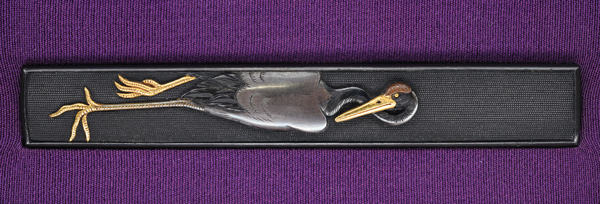
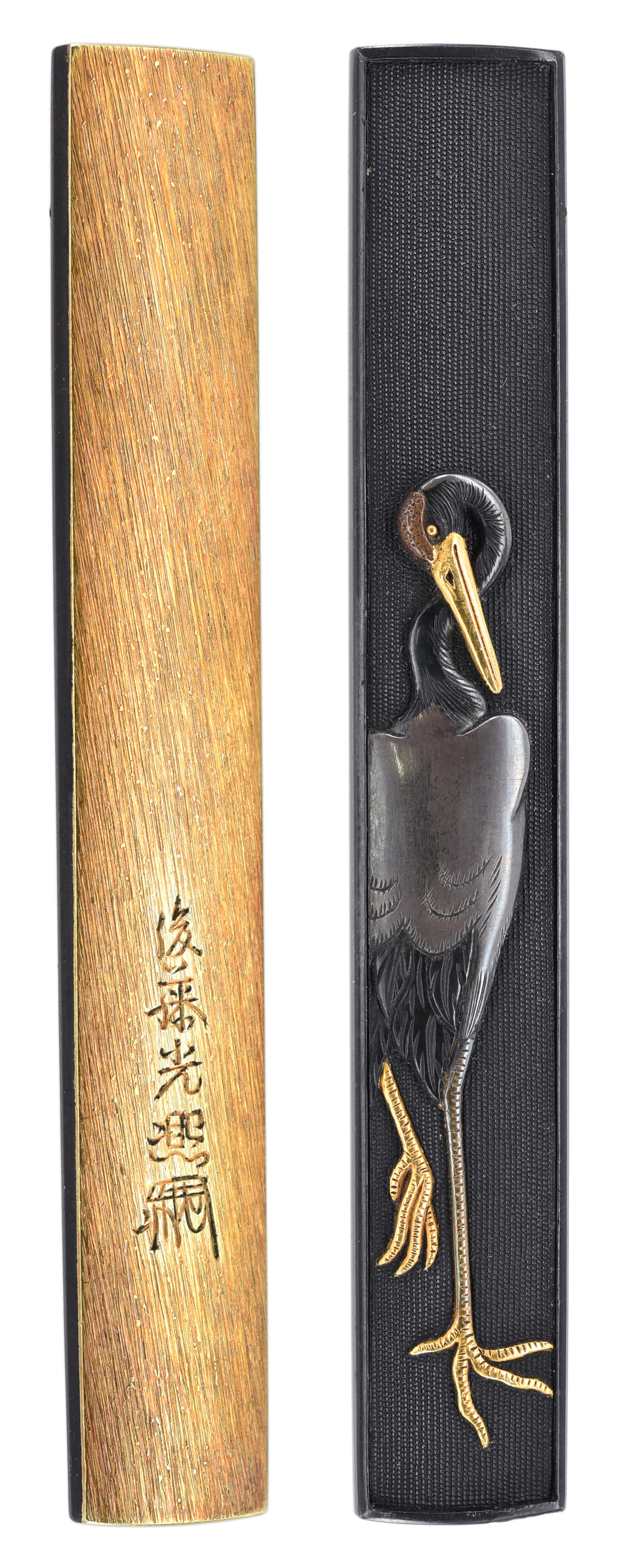
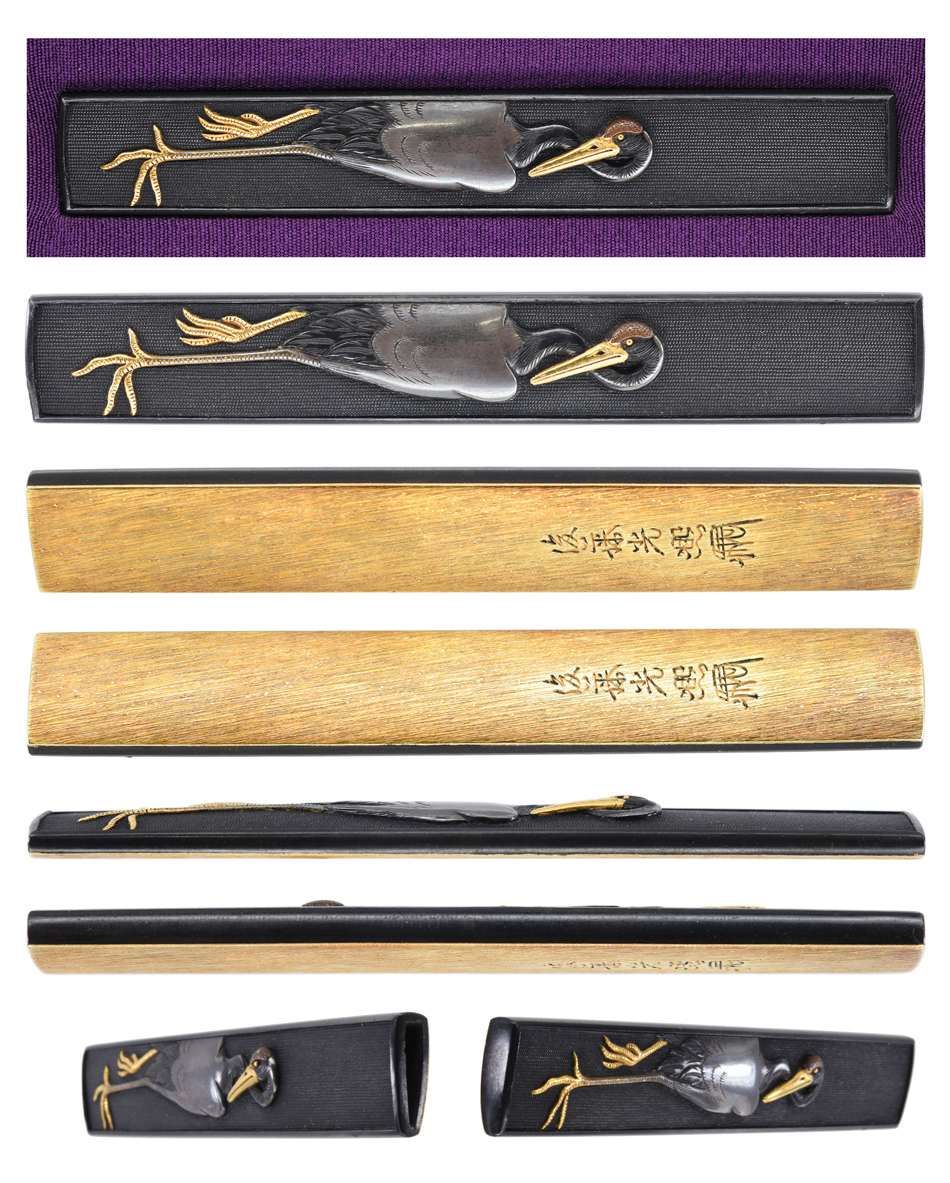
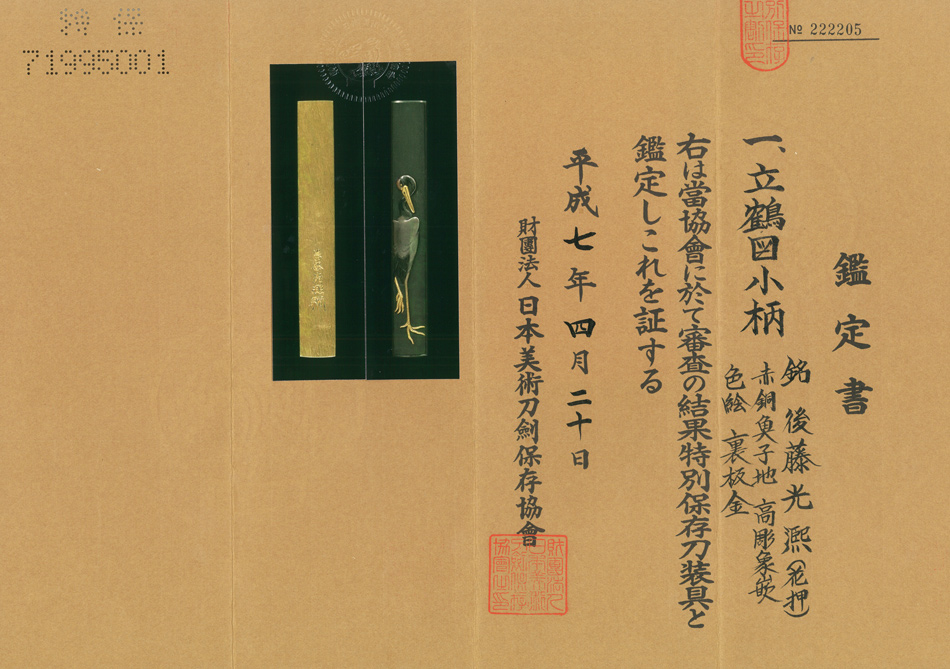
Stock number: KO-041221Paper(Certificate):[N.B.T.H.K] Tokubetsu Hozon TousoguCountry・Era:Edo periodTachizuru-zu Kozuka立鶴図小柄 赤銅魚子地 高彫象嵌 色絵 裏板金Length:9.70cmWidth:1.45cmThickness:0.70cmIn paulownia wood box
NihontoWatchOffered by World Seiyudo
This piece has sold
Get an email when a new Goto Hojo piece hits the market.

Goto Hojo
Edo
Tokuho (NBTHK)
Iebori · Yamashiro · around 1816-1856
Goto Hojo, given name Mitsuaki, was the sixteenth head of the main Goto house. The published sources record that he was born in Bunka 13 (1816), the third son of the fifteenth head Shinjo Mitsuyoshi, though two of them call him the fourth son; his childhood name was Mitsutoshi and his common name Shinjiro, later Gennojo. In the seventh month of Tenpo 6 (1835), when his father retired at fifty-six, he succeeded to the headship and took the name Shirobei Mitsuaki. He served as head for twenty-one years and died in the sixth month of Ansei 3 (1856) at forty-one. By his own memorandum he struck the Tenpo five-ryo coin on shogunal order in Tenpo 8 (1837), and afterwards 1,887 ten-ryo oban as well. The sentence the sources return to in almost every entry is that among the heads from the twelfth master Mitsumasa onward he is "said to be the most technically skilled"[[c:1]].
His hand is the orthodox house manner, carried with unusual finish. The kozuka and kogai are of shakudo in an even nanako-ji, carved in takabori with gold and silver iroe and backed with gold (kin'ura); the menuki are carved in the round, in shakudo or in solid gold. On the set of the twelve zodiac animals the sources describe the kozuka and kogai built by inlaying the plate, with long warabite feet, the menuki backed with thick gold, and fine kebori for the animals' coats, and they close that entry by saying that "Mitsuaki's true strengths are fully brought to bear"[[c:2]]. His colour is planned with care. On the falconry set and on the set of Noh implements he adds suaka to the gold and silver, and the sources write that he "uses suaka to good effect to bring in a rustic flavour"[[c:3]]. On a set for the Joshi festival he adds shibuichi and the scarlet copper hiiro-do to the gold and silver, and there the sources judge the minute precision of the carving "unusual even within the Goto house"[[c:4]], calling the set his masterpiece.
His subjects belong to the late Edo and Bakumatsu taste. The seasonal festivals recur most: the standing hina of the third month, a wakizashi koshirae whose fittings run through all five festivals, a daisho koshirae of New Year, setsubun, Tango and Tanabata with rice ears, sparrows and a bird clapper on the tsuba, and a small-sword set of festival charms. Court music and dance, Noh and falconry implements, the house lions, the longevity deities Fukurokuju and Jurojin, the zodiac animals, wild boars, the salt-makers' shore and the flowers of the four seasons paired with poem papers fill out the rest. The sources note that his work is generally dense and rich, and they set apart a Sanbaso set worked almost wholly in shakudo, where "the black monochrome crest work is extremely precise"[[c:5]]. Of the lions biting an amulet pouch they write that the vigorous animals, together with "the Goto carving of high mountains and deep valleys"[[c:6]], make a superb piece.
His signature is regular and is itself part of the record. He signs Goto Mitsuaki with a kao, and on the menuki splits the given name between the pair as 光 and 晃. On especially careful work he cuts the full long signature, Goto Shirobei Fujiwara Mitsuaki, which the sources take as the mark of a deliberate piece. The most valuable of these is on the five-festival wakizashi koshirae, whose kozuka and kogai carry a commission formula with a date: 「応需嘉永三年春三月後藤四郎兵衛藤原光晃(花押)」, the spring of Kaei 3 (1850). On a bamboo-and-sparrow set signed in that long form, the sources read a strong influence of the town carvers in the branches, the placing of the birds and the treatment of open space. They connect that piece to a new official house carving that arose once the Goto were settled in Edo, a reading resting on that one set.
He also stands in the record as a certifying head of the line, one generation before the Goto house came to its end. On a litchi set the crests are attributed to the ninth master Teijo, inscribed 紋程乗 with Mitsuaki's own name and kao beside it, and the sources record that the plates and the gold backing were made by Mitsuaki himself. That piece is evidence of his appraisal, not of his carving. On the lion set the sources observe that although "the long Goto line of metalworkers would end after one more generation"[[c:7]], the work is spirited and "does not show the slightest sign of it"[[c:8]].
His designated record is eighteen works: one Tokubetsu Juyo and seventeen Juyo. The Tokubetsu Juyo, first designated Juyo in Showa 49 (1974), is a daisho koshirae on the theme of court bugaku, every fitting signed in gold inlay, made for the Sannohe family after a design by the eleventh master Tsujo, its kogai signed 「応需三戸氏以通乗図造之」. The sources call it "a fine work in which the height of Mitsuaki's technique can be felt"[[c:9]]. Five of the eighteen are complete koshirae or koshirae built around his fittings, and the rest are mitokoromono and matched fittings. He has no National Treasure or Important Cultural Property, and no current institutional holder is recorded; the Sannohe family is the one provenance named. Signed sets by him do appear from time to time, and a signed mitokoromono in shakudo nanako-ji with gold and silver iroe is the form in which his work is most often met.
Where Goto Hojo stands among comparable artisans: across all of nihontō, and within tradition, era, and period. The tiers (Foremost · Leading · Major · Notable) weigh official designations from the NBTHK and Japan's Agency for Cultural Affairs, together with historical honors of lasting repute such as the Sansaku and Meibutsu-chō.
Select a lens to see how it's measured.
Iebori · Yamashiro
Phase: Goto Main Line後藤宗家· 1573–1900
309 pieces on the market now
| Smith | Era | Designated |
|---|---|---|
| Goto Joshin後藤乗真 | 1512-1562 | 68 |
| Goto Yujo後藤祐乗 | 1440-1512 | 41 |
| Goto Sojo後藤宗乗 | 1461-1538 | 56 |
| Goto Kenjo後藤顕乗 | 1586-1663 | 46 |
| Goto Teijo後藤程乗 | 1603-1673 | 42 |
A Hozon-certified fitting of notably superior craftsmanship and condition, often with signature or workmanship of high reference value.
The NBTHK (Nihon Bijutsu Tōken Hozon Kyōkai, the Society for the Preservation of Japanese Art Swords) is a public-interest incorporated foundation founded in 1948 and supervised by Japan’s Agency for Cultural Affairs (Bunkachō); it is based at the Japanese Sword Museum in Tokyo. Its expert panels physically examine each submitted work (shinsa) and issue a certificate (kanteishō) ranking it by artistic and historical merit. NBTHK papers are the most widely recognized standard of authentication for Japanese swords and fittings.
NBTHK official siteNo cooling-off period or returns; refund only if the purchased sword is proven fake, capped at purchase price (excludes commission sales, accessories, auction items).