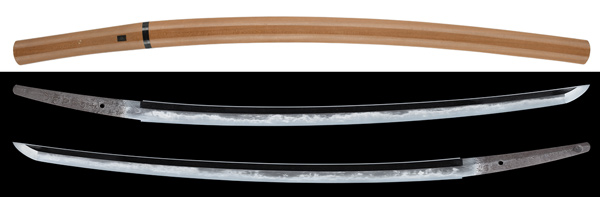
Taikei Naotane was born in An'ei 8 (1779) at Yamagata in Dewa, with the common name Shōji Minobei and the art name Taikei. As a young man he went to Edo and entered the school of Suishinshi Masahide, his senior from the same province and the leading advocate of the revival-sword movement, and like his teacher he later served Lord Akimoto. The published sources count him with Hosokawa Masayoshi as one of the two outstanding talents among Masahide's pupils. A blade made at twenty-three is signed Shōji Naotane and dated Kansei 13 (1801), so they place his entry to the school two or three years earlier and his independence near the start of the Bunka era. He signed Chikuzen Daijō from Bunsei 4 (1821), changed the title to Mino no Suke on going up to Kyoto in Kaei 1 (1848), and died in Ansei 4 (1857) at seventy-nine. Where Masahide is regarded as the theorist of the movement, Naotane is called its practitioner, and the published sources say repeatedly that he matured until his technique was judged to surpass his teacher's[[c:1]].
He took up the several kotō traditions in turn, and the published sources name the Bizen and Sōshū manners as his strengths, with much in the Bizen work that deserves attention. They state that the finesse of his chōji-midare carries the established reputation of being the first among shinshintō[[c:2]]. In the record itself the chōji is less constant than that reputation suggests. Of forty published descriptions, seven name a chōji-midare outright, and chōji of some kind enters the temper on fourteen. More often his Bizen work is a gunome-based midare with angular kaku-gunome, kataochi-gunome, togariba and chōji mixed in. Long ashi enter and in places pass through to the edge, and the temper leans in reverse, a saka-gakari the published sources read as aimed at the late-Kamakura Osafune masters Kagemitsu and Kanemitsu. The nioiguchi is bright and clear, nioi-dominant with ko-nie, and the shape recalls a Kamakura tachi, with sori at the koshi-moto and a chū-kissaki.
The jigane of this Bizen work is a tight ko-itame with fine ji-nie and chikei. On the finest pieces a midare-utsuri rises distinctly, and on one katana of Bunka 12 it connects in places into the yakigashira of the temper. The published sources take that revived utsuri as evidence of his Osafune model. They are equally clear about what marks it as new work. Of a Bunka 13 katana with a splendid reverse chōji and a distinct midare-utsuri, they write that it is unfortunately not a pure nioi-deki, and that the nie appearing throughout is precisely the difference between the old works and shinshintō[[c:3]]. The bōshi enters in midare, turns pointed and sweeps back with hakikake, or runs straight to a ko-maru.
His Sōshū-den is the second face of his record, and the published sources call it rarer than the Bizen, aimed at Masamune, Sadamune and Shizu. The jigane becomes a large, standing itame mixed with ō-mokume, and on the strongest pieces a whorled uzumaki-hada that they name a principal point of interest in his Sōden work. Over it lies a notare mixed with gunome and large gunome, the nioi deep and the nie thick, gathering coarse and uneven, with sunagashi and nie-suji in stripes and long kinsuji. Of one wakizashi of Bunsei 13 the commentary finds the uneven nie and frequent hakikake bold and faintly rustic[[c:4]]. A smaller, third register survives in the Yamato manner and in suguha. A katana of Tenpō 5 tempers a suguha-chō with ko-gunome, which the published sources call relatively uncommon for him, and the long sword of a Tenpō 7 daishō crosses an all-masame Yamato forging with a Sōshū notare and gunome.
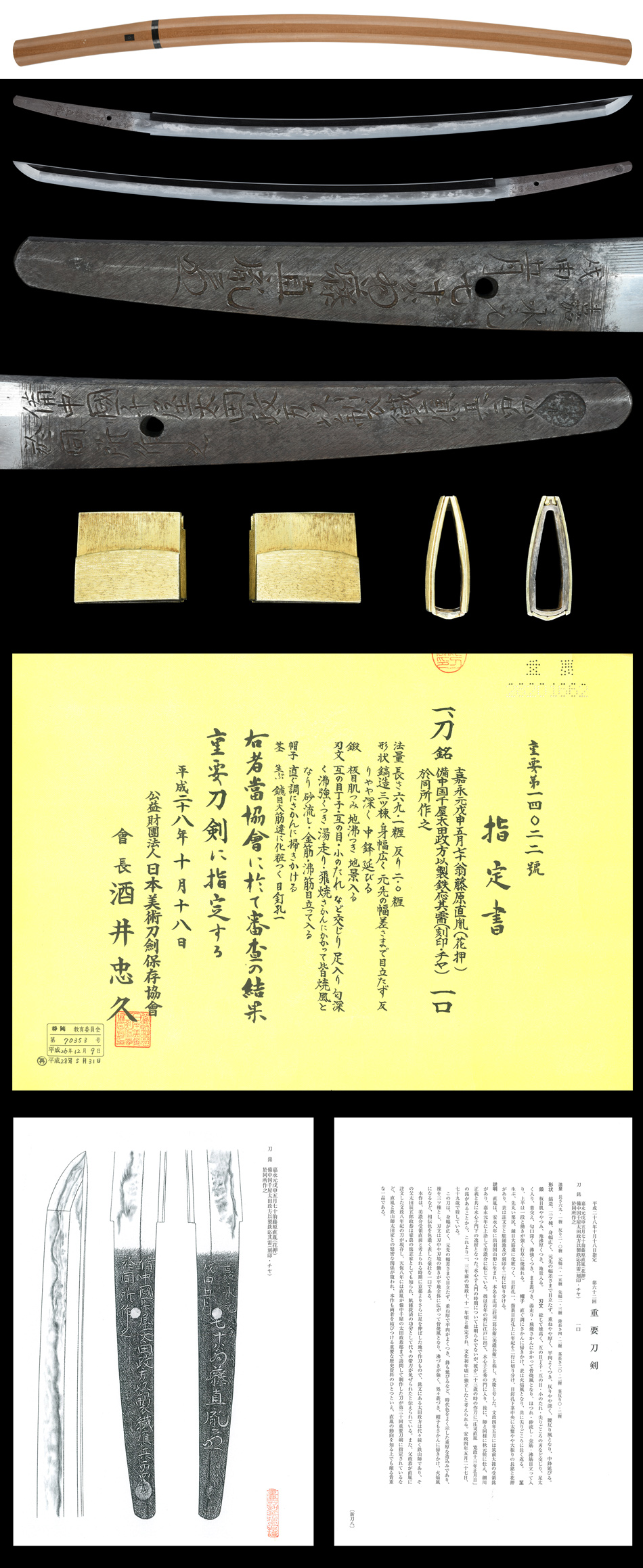
He worked in Edo and also travelled. Stamps on the tang record work at Ise, in Shinano, at Hisai, at Naniwa and in Bitchū, and in explaining a Bitchū katana of Tenpō 8 the published sources cite another blade of that year naming his pupils Shigetsugu, Shigeyuki and Katsunaga, so that he travelled with his disciples. Much of his carving is by Honjō Yoshitane of the Suishinshi circle, whose added signature on one Bunka wakizashi the published sources call of documentary value. His Kyoto work of Kōka 5 bears the stamp 都 and is recorded as a companion piece to a tachi made for the Chancellor of the Realm.
Fujishiro ranks him Sai-jo saku. He has no National Treasures and no Important Cultural Properties. Forty works are on the official record, one Tokubetsu Juyo, thirty-five Juyo, three prewar Juyo Bijutsuhin and a wakizashi stamped Naniwa and dated Tenpō 8 that is recorded in Honma's inventory of the Imperial collection, all of them signed and most of them dated, from Bunka 2 (1805) to Ansei 4. The prewar Bizen-den katana made for Sugihara is judged, in Honma's words, the one to be placed first among his Bizen-den works[[c:5]], and a Tenpō 5 Sōshū katana of the same series is called the right wing of his work. A Bizen-den katana forged at Hisai in Tenpō 3 is named a blade of his full satisfaction[[c:6]], and the Bitchū katana of Tenpō 8, made for Ōta Masayasu, a figure in iron production, is judged finer than his general output, perhaps for its carefully chosen iron. Others were made for Watanabe Shū of the Tsu domain, and the Tenpō 7 daishō was transmitted in the Sanada family. Because his output was large, forgeries are common, as the published sources warn, and a signed Naotane is far easier to find than a great kotō name. His Tokubetsu Juyo and Juyo blades are still held far more often than traded, and one comes to a private collector only from time to time.