Around 1800 Suishinshi Masahide argued in his writings that the craft must return to the old masters’ methods: the fukkotō revival. His greatest successor Naotane worked convincingly in Bizen and Sōshū manners that had been dead for centuries.
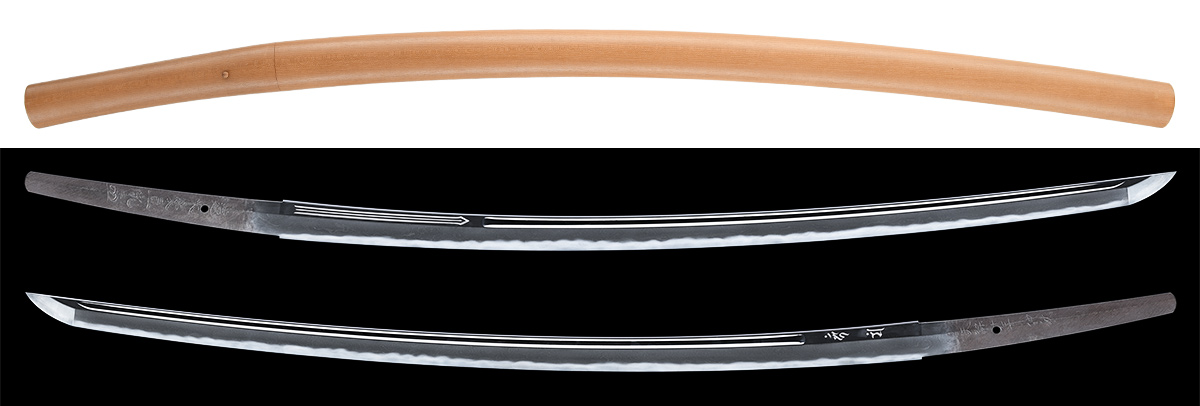
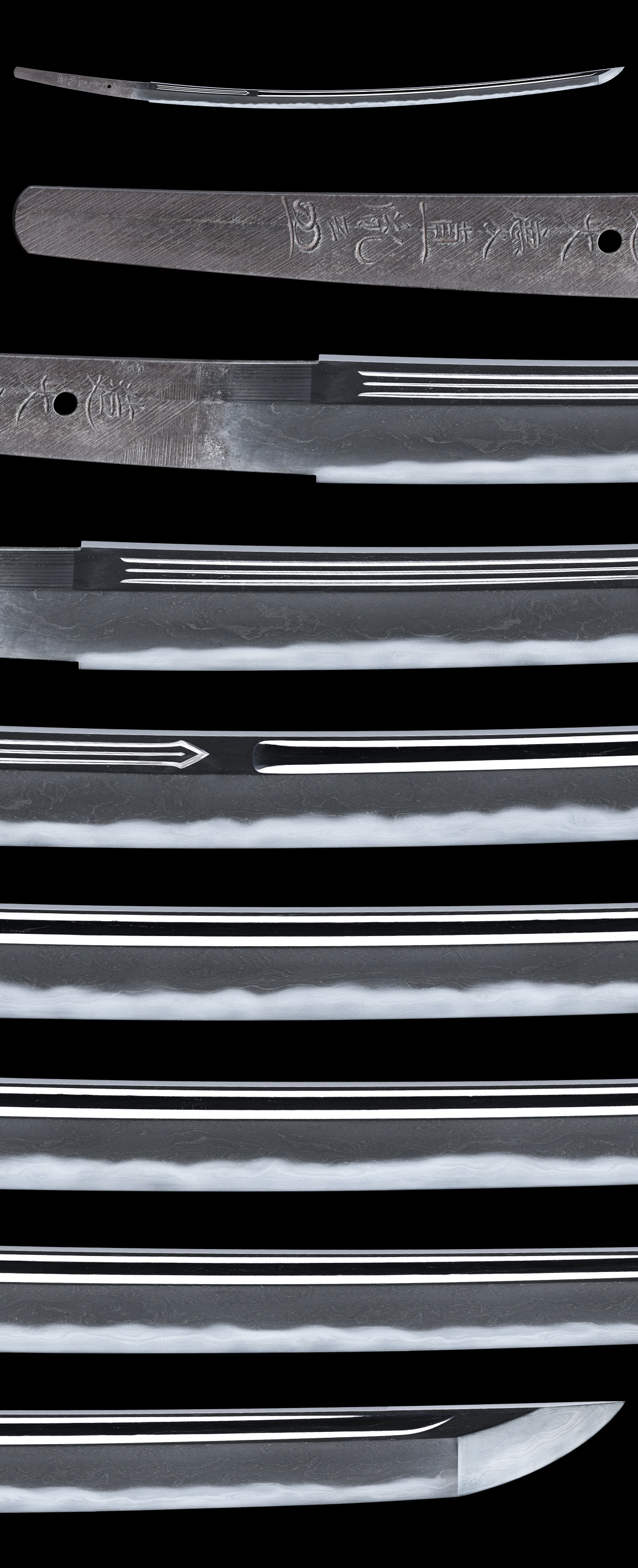
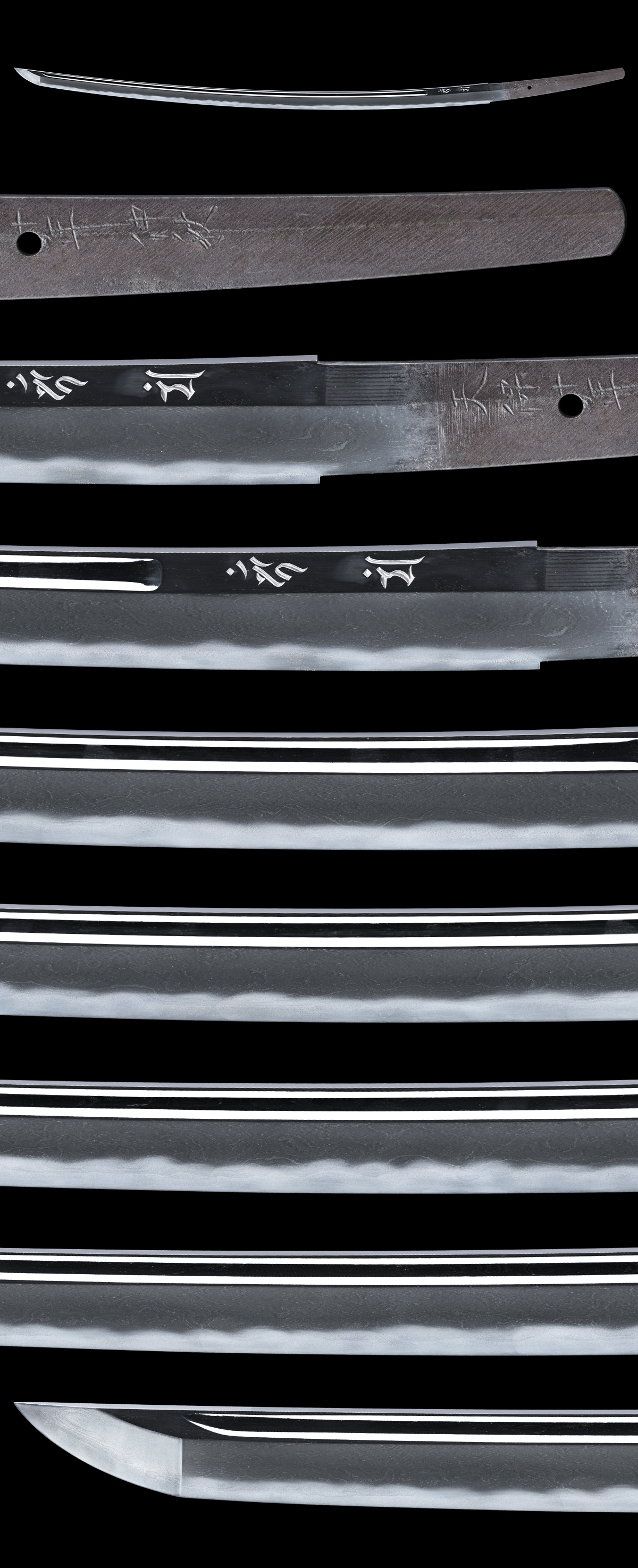
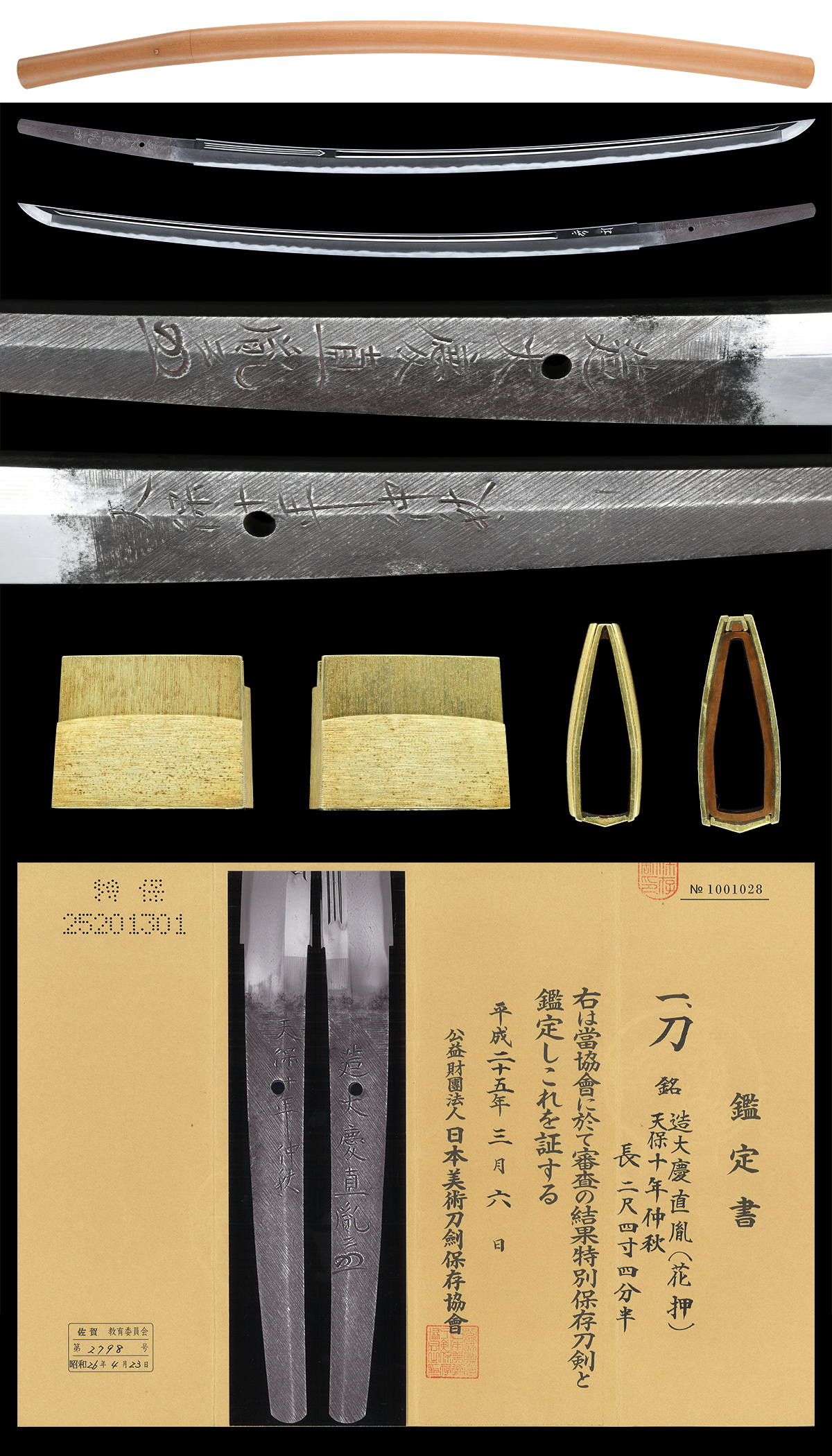
大慶直胤は本名を荘司(庄司)蓑兵衛、大慶と号しました。安永七年、出羽国山形に生まれ。造大慶直胤、大慶直胤造、荘司箕兵衛大慶直胤、出羽国住人大慶庄司直胤、直胤、美濃守直胤などの銘を切ります。水心子正秀の門に入り、初期は濤瀾乱れに始まり、丁字乱れの備前伝、柾目肌の大和伝、尖り刃を交えた美濃伝、大乱れの相州伝、中直刃の山城伝を焼き、器用な直胤は五箇伝の伝法全てに通じ、特に備前伝、相州伝に於いて傑出した作品を多く遺し、その技量は新々刀期の刀工中随一と言われています。姿豪壮な作品に大乱相州伝があり、板目肌の中に渦巻肌を現す様は直胤独特の手癖です。山形藩主 秋元家に仕えて文政四年~五年頃に筑前大掾を受領し、寛永元年には美濃守を受領。作刀期間は五十年にも及びます。刀身の彫刻がある刀には本荘義胤の作が多く現存します。同工の類まれなる技能を見込んだ権力者からの要望多く、同工は日本各地を巡って鍛刀しています。鍛刀した刀剣には鍛刀地の地名を刻印するものがあり、判明しているものだけで十六ヶ所を数えています。 本作体配は、刃長が二尺四寸四分半と常寸を超えて長さ十分、身幅元先で広く、重ね確りとし、反り高く、中切っ先延びごころとなる威厳のある立派な太刀姿を呈します。佩表に素剣と棒樋を丸止め、佩裏に梵字、棒樋を丸止めします。地鉄は板目肌に杢目、小杢目、一部渦巻肌風を交えて、総体肌が顕著に現れます。地沸微塵に厚く付き、肌目に沿って地景が太く頻りに入るなどして、良く練れた肌合いを呈し、鉄良く冴えます。焼刃は、浅い湾れ主調に互の目・小互の目交じり、足太く入り、湯走り掛かり、地肌より影響し、金筋や砂流しが幾重にも掛かります。刃中には沸匂充満し、匂口爛々と冴えます。帽子はそのまま湾れ、先掃きかけて火炎風となり返ります。茎は生ぶ、化粧鑢、勢いのある鏨使いで鏨枕立ち、刀工銘と年紀を刻します。本刀は天保十年、大慶直胤による相州出来の一口です。渦巻肌風を交えて地沸微塵に付き、地景太く入るなど良く練れた地肌、金筋や砂流しが幾重にも掛かる躍動感に富む刃が光彩を放つなど、相州伝の妙味がよく現れた名刀です。白鞘、金着二重はばき、特別保存刀剣鑑定書。
Offered by World Seiyudo
This piece has sold
Get an email when a new Suishinshi Masahide Naotane piece hits the market.


Taikei Naotane (shinshinto, Suishinshi Masahide line, Yamagata / Edo) · Musashi · around 1801-1837
Fujishiro Sai-jo saku · Tōken Taikan top 10%
11 pieces on the market now
Taikei Naotane was born in An'ei 8 (1779) at Yamagata in Dewa, with the common name Shōji Minobei and the art name Taikei. As a young man he went to Edo and entered the school of Suishinshi Masahide, his senior from the same province and the leading advocate of the revival-sword movement, and like his teacher he later served Lord Akimoto. The published sources count him with Hosokawa Masayoshi as one of the two outstanding talents among Masahide's pupils. A blade made at twenty-three is signed Shōji Naotane and dated Kansei 13 (1801), so they place his entry to the school two or three years earlier and his independence near the start of the Bunka era. He signed Chikuzen Daijō from Bunsei 4 (1821), changed the title to Mino no Suke on going up to Kyoto in Kaei 1 (1848), and died in Ansei 4 (1857) at seventy-nine. Where Masahide is regarded as the theorist of the movement, Naotane is called its practitioner, and the published sources say repeatedly that he matured until his technique was judged to surpass his teacher's[[c:1]].
He took up the several kotō traditions in turn, and the published sources name the Bizen and Sōshū manners as his strengths, with much in the Bizen work that deserves attention. They state that the finesse of his chōji-midare carries the established reputation of being the first among shinshintō[[c:2]]. In the record itself the chōji is less constant than that reputation suggests. Of forty published descriptions, seven name a chōji-midare outright, and chōji of some kind enters the temper on fourteen. More often his Bizen work is a gunome-based midare with angular kaku-gunome, kataochi-gunome, togariba and chōji mixed in. Long ashi enter and in places pass through to the edge, and the temper leans in reverse, a saka-gakari the published sources read as aimed at the late-Kamakura Osafune masters Kagemitsu and Kanemitsu. The nioiguchi is bright and clear, nioi-dominant with ko-nie, and the shape recalls a Kamakura tachi, with sori at the koshi-moto and a chū-kissaki.
The jigane of this Bizen work is a tight ko-itame with fine ji-nie and chikei. On the finest pieces a midare-utsuri rises distinctly, and on one katana of Bunka 12 it connects in places into the yakigashira of the temper. The published sources take that revived utsuri as evidence of his Osafune model. They are equally clear about what marks it as new work. Of a Bunka 13 katana with a splendid reverse chōji and a distinct midare-utsuri, they write that it is unfortunately not a pure nioi-deki, and that the nie appearing throughout is precisely the difference between the old works and shinshintō[[c:3]]. The bōshi enters in midare, turns pointed and sweeps back with hakikake, or runs straight to a ko-maru.
His Sōshū-den is the second face of his record, and the published sources call it rarer than the Bizen, aimed at Masamune, Sadamune and Shizu. The jigane becomes a large, standing itame mixed with ō-mokume, and on the strongest pieces a whorled uzumaki-hada that they name a principal point of interest in his Sōden work. Over it lies a notare mixed with gunome and large gunome, the nioi deep and the nie thick, gathering coarse and uneven, with sunagashi and nie-suji in stripes and long kinsuji. Of one wakizashi of Bunsei 13 the commentary finds the uneven nie and frequent hakikake bold and faintly rustic[[c:4]]. A smaller, third register survives in the Yamato manner and in suguha. A katana of Tenpō 5 tempers a suguha-chō with ko-gunome, which the published sources call relatively uncommon for him, and the long sword of a Tenpō 7 daishō crosses an all-masame Yamato forging with a Sōshū notare and gunome.
He worked in Edo and also travelled. Stamps on the tang record work at Ise, in Shinano, at Hisai, at Naniwa and in Bitchū, and in explaining a Bitchū katana of Tenpō 8 the published sources cite another blade of that year naming his pupils Shigetsugu, Shigeyuki and Katsunaga, so that he travelled with his disciples. Much of his carving is by Honjō Yoshitane of the Suishinshi circle, whose added signature on one Bunka wakizashi the published sources call of documentary value. His Kyoto work of Kōka 5 bears the stamp 都 and is recorded as a companion piece to a tachi made for the Chancellor of the Realm.
Fujishiro ranks him Sai-jo saku. He has no National Treasures and no Important Cultural Properties. Forty works are on the official record, one Tokubetsu Juyo, thirty-five Juyo, three prewar Juyo Bijutsuhin and a wakizashi stamped Naniwa and dated Tenpō 8 that is recorded in Honma's inventory of the Imperial collection, all of them signed and most of them dated, from Bunka 2 (1805) to Ansei 4. The prewar Bizen-den katana made for Sugihara is judged, in Honma's words, the one to be placed first among his Bizen-den works[[c:5]], and a Tenpō 5 Sōshū katana of the same series is called the right wing of his work. A Bizen-den katana forged at Hisai in Tenpō 3 is named a blade of his full satisfaction[[c:6]], and the Bitchū katana of Tenpō 8, made for Ōta Masayasu, a figure in iron production, is judged finer than his general output, perhaps for its carefully chosen iron. Others were made for Watanabe Shū of the Tsu domain, and the Tenpō 7 daishō was transmitted in the Sanada family. Because his output was large, forgeries are common, as the published sources warn, and a signed Naotane is far easier to find than a great kotō name. His Tokubetsu Juyo and Juyo blades are still held far more often than traded, and one comes to a private collector only from time to time.
Where Naotane stands among comparable artisans: across all of nihontō, and within tradition, era, and period. The tiers (Foremost · Leading · Major · Notable) weigh official designations from the NBTHK and Japan's Agency for Cultural Affairs, together with historical honors of lasting repute such as the Sansaku and Meibutsu-chō.
Select a lens to see how it's measured.
Years he was demonstrably active, proven by signed-and-dated blades
Shinshinto · Musashi
70 pieces on the market now
At Hamachō in Edo, in the closing decades of the eighteenth century and the opening ones of the nineteenth, Suishinshi Masahide[[c:1]] gathered the school that would turn Japanese swordmaking back toward its medieval models. Born Kawabe Gihachirō at Akayu in Dewa in 1750, signing first as Suzuki Takahide and then Eikoku, he studied under the Shitahara smith Yoshihide of Musashi, took the name Masahide in An'ei 3, and served the Akimoto house of Yamagata before settling in Edo, where he worked for nearly fifty years. He is the founding figure of the shinshintō and the theorist of the fukko-tō (revival-sword) doctrine, the argument that the sword ought to return to its Kamakura forms. Around that teaching he drew a large body of pupils, among them Taikei Naotane, who would give the revival its fullest practical form, the future second Masayoshi (Hosokawa Morihide), and a wider Edo and provincial following that carried the program into the Mito, Yonezawa, Tsuyama, and Tatebayashi domains. The shared vocabulary of the school is the deliberate reach back into the koto traditions, worked over a tightly forged, often muji-toned ko-itame with thick ji-nie. Masahide's own prime hand was the Ōsaka-utsushi, the surging tōran-midare of Tsuda Sukehiro opening from a long yakidashi and the broad suguha after Inoue Shinkai, betrayed on even his closest copies by a blackish, coarse nie that spills from the ha into the ji. Naotane gave the revival its Bizen and Sōshū faces: a reverse-leaning chōji-midare with angular kaku-gunome and saka-ashi, modeled on the late-Kamakura Osafune masters Kagemitsu and Kanemitsu and anchored by a consciously revived midare-utsuri that no ordinary shinshintō steel carries, set beside a Sōshū notare with its whorled uzumaki-hada and coarse, striped nie. The pupils divided this inheritance along their own lines. Jirōtarō Naokatsu, Naotane's adopted son, took a Bizen-den led by a kataochi-gunome from Kanemitsu with a pervasive saka-gakari slant and chōji- or midare-utsuri in the ji.
Suishinshi Masatsugu reproduced Naotane's two traditions, Sōshū and Bizen, down to the cut of his signature. Through Masayoshi the Bizen current passed to his heir Hosokawa Masamori of Tsuyama, whose chōji clusters mixed with gunome-chōji and togariba. The Osaka wave traveled separately into Mito through Naoe Sukemasa, who set a Shinkai-styled suguha and a Sukehiro tōran over a clear ko-itame, while Chōunsai Tsunatoshi of the Uesugi service carried a nioi-deki chōji mixed with gunome, suguha, and tōran-midare, often with carving by his own hand. To kantei the school is to weigh a tradition consciously copied against the period marks the copy cannot shed: the constant of the line is that the hamon is never the pure nioi-deki of old Bizen but carries nie throughout, a difference the NBTHK names outright as the divide between koto and shinshintō. The revived utsuri in Naotane and Naokatsu, the spilling nie in Masahide, the whorled uzumaki-hada shared across the line, and the broad, thick-kasane late-Edo sugata are the surest tells, narrowed further by the school's habit of full, dated signatures that make these smiths among the most exactly knowable of their age. Masahide stands at the head as the teacher and theorist, his finest work in his Ōsaka copies rather than the doctrine he proclaimed; Naotane stands ahead of him in execution, his Bizen-den held the finest among the shinshintō. Their pupils define the late-Edo Osafune and Sōshū revivals as practiced through Edo and the domains, with Naokatsu and Masatsugu read as the next hands after Naotane and Masayoshi. The provenance of the school runs through domain commission and bestowal (Mito blades forged at the Kōrakuen by lordly order, Tsuyama and Yonezawa fief work, Naotane's Sanada daishō and a tachi recorded in Honma's inventory of the Imperial collection) rather than ancient daimyō transmission, fitting for a movement that, within a single generation at Edo, redrew the direction of nineteenth-century swordmaking by turning it back toward the old models. Learn more →
| Smith | Era | Designated |
|---|---|---|
| Naotane直胤 | 1801-1837 | 40 |
| Masahide正秀 | 1777-1817 | 28 |
| Sukemasa助政 | 1804-1825 | 8 |
| Jirotaro Naokatsu直勝 | 1805-1858 | 7 |
| Masayoshi正義 | 1791-1860 | 5 |
The Shinshintō revival
Around 1800 Suishinshi Masahide argued in his writings that the craft must return to the old masters’ methods: the fukkotō revival. His greatest successor Naotane worked convincingly in Bizen and Sōshū manners that had been dead for centuries.
A Hozon-certified blade judged to show notably superior workmanship and a better state of preservation. The bar is higher: re-tempered blades and most unsigned Muromachi/Edo works are excluded.
The NBTHK (Nihon Bijutsu Tōken Hozon Kyōkai, the Society for the Preservation of Japanese Art Swords) is a public-interest incorporated foundation founded in 1948 and supervised by Japan’s Agency for Cultural Affairs (Bunkachō); it is based at the Japanese Sword Museum in Tokyo. Its expert panels physically examine each submitted work (shinsa) and issue a certificate (kanteishō) ranking it by artistic and historical merit. NBTHK papers are the most widely recognized standard of authentication for Japanese swords and fittings.
NBTHK official siteNo cooling-off period or returns; refund only if the purchased sword is proven fake, capped at purchase price (excludes commission sales, accessories, auction items).