Unification closed the mass market, and Seki’s smiths moved to where the new money was: the Mishina line to Kyōto with court titles, Daidō smiths to castle towns across the provinces. Mino became the great technical ancestor of the Shintō age.
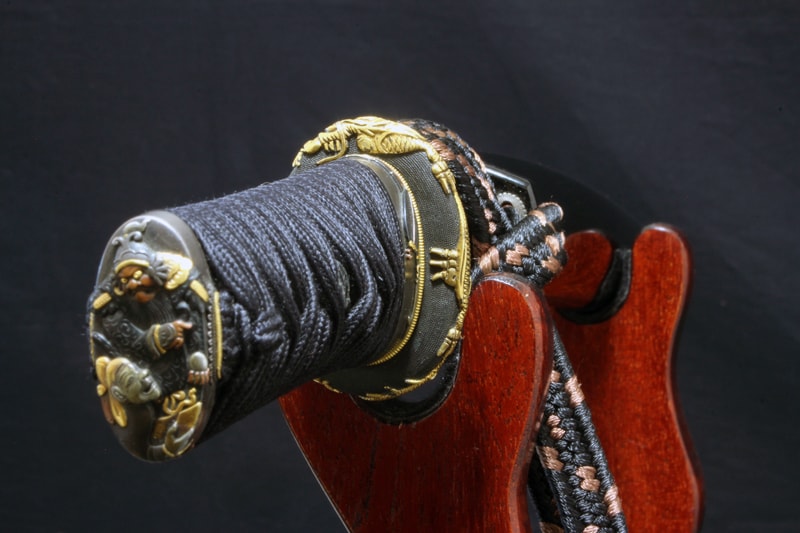
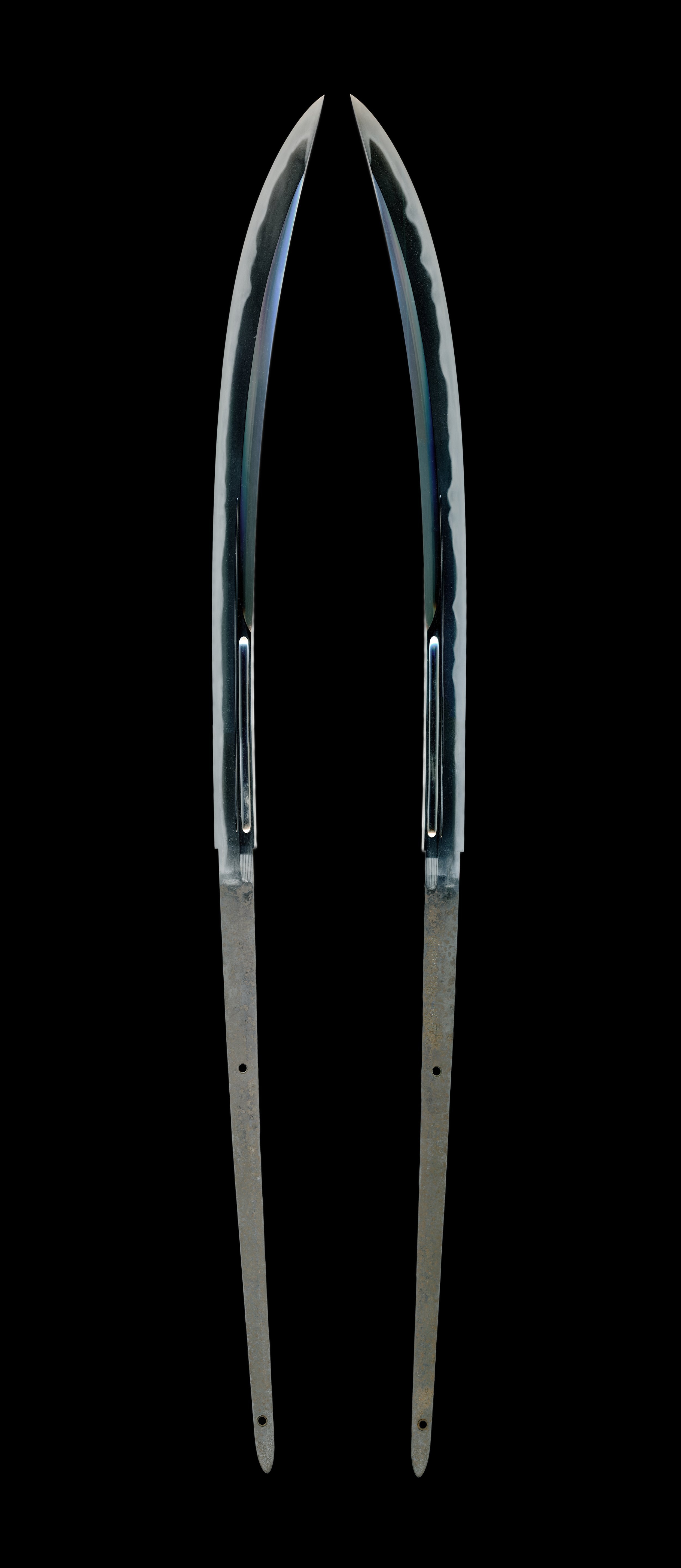
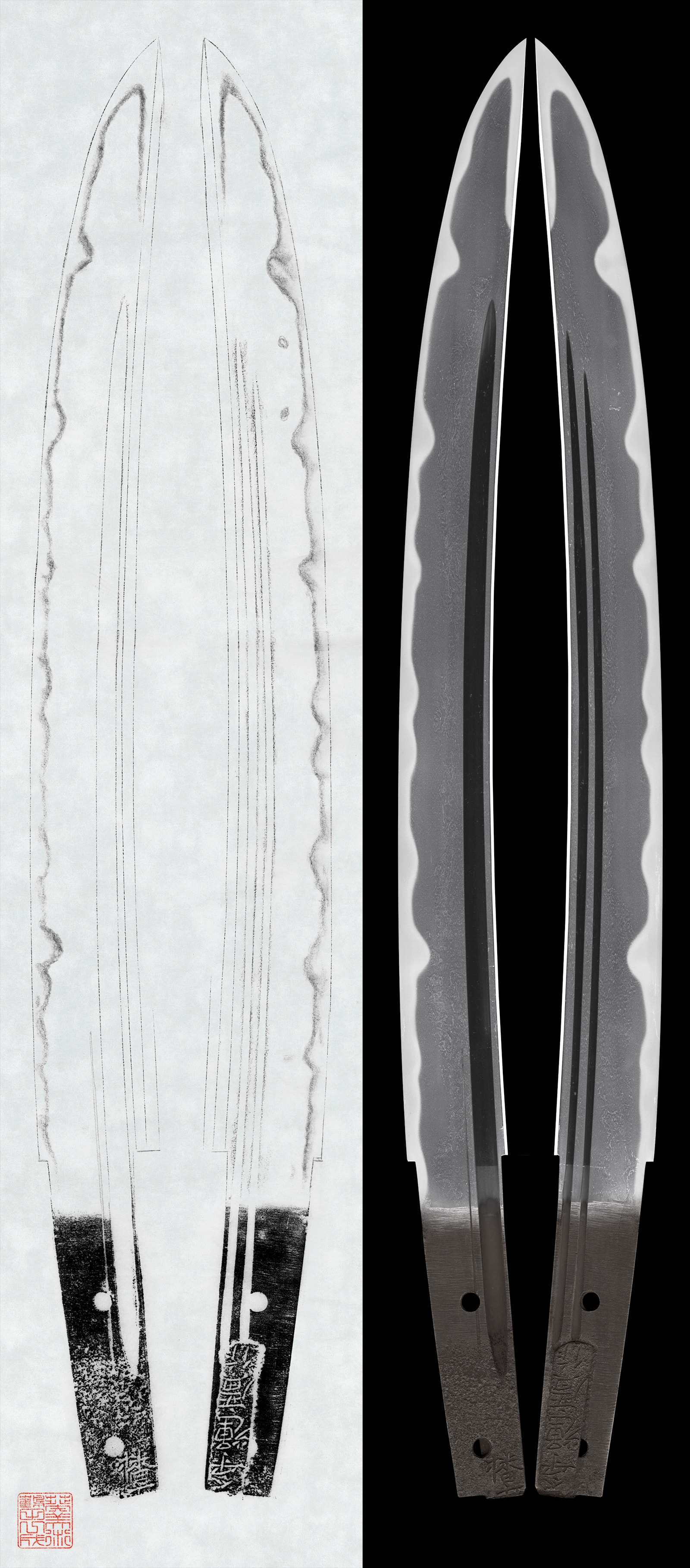
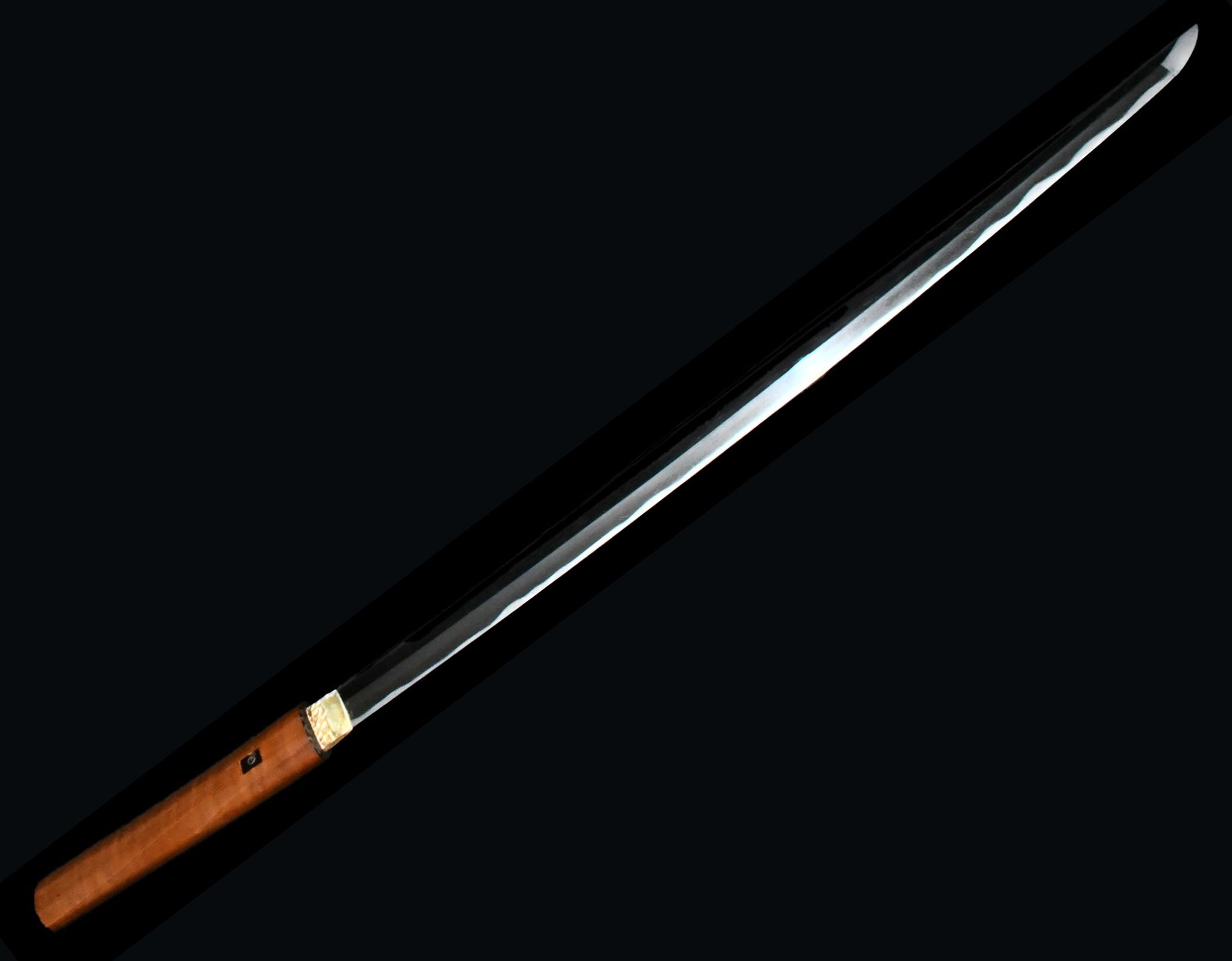
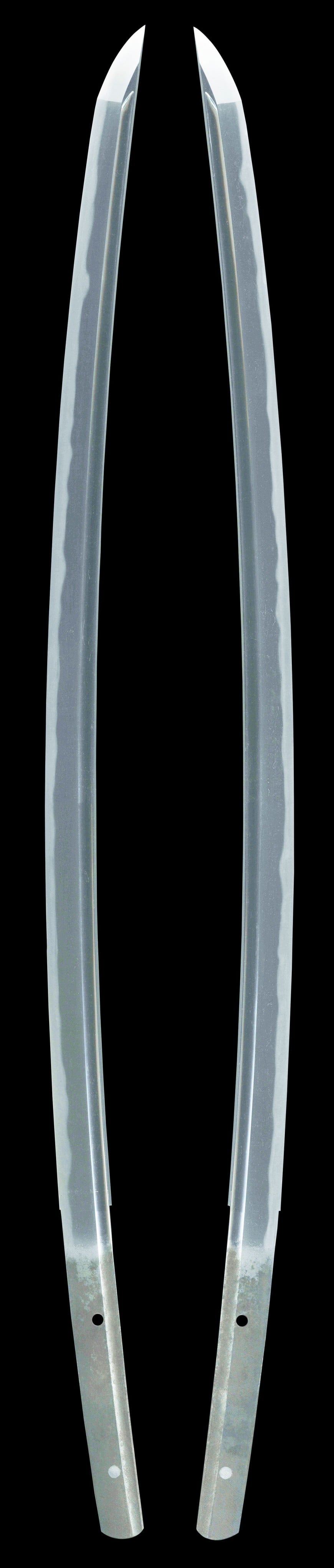
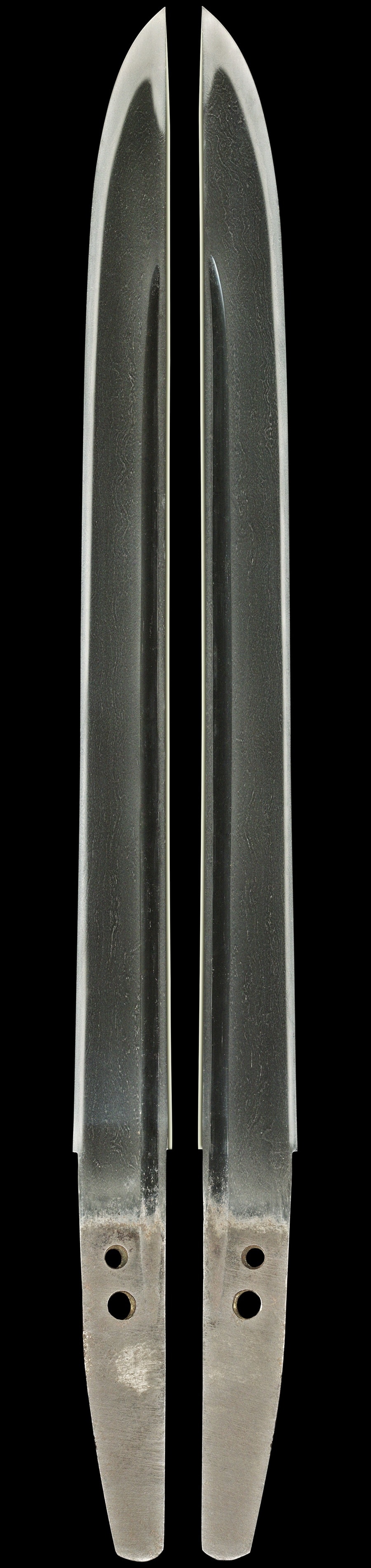
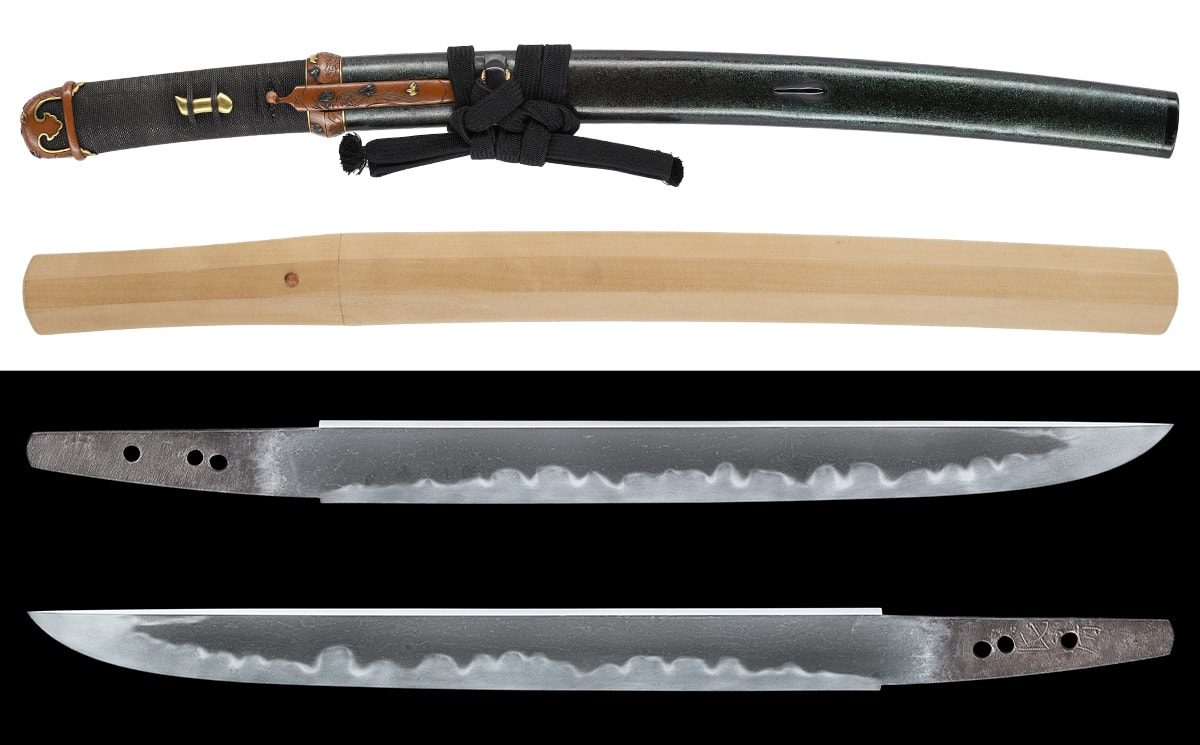
This is a wakizashi by Harima-no-kami Fujiwara Teruhiro, a smith from Aki province active in the early Edo period. It features a shinogizukuri shape with a dai-kissaki, koshi-hi and soe-hi on the front, and bohi on the back. The jigane is itame with mokume, and the hamon is a shallow notare with gunome-ashi and sunagashi.
 NihontoWatch
mei · Keicho (1596-1615) · nagasa 46cm · sori 1.5cm
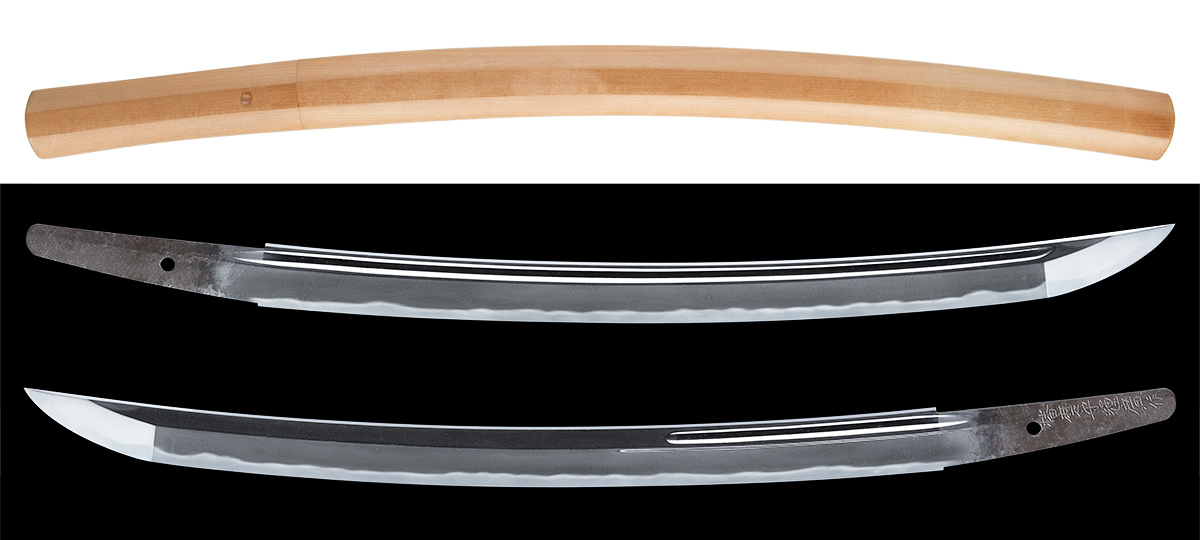
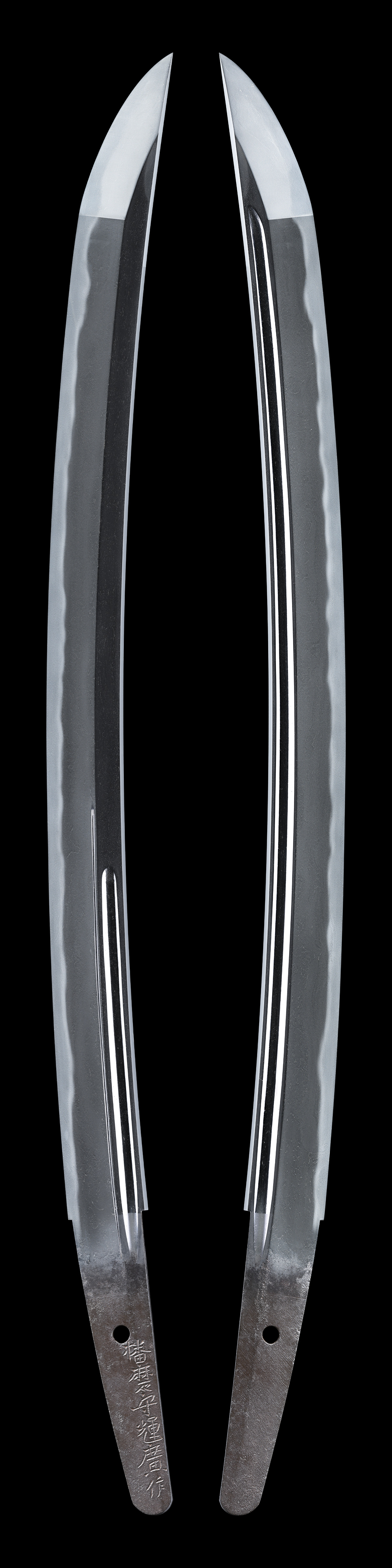
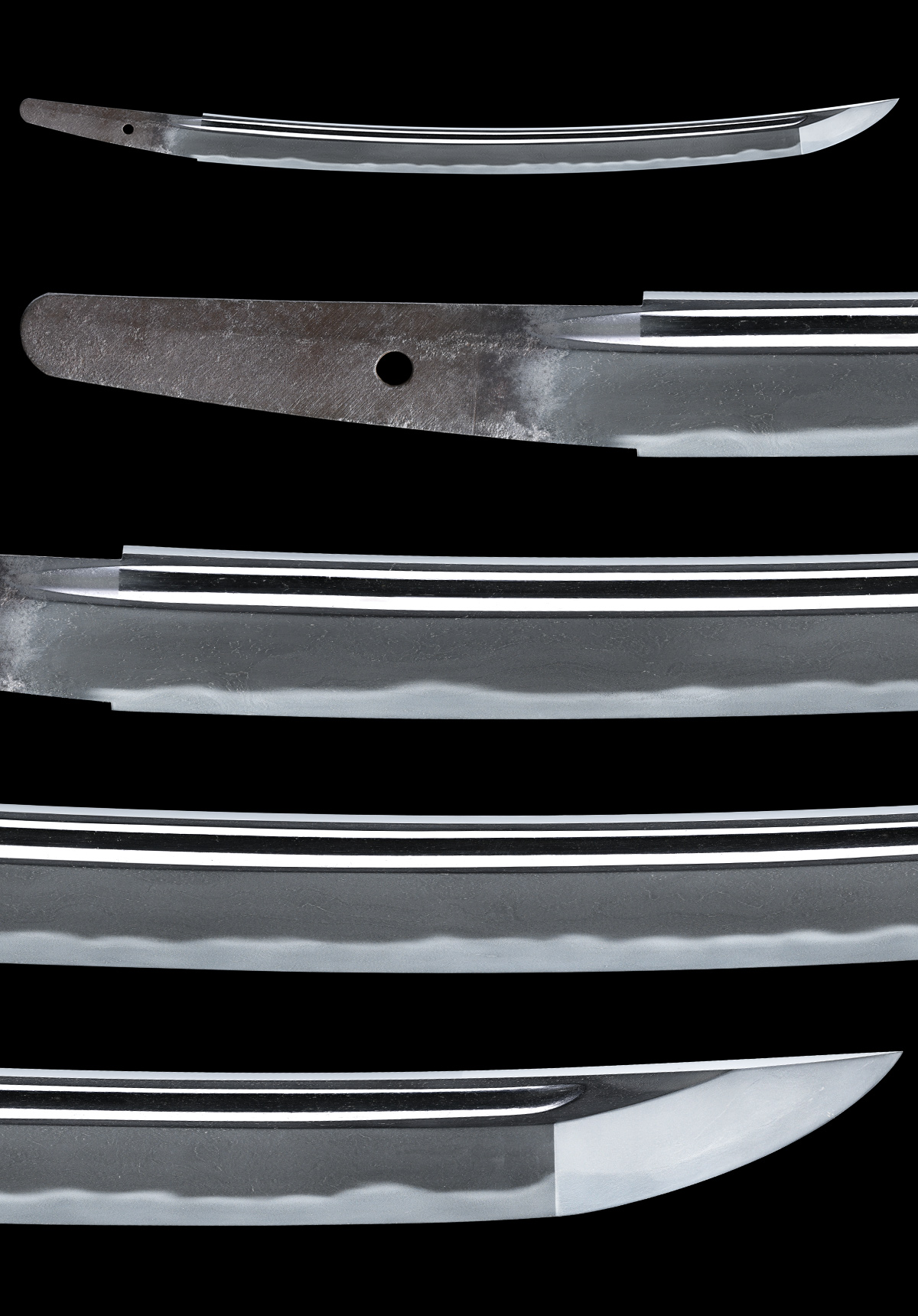
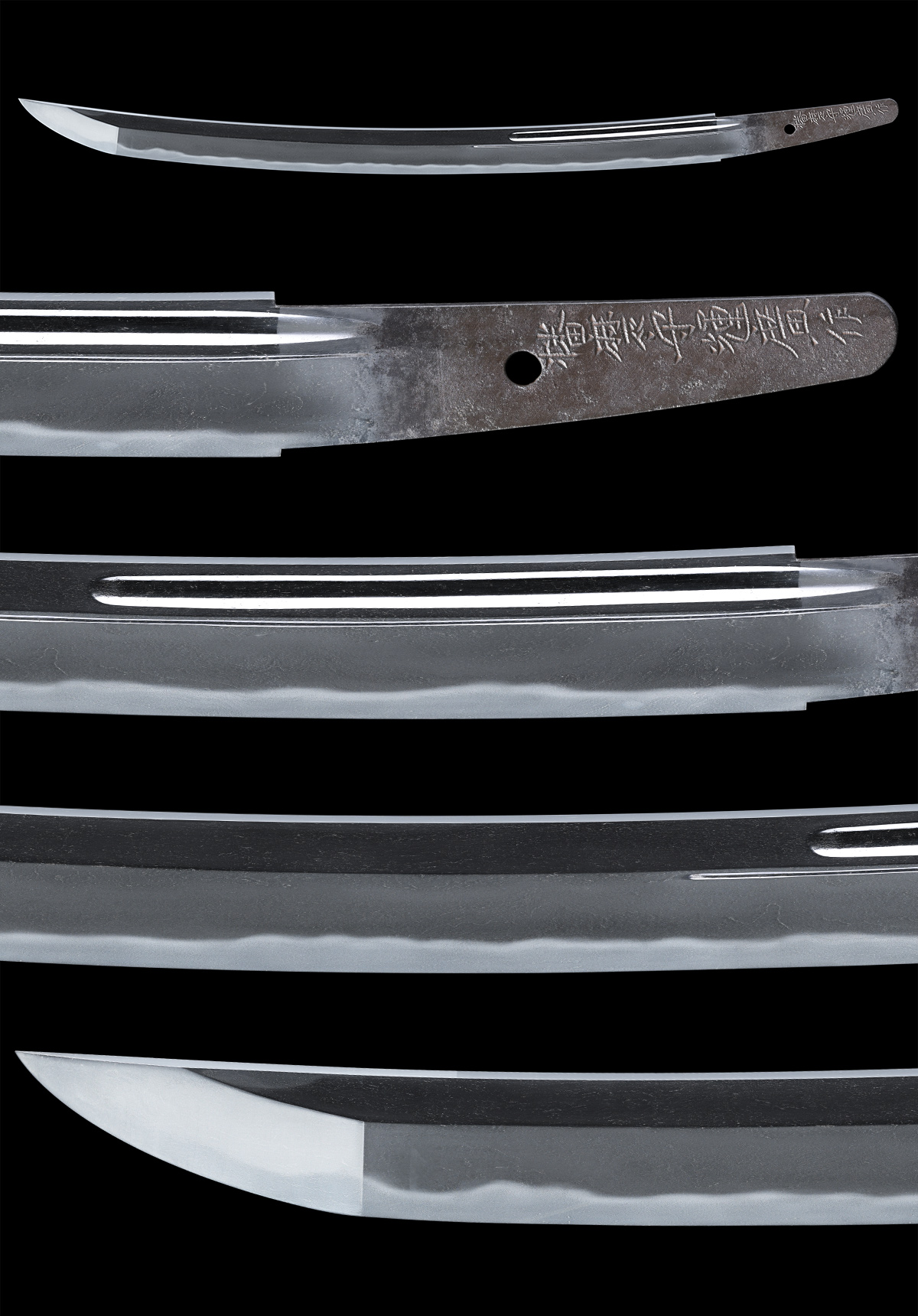
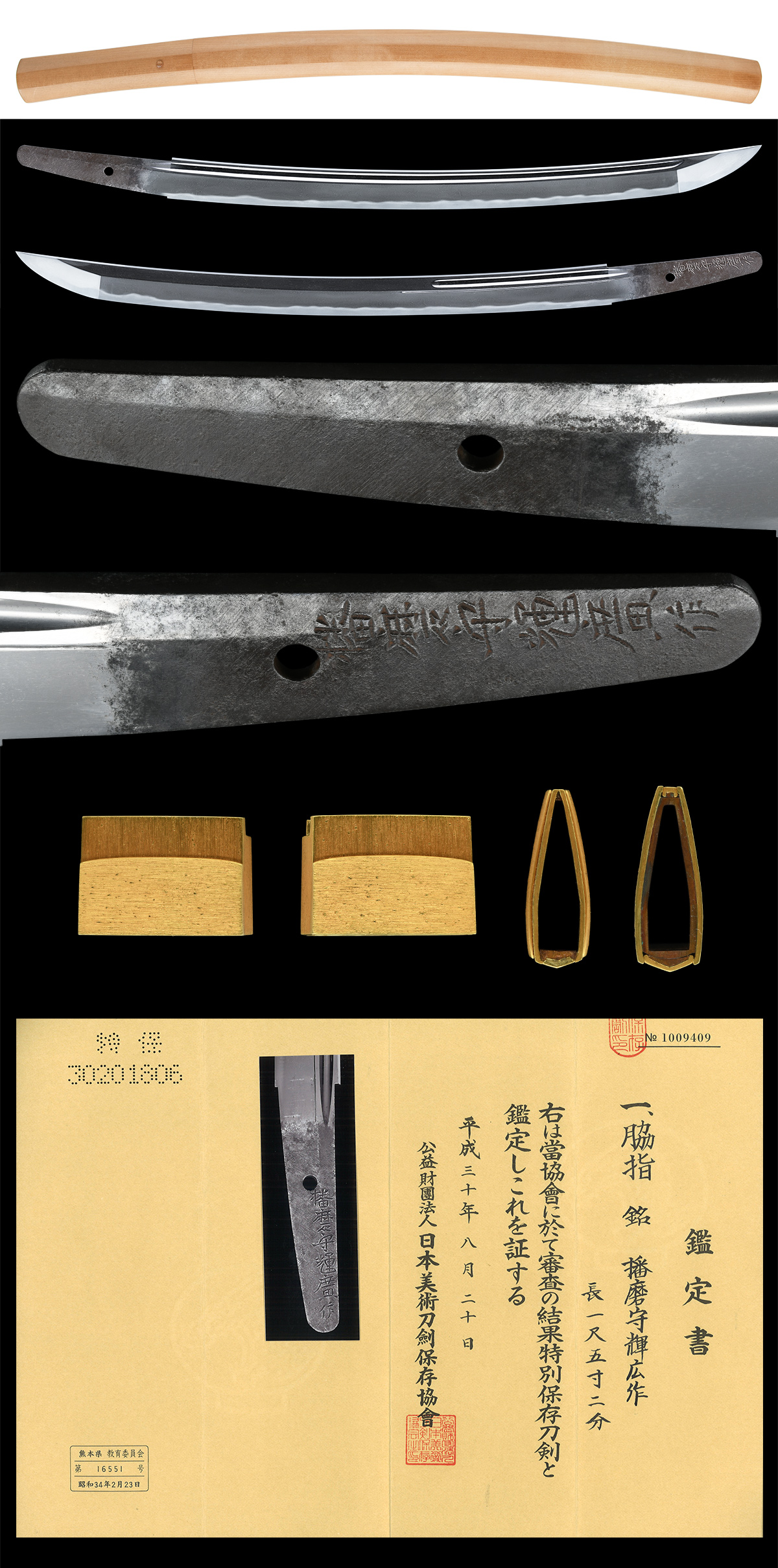
Aki Teruhiro (Geishū Hiroshima), of Mino origin; the second generation, Harima no Kami Teruhiro · Aki · around 1624-1644
Fujishiro Jo-jo saku · Tōken Taikan top 17%
1 piece on the market now
A naginata dated to the strengths of his hand, designated at the fortieth Jūyō session, is read by the published sources as the example in which the true strengths of the second-generation Teruhiro are fully manifested. The smith who made it, Harima no Kami Teruhiro, is the second generation of the Aki Teruhiro line, the Hiroshima house of Mino origin that worked under the patronage of the Fukushima and then the Asano daimyō in early Shintō times. He was a native of Owari of the Kanie family, commonly called Jinpachi, and signed at first as Kanehisa before he studied under the first-generation Higo no Kami Teruhiro, was favorably regarded by his teacher, and became his son-in-law. He served the Fukushima house, moved with it to Hiroshima in Geishū, and after that family was dispossessed entered the service of the Asano. His earliest dated work bears a Keichō 15 date of 1610, so that his active years stand close to the first generation's, and he is documented as a Jō-jō saku smith of the early Hiroshima school.
His characteristic hand is a ko-notare carried in a deep nioiguchi, mixed with gunome and blades of a pointed togari-gokoro tendency. The published sources name this his forte and, on his finest naginata, call the deep nioi, the evenly and thickly adhering ko-nie, and the ji and ha alike bright and clear the very essence of his work, 「正に同工の真骨頂である」[[c:1]]. Within the temper ashi and yō enter, kinsuji run in the lower half, sunagashi streams through, and small tobiyaki appear here and there, the whole hardened in a nioiguchi that runs bright on his best work and settles toward a subdued shizumi on a quieter piece. It is the opposite pole from the showy Bizen clove temper, a controlled undulating line in which the activity is read rather than displayed.
The jigane beneath it is an itame that takes in a masame-leaning, flowing texture and stands somewhat in hada-dachi, an open grain rather than a tight one. On the best naginata the ji-nie gathers at the finest into dust-fine ji-nie mijin laid thickly, with fine chikei entering well and the steel clear, while on the wakizashi the same flowing jigane stands more plainly with ji-nie and chikei. The bōshi most often turns in a ko-maru; on the largest naginata it runs a shallow notare to a somewhat ō-maru tip on the omote and becomes notare-komi with a thrusting-up, pointed finish on the ura, and on the wakizashi it goes straight to a small round turn on one face and into midare-komi on the other.
Two manners recur across his small body of recorded work. The first is the deep-nioi naginata just described, the area in which his forte shows fullest. The second is a slightly elongated sun-nobi hira-zukuri ko-wakizashi, somewhat wide in the mihaba with a thick kasane, presenting the sugata of Keichō-era Shintō and deliberately aiming at the flavor of Shizu work, which the published sources call a success, 「志津の風をねらって成功している」[[c:2]], and indeed a typical work of this smith, 「勿論彼の典型作でもある」[[c:3]]. On these the temper is a shallow, gently undulating line with small gunome, the nioiguchi tight, with a hotsure-like fraying and a slight sunagashi; they carry carvings more often than the naginata, a bō-hi or katana-hi, bonji and a lotus pedestal, gomabashi or a plain suken. The published sources read both manners as a close inheritance of his teacher's style and infer, as with the first generation, an association with the Kyoto master Umetada Myōju, drawn from the deep-nioi notare the two hands share and from the small difference in their working years.
Within the school he is set apart from his teacher by his title and by his descent showing through the steel. Where the first generation signs Higo no Kami, the second signs Harima no Kami, and the published sources read three marks as betraying his Mino lineage even where the temper looks to Shizu: the flowing nagare-hada in the forging, the pointed togari-gokoro blades within the hamon, and especially a bōshi reminiscent of the Mino Sanpin manner. On the finest naginata they name these explicitly and conclude that they allow one to perceive that he was a swordsmith of Mino lineage, 「彼が美濃系出身の刀工であることを察知させる」[[c:4]]. His work is thus legible as Hiroshima Shintō with a Mino root rather than as pure Sōshū, the deep-nioi notare and the flowing, standing ji placing him beside his father and apart from the smiths he admired.
Six of his works are on record, all of them designated Jūyō, spanning tantō, wakizashi and naginata, and all signed; there is no National Treasure or Important Cultural Property among them, and his line is one whose pieces survive in small numbers rather than in quantity. The published sources note that while tantō signed Harima no Kami Teruhiro are by no means scarce, dated examples are exceedingly few, so that a tantō bearing a date carries high documentary value, and the pieces dated Kan'ei 5 of 1628 and Kan'ei 9 of 1632 are valued for exactly that reason. Recorded ownership is private rather than institutional, and no famous provenance attaches to the recorded blades. A designated Teruhiro of the second generation is not among the unattainable names, but it is a blade that comes to a collector only from time to time and with patience, the deep-nioi naginata most of all the one in which, as the published sources have it, the true strengths of the second-generation Teruhiro are fully manifested, 「二代輝広の本領が遺憾無く発揮された同作中の優品である」.
Where Teruhiro stands among comparable artisans: across all of nihontō, and within tradition, era, and period. The tiers (Foremost · Leading · Major · Notable) weigh official designations from the NBTHK and Japan's Agency for Cultural Affairs, together with historical honors of lasting repute such as the Sansaku and Meibutsu-chō.
Select a lens to see how it's measured.
Years he was demonstrably active, proven by signed-and-dated blades
Mino-den · Aki
7 pieces on the market now
The Teruhiro line takes its place in Hiroshima, in Aki province, where its swords were forged from the close of the Momoyama period into early Edo. The first generation (shodai) is recorded in the setsumei as a native of Mino, a later descendant of Kanetsune of Seki, who signed at first as Kanetomo (兼友 or 兼伴) before studying under Umetada Myōju, taking the name Teruhiro, and receiving the court title Higo no Kami. A katana dated Tenshō 17 (1589) and inscribed Nōshū Seki-jū Teruhiro saku[[c:1]] shows, as the registers note, that he already used the Teruhiro name while resident in Mino and had reached full stature before entering Myōju's circle, a point the NBTHK records leave open for further study. He followed Fukushima Masanori to Kiyosu in Owari and, in Keichō 5 (1600), relocated to Hiroshima. The second generation, Harima no Kami Teruhiro, came from Owari; the setsumei give his surname as Kanie, his common name Jinpachi, and his earliest signature Kanehisa (兼久). He studied under the shodai, was valued enough to become his son-in-law, served the Fukushima house, and, after that family's forfeiture, entered the service of the Asano. A wakizashi dated Keichō 15 (1610) places his active years close to those of the first generation, with further dated works cited from Kan'ei 5 (1628) and Kan'ei 9 (1632). Across the line the kitae is itame mixed with mokume and flowing nagare-hada, the grain tending to stand (hada-dachi) and turning toward masame near the edge, with ji-nie and chikei throughout and steel that the registers repeatedly call clear (saeru).
The signature temper is a notare base, often ko-notare, mixed with gunome and pointed (togari-gokoro) elements, carrying deep nioi, thick nie, kinsuji, sunagashi, and scattered tobiyaki; the first generation's Tenshō and Keichō katana broaden this into large, hako-leaning undulations with muneyaki, while the second generation favors deep-nioi ko-notare held at a high level. The bōshi commonly runs notare-komi into ko-maru, at times deeply yaki-sage into muneyaki or showing hakikake. To tell the hands apart, the setsumei observe that the nidai's gunome stands out more strongly than the shodai's, and that nagare-hada in the forging, togari blades in the ha, and a bōshi of Sanbon-sugi or sanpin flavor mark his Mino descent; both generations also worked suguha-toned and masame yari and naginata in a quieter key. The setsumei treat the line as a Mino-rooted hand carrying a strong Sōshū current, and several blades are read as deliberate evocations of older models. The second generation's tantō and wakizashi are described as aiming at Sadamune, "whom Teruhiro most admired," with one kanmuri-otoshi wakizashi bearing naginata-hi read as a study of old Yamato, particularly Taima; a wide notare katana with hardened koshi-ba is likened to Kanemoto and Muramasa. The named registered works span the formats: the shodai's Nōshū Seki-jū katana and Higo no Kami yari and naginata, and the nidai's Harima no Kami katana, wakizashi, naginata, and tantō, several signed Fujiwara Teruhiro. The records stress that surviving pieces are few, numbering fewer than twenty across swords, tantō, yari, and naginata, which lends the ōmi-yari and the carved examples particular documentary value; one note holds that the nidai equals or surpasses the shodai. Kantei rests on the notare core with deep nioi and thick nie, the standing itame with nagare and chikei, the recurrent tobiyaki, and the long thick-chisel signatures on ubu tangs that fix this Aki workshop and its place under Fukushima and Asano patronage. Learn more →
| Smith | Era | Designated |
|---|---|---|
| Teruhiro輝廣 | 1589-1615 | 38 |
| Teruhiro輝廣 | 1624-1644 | 5 |
| Teruhiro輝廣 | 1772-1781 | 0 |
| Teruhiro輝廣 | 1624-1644 | 0 |
| Teruhiro輝廣 | 1716-1736 | 0 |
Mino in the Momoyama period
Unification closed the mass market, and Seki’s smiths moved to where the new money was: the Mishina line to Kyōto with court titles, Daidō smiths to castle towns across the provinces. Mino became the great technical ancestor of the Shintō age.
A Hozon-certified blade judged to show notably superior workmanship and a better state of preservation. The bar is higher: re-tempered blades and most unsigned Muromachi/Edo works are excluded.
The NBTHK (Nihon Bijutsu Tōken Hozon Kyōkai, the Society for the Preservation of Japanese Art Swords) is a public-interest incorporated foundation founded in 1948 and supervised by Japan’s Agency for Cultural Affairs (Bunkachō); it is based at the Japanese Sword Museum in Tokyo. Its expert panels physically examine each submitted work (shinsa) and issue a certificate (kanteishō) ranking it by artistic and historical merit. NBTHK papers are the most widely recognized standard of authentication for Japanese swords and fittings.
NBTHK official siteNo cooling-off period or returns; refund only if the purchased sword is proven fake, capped at purchase price (excludes commission sales, accessories, auction items).
This is a wakizashi by Harima-no-kami Fujiwara Teruhiro, a smith from Aki province active in the early Edo period. It features a shinogizukuri shape with a dai-kissaki, koshi-hi and soe-hi on the front, and bohi on the back. The jigane is itame with mokume, and the hamon is a shallow notare with gunome-ashi and sunagashi.
NihontoWatchmei · Keicho (1596-1615) · nagasa 46cm · sori 1.5cm
Aki Teruhiro (Geishū Hiroshima), of Mino origin; the second generation, Harima no Kami Teruhiro · Aki · around 1624-1644
Fujishiro Jo-jo saku · Tōken Taikan top 17%
1 piece on the market now
A naginata dated to the strengths of his hand, designated at the fortieth Jūyō session, is read by the published sources as the example in which the true strengths of the second-generation Teruhiro are fully manifested. The smith who made it, Harima no Kami Teruhiro, is the second generation of the Aki Teruhiro line, the Hiroshima house of Mino origin that worked under the patronage of the Fukushima and then the Asano daimyō in early Shintō times. He was a native of Owari of the Kanie family, commonly called Jinpachi, and signed at first as Kanehisa before he studied under the first-generation Higo no Kami Teruhiro, was favorably regarded by his teacher, and became his son-in-law. He served the Fukushima house, moved with it to Hiroshima in Geishū, and after that family was dispossessed entered the service of the Asano. His earliest dated work bears a Keichō 15 date of 1610, so that his active years stand close to the first generation's, and he is documented as a Jō-jō saku smith of the early Hiroshima school.
His characteristic hand is a ko-notare carried in a deep nioiguchi, mixed with gunome and blades of a pointed togari-gokoro tendency. The published sources name this his forte and, on his finest naginata, call the deep nioi, the evenly and thickly adhering ko-nie, and the ji and ha alike bright and clear the very essence of his work, 「正に同工の真骨頂である」[[c:1]]. Within the temper ashi and yō enter, kinsuji run in the lower half, sunagashi streams through, and small tobiyaki appear here and there, the whole hardened in a nioiguchi that runs bright on his best work and settles toward a subdued shizumi on a quieter piece. It is the opposite pole from the showy Bizen clove temper, a controlled undulating line in which the activity is read rather than displayed.
The jigane beneath it is an itame that takes in a masame-leaning, flowing texture and stands somewhat in hada-dachi, an open grain rather than a tight one. On the best naginata the ji-nie gathers at the finest into dust-fine ji-nie mijin laid thickly, with fine chikei entering well and the steel clear, while on the wakizashi the same flowing jigane stands more plainly with ji-nie and chikei. The bōshi most often turns in a ko-maru; on the largest naginata it runs a shallow notare to a somewhat ō-maru tip on the omote and becomes notare-komi with a thrusting-up, pointed finish on the ura, and on the wakizashi it goes straight to a small round turn on one face and into midare-komi on the other.
Two manners recur across his small body of recorded work. The first is the deep-nioi naginata just described, the area in which his forte shows fullest. The second is a slightly elongated sun-nobi hira-zukuri ko-wakizashi, somewhat wide in the mihaba with a thick kasane, presenting the sugata of Keichō-era Shintō and deliberately aiming at the flavor of Shizu work, which the published sources call a success, 「志津の風をねらって成功している」[[c:2]], and indeed a typical work of this smith, 「勿論彼の典型作でもある」[[c:3]]. On these the temper is a shallow, gently undulating line with small gunome, the nioiguchi tight, with a hotsure-like fraying and a slight sunagashi; they carry carvings more often than the naginata, a bō-hi or katana-hi, bonji and a lotus pedestal, gomabashi or a plain suken. The published sources read both manners as a close inheritance of his teacher's style and infer, as with the first generation, an association with the Kyoto master Umetada Myōju, drawn from the deep-nioi notare the two hands share and from the small difference in their working years.
Within the school he is set apart from his teacher by his title and by his descent showing through the steel. Where the first generation signs Higo no Kami, the second signs Harima no Kami, and the published sources read three marks as betraying his Mino lineage even where the temper looks to Shizu: the flowing nagare-hada in the forging, the pointed togari-gokoro blades within the hamon, and especially a bōshi reminiscent of the Mino Sanpin manner. On the finest naginata they name these explicitly and conclude that they allow one to perceive that he was a swordsmith of Mino lineage, 「彼が美濃系出身の刀工であることを察知させる」[[c:4]]. His work is thus legible as Hiroshima Shintō with a Mino root rather than as pure Sōshū, the deep-nioi notare and the flowing, standing ji placing him beside his father and apart from the smiths he admired.
Six of his works are on record, all of them designated Jūyō, spanning tantō, wakizashi and naginata, and all signed; there is no National Treasure or Important Cultural Property among them, and his line is one whose pieces survive in small numbers rather than in quantity. The published sources note that while tantō signed Harima no Kami Teruhiro are by no means scarce, dated examples are exceedingly few, so that a tantō bearing a date carries high documentary value, and the pieces dated Kan'ei 5 of 1628 and Kan'ei 9 of 1632 are valued for exactly that reason. Recorded ownership is private rather than institutional, and no famous provenance attaches to the recorded blades. A designated Teruhiro of the second generation is not among the unattainable names, but it is a blade that comes to a collector only from time to time and with patience, the deep-nioi naginata most of all the one in which, as the published sources have it, the true strengths of the second-generation Teruhiro are fully manifested, 「二代輝広の本領が遺憾無く発揮された同作中の優品である」.
Where Teruhiro stands among comparable artisans: across all of nihontō, and within tradition, era, and period. The tiers (Foremost · Leading · Major · Notable) weigh official designations from the NBTHK and Japan's Agency for Cultural Affairs, together with historical honors of lasting repute such as the Sansaku and Meibutsu-chō.
Select a lens to see how it's measured.
Years he was demonstrably active, proven by signed-and-dated blades
Mino-den · Aki
7 pieces on the market now
The Teruhiro line takes its place in Hiroshima, in Aki province, where its swords were forged from the close of the Momoyama period into early Edo. The first generation (shodai) is recorded in the setsumei as a native of Mino, a later descendant of Kanetsune of Seki, who signed at first as Kanetomo (兼友 or 兼伴) before studying under Umetada Myōju, taking the name Teruhiro, and receiving the court title Higo no Kami. A katana dated Tenshō 17 (1589) and inscribed Nōshū Seki-jū Teruhiro saku[[c:1]] shows, as the registers note, that he already used the Teruhiro name while resident in Mino and had reached full stature before entering Myōju's circle, a point the NBTHK records leave open for further study. He followed Fukushima Masanori to Kiyosu in Owari and, in Keichō 5 (1600), relocated to Hiroshima. The second generation, Harima no Kami Teruhiro, came from Owari; the setsumei give his surname as Kanie, his common name Jinpachi, and his earliest signature Kanehisa (兼久). He studied under the shodai, was valued enough to become his son-in-law, served the Fukushima house, and, after that family's forfeiture, entered the service of the Asano. A wakizashi dated Keichō 15 (1610) places his active years close to those of the first generation, with further dated works cited from Kan'ei 5 (1628) and Kan'ei 9 (1632). Across the line the kitae is itame mixed with mokume and flowing nagare-hada, the grain tending to stand (hada-dachi) and turning toward masame near the edge, with ji-nie and chikei throughout and steel that the registers repeatedly call clear (saeru).
The signature temper is a notare base, often ko-notare, mixed with gunome and pointed (togari-gokoro) elements, carrying deep nioi, thick nie, kinsuji, sunagashi, and scattered tobiyaki; the first generation's Tenshō and Keichō katana broaden this into large, hako-leaning undulations with muneyaki, while the second generation favors deep-nioi ko-notare held at a high level. The bōshi commonly runs notare-komi into ko-maru, at times deeply yaki-sage into muneyaki or showing hakikake. To tell the hands apart, the setsumei observe that the nidai's gunome stands out more strongly than the shodai's, and that nagare-hada in the forging, togari blades in the ha, and a bōshi of Sanbon-sugi or sanpin flavor mark his Mino descent; both generations also worked suguha-toned and masame yari and naginata in a quieter key. The setsumei treat the line as a Mino-rooted hand carrying a strong Sōshū current, and several blades are read as deliberate evocations of older models. The second generation's tantō and wakizashi are described as aiming at Sadamune, "whom Teruhiro most admired," with one kanmuri-otoshi wakizashi bearing naginata-hi read as a study of old Yamato, particularly Taima; a wide notare katana with hardened koshi-ba is likened to Kanemoto and Muramasa. The named registered works span the formats: the shodai's Nōshū Seki-jū katana and Higo no Kami yari and naginata, and the nidai's Harima no Kami katana, wakizashi, naginata, and tantō, several signed Fujiwara Teruhiro. The records stress that surviving pieces are few, numbering fewer than twenty across swords, tantō, yari, and naginata, which lends the ōmi-yari and the carved examples particular documentary value; one note holds that the nidai equals or surpasses the shodai. Kantei rests on the notare core with deep nioi and thick nie, the standing itame with nagare and chikei, the recurrent tobiyaki, and the long thick-chisel signatures on ubu tangs that fix this Aki workshop and its place under Fukushima and Asano patronage. Learn more →
| Smith | Era | Designated |
|---|---|---|
| Teruhiro輝廣 | 1589-1615 | 38 |
| Teruhiro輝廣 | 1624-1644 | 5 |
| Teruhiro輝廣 | 1772-1781 | 0 |
| Teruhiro輝廣 | 1624-1644 | 0 |
| Teruhiro輝廣 | 1716-1736 | 0 |
Mino in the Momoyama period
Unification closed the mass market, and Seki’s smiths moved to where the new money was: the Mishina line to Kyōto with court titles, Daidō smiths to castle towns across the provinces. Mino became the great technical ancestor of the Shintō age.
A Hozon-certified blade judged to show notably superior workmanship and a better state of preservation. The bar is higher: re-tempered blades and most unsigned Muromachi/Edo works are excluded.
The NBTHK (Nihon Bijutsu Tōken Hozon Kyōkai, the Society for the Preservation of Japanese Art Swords) is a public-interest incorporated foundation founded in 1948 and supervised by Japan’s Agency for Cultural Affairs (Bunkachō); it is based at the Japanese Sword Museum in Tokyo. Its expert panels physically examine each submitted work (shinsa) and issue a certificate (kanteishō) ranking it by artistic and historical merit. NBTHK papers are the most widely recognized standard of authentication for Japanese swords and fittings.
NBTHK official siteNo cooling-off period or returns; refund only if the purchased sword is proven fake, capped at purchase price (excludes commission sales, accessories, auction items).