Edo was the sword’s age of connoisseurship: the Hon’ami appraisers, the shogunal register of famous blades of 1719, and a thriving literature turned the sword into an object of study even as it ceased to be drawn in war.
 NihontoWatchNihontoWatch
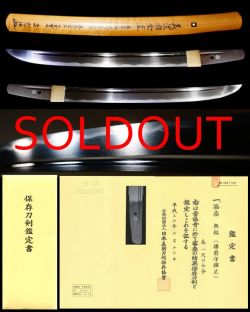
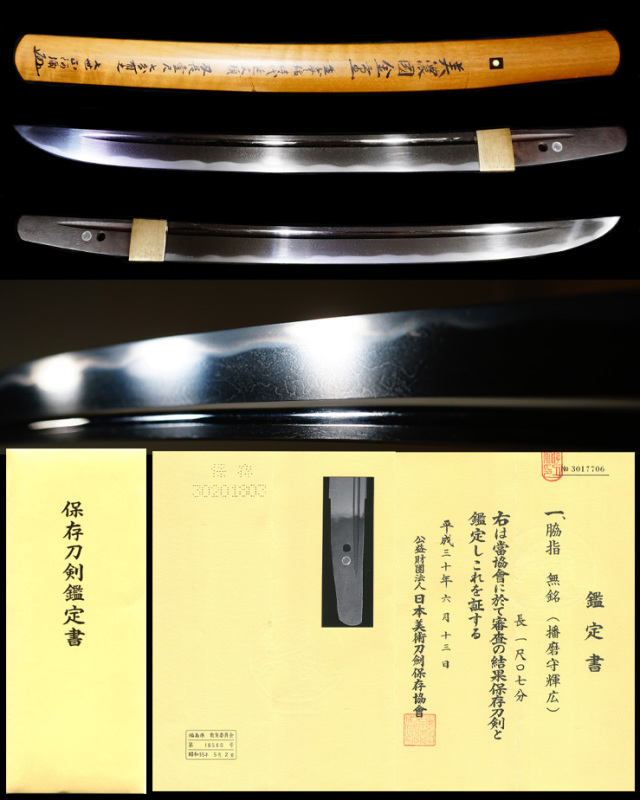
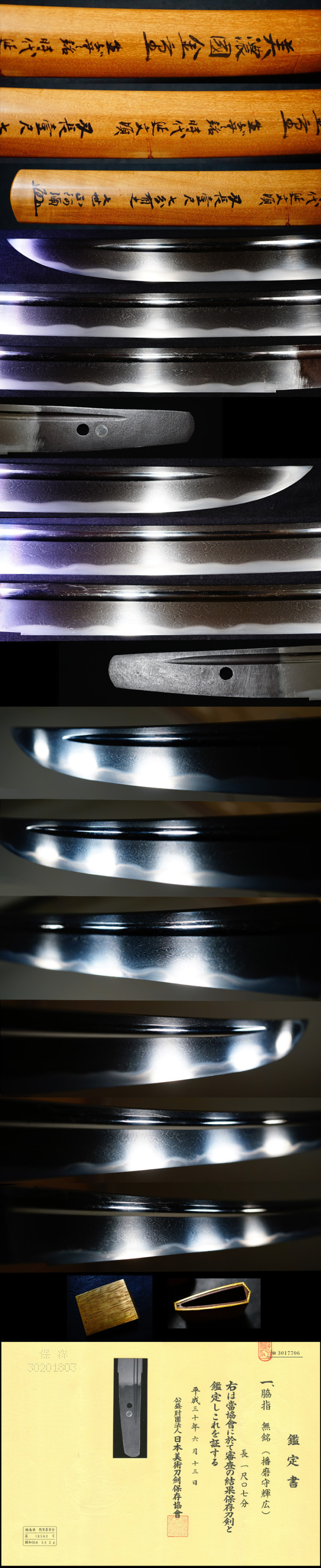
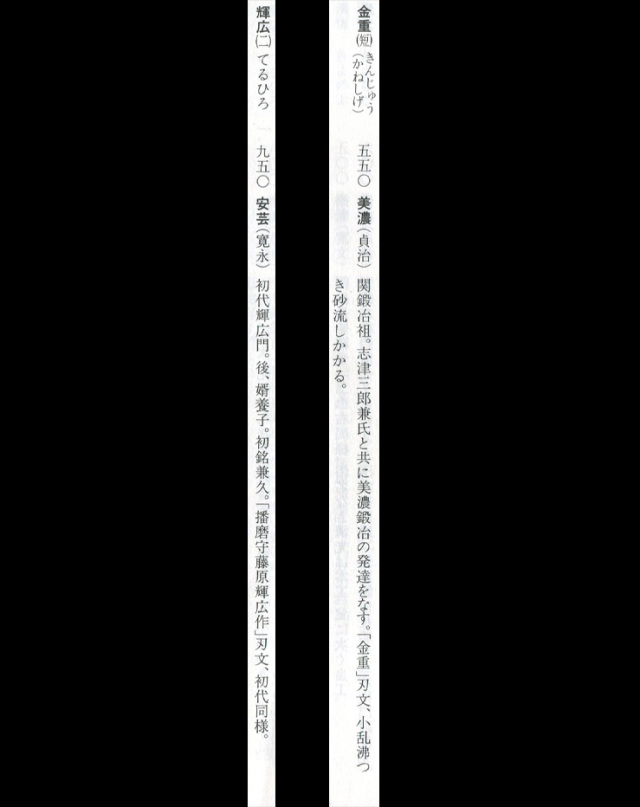
七世本阿弥という方の鞘書きで美濃国金重と極められており、当たり同然と思いますが協会の鑑定は浅野家に仕えた名工として名高い播磨守輝広と極まりました。 地景を交えた躍動感ある小板目鍛えが詰み、洗練された地沸、砂流しが厚く付き、刃縁には沸、砂流しが溢れる古刀名作を見るような素晴らしい御刀です。 二代輝廣は尾張国蟹江刑部の子で、名を甚八、初銘を兼久、初代肥後守輝廣の門人で当時清洲二十万石の領主であった福島正則が慶長五年(1600)芸州廣島五十万石の城主として転封した際、初代輝廣とともに廣島に移住、二代目を継ぎ、福島正則のもと播磨守を受領し、福島家に仕え、のちに浅野家に仕えた名工です。刀剣要覧に於いても高額評価となっております。
NihontoWatchOffered by Kusanagi
This piece has sold
Get an email when a new Aki Teruhiro piece hits the market.

As written by the shop
Aki Teruhiro (Geishū Hiroshima), of Mino origin; the second generation, Harima no Kami Teruhiro · Aki · around 1624-1644
Fujishiro Jo-jo saku · Tōken Taikan top 17%
1 piece on the market now
Harima no Kami Teruhiro is the second generation of the Aki Teruhiro line of Hiroshima, and the published sources date him by a single document: "the oldest date we have seen is Keichō 15"[[c:1]]. He was an Owari man of the Kanie family, commonly called Jinpachi, who first signed Kanehisa and studied under the founder, Higo no Kami Teruhiro, until he was "recognized by his teacher and made his son-in-law"[[c:2]]. He served the Fukushima house and, after its dispossession, the Asano. Because of the Keichō 15 piece the published sources hold that "his working years differ little from the first-generation Teruhiro's"[[c:3]], and from the closeness of the two styles they infer that he, like the founder, was connected with Umetada Myōju. Dates of Kan'ei 5 and Kan'ei 9 extend his record.
His principal manner is a ko-notare carried in a deep nioi, mixed with gunome, angular gunome and blades of a pointed tendency, with ashi, thick nie, kinsuji and sunagashi, in places yubashiri and small ball-like tobiyaki, and a bright, clear nioiguchi. The published sources compare it with the founder's and find the gunome stronger: on one katana "the gunome stands out more than in the first generation"[[c:4]], on a wakizashi the work is "more marked than usual by gunome between the undulations, deep in nioi and well covered in ko-nie"[[c:5]]. Of his finest naginata, its jigane bright and clear, they write that it is "truly the essence of this smith"[[c:6]] and "an excellent work in which the true strength of the second-generation Teruhiro is fully shown"[[c:7]].
The jigane is where he most clearly parts from the founder. An itame mixed with mokume and nagare-hada, standing somewhat in hada-dachi, carries ji-nie laid thick in dust-fine particles, and chikei enter frequently, the steel clear. The published sources single the forging out again and again; on one katana "the forging is particularly excellent"[[c:8]]. The bōshi most often turns in a ko-maru.
Most of his designated work takes one form, the wide, strongly elongated, thick hira-zukuri ko-wakizashi of Keichō-shintō shape, "the sun-nobi hira-zukuri ko-wakizashi so common among his works"[[c:9]]. The published sources read these as aimed at Shizu, "succeeding in aiming at the manner of Shizu"[[c:10]], and call the type "of course also his typical work"[[c:11]]. Some are katakiriba-zukuri, a form also seen in Myōju, but "unlike the kiriha of his teacher Myōju, the kiriha runs through to the tip of the tang"[[c:12]]. Katana are fewer, and the sources note that "katana are rare for the second-generation Teruhiro"[[c:13]]. One of them, tempered in a straight chū-suguha, is called outstanding: "this katana is tempered in suguha and is of outstanding workmanship"[[c:14]].
He also turned deliberately to older masters. A massive, thick wakizashi with a large midare of ko-notare, angular gunome and pointed blades is read as modeled on "Sōshū Sadamune, whom he admired most"[[c:15]]. A kanmuri-otoshi wakizashi carved with naginata-hi, tempered in a chū-suguha with hotsure and kuichigai-ba, is read as aiming at "old Yamato work, and above all Taima"[[c:16]], and the sources add that "of this kind of work, this one blade is the only example we have seen"[[c:17]]. A thick tantō is thought "to have taken a high Sōshū master as its model"[[c:18]], and a broad katana with a wide, high notare and koshi-ba "shows a manner recalling Muramasa"[[c:19]]. Through all of these the flowing hada, the pointed blades and a Sanpin-style bōshi show the published sources "that he was a swordsmith of Mino descent"[[c:20]].
Fujishiro grades him Jō-jō saku, and twenty-seven designated works are on record: twenty-six in the Jūyō tier, and one tantō, signed Harima no Kami Fujiwara Teruhiro saku, recorded in Honma's inventory of the Imperial collection. The published sources observe that "tantō signed Harima no Kami Teruhiro are by no means few in number, but those with dates are exceedingly rare"[[c:21]], so that his dated pieces carry documentary weight, and that his works are said to bear few carvings, "it is said that Harima no Kami Teruhiro's works have few carvings"[[c:22]], though the few that do are skilled. For a collector his ko-wakizashi are the realistic encounter, appearing from time to time, while a katana or a dated piece is rare.
Where Teruhiro stands among comparable artisans: across all of nihontō, and within tradition, era, and period. The tiers (Foremost · Leading · Major · Notable) weigh official designations from the NBTHK and Japan's Agency for Cultural Affairs, together with historical honors of lasting repute such as the Sansaku and Meibutsu-chō.
Select a lens to see how it's measured.
Years he was demonstrably active, proven by signed-and-dated blades
Mino-den · Aki
6 pieces on the market now
The Teruhiro line takes its place in Hiroshima, in Aki province, where its swords were forged from the close of the Momoyama period into early Edo. The first generation (shodai) is recorded in the setsumei as a native of Mino, a later descendant of Kanetsune of Seki, who signed at first as Kanetomo (兼友 or 兼伴) before studying under Umetada Myōju, taking the name Teruhiro, and receiving the court title Higo no Kami. A katana dated Tenshō 17 (1589) and inscribed Nōshū Seki-jū Teruhiro saku[[c:1]] shows, as the registers note, that he already used the Teruhiro name while resident in Mino and had reached full stature before entering Myōju's circle, a point the NBTHK records leave open for further study. He followed Fukushima Masanori to Kiyosu in Owari and, in Keichō 5 (1600), relocated to Hiroshima. The second generation, Harima no Kami Teruhiro, came from Owari; the setsumei give his surname as Kanie, his common name Jinpachi, and his earliest signature Kanehisa (兼久). He studied under the shodai, was valued enough to become his son-in-law, served the Fukushima house, and, after that family's forfeiture, entered the service of the Asano. A wakizashi dated Keichō 15 (1610) places his active years close to those of the first generation, with further dated works cited from Kan'ei 5 (1628) and Kan'ei 9 (1632). Across the line the kitae is itame mixed with mokume and flowing nagare-hada, the grain tending to stand (hada-dachi) and turning toward masame near the edge, with ji-nie and chikei throughout and steel that the registers repeatedly call clear (saeru).
The signature temper is a notare base, often ko-notare, mixed with gunome and pointed (togari-gokoro) elements, carrying deep nioi, thick nie, kinsuji, sunagashi, and scattered tobiyaki; the first generation's Tenshō and Keichō katana broaden this into large, hako-leaning undulations with muneyaki, while the second generation favors deep-nioi ko-notare held at a high level. The bōshi commonly runs notare-komi into ko-maru, at times deeply yaki-sage into muneyaki or showing hakikake. To tell the hands apart, the setsumei observe that the nidai's gunome stands out more strongly than the shodai's, and that nagare-hada in the forging, togari blades in the ha, and a bōshi of Sanbon-sugi or sanpin flavor mark his Mino descent; both generations also worked suguha-toned and masame yari and naginata in a quieter key. The setsumei treat the line as a Mino-rooted hand carrying a strong Sōshū current, and several blades are read as deliberate evocations of older models. The second generation's tantō and wakizashi are described as aiming at Sadamune, "whom Teruhiro most admired," with one kanmuri-otoshi wakizashi bearing naginata-hi read as a study of old Yamato, particularly Taima; a wide notare katana with hardened koshi-ba is likened to Kanemoto and Muramasa. The named registered works span the formats: the shodai's Nōshū Seki-jū katana and Higo no Kami yari and naginata, and the nidai's Harima no Kami katana, wakizashi, naginata, and tantō, several signed Fujiwara Teruhiro. The records stress that surviving pieces are few, numbering fewer than twenty across swords, tantō, yari, and naginata, which lends the ōmi-yari and the carved examples particular documentary value; one note holds that the nidai equals or surpasses the shodai. Kantei rests on the notare core with deep nioi and thick nie, the standing itame with nagare and chikei, the recurrent tobiyaki, and the long thick-chisel signatures on ubu tangs that fix this Aki workshop and its place under Fukushima and Asano patronage. Learn more →
| Smith | Era | Designated |
|---|---|---|
| Teruhiro輝廣 | 1624-1644 | 27 |
| Teruhiro輝廣 | 1589-1615 | 17 |
| Teruhiro輝廣 | 1624-1644 | 0 |
| Teruhiro輝廣 | 1748-1751 | 0 |
| Teruhiro輝廣 | 1661-1673 | 0 |
The Edo period (1615 to 1868)
Edo was the sword’s age of connoisseurship: the Hon’ami appraisers, the shogunal register of famous blades of 1719, and a thriving literature turned the sword into an object of study even as it ceased to be drawn in war.
Certifies a genuine blade worth preserving: a signature confirmed correct, or, if unsigned, an era, province, and school that the NBTHK can reliably identify.
The NBTHK (Nihon Bijutsu Tōken Hozon Kyōkai, the Society for the Preservation of Japanese Art Swords) is a public-interest incorporated foundation founded in 1948 and supervised by Japan’s Agency for Cultural Affairs (Bunkachō); it is based at the Japanese Sword Museum in Tokyo. Its expert panels physically examine each submitted work (shinsa) and issue a certificate (kanteishō) ranking it by artistic and historical merit. NBTHK papers are the most widely recognized standard of authentication for Japanese swords and fittings.
NBTHK official sitePlease notify us of your intention to return, by email or fax, no later than the day after the item's arrival. Return shipping, insurance, and refund transfer fees are the customer's responsibility.