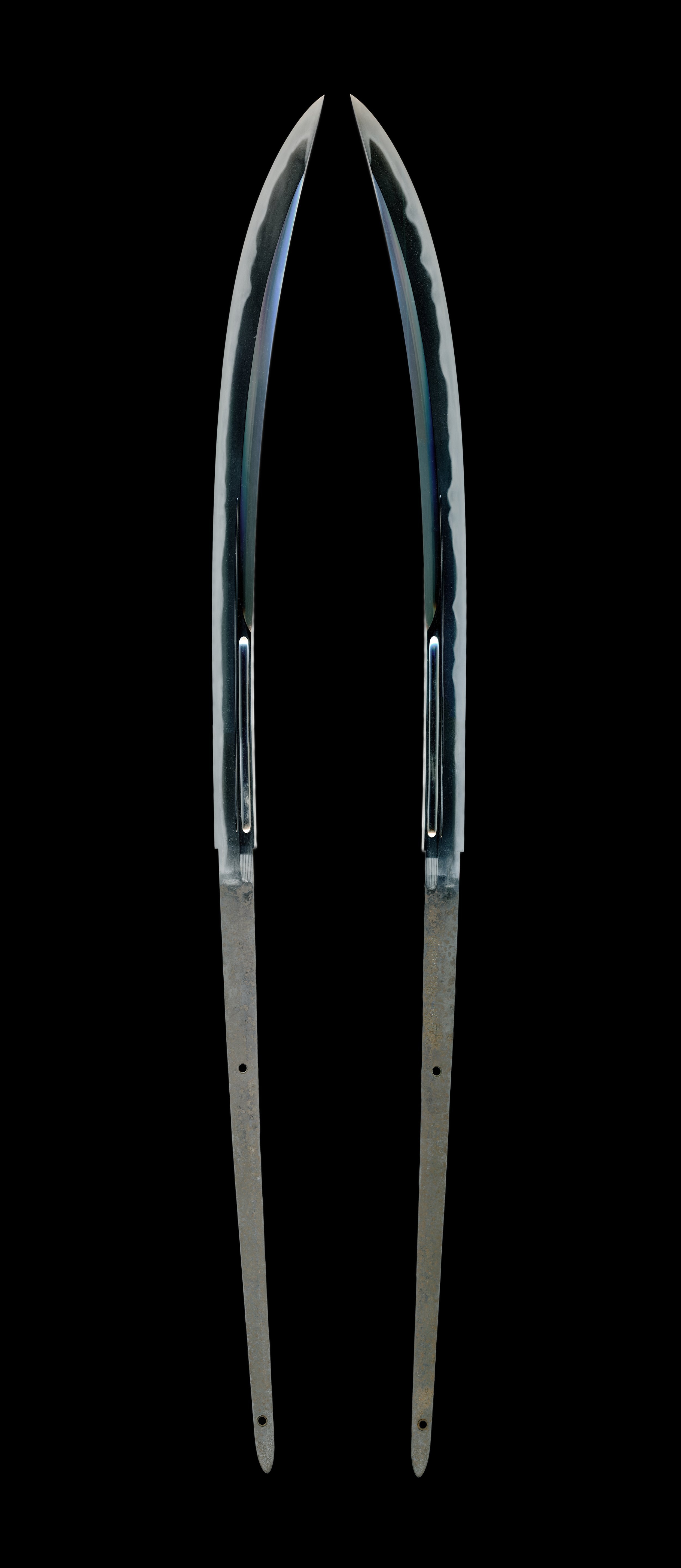
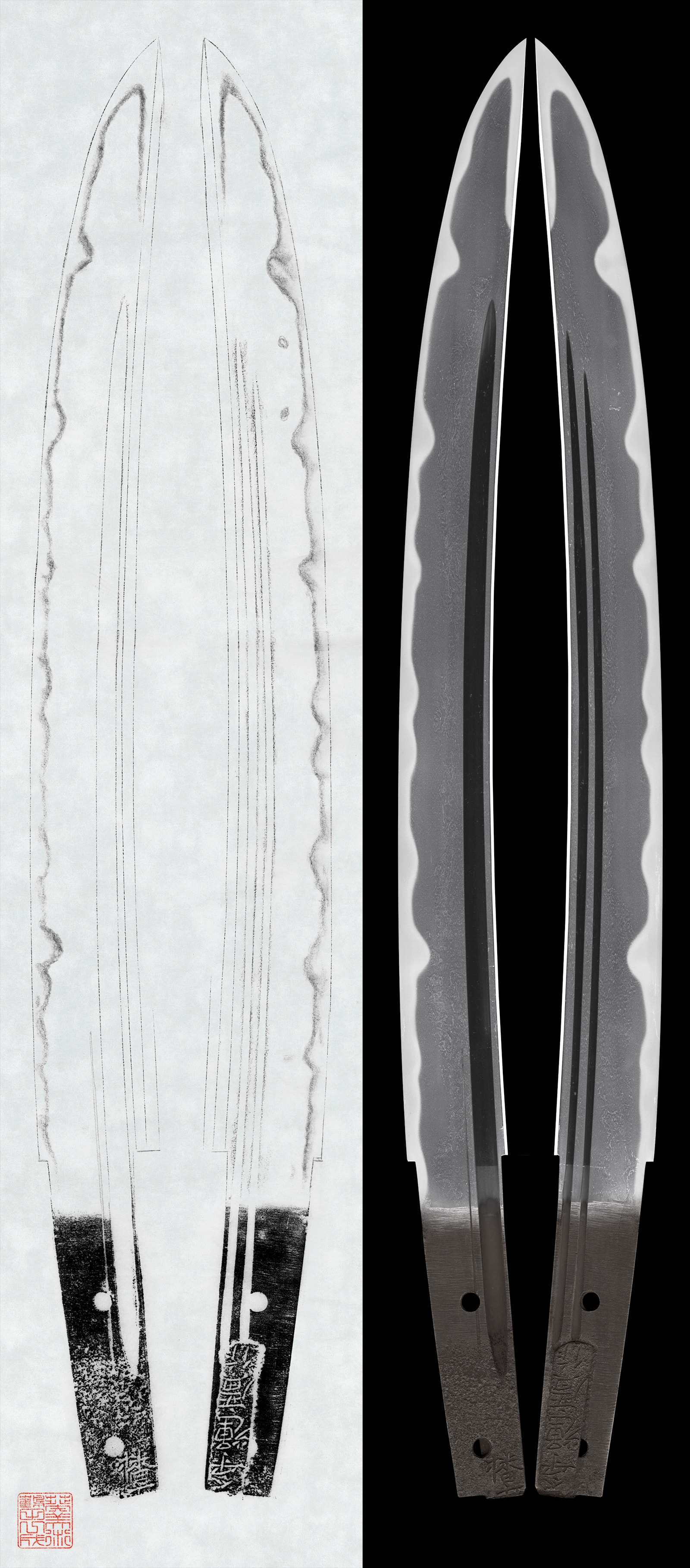
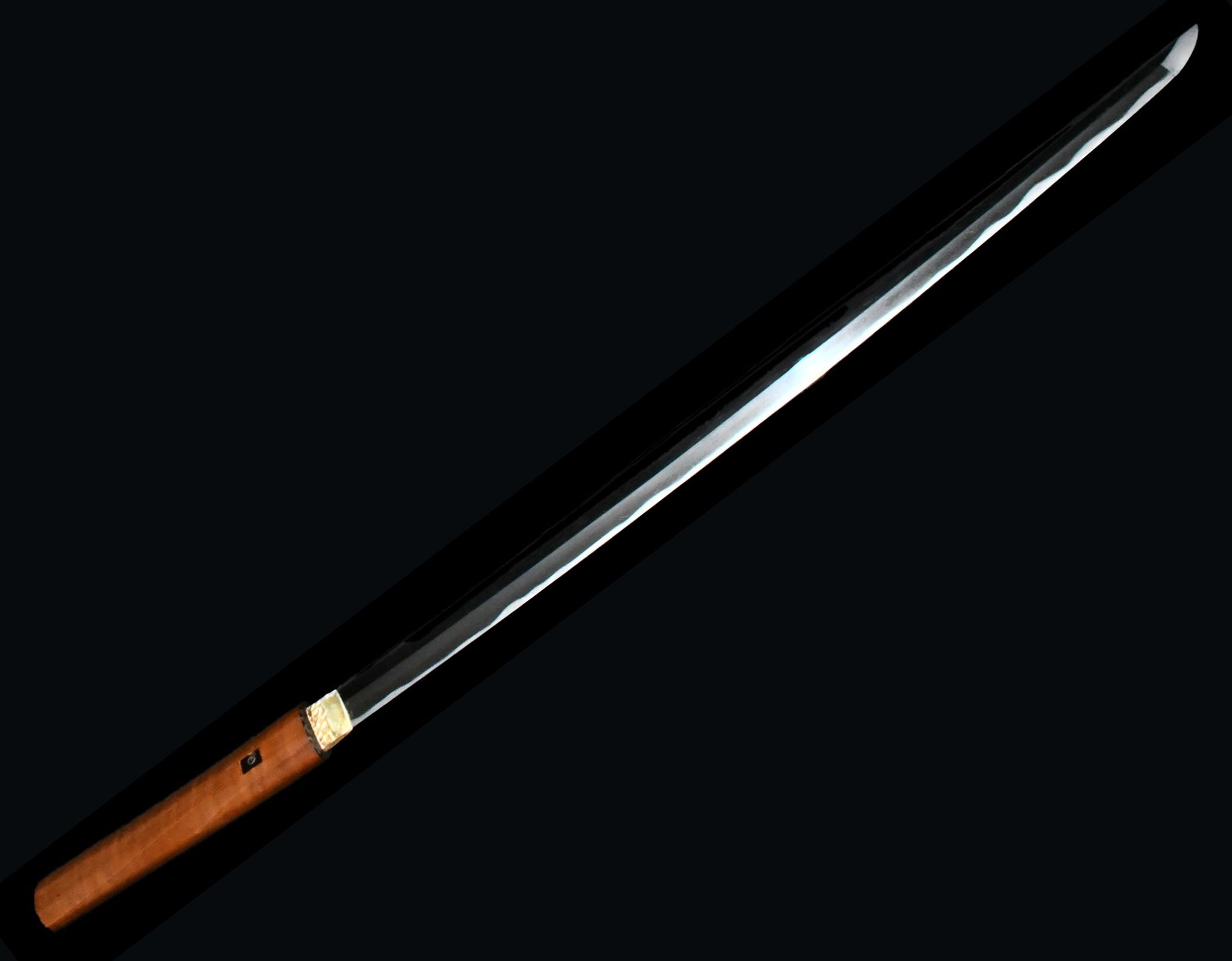
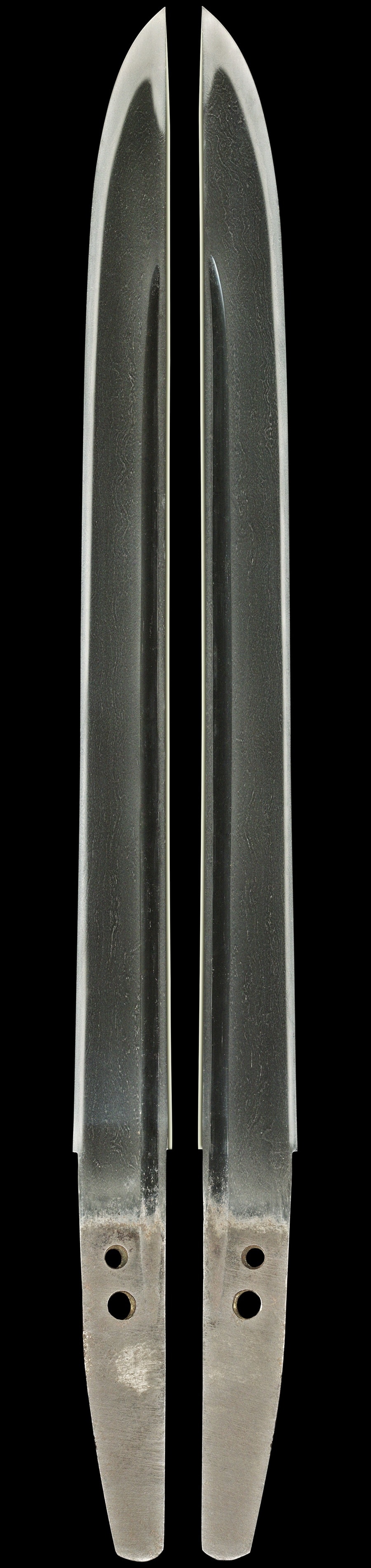
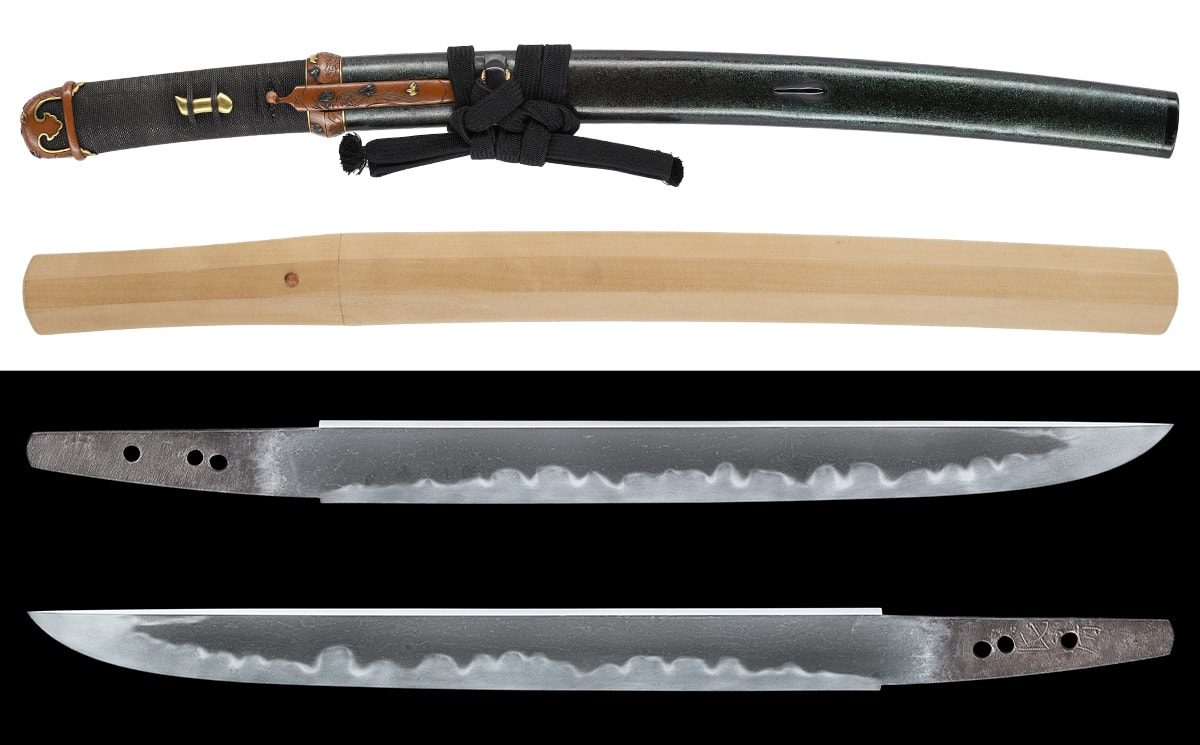
A dated Tenshō 17 (1589) and inscribed Nōshū Seki-jū Teruhiro is the document around which this smith's history was rewritten. Teruhiro is the founding name of an early- Hiroshima line, and the published sources read it as two closely matched hands set down together: the , no Kami Fujiwara Teruhiro, and his son-in-law the nidai, Harima no Kami Teruhiro. The was a native of , said to descend from Seki Kanetsune, who signed first as Kanetomo, then studied under Myōju of Kyōto, took service with Fukushima Masanori, changed his name and received the title no Kami, and accompanied his lord from Kiyosu in Owari to Hiroshima in Geishū in Keichō 5 (1600). The traditional account made him a Myōju pupil first and an accomplished smith second. The Tenshō-dated overturned the order: the published commentary holds that it proves he was already signing Teruhiro and meijin-class while still in , so that, in their words, he had already reached full stature 「明寿入門以前に既に大成していた」 before entering Myōju's circle, a finding that reopens the question of that teaching and is left to future research.
His recognized work is a broad , strong in and at its largest carrying an . Over an that flows toward the edge into and stands somewhat in , the tempers a vigorous that boxes up in places into large, -leaning patterns, mixing and gunome-chōji, with and breaking out, and within, a that runs tight or subdued with mura-, and and throughout. The tempers deep and enters , turning back in with a deep return that joins the . The published sources read this as an admiration for workmanship, and of the they call it 「放胆な作柄を示した初代輝広の傑出した一振」, a blade that, with its wide body and large point, 「迫力に満ち溢れている」.
The is where the origin shows most plainly. The 's is an run through with , standing in , at times faintly whitish, the gathered over a forging that is more vigorous than refined. The nidai's is the more polished of the two: a tightly worked mixed with and , the laid in minute particles and densely, with woven in frequently, a forging the published sources single out as bright and clear. Across both hands the temper is the constant. The principal manner is a , deep in , with set into it, entering, thick on the edge, and running, and breaking out here and there, the bright. A quieter register recurs across both, drawn especially on , and a few , in a that undulates shallowly with , and along the .
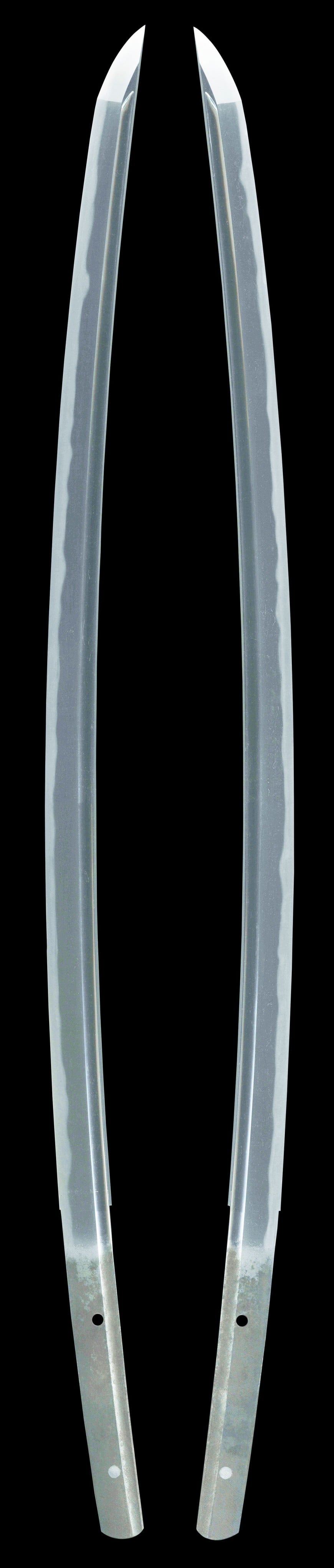
The nidai, an Owari man of the Kanie family commonly called Jinpachi who first signed Kanehisa, became the 's son-in-law and is thought, like his teacher, to have had a connection with Myōju; his earliest dated work is of Keichō 15 (1610). His own manner keeps the deep- with , the standing a little more strongly than in the . Beyond it he turns deliberately to older models, and the record of those copies is unusually explicit. One wide kata- the published sources read as modeled on Sadamune, the master 「彼が最も私淑した相州貞宗に範を」 taken from; a piece in , carved with , they read as an evocation of old Yamato, particularly ; a broad whose wide, high with a hardened -ba they say calls to mind Kanemoto and Muramasa; and a recent they take as a copy after a high hand. Through all of them the flowing , the angular and pointed elements, and a -like betray, in their reading, his descent.
What sets the two hands apart from their and sources is exactly what the judges name in them. The is read as the bolder, -touched hand, his spirited and large; the nidai as the more refined and various, deep in and bright in the , and confident enough to range from Sadamune to to Kanemoto. The published sources hold that the nidai equals or surpasses his teacher, recording that the second-generation Harima no Kami 「二代播磨守は初代に優るとも劣らぬものがある」, and of his finest blades they say his true strength is shown without reserve. The line did not end with him: after the Fukushima house was dispossessed it passed into the service of the Asano and prospered in Hiroshima for generations, many descendants likewise taking the title Harima no Kami.
For the collector Teruhiro is a scarce early- name graded Jō-jō by Fujishiro. The 's surviving production is repeatedly said to number fewer than twenty pieces in all, counting , , and together, and his work has no National Treasures or Important Cultural Properties; the designated record runs instead through one , a body of some thirty-five blades across both generations, and a prewar Jūyō Bijutsuhin. Provenance is thin but real, the recorded names being the Fukushima and Asano houses the smiths served and the prewar collector Hayashida Shōkei. Of the dated the published sources say it is exceptional documentary material, and of the early example, that it is 「同作中の優品の一である」; of the nidai's best, that 「覇気があって出来も優れている」. Most designated Teruhiro blades are held rather than traded, so an example reaching the market is uncommon and is a notable thing for a private collector to encounter, a record of how a Seki smith carried and into the swords of early- Hiroshima.