Unification closed the mass market, and Seki’s smiths moved to where the new money was: the Mishina line to Kyōto with court titles, Daidō smiths to castle towns across the provinces. Mino became the great technical ancestor of the Shintō age.
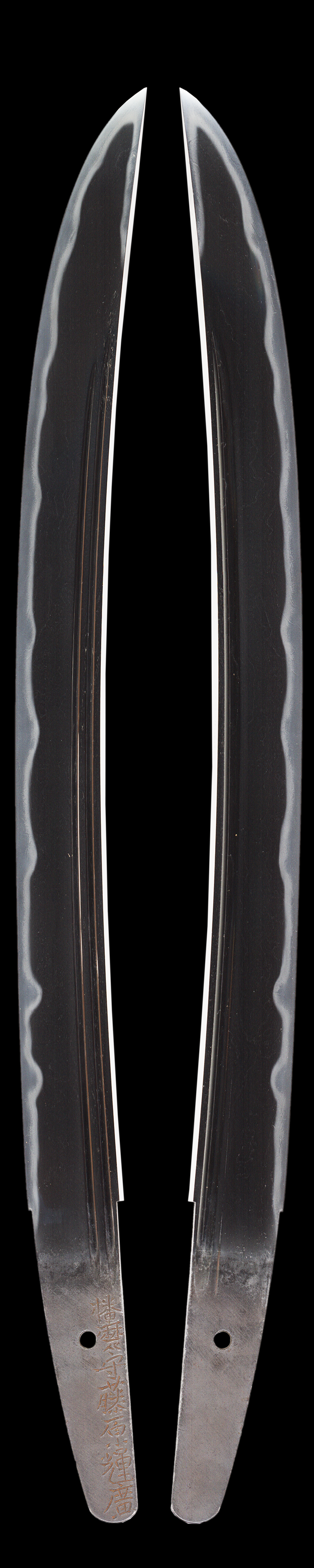
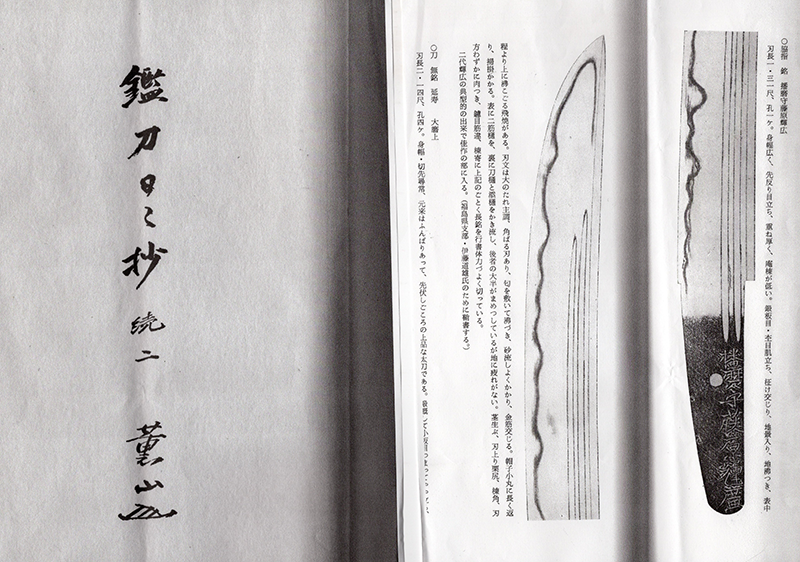
A Tokubetsu Hozon Token designated work by Harima no Kami Teruhiro, an exclusive smith for the Asano family of Aki Province. It is said that Harima no Kami Teruhiro was from Owari Province, his surname was Kanie, his common name was Jinpachi, and his first mei was Kanehisa; he studied under the first generation Higo no Kami Teruhiro, was favored by his master and became his son-in-law, served the Fukushima family, and served the Asano family after the former family's attainder. Since a wakizashi dated Keicho 15 remains among his swords, there is not much difference in the production period compared to the first generation Teruhiro, and furthermore, because he tempered blades based primarily on small notare with deep nioi that resemble the style of the first generation and are skillfully executed, a relationship with Umetada Myoju can be perceived just as with the first generation. This work shows the style he was most proficient in, based on a large-patterned notare mixed with gunome and the like, with deep nioi, thick ko-nie, and the appearance of kinsuji and sunagashi; in particular, the point that the kitae is even more excellent draws attention. The state in which the nioi is deep, the ko-nie is applied evenly and well, and both the ji and ha are bright and clear is truly the true essence of this smith. Furthermore, characteristics such as the boshi on the ura exhibiting a Mishina style allow one to perceive that he was a swordsmith of Mino lineage, and it is a superior work among his productions in which the true ability of the second generation Teruhiro, who is considered to have aimed for the style of Shizu or perhaps Sadamune, is demonstrated without regret.
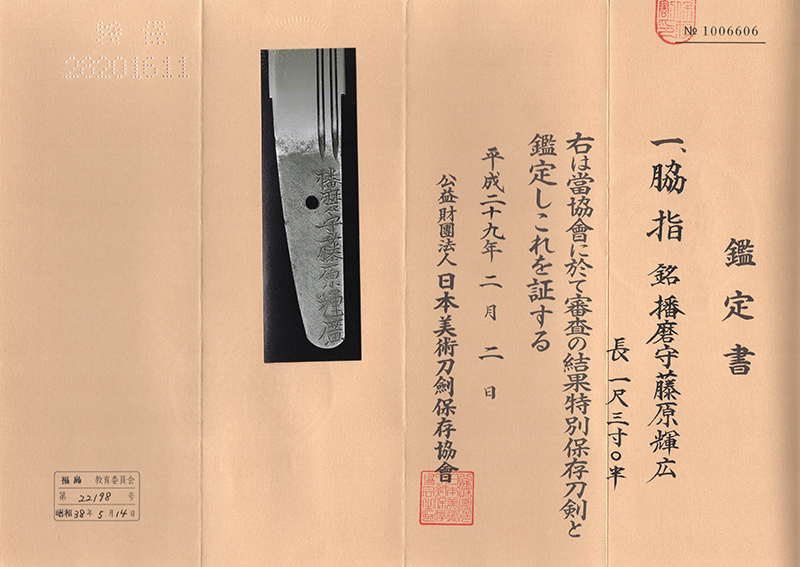
Certificate reading — 銘 播磨守藤原輝広
Offered by Iida Koendo
6 on the market


As written by the shop
Machine translation from the shop's Japanese · may contain errors ·
Aki Teruhiro (Geishū Hiroshima), of Mino origin; the first generation, Higo no Kami Teruhiro · Aki · around 1589-1615
Fujishiro Jo-jo saku · Tōken Taikan top 8%
1 piece on the market now
A katana inscribed Nōshū Seki-jū Teruhiro and dated the ninth month of Tenshō 17 is the document around which the history of this smith has been rewritten. Higo no Kami Fujiwara Teruhiro is the founder of the Aki Teruhiro line of Hiroshima. The published sources record the transmitted account: a native of Mino said to descend from Seki Kanetsune, he first signed Kanetomo, studied under Umetada Myōju, entered the service of Fukushima Masanori, changed his name to Teruhiro and received the title Higo no Kami, and followed his lord to Kiyosu in Owari and then, in Keichō 5, to Hiroshima in Geishū. The Tenshō katana shows that he already signed Teruhiro while still in Mino, and the published sources conclude that he had "already reached maturity before entering Myōju's school"[[c:1]]. The teaching relationship with Myōju, they write, now needs fresh examination and is "left to future research"[[c:2]].
His surviving work is exceedingly scarce. The earliest papers judge that it does "not exceed ten fingers even counting katana, tantō and naginata together"[[c:3]], and later papers repeatedly give "fewer than twenty pieces"[[c:4]], counting katana, tantō, yari and naginata. Within that small record the long weapons predominate. The published sources note that "among them, naginata survive from time to time"[[c:5]], and the yari include a great ōmi-yari of a shaku and a half, of which they write that "a large spear reaching a shaku and five sun is rare, and the workmanship is also excellent"[[c:6]].
The Tenshō katana sets the measure of his hand. It is somewhat wide, with little taper, a strong sakizori and an ō-kissaki. The jigane is an itame mixed with nagare-hada, taking masame toward the edge and standing somewhat in hada-dachi, with ji-nie. The hamon is notare-based and boxes up in places into large patterns, with gunome-chōji-like elements, tobiyaki and muneyaki, ashi and yō, deep nie, kinsuji and sunagashi. The published sources call it "an outstanding blade of the first-generation Teruhiro showing a bold style"[[c:7]], "overflowing with presence together with its wide body and ō-kissaki"[[c:8]]. The Higo no Kami katana designated at the very first session is read in another key, as a work "that admired the Shizu style, one of the fine pieces among his works"[[c:9]]. Its flowing itame runs toward masame and is zanguri, and its ko-notare with gunome is crossed with sunagashi.
On the naginata the itame flows, often toward masame, and stands in places, with ji-nie. The hamon is a ko-notare or notare mixed with gunome, small gunome and pointed elements, with ashi, yō and sunagashi, the nioiguchi sometimes tight and sometimes settling into shizumi. One is singled out as the work "showing the most spirited style among his works"[[c:10]], another as "a work that does not shame the name of a master smith"[[c:11]]. The yari are forged in masame or a flowing grain and tempered in a suguha-toned shallow notare with small gunome, the nioiguchi bright. A few wide, elongated hira-zukuri tantō and wakizashi stand apart. Of one tantō the published sources write that it "shows no trace at all of having studied under Umetada Myōju"[[c:12]], showing instead the Owari Seki manner of its day while being well made, and of a hira-wakizashi that it "shows the Seki manner and is well made"[[c:13]].
Two features run through the whole record. His bōshi enters midare and finishes pointed, often turning back long, far more often than on the blades of his son-in-law, whose bōshi runs mostly straight to a ko-maru. And the published sources name a deep nioi only once for him, where it is the constant of the second generation's ko-notare. That son-in-law, an Owari man of the Kanie family, became Harima no Kami Teruhiro, and the published sources set the two titles side by side: "the first generation received Higo no Kami, and the second received Harima no Kami"[[c:14]]. After the Fukushima house was dispossessed the line served the Asano daimyō, and "the descendants served the Asano family and have prospered in this place for generations"[[c:15]].
Fujishiro grades him Jō-jō saku. Seventeen designated works are on record: the Tenshō katana, first designated Jūyō and later raised to Tokubetsu Jūyō, a prewar Jūyō Bijutsuhin katana, and Jūyō naginata, yari, tantō, wakizashi and katana. For a collector the long weapons are the realistic encounter: a naginata or yari by his hand comes to light from time to time, while a signed katana, of which so few survive, is a rare event. The Tenshō katana itself is a landmark of early Shintō scholarship, a single blade that changed how the founder of a Hiroshima house is understood.
Where Teruhiro stands among comparable artisans: across all of nihontō, and within tradition, era, and period. The tiers (Foremost · Leading · Major · Notable) weigh official designations from the NBTHK and Japan's Agency for Cultural Affairs, together with historical honors of lasting repute such as the Sansaku and Meibutsu-chō.
Select a lens to see how it's measured.
Years he was demonstrably active, proven by signed-and-dated blades
Mino-den · Aki
6 pieces on the market now
The Teruhiro line takes its place in Hiroshima, in Aki province, where its swords were forged from the close of the Momoyama period into early Edo. The first generation (shodai) is recorded in the setsumei as a native of Mino, a later descendant of Kanetsune of Seki, who signed at first as Kanetomo (兼友 or 兼伴) before studying under Umetada Myōju, taking the name Teruhiro, and receiving the court title Higo no Kami. A katana dated Tenshō 17 (1589) and inscribed Nōshū Seki-jū Teruhiro saku[[c:1]] shows, as the registers note, that he already used the Teruhiro name while resident in Mino and had reached full stature before entering Myōju's circle, a point the NBTHK records leave open for further study. He followed Fukushima Masanori to Kiyosu in Owari and, in Keichō 5 (1600), relocated to Hiroshima. The second generation, Harima no Kami Teruhiro, came from Owari; the setsumei give his surname as Kanie, his common name Jinpachi, and his earliest signature Kanehisa (兼久). He studied under the shodai, was valued enough to become his son-in-law, served the Fukushima house, and, after that family's forfeiture, entered the service of the Asano. A wakizashi dated Keichō 15 (1610) places his active years close to those of the first generation, with further dated works cited from Kan'ei 5 (1628) and Kan'ei 9 (1632). Across the line the kitae is itame mixed with mokume and flowing nagare-hada, the grain tending to stand (hada-dachi) and turning toward masame near the edge, with ji-nie and chikei throughout and steel that the registers repeatedly call clear (saeru).
The signature temper is a notare base, often ko-notare, mixed with gunome and pointed (togari-gokoro) elements, carrying deep nioi, thick nie, kinsuji, sunagashi, and scattered tobiyaki; the first generation's Tenshō and Keichō katana broaden this into large, hako-leaning undulations with muneyaki, while the second generation favors deep-nioi ko-notare held at a high level. The bōshi commonly runs notare-komi into ko-maru, at times deeply yaki-sage into muneyaki or showing hakikake. To tell the hands apart, the setsumei observe that the nidai's gunome stands out more strongly than the shodai's, and that nagare-hada in the forging, togari blades in the ha, and a bōshi of Sanbon-sugi or sanpin flavor mark his Mino descent; both generations also worked suguha-toned and masame yari and naginata in a quieter key. The setsumei treat the line as a Mino-rooted hand carrying a strong Sōshū current, and several blades are read as deliberate evocations of older models. The second generation's tantō and wakizashi are described as aiming at Sadamune, "whom Teruhiro most admired," with one kanmuri-otoshi wakizashi bearing naginata-hi read as a study of old Yamato, particularly Taima; a wide notare katana with hardened koshi-ba is likened to Kanemoto and Muramasa. The named registered works span the formats: the shodai's Nōshū Seki-jū katana and Higo no Kami yari and naginata, and the nidai's Harima no Kami katana, wakizashi, naginata, and tantō, several signed Fujiwara Teruhiro. The records stress that surviving pieces are few, numbering fewer than twenty across swords, tantō, yari, and naginata, which lends the ōmi-yari and the carved examples particular documentary value; one note holds that the nidai equals or surpasses the shodai. Kantei rests on the notare core with deep nioi and thick nie, the standing itame with nagare and chikei, the recurrent tobiyaki, and the long thick-chisel signatures on ubu tangs that fix this Aki workshop and its place under Fukushima and Asano patronage. Learn more →
| Smith | Era | Designated |
|---|---|---|
| Teruhiro輝廣 | 1624-1644 | 27 |
| Teruhiro輝廣 | 1589-1615 | 17 |
| Teruhiro輝廣 | 1624-1644 | 0 |
| Teruhiro輝廣 | 1748-1751 | 0 |
| Teruhiro輝廣 | 1661-1673 | 0 |
Mino in the Momoyama period
Unification closed the mass market, and Seki’s smiths moved to where the new money was: the Mishina line to Kyōto with court titles, Daidō smiths to castle towns across the provinces. Mino became the great technical ancestor of the Shintō age.
A Hozon-certified blade judged to show notably superior workmanship and a better state of preservation. The bar is higher: re-tempered blades and most unsigned Muromachi/Edo works are excluded.
The NBTHK (Nihon Bijutsu Tōken Hozon Kyōkai, the Society for the Preservation of Japanese Art Swords) is a public-interest incorporated foundation founded in 1948 and supervised by Japan’s Agency for Cultural Affairs (Bunkachō); it is based at the Japanese Sword Museum in Tokyo. Its expert panels physically examine each submitted work (shinsa) and issue a certificate (kanteishō) ranking it by artistic and historical merit. NBTHK papers are the most widely recognized standard of authentication for Japanese swords and fittings.
NBTHK official siteFor returns at the customer's convenience, please notify us within two days of the item's arrival. Items that have been altered cannot be accepted. Return shipping is at the customer's expense. Costs other than the item price (bank transfer fees, cash-on-delivery fees, etc.) cannot be refunded. Items delivered overseas cannot be returned or refunded.
¥1,100,000