Harima no Kami Teruhiro is the second generation of the Aki Teruhiro line of Hiroshima, and the published sources date him by a single document: "the oldest date we have seen is Keichō 15"[[c:1]]. He was an Owari man of the Kanie family, commonly called Jinpachi, who first signed Kanehisa and studied under the founder, Higo no Kami Teruhiro, until he was "recognized by his teacher and made his son-in-law"[[c:2]]. He served the Fukushima house and, after its dispossession, the Asano. Because of the Keichō 15 piece the published sources hold that "his working years differ little from the first-generation Teruhiro's"[[c:3]], and from the closeness of the two styles they infer that he, like the founder, was connected with Umetada Myōju. Dates of Kan'ei 5 and Kan'ei 9 extend his record.
His principal manner is a ko-notare carried in a deep nioi, mixed with gunome, angular gunome and blades of a pointed tendency, with ashi, thick nie, kinsuji and sunagashi, in places yubashiri and small ball-like tobiyaki, and a bright, clear nioiguchi. The published sources compare it with the founder's and find the gunome stronger: on one katana "the gunome stands out more than in the first generation"[[c:4]], on a wakizashi the work is "more marked than usual by gunome between the undulations, deep in nioi and well covered in ko-nie"[[c:5]]. Of his finest naginata, its jigane bright and clear, they write that it is "truly the essence of this smith"[[c:6]] and "an excellent work in which the true strength of the second-generation Teruhiro is fully shown"[[c:7]].
The jigane is where he most clearly parts from the founder. An itame mixed with mokume and nagare-hada, standing somewhat in hada-dachi, carries ji-nie laid thick in dust-fine particles, and chikei enter frequently, the steel clear. The published sources single the forging out again and again; on one katana "the forging is particularly excellent"[[c:8]]. The bōshi most often turns in a ko-maru.
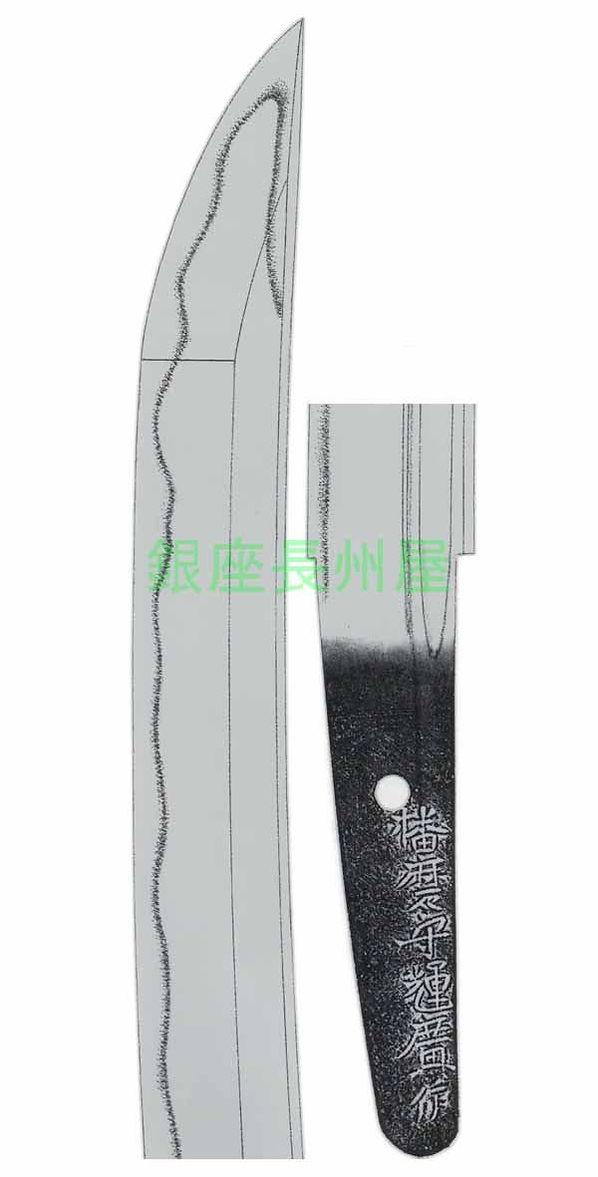
Most of his designated work takes one form, the wide, strongly elongated, thick hira-zukuri ko-wakizashi of Keichō-shintō shape, "the sun-nobi hira-zukuri ko-wakizashi so common among his works"[[c:9]]. The published sources read these as aimed at Shizu, "succeeding in aiming at the manner of Shizu"[[c:10]], and call the type "of course also his typical work"[[c:11]]. Some are katakiriba-zukuri, a form also seen in Myōju, but "unlike the kiriha of his teacher Myōju, the kiriha runs through to the tip of the tang"[[c:12]]. Katana are fewer, and the sources note that "katana are rare for the second-generation Teruhiro"[[c:13]]. One of them, tempered in a straight chū-suguha, is called outstanding: "this katana is tempered in suguha and is of outstanding workmanship"[[c:14]].
He also turned deliberately to older masters. A massive, thick wakizashi with a large midare of ko-notare, angular gunome and pointed blades is read as modeled on "Sōshū Sadamune, whom he admired most"[[c:15]]. A kanmuri-otoshi wakizashi carved with naginata-hi, tempered in a chū-suguha with hotsure and kuichigai-ba, is read as aiming at "old Yamato work, and above all Taima"[[c:16]], and the sources add that "of this kind of work, this one blade is the only example we have seen"[[c:17]]. A thick tantō is thought "to have taken a high Sōshū master as its model"[[c:18]], and a broad katana with a wide, high notare and koshi-ba "shows a manner recalling Muramasa"[[c:19]]. Through all of these the flowing hada, the pointed blades and a Sanpin-style bōshi show the published sources "that he was a swordsmith of Mino descent"[[c:20]].
Fujishiro grades him Jō-jō saku, and twenty-seven designated works are on record: twenty-six in the Jūyō tier, and one tantō, signed Harima no Kami Fujiwara Teruhiro saku, recorded in Honma's inventory of the Imperial collection. The published sources observe that "tantō signed Harima no Kami Teruhiro are by no means few in number, but those with dates are exceedingly rare"[[c:21]], so that his dated pieces carry documentary weight, and that his works are said to bear few carvings, "it is said that Harima no Kami Teruhiro's works have few carvings"[[c:22]], though the few that do are skilled. For a collector his ko-wakizashi are the realistic encounter, appearing from time to time, while a katana or a dated piece is rare.
 NihontoWatch