Power sat in Kamakura, but taste was still made in Kyōto. The Awataguchi school’s pear-skin steel became a byword for perfection, and the Rai line supplied dignified tachi to the court, senior warriors, and the great temples alike.
 NihontoWatchNihontoWatch
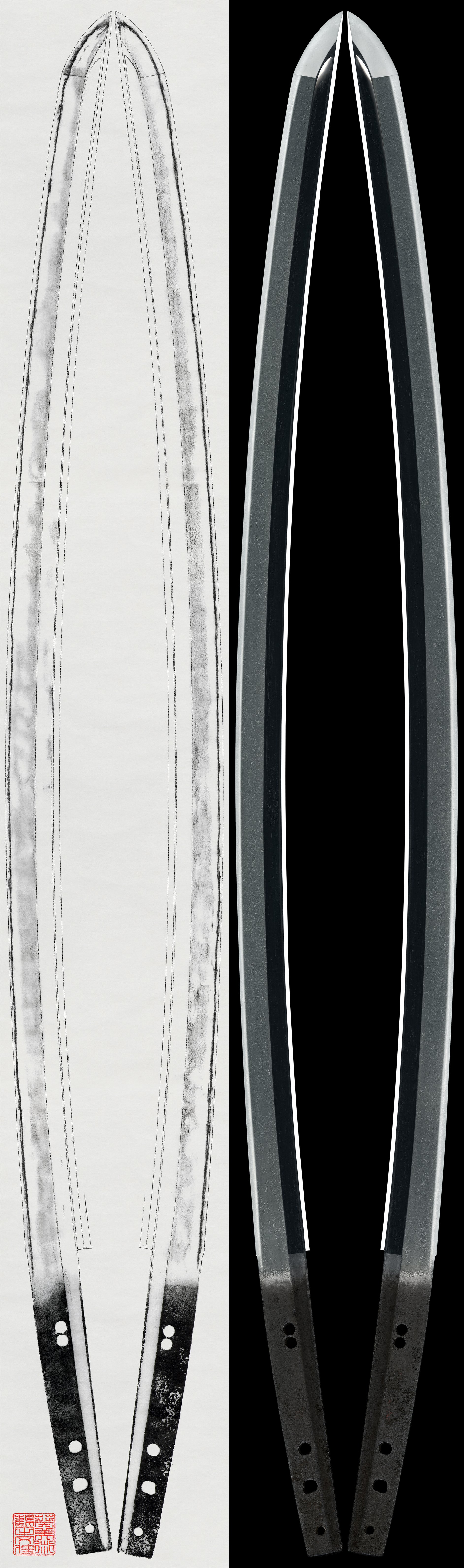
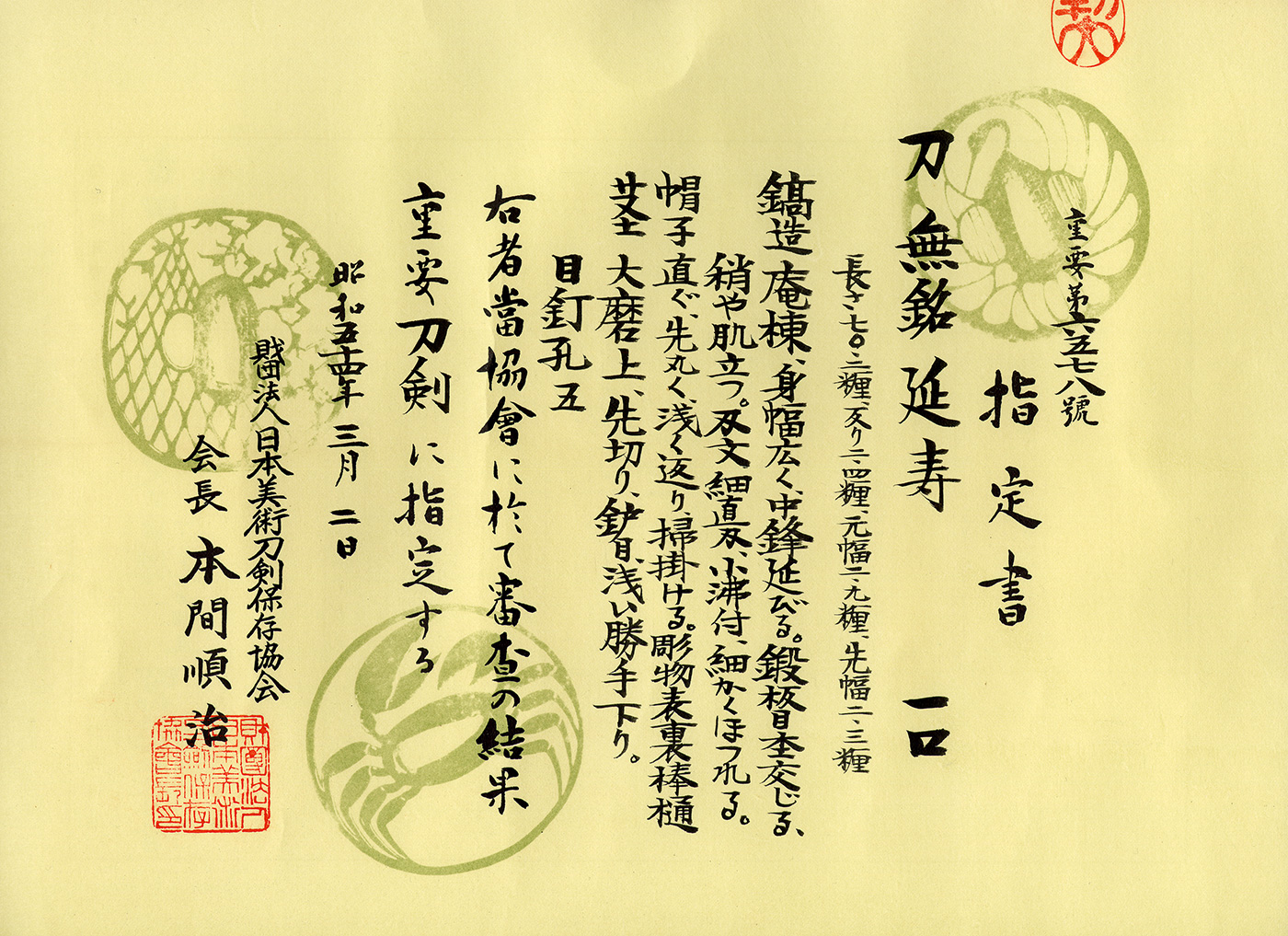
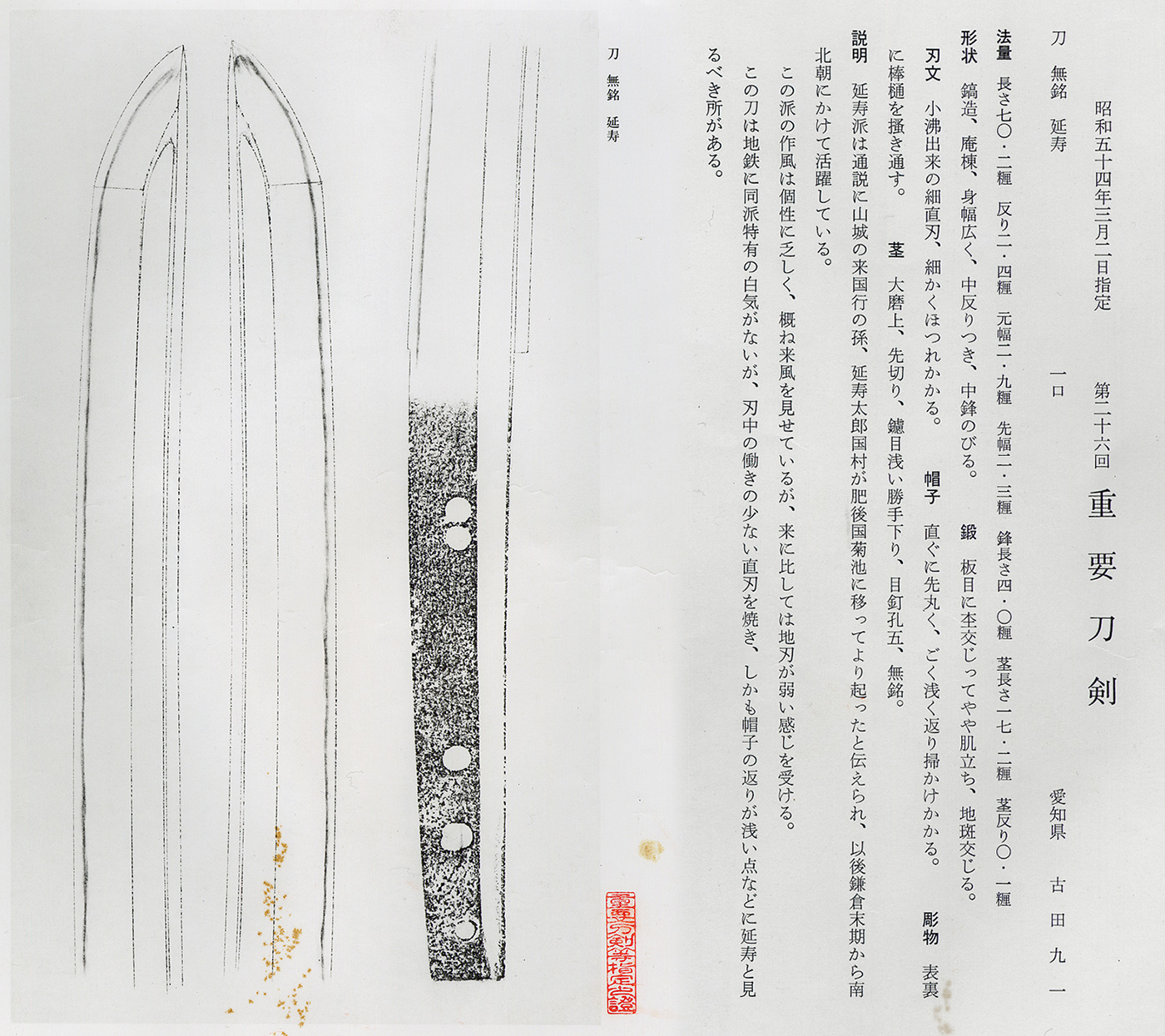
We divide works into Saijo Saku, Jyojyo Saku, Jyo Saku,and Regular Saku. This piece is ranked as Jyojyo Saku for Mumei(Enju school). Shape: wide and robust blade with Bohi carving. Jigane: Intense Itame and Mokume wiht visible grain patterns. Hamon: Ko-nie base thin Suguha with tight Nioikuchi with some Hotsure. Features: The Higo no Kuni Enju School is said to have been founded by Enju Taro Kunimura, who is traditionally considered a grandson of Rai Kuniyuki. The school was active in Higo Province from the late Kamakura period through the Nanbokuchō period. The workmanship of this school generally resembles that of the Rai school, featuring a jihada with flowing masame mixed in and showing a whitish utsuri. A distinguishing point, however, is that the hamon tends to be more subdued, with calmer activity. This piece displays a robust shape typical of the late Kamakura to Nanbokuchō period, along with a prominent jigane featuring a standing, large-patterned texture. Notably, the whitish utsuri characteristic of Enju works is not observed. The hamon is a typical Enju-style suguha, with activities such as slight fraying (hotsure) visible within the temper line. NBTHK 26th Juyo Certificate Aoi-Art estimation Paper whole Oshigata
NihontoWatchOffered by Aoi Art



Machine translation of the shop's Japanese ·
Yamashiro-den · Higo
14 pieces on the market now
Among the provincial lines that carried the Kyoto manner beyond Yamashiro, the Enju (延寿) school of Higo province grew up at Kumafu in the Kikuchi District, working from the close of the Kamakura period through the Nanbokuchō era. Its founder, Tarō Kunimura, is transmitted in the prevailing account as the son of Hiromura of the Yamato Senjuin line, who married a daughter of Rai Kuniyuki of Yamashiro; by that marriage Kunimura is held to be Kuniyuki's grandson in the female line and a pupil of the Rai workshop (one early text instead places him in the gate of Rai Kunitoshi). The school name reads on the same characters as the Rai line itself, and from that double descent, Yamashiro through the Rai marriage and Yamato through the Senjuin side, the family took its character. Around the founder a cluster of named smiths arose almost at once, Kuniyoshi, Kunitoki, Kuniyasu, Kunitomo, Kunisuke, Kuninobu and Kunitsuna among them, the Enju line attached to the Kikuchi clan and loyal to the Southern Court, so that the dated blades carry that history in their Southern-Court eras. The published sources describe Enju work as one that broadly resembles the Rai school[[c:1]], refined in suguha yet cooler and whiter than its Kyoto parent, and they name the provincial accents by which the two are separated. The forging is an itame or closely packed ko-itame that flows toward the edge into masame, the grain standing a little, with fine ji-nie laid on and delicate chikei entering; over it rises a whitish shirake-utsuri, the surest single Enju tell, the cool reflection of a Kyushu steel that is not quite the bright Rai jigane. The temper is a chū-suguha or narrower hoso-suguha, the nioiguchi carried somewhat shizumi (sunken and quiet), often breaking into nijūba, the doubled line that recurs across the line; ko-ashi, yō, ko-nie, fine sunagashi and kinsuji play within it, the activity gentler than the brighter Rai suguha. The bōshi turns back on a larger radius than Rai's tight ko-maru, a shallow ō-maru with a short kaeri.
The signature is a tool of attribution: across the line the right half within the kuni (国) enclosure is cut in an ear-shaped form, a calligraphic habit the sources say cannot be confused with another school. Against true Rai, the school is read by its masame-lean, its whitish utsuri, its sinking nioiguchi and its quieter internal work, the ji and ha running a degree softer than the Yamashiro line. To kantei an Enju blade is to weigh those provincial accents against the Rai air it carries: a wheel-like wa-zori and Kyoto refinement may recall the parent at a glance, but the nagare in the ji, the shirake-utsuri, the subdued nioiguchi and the ear-shaped kuni settle the attribution, and the level of the work then narrows it to a hand. The founder Kunimura sets the quiet register and signs the slender, sharply tapering tachi the sources call distinctive even within the school; among the later smiths, Kunitoki survives in relative number and runs his suguha the busiest with ko-gunome and kinsuji, Kuniyasu is the most nie-laden and brightest, Kunisuke cuts the boldest chisel and hardens a unique flaming bōshi on his wide pieces, while Kuniyoshi, Kuninobu and the various other Kuni- smiths work the same vocabulary, the best of them refining the steel to a clarity that escapes the school's whitish thinness. The corpus runs mostly to slender signed tachi and to ō-suriage mumei katana attributed on appraisal, with broad sunobi tantō in the Nanbokuchō phase, the work confined to long blades in the founder's case. Provenance is unusually grand for a provincial line: blades pass through Toyotomi Hideyoshi and Tokugawa Ieyasu and rest in the Hosokawa, Date, Uesugi, Owari and Mito Tokugawa houses, with examples held today by the Sano, Tokugawa, Seikadō and other institutions. A signed ubu Enju tachi is among the rarer encounters in Higo work; most survive as the mumei attribution, held as heritage rather than offered. Learn more →
| Smith | Era | Designated |
|---|---|---|
| Kunimura國村 | 1275-1278 | 15 |
| Kunitoki國時 | 1317-1353 | 32 |
| Kunisuke國資 | 1346-1370 | 22 |
| Kuniyasu國泰 | 1329-1331 | 16 |
| Kunitoki國時 | 1275-1278 | 7 |
Yamashiro in the Kamakura period
Power sat in Kamakura, but taste was still made in Kyōto. The Awataguchi school’s pear-skin steel became a byword for perfection, and the Rai line supplied dignified tachi to the court, senior warriors, and the great temples alike.
A blade of top-grade workmanship and condition, formally judged to rank with a nationally recognized Important Art Object (Jūyō Bijutsuhin). Awarded only at the NBTHK’s competitive annual examination.
Of Japan’s roughly 2.5 million registered swords, only 12,348 (about 1 in 202) have ever attained Jūyō.
The NBTHK (Nihon Bijutsu Tōken Hozon Kyōkai, the Society for the Preservation of Japanese Art Swords) is a public-interest incorporated foundation founded in 1948 and supervised by Japan’s Agency for Cultural Affairs (Bunkachō); it is based at the Japanese Sword Museum in Tokyo. Its expert panels physically examine each submitted work (shinsa) and issue a certificate (kanteishō) ranking it by artistic and historical merit. NBTHK papers are the most widely recognized standard of authentication for Japanese swords and fittings.
NBTHK official siteIf you wish to return an item, please notify us within 3 days of receipt. After this period we cannot accept cancellations. Please ship the return to us within 5 business days. Cancellation is conditional on the item being kept in the same condition as at the time of sale, so please handle it with care.