徳川の泰平のもと、大小は法度の定める身分の制服となり、需要は城下町、とりわけ江戸に集まった。工芸は二つに分かれる。目利きのための華やかな鑑賞の作と、截断の結果を金象嵌に刻む実証の刀である。
 NihontoWatchNihontoWatch
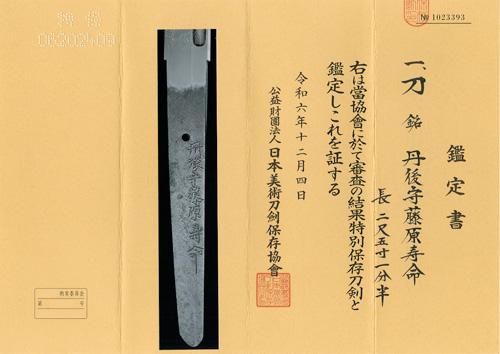
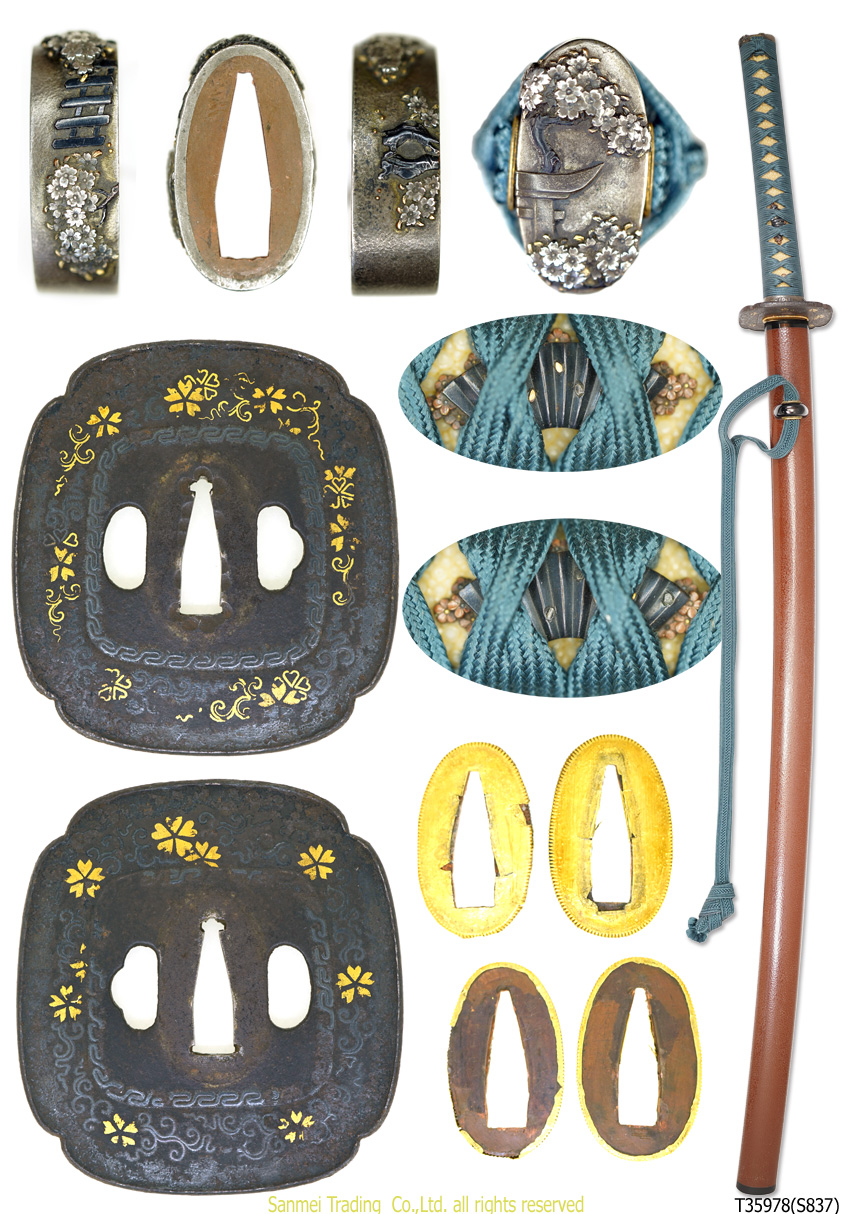
Sword construction: Shinogi-zukuri, Iorimune. A prpnounced extra-long Katana with a blade length of 2 shaku 5 sun 1 bu (approx. 79.2 cm). It has a moderate curvature, a wide width at the base, and less degree of tapering toward the tip, ending with an extended Chu-kissaki. It feels heavy in hand (802 grams excluding Habaki) and shows the characteristically massive construction typical of the Kan’ei era. Horimono (Carvings): On both sides, there is a Bo-hi (groove) carved in kata-chiri style (one side beveled) starting just above the Habaki with a round end. Hada (Forging): Itame-hada and flowing ware of Masame appears along boundary area, Sparkling granules of Ji-nie attaches thickly on Hiraji where thick lines of Chikei appears. Hamon: Gunome and Togari-ha and transitions into large clustered Gunome in high where some of Yakiba splash onto Hira-ji to form Tobiyaki. The boundary edge has condensed Nie in deep, with thick Ashi radiating long into the cutting edge. The blade interior is lively with frequent Sunagashi, giving a bright and clear appearance enriched by active Nie. Boshi: The Yakiba is high, sweeps internsively (Hakikake). Nakago: Ubu in original. One Mekugi-ana. The Nakago tip is shaped in an Iriyama-gata V-shape. File marks are Ō-sujikai (greatly slanting left marks), and the Mune side is well-contoured and shows Ō-sujikai also. On the Shinogi-ji just below the Mekugi-ana, there is a long signature engraved “Tango-no-kami Fujiwara TOSHINAGA” 丹後守藤原寿命. About TOSHINAGA 寿命: It reads “Toshinaga” or “Jumyō.” His real name was "Kondō Sukesaemon" 近藤助左衛門. Born in Tenshō 8 (1580) in Seki, Mino Province. During the Keichō era (1596-14), he moved to Kiyosu Kaji-machi in Owari and became known as “Ganmaku Toshinaga” 岩捲寿命. In Kan’ei 2 (1625), he was granted the title “Tango-no-Kami” 丹後守 and received a rice stipend from the Owari Tokugawa family. In Kan’ei 5 (1628), he established his forge studio in Todamachi, Nagoya Castle town. In Keian 4 (1651), by order of Tokugawa Yoshinao 徳川義直, he forged swords using imported Nanban tetsu (foreign steel) stored in Nagoya Castle, and for this service, he was granted a ten-person stipend. There is an extant work inscribed “Tango-no-Kami Fujiwara TOSHINAGA, made with Nanban tetsu” 丹後守藤原寿命 以南蛮鉄作之 . He passed away in Kanbun 3 (1663) at the venerable age of 84. The second-generation “TOSHINAGA” 寿命 was his third son. He also received the title Tango-no-Kami 丹後守 and on June 12 of Kanbun 2 (1662), received a ten-person stipend from the Owari Tokugawa family. In Tenna 3 (1683), he was granted the monk title “Hōkyō” 法橋 and became known as “Hōkyō Kōan-sai TOSHINAGA” 法橋弘安斉寿命. He served as a designated swordsmith for the second Owari lord, Tokugawa Mitsutomo 徳川光友. Thereafter, the TOSHINAGA family continued to serve the Owari Tokugawa clan throughout the Edo period as a distinguished lineage of swordsmiths. Originally, the name “TOSHINAGA” was treasured as an auspicious and fortunate smith name. This Katana is impressively massive and heavy in hands that maintains almost origional shape and the Nakago keeps great taste of patina after the passage of 400 years. Old polish/Condition scale: mint - exellent (using a scale of mint-excellent-very good-good-fair-poor). with) Rapeseed-surface Burgundy lacquered surface Uchikatana Koshirae (clikc HERE for entire Koshirae/HERE for each fitting Fuchi/kashira : Cherry blossoms design, Oborogin silver ground, Stone surface, Takabori carving, unsigned Menuki : Cherry blossoms on unfold fan design, Shakudo ground, Katabori carving, Ioe Tsuba : Cherry blossoms design, Iron ground, Mokko-shape, gold/silver inlay, unsigned Tsuka : White layskin, gray indigo-blue silk cord Moro-tsumami-maki wrap Shakudo foiled Copper Habaki, preserved in Shirasaya (plain wood mounting) with Sayagaki. Reference: Masakuni Ishii & Kunzan Honma, Nihontō Meikan, Yuzankaku, 1975 (Showa 50)




販売店の記載のまま
(翻訳なし)
美濃伝 · 尾張 · 1624-1644頃
刀剣大鑑 上位87%
現在1点販売中
美濃伝 · 美濃
現在9点販売中
江戸時代
徳川の泰平のもと、大小は法度の定める身分の制服となり、需要は城下町、とりわけ江戸に集まった。工芸は二つに分かれる。目利きのための華やかな鑑賞の作と、截断の結果を金象嵌に刻む実証の刀である。
保存刀剣のうち、出来が一層優れ、保存状態も良好と認められたものです。再刃や、室町・江戸期の多くの無銘作は対象外となり、保存刀剣より高い基準が課されます。
日本美術刀剣保存協会(NBTHK)は、1948年に設立され、文化庁の監督を受ける公益財団法人で、東京・刀剣博物館に本部を置きます。専門の審査員が出品作を直接審査し、美術的・歴史的価値に応じた鑑定書を発行します。NBTHKの鑑定書は、日本刀および刀装具の真正性を示す最も広く認知された基準です。
NBTHK公式サイト返品は商品到着後7日以内に当社までご連絡ください。お客様のご指定による寸法などの仕様の変更を行った際はご返品を受けかねます。送料および振込み手数料はお客様のご負担とさせていただきます。
¥1,350,000
Certificate reading — 銘 丹後守藤原寿命