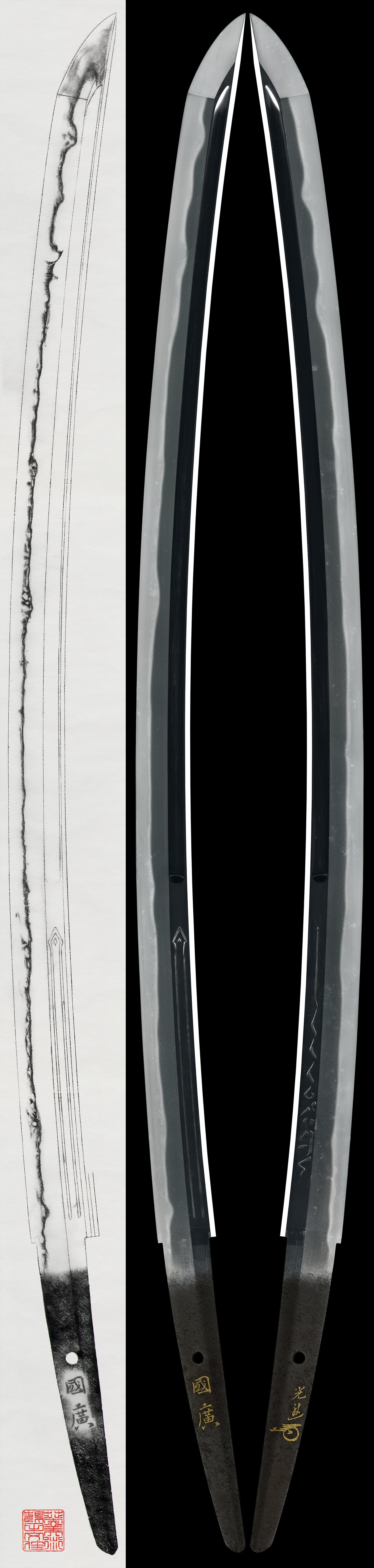
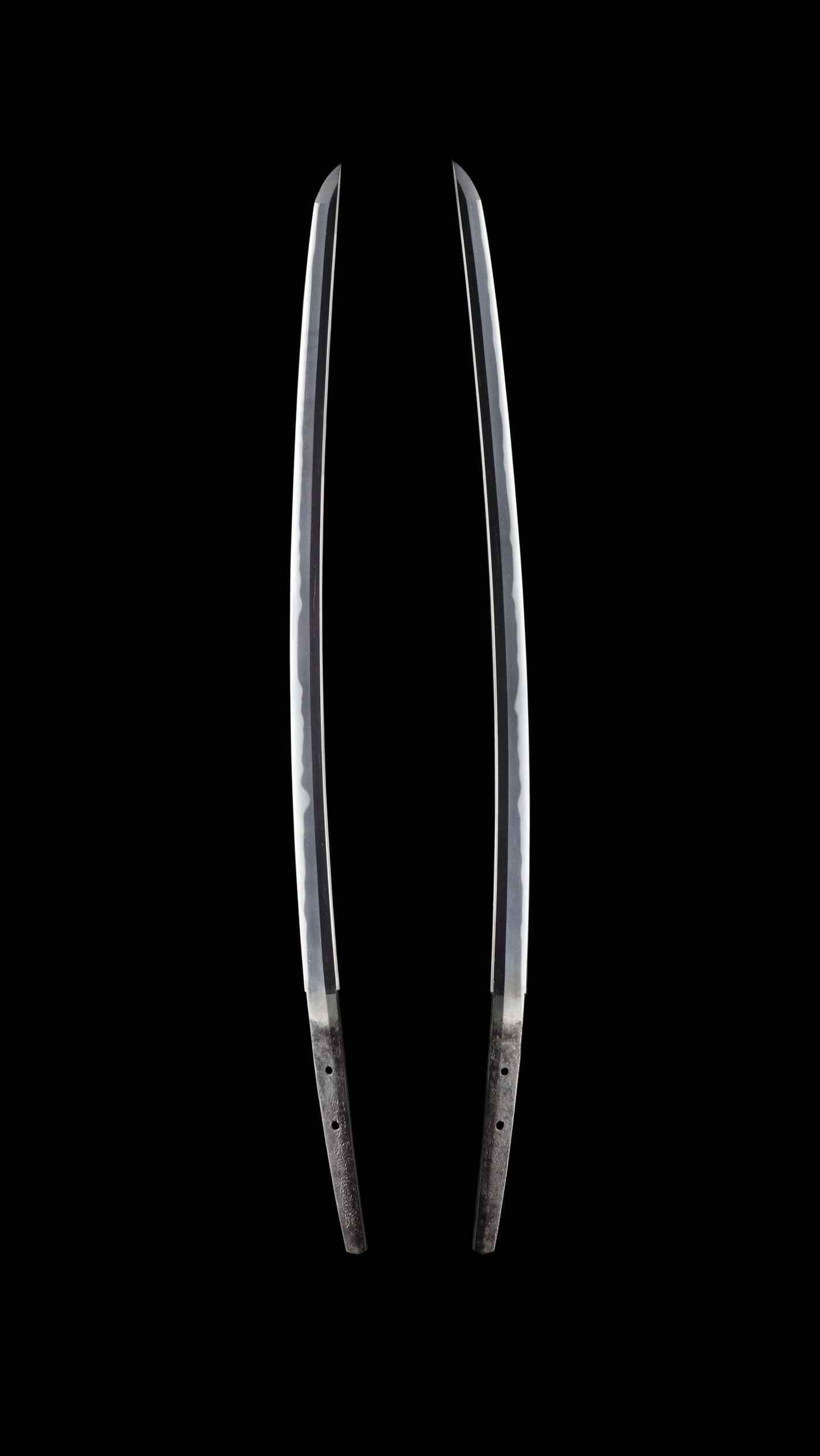
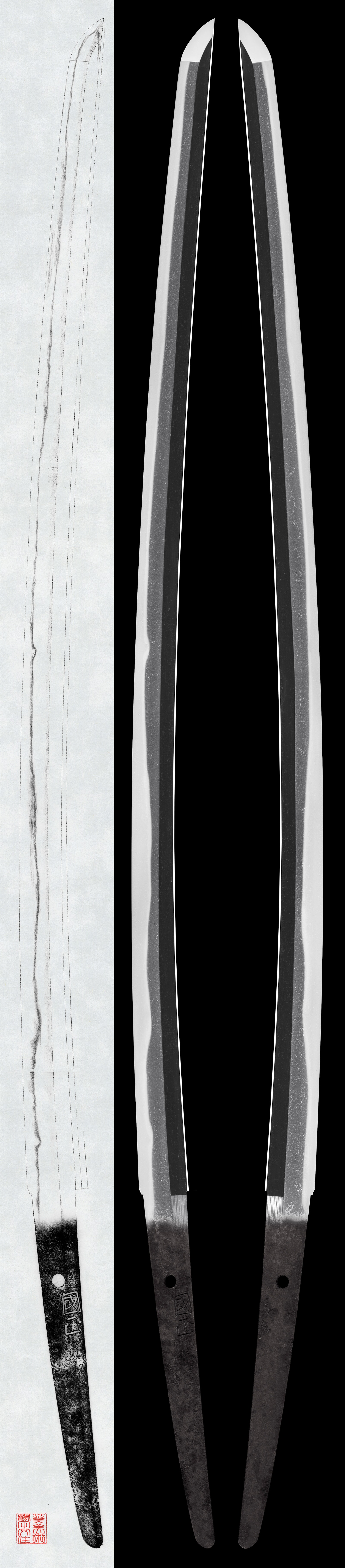
Yamashiro-no-kami Fujiwara Kunikiyo is the founder of the Kunikiyo line, a Shinshu man of Matsumoto who, the published sources say, was a son of the third-generation Shimada Sukemune and first called Kichiemon. He went up to Kyoto and entered the gate of Kunihiro, and there changed his name to Kunikiyo; after Kunihiro's death he took service with Matsudaira Tadamasa of Takada in Echigo and followed his lord to Fukui when the house was transferred to . In the second month of 'ei 4 (1627) he received the court title Yamashiro-daijo, and a year later, in 'ei 5, he advanced to Yamashiro-no-kami and was granted the chrysanthemum crest to cut into his . The name passed through several -name generations whose work and signatures the published record calls hard to tell apart, and within that line the institution places him plainly at the head: the first generation, it states, possessed the highest technical ability, the second next to him in skill. The blades that survive under his full long signature, the cut above it, are read as the founder's, and they show the dark northern steel and the calm temper on which his reputation rests.
His forte is , the manner the published sources return to as the one in which he most excelled. Over an that stands somewhat open, mixed with and running here and there into flowing , he tempers a that takes in and through its upper half, deep in and thick in , the faintly frayed in and crossed by , fine running through it and entering, and the inclining toward , a subdued, settled tone rather than a bright one. The runs straight into a , returning somewhat deeply with a touch of at the tip. The published commentary names this the straight-temper domain in which Kunikiyo most excelled, and reads his full strength in a piece where, set beside his usual work of the kind, the runs a shade deeper, the stronger, and the activity within the more abundant, a blade in which 「国清の本領」, the smith's true character, is brought forth without reservation.
The is the most constant thing he forges, and the published sources make it the seat of his recognition. The stands with conspicuous mixed in, the adhering densely and fine, entering well, and the steel taking a slightly blackish cast that the commentary calls an antique feeling, the quality it identifies as the special character of steel and, on one late , of the 「北国がね」, the northern-province steel. It is a darker, denser than the bright Yamashiro from which his teacher's school descended, and the published record reads it as the hallmark, writing of one blade that 「越前がねの特色がよく表示されている」, the characteristics of steel are well displayed. On this dark the and the deep sit with a sober, weighty effect, the and alike sound on the pieces that reached , their robust forms called imposing and dignified.
Against the forte the published sources record a second manner, a he turned to from time to time, and a portion of his work carries it. The base is a mixed with , the peaks turning angular in the , the thick and at times coarse, running overall and entering well, with the deep and the sinking as the . On a wide, thick of conspicuous the temper opens into its boldest form, and here the commentary reaches for the highest comparison the forges allow, finding aspects that 「二代康継の出来口を想わせる」, that call to mind the typical workmanship of the second Yasutsugu, and 「放胆で迫力が感ぜられる」, an unrestrained boldness and a sense of compelling power. An earlier of carries the in a quieter key, a with and deep under carving of and . The is always the lesser register, named as the alternative to the he is best at, 「最も直刃を得意とし、又、本作に見る乱刃もある」, most given to , with a also among his work.
Distinguishing the founder from his successors is itself part of the published , because the styles run so close that the generations are read largely off the signature. The plain long without the 一 character is taken as the 's, the 一 cut below the as belonging to the second generation onward, the nidai being Shinbei, his second son. The published commentary is candid about the limits of this method: of one fine that carries the 一 and whose resembles a dated Tenna 2 (1682) , it allows the piece may perhaps be the second generation, then states plainly that cleanly separating the first and second generations is at present difficult and a matter that must await further research. His descent from Kunihiro places his standing dark and -laden within the broad Keicho- current his teacher spread, and the , and carved on his nanban-tetsu pieces belong to the vocabulary, while the dark and the settled are his own contribution to it, the marks by which the founder is known.
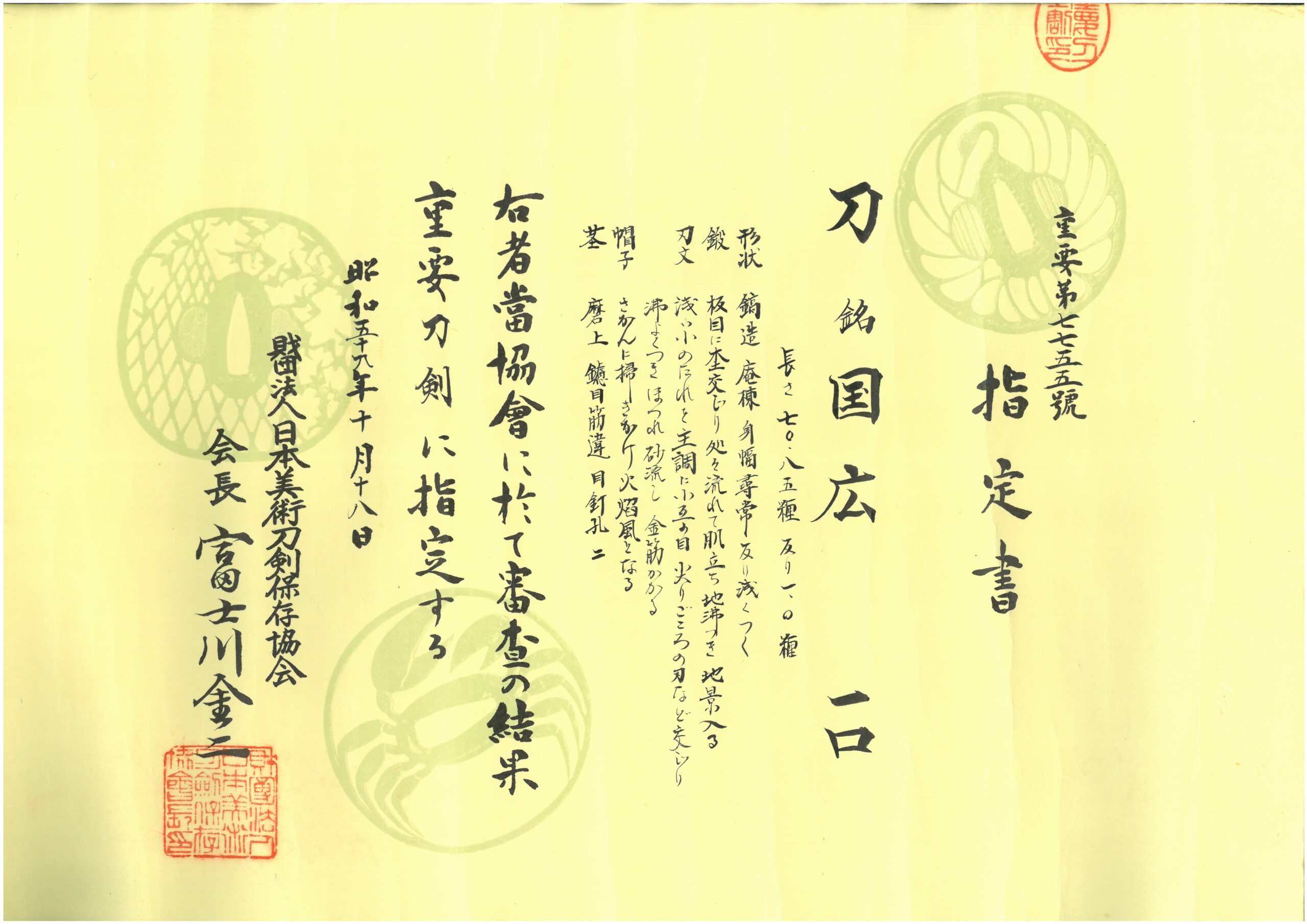
Kunikiyo is rated jo-jo by Fujishiro, and the connoisseurship around his work runs to the signatures and the steel as much as to the temper. Two of his blades carry the added inscription that they were forged of nanban-tetsu, the imported steel then in fashion at the forges, cut beside the long and suiting the dark, dense quality of his ; others bear gold-inlaid cutting tests, one a futatsu-do-otoshi, a cut through two bodies, evidence of the line's standing as cutting steel. Among the rarest of his signatures is a nyudo , a tonsured priest-name signature on a late that the published sources call 「入道銘は頗る珍しい」, an extremely rare inscription, and 「典型作の一口」, a representative example of his typical work. His designated blades are uncommon and seldom move: six stand at the level and none higher, while a gold-inlaid 7 (1667) carrying a Yamano Kanjuro Hisahide cutting test is held in the Imperial Collection at the Imperial Household Agency, a piece that by its nature will not trade. A privately held Kunikiyo of recorded whereabouts is accordingly an occasional rather than a regular encounter, a sound example of the founder's hand reaching a serious collection only from time to time and most readily in his named forte, the calm over the dark northern steel.