Kuniyasu signed only the two characters of his name, never a court title, and within the whole school he alone cut his file marks in reverse. These two habits, more than any single feature of forging or temper, are how the published sources tell him apart. The Tanaka genealogy gives his common name as Saburōdayū and records that he was the youngest brother of Kunihiro; other sword books make him instead a nephew, originally from Obi in , who admired Kunihiro, traveled up to Kyoto, entered his gate and there matured. He worked in the Keichō years, at the opening of the age, and his record is one of the closest in the school to its founder.
The published sources return again and again to a single explanation for how few of his signed blades survive. His manner of forging, the construction of his tang, and the cut of his signature so closely resemble Kunihiro's that he is thought to have served as one of his , the substitute hand producing work under the master's name. The first-session commentary puts it plainly: among signed blades that survive, those bearing Kunihiro's own signature yet judged on appraisal to be wholly Kuniyasu's hand are not few. He is, in effect, the whose work stands closest of all to Kunihiro's, and the small body of pieces signed Kuniyasu is what remains once the blades that went out under his brother's name are set aside.
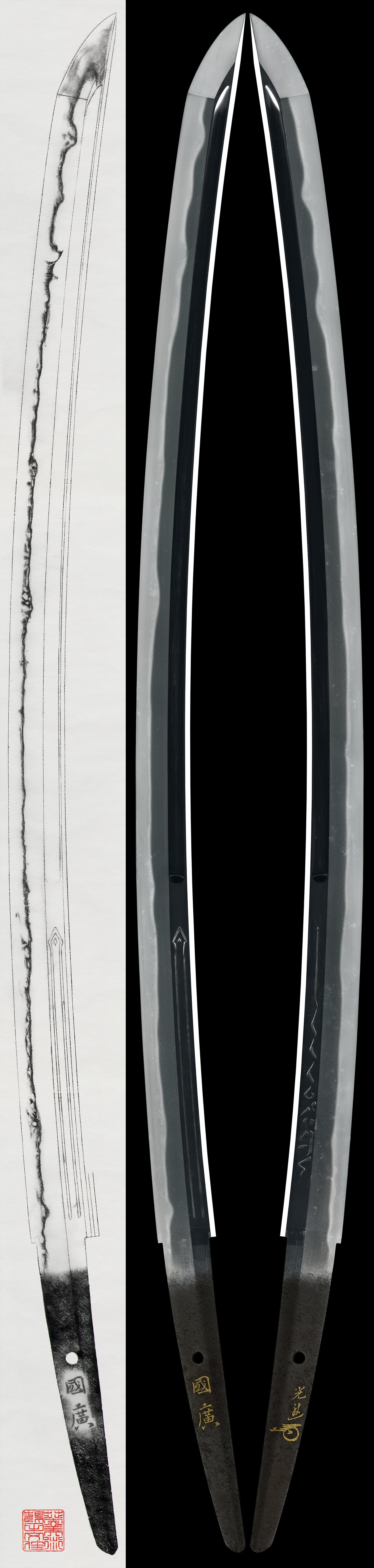
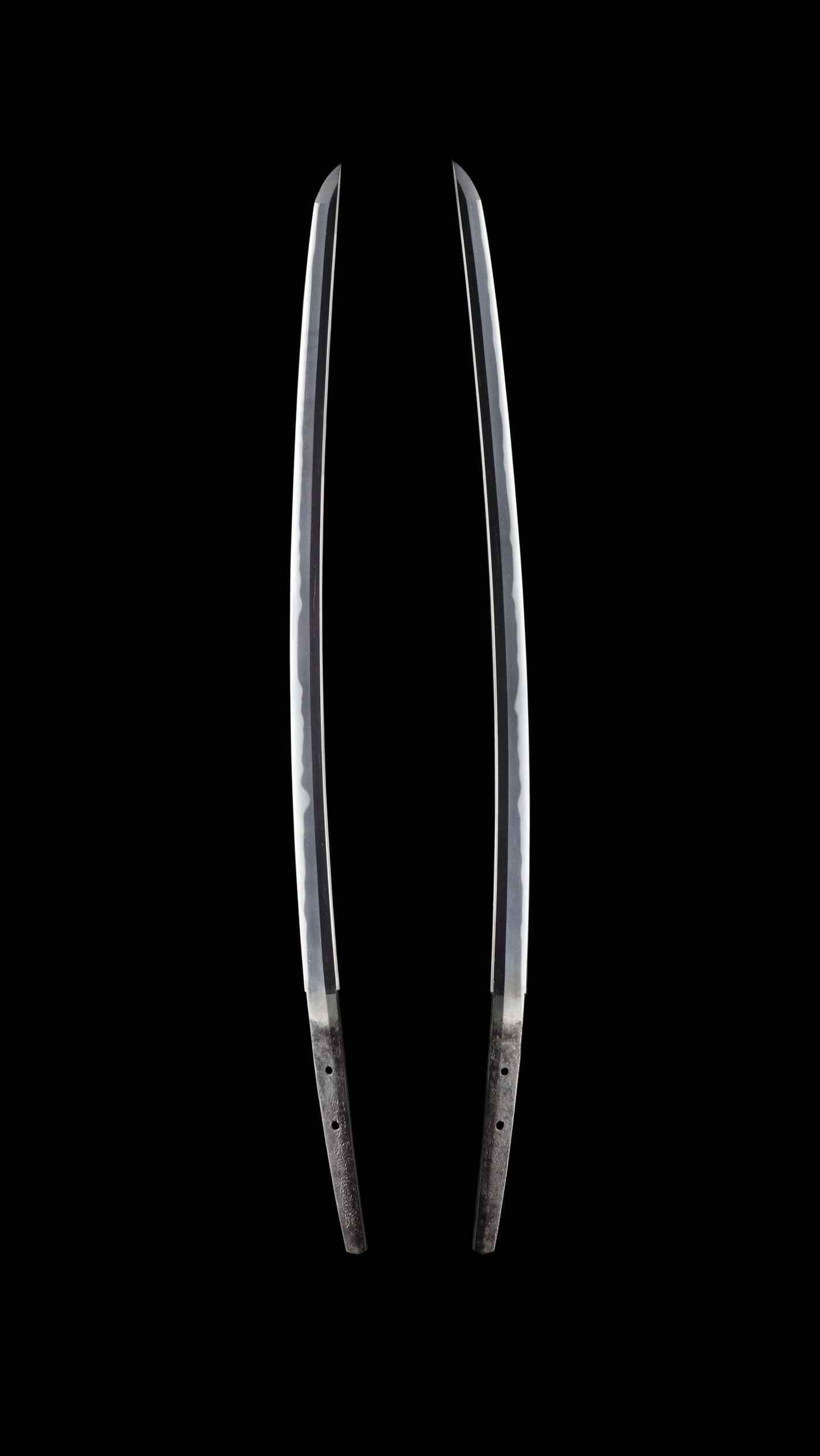
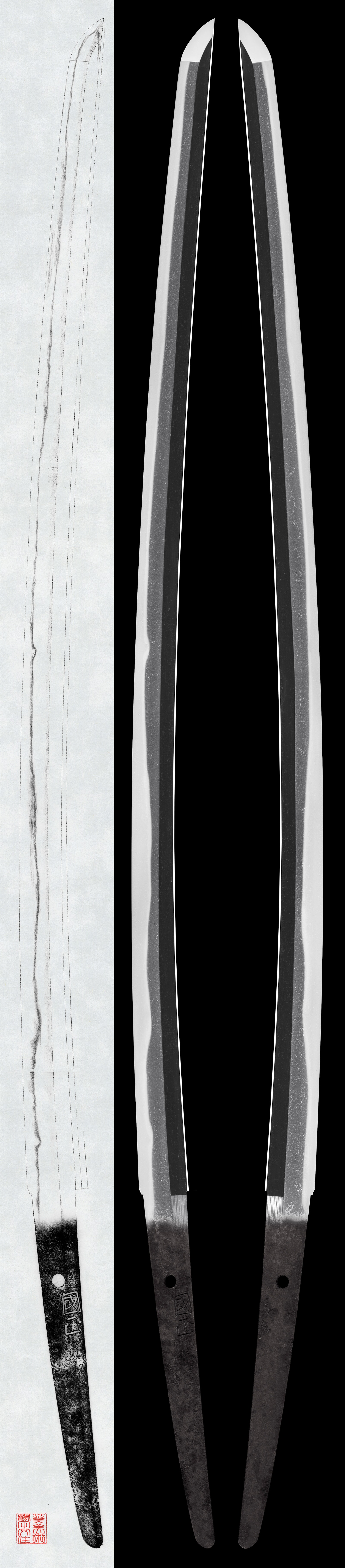
His characteristic hand copies the higher masters, and within them the Naoe- manner above all, what the commentaries call 「彼が最も得意とした志津風の作域」, the -style range in which he most excelled. The is the constant. Over a board-grain mixed with , and at times , the grain stands up into a coarse, dry texture the published sources name the most conspicuously standing in the whole group and a distinctive trait of this smith; fine sets densely and rather thickly, enter well, and on several blades a diagonal rises from below the . The carvings run to the devotional, with , and , , and , executed in relief and harmonizing with the wide, forceful Keichō shape.
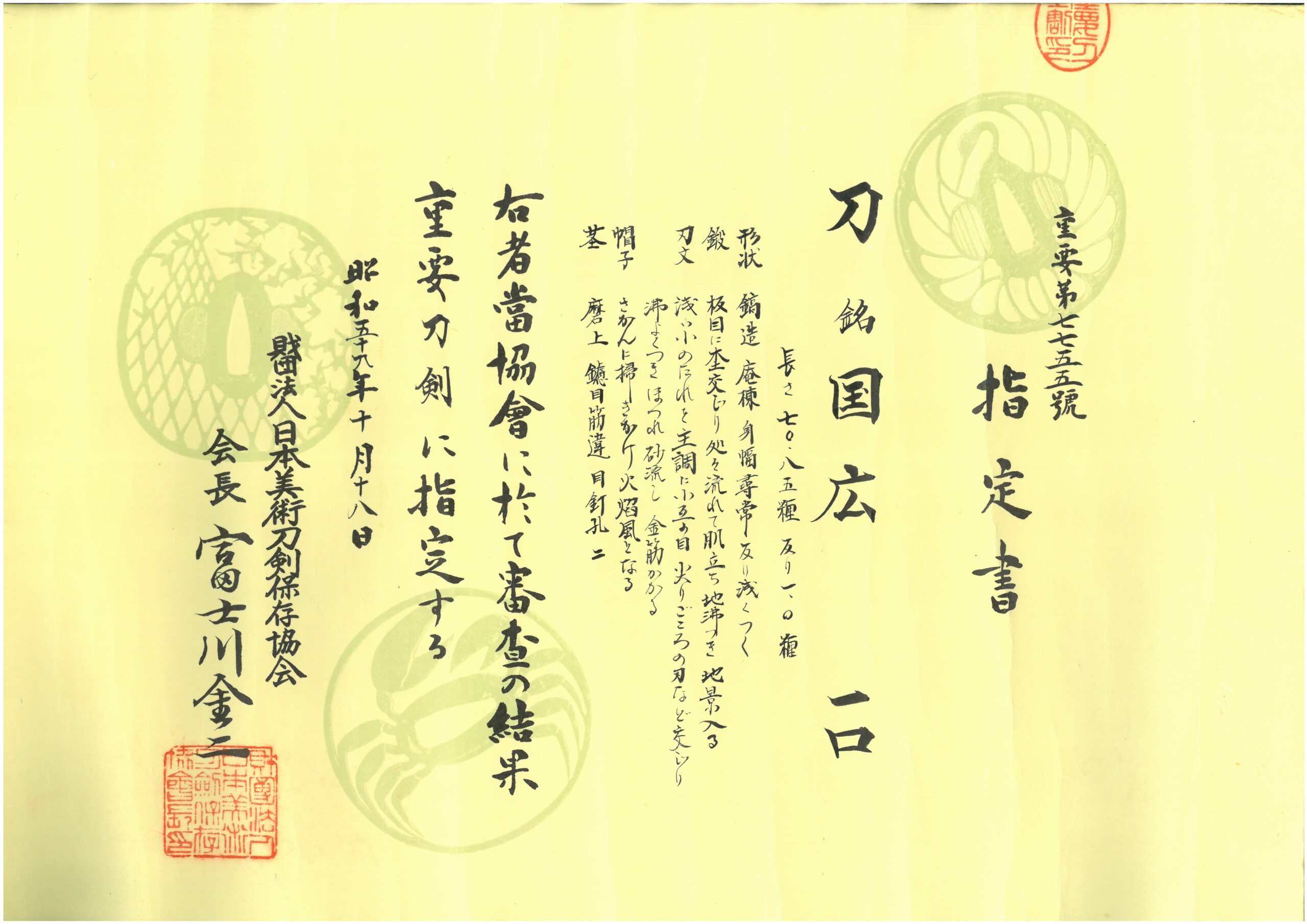
Over that he tempers a shallow, large into which , and angular, squared-off elements gather, entering, the deep and the thick. The is the point the published sources name as his recognition: at times it coarsens and gathers in uneven clusters, breaks along the edge, runs broadly, long enter, and small and are mixed in, while the inclines to , a subdued, slightly sunken line the commentaries read as a mark of this group. The enters in or and turns back in or with vigorous . Against this bold, rustic prime stands a rare second register: on one he tempers instead a with places of shallow, small , the not coarsened as usual but composed quietly in . The published sources call examples of his rare, judge this one finished with consummate skill, and liken it to 「同派の平安城弘幸を想わせる」, the work of Heianjō Hiroyuki of the line.
What singles him out in the school is not chiefly his style, which is by design close to his master's, but two technical habits the commentaries name as his great points of connoisseurship. He signs only the two characters Kuniyasu and never took a court title, 「銘字は必ず二字銘にきり、受領銘はない」, the only one among the superior smiths to receive no . And alone in the school he cuts his file marks reverse, 「一門中、鑢目が逆筋違」, said to be because he was left-handed, a feature the published sources note does not appear on the blades signed Kunihiro. The commentaries connect his two-character work in both style and signature to Kunitsugu, transmitted as his elder brother, and observe that within the group no one but Kuniyasu produced the -built Sadamune-style copies seen among his work. From the manner of his forging and temper they read him as one who took the orbit of Sadamune for his model, 「おそらく国広の代作に任じていたためと思われる」, and so served the master's name with his own hand.
For the collector he is a rare and rewarding name. Fujishiro grades him Jō-jō . He has no National Treasures; his record runs instead through one Important Cultural Property, a held in the Tokyo National Museum, a at the rank, a prewar Jūyō-Bijutsuhin once owned by Jinbei Kashiwara of Osaka, and some fourteen blades, one of them transmitted in the Shimazu family, lords of the Kagoshima domain. The published sources call his finest pieces masterworks that bear comparison with Kunihiro's own, one first-session blade praised as 「国広の傑作に比肩する出来映えで、同作中傑出した一口である」, comparable in quality to Kunihiro's masterworks and outstanding among Kuniyasu's oeuvre. Because so few signed works exist, and because most designated blades are long held rather than traded, a signed Kuniyasu comes to light only seldom; a privately held example is a notable thing for a collector to encounter, and it carries the added interest of a hand that, in the world at large, is hidden inside the signed work of Kunihiro himself.