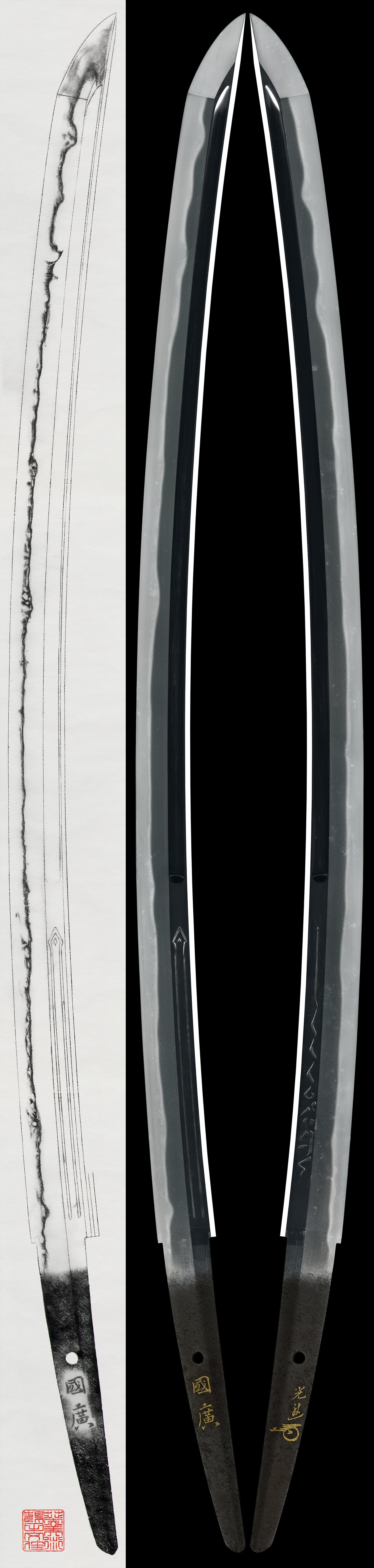
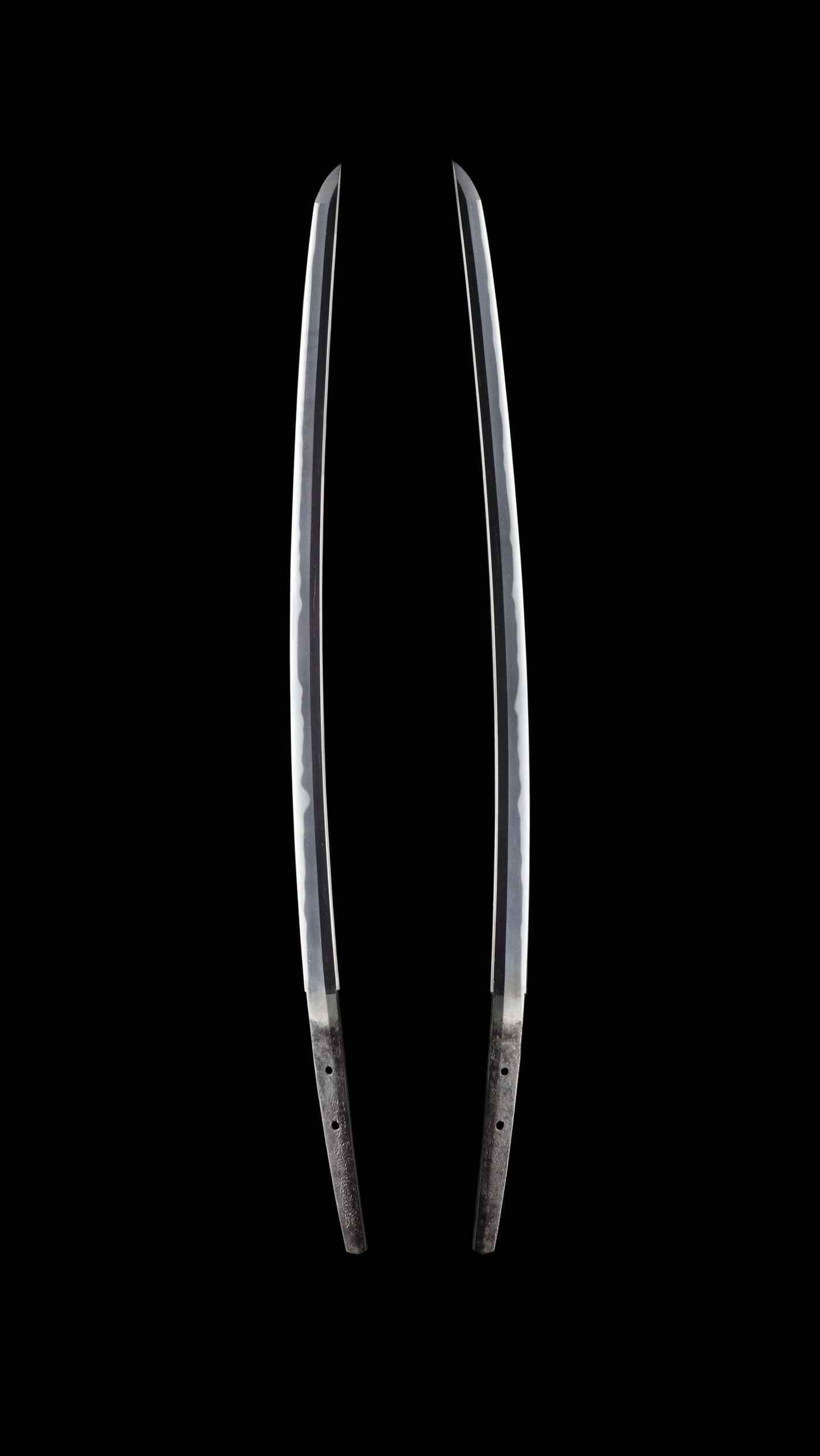
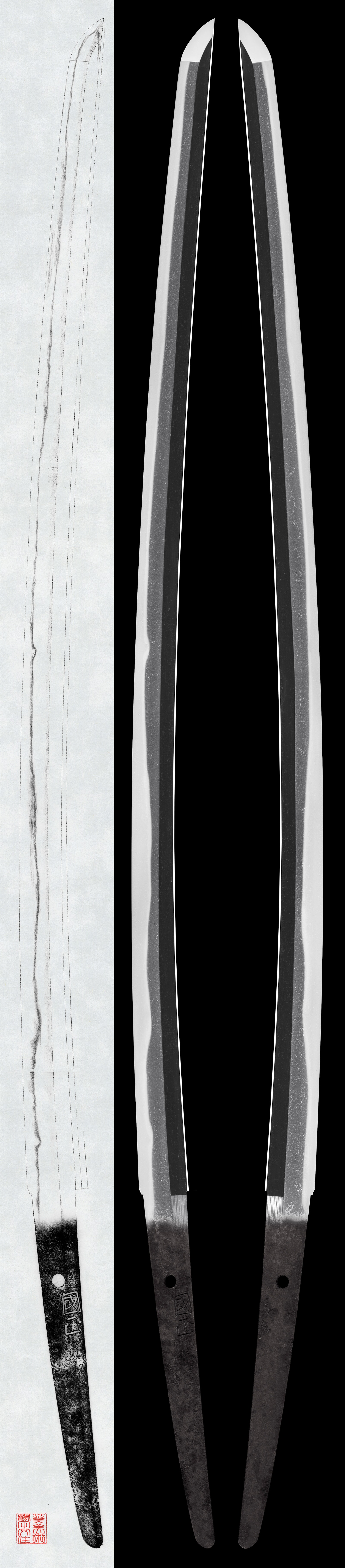
A signed Yamashiro no Kami Fujiwara Kunikiyo and dated 'ei 22 (1645) was dedicated to the shrine of Amaterasu Omikami, the great deity, and the published sources call it valuable as a record as much as fine in its making. The smith who forged it stands at the head of an line that carried the one name Kunikiyo across several generations. The first generation came, by the received account, from Matsushiro in Shinshu, was held to be the son of the third-generation Shimada Sukemune, and was first called Yoshiemon; he went up to the capital to study in the gate of Kunihiro, took the name Kunikiyo, and after Kunihiro's death entered the service of the Matsudaira house at Takada in Echigo, following his lord when the house was transferred to Fukui in . He received the title Yamashiro-daijo in 'ei 4 and Yamashiro no Kami the next year, and was granted the chrysanthemum crest to cut into his . Of the -name smiths the published sources rank the generations plainly, the first the most skilled and the second the most accomplished after him.
His forte is . The published sources name him a smith who was most given to a straight temper, a or a narrow that leans here and there into a shallow , with short entering, the faintly frayed in , the deep and the thick, fine and running through it and the tending to sink. The runs straight into a with a little brushing the tip. Beside this calm forte he also tempers a , a based on a shallow with that at its broadest opens into large breaking up into bold, irregular peaks, small and pointed crowding in, with slight mixed and the clumping into muranie in places, the deep and the and carrying over from the . The wide of large that survives is singled out as a shape uncommon both in his own work and within his line.
The is the constant beneath both manners and the surest mark of the hand. Over a standing mixed with and flowing the gathers dust-fine and thick in , fine enter well, and the steel takes a blackish tone, which the published sources read as the special quality of the northern-province steel, the hokkoku-gane, well shown and at its finest dense and pure. On the best of his the forging is described as standing finely yet refined, dark steel mixed through it, the maker's full strength on view. The and the sit on this without strain, and where the everyday is exceeded the temper widens a shade, the deepens, the grow larger and more even, and the steel turns finer still, the make that the published sources call his true character fully realized. The that sinks, recurring across the , draws the and the close without letting the border blur into the manner the school descends from.
The order of his work is read less by date, which is scarce, than by signature. The plain long is taken for the first generation; the character cut below the chrysanthemum crest is read as the second generation and after, the second generation being Shinbei, the first generation's second son. The form of the 国 character separates them as well, the five and eight strokes of the element inside the enclosure running parallel on the first generation's hand. Yet the published sources keep their caution in plain sight, holding that cleanly dividing the first and second generation is at present difficult and a matter for further study, even where the -marked of a resembles the dated Tenna 2 closely enough to suggest the second generation. The few dated pieces are prized for their rarity, the 'ei 9 (1632) among them, and the second generation's Tenna 2 (1682) , a of clear and , anchors his hand at the later end of the line.
What sets him apart is told through his own grounded traits rather than through the school he came from. His is the calmest register of an hand whose is dark and dense, the dust-fine and the fine of the hokkoku-gane carrying the work where a smith would carry it with standing and a brighter, more broken . The Jubi note transmits a scholar's reservation about the received descent, observing that among examined works of this smith a make that necessarily compels the Kunihiro connection is rare; the standing dark and the -laden nonetheless sit within the broad current, and his carving and his steel count among the typical -bori and of the day. The of the line runs backward as readily as forward, the generation read off the and the form of one character because the styles themselves will not separate, which is the school's defining condition as much as its difficulty.
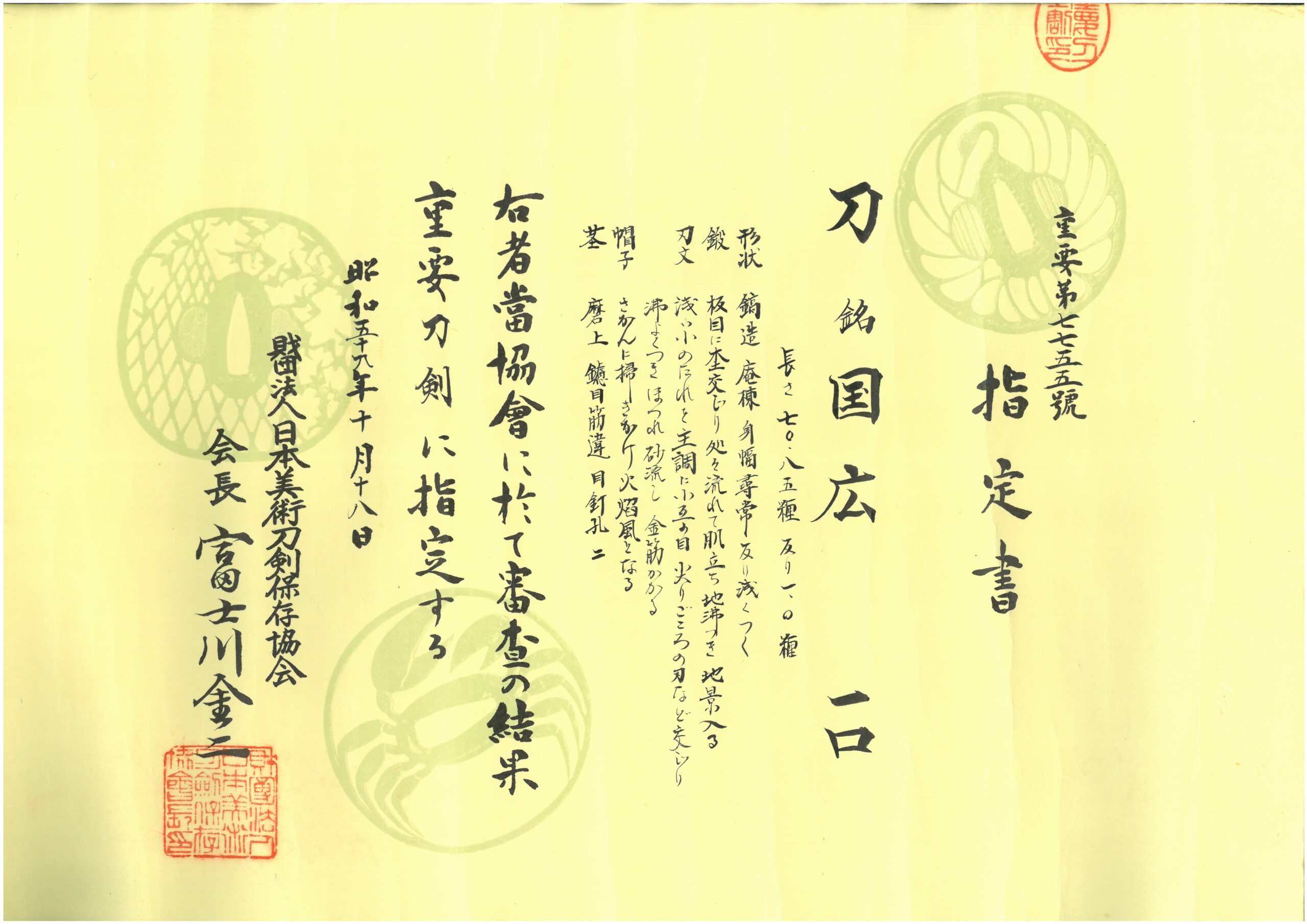
Kunikiyo is rated Jo- by Fujishiro, and twelve of his blades have reached the level with one further an Important Art Object, all of them signed. His designations run to the and Jubi tiers rather than the highest patrimony, so the line is not removed wholly from circulation as the very first names are; the designated work is held rather than traded, and a Kunikiyo comes before a private collector from time to time and with patience rather than readily. Provenance of recorded whereabouts is thin but distinguished where it survives: the 'ei 22 descends from its dedication to the shrine of Amaterasu Omikami, and a blade of the line is recorded among Imperial Family holdings, the kind of standing the chrysanthemum crest on his already declares. Cutting-test inscriptions attend his , a gold-inlaid three-body test on one 'ei 6 piece and a -otoshi inlay on another, the marks of a steel valued for its edge as much as for the quiet dignity of its .