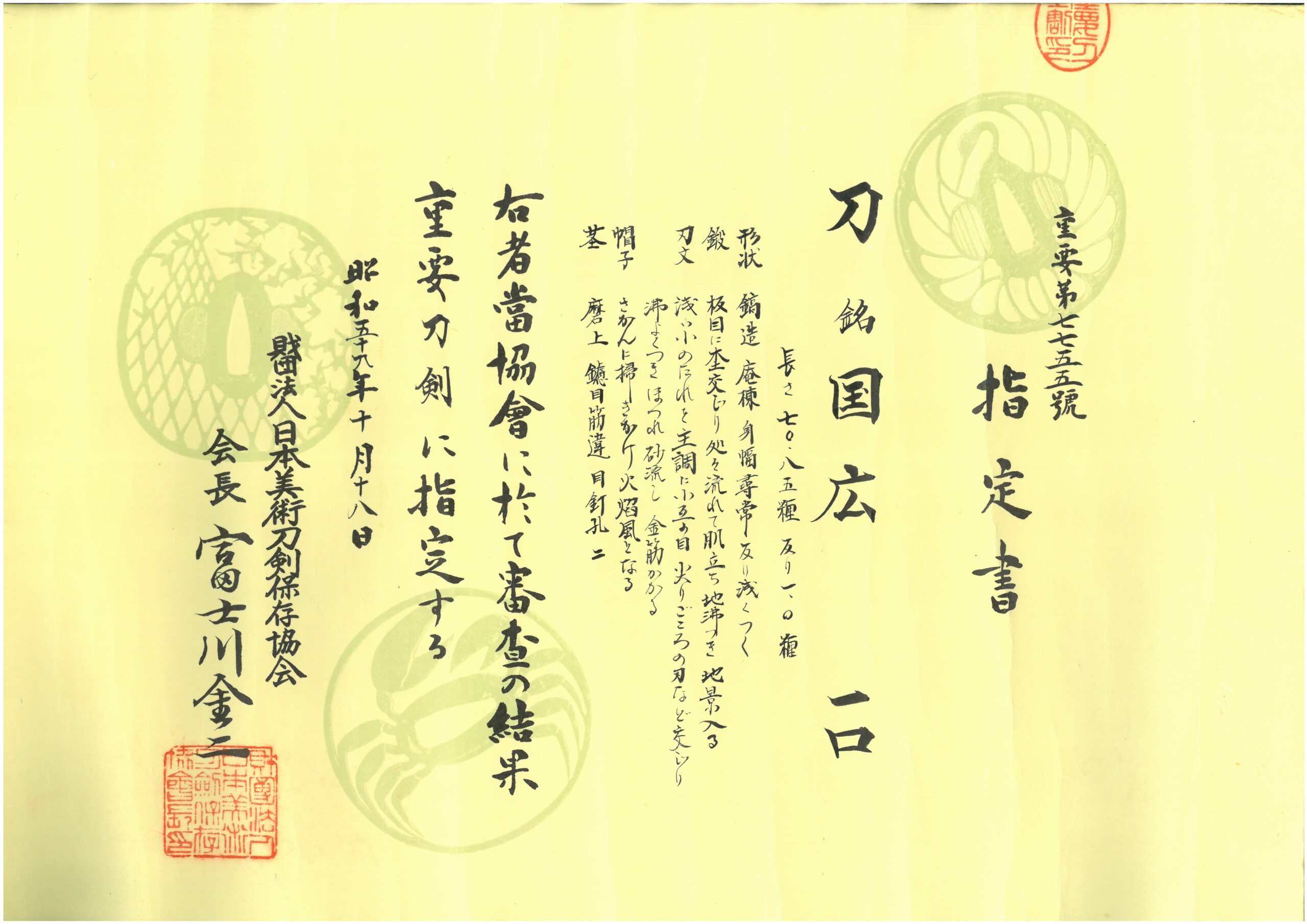
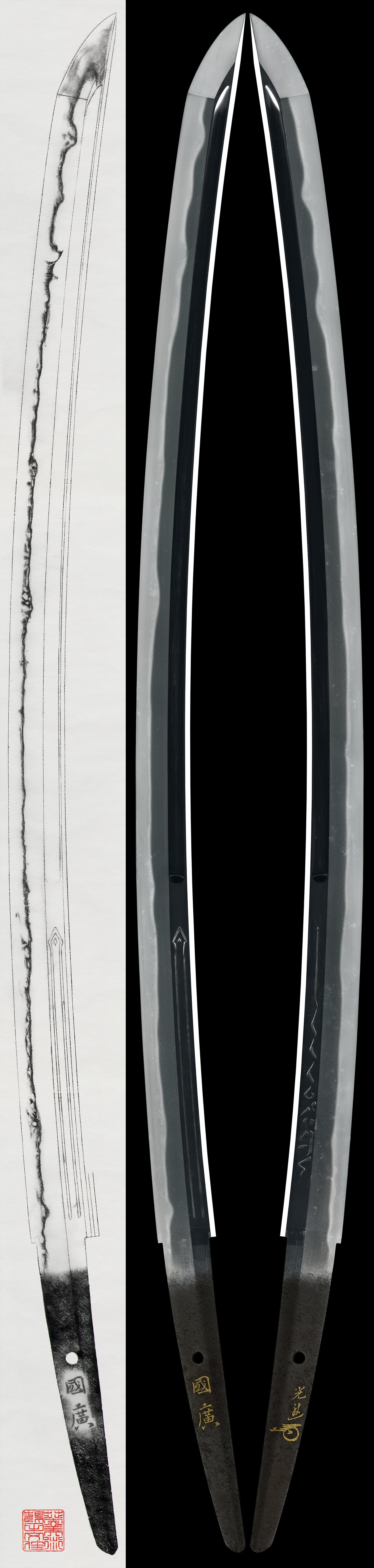
On the reverse of a dated to the sixth month of Enpo 3 (1675), the swordsmith Yoshitake's signature toward the is answered by a gold-inlaid cutting-test inscription recording that Tomita Shigetsuna cut through three bodies in two passes. Yoshitake worked in the line of Yamashiro and later of , the son of Heianjo Kunitake, who was himself a disciple of Kunihiro, the founder of the Kyoto school. He was commonly called Kawate Ichidayu, received the court title Izumo Daijo and later Izumo no Kami, and in his late years took the tonsure under the name Hotetsu Nyudo. The published sources hold that, while his father Kunitake was among the more unremarkable smiths of the group, Yoshitake was a craftsman 'who surpassed his father,' and that he 'conveys the boldness characteristic of works' over a good . His dated blades carry him from Enpo 3 through the Tenna era and on to Shotoku 1 (1711), a span that follows his move from Kyoto to the new capital at .
His recognized strength is a broad, calm . The published sources say plainly that 'he particularly excelled in works in a -based style,' and they set that manner beside the Hojoji school, noting that many of his blades show the kind of seen in that lineage. On the dated Enpo 3 the hardened edge is a wide with mixed in, entering and adhering, the deep, over a closely packed with and . The shape is a dignified of wide , shallow and , the left with an tip and or file marks, and on these cutting-test pieces the long signature toward the is answered on the by Shigetsuna's gold-inlaid record of the trial. The runs straight and turns back in a small round.
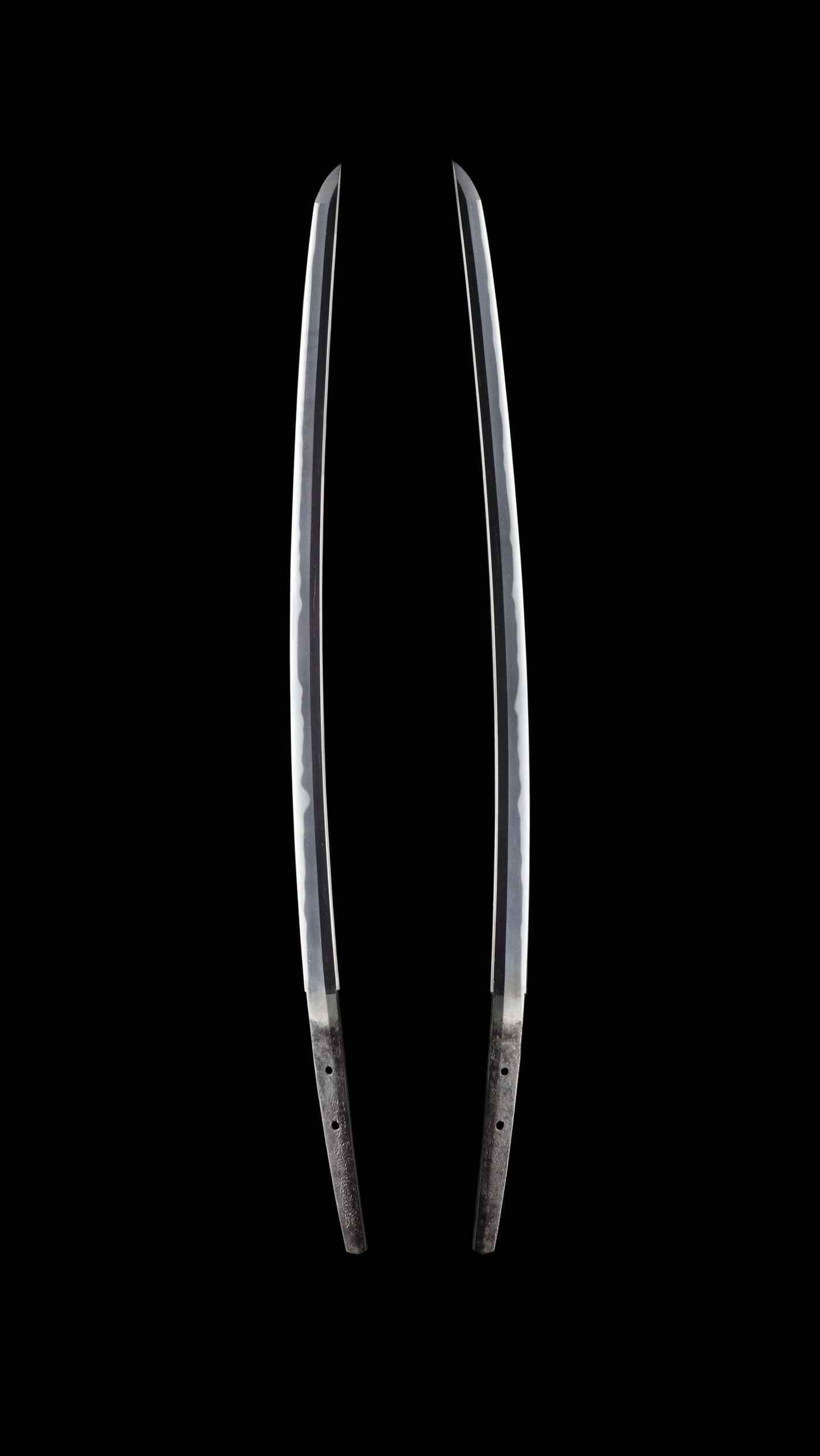
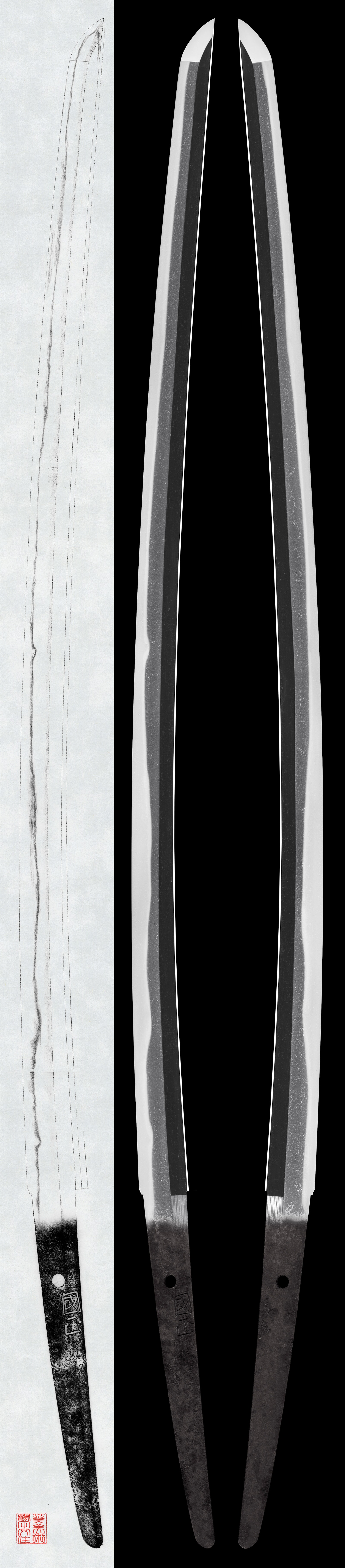
Beside this steady manner runs a more active one. Over a and mixed with , the tends at times toward a standing grain, with a touch of o- gathering at the and present throughout, the good steel the sources credit him with. On the Tenna , which the published sources call one of his finest works, the temper is a mixed with and ear-shaped elements, and entering, the deep and clear, fine well-adhering and appearing; the is straight to a small round with a brushed, swept tip. A second of his finest blades runs a notare-based line with and large , the deep and well-adhering, a slight suggestion of crossing the lower half. The whole of this register reaches what the sources liken to the billowing 'toran-style ,' and it is in this -based work, rather than in the quiet , that the breadth of his hand is most visible.
The two manners answer to the two halves of his career and to the company he kept. The published sources record that, although Yoshitake originally drew on the stream of the group, in his work grew close to the Hojoji school, citing as evidence collaborative blades produced jointly with Hojoji Shosho. From those joint works they infer that he maintained a notably deep relationship with that lineage, and they read the -based tempering of his blades as confirming the connection; the that is his forte is, in their account, the very manner of the Hojoji line. His track the arc. The earliest dated works sign Izumo Daijo Fujiwara Yoshitake in a large, long inscription cut toward the ; later blades carry a date of Shotoku 1 and are signed Hotetsu Nyudo, by which time he had advanced his title to Izumo no Kami.
What the published sources press, across all four of the designated , is that Yoshitake stood above the father from whom he descended. Kunitake is named among the plainer hands of the group, and the texts measure the son against him directly, calling Yoshitake a noted craftsman who surpassed his father and who carried the boldness of work forward on a sound . His own tell is therefore double: the wide that the sources treat as his particular strength, and beside it the toran-leaning of his years, the one quiet and the other active, both laid over the closely forged and with that is constant in his work. The judges describe individual blades as a 'standing-out example' and as among his finest, the language of a smith valued not as a school epigone but as a hand who outgrew his origins.
Yoshitake's record on the books is small and entirely signed: four , all at the rank of , with none carried to the higher national designations and no recorded provenance in houses. Two of the four carry gold-inlaid cutting-test inscriptions by Tomita Shigetsuna, one recording a cut through two bodies and the other through three, which fix the blades to Enpo 3 and lend them documentary weight beyond the temper. Fujishiro rates him Jo-, a measure of solid competence rather than of the first rank, and the designated blades are held privately, having passed through collections in Saitama, Ibaraki and Tokyo by the time of their . A signed Yoshitake of this grade is not beyond the reach of a patient collector in the way a nationally designated blade is, but with only a handful on record and a cutting-test example rarer still, one comes to market seldom, and a saidan- piece is a notable thing when it does.