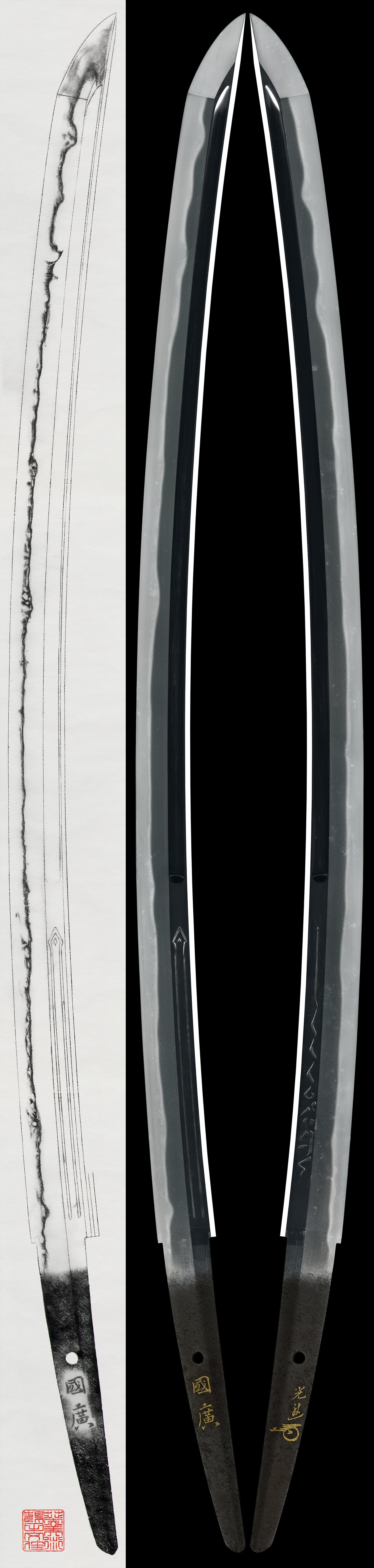
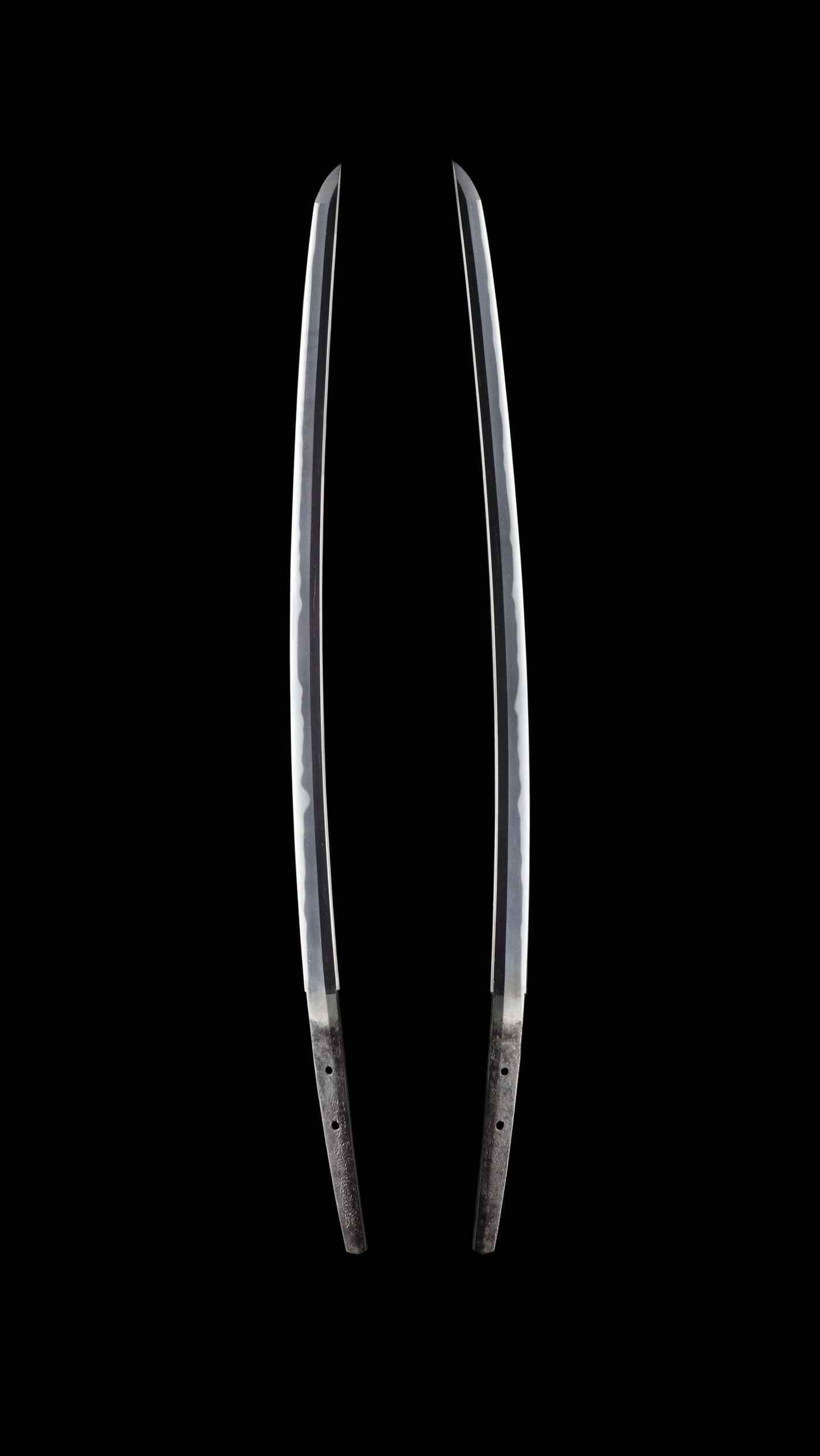
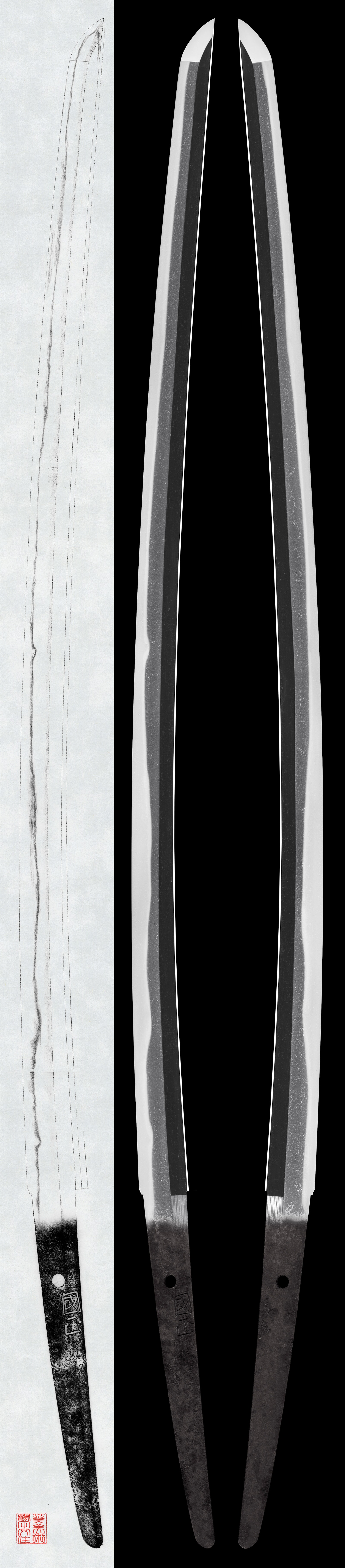
A long dated Tensho 4 (1576), signed in , carries the oldest date of Kunihiro, whom the published sources acclaim, with Myoju, as a founder of the sword. Tanaka Kunihiro served as a warrior under the family, lords of Obi castle in ; after that house fell he wandered the provinces, forging where he stopped, and from Keicho 4 (1599) he settled at Ichijo in Kyoto, trained many outstanding pupils, and is said to have died in Keicho 19 (1614). The registers make him a son of Sanetada or of Kunimasa. His designation texts open with one sentence repeated for half a century: his work divides broadly into two manners, the Tensho-uchi of the wandering years, looking to late and late Seki, and the Keicho-uchi after the settlement, modeled on the top masters. In technique, and equally in the pupils he raised, the texts call him the first man of the age.
His is the school's own: mixed with and , the grain standing, in the rough, loose surface the texts name outright the peculiar to work; over it lies minute and thick, and enter finely. From above the a rises obliquely, on one noted as the that is his habit. The carries a second tell: rough stands in uneven patches, the width varies, and of one the published commentary writes that the slightly uneven temper and the sinking are Kunihiro's habits of hand. He hardens the past the and widens the temper at the . Nearly everything is signed, the Keicho work above all with the large two-character beside the long residence signatures. He sets the low, so that on a two-hole tang the plugged lower hole is the original.
The Keicho-uchi rests on a stated ideal: his goal, the sources write, lay in the revival of the tradition, and the leaning is strongest toward . The of these years are wide, with little taper, shallow in , the extended or grown to , a build the texts liken to a great cut down to a ; one blade is read as a direct transcription of an , down to the half-worn look of its copied carvings. Over the he tempers a shallow mixed with and pointed teeth, thick in , with , and ; the runs or shallowly undulating into or , lightly swept. Beside the stand the wide, with , the form, where the copying reaches past : one piece is judged in temper and carvings to recall Sadamune, and the manner of is taken in so actively that the texts call one piece to the life.
The Tensho-uchi is another smith at first sight: and small with strong -zori, tempered in a mixing and angular teeth, and running to a -like effect, the brighter than in his later work, and warrior deities, Daikokuten and Bishamonten, carved in a strong chisel. The sources read these blades as late and late Seki at a glance, and his itinerary is written into the themselves: the Furuya signatures of , a signed as made in his days as a yamabushi (山伏時作), a blade forged at the Ashikaga school in Tensho 18 (1590), a Gifu collaboration with the senior smith Daido, and work cut in Kyoto in Tensho 19 (1591). In carving he is paired with Myoju, in force, the sources allow, even his superior; Honma takes the for the smith's own hand from the one manner running through every period. At the opposite pole stands a small, quiet class: is rare in him, and these and small , their finer than his norm, their tighter and brighter, are read as aimed at Kunimitsu, Yukimitsu or Kunimitsu. The texts pass one judgment on all this copying: he chews the model thoroughly and creates without artifice, so that even there the surface, the and the uneven give his hand away.
What he founded outlived him in the men he trained. From the school came Dewa no Daijo Kunimichi, Kuniyasu, Osumi no Jo Masahiro, Echigo no Kami Kunitomo and the elder Kunisada, the record tracing his manner onward in Kunimichi's small-patterned and Oya-Kunisada's carving. The last years belong partly to that workshop: among his dated works those of Keicho 15 (1610) are the most numerous, the sources note, a year falling by the traditional reckoning near his eighty-ninth; of this period one text concludes there is no way to take it but as almost entirely the disciples' and . The texts set this sharply apart from forgery: supervision was strict, and the blades of these years show no falling-off.
Fujishiro rates him Sai-jo . Of one hundred forty-eight designated works on record, one hundred forty-seven are signed and none unsigned; the single blade counted otherwise bears his large two-character beside the gold-inlaid cutting test of Yamano Kaemon Nagahisa, dated 6 (1666), rare on his work. Twelve blades are Important Cultural Properties, patrimony outside the market, and twelve more are prewar Bijutsuhin; nine are and one hundred thirteen , one hundred twenty-two blades in those two tiers. The he dedicated to the Hataeda Hachimangu in Keicho 2 (1597), with an transmitted as the donation of Emperor Go-Mizunoo, remains in the shrine's keeping. The provenance runs through the houses of his own story and of the country: blades handed down in the he had served; the sidearm of Iki Nagato no Kami Tadasumi, chief retainer of the Okayama Ikeda; pieces of the Tosa Yamauchi and of the great Shimazu house, one old scabbard inscribed for the use of lord Mitsuhisa; transmissions reaching Toyotomi Hideyori and the Imperial Family; order pieces for Nagaoka Okimoto of the Hosokawa and the connoisseur Sawada Doen. What a private collector may realistically encounter is the and tier, and even there a Kunihiro is held closely, coming to market only from time to time; when one appears, it carries on its the signed hand of the smith with whom the new sword begins.