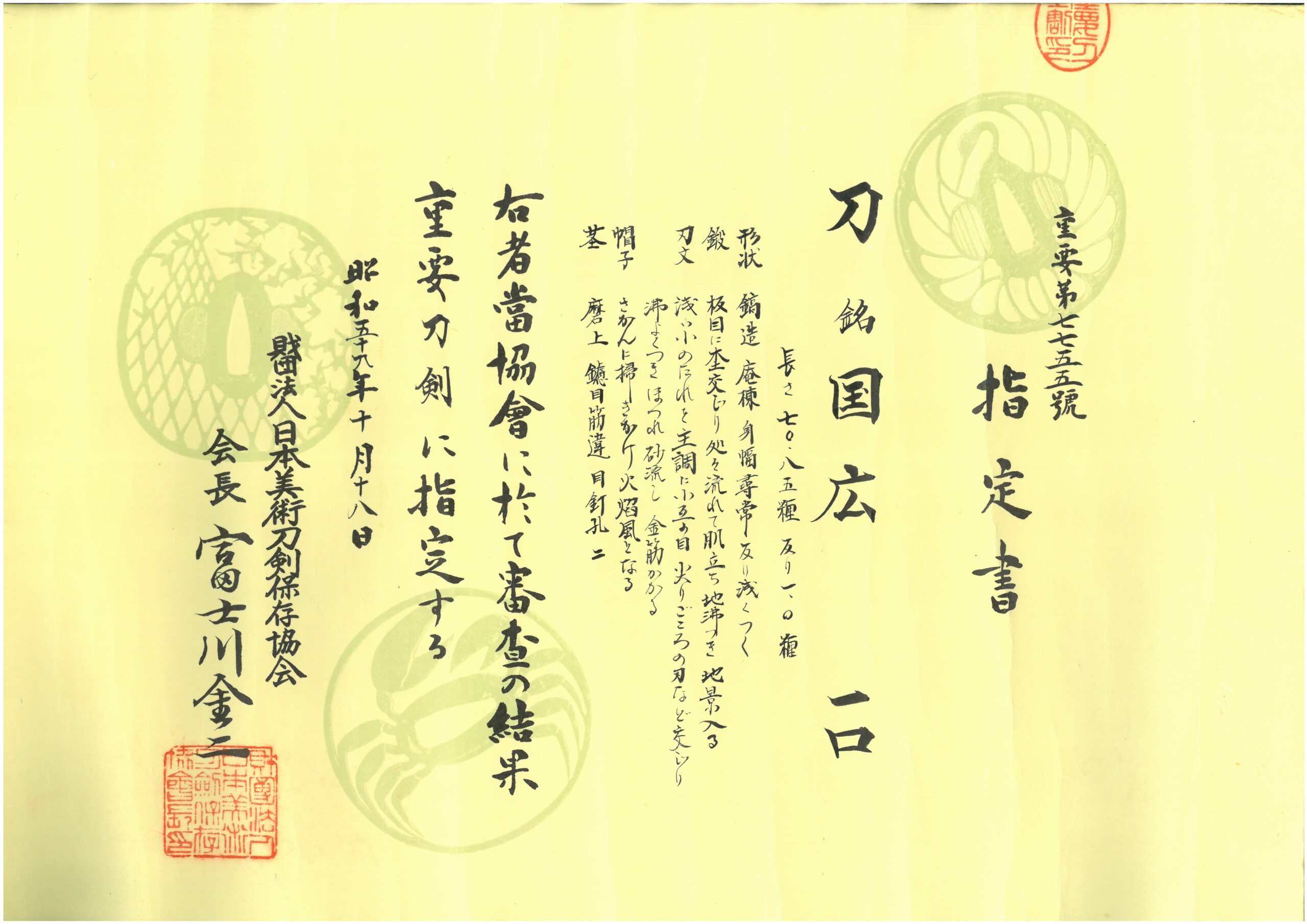
Dewa Daijō Fujiwara Kunimichi worked in Kyoto in the Keichō- years, the foremost pupil of Kunihiro and, the published sources say, the most versatile hand of that whole circle, calling him "the most dexterous of the school". His career is unusually long. Dated blades run from Keichō 13 (1608) to 2 (1662), and one piece carries an added inscription giving his age as seventy-seven in Keian 5, so that some accounts even propose a second-generation Kunimichi for the works after the Jōō era. He is said to have lived in the Ebisugawa quarter near , and the sword books record that he first studied under Iga-no-kami Kinmichi of the house before entering Kunihiro's gate; after his teacher's death he received the title Dewa Daijō, around Keichō 19 to Genna 1, in an arrangement sponsored by Kinmichi.
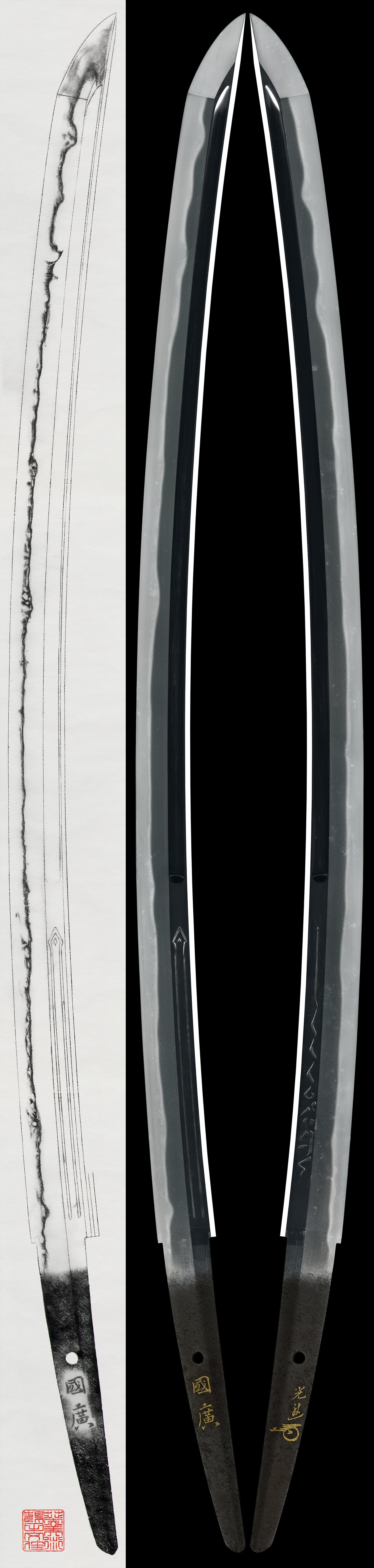
His characteristic work is a copy of the tradition, and within it the Naoe- manner above all. The published sources are consistent on where his strength lay: he handled every tradition but with skill, "and of these the tradition was his greatest specialty, looking devotedly to and ". Over a board-grain that stands up he tempers a and base into which and large gather, building to a lively large with ; the is deep, the thick and at times coarse, with broad and long . The published sources name exactly these as the points by which he is known, his strong, lively , his large flamboyant , and the rich work of and . His most personal feature lies in the : a shallow that thrusts up and turns pointed with , "the so-called , entering in and becoming pointed at the tip".
The is where he is most himself. His stands up and is often dry and coarse, a distinctive texture mixed with and flowing grain, inclining toward near the edge, with adhering and entering. It is not the unhurried, expansive steel of his teacher; it is a tauter, more worked , and the published sources, while granting that in breadth of range he even surpasses Kunihiro, are clear that in leisurely grandeur of scale he does not match him. Across the temper run the activities he is read by, entering well, the deep and at times brightly clear, along the back of some blades, and on the more boisterous pieces a tendency toward coarse and basake.
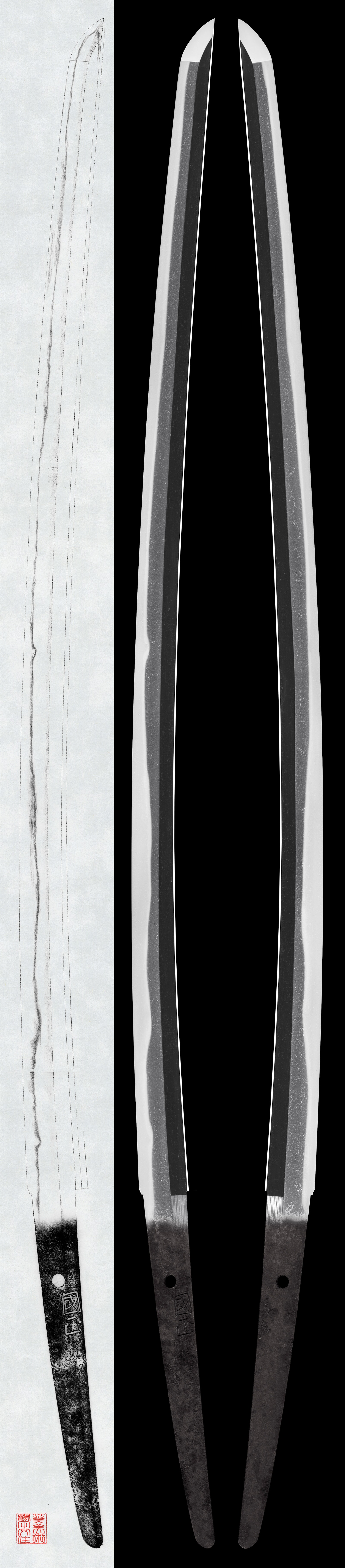
Two registers divide his work. The first and most frequent is the flamboyant copy, the large fully tempered, the pointed in the manner, devotional carvings of , and on the and , and on his wide a Fudō or a . The second is a subdued, low-temper register encountered from time to time, the quiet, the tighter, the line dignified and sometimes carrying an archaic colour like old ; one of this kind lacks all flamboyance and is so richly covered in in both and that the published sources say it could "be mistaken for a work by his teacher Kunihiro", proof of how completely he had absorbed the hand. His signatures track his life across both registers, the early Kunidō written with the character 道, the prime full signature Dewa Daijō Fujiwara Kunimichi after he took the title, and the late pieces prefixed , the changing name read together with the pointed as evidence of his connection to the house.
What sets Kunimichi apart within the school is not a single feature but a balance. Among Kunihiro's pupils he and Izumi-no-kami Kunisada are reckoned the two most prolific, and his collaborator Kunitsugu, transmitted as either his son or his disciple, served as his capable and signed a joint before taking his own title. Against the school's other great hands his own features set him off: the standing, dry , the pointed that the norm does not show, the thick coarse and long of a thorough copy. The published sources call his finest work in this manner "the flower of his copies", and praise his strongest pieces as overflowing with power, close to the highest rank of his oeuvre; his copy, too, is held to stand without disadvantage beside his teacher's.
For the collector Kunimichi is an attainable major name among the Keichō- smiths, where so much of the school's best is held rather than traded. Fujishiro grades him Jō-jō . He has no National Treasures; his record runs instead through two Important Cultural Properties, two and many , sixty-seven blades in all in the and tiers, with seventy-four designated works on record, alongside prewar Jūyō-Bijutsuhin that include the great long dedicated to the Goryō Shrine in Kyoto. The provenance recorded for his blades reaches into the Imperial Family and old collections, with examples now held at the Goryō Shrine and the Yasaka Shrine in Kyoto and others long in private hands. Of the seven tiers above only a small number can ever change hands, and most designated blades, even in private collections, are kept rather than sold; but a signed Dewa Daijō Kunimichi in the tradeable tier does come to a patient collector from time to time, a Kyoto copy of the first rank by the most versatile of Kunihiro's pupils.