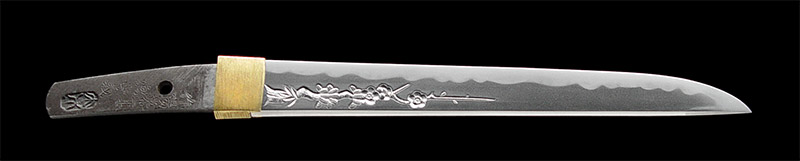
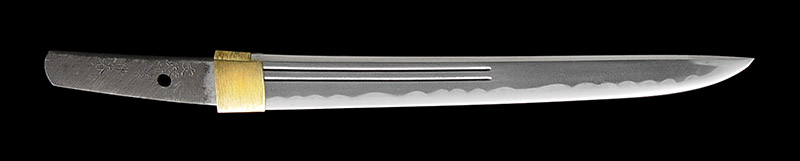
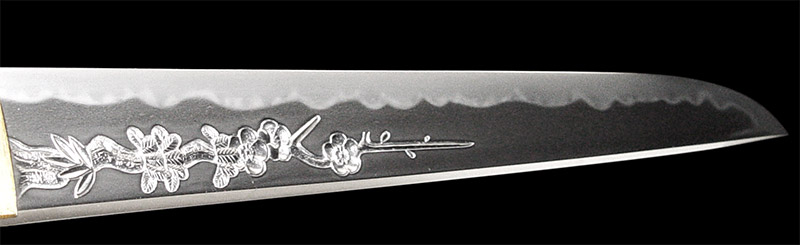
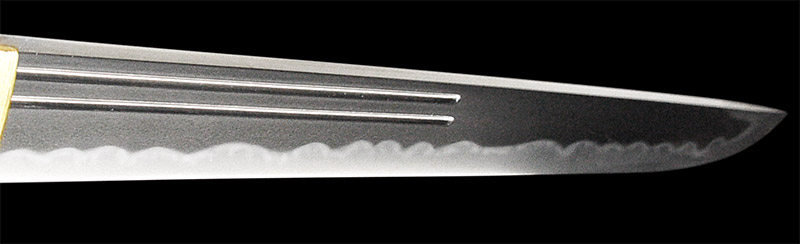
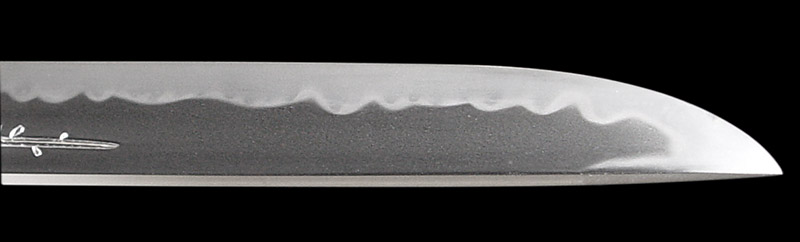
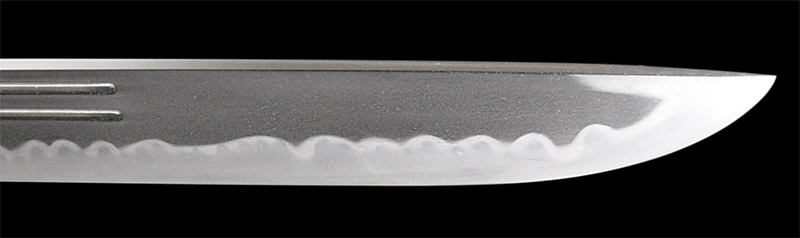
At Hamachō in Edo, in the closing decades of the eighteenth century and the opening ones of the nineteenth, Suishinshi Masahide[[c:1]] gathered the school that would turn Japanese swordmaking back toward its medieval models. Born Kawabe Gihachirō at Akayu in Dewa in 1750, signing first as Suzuki Takahide and then Eikoku, he studied under the Shitahara smith Yoshihide of Musashi, took the name Masahide in An'ei 3, and served the Akimoto house of Yamagata before settling in Edo, where he worked for nearly fifty years. He is the founding figure of the shinshintō and the theorist of the fukko-tō (revival-sword) doctrine, the argument that the sword ought to return to its Kamakura forms. Around that teaching he drew a large body of pupils, among them Taikei Naotane, who would give the revival its fullest practical form, the future second Masayoshi (Hosokawa Morihide), and a wider Edo and provincial following that carried the program into the Mito, Yonezawa, Tsuyama, and Tatebayashi domains. The shared vocabulary of the school is the deliberate reach back into the koto traditions, worked over a tightly forged, often muji-toned ko-itame with thick ji-nie. Masahide's own prime hand was the Ōsaka-utsushi, the surging tōran-midare of Tsuda Sukehiro opening from a long yakidashi and the broad suguha after Inoue Shinkai, betrayed on even his closest copies by a blackish, coarse nie that spills from the ha into the ji. Naotane gave the revival its Bizen and Sōshū faces: a reverse-leaning chōji-midare with angular kaku-gunome and saka-ashi, modeled on the late-Kamakura Osafune masters Kagemitsu and Kanemitsu and anchored by a consciously revived midare-utsuri that no ordinary shinshintō steel carries, set beside a Sōshū notare with its whorled uzumaki-hada and coarse, striped nie. The pupils divided this inheritance along their own lines. Jirōtarō Naokatsu, Naotane's adopted son, took a Bizen-den led by a kataochi-gunome from Kanemitsu with a pervasive saka-gakari slant and chōji- or midare-utsuri in the ji.
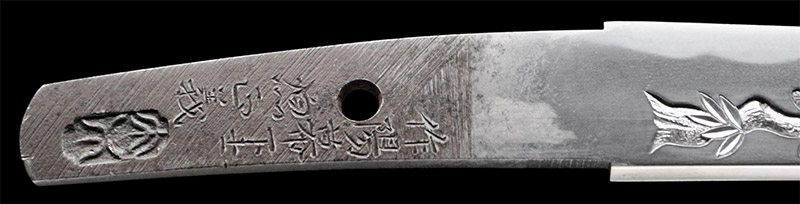
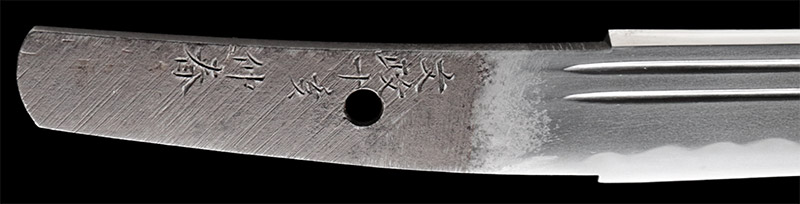
Suishinshi Masatsugu reproduced Naotane's two traditions, Sōshū and Bizen, down to the cut of his signature. Through Masayoshi the Bizen current passed to his heir Hosokawa Masamori of Tsuyama, whose chōji clusters mixed with gunome-chōji and togariba. The Osaka wave traveled separately into Mito through Naoe Sukemasa, who set a Shinkai-styled suguha and a Sukehiro tōran over a clear ko-itame, while Chōunsai Tsunatoshi of the Uesugi service carried a nioi-deki chōji mixed with gunome, suguha, and tōran-midare, often with carving by his own hand. To kantei the school is to weigh a tradition consciously copied against the period marks the copy cannot shed: the constant of the line is that the hamon is never the pure nioi-deki of old Bizen but carries nie throughout, a difference the NBTHK names outright as the divide between koto and shinshintō. The revived utsuri in Naotane and Naokatsu, the spilling nie in Masahide, the whorled uzumaki-hada shared across the line, and the broad, thick-kasane late-Edo sugata are the surest tells, narrowed further by the school's habit of full, dated signatures that make these smiths among the most exactly knowable of their age. Masahide stands at the head as the teacher and theorist, his finest work in his Ōsaka copies rather than the doctrine he proclaimed; Naotane stands ahead of him in execution, his Bizen-den held the finest among the shinshintō. Their pupils define the late-Edo Osafune and Sōshū revivals as practiced through Edo and the domains, with Naokatsu and Masatsugu read as the next hands after Naotane and Masayoshi. The provenance of the school runs through domain commission and bestowal (Mito blades forged at the Kōrakuen by lordly order, Tsuyama and Yonezawa fief work, Naotane's Sanada daishō and a tachi recorded in Honma's inventory of the Imperial collection) rather than ancient daimyō transmission, fitting for a movement that, within a single generation at Edo, redrew the direction of nineteenth-century swordmaking by turning it back toward the old models. Learn more →



 NihontoWatch