Sengoku Seki was an industry: smiths organized under their tutelary Kasuga shrine, arming the war bands of central Japan. Magoroku Kanemoto’s sanbonsugi and the finest Kanesada work prove quality survived inside mass production.
 NihontoWatchNihontoWatch
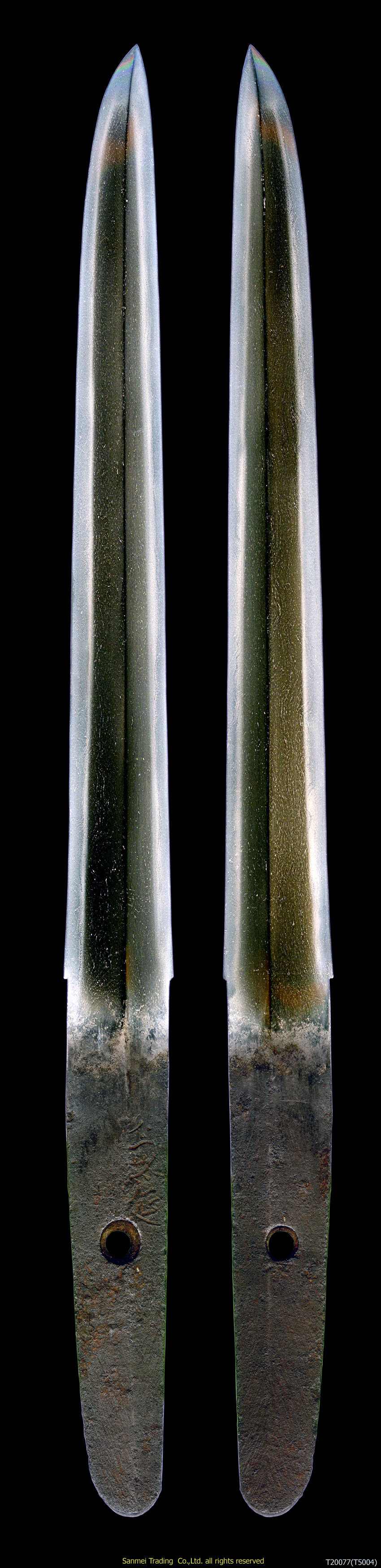
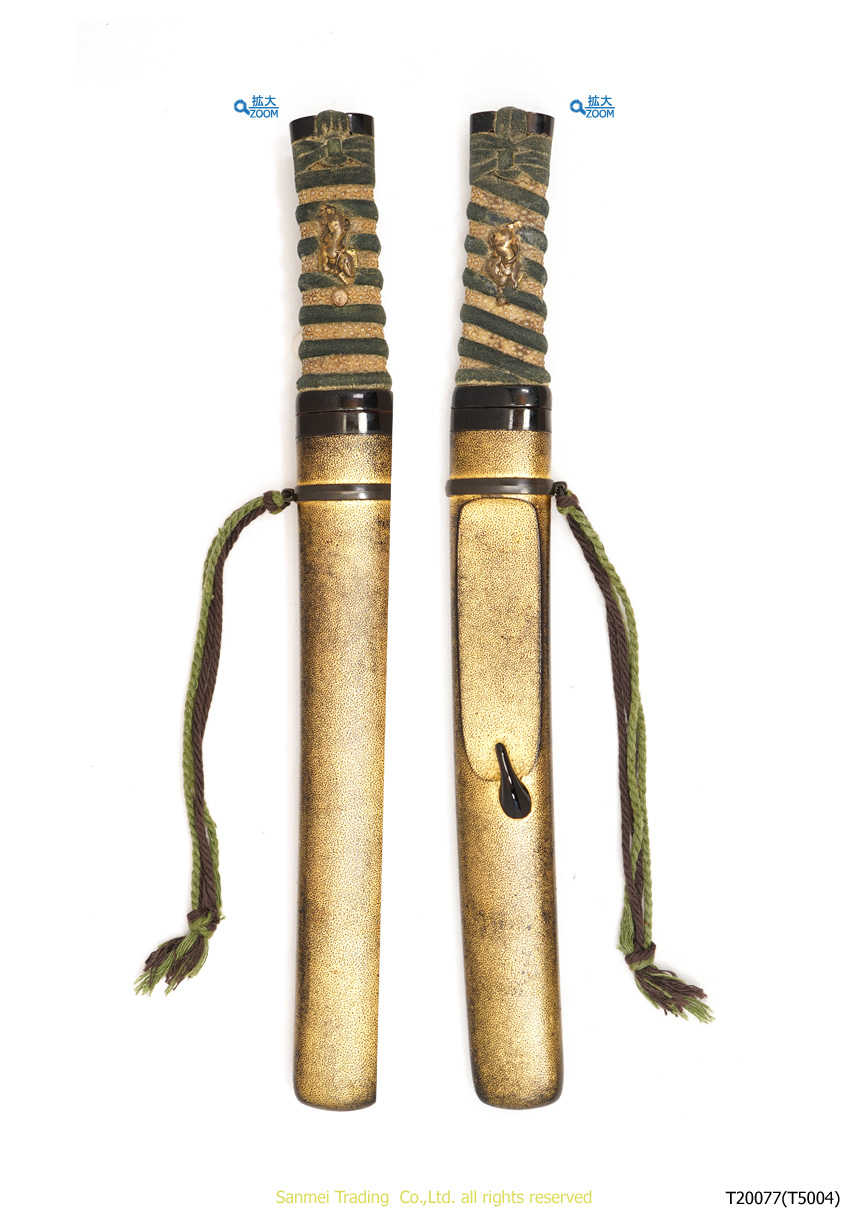
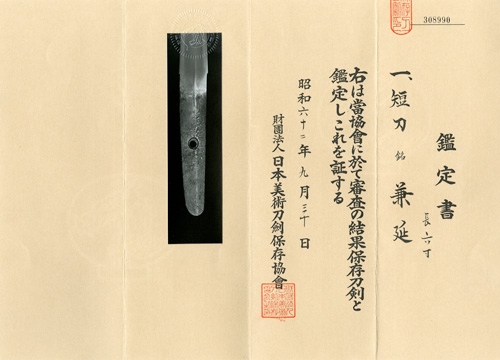
Blade construction: A double-edged tantō (Ryōba-zukuri). The blade length is 6 sun (approx. 18.1 cm) in a moderate size. The form emphasizes thrusting with a less swelling in upper Fukura. Jigane (Forging pattern): A robust forging with prominently standing Itame-hada (wood grain pattern) and streaming Masame-hada as well, featuring fine sparkling Ji-nie and visible bluish Chikei in the steel. Hamon (Temper line): The Hamon at both Machi forms with a short Yaki-otoshi, developing into a wide Sugu-ha temper. The Yakiba displays a bit on stronger side in brighter the Nie clinging to the Ha with frequent short Ashi, Sunagashi and active Nie-suji, creating an overall sparkling brilliance appearance. Bōshi (Tip temper): A violently sweeping up with an indication of medium circle. Nakago (Tang): Ubu (unaltered) with one Mekugi-ana (peg hole). The Kurijiri (rounded tang tip) heel in full. The Nakago is relatively long in proportion to the blade with an Inverted V (Gyaku-taka-no-ha) file marks on the front whereas the other side forms V-shaped (Taka-no-ha). On the front above Mekugi-ana punch, there is two typical inscription signature “KANENOBE” 兼延 in the elegance of antiquity. Here is a splendidly classical tanto of KANENOBE 兼延 (KANENOBU in other pronounce) in Owari from late 15th C. from Muromachi period. The "KANENOBE" 兼延 is recorded in the Nihonto-meikan as belonging to the Naoe-Shizu school around the Ouan era (1368~). Generically called Naoe-shizu school such as Kanetomo 兼友、Kanetoshi 兼俊、Kanenobe 兼延, had established a foothold in Naoe town and flourished to meet with sharp rise in demand for the Nanbokucho period while the two courts fought for fifty years. In the prime of Nanbokucho period, Naoe-shizu makers accomplished their own workmanship in the dawning style of Mino-den of which Soushu and Yamato techniques were integrated. The Naoe school, due to the decline in demand after the unification of the Northern and Southern Courts and repeated river floods, had left their original location in Naoe and moved to Seki and Akasaka or Oyama. Around the Meio era (1492~), "KANENOBE" 兼延 is said to be the child of "KANEARI" 兼在 who lived in Oyama and he later migrated to the Owari region. This lineage such as KANENOBE 兼延, KANETSUGU 兼次, KUNITSUGU 国次 lived in Shiga (now Kinjyo Town, Kita Ward, Nagoya City) or the northern area of Yamada Town (Yamada Village, Nishikasugai District), is referred to as the "Shiga-Seki" 志賀関 or "Yamada-Seki" 山田関 and they laid the foundation for the Owari sword-smiting tradition. The subject tanto is characterized by a firm physique adept at thrusting with a bdoble-edged "Ryōba-zukuri" construction and was highly valued as a companion dagger for the long katana. The steel surface, a deep blue-black hue interspersed with burl and streaming grain patterns, emanates from the abyss, featuring a strong resilient construction with horizontal and vertical forging patterns formed by the Ji-nie sparkling granules. Upper the Hamon, more forceful in handening temper and it's Boshi forms intensely powerfull with an intensive Hakikake sweeping up, exhibiting a robust and dynamic quenching structure. The overall impression of this tanto is filled with a sense of vitality. The blade is admired for the very good condition for the age and its Nakago holds the excellent taste of patina over the passage of 500 years even more. with) Gold stone-surface lacquered scabbard Metezashi-style Aikuchi Koshirae The Aikuchi mounting for right-hand wear features Fuchi-kashira, KoikuchI and Kaeri-tsuno all made of horn, with the Menuki in the form of guardian lion-dogs (komainu). The hilt is wrapped in white Samegawa rayskin fitted in the “Ryuko” style with one-handed wrapping in indigo lacquered leather.The distinctive feature of this right-hand mounting lies in the design intended for instantaneous thrusting: the section between the Kaeri-tsuno on the reverse of the right hand and the Koikuchi is pared down, allowing the scabbard to be bound tightly against the sash at the wearer’s right hip. The scabbard’s reinforcement fitting is positioned only a finger’s width from the mouth of the scabbard, enabling a one-handed grip and the possibility of drawing the blade in an instant. It is said that the origin of this right-hand mounting style traces back to the Yagyū school’s Shinobi, who employed it as a dagger carried close at hand so called "kanken" as a concealed weapon. Yamagane copper ground single layer Habaki collar, preserved in a Shira-saya plain wood mounting Recent good polish/Condition scale: very good (using a scale of mint-excellent-very good-good-fair-poor) reference data : Honma Kunzan/Ishii Masakuni, Nihontomeikan, Yuzanaku, 1975 Honma Kunzan/Sato Kan'ichi, Nihonto-Taikan/Koto 3, Otsuka-Kogeisha, 1969 Suzuki Taskuo/Sugiura Yoshiyuki, Muromachi-ki Mino-Toko-no kenkyu, Ribun-shuppan, 2006
Offered by Sanmei
2 on the market

Mino-den · Owari · around 1492-1501
Fujishiro Jo saku · Tōken Taikan top 49%
2 pieces on the market now
Where Kanenobu stands among comparable artisans: across all of nihontō, and within tradition, era, and period. The tiers (Foremost · Leading · Major · Notable) weigh official designations from the NBTHK and Japan's Agency for Cultural Affairs, together with historical honors of lasting repute such as the Sansaku and Meibutsu-chō.
Select a lens to see how it's measured.
Mino-den · Mino
129 pieces on the market now
Seki (関), in Mino Province, grew from two roots set down in the Nanbokuchō period and rose to become the great center of mass sword production in the late medieval age. The published sources trace the wellspring of Mino swordmaking to Kinju (whose name the commentary also reads Kaneshige), counted since antiquity among the Masamune Jittetsu, the ten disciples of Sōshū Masamune, and to Kaneuji of the Shizu line; the Kokon Meizukushi records Kinju as a native of Tsuruga in Echizen who "crossed over to Seki and resided there," carrying the Sōshū-den manner east. Beneath that Sagami inheritance lay a Yamato foundation, legible in the Tegai descent of the Seki Zensada line through Kaneyoshi, so that the Mino-den the Seki workshops forged stands as a fusion of Yamato grain and Sōshū activity in nie. From this Nanbokuchō founding the name multiplied across the Muromachi period into Sue-Seki, the last and largest body of the tradition; its representative masters at the close of the old-sword age were Magoroku Kanemoto, famed for the sanbonsugi, and Izumi no Kami Kanesada, the smith called Nosada, while the Kanefusa, Ujifusa and Daidō hands worked beside them and the move of Wakasa no Kami Ujifusa to Kiyosu carried the Mino body to the threshold of Owari shintō. A common Mino vocabulary binds the Seki body, however widely its members range. The forging is an itame that stands and runs to masame, often mixed with mokume and nagare, over which rises the cool whitish shirake-utsuri of Mino steel rather than the bright midare-utsuri of Bizen; this pale, standing jigane is the constant tell the judges read first, present alike on Kinju's Nanbokuchō katana, Kaneyoshi's Ōei tachi and Nosada's late-Muromachi blades. Over it the smiths temper gunome into which the pointed togariba of Mino enters, with ko-nie clinging to a tight nioiguchi, ashi and yō, and sunagashi streaming through; the bōshi answers in midare-komi turning to a pointed or jizō-cast ko-maru swept with hakikake. From this shared grammar the individual hands diverge.
Kanemoto fixed the regular three-cedar sanbonsugi of pointed teeth; Kanefusa devised the rounded-head, constricted-waist "Kanefusa midare"; Kinju and the early founders held a calmer, rounder gunome away from the restless Shizu line, their work laid with thicker ji-nie and dry, standing grain. The late masters carried the manner to a higher finish: Nosada wove togariba among rounder forms for a broader temper than Kanemoto's one-sided file, and turned at times to a slender Rai-styled suguha with a hidden gunome; Kaneyoshi held instead to a cool ito-suguha, the disciplined Yamato face of late Seki, lightly broken with ko-gunome. A collector seeks Seki because it is the connoisseur's ground for reading Mino-den across a vast body of signed and attributed work. The kantei runs through the jigane first: the standing, masame-leaning itame and the whitish shirake separate a Seki blade from Bizen and Yamashiro, after which the pointed togariba, the dry nie, and the pointed or jizō bōshi confirm the province; the discriminations the judges draw, Kinju held apart from Shizu by his rounder gunome, Nosada parted from Kanemoto by his breadth, give the eye its anchors. Within the school the standing of the best members is settled: Magoroku Kanemoto for the sanbonsugi, Nosada whom the swordbooks call simply "an excellent master" and the most accomplished of the several Kanesada hands, and the early Kinju as a rare and precious founding name, his record running through the Jūyō tier with the signed pieces few and the long blades attributed den. Signature works carry real provenance: a Kinju tantō presented to the Tokugawa shogunal house in 1679, a Nosada katana borne by a chief retainer of the Kii Tokugawa and a tachi forged for the father of Takeda Shingen, a Kaneyoshi tachi transmitted in the Chikuzen Kuroda family. Beyond connoisseurship, Seki's blades earned a battlefield reputation for cutting; the full hiraniku and stout build of the Sue-Seki katana, made to sever, set the wazamono standing that made Mino the working sword of its age. Learn more →
| Smith | Era | Designated |
|---|---|---|
| Kinju金重 | 1340-1346 | 42 |
| Kaneyuki金行 | 1350-1352 | 10 |
| Kanekore兼之 | 1504-1555 | 7 |
| Kanenori兼法 | 1579-1615 | 5 |
| Nagasada永貞 | 1862-1866 | 5 |
Mino in the Muromachi period
Sengoku Seki was an industry: smiths organized under their tutelary Kasuga shrine, arming the war bands of central Japan. Magoroku Kanemoto’s sanbonsugi and the finest Kanesada work prove quality survived inside mass production.
A Hozon-certified blade judged to show notably superior workmanship and a better state of preservation. The bar is higher: re-tempered blades and most unsigned Muromachi/Edo works are excluded.
The NBTHK (Nihon Bijutsu Tōken Hozon Kyōkai, the Society for the Preservation of Japanese Art Swords) is a public-interest incorporated foundation founded in 1948 and supervised by Japan’s Agency for Cultural Affairs (Bunkachō); it is based at the Japanese Sword Museum in Tokyo. Its expert panels physically examine each submitted work (shinsa) and issue a certificate (kanteishō) ranking it by artistic and historical merit. NBTHK papers are the most widely recognized standard of authentication for Japanese swords and fittings.
NBTHK official siteFor a return, please contact us within 7 days of the item's arrival. If specification changes such as dimensions were made at the customer's request, a return cannot be accepted. Shipping and transfer fees are the customer's responsibility.
¥600,000