The Yamato schools grew up in the shadow of Nara’s great monasteries: Tegai took its name from a gate of Tōdaiji. Their austere masame and quiet suguha are a temple aesthetic, prized ever since for exactly that restraint.
 NihontoWatchNihontoWatch
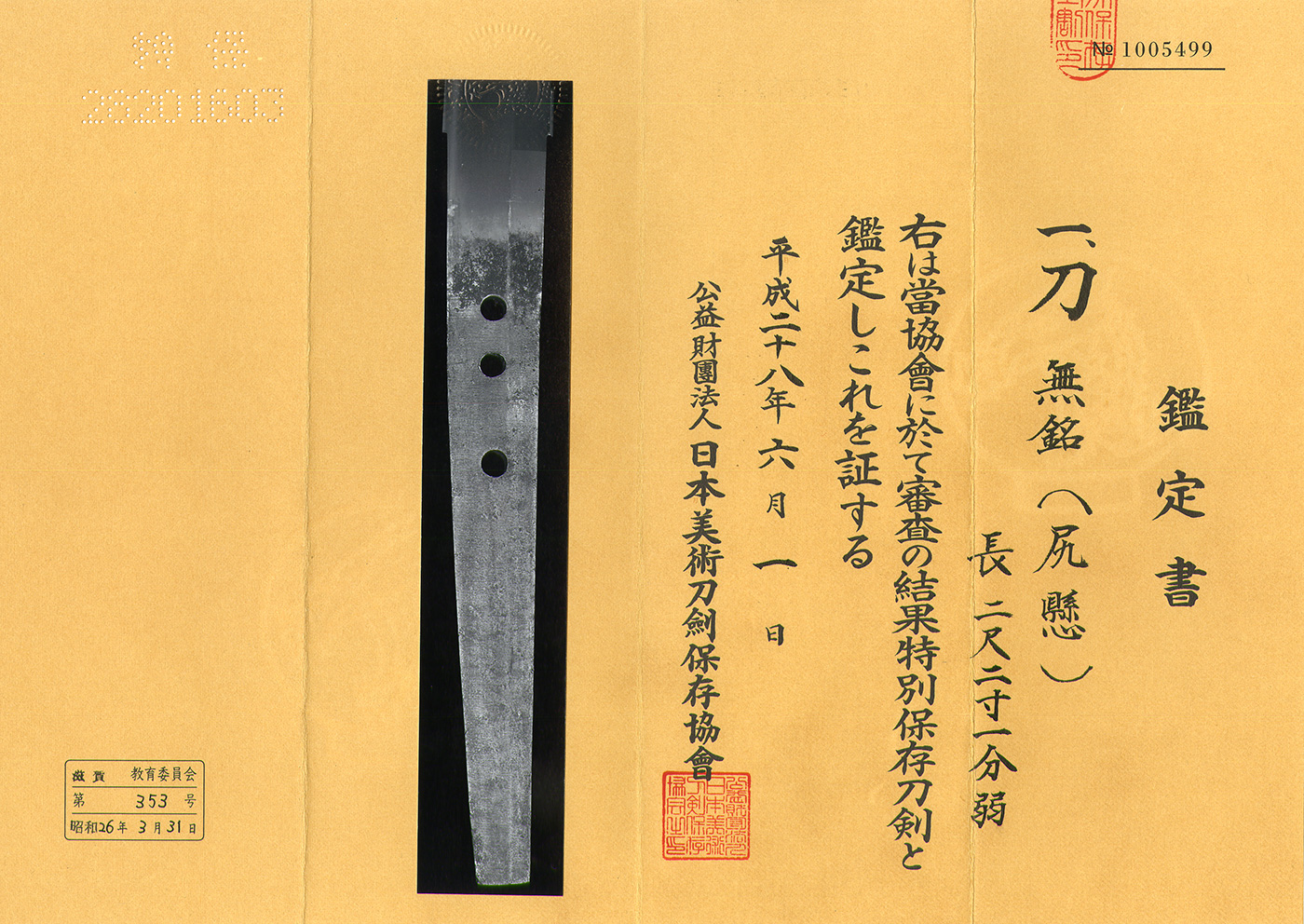
Ordering Number: AS26359Katana in Koshirae (NBTHK Tokubetsu Hozon Token)Signature: Mumei (Shikkake)無銘(尻懸)(We divide 4 sections for each sword as Saijyo Saku, Jyojyo Saku, Jyo Saku and Regular Saku).This blade is ranked as Jyojyo Saku among Mumei Suriage Shikkake works.Habaki: Single silver habaki.Blade Length: 66.7 cm (26.26 in) (2 shaku 2 sun).Curvature: 1.5 cm (0.59 in) (5 bu).Mekugi Hole: 3.Width at Base (Motohaba): 3.07 cm (1.21 in).Width at Yokote: 2.05 cm (0.81 in).Thickness of rim (Kasane): 0.71 cm (0.28 in).Sword Weight: 715 g.Era: Kamakura period, around Bunpo (1317).Shape: An o-suriage mumei katana with normal curvature and a slightly elongated kissaki.Jigane: Well-forged ko-itame hada with active chikei and visible shirake-utsuri.Hamon: Nioi-deki suguha with nijuba. Bright ko-ashi are active, while yo work together with the soft double temper line. The boshi becomes slightly irregular before finishing with a hakikake tip.Features: The Shikkake School, one of the five major Yamato traditions, flourished under Norinaga, who is regarded as its effective founder. Existing tanto signed by Norinaga and inscribed with his age—48 in Bunpo 3 (1319) and 69 in Ryakuo 3 (1340)—indicate that he was born in Bun'ei 7 (1270). Later generations also inherited the same name during the Muromachi period. The characteristic workmanship of the Shikkake School includes a high shinogi, broad mihaba, flowing itame hada, and a suguha-based hamon, all representative of the Yamato tradition. Distinctively, however, the hamon often incorporates conspicuous ko-gunome, giving the school its own unique identity. Although this blade has been o-suriage and additional mekugi-ana have been made over time, the machi-okuri and overall proportions indicate that it was originally forged as a tachi. Its broad construction, high shinogi, flowing itame hada, and suguha mixed with ko-gunome clearly justify its attribution to the Shikkake School.Koshirae:Tsuba: Vertically oval tsuba carved with wave
NihontoWatchOffered by Aoi Art





Yamato-den · Yamato
11 pieces on the market now
The Shikkake school (尻懸派) stands among the five great Yamato traditions (Yamato goha) that flourished in the shadow of Nara's powerful temples during the late Kamakura period. While traditionally attributed to Norihiro as founder, Norinaga (則長) is regarded as the de facto progenitor, documented through extant tantō bearing inscriptions of his age: forty-eight in Bunpō 3 (1319) and sixty-nine in Ryakuō 3 (1340). These datings place his birth in Bun'ei 9 (1272), establishing him as a contemporary of the school's early development. Works attributed to later generations extend into the Muromachi period, indicating successive transmission of the name across multiple generations. Given the concentration of sōhei (warrior monks) in Yamato Province, it is natural that Shikkake smiths produced numerous naginata, with more surviving examples attributed to this school than any other Yamato tradition. Shikkake workmanship shares the fundamental Yamato vocabulary: construction with high shinogi and conspicuously wide shinogi-ji; forging in itame that characteristically flows, often incorporating mokume and nagare-hada with areas trending toward masame near the edge; and steel exhibiting thickly adhering ji-nie with frequent, stout chikei and occasional nie-utsuri. The tempering centers on suguha-based patterns, yet the school's signature lies in its treatment of the hamon: while maintaining the suguha foundation, Shikkake smiths tempered small gunome in connected succession (ko-gunome-tsure), creating a gently undulating effect. Along the habuchi appear characteristic Yamato activities—hotsure, nijūba, kuichigai-ba, uchi-noke, and yubashiri—with well-adhering ko-nie producing a bright, clear nioiguchi interwoven with kinsuji and sunagashi.
The bōshi typically runs straight with vigorous hakikake, often tending toward yakizume or taking on a flame-like (kaen) character at the point. While some examples execute pure suguha patterns, the intermixing of running ko-gunome within the ha remains the critical diagnostic feature distinguishing Shikkake from other Yamato schools[[c:1]], particularly Taima, with which it shares close affinities. The school's legacy endures through works of exceptional quality and preservation. Surviving naginata of grand scale—some exceeding 2 shaku 7 sun—demonstrate Nanbokuchō-period construction with characteristic shallow flaring and deep curvature, often transmitted in rare ubu-nakago condition. Shortened katana attributed to the school display vigorous forging in which flowing grain and chikei interweave, producing steel of remarkable clarity (saeru), while the tempering exhibits thickly adhering, strongly luminous nie creating bright visual effects. The consistent appearance of well-refined jigane with dense ko-itame and abundant ji-nie, paired with distinctive tempering patterns that balance fundamental suguha with running ko-gunome, establishes Shikkake as a school whose characteristic features remain unmistakable across centuries of production. Works attributed to this tradition regularly survive in kenzen (sound and well-preserved) condition, testimony to both original forging quality and careful transmission through successive generations. Learn more →
| Smith | Era | Designated |
|---|---|---|
| Norinaga則長 | 1317-1319 | 43 |
| Norinari則成 | 1312-1317 | 0 |
| Nagamitsu長光 | 1233-1234 | 0 |
| Sukehiro助弘 | 1308-1311 | 0 |
| Norisada則貞 | 1428-1429 | 0 |
Yamato in the Kamakura period
The Yamato schools grew up in the shadow of Nara’s great monasteries: Tegai took its name from a gate of Tōdaiji. Their austere masame and quiet suguha are a temple aesthetic, prized ever since for exactly that restraint.
A Hozon-certified blade judged to show notably superior workmanship and a better state of preservation. The bar is higher: re-tempered blades and most unsigned Muromachi/Edo works are excluded.
The NBTHK (Nihon Bijutsu Tōken Hozon Kyōkai, the Society for the Preservation of Japanese Art Swords) is a public-interest incorporated foundation founded in 1948 and supervised by Japan’s Agency for Cultural Affairs (Bunkachō); it is based at the Japanese Sword Museum in Tokyo. Its expert panels physically examine each submitted work (shinsa) and issue a certificate (kanteishō) ranking it by artistic and historical merit. NBTHK papers are the most widely recognized standard of authentication for Japanese swords and fittings.
NBTHK official siteIf you wish to return an item, please notify us within 3 days of receipt. After this period we cannot accept cancellations. Please ship the return to us within 5 business days. Cancellation is conditional on the item being kept in the same condition as at the time of sale, so please handle it with care.