The Yamato schools grew up in the shadow of Nara’s great monasteries: Tegai took its name from a gate of Tōdaiji. Their austere masame and quiet suguha are a temple aesthetic, prized ever since for exactly that restraint.
 NihontoWatchNihontoWatch
The Shikkake school, one of the five traditions of Yamato-den, was active from the late Kamakura to the early Nanbokuchô period. Based in the Shikkake area behind Tôdai-ji Temple in Nara, the school was part of a group of temple-affiliated smiths who produced robust swords primarily for temple use rather than commercial distribution. The school’s founder is traditionally said to be Norihiro (則弘), though no signed works by him are known to exist. His son Norinaga (則長) is regarded as the de facto originator of the Shikkake lineage. These smiths are identifiable not by signatures – most of their extant blades are unsigned – but by their distinctive workmanship. This katana is an unsigned, ô-suriage blade that retains a clean, graceful silhouette suggestive of its original long length. The jihada is a glorious example of textbook shikkake-hada, combining primarily mokume-hada in the body of the sword with clear straight-lined masame-hada running through the yakiba – especially prominent in the kissaki. This dual-grain forging pattern is the defining characteristic of the school: masame in the hardened area, mokume closer to the shinogi ridge line. Vivid chikei runs throughout. The hamon is bright ko-gunome interwoven with ashi, sunagashi, kinsuji, and tobiyaki. A wide bôhi runs the length of the blade. This is classic Yamato-den workmanship of the kotô period, where the small details carry big impact. The sword was rightfully awarded a Tokubetsu Hozon certificate from the NBTHK. The accompanying koshirae has been dated to the Meiji period (1876–1912) and centres around a gorgeous saya featuring luxurious mokume-style black and gold lacquerwork – swirling cycles that echo the jihada of the sword and suggest reincarnation, a fitting design for a blade from smiths who worked for temples. The signed tsuba by Nakai Tomonori (中井友則) is in the form of a lotus flower, executed in masterful openwork with the hitsu-ana seamlessly integrated into the leaf design. Originally adorned with extensive gold inlay, only traces remain – a quiet elegance that evokes the impermanence of all things. The fuchi is attributed to the Kusakari school (草刈) of Sendai, known for fine linear hira-zôgan inlay work: the motif combines two interlocking circles – the wachigai-mon – paired with pine needles, a symbol seen as far back as the Heian period representing the interlocking realms of wisdom and reason. The kashira features a dynamic wave design with subtle gold touches that harmonises with the lacquered saya. Powerful gold unryû (cloud dragon) menuki embody both ferocity and protection – qualities revered by samurai warriors throughout history. The tsuka is wrapped in black silk over black-lacquered samekawa, with a waxy patina developed through years of natural use by its former owner – possibly a former iaido practitioner.
Offered by Unique Japan
This piece has sold
10 on the market
Get an email when new Shikkake School work hits the market.
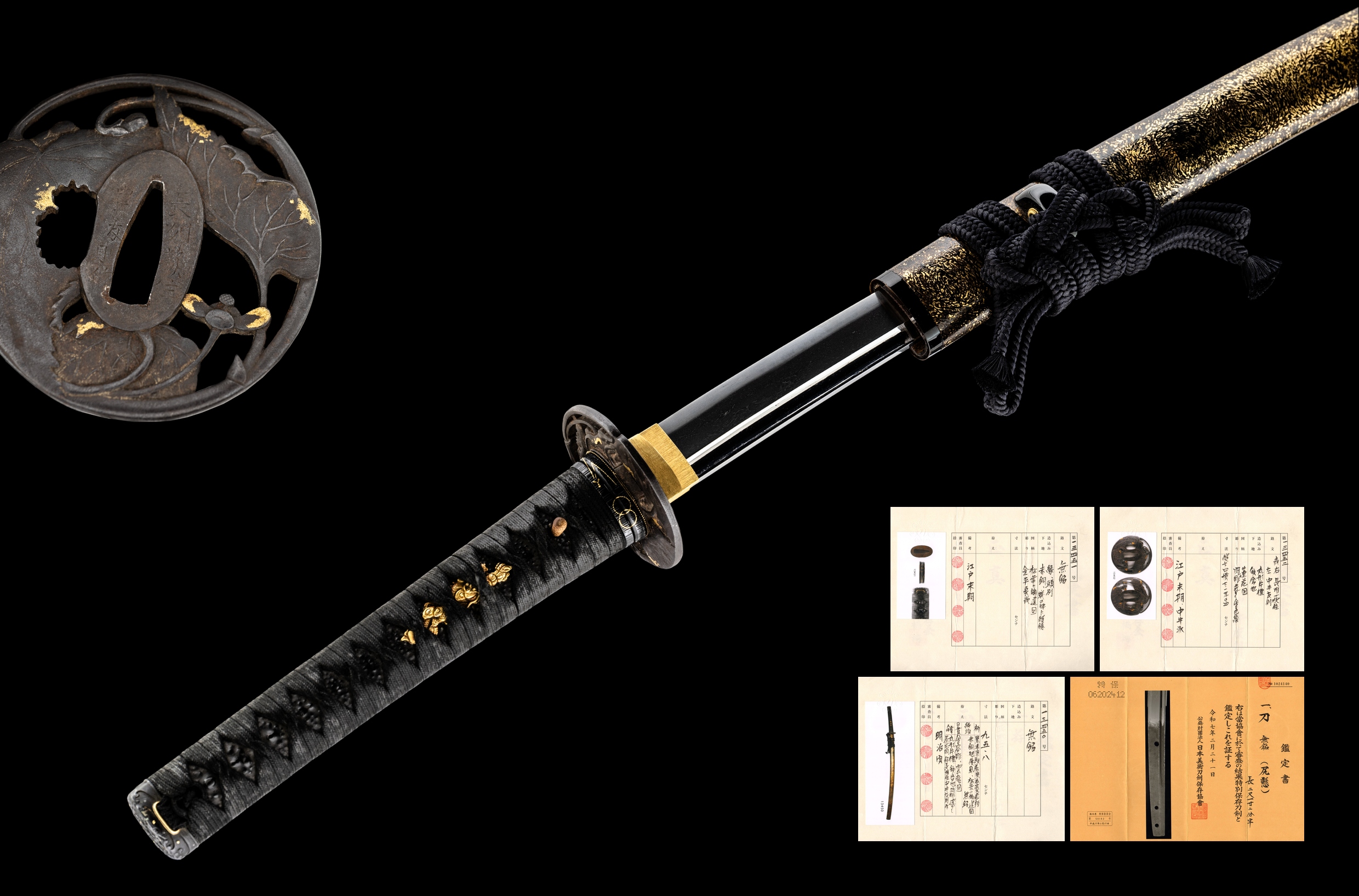
As written by the shop
Yamato-den · Yamato
10 pieces on the market now
The Shikkake school (尻懸派) stands among the five great Yamato traditions (Yamato goha) that flourished in the shadow of Nara's powerful temples during the late Kamakura period. While traditionally attributed to Norihiro as founder, Norinaga (則長) is regarded as the de facto progenitor, documented through extant tantō bearing inscriptions of his age: forty-eight in Bunpō 3 (1319) and sixty-nine in Ryakuō 3 (1340). These datings place his birth in Bun'ei 9 (1272), establishing him as a contemporary of the school's early development. Works attributed to later generations extend into the Muromachi period, indicating successive transmission of the name across multiple generations. Given the concentration of sōhei (warrior monks) in Yamato Province, it is natural that Shikkake smiths produced numerous naginata, with more surviving examples attributed to this school than any other Yamato tradition. Shikkake workmanship shares the fundamental Yamato vocabulary: construction with high shinogi and conspicuously wide shinogi-ji; forging in itame that characteristically flows, often incorporating mokume and nagare-hada with areas trending toward masame near the edge; and steel exhibiting thickly adhering ji-nie with frequent, stout chikei and occasional nie-utsuri. The tempering centers on suguha-based patterns, yet the school's signature lies in its treatment of the hamon: while maintaining the suguha foundation, Shikkake smiths tempered small gunome in connected succession (ko-gunome-tsure), creating a gently undulating effect. Along the habuchi appear characteristic Yamato activities—hotsure, nijūba, kuichigai-ba, uchi-noke, and yubashiri—with well-adhering ko-nie producing a bright, clear nioiguchi interwoven with kinsuji and sunagashi.
The bōshi typically runs straight with vigorous hakikake, often tending toward yakizume or taking on a flame-like (kaen) character at the point. While some examples execute pure suguha patterns, the intermixing of running ko-gunome within the ha remains the critical diagnostic feature distinguishing Shikkake from other Yamato schools[[c:1]], particularly Taima, with which it shares close affinities. The school's legacy endures through works of exceptional quality and preservation. Surviving naginata of grand scale—some exceeding 2 shaku 7 sun—demonstrate Nanbokuchō-period construction with characteristic shallow flaring and deep curvature, often transmitted in rare ubu-nakago condition. Shortened katana attributed to the school display vigorous forging in which flowing grain and chikei interweave, producing steel of remarkable clarity (saeru), while the tempering exhibits thickly adhering, strongly luminous nie creating bright visual effects. The consistent appearance of well-refined jigane with dense ko-itame and abundant ji-nie, paired with distinctive tempering patterns that balance fundamental suguha with running ko-gunome, establishes Shikkake as a school whose characteristic features remain unmistakable across centuries of production. Works attributed to this tradition regularly survive in kenzen (sound and well-preserved) condition, testimony to both original forging quality and careful transmission through successive generations. Learn more →
| Smith | Era | Designated |
|---|---|---|
| Norinaga則長 | 1317-1319 | 43 |
| Norinari則成 | 1312-1317 | 0 |
| Nagamitsu長光 | 1233-1234 | 0 |
| Sukehiro助弘 | 1308-1311 | 0 |
| Norisada則貞 | 1428-1429 | 0 |
Yamato in the Kamakura period
The Yamato schools grew up in the shadow of Nara’s great monasteries: Tegai took its name from a gate of Tōdaiji. Their austere masame and quiet suguha are a temple aesthetic, prized ever since for exactly that restraint.
A Hozon-certified blade judged to show notably superior workmanship and a better state of preservation. The bar is higher: re-tempered blades and most unsigned Muromachi/Edo works are excluded.
The NBTHK (Nihon Bijutsu Tōken Hozon Kyōkai, the Society for the Preservation of Japanese Art Swords) is a public-interest incorporated foundation founded in 1948 and supervised by Japan’s Agency for Cultural Affairs (Bunkachō); it is based at the Japanese Sword Museum in Tokyo. Its expert panels physically examine each submitted work (shinsa) and issue a certificate (kanteishō) ranking it by artistic and historical merit. NBTHK papers are the most widely recognized standard of authentication for Japanese swords and fittings.
NBTHK official siteAll swords come with a three-day inspection period beginning from the date of delivery. If not satisfied, the sword may be returned within this period for a full refund of the purchase price. Outside of this period, all sales are final. Swords purchased on a layaway payment plan are not eligible for the three-day inspection period.