Aizu 11th generation Kanesada was born in Tenpo 8 in the Aizu-Wakamatsu castle town as the son of the 10th generation. He learned sword forging from his father and entered the service of the Aizu clan in Kaei 5 at the age of sixteen, initially using the mei "Kanemoto," and from Kaei 7 at the age of eighteen, he also performed daisaku daimei for his father. In Bunkyo 3, 4th month, he went to the capital by order of the daimyo Matsudaira Katamori to guard the Kyoto Imperial Palace, and in the 12th month of the same year, he received the title "Izumi no Kami" and simultaneously changed his mei to "Kanesada"; works produced from then until his return to Aizu in Genji 2, 2nd month, are called "Rakuyo (Kyo) uchi." In Keio 1, 8th month, he succeeded as head of the family, and in Meiji 2, 9th month, after his father passed away, he moved to Kamo in Echigo Province by clan order, forging swords there for five years until Meiji 7, 9th month. These are called "Kamo uchi." He died in Meiji 36 at the age of sixty-seven. His forging locations included Aizu, Kyo, Echigo, and in his final years he also forged in Tokyo, but works from Kyo and Tokyo are rarely seen.
His style includes those with finely packed ko-itame, muji-fu, hadamono with undulating itame, and masame kitae, while the hamon is diverse, ranging from suguha, notare, midare, and sanbonsugi-style gunome. Regarding the tsukurikomi, grand and imposing works are rare, and many examples with a jinjo sugata are seen.
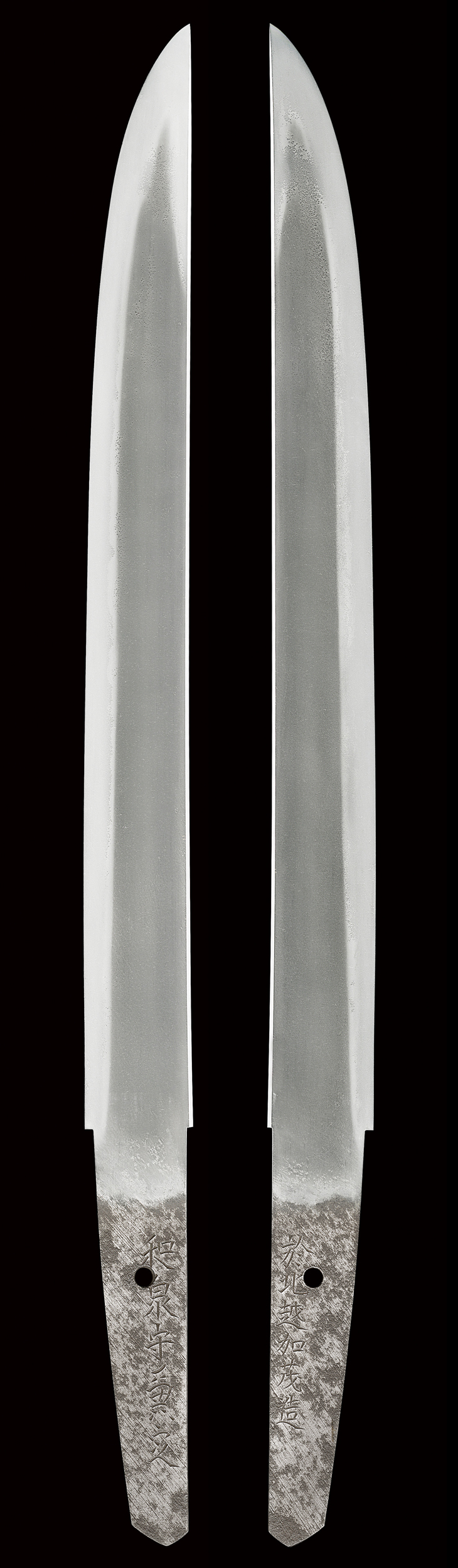
This work, as can be understood from the inscription "Oite Hokuetsu Kamo zo," is a so-called "Kamo uchi," and although it has no nenkio, it is appraised as a work from around Meiji 6 based on the somewhat thin tagane of the mei.
With a nagasa of 9 sun 5 bu and a firm mihaba, it is a large-sized tanto; while this magazine has featured several Kamo uchi tanto before, they are at most around 8 sun 5 bu even when long, so this is precious.
The sugu-notare-style ha has nijuba, kinsuji, and sunagashi appearing frequently, and with yubashiri appearing violently near the kissaki, the activities of the nie are magnificent.
Although there are places where the ji is slightly rough, this dimension in a Kamo uchi tanto cannot be overlooked. This is the Aizu 11th generation Kanesada, famous as the favorite sword of the Shinsengumi's "Demon Vice-Commander," Hijikata Toshizo.
Machine translation from the shop's Japanese · may contain errors ·
Aizu 11th generation Kanesada was born in Tenpo 8 in the Aizu-Wakamatsu castle town as the son of the 10th generation. He learned sword forging from his father and entered the service of the Aizu clan in Kaei 5 at the age of sixteen, initially using the mei "Kanemoto," and from Kaei 7 at the age of eighteen, he also performed daisaku daimei for his father. In Bunkyo 3, 4th month, he went to the capital by order of the daimyo Matsudaira Katamori to guard the Kyoto Imperial Palace, and in the 12th month of the same year, he received the title "Izumi no Kami" and simultaneously changed his mei to "Kanesada"; works produced from then until his return to Aizu in Genji 2, 2nd month, are called "Rakuyo (Kyo) uchi." In Keio 1, 8th month, he succeeded as head of the family, and in Meiji 2, 9th month, after his father passed away, he moved to Kamo in Echigo Province by clan order, forging swords there for five years until Meiji 7, 9th month. These are called "Kamo uchi." He died in Meiji 36 at the age of sixty-seven. His forging locations included Aizu, Kyo, Echigo, and in his final years he also forged in Tokyo, but works from Kyo and Tokyo are rarely seen.
His style includes those with finely packed ko-itame, muji-fu, hadamono with undulating itame, and masame kitae, while the hamon is diverse, ranging from suguha, notare, midare, and sanbonsugi-style gunome. Regarding the tsukurikomi, grand and imposing works are rare, and many examples with a jinjo sugata are seen.
This work, as can be understood from the inscription "Oite Hokuetsu Kamo zo," is a so-called "Kamo uchi," and although it has no nenkio, it is appraised as a work from around Meiji 6 based on the somewhat thin tagane of the mei.
With a nagasa of 9 sun 5 bu and a firm mihaba, it is a large-sized tanto; while this magazine has featured several Kamo uchi tanto before, they are at most around 8 sun 5 bu even when long, so this is precious.
The sugu-notare-style ha has nijuba, kinsuji, and sunagashi appearing frequently, and with yubashiri appearing violently near the kissaki, the activities of the nie are magnificent.
Although there are places where the ji is slightly rough, this dimension in a Kamo uchi tanto cannot be overlooked. This is the Aizu 11th generation Kanesada, famous as the favorite sword of the Shinsengumi's "Demon Vice-Commander," Hijikata Toshizo.
The Haitōrei edict of 1876 ended sword wearing and nearly ended the craft itself. Military demand and imperial patronage kept a remnant alive, and in 1906 Gassan Sadakazu and Miyamoto Kanenori were named Artists to the Imperial Household.
A Hozon-certified blade judged to show notably superior workmanship and a better state of preservation. The bar is higher: re-tempered blades and most unsigned Muromachi/Edo works are excluded.
About the NBTHK›
The NBTHK (Nihon Bijutsu Tōken Hozon Kyōkai, the Society for the Preservation of Japanese Art Swords) is a public-interest incorporated foundation founded in 1948 and supervised by Japan’s Agency for Cultural Affairs (Bunkachō); it is based at the Japanese Sword Museum in Tokyo. Its expert panels physically examine each submitted work (shinsa) and issue a certificate (kanteishō) ranking it by artistic and historical merit. NBTHK papers are the most widely recognized standard of authentication for Japanese swords and fittings.
For one-of-a-kind items such as swords, sword fittings and antiques, other customers may be waiting for the item, so please contact us about a return within 3 days of its arrival and ship it back within 8 days. Refunds are made on the day the returned item arrives.

 NihontoWatch