Around 1800 Suishinshi Masahide argued in his writings that the craft must return to the old masters’ methods: the fukkotō revival. His greatest successor Naotane worked convincingly in Bizen and Sōshū manners that had been dead for centuries.
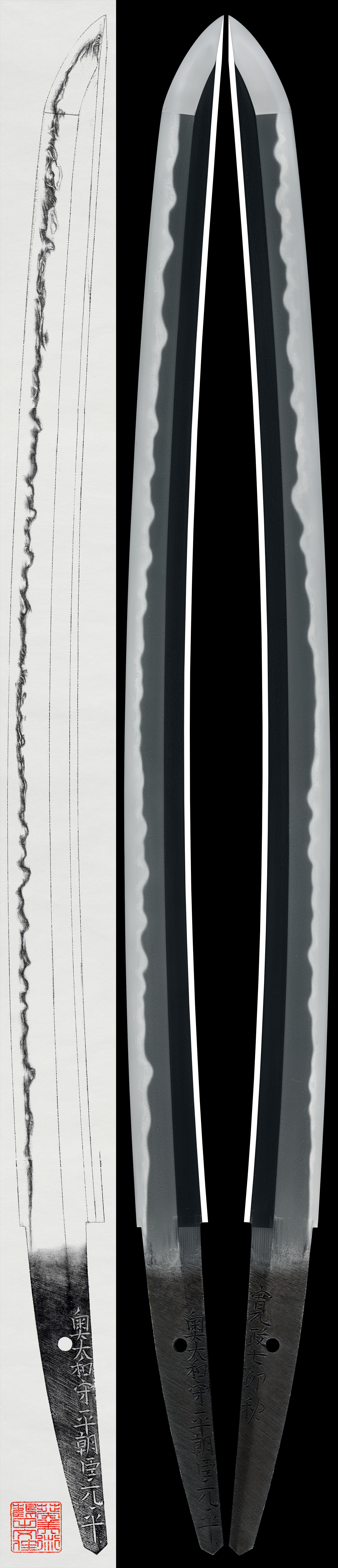
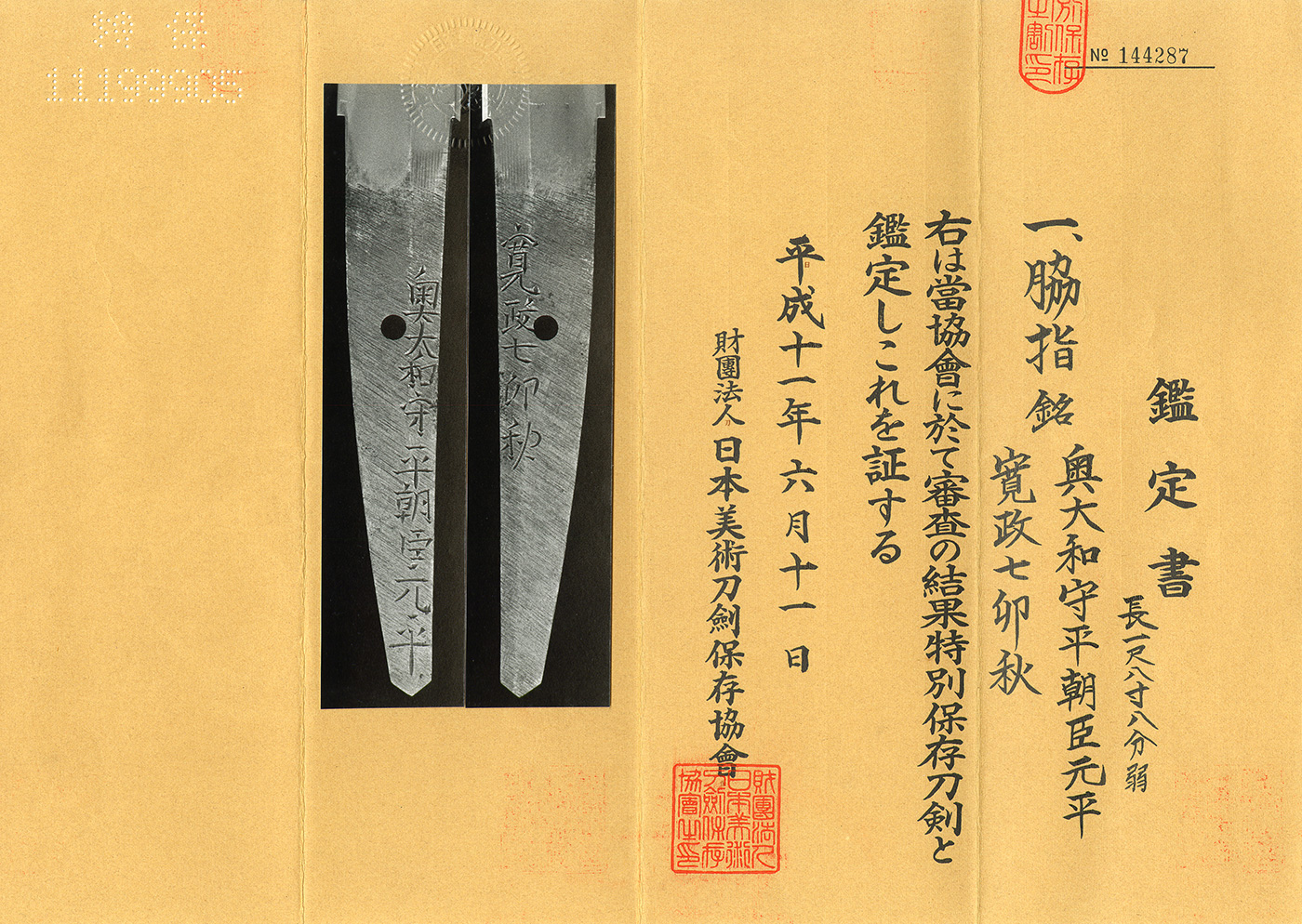
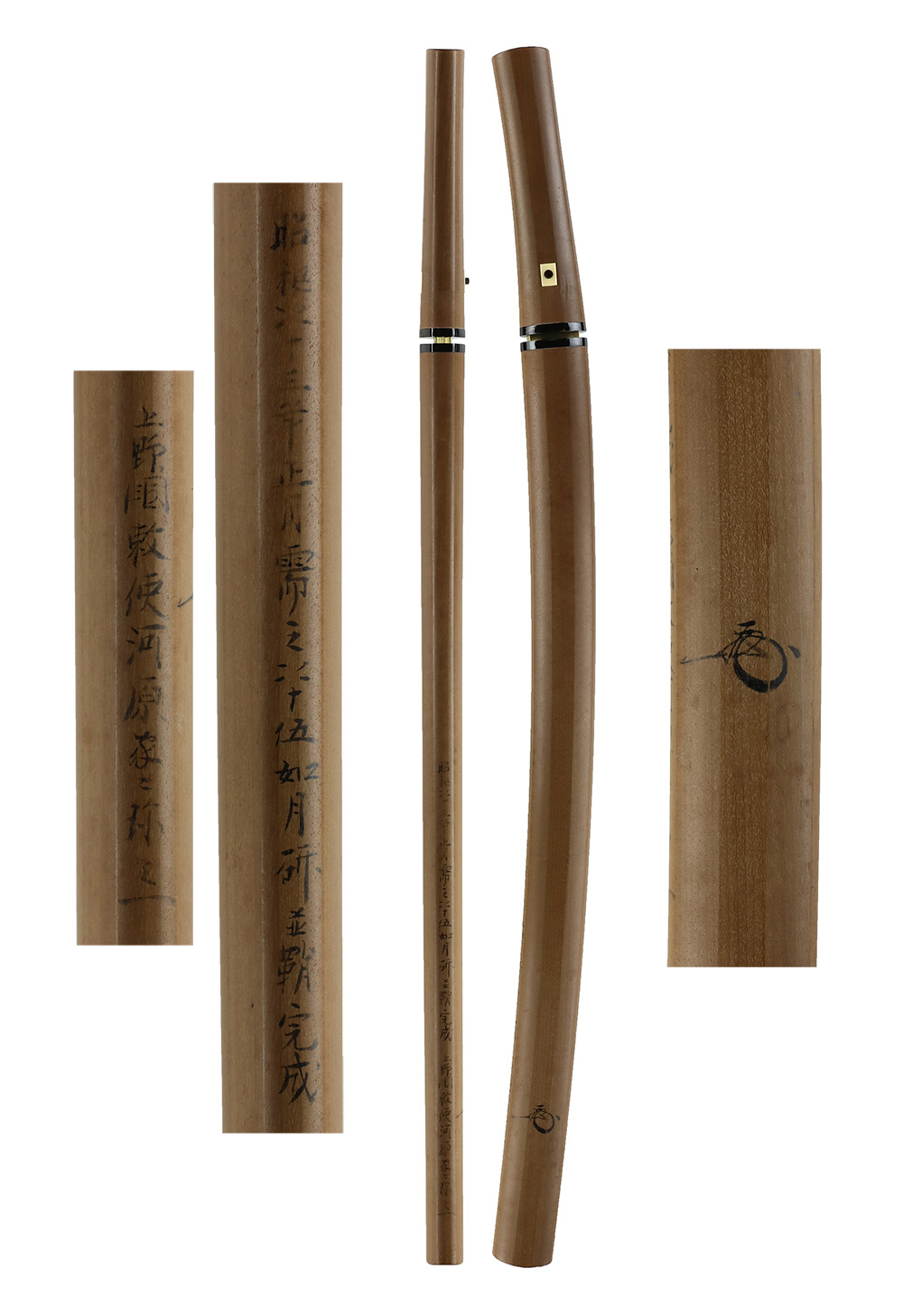
Wakizashi in Shirasaya (NBTHK Tokubetsu Hozon Token) (We divide 4 sections for each sword as Saijyo Saku, Jyojyo Saku, Jyo Saku and Regular Saku). This blade is ranked as Jyojyo Saku among the works of Oku Yamato no Kami Taira Ason Motohira. Shape: A robust wakizashi with substantial mihaba and thick kasane. It has relatively deep curvature and an elongated kissaki, giving the blade an imposing appearance. Jigane: A slightly dark steel surface with active chikei. Sunagashi and kinsuji are visible within the hardened edge. Hamon: Nie-deki gunome-midare with a deep nioiguchi. Sunagashi and kinsuji are active throughout, and the boshi droops before returning in a rounded form. Features: The Shimazu family of Satsuma generously patronized many swordsmiths and produced outstanding masters, among whom Motohira was one of the finest. He was one of the leading swordsmiths of the early Shinshinto period in Satsuma. Born in Enkyo 1 (1744) as the son of the Satsuma domain swordsmith Oku Motonao, he succeeded to the family profession after his father's death in An'ei 6 (1777). He studied sword forging under his father, and in Tenmei 5 (1785) was permitted to sign his works "Satsuhan-shin Oku Motohira." In the 12th month of Kansei 1 (1789), he received the honorary title of Yamato no Kami at the same time as Hoki no Kami Masayuki, and from Kansei 2 (1790) onward he signed "Oku Yamato no Kami Taira Ason Motohira." He passed away in Bunsei 9 (1826) at the age of 83. This blade, dated Kansei 7 (1795), is an excellent example with a wide mihaba and thick kasane. Aoi Art’s Comment: Oku Yamato no Kami Taira Ason Motohira had the habit of dating many of his own works in order to discourage forgeries. He also intentionally cut one or two file marks on the final yasurime of the tang, and the last file mark is deliberately offset slightly from the pointed end of the nakago. If this characteristic offset is absent or executed differently, the signature is highly likely to be false. Please examine both sides of the tang carefully. The shinogi-ji consists of itame mixed with mokume and masame, with the masame not overly prominent, giving many of his works an appearance reminiscent of Soshu-den Koto blades. Moreover, this characteristic is not unique to Motohira; many Satsuma and Kyushu swords also exhibit a similar offset from the centerline of the tang, so careful examination is essential. Historical Background: During the Kansei era, Japan experienced repeated natural disasters and famines from the very beginning of the period. Even in Edo, shortages of rice caused widespread hardship among the people. NBTHK Tokubetsu Hozon Token.
Offered by Aoi Art
32 on the market


As written by the shop
Yamato-den · Satsuma
32 pieces on the market now
The Satsuma school gathered the smiths of southern Kyushu under the patronage of the Shimazu, the daimyo house of Satsuma and Osumi, and the published sources read its history in two distinct flowerings rather than one continuous line. Its shinto fountainhead is Izu no Kami Masafusa, a son of the Mino smith Ujifusa who moved to Kagoshima and carried a strongly nie-laden hand into the province; the NBTHK names him the origin of Satsuma forging. From that root the early school rose to its summit in the pair the judges return to whenever they place it, Mondo-no-Sho Masakiyo and Ippei Yasuyo, the twin pillars of Satsuma shinto. Both were summoned in Kyoho 6 (1721) by the eighth shogun Tokugawa Yoshimune to forge in Edo and were granted the single-leaf hollyhock crest of the Tokugawa for their tangs, and the Ippei line continued through Yasuyo's adopted heir Yasuari. A century later a second summit formed in the shinshinto twin pillars, Oku Yamato no Kami Motohira of the Oku house and Hoki no Kami Masayuki of the Ijichi house, raised to their court titles in the same year of Kansei 1 (1789); Masayuki's name had begun as Masayoshi, and his pupil Masakage carried the manner into the Bunka and Bunsei years. The training the members record runs back through the Naminohira and Yamato roots of the early Ippei smiths, but the working idiom the school is known by is its own. That idiom is a Soshu-den read in coarse nie rather than in clove-flower, and the members describe it in a shared vocabulary. The body is broad in mihaba, thick in kasane, full in hiraniku and stoutly built, the imposing Satsuma sugata. Over a well-forged itame, often a tight ko-itame turning toward nagare or masame and carrying thick ji-nie and dark chikei, the smiths temper a notare-toned gunome-midare into which they set pointed togariba, deep in nioi with thick nie and coarse ara-nie mixed through. The feature the commentary names most often is what streams within that temper, the long kinsuji, nie-suji and sunagashi the sources call imozuru, the yam-vine of the province, vine-like nie-lines running unbroken through the ha.
The jigane takes a markedly blackish cast against which the bright nioiguchi and coarse nie stand out, and the boshi runs in midare-komi or straight, swept with hakikake and on the most vigorous work flaring to a flame-like kaen. Within this one settled manner the members divide. Masakiyo handled the varied Shizu-style midare, his yubashiri gathering at the crests of the temper into a nijuba-like, antique appearance, where Yasuyo tempered a calmer notare-toned suguha whose strength lay in the depth of its nioi and the length of its imozuru; Motohira and Masayuki carried the flamboyant gunome with its kaen boshi into the later period, while a small number of blades lean toward masame and recall the Yamato Hosho grain that the early training laid down. To kantei Satsuma work, the judges read three grounded marks together: the pointed togariba riding a notare base, the deep coarse nie with its running imozuru, and the dark, chikei-laden standing jigane, completed by the swept hakikake or kaen boshi and the broad heavy body. The tang offers further constants, almost always ubu with a bold thick-chiseled signature that frequently carries the smith's age, Motohira's funagata-narrowed kengyo point and Masayuki's bo-hi among them. Among the members the standing is high: Masakiyo and Yasuyo hold the early summit, while Motohira and Masayuki lead the shinshinto generation, the latter's pupil Masakage judged to have inherited the master's hand with notable refinement. The cutting reputation of the province, tied to its Jigen-ryu martial tradition, runs through the bold robust construction the sources call decisive in the hand. The provenance is grand for a domain school: blades presented by the Shimazu house upward to the shogun Yoshimune and to Konoe Iehisa, Minister of the Left, who returned silver and poems to the smiths, with pieces descending through the Tokugawa, the Imperial family and Shimazu branch houses such as the Kabayama. Such blades are held in long-established collections rather than traded, and a signed Satsuma work in its full vigorous Soshu-den comes to a collector only with patience. Learn more →
| Smith | Era | Designated |
|---|---|---|
| Yasuyo安代 | 1716-1736 | 18 |
| Motohira元平 | 1778-1789 | 39 |
| Masayuki正幸 | 1772-1817 | 36 |
| Masakiyo正清 | 1714-1736 | 26 |
| Yasuari安在 | 1744-1748 | 4 |
The Shinshintō revival
Around 1800 Suishinshi Masahide argued in his writings that the craft must return to the old masters’ methods: the fukkotō revival. His greatest successor Naotane worked convincingly in Bizen and Sōshū manners that had been dead for centuries.
A Hozon-certified blade judged to show notably superior workmanship and a better state of preservation. The bar is higher: re-tempered blades and most unsigned Muromachi/Edo works are excluded.
The NBTHK (Nihon Bijutsu Tōken Hozon Kyōkai, the Society for the Preservation of Japanese Art Swords) is a public-interest incorporated foundation founded in 1948 and supervised by Japan’s Agency for Cultural Affairs (Bunkachō); it is based at the Japanese Sword Museum in Tokyo. Its expert panels physically examine each submitted work (shinsa) and issue a certificate (kanteishō) ranking it by artistic and historical merit. NBTHK papers are the most widely recognized standard of authentication for Japanese swords and fittings.
NBTHK official siteIf you wish to return an item, please notify us within 3 days of receipt. After this period we cannot accept cancellations. Please ship the return to us within 5 business days. Cancellation is conditional on the item being kept in the same condition as at the time of sale, so please handle it with care.
¥1,100,000