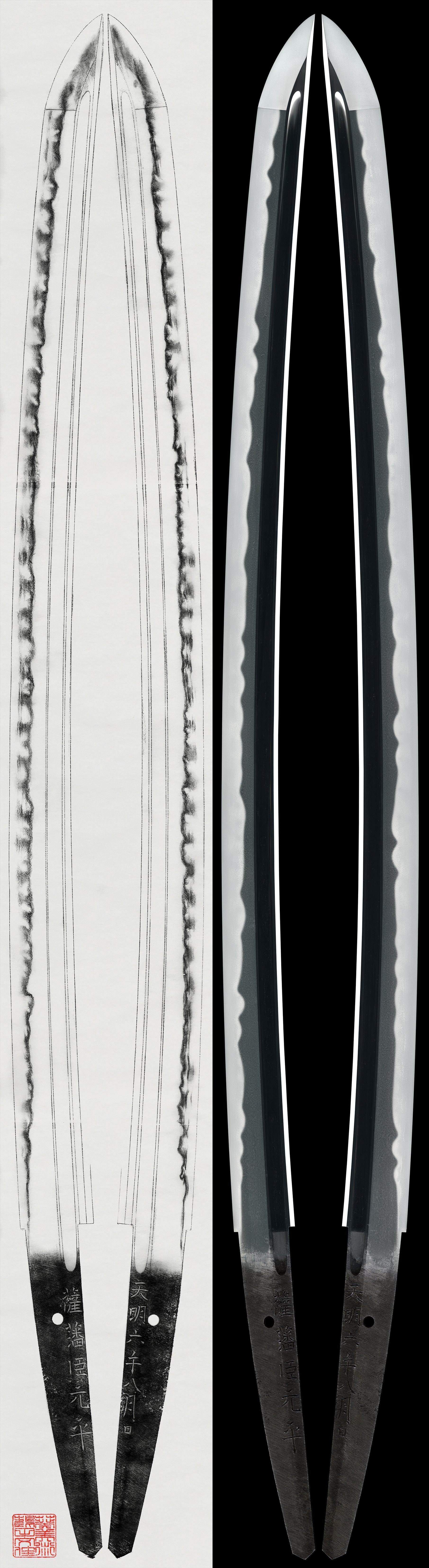
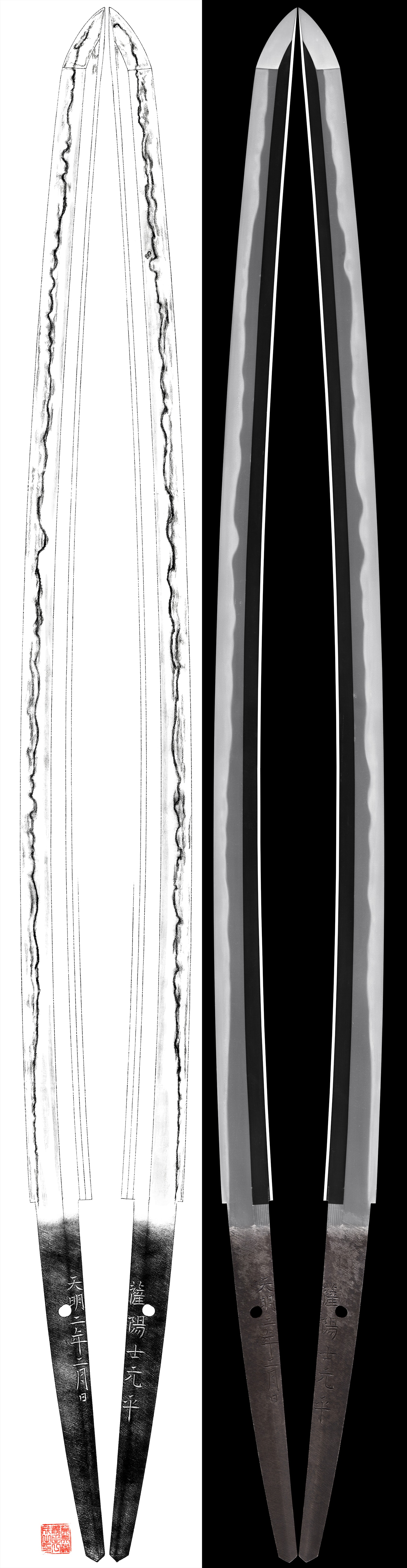
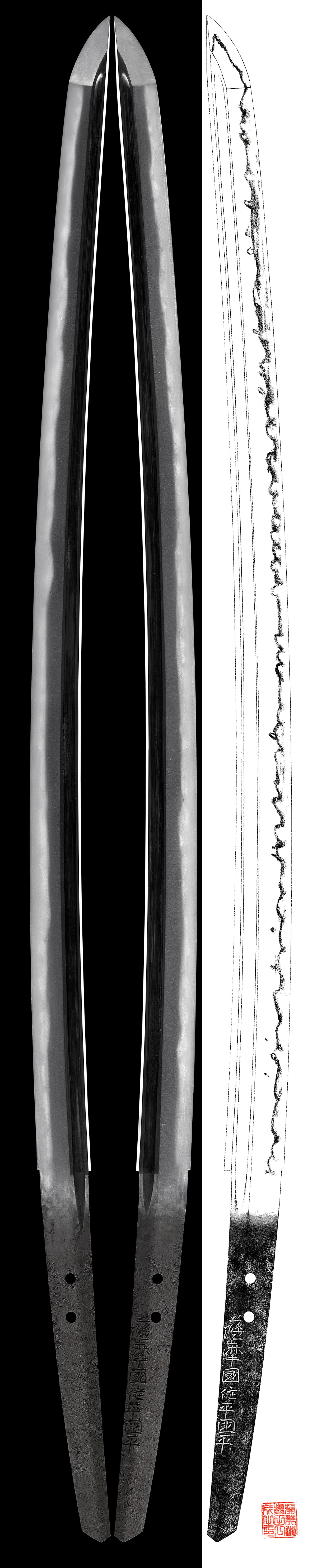
Ippei Yasuyo, common name Tamaoki Koichi, was the eldest son of the Satsuma smith Ippei Yasusada, born in Enpo 8 (1680). The published sources record that he learned forging first under his father and then under Yamato no Kami Yasukuni of the main Naminohira line, and that in the first month of Kyoho 6 (1721) he was summoned together with Masakiyo by the eighth shogun Tokugawa Yoshimune to forge swords in . In recognition of his skill the bakufu permitted him to cut the single-leaf hollyhock crest into his tang, and on his return journey the court appointed him Shume no . He died in Kyoho 13 (1728) at the age of forty-nine, so that the great part of his recorded work falls into the narrow span of years between the summons and that early death. The institutional verdict on him is consistent and almost formulaic across his designations: he and Masakiyo are 'the twin pillars of Satsuma '.
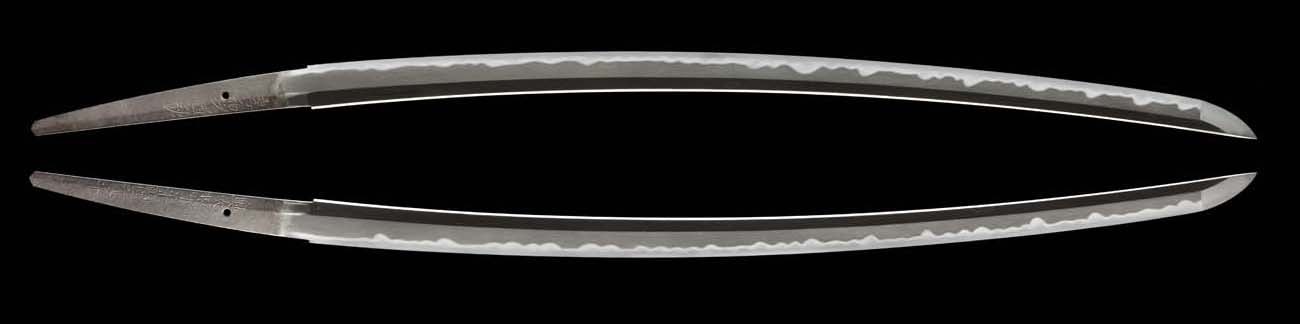
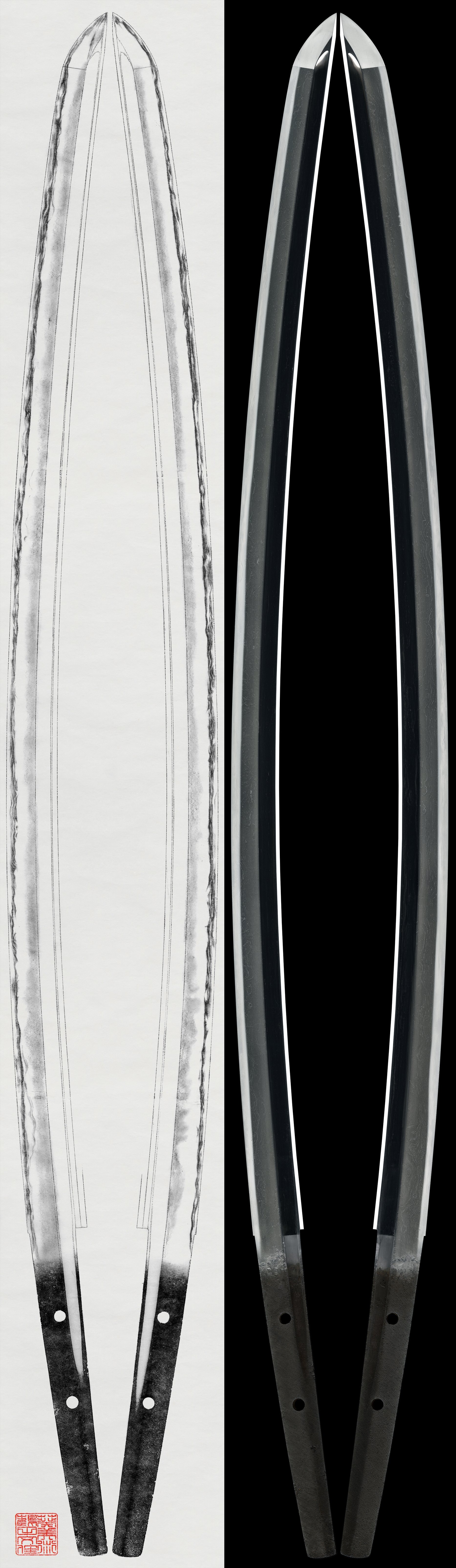
That pairing carries within it the contrast by which his hand is recognized. Where Masakiyo favored a varied, -like that mixes with and pointed , the published sources record that 'Yasuyo more often tempered a calm, -toned '. His characteristic temper is a , or a wide , that undulates in shallow , deep in , the laid on thick and strong with coarse mixed through it. The feature the judges return to is what runs inside that quiet line: vigorous together with long and , the streaming -lines the sources name 'the so-called imozuru of Satsuma', the yam-vine of the province. On his finest blades these run especially long and are called splendid, the activity in both and richer than usual.
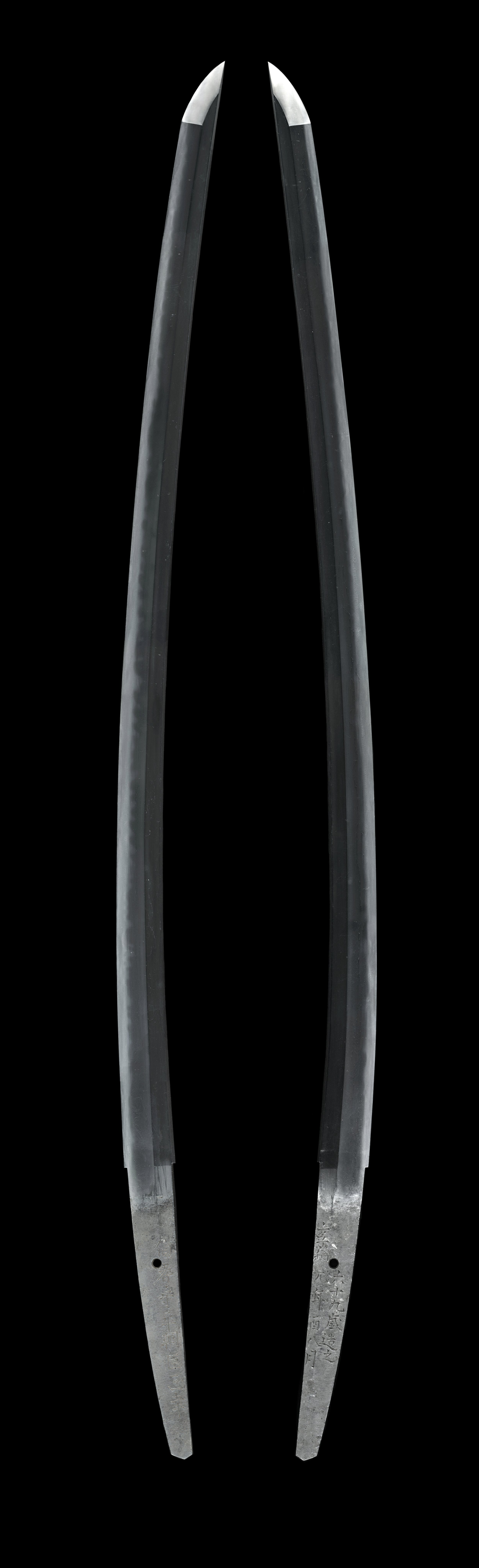
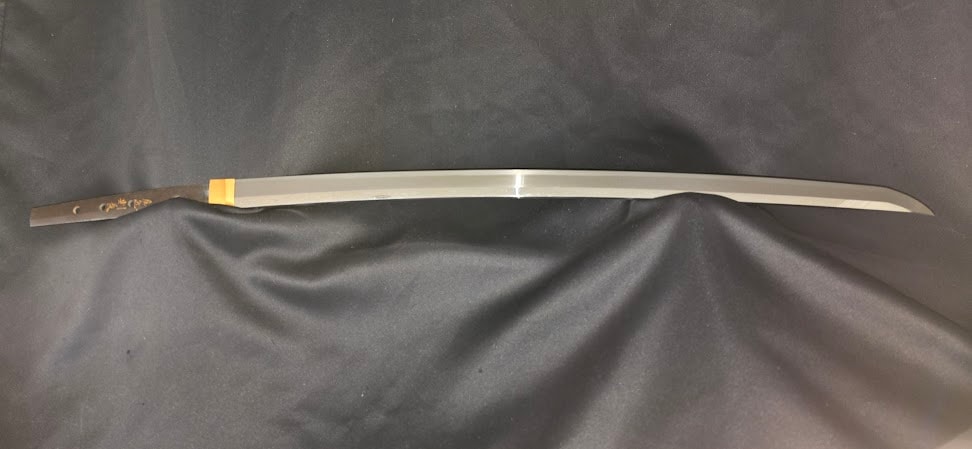
Beneath that temper the is a tightly packed , at times mixed with or flowing toward , with thick and entering, and a steel that takes on a markedly blackish tone. Against that dark the bright and coarse of the edge stand out, which is much of why a Yasuyo blade reads as it does. The is essentially straight and turns back in an or a , the point swept with , on the deeper-tempered pieces vigorous enough to take a flame-like cast. His is the other half of the impression: broad in the , thick in the with ample and a , heavy in the hand and frankly imposing, and almost always preserved with a deep , file marks and a long signature.
Within this one settled manner the published sources draw two finer registers. A small number of his blades lean toward , the flowing and the raised a little, and on one such the judges read the whole as 'workmanship that recalls the Yamato Hosho tradition' and name it a representative piece; the Naminohira and Yamato roots of his training surface there in the standing grain. At the other end of his career, an early cut with a four-character signature below the peg-hole is identified as a formative work, and the sources note that such early pieces are comparatively few and valuable for understanding how his style began. The continuity matters more than the divisions: the is constant, read once over a calm and once over a more standing, -tinged .
What sets him apart is exactly what the judges name, and it is best read through his own work rather than against his neighbor's. His is the quiet of the Satsuma pair, its strength carried not in the height of the temper but in the depth of its , the thickness of its , and the long imozuru threads that course through it; his is dark and well forged, his broad and robust. Of one the published commentary writes that it is 'his masterpiece, showing outstanding workmanship among his works', the kind of judgment the sources reserve for the pieces in which the deep , the thick and the running all come together on a grand, sound body.
For the collector Yasuyo is one of the most sought names in Satsuma , and his record is almost wholly a signed one, twenty of his designated blades carrying his own inscription. Fujishiro grades him Jo-jo . He has no National Treasures and no Important Cultural Properties; his standing rests instead on four pieces at the rank and thirteen at , with a further prewar Bijutsuhin, seventeen blades in the and tiers in all. The provenance is unusually grand for a smith: the sources record blades presented from the Shimazu house upward, one presented by Shimazu Tsugutoyo to the shogun Yoshimune, another 'presented by the Shimazu family to Konoe Sadaijin Iehisa', whose household prized it so highly that it sent Yasuyo silver and a set of poems in return. Imperial, Shimazu, Konoe and Tokugawa names run through his . Almost none of this trades; the designated blades are held in long-established collections, and a signed Ippei Yasuyo comes to a private collector only seldom, and as one of the more rewarding Satsuma encounters when it does.