NihontoWatch Mon

NihontoWatch

MarketAuctions
Encyclopedia
NihontoWatch Mon

NihontoWatch

MarketAuctions
Encyclopedia

Description

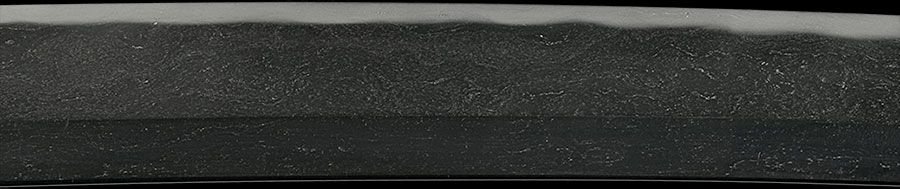
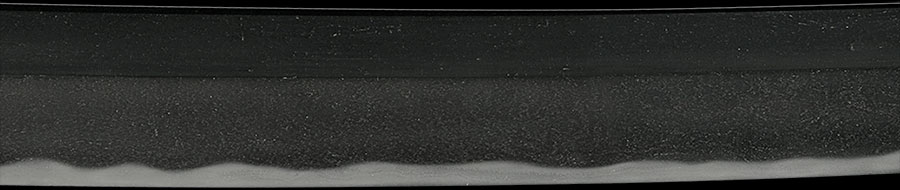
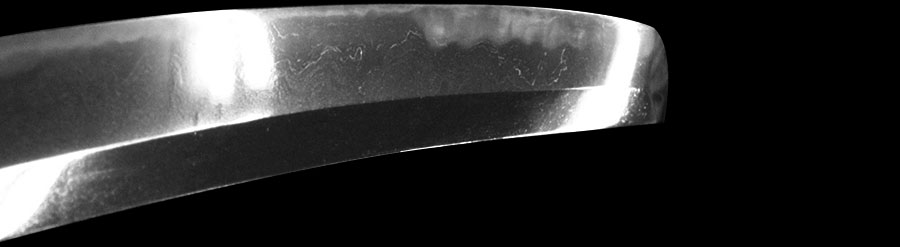
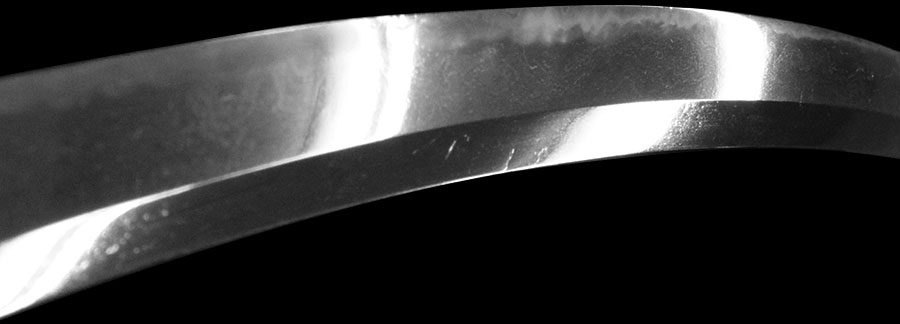
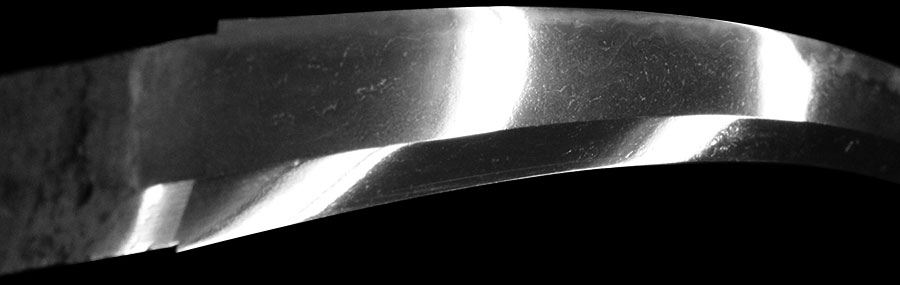
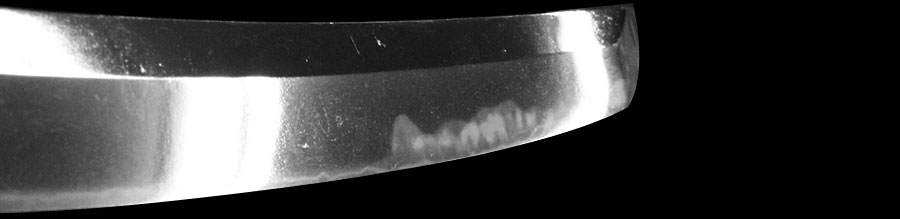
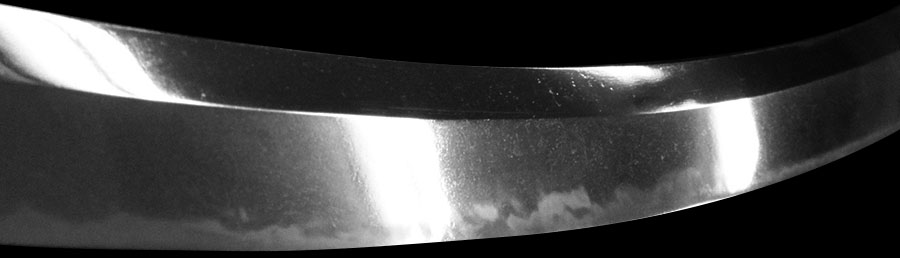
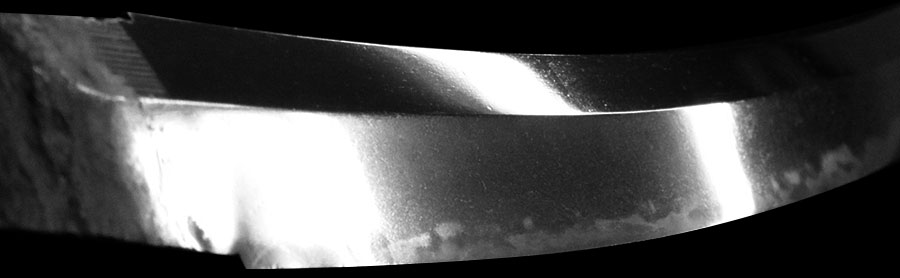
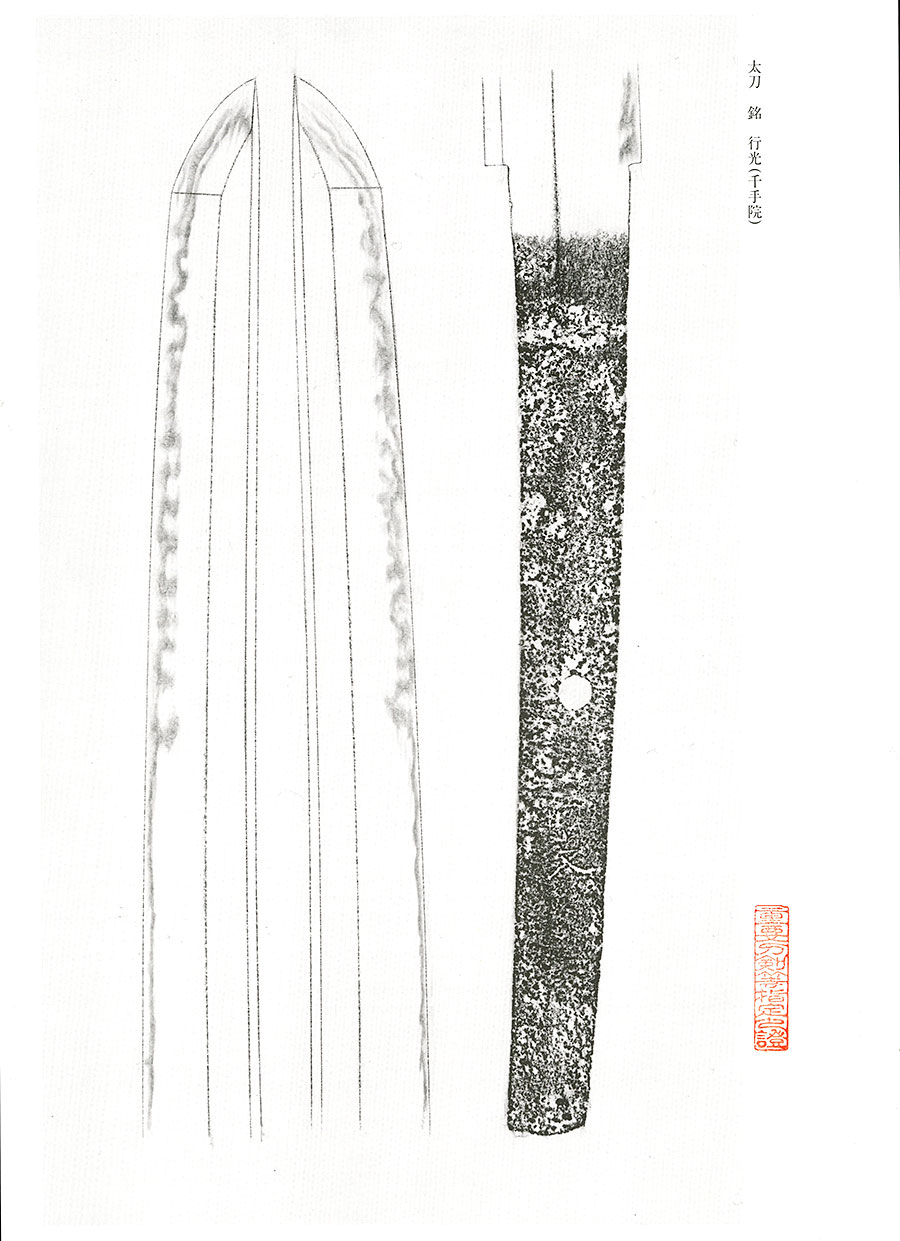
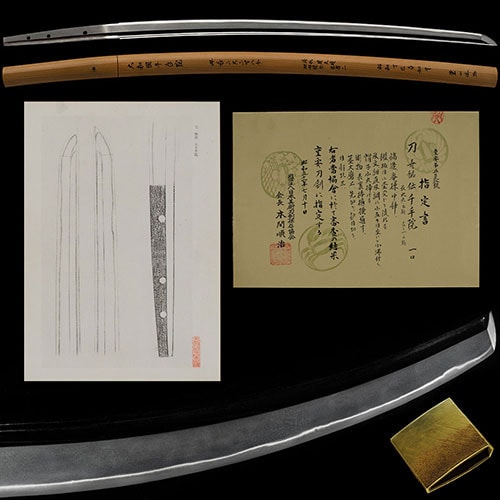
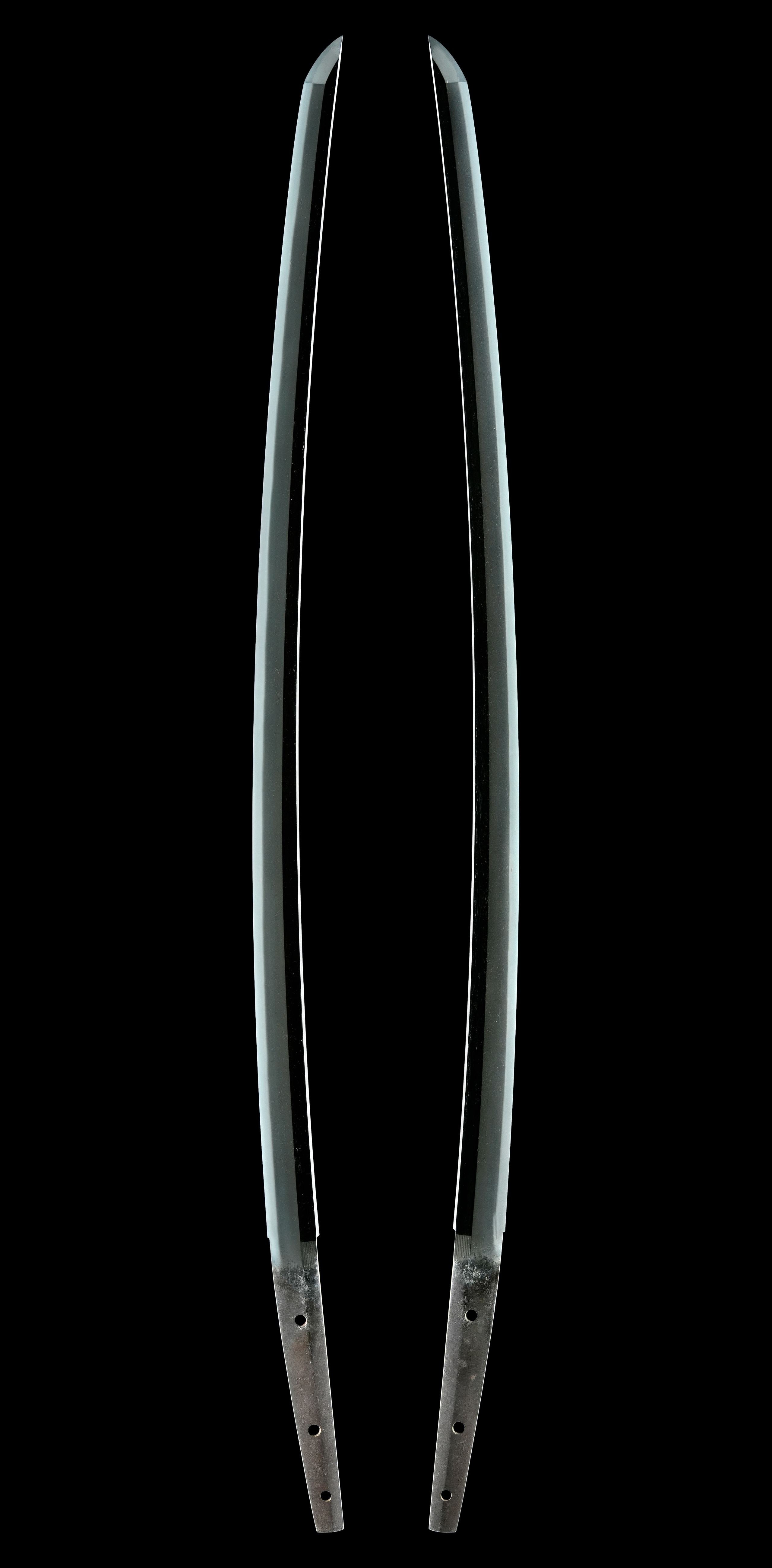
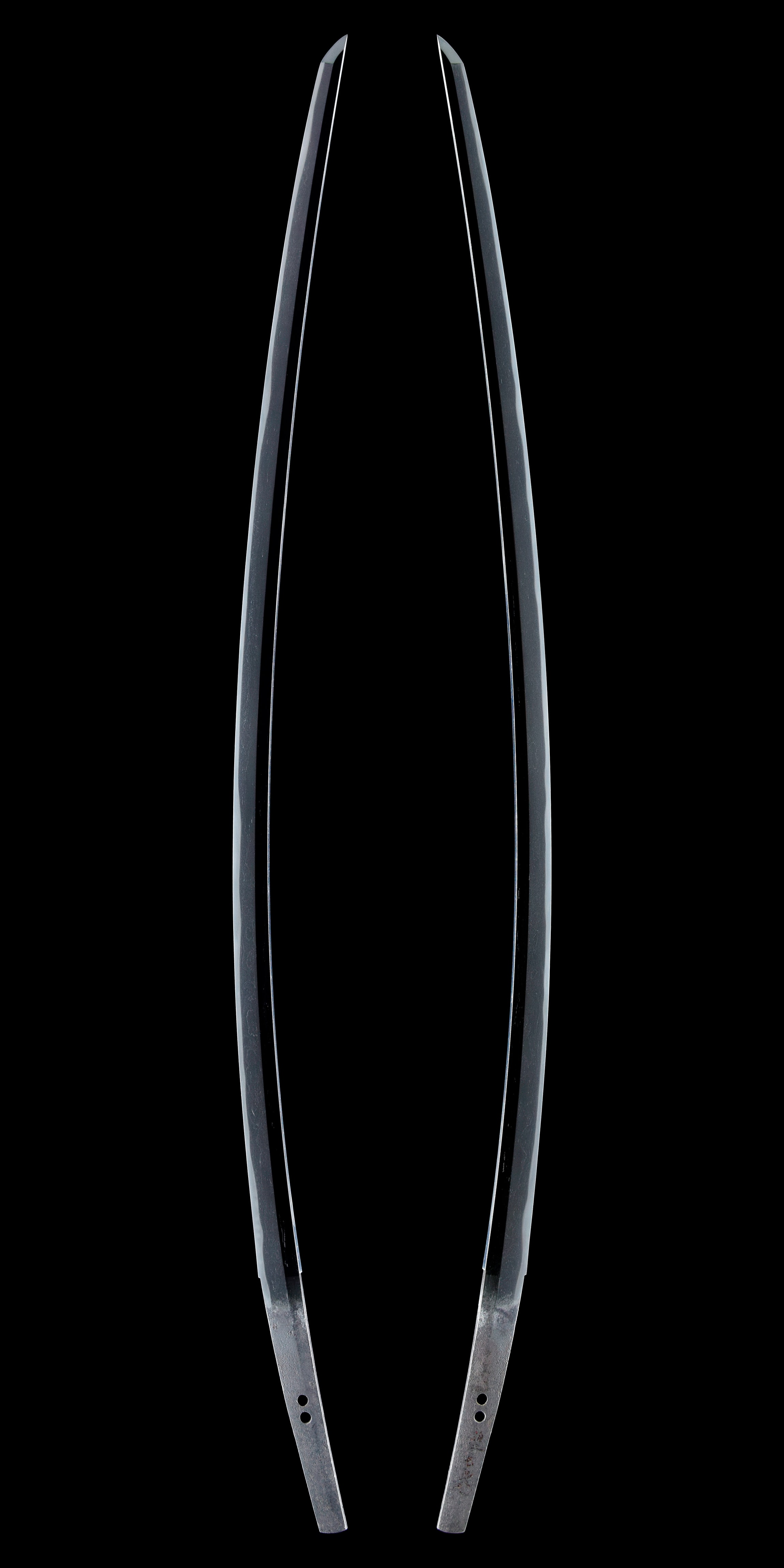
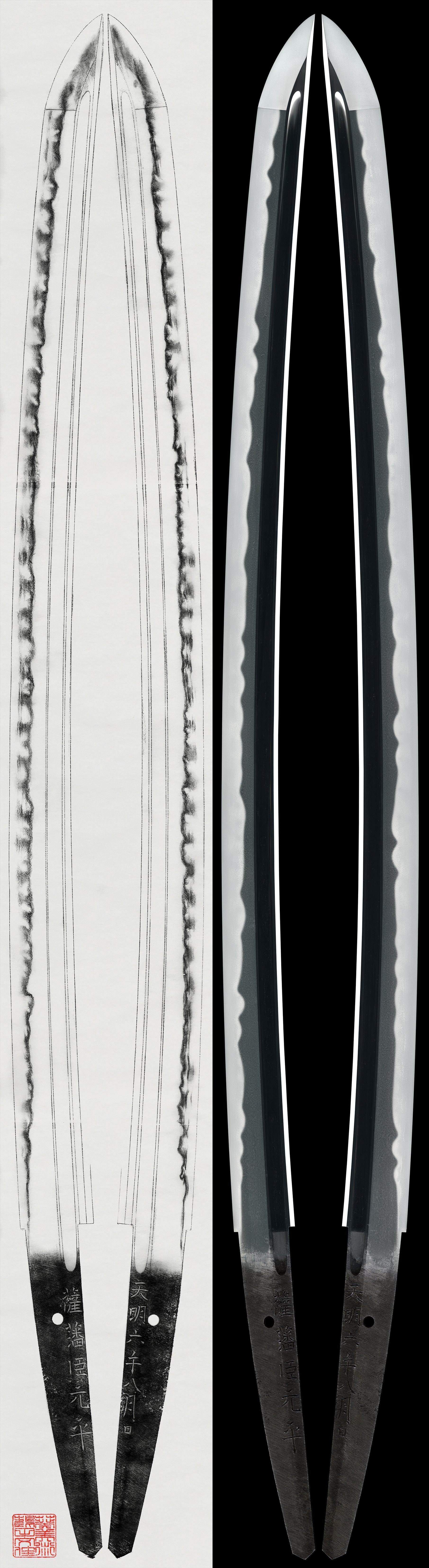
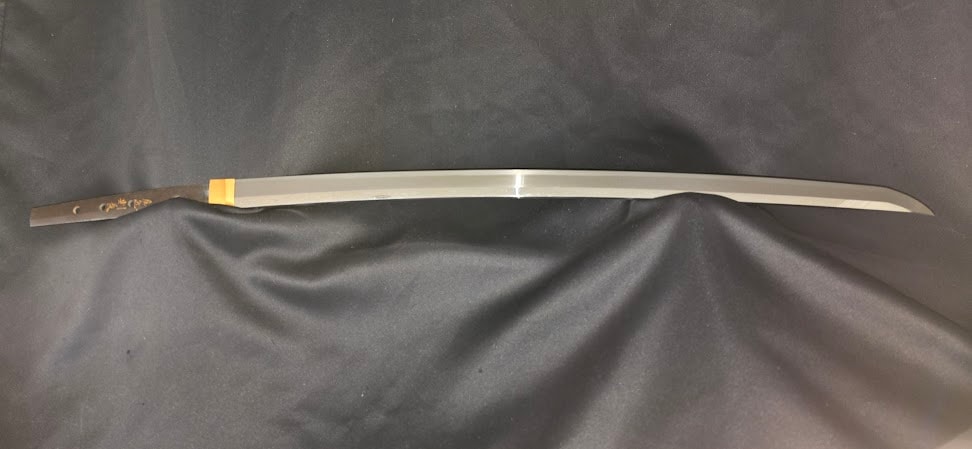
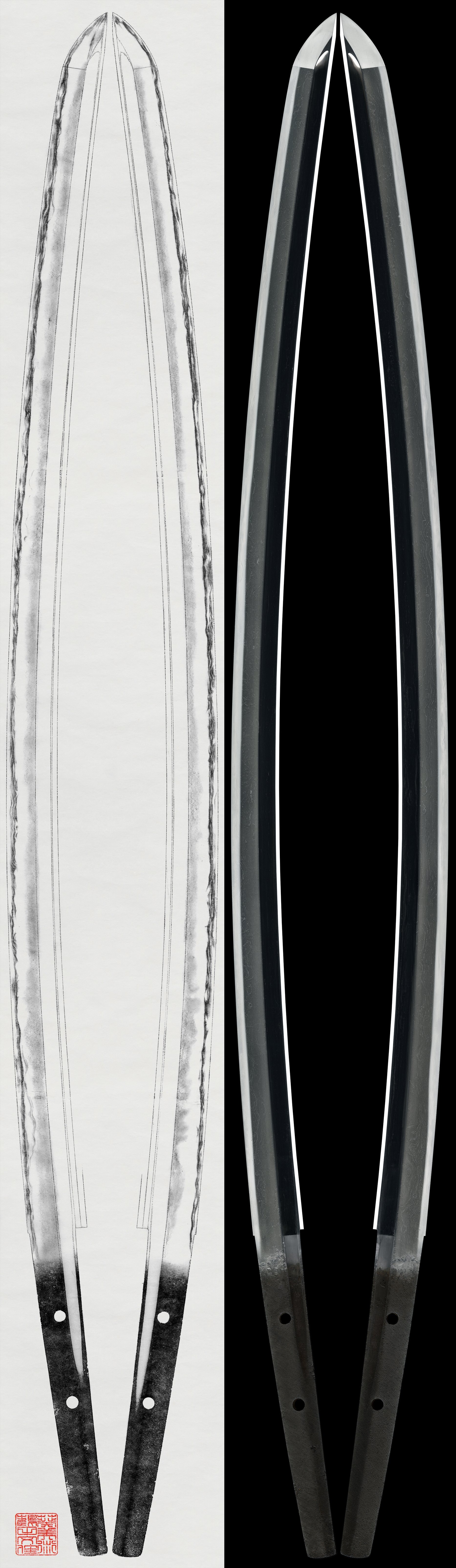
Among the five schools of Yamato, the Senjuin school is the oldest to have emerged. At the western foot of Mount Wakakusa in Nara, there was a Senju-do temple dedicated to Senju Kannon, and the area was called Senju-gaya. The group of swordsmiths there was the Senjuin; because they belonged to Todai-ji temple since the Heian period, most of their works are *mumei*. This *hon-Senjuin* is a *tachi* by Senjuin Yukimitsu, said to be the son of Yukinobu, and is an extremely rare extant *ubu-zaimei* (original signed) *tachi*. The production period is around the Enkyo era of the late Kamakura period (1308) (709 years ago). The *tachi-sugata* is dignified and strong, featuring a long *nagasa* with *funbari*. The *jigane* is forged in *itame-hada* with abundant *ji-nie* and *chikei*, manifesting a faint *midare-utsuri*. The color of the steel is blackish, moist, and clear. The *hamon* is based on *suguha* with *notare*; around the *monouchi* and the middle section, it becomes a gorgeous *midare* mixed with *choji-gokoro* and *gunome*. It features *hotsure*, *uchinoke*, *yubashiri*, and *tobiyaki*, with *ko-nie* shining brightly. The *yakiba* shows a highly varied *midare-ba* not seen in the other four schools, strongly displaying the characteristics of the Senjuin school. Please enjoy this particularly precious masterpiece, a signed Senjuin by Yukimitsu.

NBTHK Setsumei

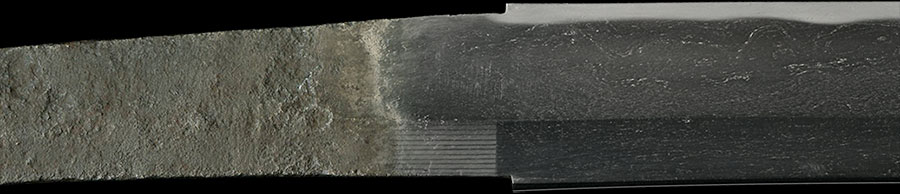
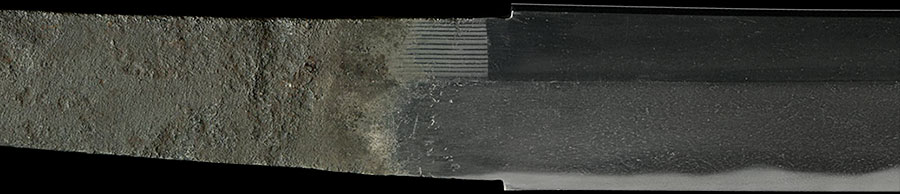
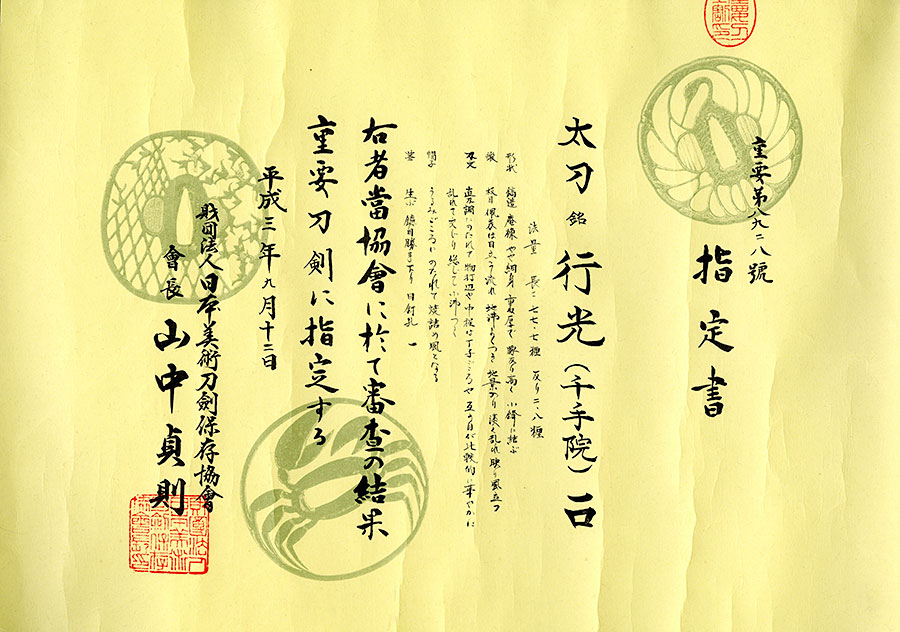
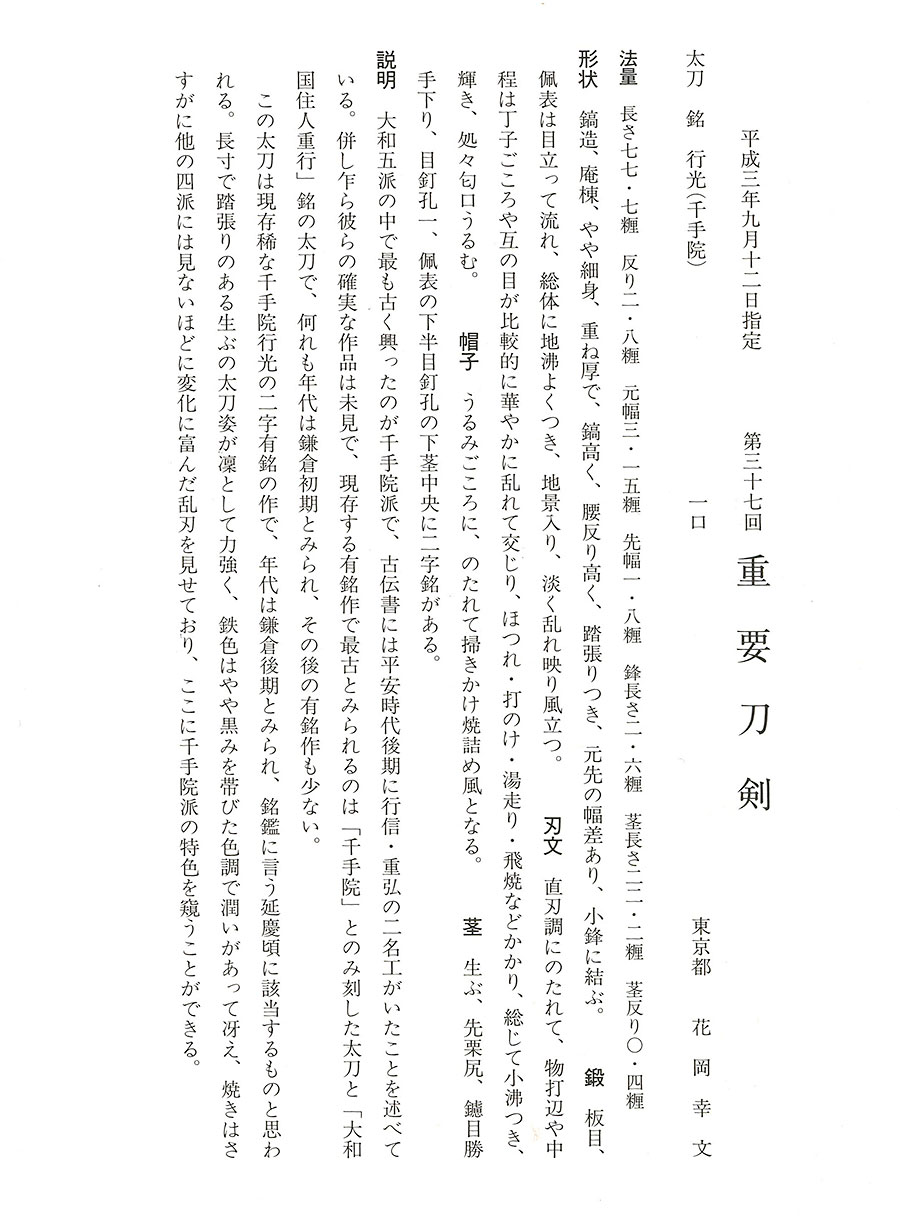
Jūyō-Tōken, 37th Session — Designated September 12, 1991 Tachi, mei: Yukimitsu (Senjuin) (行光) Measurements Nagasa 77.7 cm, sori 2.8 cm, motohaba 3.15 cm, sakihaba 1.8 cm, kissaki-nagasa 2.6 cm, nakago-nagasa 22.2 cm, nakago-sori 0.4 cm Description Keijō: shinogi-zukuri, iori-mune; slightly slender, with thick kasane and a high shinogi; deep koshizori with funbari; a marked difference between base and tip widths; forming a ko-kissaki. Kitae: itame; on the omote it shows conspicuous nagare; overall ji-nie adheres well with chikei visible, and a faint midare-utsuri-like effect appears. Hamon: A suguha-toned notare; around the monouchi and midsection, chōji-tendency and gunome mingle in a relatively showy midare; with hotsure, uchi-noke, yubashiri, and tobiyaki appearing; overall ko-nie adheres and the temper is bright, and in places the nioiguchi shows urumi (a moist/soft quality). Bōshi: With an urumi-tendency, it becomes notare and ends in hakikake, taking on an appearance close to yakizume. Horimono: None. Nakago: ubu; kurijiri; yasurime katte-sagari; one mekugi-ana; on the omote, in the lower half below the peg-hole, there is a two-character signature at the center of the tang. Artisan Senjuin Yukimitsu (千手院 行光) Era Late Kamakura period (corresponding to around the Enkyō era) Explanation Among the five Yamato schools, the Senjuin school is regarded as the earliest to have arisen. Old transmitted writings state that, in the late Heian period, there were two master smiths named Yukinobu and Shigehiro. However, no works that can be accepted as firmly attributable to them have yet been seen. Of extant signed works, those considered the earliest are a tachi bearing only the inscription “Senjuin,” and a tachi signed “Yamato no kuni jūnin Shigeyuki”; both are thought to date to the early Kamakura period, and thereafter signed works remain few. This tachi is a rare extant, two-character signed work by Senjuin Yukimitsu. Its date is considered late Kamakura, and it likely corresponds to what the meikan describes as the Enkyō period. The long-bladed, ubu tachi sugata—with funbari—is dignified and powerful. The steel color carries a slightly blackish tone, yet possesses a lustrous quality and is clear. The tempering, as expected, displays a richly varied midareba with changes of a kind not seen among the other four Yamato schools; in this, one can discern the distinctive features of the Senjuin tradition.

NihontoWatch MonNihontoWatch
MarketAuctionsEncyclopedia
Swords›Yamato-den›Senjuin›Yukimitsu›Juyo Tachi by Yukimitsu of Yamato Senjuin
katanaJūyō
Senjuin Yukimitsu

Juyo Tachi by Yukimitsu of Yamato Senjuin

mumei · Heian · nagasa 77.6cm · sori 3cm

SOLD
Senjuin Yukimitsu — 1 of 27
Senjuin Yukimitsu — 2 of 27
Senjuin Yukimitsu — 3 of 27
Senjuin Yukimitsu — 4 of 27
Senjuin Yukimitsu — 5 of 27
Senjuin Yukimitsu — 6 of 27
Senjuin Yukimitsu — 7 of 27
Senjuin Yukimitsu — 8 of 27
Senjuin Yukimitsu — 9 of 27
Senjuin Yukimitsu — 10 of 27
Senjuin Yukimitsu — 11 of 27
Senjuin Yukimitsu — 12 of 27
Senjuin Yukimitsu — 13 of 27
Senjuin Yukimitsu — 14 of 27
Senjuin Yukimitsu — 15 of 27
Senjuin Yukimitsu — 16 of 27
Senjuin Yukimitsu — 17 of 27
Senjuin Yukimitsu — 18 of 27
Senjuin Yukimitsu — 19 of 27
Senjuin Yukimitsu — 20 of 27
Senjuin Yukimitsu — 21 of 27
Senjuin Yukimitsu — 22 of 27
Senjuin Yukimitsu — 23 of 27
Senjuin Yukimitsu — 24 of 27
Senjuin Yukimitsu — 25 of 27
Senjuin Yukimitsu — 26 of 27
Senjuin Yukimitsu — 27 of 27
1 / 27
1 / 27
Senjuin Yukimitsu — 1 of 27Senjuin Yukimitsu — 2 of 27Senjuin Yukimitsu — 3 of 27Senjuin Yukimitsu — 4 of 27Senjuin Yukimitsu — 5 of 27Senjuin Yukimitsu — 6 of 27Senjuin Yukimitsu — 7 of 27Senjuin Yukimitsu — 8 of 27Senjuin Yukimitsu — 9 of 27Senjuin Yukimitsu — 10 of 27Senjuin Yukimitsu — 11 of 27Senjuin Yukimitsu — 12 of 27Senjuin Yukimitsu — 13 of 27Senjuin Yukimitsu — 14 of 27Senjuin Yukimitsu — 15 of 27Senjuin Yukimitsu — 16 of 27Senjuin Yukimitsu — 17 of 27Senjuin Yukimitsu — 18 of 27Senjuin Yukimitsu — 19 of 27Senjuin Yukimitsu — 20 of 27Senjuin Yukimitsu — 21 of 27Senjuin Yukimitsu — 22 of 27Senjuin Yukimitsu — 23 of 27Senjuin Yukimitsu — 24 of 27Senjuin Yukimitsu — 25 of 27Senjuin Yukimitsu — 26 of 27Senjuin Yukimitsu — 27 of 27
Measurements & details
Smith
Senjuin Yukimitsu
Type
Katana
School
Senjuin
Period
Around 1308–1311(Enkei)
Province
大和
Signature
Unsigned(100% of this smith's designated works are signed)
Measurements
Nagasa 77.6cmSori 3cmMotohaba 3.13cmSakihaba 1.82cmKasane 0.83cm
Description

Among the five schools of Yamato, the Senjuin school is the oldest to have emerged. At the western foot of Mount Wakakusa in Nara, there was a Senju-do temple dedicated to Senju Kannon, and the area was called Senju-gaya. The group of swordsmiths there was the Senjuin; because they belonged to Todai-ji temple since the Heian period, most of their works are mumei. This hon-Senjuin is a tachi by Senjuin Yukimitsu, said to be the son of Yukinobu, and is an extremely rare extant ubu-zaimei (original signed) tachi. The production period is around the Enkyo era of the late Kamakura period (1308) (709 years ago).

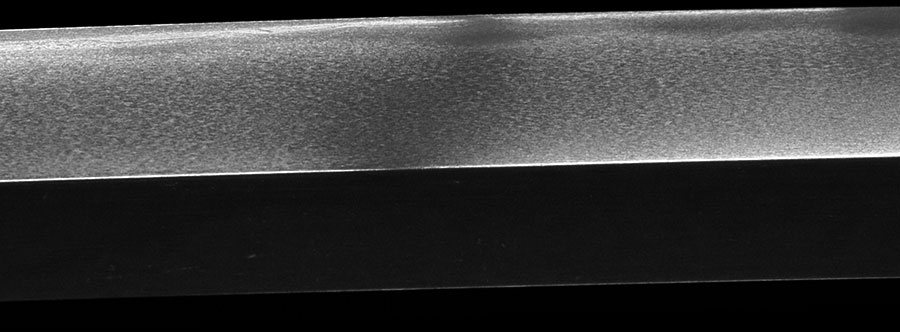
The tachi-sugata is dignified and strong, featuring a long nagasa with funbari. The jigane is forged in itame-hada with abundant ji-nie and chikei, manifesting a faint midare-utsuri. The color of the steel is blackish, moist, and clear. The hamon is based on suguha with notare; around the monouchi and the middle section, it becomes a gorgeous midare mixed with choji-gokoro and gunome. It features hotsure, uchinoke, yubashiri, and tobiyaki, with ko-nie shining brightly. The yakiba shows a highly varied midare-ba not seen in the other four schools, strongly displaying the characteristics of the Senjuin school. Please enjoy this particularly precious masterpiece, a signed Senjuin by Yukimitsu.

NBTHK Zufu Commentary

Juyo #37

AI translation — may contain errors

-, 37th Session — Designated September 12, 1991

, : Yukimitsu (Senjuin) (行光)

Measurements 77.7 cm, 2.8 cm, 3.15 cm, 1.8 cm, 2.6 cm, 22.2 cm, 0.4 cm

Description Keijō: , ; slightly slender, with thick and a high ; deep with ; a marked difference between base and tip widths; forming a . : ; on the it shows conspicuous ; overall adheres well with visible, and a faint -like effect appears. : A -toned ; around the and midsection, -tendency and mingle in a relatively showy ; with , uchi-noke, , and appearing; overall adheres and the temper is bright, and in places the shows (a moist/soft quality). : With an -tendency, it becomes and ends in , taking on an appearance close to . : None. : ; ; ; one ; on the , in the lower half below the peg-hole, there is a two-character signature at the center of the tang.

Artisan Senjuin Yukimitsu (千手院 行光)

Era Late period (corresponding to around the Enkyō era)

Explanation Among the five Yamato schools, the Senjuin school is regarded as the earliest to have arisen. Old transmitted writings state that, in the late period, there were two master smiths named Yukinobu and Shigehiro. However, no works that can be accepted as firmly attributable to them have yet been seen. Of extant signed works, those considered the earliest are a bearing only the inscription “Senjuin,” and a signed “Yamato no jūnin Shigeyuki”; both are thought to date to the early period, and thereafter signed works remain few.

This is a rare extant, two-character signed work by Senjuin Yukimitsu. Its date is considered late , and it likely corresponds to what the describes as the Enkyō period. The long-bladed, —with —is dignified and powerful. The steel color carries a slightly blackish tone, yet possesses a lustrous quality and is clear. The tempering, as expected, displays a richly varied with changes of a kind not seen among the other four Yamato schools; in this, one can discern the distinctive features of the Senjuin tradition.

About the maker

Yukimitsu

行光

Yamato-den · Yamato · around 1308-1311

›

Historical importance

Where Yukimitsu stands among comparable artisans: across all of nihontō, and within tradition, era, and period. The tiers (Foremost · Leading · Major · Notable) weigh official designations from the NBTHK and Japan's Agency for Cultural Affairs, together with historical honors of lasting repute such as the Sansaku and Meibutsu-chō.

随一
Foremost
屈指
Leading
有数
Major
著名
Notable

Select a lens to see how it's measured.

Designation record
1 designated works
Jūyō
1
Yukimitsu — full profileYamato-den school
About the school

Senjuin

千手院

Yamato-den · Yamato

23 pieces on the market now

›

Among the five schools of the Yamato-den, Senjuin (千手院) is held to be the earliest in origin, its name drawn from the Senjudo, a hall enshrining Senju Kannon (the Thousand-Armed Avalokitesvara) said to have stood at the western foothills of Mt. Wakakusa in Nara. Learn more →
40 recorded smiths231 designated works
Leading smiths
SmithEraDesignated
Nobuyoshi延吉1288-129329
Sukemitsu助光1243-12476
Yoshihiro吉弘1352-13565
Yoshihiro義弘1312-13173
Akimitsu日光1303-13060
Explore the Senjuin school →
NBTHK Certificate
Jūyō Tōken重要刀剣
Important Sword
›

A blade of top-grade workmanship and condition, formally judged to rank with a nationally recognized Important Art Object (Jūyō Bijutsuhin). Awarded only at the NBTHK’s competitive annual examination.

Of Japan’s roughly 2.5 million registered swords, only 12,307 (about 1 in 203) have ever attained Jūyō.

About the NBTHK›

The NBTHK (Nihon Bijutsu Tōken Hozon Kyōkai, the Society for the Preservation of Japanese Art Swords) is a public-interest incorporated foundation founded in 1948 and supervised by Japan’s Agency for Cultural Affairs (Bunkachō); it is based at the Japanese Sword Museum in Tokyo. Its expert panels physically examine each submitted work (shinsa) and issue a certificate (kanteishō) ranking it by artistic and historical merit. NBTHK papers are the most widely recognized standard of authentication for Japanese swords and fittings.

NBTHK official site→
Seller
N
Nipponto
Established 1953 · 73 yrs on the market
🇯🇵Ships from Japan
›
✓Verified dealernipponto.co.jp
✓Ships worldwide✓English supportPayPalCredit card
Return policy

For returns due to customer circumstances, the cost is the customer's responsibility. For returns due to our mis-shipment or a defective item, we bear the cost.

View all of Nipponto’s listings→View this item on the dealer’s site→

Previously sold by Senjuin Yukimitsu

Nipponto
Katana - by Senjuin Yukimitsu - Katana by Yukimitsu of SenjuinKatana - by Senjuin Yukimitsu - Katana by Yukimitsu of Senjuin
Sold

Katana

BySenjuin Yukimitsu
SOLD

More from the Senjuin school

View all →
Aoi Art
Jūyō
Katana - Jūyō - by Senjuin - Mumei (Senjuin)Katana - Jūyō - by Senjuin - Mumei (Senjuin)

Katana

BySenjuin
Starting Bid¥4,000,000
Token-Net
Tokuho
Wakizashi - Tokuho - by Mino Senjuin School - Mumei (Echizen Kunihiro)Wakizashi - Tokuho - by Mino Senjuin School - Mumei (Echizen Kunihiro)

Wakizashi

ByMino Senjuin School
¥780,000
Touken Komachi
Tokuho
Katana - Tokuho - by Senjuin School - Senjuin - ShirasayaKatana - Tokuho - by Senjuin School - Senjuin - Shirasaya

Katana

BySenjuin School
¥880,000
Eirakudo
Jūyō
Katana - Jūyō - by Senjuin School - Senjuin - Juyo TokenKatana - Jūyō - by Senjuin School - Senjuin - Juyo Token

Katana

BySenjuin School
¥3,500,000
Ayakashi
Tokuho
Ken - Tokuho - by Senjuin School - Ken: SenjuinKen - Tokuho - by Senjuin School - Ken: Senjuin

Ken

BySenjuin School
¥1,800,000
Eirakudo
Jūyō
Katana - Jūyō - by Senjuin School - Senjuin - Juyo TokenKatana - Jūyō - by Senjuin School - Senjuin - Juyo Token

Katana

BySenjuin School
¥3,900,000
Toushin
Jūyō
Katana - Jūyō - by Senjuin Nobuyoshi - Mumei (Ryumon)Katana - Jūyō - by Senjuin Nobuyoshi - Mumei (Ryumon)

Katana

BySenjuin Nobuyoshi
Ask
Toushin
Tokuho
Tachi - Tokuho - by Senjuin School - Mumei (Senjyuin) - 1-086Tachi - Tokuho - by Senjuin School - Mumei (Senjyuin) - 1-086

Tachi

BySenjuin School
¥3,520,000

More from the Yamato tradition

View all →
Kusanagi
Tokuho
Katana - Tokuho - by Shikkake Norinaga - Shitagake School Founder, Oowazamono 1st Gen. "Shitagake Norinaga" - Tokubetsu Hozon Token AppraisalKatana - Tokuho - by Shikkake Norinaga - Shitagake School Founder, Oowazamono 1st Gen. "Shitagake Norinaga" - Tokubetsu Hozon Token Appraisal

Katana

ByShikkake Norinaga
¥1,280,000
Goushuya
Tokujū
Katana - Tokuju - by Satsuma Yasuyo - Tokubetsu Juyo Token (One-Leaf Aoi Mon) Shume no Kami Ichihei Fujiwara Ason Yasuyo, Made in Satsushu Kirei-gun on an Auspicious Day in March, Kyoho 12Katana - Tokuju - by Satsuma Yasuyo - Tokubetsu Juyo Token (One-Leaf Aoi Mon) Shume no Kami Ichihei Fujiwara Ason Yasuyo, Made in Satsushu Kirei-gun on an Auspicious Day in March, Kyoho 12

Katana

BySatsuma Yasuyo
Ask
Tsuruginoya
Jūyō
Katana - Jūyō - by Tegai Kanenaga - Tegai KanenagaKatana - Jūyō - by Tegai Kanenaga - Tegai Kanenaga

Katana

ByTegai Kanenaga
¥7,500,000
Aoi Art
Hozon
Wakizashi - Hozon - by Mihara School - Mumei (Mihara school)Wakizashi - Hozon - by Mihara School - Mumei (Mihara school)

Wakizashi

ByMihara School
Starting Bid¥250,000
Aoi Art
Tokuho
Katana - Tokuho - by Tegai School - Mumei (Unsigned) (Tegai) (Koshirae: NBTHK Tokubetsu Kicho Tosogu)Katana - Tokuho - by Tegai School - Mumei (Unsigned) (Tegai) (Koshirae: NBTHK Tokubetsu Kicho Tosogu)

Katana

ByTegai School
¥2,500,000
Choshuya
Jūyō
Katana - Jūyō - by Shikkake School - Unsigned (O-suriage), attributed to ShikkakeKatana - Jūyō - by Shikkake School - Unsigned (O-suriage), attributed to Shikkake

Katana

ByShikkake School
¥3,600,000
Toushin
Tokuho
Tanto - Tokuho - by Tegai School - Tegai KanetoshiTanto - Tokuho - by Tegai School - Tegai Kanetoshi

Tantō

ByTegai School
¥1,100,000
Touken Komachi
Tokuho
Katana - Tokuho - by Tegai Kanenaga - Katana in ShirasayaKatana - Tokuho - by Tegai Kanenaga - Katana in Shirasaya

Katana

ByTegai Kanenaga
¥3,000,000

Swords

  • Katana
  • Wakizashi
  • Tantō
  • Tachi
  • Naginata
  • Yari

Fittings

  • Tsuba
  • Fuchi-Kashira
  • Kozuka
  • Menuki

By Certification

  • Tokujū
  • Jūyō
  • Tokuho
  • Hozon

Resources

  • Dealer Directory
  • Artist Directory
  • Glossary
  • Browse All
Nihontowatch© 2026
TermsPrivacyCookiesAbout

Description

Among the five schools of Yamato, the Senjuin school is the oldest to have emerged. At the western foot of Mount Wakakusa in Nara, there was a Senju-do temple dedicated to Senju Kannon, and the area was called Senju-gaya. The group of swordsmiths there was the Senjuin; because they belonged to Todai-ji temple since the Heian period, most of their works are *mumei*. This *hon-Senjuin* is a *tachi* by Senjuin Yukimitsu, said to be the son of Yukinobu, and is an extremely rare extant *ubu-zaimei* (original signed) *tachi*. The production period is around the Enkyo era of the late Kamakura period (1308) (709 years ago). The *tachi-sugata* is dignified and strong, featuring a long *nagasa* with *funbari*. The *jigane* is forged in *itame-hada* with abundant *ji-nie* and *chikei*, manifesting a faint *midare-utsuri*. The color of the steel is blackish, moist, and clear. The *hamon* is based on *suguha* with *notare*; around the *monouchi* and the middle section, it becomes a gorgeous *midare* mixed with *choji-gokoro* and *gunome*. It features *hotsure*, *uchinoke*, *yubashiri*, and *tobiyaki*, with *ko-nie* shining brightly. The *yakiba* shows a highly varied *midare-ba* not seen in the other four schools, strongly displaying the characteristics of the Senjuin school. Please enjoy this particularly precious masterpiece, a signed Senjuin by Yukimitsu.

NBTHK Setsumei

Jūyō-Tōken, 37th Session — Designated September 12, 1991 Tachi, mei: Yukimitsu (Senjuin) (行光) Measurements Nagasa 77.7 cm, sori 2.8 cm, motohaba 3.15 cm, sakihaba 1.8 cm, kissaki-nagasa 2.6 cm, nakago-nagasa 22.2 cm, nakago-sori 0.4 cm Description Keijō: shinogi-zukuri, iori-mune; slightly slender, with thick kasane and a high shinogi; deep koshizori with funbari; a marked difference between base and tip widths; forming a ko-kissaki. Kitae: itame; on the omote it shows conspicuous nagare; overall ji-nie adheres well with chikei visible, and a faint midare-utsuri-like effect appears. Hamon: A suguha-toned notare; around the monouchi and midsection, chōji-tendency and gunome mingle in a relatively showy midare; with hotsure, uchi-noke, yubashiri, and tobiyaki appearing; overall ko-nie adheres and the temper is bright, and in places the nioiguchi shows urumi (a moist/soft quality). Bōshi: With an urumi-tendency, it becomes notare and ends in hakikake, taking on an appearance close to yakizume. Horimono: None. Nakago: ubu; kurijiri; yasurime katte-sagari; one mekugi-ana; on the omote, in the lower half below the peg-hole, there is a two-character signature at the center of the tang. Artisan Senjuin Yukimitsu (千手院 行光) Era Late Kamakura period (corresponding to around the Enkyō era) Explanation Among the five Yamato schools, the Senjuin school is regarded as the earliest to have arisen. Old transmitted writings state that, in the late Heian period, there were two master smiths named Yukinobu and Shigehiro. However, no works that can be accepted as firmly attributable to them have yet been seen. Of extant signed works, those considered the earliest are a tachi bearing only the inscription “Senjuin,” and a tachi signed “Yamato no kuni jūnin Shigeyuki”; both are thought to date to the early Kamakura period, and thereafter signed works remain few. This tachi is a rare extant, two-character signed work by Senjuin Yukimitsu. Its date is considered late Kamakura, and it likely corresponds to what the meikan describes as the Enkyō period. The long-bladed, ubu tachi sugata—with funbari—is dignified and powerful. The steel color carries a slightly blackish tone, yet possesses a lustrous quality and is clear. The tempering, as expected, displays a richly varied midareba with changes of a kind not seen among the other four Yamato schools; in this, one can discern the distinctive features of the Senjuin tradition.

NihontoWatch MonNihontoWatch
MarketAuctionsEncyclopedia
Swords›Yamato-den›Senjuin›Yukimitsu›Juyo Tachi by Yukimitsu of Yamato Senjuin
katanaJūyō
Senjuin Yukimitsu

Juyo Tachi by Yukimitsu of Yamato Senjuin

mumei · Heian · nagasa 77.6cm · sori 3cm

SOLD
Senjuin Yukimitsu — 1 of 27
Senjuin Yukimitsu — 2 of 27
Senjuin Yukimitsu — 3 of 27
Senjuin Yukimitsu — 4 of 27
Senjuin Yukimitsu — 5 of 27
Senjuin Yukimitsu — 6 of 27
Senjuin Yukimitsu — 7 of 27
Senjuin Yukimitsu — 8 of 27
Senjuin Yukimitsu — 9 of 27
Senjuin Yukimitsu — 10 of 27
Senjuin Yukimitsu — 11 of 27
Senjuin Yukimitsu — 12 of 27
Senjuin Yukimitsu — 13 of 27
Senjuin Yukimitsu — 14 of 27
Senjuin Yukimitsu — 15 of 27
Senjuin Yukimitsu — 16 of 27
Senjuin Yukimitsu — 17 of 27
Senjuin Yukimitsu — 18 of 27
Senjuin Yukimitsu — 19 of 27
Senjuin Yukimitsu — 20 of 27
Senjuin Yukimitsu — 21 of 27
Senjuin Yukimitsu — 22 of 27
Senjuin Yukimitsu — 23 of 27
Senjuin Yukimitsu — 24 of 27
Senjuin Yukimitsu — 25 of 27
Senjuin Yukimitsu — 26 of 27
Senjuin Yukimitsu — 27 of 27
1 / 27
1 / 27
Senjuin Yukimitsu — 1 of 27Senjuin Yukimitsu — 2 of 27Senjuin Yukimitsu — 3 of 27Senjuin Yukimitsu — 4 of 27Senjuin Yukimitsu — 5 of 27Senjuin Yukimitsu — 6 of 27Senjuin Yukimitsu — 7 of 27Senjuin Yukimitsu — 8 of 27Senjuin Yukimitsu — 9 of 27Senjuin Yukimitsu — 10 of 27Senjuin Yukimitsu — 11 of 27Senjuin Yukimitsu — 12 of 27Senjuin Yukimitsu — 13 of 27Senjuin Yukimitsu — 14 of 27Senjuin Yukimitsu — 15 of 27Senjuin Yukimitsu — 16 of 27Senjuin Yukimitsu — 17 of 27Senjuin Yukimitsu — 18 of 27Senjuin Yukimitsu — 19 of 27Senjuin Yukimitsu — 20 of 27Senjuin Yukimitsu — 21 of 27Senjuin Yukimitsu — 22 of 27Senjuin Yukimitsu — 23 of 27Senjuin Yukimitsu — 24 of 27Senjuin Yukimitsu — 25 of 27Senjuin Yukimitsu — 26 of 27Senjuin Yukimitsu — 27 of 27
Measurements & details
Smith
Senjuin Yukimitsu
Type
Katana
School
Senjuin
Period
Around 1308–1311(Enkei)
Province
大和
Signature
Unsigned(100% of this smith's designated works are signed)
Measurements
Nagasa 77.6cmSori 3cmMotohaba 3.13cmSakihaba 1.82cmKasane 0.83cm
Description

Among the five schools of Yamato, the Senjuin school is the oldest to have emerged. At the western foot of Mount Wakakusa in Nara, there was a Senju-do temple dedicated to Senju Kannon, and the area was called Senju-gaya. The group of swordsmiths there was the Senjuin; because they belonged to Todai-ji temple since the Heian period, most of their works are mumei. This hon-Senjuin is a tachi by Senjuin Yukimitsu, said to be the son of Yukinobu, and is an extremely rare extant ubu-zaimei (original signed) tachi. The production period is around the Enkyo era of the late Kamakura period (1308) (709 years ago).

The tachi-sugata is dignified and strong, featuring a long nagasa with funbari. The jigane is forged in itame-hada with abundant ji-nie and chikei, manifesting a faint midare-utsuri. The color of the steel is blackish, moist, and clear. The hamon is based on suguha with notare; around the monouchi and the middle section, it becomes a gorgeous midare mixed with choji-gokoro and gunome. It features hotsure, uchinoke, yubashiri, and tobiyaki, with ko-nie shining brightly. The yakiba shows a highly varied midare-ba not seen in the other four schools, strongly displaying the characteristics of the Senjuin school. Please enjoy this particularly precious masterpiece, a signed Senjuin by Yukimitsu.

NBTHK Zufu Commentary

Juyo #37

AI translation — may contain errors

-, 37th Session — Designated September 12, 1991

, : Yukimitsu (Senjuin) (行光)

Measurements 77.7 cm, 2.8 cm, 3.15 cm, 1.8 cm, 2.6 cm, 22.2 cm, 0.4 cm

Description Keijō: , ; slightly slender, with thick and a high ; deep with ; a marked difference between base and tip widths; forming a . : ; on the it shows conspicuous ; overall adheres well with visible, and a faint -like effect appears. : A -toned ; around the and midsection, -tendency and mingle in a relatively showy ; with , uchi-noke, , and appearing; overall adheres and the temper is bright, and in places the shows (a moist/soft quality). : With an -tendency, it becomes and ends in , taking on an appearance close to . : None. : ; ; ; one ; on the , in the lower half below the peg-hole, there is a two-character signature at the center of the tang.

Artisan Senjuin Yukimitsu (千手院 行光)

Era Late period (corresponding to around the Enkyō era)

Explanation Among the five Yamato schools, the Senjuin school is regarded as the earliest to have arisen. Old transmitted writings state that, in the late period, there were two master smiths named Yukinobu and Shigehiro. However, no works that can be accepted as firmly attributable to them have yet been seen. Of extant signed works, those considered the earliest are a bearing only the inscription “Senjuin,” and a signed “Yamato no jūnin Shigeyuki”; both are thought to date to the early period, and thereafter signed works remain few.

This is a rare extant, two-character signed work by Senjuin Yukimitsu. Its date is considered late , and it likely corresponds to what the describes as the Enkyō period. The long-bladed, —with —is dignified and powerful. The steel color carries a slightly blackish tone, yet possesses a lustrous quality and is clear. The tempering, as expected, displays a richly varied with changes of a kind not seen among the other four Yamato schools; in this, one can discern the distinctive features of the Senjuin tradition.

About the maker

Yukimitsu

行光

Yamato-den · Yamato · around 1308-1311

›

Historical importance

Where Yukimitsu stands among comparable artisans: across all of nihontō, and within tradition, era, and period. The tiers (Foremost · Leading · Major · Notable) weigh official designations from the NBTHK and Japan's Agency for Cultural Affairs, together with historical honors of lasting repute such as the Sansaku and Meibutsu-chō.

随一
Foremost
屈指
Leading
有数
Major
著名
Notable

Select a lens to see how it's measured.

Designation record
1 designated works
Jūyō
1
Yukimitsu — full profileYamato-den school
About the school

Senjuin

千手院

Yamato-den · Yamato

23 pieces on the market now

›

Among the five schools of the Yamato-den, Senjuin (千手院) is held to be the earliest in origin, its name drawn from the Senjudo, a hall enshrining Senju Kannon (the Thousand-Armed Avalokitesvara) said to have stood at the western foothills of Mt. Wakakusa in Nara. Learn more →
40 recorded smiths231 designated works
Leading smiths
SmithEraDesignated
Nobuyoshi延吉1288-129329
Sukemitsu助光1243-12476
Yoshihiro吉弘1352-13565
Yoshihiro義弘1312-13173
Akimitsu日光1303-13060
Explore the Senjuin school →
NBTHK Certificate
Jūyō Tōken重要刀剣
Important Sword
›

A blade of top-grade workmanship and condition, formally judged to rank with a nationally recognized Important Art Object (Jūyō Bijutsuhin). Awarded only at the NBTHK’s competitive annual examination.

Of Japan’s roughly 2.5 million registered swords, only 12,307 (about 1 in 203) have ever attained Jūyō.

About the NBTHK›

The NBTHK (Nihon Bijutsu Tōken Hozon Kyōkai, the Society for the Preservation of Japanese Art Swords) is a public-interest incorporated foundation founded in 1948 and supervised by Japan’s Agency for Cultural Affairs (Bunkachō); it is based at the Japanese Sword Museum in Tokyo. Its expert panels physically examine each submitted work (shinsa) and issue a certificate (kanteishō) ranking it by artistic and historical merit. NBTHK papers are the most widely recognized standard of authentication for Japanese swords and fittings.

NBTHK official site→

Seller
N
Nipponto
Established 1953 · 73 yrs on the market
🇯🇵Ships from Japan
›
✓Verified dealernipponto.co.jp
✓Ships worldwide✓English supportPayPalCredit card
Return policy

For returns due to customer circumstances, the cost is the customer's responsibility. For returns due to our mis-shipment or a defective item, we bear the cost.

View all of Nipponto’s listings→View this item on the dealer’s site→

Previously sold by Senjuin Yukimitsu

Nipponto
Katana - by Senjuin Yukimitsu - Katana by Yukimitsu of SenjuinKatana - by Senjuin Yukimitsu - Katana by Yukimitsu of Senjuin
Sold

Katana

BySenjuin Yukimitsu
SOLD

More from the Senjuin school

View all →
Aoi Art
Jūyō
Katana - Jūyō - by Senjuin - Mumei (Senjuin)Katana - Jūyō - by Senjuin - Mumei (Senjuin)

Katana

BySenjuin
Starting Bid¥4,000,000
Token-Net
Tokuho
Wakizashi - Tokuho - by Mino Senjuin School - Mumei (Echizen Kunihiro)Wakizashi - Tokuho - by Mino Senjuin School - Mumei (Echizen Kunihiro)

Wakizashi

ByMino Senjuin School
¥780,000
Touken Komachi
Tokuho
Katana - Tokuho - by Senjuin School - Senjuin - ShirasayaKatana - Tokuho - by Senjuin School - Senjuin - Shirasaya

Katana

BySenjuin School
¥880,000
Eirakudo
Jūyō
Katana - Jūyō - by Senjuin School - Senjuin - Juyo TokenKatana - Jūyō - by Senjuin School - Senjuin - Juyo Token

Katana

BySenjuin School
¥3,500,000
Ayakashi
Tokuho
Ken - Tokuho - by Senjuin School - Ken: SenjuinKen - Tokuho - by Senjuin School - Ken: Senjuin

Ken

BySenjuin School
¥1,800,000
Eirakudo
Jūyō
Katana - Jūyō - by Senjuin School - Senjuin - Juyo TokenKatana - Jūyō - by Senjuin School - Senjuin - Juyo Token

Katana

BySenjuin School
¥3,900,000
Toushin
Jūyō
Katana - Jūyō - by Senjuin Nobuyoshi - Mumei (Ryumon)Katana - Jūyō - by Senjuin Nobuyoshi - Mumei (Ryumon)

Katana

BySenjuin Nobuyoshi
Ask
Toushin
Tokuho
Tachi - Tokuho - by Senjuin School - Mumei (Senjyuin) - 1-086Tachi - Tokuho - by Senjuin School - Mumei (Senjyuin) - 1-086

Tachi

BySenjuin School
¥3,520,000

More from the Yamato tradition

View all →
Kusanagi
Tokuho
Katana - Tokuho - by Shikkake Norinaga - Shitagake School Founder, Oowazamono 1st Gen. "Shitagake Norinaga" - Tokubetsu Hozon Token AppraisalKatana - Tokuho - by Shikkake Norinaga - Shitagake School Founder, Oowazamono 1st Gen. "Shitagake Norinaga" - Tokubetsu Hozon Token Appraisal

Katana

ByShikkake Norinaga
¥1,280,000
Goushuya
Tokujū
Katana - Tokuju - by Satsuma Yasuyo - Tokubetsu Juyo Token (One-Leaf Aoi Mon) Shume no Kami Ichihei Fujiwara Ason Yasuyo, Made in Satsushu Kirei-gun on an Auspicious Day in March, Kyoho 12Katana - Tokuju - by Satsuma Yasuyo - Tokubetsu Juyo Token (One-Leaf Aoi Mon) Shume no Kami Ichihei Fujiwara Ason Yasuyo, Made in Satsushu Kirei-gun on an Auspicious Day in March, Kyoho 12

Katana

BySatsuma Yasuyo
Ask
Tsuruginoya
Jūyō
Katana - Jūyō - by Tegai Kanenaga - Tegai KanenagaKatana - Jūyō - by Tegai Kanenaga - Tegai Kanenaga

Katana

ByTegai Kanenaga
¥7,500,000
Aoi Art
Hozon
Wakizashi - Hozon - by Mihara School - Mumei (Mihara school)Wakizashi - Hozon - by Mihara School - Mumei (Mihara school)

Wakizashi

ByMihara School
Starting Bid¥250,000
Aoi Art
Tokuho
Katana - Tokuho - by Tegai School - Mumei (Unsigned) (Tegai) (Koshirae: NBTHK Tokubetsu Kicho Tosogu)Katana - Tokuho - by Tegai School - Mumei (Unsigned) (Tegai) (Koshirae: NBTHK Tokubetsu Kicho Tosogu)

Katana

ByTegai School
¥2,500,000
Choshuya
Jūyō
Katana - Jūyō - by Shikkake School - Unsigned (O-suriage), attributed to ShikkakeKatana - Jūyō - by Shikkake School - Unsigned (O-suriage), attributed to Shikkake

Katana

ByShikkake School
¥3,600,000
Toushin
Tokuho
Tanto - Tokuho - by Tegai School - Tegai KanetoshiTanto - Tokuho - by Tegai School - Tegai Kanetoshi

Tantō

ByTegai School
¥1,100,000
Touken Komachi
Tokuho
Katana - Tokuho - by Tegai Kanenaga - Katana in ShirasayaKatana - Tokuho - by Tegai Kanenaga - Katana in Shirasaya

Katana

ByTegai Kanenaga
¥3,000,000

Swords

  • Katana
  • Wakizashi
  • Tantō
  • Tachi
  • Naginata
  • Yari

Fittings

  • Tsuba
  • Fuchi-Kashira
  • Kozuka
  • Menuki

By Certification

  • Tokujū
  • Jūyō
  • Tokuho
  • Hozon

Resources

  • Dealer Directory
  • Artist Directory
  • Glossary
  • Browse All
Nihontowatch© 2026
TermsPrivacyCookiesAbout
NihontoWatch Mon

NihontoWatch

MarketAuctions
Encyclopedia
NihontoWatch Mon

NihontoWatch

MarketAuctions
Encyclopedia