NihontoWatch MonNihontoWatch
Market
Encyclopedia
Kantei
NihontoWatch MonNihontoWatch
Market
Encyclopedia
Kantei

Description

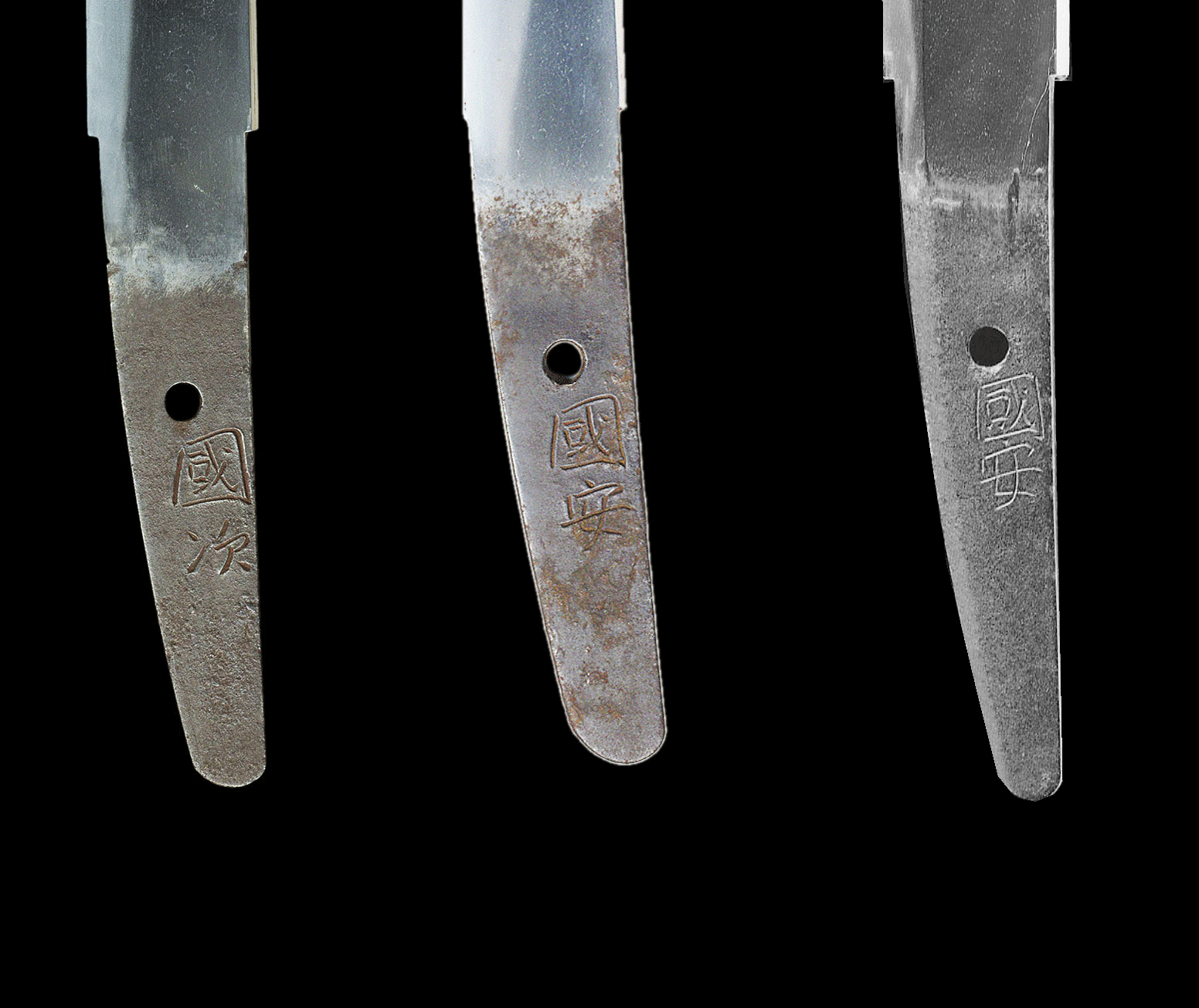
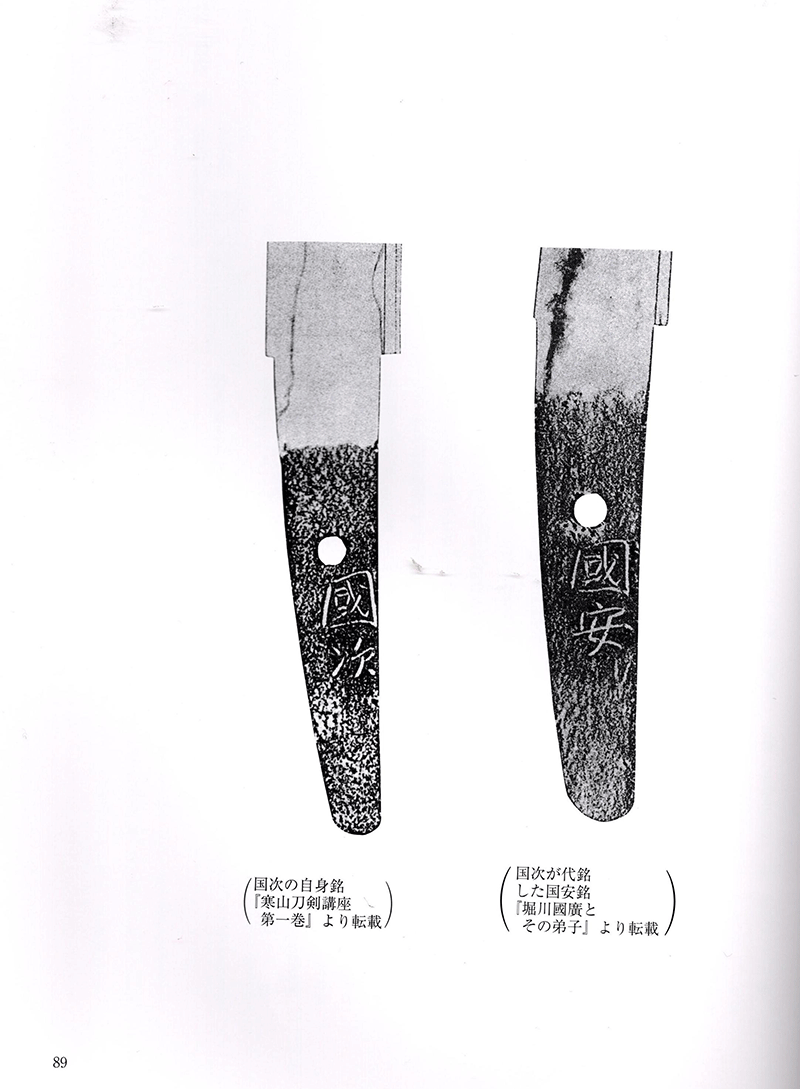
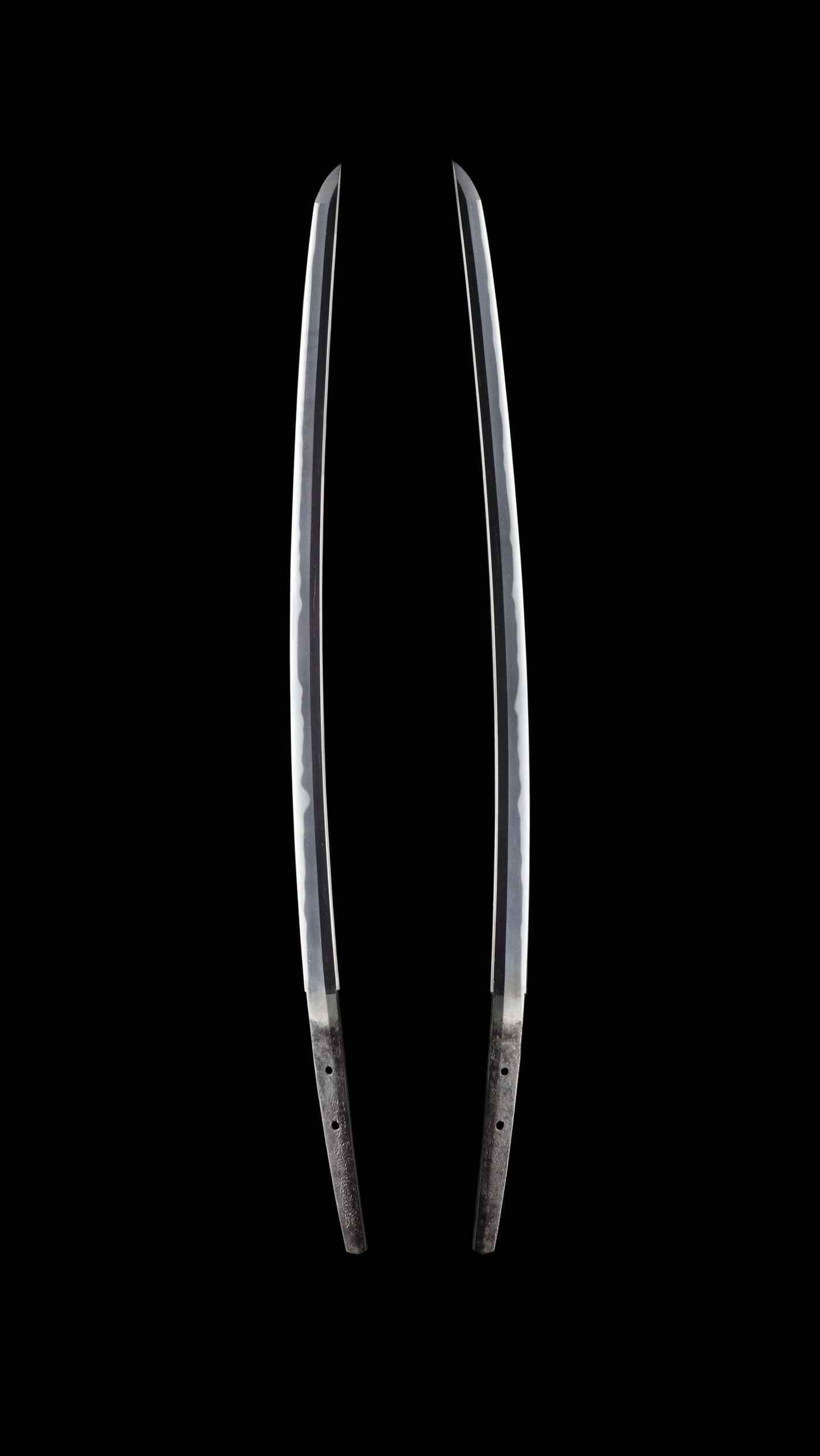
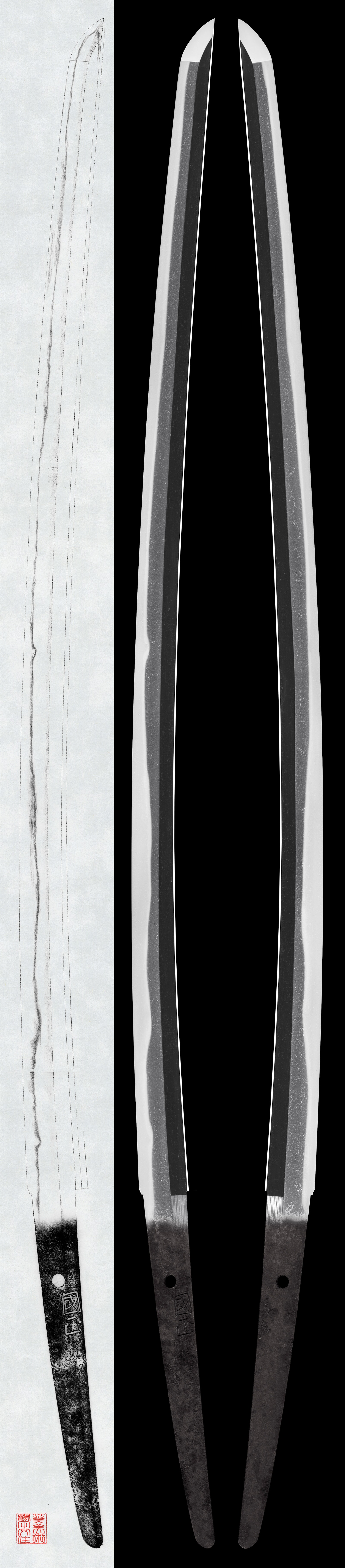
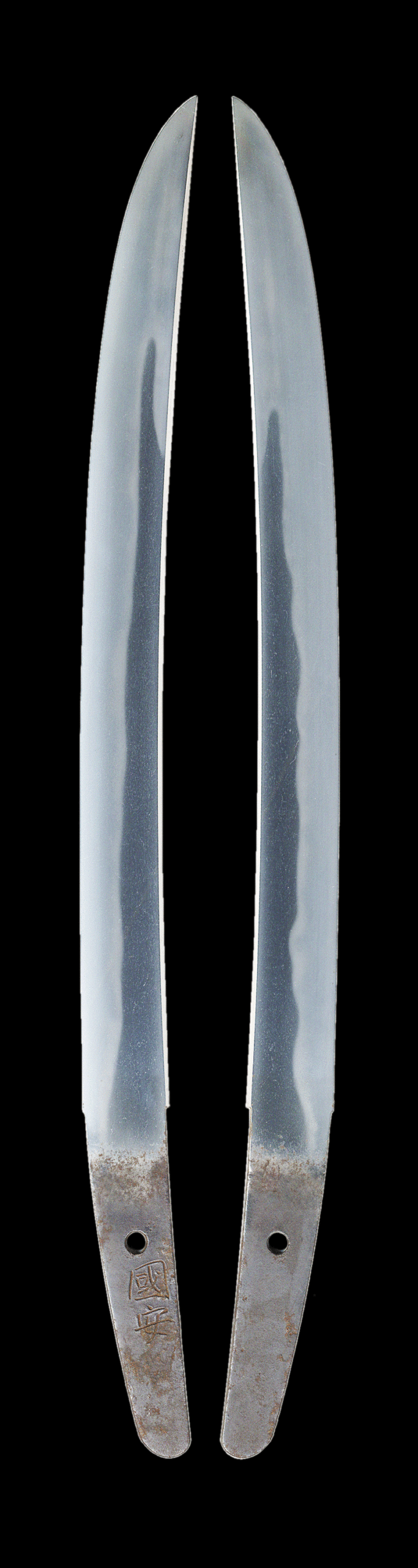
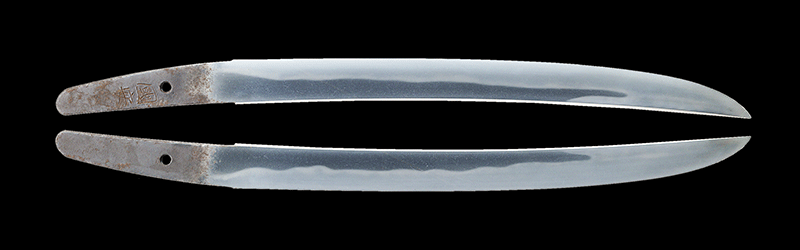
This is a Juyo Token designated tanto by Kuniyasu, a student of Horikawa Kunihiro, active in Yamashiro province during the Edo period. It is a long hira-zukuri tanto exceeding 30cm, featuring a robust Keicho Shinto form, with active kinsuji and sunagashi in the hamon, and the distinctive 'zanguri hada' of the Horikawa school. The mei is particularly notable, having been identified by Takashi Iwata as a proxy signature by Kunitsugu, adding significant historical and academic value to the piece.

NBTHK Setsumei

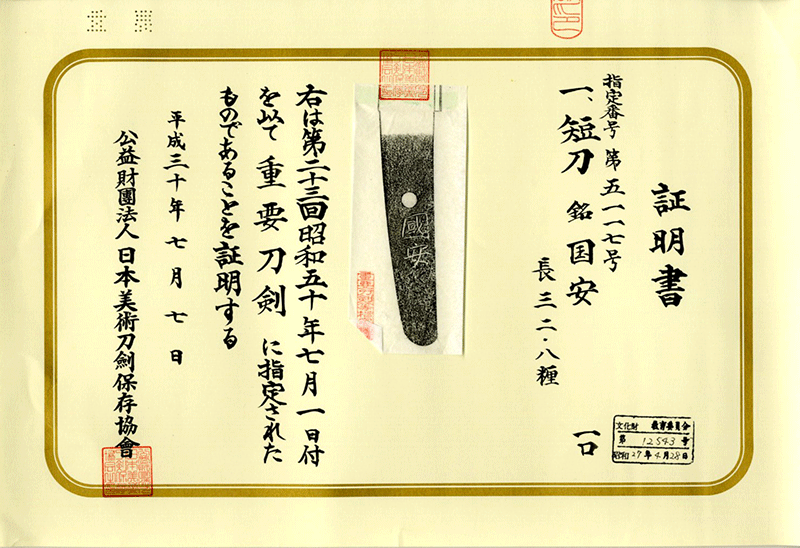
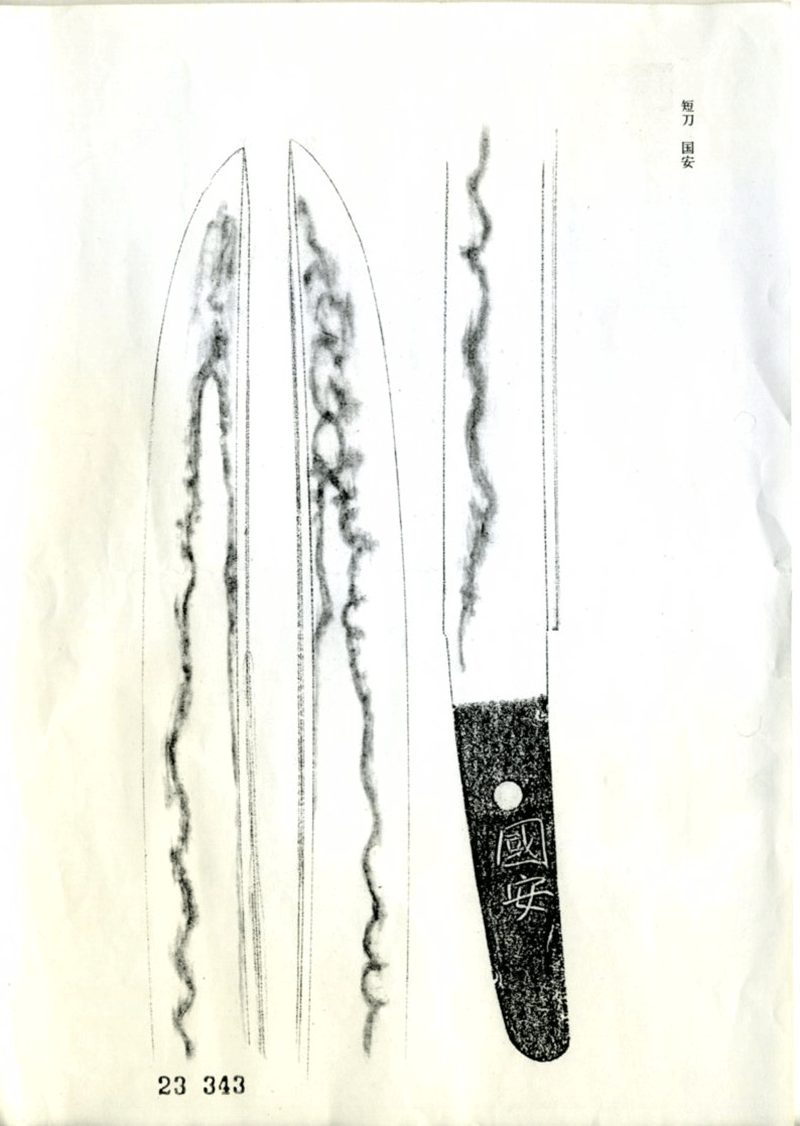
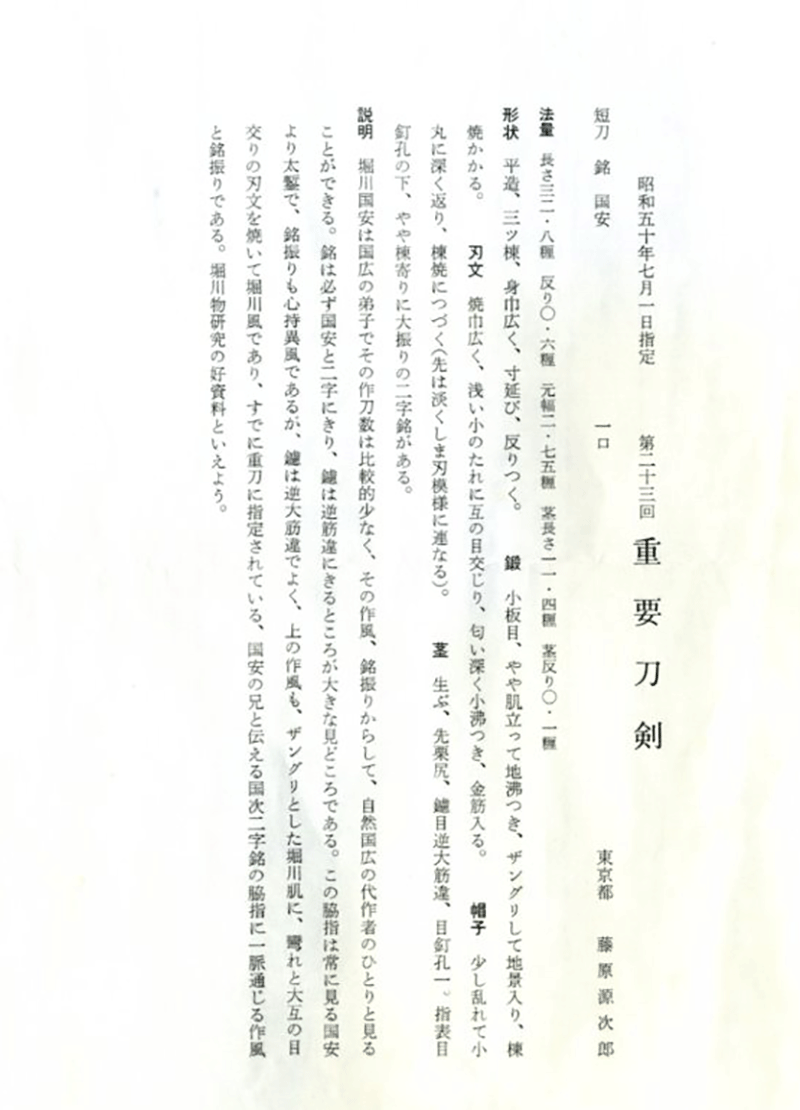
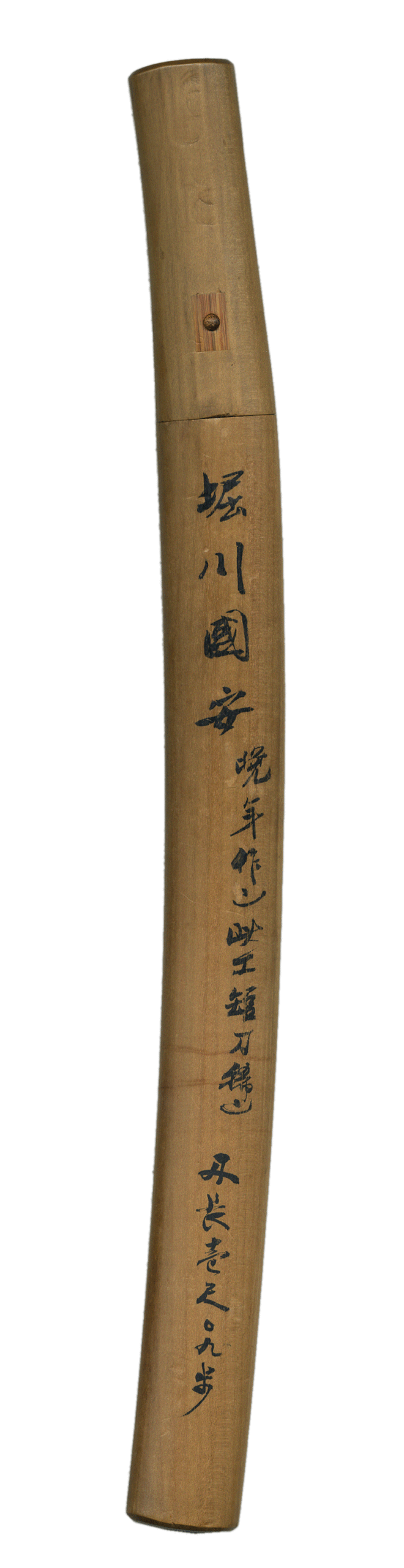
Jūyō-Tōken, 23rd Session — Designated July 1, 1975 Tantō, mei: Horikawa Kuniyasu (国安) Measurements Nagasa 32.8 cm, sori 0.6 cm, motohaba 2.75 cm, nakago-nagasa 11.4 cm, nakago-sori 0.1 cm Description Keijō: hira-zukuri, mitsu-mune; wide mihaba; sun-nobi proportions; with sori. Kitae: ko-itame; slightly hada-dachi with ji-nie; a rough (zanguri) texture with chikei; muneyaki is present. Hamon: Wide yakihaba; shallow ko-notare mixed with gunome; deep nioi with ko-nie; kinsuji appear. Bōshi: Slightly midare, forming ko-maru with a deep return; continues into the muneyaki (the point is faint, linking to a striped, shima-ba-like pattern). Horimono: None. Nakago: ubu; kurijiri; file marks are reverse great sujikai (gyaku-ō-sujikai); one mekugi-ana; on the sashi-omote, below the mekugi-ana and slightly toward the mune, there is a large two-character signature. Artisan Horikawa Kuniyasu Era Early Edo period (Shintō) Explanation Horikawa Kuniyasu was a student of Kunihiro, and the number of his extant works is comparatively small. Judging from both his manner of workmanship and the style of his signature, he may naturally be regarded as one of those who served as substitute makers (dai-saku) for Kunihiro. His signature is invariably cut as the two characters “Kuniyasu,” and the reverse sujikai file marks are a major point of interest. This wakizashi is cut with a thicker chisel than is usually seen in Kuniyasu, and the overall style of the signature feels somewhat different. However, the reverse great sujikai file marks are proper, and the workmanship above as well—showing the rough “Horikawa-hada” and a temper of notare mixed with large gunome—is in the Horikawa manner. It furthermore shares a continuous affinity, in both workmanship and signature style, with the already Jūyō-designated wakizashi bearing a two-character signature “Kunitsugu,” traditionally said to have been made by Kuniyasu’s elder brother. It may be called valuable material for the study of Horikawa works.

NihontoWatch MonNihontoWatch
MarketEncyclopediaKantei
Swords›Horikawa›Kuniyasu›Tanto: Kuniyasu (Horikawa)
tantoJūyō
Horikawa Kuniyasu

Tanto: Kuniyasu (Horikawa)

mei · Horikawa · Edo · nagasa 32.8cm · sori 0.6cm

¥6,600,000
Visit seller website →
Horikawa Kuniyasu (國安) · Horikawa · Edo1 work for sale →
TantoJūyō
Could you name the smith from the blade alone? Today’s kantei →
Horikawa Kuniyasu — 1 of 8
Horikawa Kuniyasu — 2 of 8
Horikawa Kuniyasu — 3 of 8
Horikawa Kuniyasu — 4 of 8
Horikawa Kuniyasu — 5 of 8
Horikawa Kuniyasu — 6 of 8
Horikawa Kuniyasu — 7 of 8
Horikawa Kuniyasu — 8 of 8
1 / 8
1 / 8
Horikawa Kuniyasu — 1 of 8Horikawa Kuniyasu — 2 of 8Horikawa Kuniyasu — 3 of 8Horikawa Kuniyasu — 4 of 8Horikawa Kuniyasu — 5 of 8Horikawa Kuniyasu — 6 of 8Horikawa Kuniyasu — 7 of 8Horikawa Kuniyasu — 8 of 8
Horikawa Kuniyasu (國安) · Horikawa · Edo1 work for sale →
TantoJūyō
Could you name the smith from the blade alone? Today’s kantei →
Measurements & details
Smith
Horikawa Kuniyasu
Type
Tanto
School
Horikawa
Period
Around 1596–1615(Keicho)
Province
Yamashiro
Signature
Signed(100% of this smith's designated works are signed)
Measurements
Nagasa 32.8cmSori 0.6cmMotohaba 2.7cmKasane 0.5cm
Description

This is a Juyo Token designated tanto by Kuniyasu, a student of Horikawa Kunihiro, active in Yamashiro province during the Edo period. It is a long hira-zukuri tanto exceeding 30cm, featuring a robust Keicho Shinto form, with active kinsuji and sunagashi in the hamon, and the distinctive 'zanguri hada' of the Horikawa school. The mei is particularly notable, having been identified by Takashi Iwata as a proxy signature by Kunitsugu, adding significant historical and academic value to the piece.

NBTHK Zufu Commentary

Juyo #23

AI translation — may contain errors

-, 23rd Session — Designated July 1, 1975

, : Kuniyasu (国安)

Measurements 32.8 cm, 0.6 cm, 2.75 cm, 11.4 cm, 0.1 cm

Description Keijō: , ; wide ; proportions; with . : ; slightly with ; a rough () texture with ; is present. : Wide ; shallow mixed with ; deep with ; appear. : Slightly , forming with a deep return; continues into the (the point is faint, linking to a striped, -like pattern). : None. : ; ; file marks are reverse great (gyaku-ō-sujikai); one ; on the , below the and slightly toward the , there is a large two-character signature.

Artisan Kuniyasu

Era Early period ()

Explanation Kuniyasu was a student of Kunihiro, and the number of his extant works is comparatively small. Judging from both his manner of workmanship and the style of his signature, he may naturally be regarded as one of those who served as substitute makers () for Kunihiro. His signature is invariably cut as the two characters “Kuniyasu,” and the reverse file marks are a major point of interest.

This is cut with a thicker chisel than is usually seen in Kuniyasu, and the overall style of the signature feels somewhat different. However, the reverse great file marks are proper, and the workmanship above as well—showing the rough “-” and a temper of mixed with large —is in the manner. It furthermore shares a continuous affinity, in both workmanship and signature style, with the already -designated bearing a two-character signature “Kunitsugu,” traditionally said to have been made by Kuniyasu’s elder brother.

It may be called valuable material for the study of works.

About the maker

Kuniyasu

國安

Horikawa (Yamashiro / Kyoto) · Yamashiro · around 1596-1615

Fujishiro Jo-jo saku · Tōken Taikan top 11%

1 piece on the market now

›

Horikawa Kuniyasu signed only the two characters of his name, never a court title, and within the whole Horikawa school he alone cut his file marks in reverse. These two habits, more than any single feature of forging or temper, are how the published sources tell him apart. The Tanaka genealogy gives his common name as Saburōdayū and records that he was the youngest brother of Horikawa Kunihiro; other sword books make him instead a nephew, originally from Obi in Hyūga, who admired Kunihiro, traveled up to Kyoto, entered his gate and there matured. He worked in the Keichō years, at the opening of the shintō age, and his record is one of the closest in the school to its founder.

The published sources return again and again to a single explanation for how few of his signed blades survive. His manner of forging, the construction of his tang, and the cut of his signature so closely resemble Kunihiro's that he is thought to have served as one of his daisaku, the substitute hand producing work under the master's name. The first-session Jūyō commentary puts it plainly: among signed blades that survive, those bearing Kunihiro's own signature yet judged on appraisal to be wholly Kuniyasu's hand are not few. He is, in effect, the daisaku whose work stands closest of all to Kunihiro's, and the small body of pieces signed Kuniyasu is what remains once the blades that went out under his brother's name are set aside.

His characteristic hand copies the higher Sōshū masters, and within them the Naoe-Shizu manner above all, what the commentaries call 「彼が最も得意とした志津風の作域」[[c:1]], the Shizu-style range in which he most excelled. The jigane is the constant. Over a board-grain itame mixed with mokume, and at times ō-itame, the grain stands up into a coarse, dry texture the published sources name the most conspicuously standing zanguri in the whole Horikawa group and a distinctive trait of this smith; fine ji-nie sets densely and rather thickly, chikei enter well, and on several blades a diagonal mizukage rises from below the machi. The carvings run to the devotional, futasuji-hi with bonji, rendai and kuwagata, suken, gomabashi and kurikara, executed in relief and harmonizing with the wide, forceful Keichō shape.

Over that jigane he tempers a shallow, large notare into which gunome, ko-gunome and angular, squared-off elements gather, ashi entering, the nioi deep and the nie thick. The nie is the point the published sources name as his recognition: at times it coarsens and gathers in uneven clusters, hotsure breaks along the edge, sunagashi runs broadly, long kinsuji enter, and small yubashiri and tobiyaki are mixed in, while the nioiguchi inclines to shizumi, a subdued, slightly sunken line the commentaries read as a mark of this group. The boshi enters in notare or midare and turns back in ko-maru or yakizume with vigorous hakikake. Against this bold, rustic prime stands a rare second register: on one Jūyō wakizashi he tempers instead a chū-suguha with places of shallow, small notare, the nie not coarsened as usual but composed quietly in ko-nie. The published sources call examples of his suguha rare, judge this one finished with consummate skill, and liken it to 「同派の平安城弘幸を想わせる」[[c:2]], the work of Heianjō Hiroyuki of the same line.

What singles him out in the school is not chiefly his style, which is by design close to his master's, but two technical habits the commentaries name as his great points of connoisseurship. He signs only the two characters Kuniyasu and never took a court title, 「銘字は必ず二字銘にきり, 受領銘はない」[[c:3]], the only one among the superior Horikawa smiths to receive no juryō. And alone in the school he cuts his file marks reverse, 「一門中, 鑢目が逆筋違」[[c:4]], said to be because he was left-handed, a feature the published sources note does not appear on the blades signed Kunihiro. The same commentaries connect his two-character work in both style and signature to Kunitsugu, transmitted as his elder brother, and observe that within the Horikawa group no one but Kuniyasu produced the kiriha-built Sadamune-style copies seen among his work. From the manner of his forging and temper they read him as one who took the orbit of Sadamune for his model, 「おそらく国広の代作に任じていたためと思われる」[[c:5]], and so served the master's name with his own hand.

For the collector he is a rare and rewarding name. Fujishiro grades him Jō-jō saku. He has no National Treasures; his record runs instead through one Important Cultural Property, a katana held in the Tokyo National Museum, a wakizashi at the Tokubetsu-Jūyō rank, a prewar Jūyō-Bijutsuhin katana once owned by Jinbei Kashiwara of Osaka, and some fourteen Jūyō blades, one of them transmitted in the Shimazu family, lords of the Kagoshima domain. The published sources call his finest pieces masterworks that bear comparison with Kunihiro's own, one first-session blade praised as 「国広の傑作に比肩する出来映えで, 同作中傑出した一口である」[[c:6]], comparable in quality to Kunihiro's masterworks and outstanding among Kuniyasu's oeuvre. Because so few signed works exist, and because most designated blades are long held rather than traded, a signed Kuniyasu comes to light only seldom; a privately held example is a notable thing for a collector to encounter, and it carries the added interest of a hand that, in the world at large, is hidden inside the signed work of Kunihiro himself.

Historical importance

Where Kuniyasu stands among comparable artisans: across all of nihontō, and within tradition, era, and period. The tiers (Foremost · Leading · Major · Notable) weigh official designations from the NBTHK and Japan's Agency for Cultural Affairs, together with historical honors of lasting repute such as the Sansaku and Meibutsu-chō.

随一
Foremost
屈指
Leading
有数
Major
著名
Notable

Select a lens to see how it's measured.

Designation record
16 designated works
Jūyō Bunkazai
1
Tokubetsu Jūyō
1
Jūyō
14
1 work by Kuniyasu on the market→
Kuniyasu — full profileHorikawa (Yamashiro / Kyoto) school

Study this maker →

About the school

Horikawa

堀川

Shinto · Yamashiro

79 pieces on the market now

›

At Ichijo Horikawa in Kyoto, from Keicho 4 (1599), Horikawa Kunihiro gathered the pupils whose work the published sources name with his own as the opening of the shinto age. Kunihiro himself reached forging late and by a roundabout road. Born Tanaka and serving as a warrior under the Ito of Obi castle in Hyuga, he wandered the provinces after that house fell, forging where he stopped, his earliest dated blade cut in Hyuga in Tensho 4 (1576); his itinerant Tensho-uchi looked to late Soshu and late Seki, often run toward a hitatsura-like effect over devotional carving. The settlement in Kyoto changed that. There his stated aim, the sources write, lay in the revival of the Soshu-den tradition, the leaning strongest toward Shizu, and around that ideal he trained the men who carried his manner forward: Dewa no Kami Kunimichi, Kuniyasu, Osumi no Jo Masahiro, Echigo no Kami Kunitomo, the elder Kunisada and Kunisuke, with later and minor hands reaching Settsu, Echizen and Edo. Many of them, born like the master at Obi, followed him from Hyuga to the capital. The shared vocabulary is read first in the steel. The school forges an itame mixed with mokume that stands up, the grain raised into the loose, granular surface the commentaries name outright, the zanguri hada particular to Horikawa work, with ji-nie lying thick and chikei entering; on many blades a mizukage rises obliquely from the machi. Over that ground the prime manner is the Keicho-shinto sugata, wide with little taper and an extended chu-kissaki or o-kissaki, the build likened to a Nanbokucho odachi cut down, tempered in a notare and gunome with thick nie, sunagashi and long kinsuji, the nioiguchi often sinking into shizumi. Within that frame the pupils diverge sharply.

Kunimichi runs the flamboyant Shizu copy fully out and turns his boshi pointed in the Mishina manner, the Sanpin boshi the school otherwise does not show. Masahiro keeps the same Soshu-den worked at lower temperature, his temper calm and his mokume conspicuous; Kuniyasu and Kunitsugu stand closest of all to the master and signed for him. Kunitomo turns alone toward late Seki, his gunome round-headed and his chisel the finest in the group, and the elder Kunisada and Kunisuke carry the zanguri steel south into Osaka, the latter keeping the Ishido clove he was born to. Hiroyuki holds suguha over a blackish steel that recalls old Yamato, and the two Echizen Kunikiyo forge a dark, dense hokkoku-gane under a calm chu-suguha. A collector seeks Horikawa because the school stands at a hinge: Kunihiro is read as the first hand of the new-sword age, and the line he taught runs forward into the Osaka tradition through Kunisada and Kunisuke and into Echizen through Kunikiyo. To kantei the work, read the steel first, the standing zanguri surface and the oblique mizukage, then the sinking nioiguchi and the Soshu-revival notare with its sunagashi and kinsuji; the individual hand declares itself in the departures, Kunimichi's pointed boshi, Kunitomo's Seki gunome and compact tang, Kuniyasu's reversed file marks and two-character mei, Hiroyuki's kiri-yasuri. The founder and his closest pupils sit at the top of the line, Kunihiro signing almost everything he made, the large kata-ochi two-character mei beside his long residence signatures; because Kuniyasu, Masahiro, Kunitsugu and Hiromi worked as his daisaku, a share of the blades signed Kunihiro are in fact theirs. Provenance runs through the houses of the founder's own story and of the country, the Hyuga Ito he had served, the Shimazu of Kagoshima, the Imperial Family and Toyotomi Hideyori, with the tachi Kunihiro dedicated to the Hataeda Hachimangu still in the shrine's keeping. A signed Horikawa blade reaches a private collection only from time to time, carrying on its nakago the hand with which the new sword begins. Learn more →

25 recorded smiths495 designated works
Leading smiths
SmithEraDesignated
Kunihiro國廣1573-1613148
Kunimichi國路1615-162474
Kunisada國貞1624-164688
Masahiro正弘1596-161514
Kunitomo國儔1596-161527
Explore the Horikawa school →

Historical context

Kyōto: the revival workshop

›

The Shintō era was largely invented in Kyōto: Umetada Myōju’s workshop trained the movement, Horikawa Kunihiro raised a generation, and the Hon’ami appraisers, who held no forge, governed the meaning of famous blades.

Kyōto: the revival workshop →

NBTHK Certificate
Jūyō Tōken重要刀剣
Important Sword
›

A blade of top-grade workmanship and condition, formally judged to rank with a nationally recognized Important Art Object (Jūyō Bijutsuhin). Awarded only at the NBTHK’s competitive annual examination.

Of Japan’s roughly 2.5 million registered swords, only 12,307 (about 1 in 203) have ever attained Jūyō.

About the NBTHK›

The NBTHK (Nihon Bijutsu Tōken Hozon Kyōkai, the Society for the Preservation of Japanese Art Swords) is a public-interest incorporated foundation founded in 1948 and supervised by Japan’s Agency for Cultural Affairs (Bunkachō); it is based at the Japanese Sword Museum in Tokyo. Its expert panels physically examine each submitted work (shinsa) and issue a certificate (kanteishō) ranking it by artistic and historical merit. NBTHK papers are the most widely recognized standard of authentication for Japanese swords and fittings.

NBTHK official site→
Seller
I
Iida Koendo
Established 1880 · 146 yrs on the market
🇯🇵Ships from Japan
›
✓Verified dealeriidakoendo.com
Settles in JPY
✓Ships worldwide✓English supportWire transfer
Return policy

Customer-initiated returns accepted within two days of arrival; return shipping paid by customer and fees non-refundable. Returns/refunds unavailable for overseas deliveries.

View all of Iida Koendo’s listings→View this item on the dealer’s site→

Previously sold by Horikawa Kuniyasu

View all →
Nipponto
Tokubetsu Kichō
Katana - Tokubetsu Kichō - by Horikawa Kuniyasu - Mumei Katana by Horikawa Kuniyasu (attributed to Kunihiro)Katana - Tokubetsu Kichō - by Horikawa Kuniyasu - Mumei Katana by Horikawa Kuniyasu (attributed to Kunihiro)
Sold

Katana

ByHorikawa Kuniyasu
SOLD
Choshuya
Wakizashi - by Horikawa Kuniyasu - Kuniyasu (O-wazamono), 1067Wakizashi - by Horikawa Kuniyasu - Kuniyasu (O-wazamono), 1067
Sold

Wakizashi

ByHorikawa Kuniyasu
SOLD

More from the Horikawa school

View all →
Goushuya
Jūyō
Katana - Jūyō - by Horikawa Kunihiro - Juyo Token: KunihiroKatana - Jūyō - by Horikawa Kunihiro - Juyo Token: Kunihiro

Katana

ByHorikawa Kunihiro
Ask
Aoi Art
Hozon
Katana - Hozon - by Horikawa School - (Gold Inlaid Attribution on the Nakago-jiri) KunihiroKatana - Hozon - by Horikawa School - (Gold Inlaid Attribution on the Nakago-jiri) Kunihiro

Katana

ByHorikawa School
Starting Bid¥800,000
Choshuya
Tokuho
Katana - Tokuho - by Horikawa Kunihiro - Signed KunihiroKatana - Tokuho - by Horikawa Kunihiro - Signed Kunihiro

Katana

ByHorikawa Kunihiro
¥4,000,000
Katana Yamadaiya
Tokuho
Wakizashi - Tokuho - by Horikawa Kunisada - Tokubetsu Hozon Token: Izumi no Kami Fujiwara KunisadaWakizashi - Tokuho - by Horikawa Kunisada - Tokubetsu Hozon Token: Izumi no Kami Fujiwara Kunisada

Wakizashi

ByHorikawa Kunisada
¥750,000
Samurai Museum
Tokuho
Katana - Tokuho - by Horikawa Kunimichi - Antique Japanese Sword Katana Signed by KunimichiKatana - Tokuho - by Horikawa Kunimichi - Antique Japanese Sword Katana Signed by Kunimichi

Katana

ByHorikawa Kunimichi
¥8,422
Nipponto
Tokuho
Katana - Tokuho - by Horikawa Kunihiro - Katana by Fujiwara Kunihiro of Horikawa, Rakuyo with Keicho 17th Year Date, Tokubetsu HozonKatana - Tokuho - by Horikawa Kunihiro - Katana by Fujiwara Kunihiro of Horikawa, Rakuyo with Keicho 17th Year Date, Tokubetsu Hozon

Katana

ByHorikawa Kunihiro
Ask
Aoi Art
Hozon
Katana - Hozon - by Horikawa Kunimasa - Kunimasa (Horikawa school)Katana - Hozon - by Horikawa Kunimasa - Kunimasa (Horikawa school)

Katana

ByHorikawa Kunimasa
Starting Bid¥800,000
Token-Net
Jūyō
Katana - Jūyō - by Horikawa Kunisada - Izumi no Kami Kunisada (Settsu) - 17th Juyo TokenKatana - Jūyō - by Horikawa Kunisada - Izumi no Kami Kunisada (Settsu) - 17th Juyo Token

Katana

ByHorikawa Kunisada
¥7,800,000

Swords

  • Katana
  • Wakizashi
  • Tantō
  • Tachi
  • Naginata
  • Yari
  • Japanese Swords
  • Samurai Swords

Fittings

  • Tsuba
  • Fuchi-Kashira
  • Kozuka
  • Menuki
  • Sword Guards (Tsuba)

Armor

  • Kabuto
  • Samurai Armor
  • All Samurai Armor

By Certification

  • Tokujū
  • Jūyō
  • Tokuho
  • Hozon

Resources

  • Dealer Directory
  • Artist Directory
  • The Daily Kantei
  • Glossary
  • Browse All
Nihontowatch© 2026
TermsPrivacyCookiesAbout

¥6,600,000

View on Iida Koendo

Description

This is a Juyo Token designated tanto by Kuniyasu, a student of Horikawa Kunihiro, active in Yamashiro province during the Edo period. It is a long hira-zukuri tanto exceeding 30cm, featuring a robust Keicho Shinto form, with active kinsuji and sunagashi in the hamon, and the distinctive 'zanguri hada' of the Horikawa school. The mei is particularly notable, having been identified by Takashi Iwata as a proxy signature by Kunitsugu, adding significant historical and academic value to the piece.

NBTHK Setsumei

Jūyō-Tōken, 23rd Session — Designated July 1, 1975 Tantō, mei: Horikawa Kuniyasu (国安) Measurements Nagasa 32.8 cm, sori 0.6 cm, motohaba 2.75 cm, nakago-nagasa 11.4 cm, nakago-sori 0.1 cm Description Keijō: hira-zukuri, mitsu-mune; wide mihaba; sun-nobi proportions; with sori. Kitae: ko-itame; slightly hada-dachi with ji-nie; a rough (zanguri) texture with chikei; muneyaki is present. Hamon: Wide yakihaba; shallow ko-notare mixed with gunome; deep nioi with ko-nie; kinsuji appear. Bōshi: Slightly midare, forming ko-maru with a deep return; continues into the muneyaki (the point is faint, linking to a striped, shima-ba-like pattern). Horimono: None. Nakago: ubu; kurijiri; file marks are reverse great sujikai (gyaku-ō-sujikai); one mekugi-ana; on the sashi-omote, below the mekugi-ana and slightly toward the mune, there is a large two-character signature. Artisan Horikawa Kuniyasu Era Early Edo period (Shintō) Explanation Horikawa Kuniyasu was a student of Kunihiro, and the number of his extant works is comparatively small. Judging from both his manner of workmanship and the style of his signature, he may naturally be regarded as one of those who served as substitute makers (dai-saku) for Kunihiro. His signature is invariably cut as the two characters “Kuniyasu,” and the reverse sujikai file marks are a major point of interest. This wakizashi is cut with a thicker chisel than is usually seen in Kuniyasu, and the overall style of the signature feels somewhat different. However, the reverse great sujikai file marks are proper, and the workmanship above as well—showing the rough “Horikawa-hada” and a temper of notare mixed with large gunome—is in the Horikawa manner. It furthermore shares a continuous affinity, in both workmanship and signature style, with the already Jūyō-designated wakizashi bearing a two-character signature “Kunitsugu,” traditionally said to have been made by Kuniyasu’s elder brother. It may be called valuable material for the study of Horikawa works.

NihontoWatch MonNihontoWatch
MarketEncyclopediaKantei
Swords›Horikawa›Kuniyasu›Tanto: Kuniyasu (Horikawa)
tantoJūyō
Horikawa Kuniyasu

Tanto: Kuniyasu (Horikawa)

mei · Horikawa · Edo · nagasa 32.8cm · sori 0.6cm

¥6,600,000
Visit seller website →
Horikawa Kuniyasu (國安) · Horikawa · Edo1 work for sale →
TantoJūyō
Could you name the smith from the blade alone? Today’s kantei →
Horikawa Kuniyasu — 1 of 8
Horikawa Kuniyasu — 2 of 8
Horikawa Kuniyasu — 3 of 8
Horikawa Kuniyasu — 4 of 8
Horikawa Kuniyasu — 5 of 8
Horikawa Kuniyasu — 6 of 8
Horikawa Kuniyasu — 7 of 8
Horikawa Kuniyasu — 8 of 8
1 / 8
1 / 8
Horikawa Kuniyasu — 1 of 8Horikawa Kuniyasu — 2 of 8Horikawa Kuniyasu — 3 of 8Horikawa Kuniyasu — 4 of 8Horikawa Kuniyasu — 5 of 8Horikawa Kuniyasu — 6 of 8Horikawa Kuniyasu — 7 of 8Horikawa Kuniyasu — 8 of 8
Horikawa Kuniyasu (國安) · Horikawa · Edo1 work for sale →
TantoJūyō
Could you name the smith from the blade alone? Today’s kantei →
Measurements & details
Smith
Horikawa Kuniyasu
Type
Tanto
School
Horikawa
Period
Around 1596–1615(Keicho)
Province
Yamashiro
Signature
Signed(100% of this smith's designated works are signed)
Measurements
Nagasa 32.8cmSori 0.6cmMotohaba 2.7cmKasane 0.5cm
Description

This is a Juyo Token designated tanto by Kuniyasu, a student of Horikawa Kunihiro, active in Yamashiro province during the Edo period. It is a long hira-zukuri tanto exceeding 30cm, featuring a robust Keicho Shinto form, with active kinsuji and sunagashi in the hamon, and the distinctive 'zanguri hada' of the Horikawa school. The mei is particularly notable, having been identified by Takashi Iwata as a proxy signature by Kunitsugu, adding significant historical and academic value to the piece.

NBTHK Zufu Commentary

Juyo #23

AI translation — may contain errors

-, 23rd Session — Designated July 1, 1975

, : Kuniyasu (国安)

Measurements 32.8 cm, 0.6 cm, 2.75 cm, 11.4 cm, 0.1 cm

Description Keijō: , ; wide ; proportions; with . : ; slightly with ; a rough () texture with ; is present. : Wide ; shallow mixed with ; deep with ; appear. : Slightly , forming with a deep return; continues into the (the point is faint, linking to a striped, -like pattern). : None. : ; ; file marks are reverse great (gyaku-ō-sujikai); one ; on the , below the and slightly toward the , there is a large two-character signature.

Artisan Kuniyasu

Era Early period ()

Explanation Kuniyasu was a student of Kunihiro, and the number of his extant works is comparatively small. Judging from both his manner of workmanship and the style of his signature, he may naturally be regarded as one of those who served as substitute makers () for Kunihiro. His signature is invariably cut as the two characters “Kuniyasu,” and the reverse file marks are a major point of interest.

This is cut with a thicker chisel than is usually seen in Kuniyasu, and the overall style of the signature feels somewhat different. However, the reverse great file marks are proper, and the workmanship above as well—showing the rough “-” and a temper of mixed with large —is in the manner. It furthermore shares a continuous affinity, in both workmanship and signature style, with the already -designated bearing a two-character signature “Kunitsugu,” traditionally said to have been made by Kuniyasu’s elder brother.

It may be called valuable material for the study of works.

About the maker

Kuniyasu

國安

Horikawa (Yamashiro / Kyoto) · Yamashiro · around 1596-1615

Fujishiro Jo-jo saku · Tōken Taikan top 11%

1 piece on the market now

›

Horikawa Kuniyasu signed only the two characters of his name, never a court title, and within the whole Horikawa school he alone cut his file marks in reverse. These two habits, more than any single feature of forging or temper, are how the published sources tell him apart. The Tanaka genealogy gives his common name as Saburōdayū and records that he was the youngest brother of Horikawa Kunihiro; other sword books make him instead a nephew, originally from Obi in Hyūga, who admired Kunihiro, traveled up to Kyoto, entered his gate and there matured. He worked in the Keichō years, at the opening of the shintō age, and his record is one of the closest in the school to its founder.

The published sources return again and again to a single explanation for how few of his signed blades survive. His manner of forging, the construction of his tang, and the cut of his signature so closely resemble Kunihiro's that he is thought to have served as one of his daisaku, the substitute hand producing work under the master's name. The first-session Jūyō commentary puts it plainly: among signed blades that survive, those bearing Kunihiro's own signature yet judged on appraisal to be wholly Kuniyasu's hand are not few. He is, in effect, the daisaku whose work stands closest of all to Kunihiro's, and the small body of pieces signed Kuniyasu is what remains once the blades that went out under his brother's name are set aside.

His characteristic hand copies the higher Sōshū masters, and within them the Naoe-Shizu manner above all, what the commentaries call 「彼が最も得意とした志津風の作域」[[c:1]], the Shizu-style range in which he most excelled. The jigane is the constant. Over a board-grain itame mixed with mokume, and at times ō-itame, the grain stands up into a coarse, dry texture the published sources name the most conspicuously standing zanguri in the whole Horikawa group and a distinctive trait of this smith; fine ji-nie sets densely and rather thickly, chikei enter well, and on several blades a diagonal mizukage rises from below the machi. The carvings run to the devotional, futasuji-hi with bonji, rendai and kuwagata, suken, gomabashi and kurikara, executed in relief and harmonizing with the wide, forceful Keichō shape.

Over that jigane he tempers a shallow, large notare into which gunome, ko-gunome and angular, squared-off elements gather, ashi entering, the nioi deep and the nie thick. The nie is the point the published sources name as his recognition: at times it coarsens and gathers in uneven clusters, hotsure breaks along the edge, sunagashi runs broadly, long kinsuji enter, and small yubashiri and tobiyaki are mixed in, while the nioiguchi inclines to shizumi, a subdued, slightly sunken line the commentaries read as a mark of this group. The boshi enters in notare or midare and turns back in ko-maru or yakizume with vigorous hakikake. Against this bold, rustic prime stands a rare second register: on one Jūyō wakizashi he tempers instead a chū-suguha with places of shallow, small notare, the nie not coarsened as usual but composed quietly in ko-nie. The published sources call examples of his suguha rare, judge this one finished with consummate skill, and liken it to 「同派の平安城弘幸を想わせる」[[c:2]], the work of Heianjō Hiroyuki of the same line.

What singles him out in the school is not chiefly his style, which is by design close to his master's, but two technical habits the commentaries name as his great points of connoisseurship. He signs only the two characters Kuniyasu and never took a court title, 「銘字は必ず二字銘にきり, 受領銘はない」[[c:3]], the only one among the superior Horikawa smiths to receive no juryō. And alone in the school he cuts his file marks reverse, 「一門中, 鑢目が逆筋違」[[c:4]], said to be because he was left-handed, a feature the published sources note does not appear on the blades signed Kunihiro. The same commentaries connect his two-character work in both style and signature to Kunitsugu, transmitted as his elder brother, and observe that within the Horikawa group no one but Kuniyasu produced the kiriha-built Sadamune-style copies seen among his work. From the manner of his forging and temper they read him as one who took the orbit of Sadamune for his model, 「おそらく国広の代作に任じていたためと思われる」[[c:5]], and so served the master's name with his own hand.

For the collector he is a rare and rewarding name. Fujishiro grades him Jō-jō saku. He has no National Treasures; his record runs instead through one Important Cultural Property, a katana held in the Tokyo National Museum, a wakizashi at the Tokubetsu-Jūyō rank, a prewar Jūyō-Bijutsuhin katana once owned by Jinbei Kashiwara of Osaka, and some fourteen Jūyō blades, one of them transmitted in the Shimazu family, lords of the Kagoshima domain. The published sources call his finest pieces masterworks that bear comparison with Kunihiro's own, one first-session blade praised as 「国広の傑作に比肩する出来映えで, 同作中傑出した一口である」[[c:6]], comparable in quality to Kunihiro's masterworks and outstanding among Kuniyasu's oeuvre. Because so few signed works exist, and because most designated blades are long held rather than traded, a signed Kuniyasu comes to light only seldom; a privately held example is a notable thing for a collector to encounter, and it carries the added interest of a hand that, in the world at large, is hidden inside the signed work of Kunihiro himself.
Historical importance

Where Kuniyasu stands among comparable artisans: across all of nihontō, and within tradition, era, and period. The tiers (Foremost · Leading · Major · Notable) weigh official designations from the NBTHK and Japan's Agency for Cultural Affairs, together with historical honors of lasting repute such as the Sansaku and Meibutsu-chō.

随一
Foremost
屈指
Leading
有数
Major
著名
Notable

Select a lens to see how it's measured.

Designation record
16 designated works
Jūyō Bunkazai
1
Tokubetsu Jūyō
1
Jūyō
14
1 work by Kuniyasu on the market→
Kuniyasu — full profileHorikawa (Yamashiro / Kyoto) school

Study this maker →

About the school

Horikawa

堀川

Shinto · Yamashiro

79 pieces on the market now

›

At Ichijo Horikawa in Kyoto, from Keicho 4 (1599), Horikawa Kunihiro gathered the pupils whose work the published sources name with his own as the opening of the shinto age. Kunihiro himself reached forging late and by a roundabout road. Born Tanaka and serving as a warrior under the Ito of Obi castle in Hyuga, he wandered the provinces after that house fell, forging where he stopped, his earliest dated blade cut in Hyuga in Tensho 4 (1576); his itinerant Tensho-uchi looked to late Soshu and late Seki, often run toward a hitatsura-like effect over devotional carving. The settlement in Kyoto changed that. There his stated aim, the sources write, lay in the revival of the Soshu-den tradition, the leaning strongest toward Shizu, and around that ideal he trained the men who carried his manner forward: Dewa no Kami Kunimichi, Kuniyasu, Osumi no Jo Masahiro, Echigo no Kami Kunitomo, the elder Kunisada and Kunisuke, with later and minor hands reaching Settsu, Echizen and Edo. Many of them, born like the master at Obi, followed him from Hyuga to the capital. The shared vocabulary is read first in the steel. The school forges an itame mixed with mokume that stands up, the grain raised into the loose, granular surface the commentaries name outright, the zanguri hada particular to Horikawa work, with ji-nie lying thick and chikei entering; on many blades a mizukage rises obliquely from the machi. Over that ground the prime manner is the Keicho-shinto sugata, wide with little taper and an extended chu-kissaki or o-kissaki, the build likened to a Nanbokucho odachi cut down, tempered in a notare and gunome with thick nie, sunagashi and long kinsuji, the nioiguchi often sinking into shizumi. Within that frame the pupils diverge sharply.

Kunimichi runs the flamboyant Shizu copy fully out and turns his boshi pointed in the Mishina manner, the Sanpin boshi the school otherwise does not show. Masahiro keeps the same Soshu-den worked at lower temperature, his temper calm and his mokume conspicuous; Kuniyasu and Kunitsugu stand closest of all to the master and signed for him. Kunitomo turns alone toward late Seki, his gunome round-headed and his chisel the finest in the group, and the elder Kunisada and Kunisuke carry the zanguri steel south into Osaka, the latter keeping the Ishido clove he was born to. Hiroyuki holds suguha over a blackish steel that recalls old Yamato, and the two Echizen Kunikiyo forge a dark, dense hokkoku-gane under a calm chu-suguha. A collector seeks Horikawa because the school stands at a hinge: Kunihiro is read as the first hand of the new-sword age, and the line he taught runs forward into the Osaka tradition through Kunisada and Kunisuke and into Echizen through Kunikiyo. To kantei the work, read the steel first, the standing zanguri surface and the oblique mizukage, then the sinking nioiguchi and the Soshu-revival notare with its sunagashi and kinsuji; the individual hand declares itself in the departures, Kunimichi's pointed boshi, Kunitomo's Seki gunome and compact tang, Kuniyasu's reversed file marks and two-character mei, Hiroyuki's kiri-yasuri. The founder and his closest pupils sit at the top of the line, Kunihiro signing almost everything he made, the large kata-ochi two-character mei beside his long residence signatures; because Kuniyasu, Masahiro, Kunitsugu and Hiromi worked as his daisaku, a share of the blades signed Kunihiro are in fact theirs. Provenance runs through the houses of the founder's own story and of the country, the Hyuga Ito he had served, the Shimazu of Kagoshima, the Imperial Family and Toyotomi Hideyori, with the tachi Kunihiro dedicated to the Hataeda Hachimangu still in the shrine's keeping. A signed Horikawa blade reaches a private collection only from time to time, carrying on its nakago the hand with which the new sword begins. Learn more →

25 recorded smiths495 designated works
Leading smiths
SmithEraDesignated
Kunihiro國廣1573-1613148
Kunimichi國路1615-162474
Kunisada國貞1624-164688
Masahiro正弘1596-161514
Kunitomo國儔1596-161527
Explore the Horikawa school →

Historical context

Kyōto: the revival workshop

›

The Shintō era was largely invented in Kyōto: Umetada Myōju’s workshop trained the movement, Horikawa Kunihiro raised a generation, and the Hon’ami appraisers, who held no forge, governed the meaning of famous blades.

Kyōto: the revival workshop →

NBTHK Certificate
Jūyō Tōken重要刀剣
Important Sword
›

A blade of top-grade workmanship and condition, formally judged to rank with a nationally recognized Important Art Object (Jūyō Bijutsuhin). Awarded only at the NBTHK’s competitive annual examination.

Of Japan’s roughly 2.5 million registered swords, only 12,307 (about 1 in 203) have ever attained Jūyō.

About the NBTHK›

The NBTHK (Nihon Bijutsu Tōken Hozon Kyōkai, the Society for the Preservation of Japanese Art Swords) is a public-interest incorporated foundation founded in 1948 and supervised by Japan’s Agency for Cultural Affairs (Bunkachō); it is based at the Japanese Sword Museum in Tokyo. Its expert panels physically examine each submitted work (shinsa) and issue a certificate (kanteishō) ranking it by artistic and historical merit. NBTHK papers are the most widely recognized standard of authentication for Japanese swords and fittings.

NBTHK official site→
Seller
I
Iida Koendo
Established 1880 · 146 yrs on the market
🇯🇵Ships from Japan
›
✓Verified dealeriidakoendo.com
Settles in JPY
✓Ships worldwide✓English supportWire transfer
Return policy

Customer-initiated returns accepted within two days of arrival; return shipping paid by customer and fees non-refundable. Returns/refunds unavailable for overseas deliveries.

View all of Iida Koendo’s listings→View this item on the dealer’s site→

Previously sold by Horikawa Kuniyasu

View all →
Nipponto
Tokubetsu Kichō
Katana - Tokubetsu Kichō - by Horikawa Kuniyasu - Mumei Katana by Horikawa Kuniyasu (attributed to Kunihiro)Katana - Tokubetsu Kichō - by Horikawa Kuniyasu - Mumei Katana by Horikawa Kuniyasu (attributed to Kunihiro)
Sold

Katana

ByHorikawa Kuniyasu
SOLD
Choshuya
Wakizashi - by Horikawa Kuniyasu - Kuniyasu (O-wazamono), 1067Wakizashi - by Horikawa Kuniyasu - Kuniyasu (O-wazamono), 1067
Sold

Wakizashi

ByHorikawa Kuniyasu
SOLD

More from the Horikawa school

View all →
Goushuya
Jūyō
Katana - Jūyō - by Horikawa Kunihiro - Juyo Token: KunihiroKatana - Jūyō - by Horikawa Kunihiro - Juyo Token: Kunihiro

Katana

ByHorikawa Kunihiro
Ask
Aoi Art
Hozon
Katana - Hozon - by Horikawa School - (Gold Inlaid Attribution on the Nakago-jiri) KunihiroKatana - Hozon - by Horikawa School - (Gold Inlaid Attribution on the Nakago-jiri) Kunihiro

Katana

ByHorikawa School
Starting Bid¥800,000
Choshuya
Tokuho
Katana - Tokuho - by Horikawa Kunihiro - Signed KunihiroKatana - Tokuho - by Horikawa Kunihiro - Signed Kunihiro

Katana

ByHorikawa Kunihiro
¥4,000,000
Katana Yamadaiya
Tokuho
Wakizashi - Tokuho - by Horikawa Kunisada - Tokubetsu Hozon Token: Izumi no Kami Fujiwara KunisadaWakizashi - Tokuho - by Horikawa Kunisada - Tokubetsu Hozon Token: Izumi no Kami Fujiwara Kunisada

Wakizashi

ByHorikawa Kunisada
¥750,000
Samurai Museum
Tokuho
Katana - Tokuho - by Horikawa Kunimichi - Antique Japanese Sword Katana Signed by KunimichiKatana - Tokuho - by Horikawa Kunimichi - Antique Japanese Sword Katana Signed by Kunimichi

Katana

ByHorikawa Kunimichi
¥8,422
Nipponto
Tokuho
Katana - Tokuho - by Horikawa Kunihiro - Katana by Fujiwara Kunihiro of Horikawa, Rakuyo with Keicho 17th Year Date, Tokubetsu HozonKatana - Tokuho - by Horikawa Kunihiro - Katana by Fujiwara Kunihiro of Horikawa, Rakuyo with Keicho 17th Year Date, Tokubetsu Hozon

Katana

ByHorikawa Kunihiro
Ask
Aoi Art
Hozon
Katana - Hozon - by Horikawa Kunimasa - Kunimasa (Horikawa school)Katana - Hozon - by Horikawa Kunimasa - Kunimasa (Horikawa school)

Katana

ByHorikawa Kunimasa
Starting Bid¥800,000
Token-Net
Jūyō
Katana - Jūyō - by Horikawa Kunisada - Izumi no Kami Kunisada (Settsu) - 17th Juyo TokenKatana - Jūyō - by Horikawa Kunisada - Izumi no Kami Kunisada (Settsu) - 17th Juyo Token

Katana

ByHorikawa Kunisada
¥7,800,000

Swords

  • Katana
  • Wakizashi
  • Tantō
  • Tachi
  • Naginata
  • Yari
  • Japanese Swords
  • Samurai Swords

Fittings

  • Tsuba
  • Fuchi-Kashira
  • Kozuka
  • Menuki
  • Sword Guards (Tsuba)

Armor

  • Kabuto
  • Samurai Armor
  • All Samurai Armor

By Certification

  • Tokujū
  • Jūyō
  • Tokuho
  • Hozon

Resources

  • Dealer Directory
  • Artist Directory
  • The Daily Kantei
  • Glossary
  • Browse All
Nihontowatch© 2026
TermsPrivacyCookiesAbout

¥6,600,000

View on Iida Koendo
NihontoWatch MonNihontoWatch
Market
Encyclopedia
Kantei
NihontoWatch MonNihontoWatch
Market
Encyclopedia
Kantei