 NihontoWatchNihontoWatch
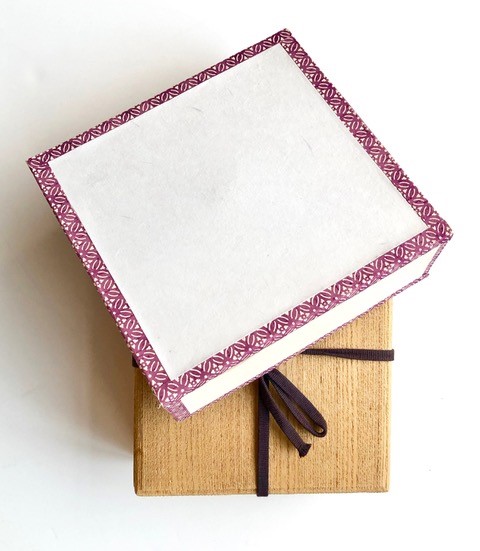
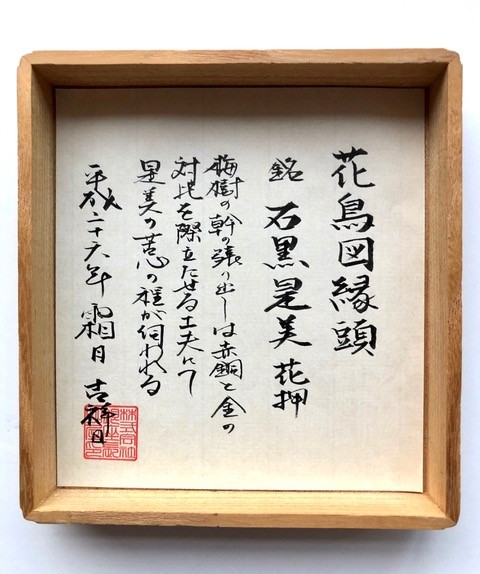
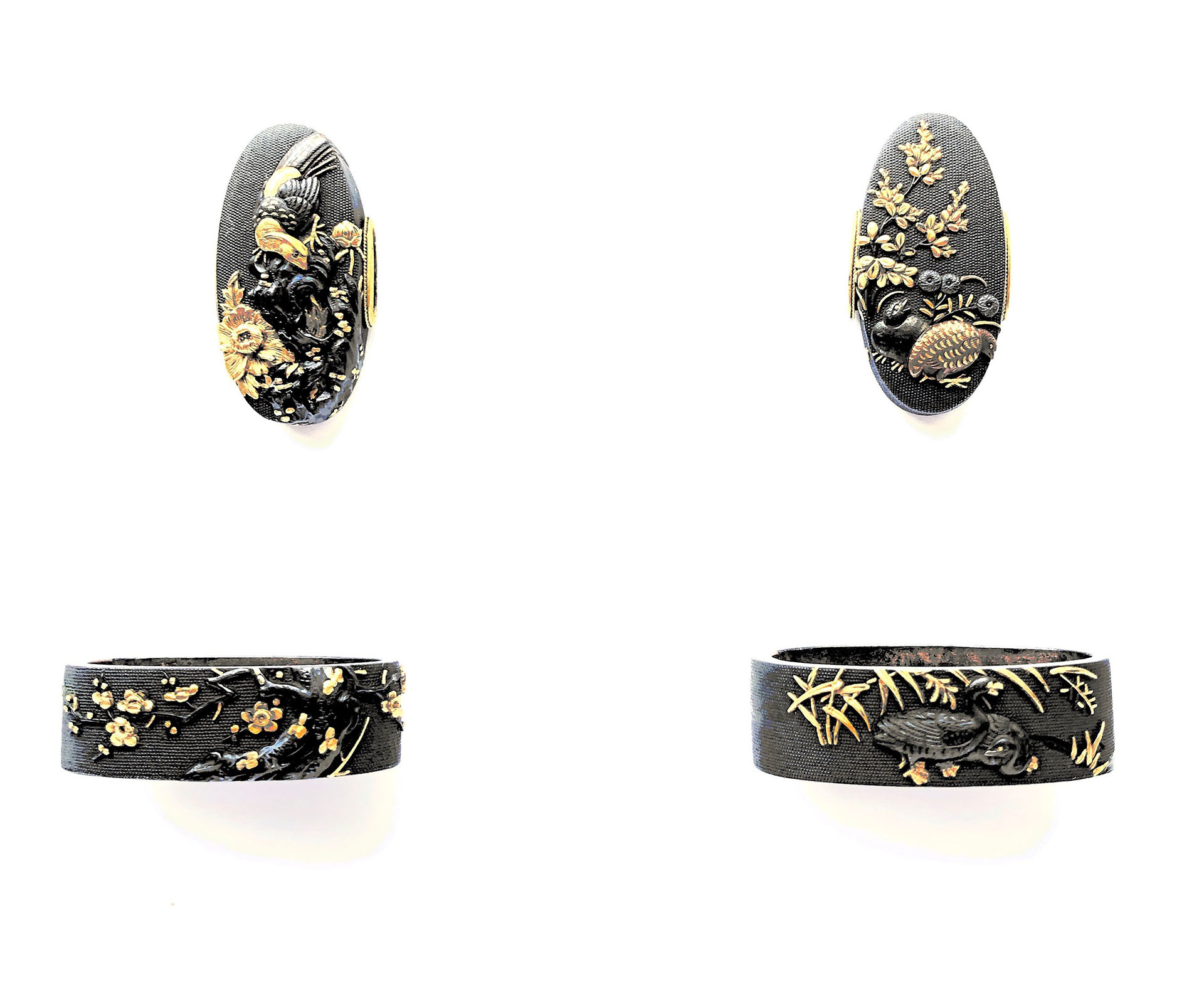
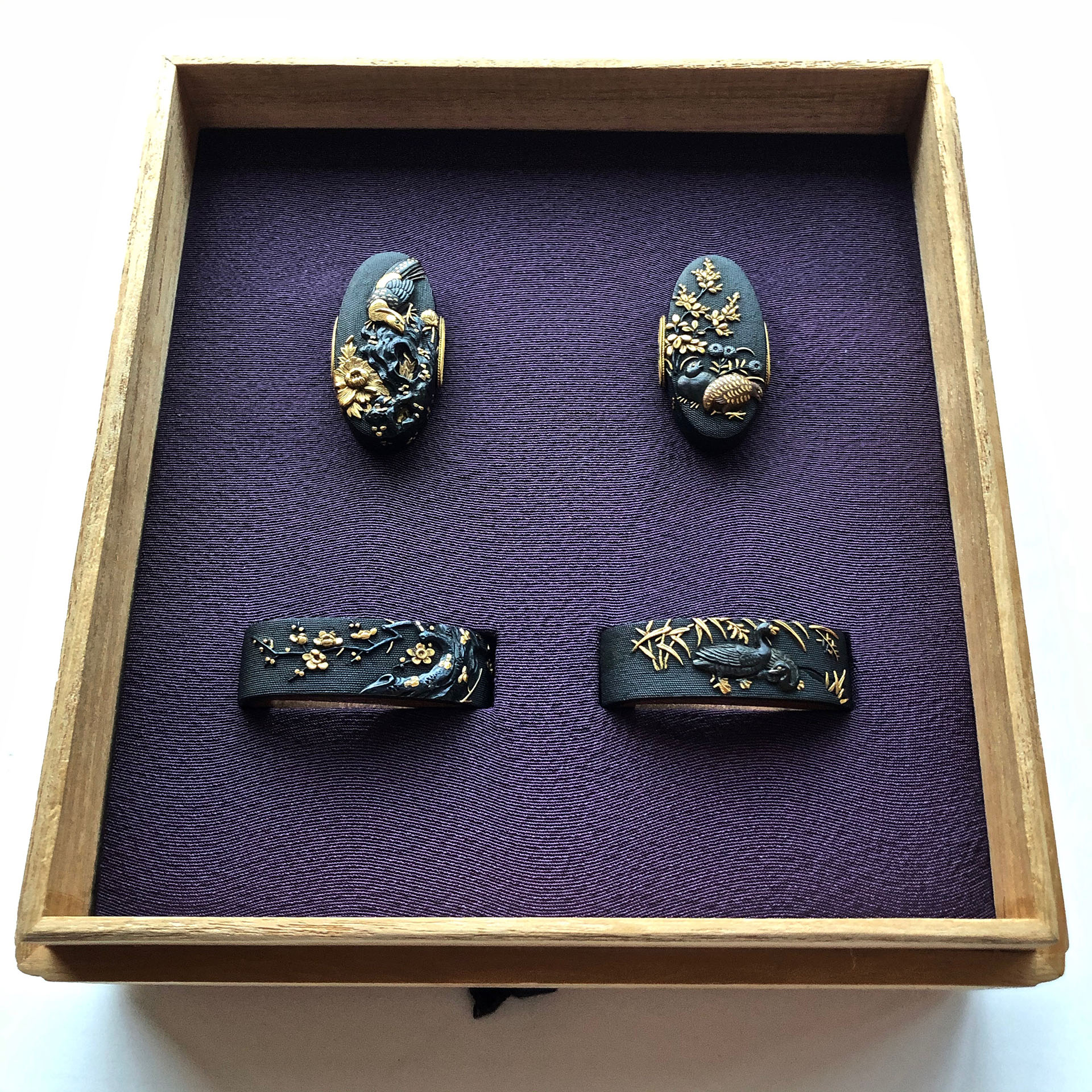
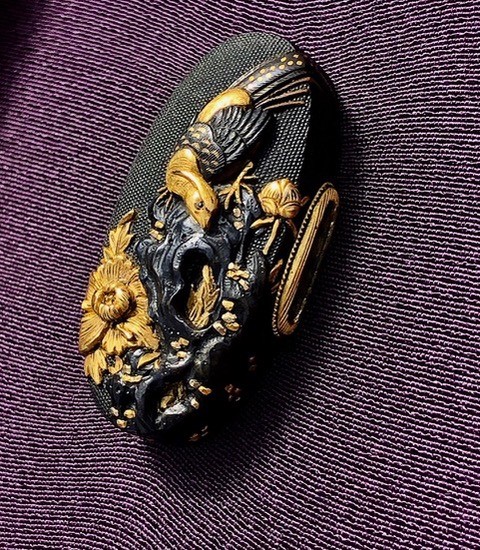
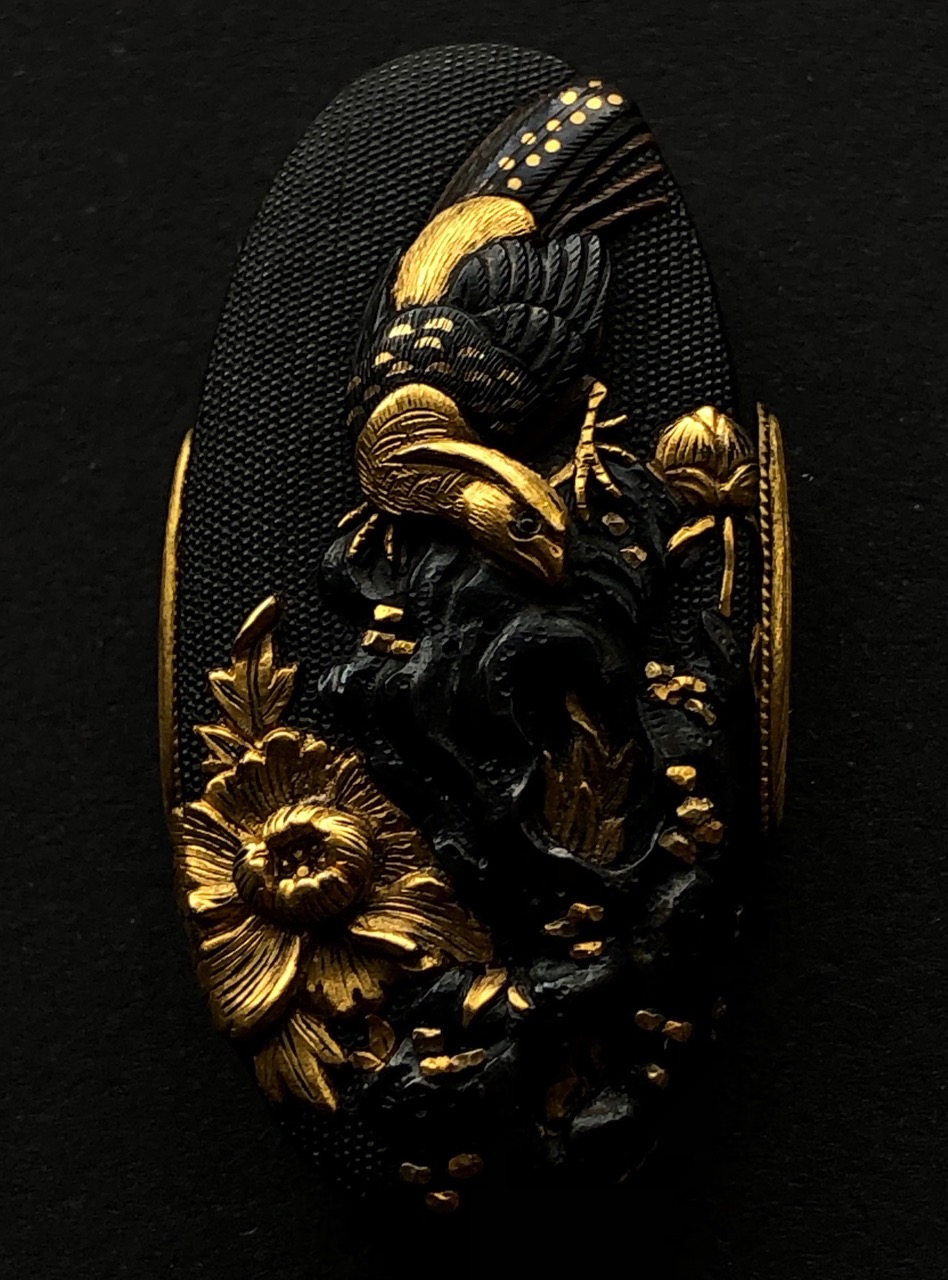
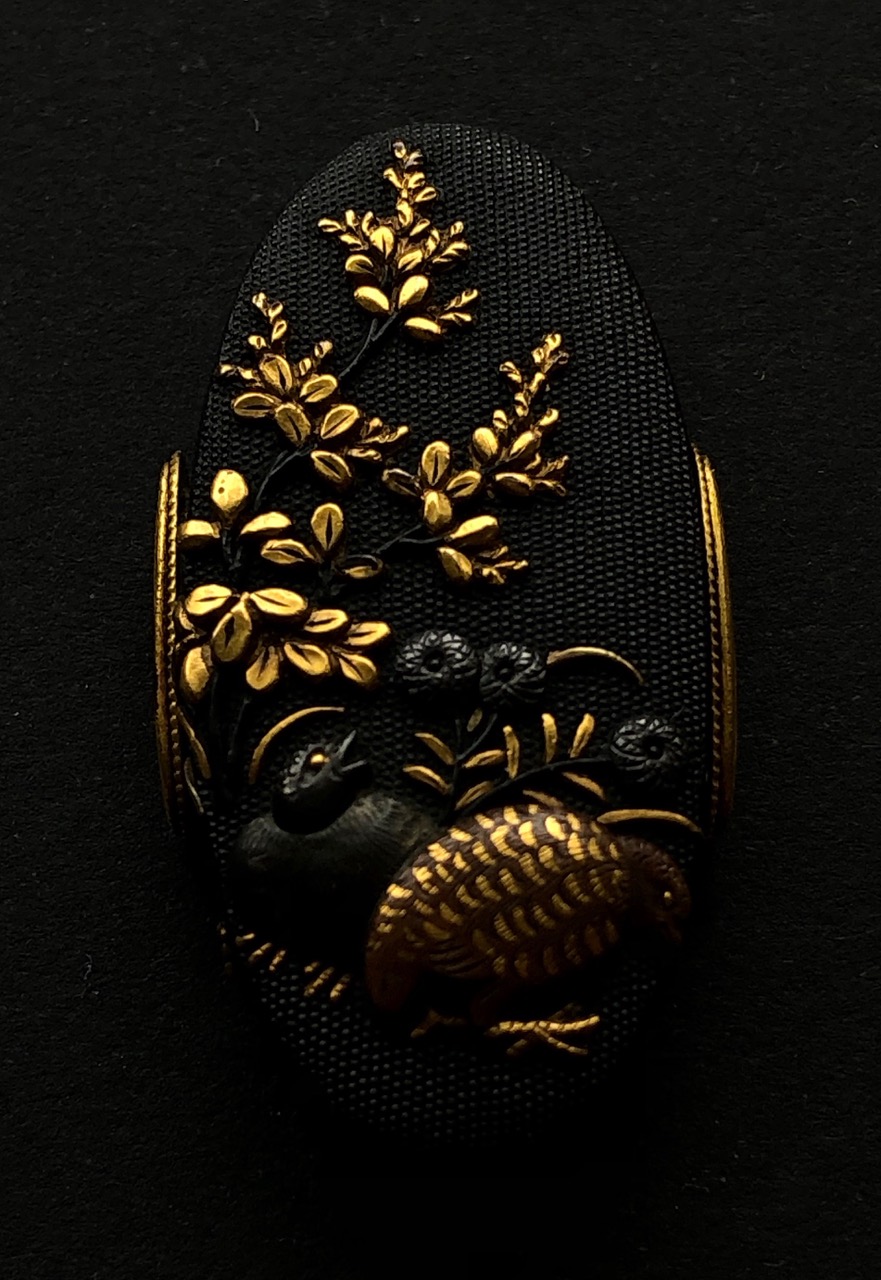
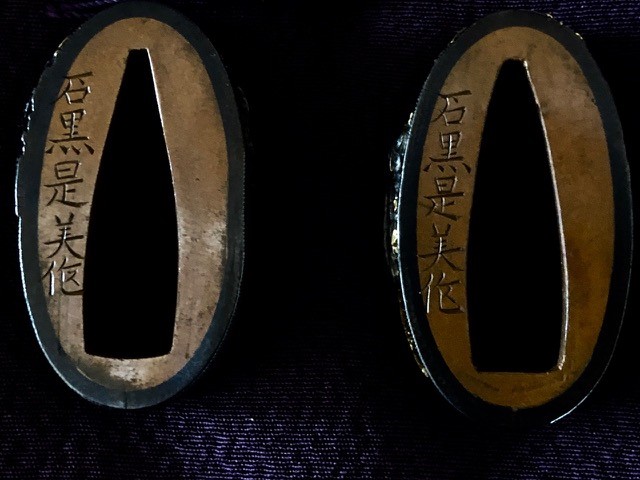
Setsumei: This is a rare Daisho set of FUCHIKASHIRA boxed in a special box with cover and calligraphy description on the inside of the box( There is translation below). ISHIGURO KOREYOSHI was a master craftsman of the Ishiguro school. Pheasants and Quail and ducks and sparrow are depicted with the utmost of detail executed. The set shows the various flowers and birds of the four seasons. The element’s are very skilfully arranged and provide a great sense of balance. This refined thematic approach, and the applied techniques of this masterwork truly reflect the great skills of ISHIGURO KOREYOSHI. The use of precious metals Gold, Silver, Shakudo and minute detail on the perfectly executed Nanako and abundance of colouring on such a small and define area and in terms of how the chisel and the iroe was applied this set testifies to the fact that Koreyoshi had certainly succeeded the highest artistic approach. Please, note that images cannot display the intricate detail on these like actually holding them by hand and viewing them with the human eye. For such detail on these Fuchikashira of such small size: Fuchi are 3.8 cm length, 2.1 cm width. The Kashira are3.4 cm length, 1.8 cm width. These are absolutely splendid and a great work of art of the highest order. The set comes with NBTHK Hozon Certificate to authenticate this to be the work of Ishiguro Koreyoshi (This item has been sold) Inscription box (inside): 花鳥図縁頭 銘 石黒是美「花押」 梅樹の幹の張り出しは赤銅と金の 対比を際立たせる工夫にて 是美の苦心の裡が伺われる 平成二十六年霜月吉祥日 Kachō no zu fuchigashira Baiju no miki no haridashi wa shakudō to kin no taihi o kiwadataseru kōfu ni te Koreyoshi no kushin no ri ga ukagawareru. Heisei nijūrokunen shimotsuki kichijōnichi “Fuchigashira with flowers and birds motif. Signed: Ishiguro Koreyoshi + monogram The way the shakudō and gold create a contrast along the protruding stem of the plum tree truly reflects the diligence with which Koreyoshi designed this work. On a lucky day in November of 2014 [Seal of Ginza Chōshūya]”
NihontoWatchOffered by Connoisseur Arms
This piece has sold
19 on the market
Get an email when a new Ishiguro Koreyoshi piece hits the market.

Ishiguro
Edo
Signed
Hozon (NBTHK)
Machibori · Musashi
Ishiguro Koreyoshi was the son of Masayoshi, whom the NBTHK identifies as "a representative master of the Ishiguro school." His common name was Kanjiro, and he employed the art names Jukakushi and Kansai. Koreyoshi trained under Koretsune of the same school, and in forming his professional name took one character from his master Koretsune and one from his father Masayoshi — a gesture of lineage that bound the school's successive generations. Possessing, in the NBTHK's assessment, ability that "surpassed that of his father," Koreyoshi contributed together with Masayoshi to the continued prosperity of the Ishiguro lineage. Works bearing Tenpo-era dates are known, and his survival is confirmed as late as Meiji 20 (1887), placing him among the last major figures of the school's classical production.
Koreyoshi worked in the established Ishiguro idiom of takabori with iroe on shakudo nanako-ji grounds, yet brought to it a distinctive refinement of color and naturalistic observation. His bird-and-flower subjects — among which the golden pheasant may be called the school's hallmark — are rendered through meticulous chiselwork that achieves "great splendor without any vulgarity." He employed an unusually wide palette of inlay metals, including scarlet copper, silver, and suaka, deployed with what the examiners recognize as "an outstanding sense of color." His menuki display rounded sculptural carving (yobori) on gold grounds, while his kozuka and kogai feature the characteristic kin'ura (gold-backed reverse) of the Ishiguro workshop. In certain works, his approach takes on a naturalistic, sketch-like quality that sets his production apart from the more formal manner of his predecessors.
The NBTHK has consistently recognized Koreyoshi as an artist in whom the Ishiguro school's distinctive character finds its fullest late-period expression. His complete fitting sets are praised as works that leave "nothing of the Ishiguro school's distinctive character unexpressed," while his finest tsuba are described as achieving a brilliance "akin to the nishiki-e color woodblock prints then in vogue." Through a superb fusion of high-relief carving, richly modeled gold ornament[[c:1]], and polychrome inlay, Koreyoshi's production represents the summation of the Ishiguro tradition — works of "great visual mass and presence" that embody the school's legacy of sumptuous yet disciplined metalwork.
Where Koreyoshi stands among comparable artisans: across all of nihontō, and within tradition, era, and period. The tiers (Foremost · Leading · Major · Notable) weigh official designations from the NBTHK and Japan's Agency for Cultural Affairs, together with historical honors of lasting repute such as the Sansaku and Meibutsu-chō.
Select a lens to see how it's measured.
Machibori · Edo
19 pieces on the market now
The Ishiguro school was founded by Ishiguro Masatsune, born in Horeki 10 (1760), who trained under Kato Naotsune and Yanagawa Naomasa within the broader Yokoya lineage before establishing an independent atelier that would become one of the most celebrated machibori ("town carving") workshops of the late Edo period. Masatsune combined one character from each teacher's name to form his professional identity, and under the art name Togakushi he attracted a succession of gifted pupils -- Masayoshi, Masaaki, Koretsune (his eldest son), Koreyoshi, Masahide, and Masahiro -- who carried the school's distinctive manner through the final decades of the Tokugawa period and into the Meiji era. Centered in Edo, the Ishiguro lineage operated within the machibori sphere, producing fittings for discerning warrior-class and merchant patrons rather than under the hereditary commissions of the Goto iebori tradition, a commercial independence that fostered pictorial ambition and technical innovation. The collective technical identity of the Ishiguro school is defined by a painterly naturalism executed through takabori upon shakudo nanako-ji grounds, enriched by lavish polychrome iroe employing an unusually wide palette of colored metals -- gold, silver, shibuichi, suaka (scarlet copper), oborogin, and hi-irodo. The school's signature subjects are kacho-zu (flowers and birds), rendered with a naturalistic, sketch-like fidelity grounded in close observation from life. Masatsune established this direction, transforming the Yanagawa manner into a personal idiom centered on birds of prey and bird-and-flower compositions that became the hallmarks of the house. His works are characterized by an "honest, finely detailed manner" and a "clear and limpid spirit" achieved through masterful use of open space. Masayoshi, who succeeded as third head, brought the school's painterly idiom to its fullest expression: front and reverse surfaces are linked through continuous branches and contrasting water motifs, male and female birds are paired with deliberate compositional care, and the interplay of a-un expression lends narrative depth to each scene.
His compositions on iron migaki-ji grounds demonstrate equal command, with kin-sunago zogan evoking atmospheric haze. " Koretsune served as vital link between the founder and the school's later flourishing, with takabori described as "dignified and sumptuous, yet steadfast and reliable," and a command of perspective achieved by subtly modulating surface depth. Koreyoshi, credited with ability "surpassing that of his father" Masayoshi, brought the school's character to its fullest late-period expression, producing work likened to the nishiki-e color woodblock prints of the age. The Ishiguro school's significance within the tosogu canon rests upon its transformation of the Yokoya-Yanagawa classical discipline into a pictorial art of extraordinary chromatic richness and compositional sophistication. Where earlier metalworking traditions relied predominantly on monochrome shakudo or gold tonalities, the Ishiguro masters deployed polychrome iroe with a sumptuousness "that never lapses into vulgarity" -- a balance of brilliance and restraint that defines the school's aesthetic. Masatsune's founding generation retained a martial vigor suited to warrior taste that distinguished his work from the "more purely ornamental output of later Ishiguro artists," while the successive generations of Masayoshi, Masaaki, and Koreyoshi progressively refined the school's decorative vocabulary toward an opulence that mirrored the cultural efflorescence of the Bunka-Bunsei era. Complete soroe-kanagu sets and unified issaku suites represent the school's highest achievement, demonstrating rigorous thematic coherence across every component of a mounting. The NBTHK has consistently praised the school's finest works as pieces in which "the Ishiguro school's distinctive character" is left "nothing unexpressed," and the tradition's enduring legacy is that of a workshop which, across four generations, brought the art of polychrome metalwork to its most accomplished and visually resplendent expression in Edo-period Japan. Learn more →
| Smith | Era | Designated |
|---|---|---|
| Masayoshi政美 | — | 30 |
| Masatsune政常 | — | 17 |
| Masaaki政明 | — | 18 |
| Koretsune是常 | — | 4 |
| Koreyoshi是美 | — | 4 |
Certifies a genuine fitting worth preserving: a correct signature, or, if unsigned, an identifiable era and school, with recognized artistic and craft value.
The NBTHK (Nihon Bijutsu Tōken Hozon Kyōkai, the Society for the Preservation of Japanese Art Swords) is a public-interest incorporated foundation founded in 1948 and supervised by Japan’s Agency for Cultural Affairs (Bunkachō); it is based at the Japanese Sword Museum in Tokyo. Its expert panels physically examine each submitted work (shinsa) and issue a certificate (kanteishō) ranking it by artistic and historical merit. NBTHK papers are the most widely recognized standard of authentication for Japanese swords and fittings.
NBTHK official sitePurchases are final and items cannot be returned unless otherwise stated.