 NihontoWatchNihontoWatch
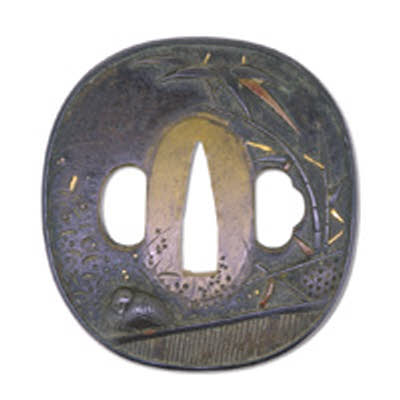
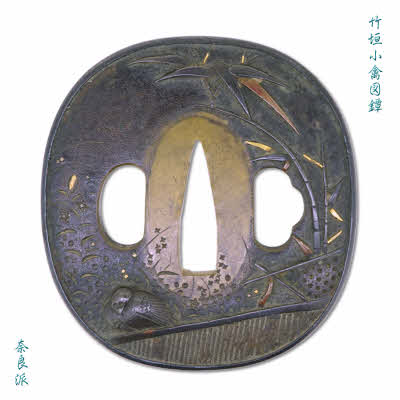
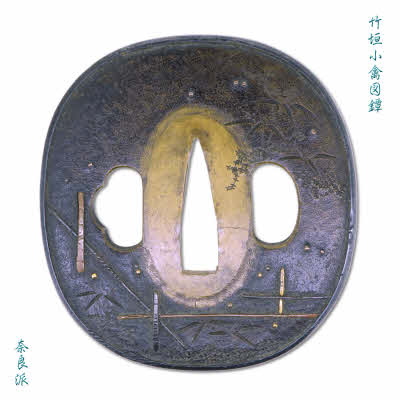
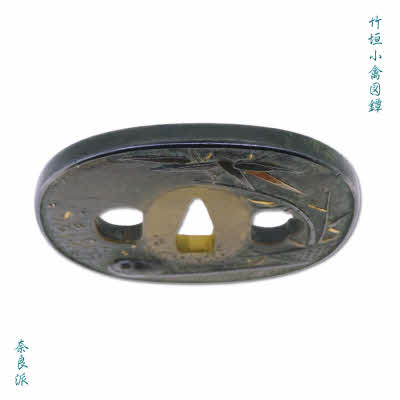
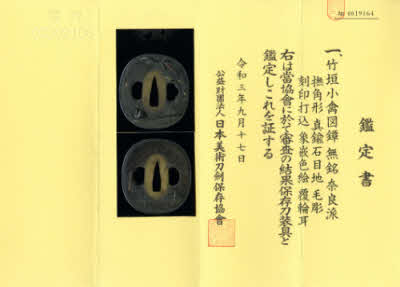
The Nara school occupied a position as one of the three major lineages in the world of metalwork, alongside the Goto family and the Yokoya school. This school enjoyed fame as Machi-bori artists who applied realistic engraving to unconventional materials such as brass, featuring free-spirited and innovative motifs. Using a sophisticated takabori technique, yamagane iroe is applied to the toes of the small bird of prey perched on the bamboo fence, while in the far distance, bamboo grass is rendered with shakudo, yamagane, and gold takabori zogan iroe to create a sense of perspective. Perhaps puffing out its feathers due to the cold, behind the lovely small bird, autumn grasses are engraved with kebori and punch marks, with some parts extending to the seppa-dai. Silver is used for the stigmas of the flowers, and gold tama-zogan is applied for the morning dew. On the reverse, perhaps a scene within a residence, bamboo grass planted in a miniature garden is carved with katakiri-bori, with gold and yamagane tama-zogan representing morning dew. The ishime-ji brass substrate is exquisitely colored to create a serene space. A masterpiece Nara school tsuba that has sublimated a realistic pictorial motif with supreme skill. Late Edo period
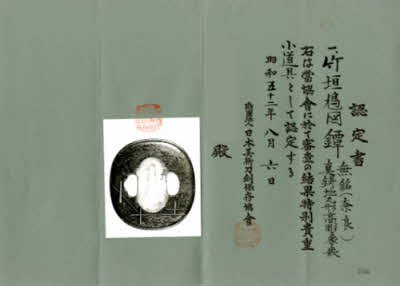
Certificate reading — 無銘(奈良派)
NihontoWatchOffered by Sanmei
80 on the market

Machine translation from the shop's Japanese · may contain errors ·
Machibori · Edo
80 pieces on the market now
The Nara school of kinko (metalwork) emerged in the mid-Edo period as one of the most celebrated independent traditions of sword-fitting craftsmanship, its masters working outside the patronage structures that governed the Goto house. The school coalesced around the figure of Nara Toshihisa (1667--1736), also known as Tahee, who as head master during its creative zenith defined the mature idiom of the lineage. Though the school's origins are often traced through the successive generations of the Nara family beginning with Toshiharu, its lasting fame rests upon the Nara sansaku — the Three Masters of Nara: Toshihisa, Tsuchiya Yasuchika, and Sugiura Joi. " Joi (1701--1761), trained under Juei in the lineage of Toshiharu, rose to become the third pillar of this triumvirate. Together, and joined by masters of allied lineages such as Hayashi Shigemitsu of the Higo kinko tradition, the Nara school and its circle represent the highest achievement of independent metalwork in the Edo period. The collective technical vocabulary of the Nara school encompasses an extraordinary breadth of materials and methods. Its masters worked in iron, shakudo, shibuichi, brass (shinchu), refined copper (suaka), and oborogin, treating surfaces as polished grounds (migaki-ji), hammered textures (tsuchime-ji), and stone-grain finishes (ishime-ji) — the latter developed by Toshihisa into a distinctive personal manner. The school's carving methods span the full spectrum: sukidashi-bori modeled relief, takabori high relief, the thread-fine line work of kebori, and the single-stroke katakiribori incision. " Yet individual specialties distinguish the masters within this shared vocabulary.
Toshihisa's art finds its fullest expression in sukidashi takabori — relief carving in which figures are raised with subtly graduated heights to produce an illusion of spatial depth — executed against his richly textured ishime-ji grounds. Joi developed nikuaibori, a modulated relief technique of unrivaled refinement, producing entire compositions through chisel work alone on polished oborogin grounds, dispensing with inlay and colored-metal accents. Yasuchika's range is perhaps the broadest, encompassing the distinctive daigaku-gata iron tsuba conceived for his patron and kozuka that "draw forth a small universe" within a confined surface, while his late works signed with the art name Tou achieve an austere, detached realm the NBTHK terms kotan. The legacy of the Nara school rests on the singular ability of its masters to transcend decorative function and achieve genuine artistic expression within the confines of sword fittings. Toshihisa, as the senior figure among the sansaku, established the standard of dignified, powerfully carved relief against richly textured grounds, and his figural subjects — gamecocks, tigers, Bishamonten — consistently achieve what NBTHK scholarship identifies as the philosophical duality of do (movement) and sei (stillness) within a single composition. " Joi, working primarily in the intimate format of the kozuka, achieved expressive authority through the sheer subtlety of his nikuaibori chisel work — his celebrated lion-and-cub compositions existing in closely related versions across multiple designations and published in the canonical reference Tagane no Hana. That the school also attracted masters of allied provincial traditions — Hayashi Shigemitsu of Higo, whose iron tsuba display the characteristic murasaki-sabi patina and "somewhat gentler feeling" that distinguishes the second generation from the founder Matahichi — attests to its gravitational influence on Edo-period metalwork as a whole. Across the school's production, the NBTHK's evaluative language converges on a consistent theme: compositional intelligence, technical command across the full range of materials and carving methods, and an expressive depth that elevates the finest works from accomplished craft to art of the highest order. Learn more →
| Smith | Era | Designated |
|---|---|---|
| Yasuchika安親 | — | 87 |
| Toshinaga利寿 | — | 30 |
| Joi乗意 | — | 12 |
| Minzan谺珉山 | — | 1 |
| Toshiyoshi利善 | — | 0 |
Certifies a genuine fitting worth preserving: a correct signature, or, if unsigned, an identifiable era and school, with recognized artistic and craft value.
The NBTHK (Nihon Bijutsu Tōken Hozon Kyōkai, the Society for the Preservation of Japanese Art Swords) is a public-interest incorporated foundation founded in 1948 and supervised by Japan’s Agency for Cultural Affairs (Bunkachō); it is based at the Japanese Sword Museum in Tokyo. Its expert panels physically examine each submitted work (shinsa) and issue a certificate (kanteishō) ranking it by artistic and historical merit. NBTHK papers are the most widely recognized standard of authentication for Japanese swords and fittings.
NBTHK official siteFor a return, please contact us within 7 days of the item's arrival. If specification changes such as dimensions were made at the customer's request, a return cannot be accepted. Shipping and transfer fees are the customer's responsibility.
¥120,000