NihontoWatch MonNihontoWatch
Market
Encyclopedia
Kantei

Description

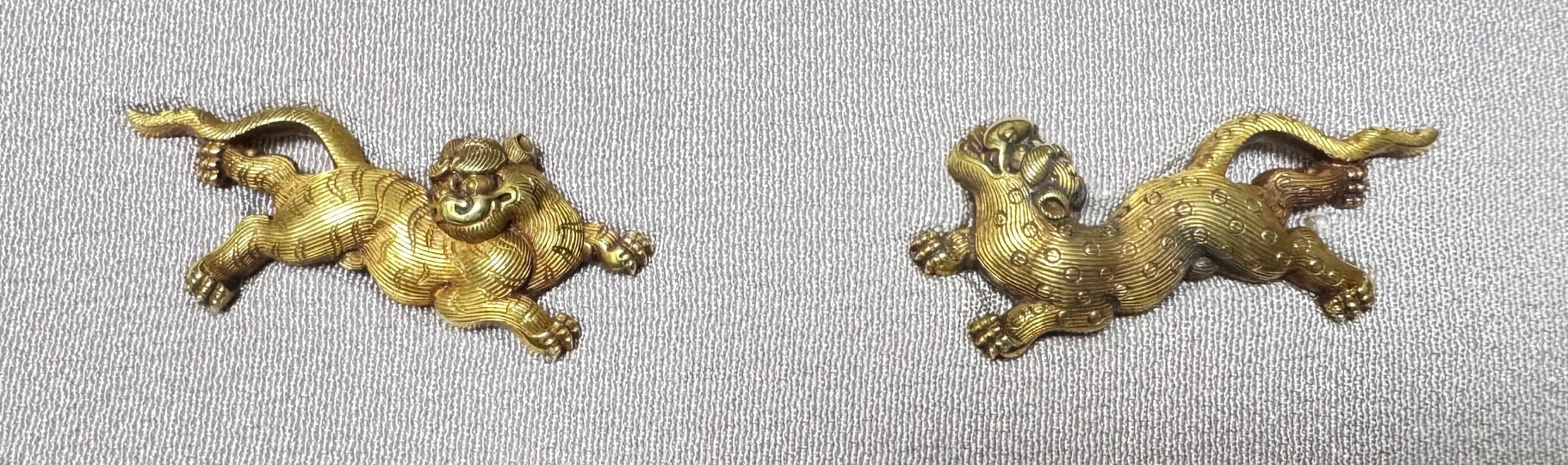
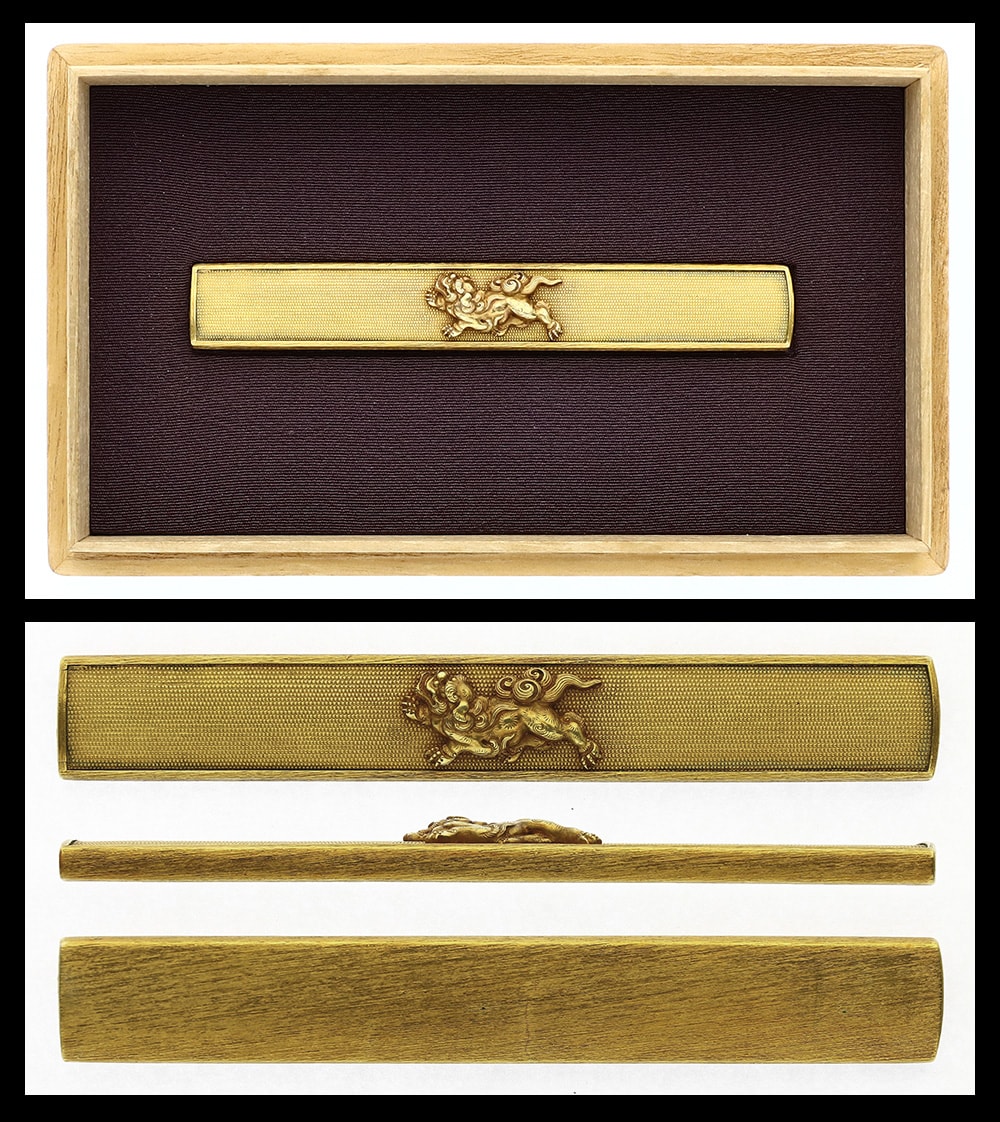
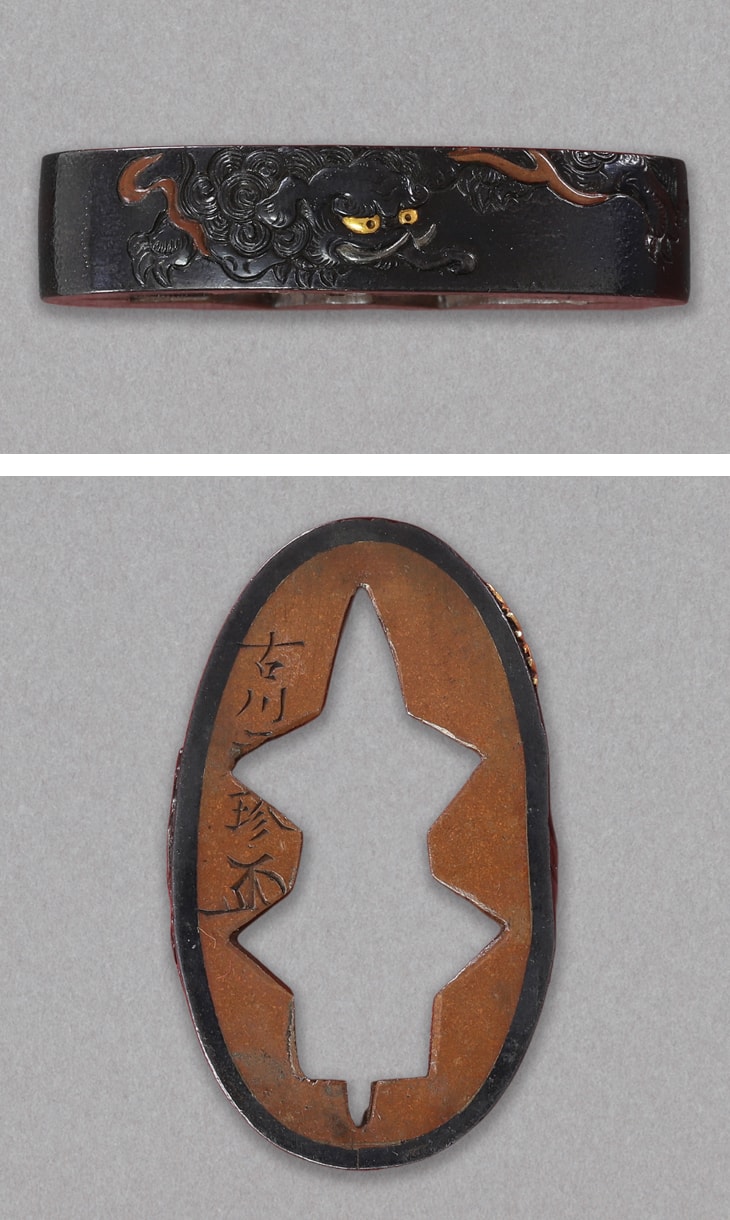
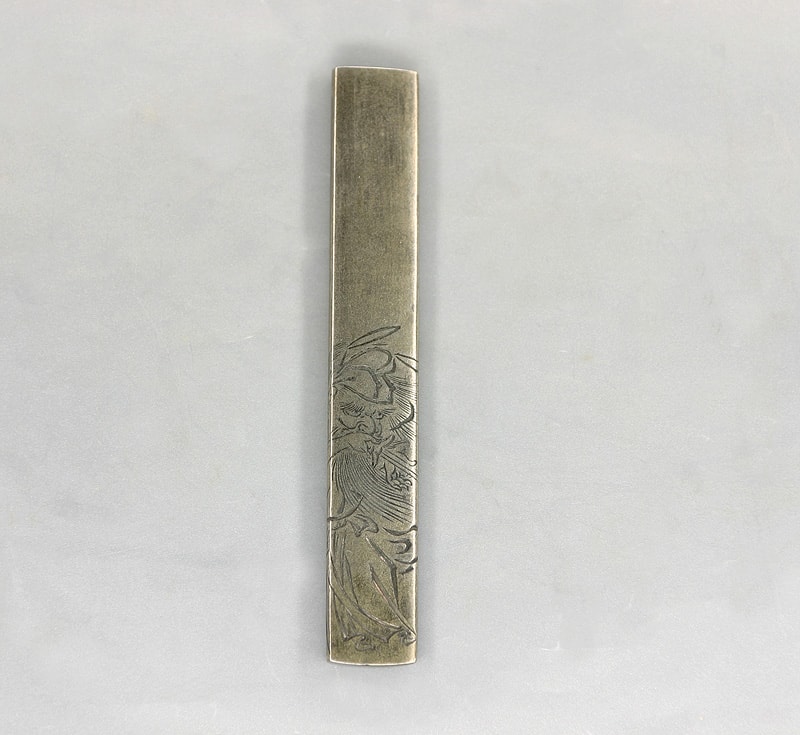
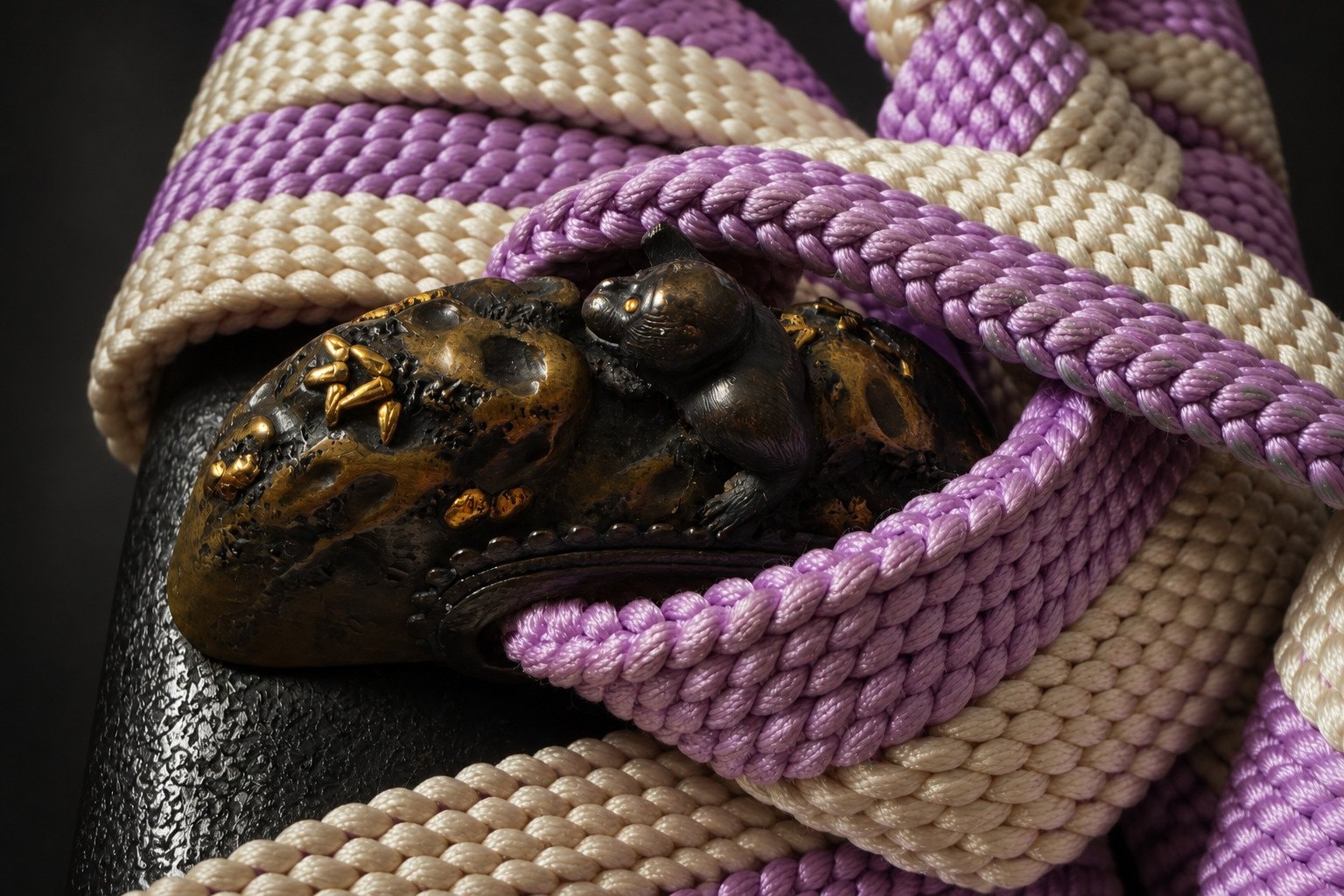
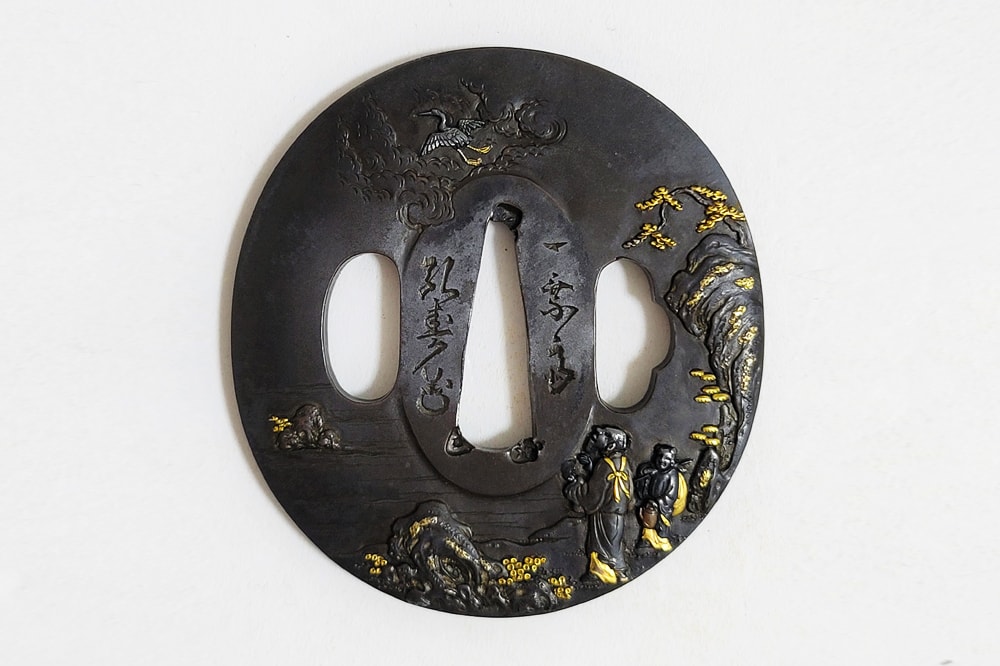
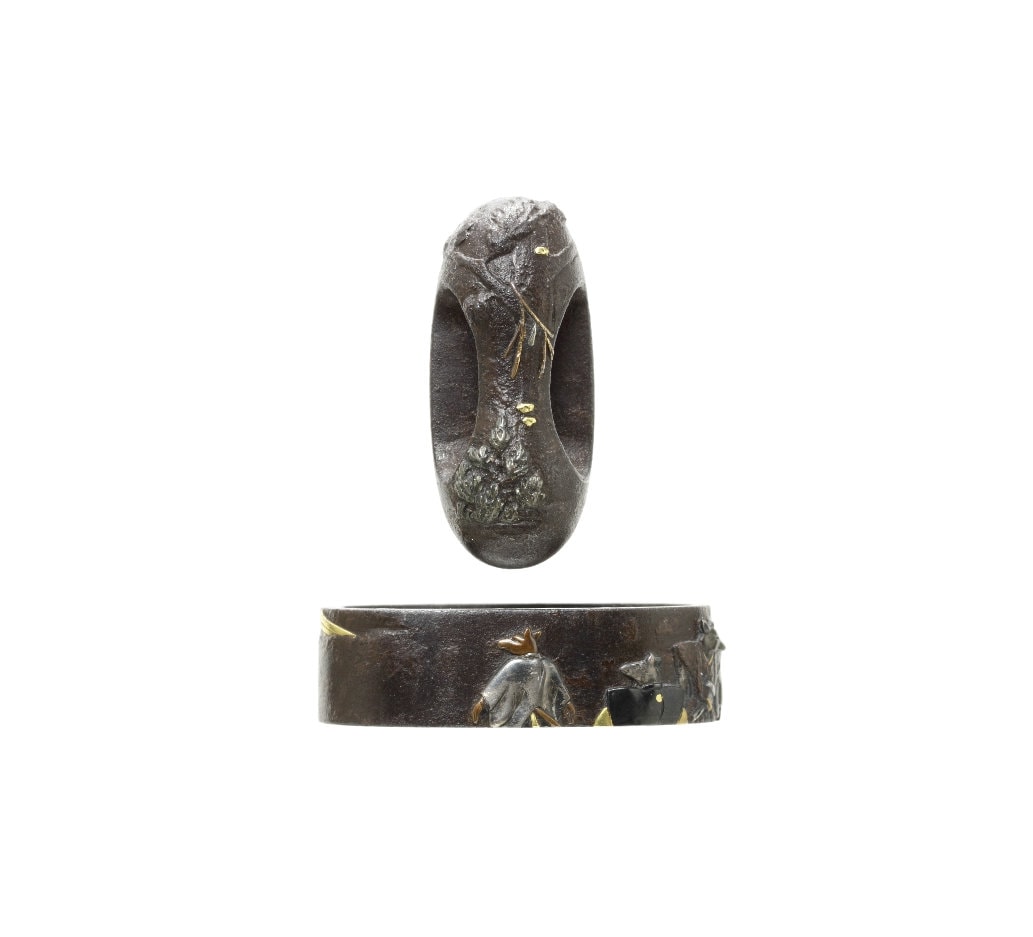
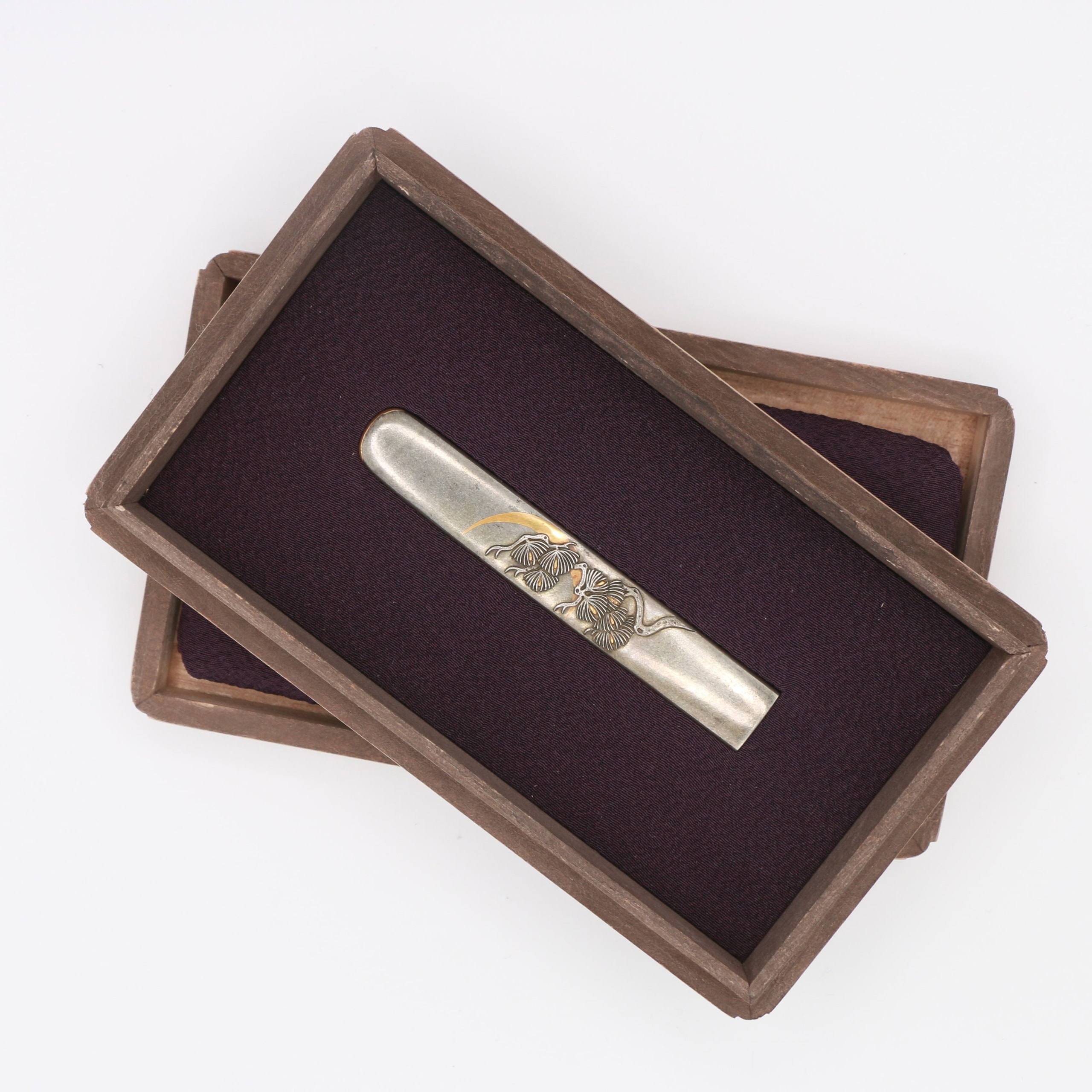
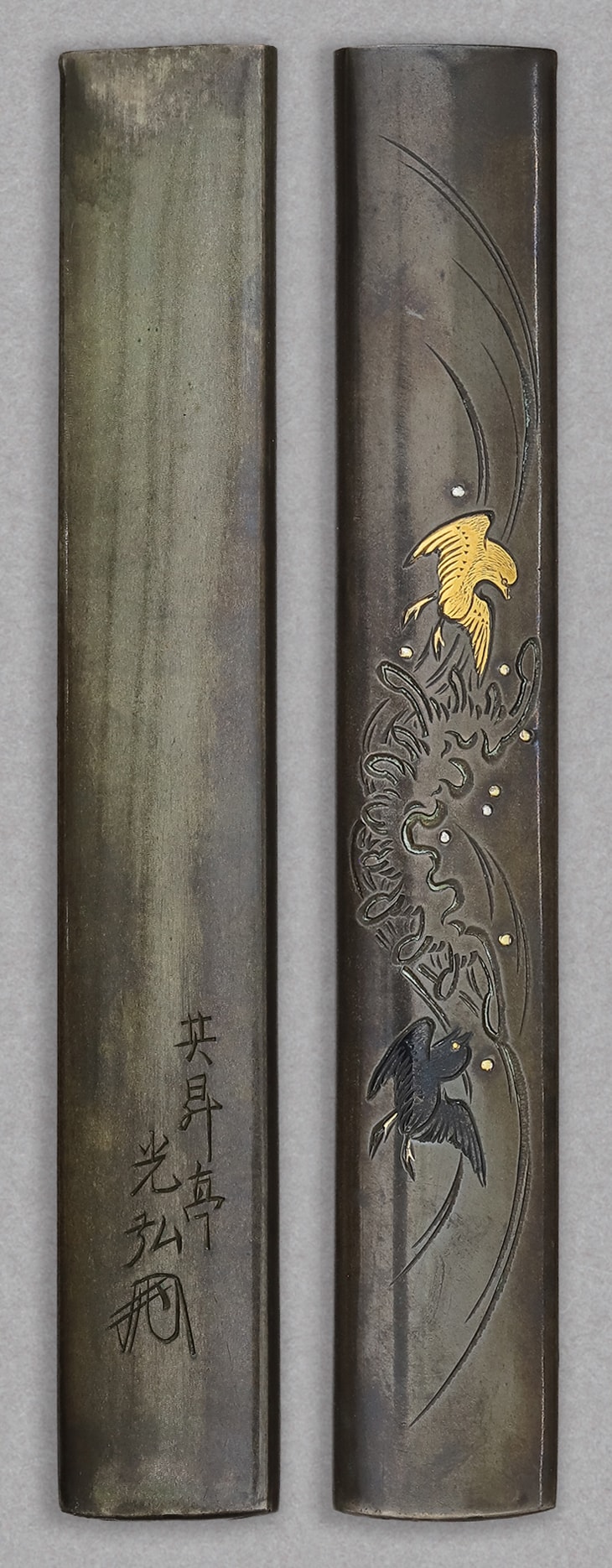
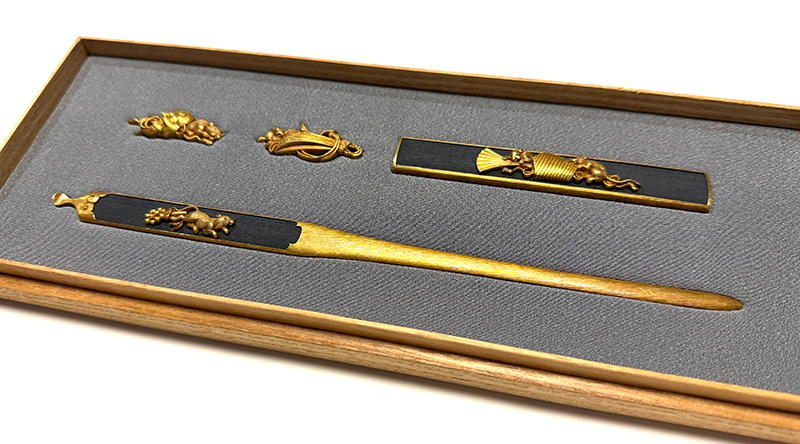
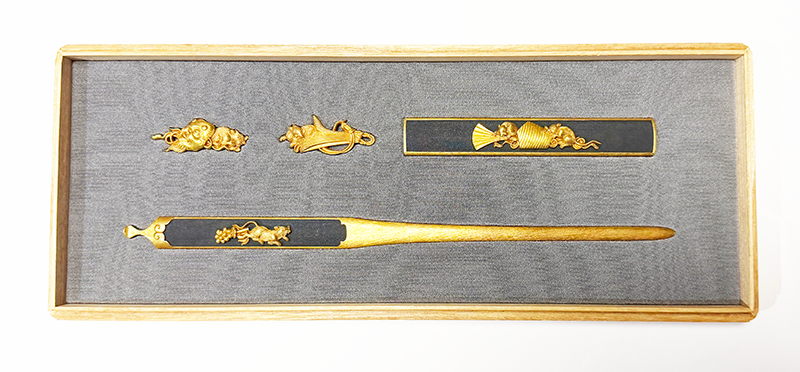
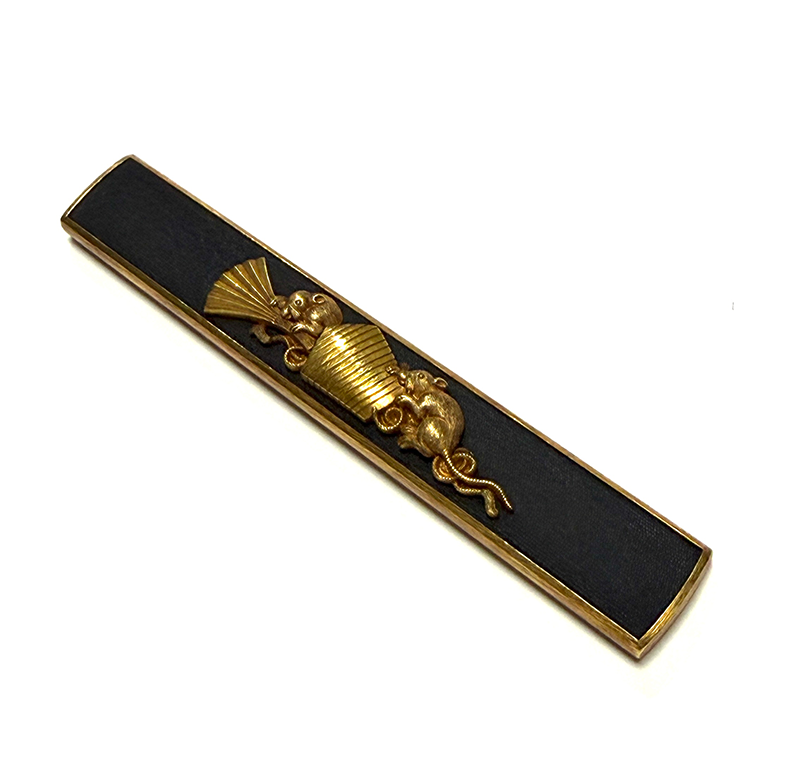
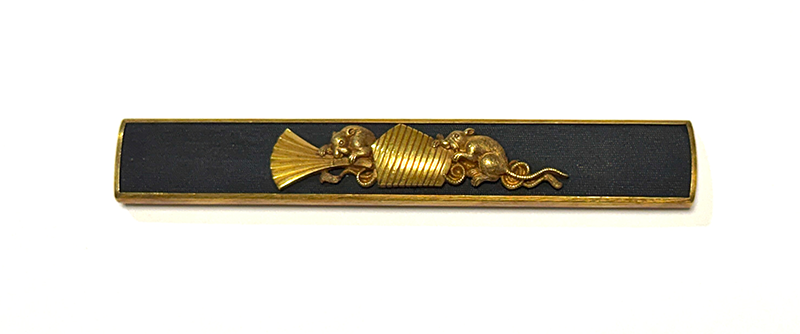
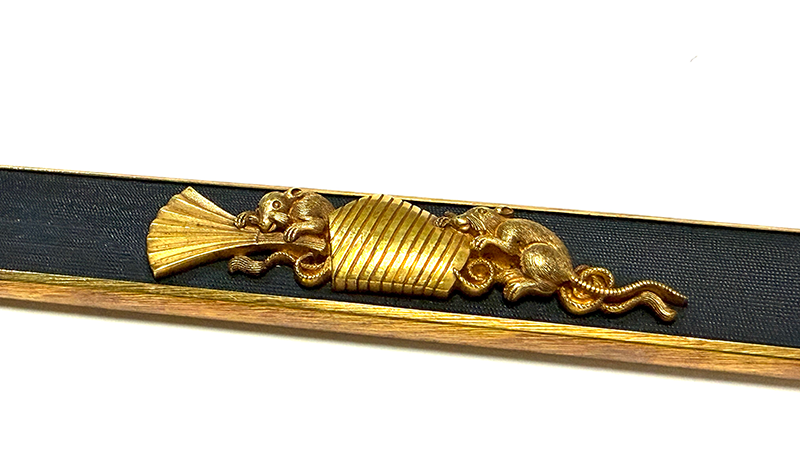
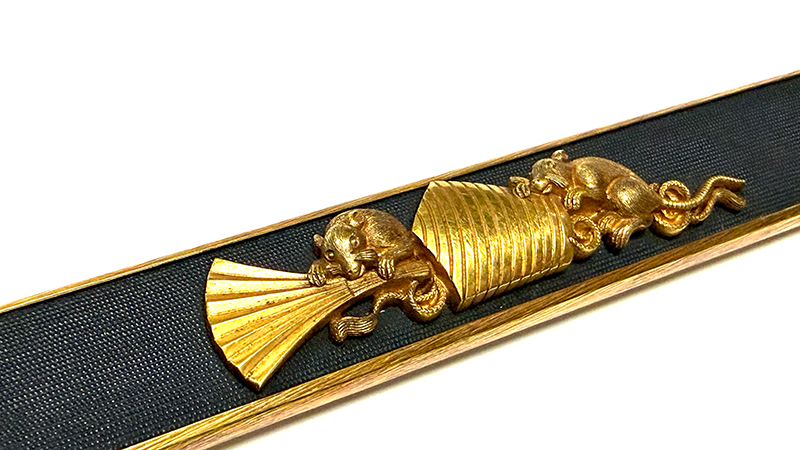
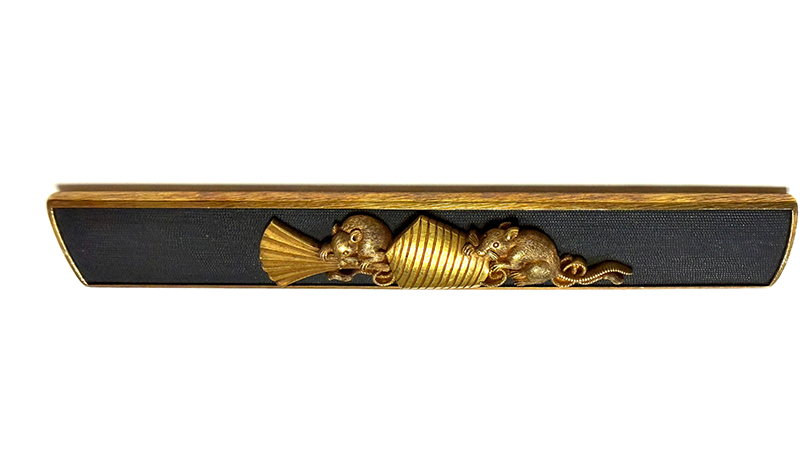
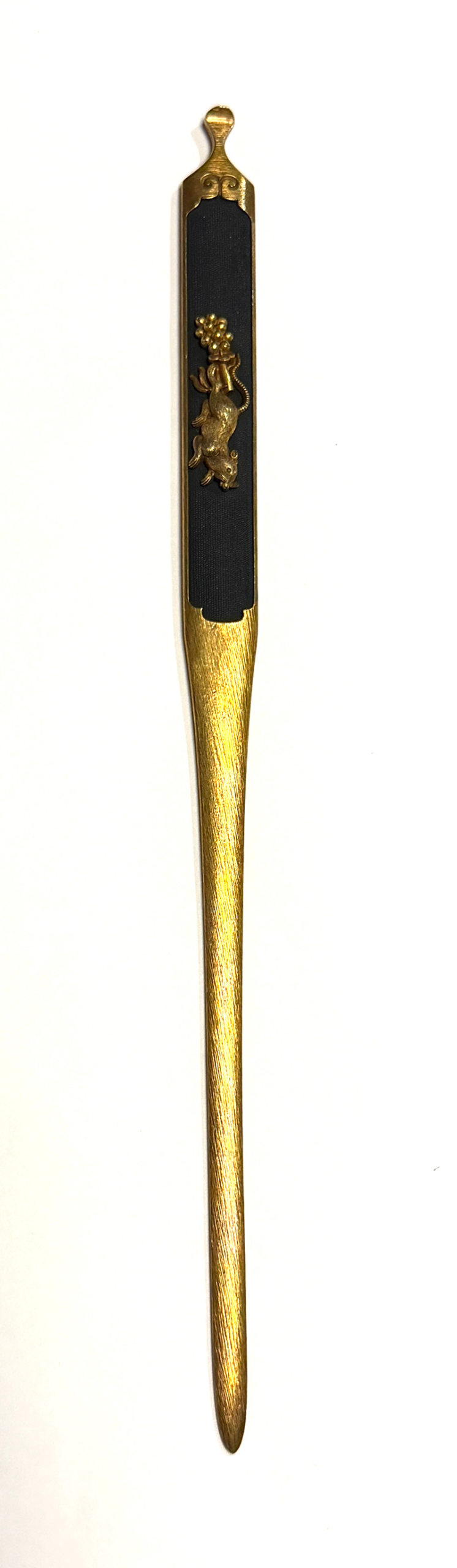
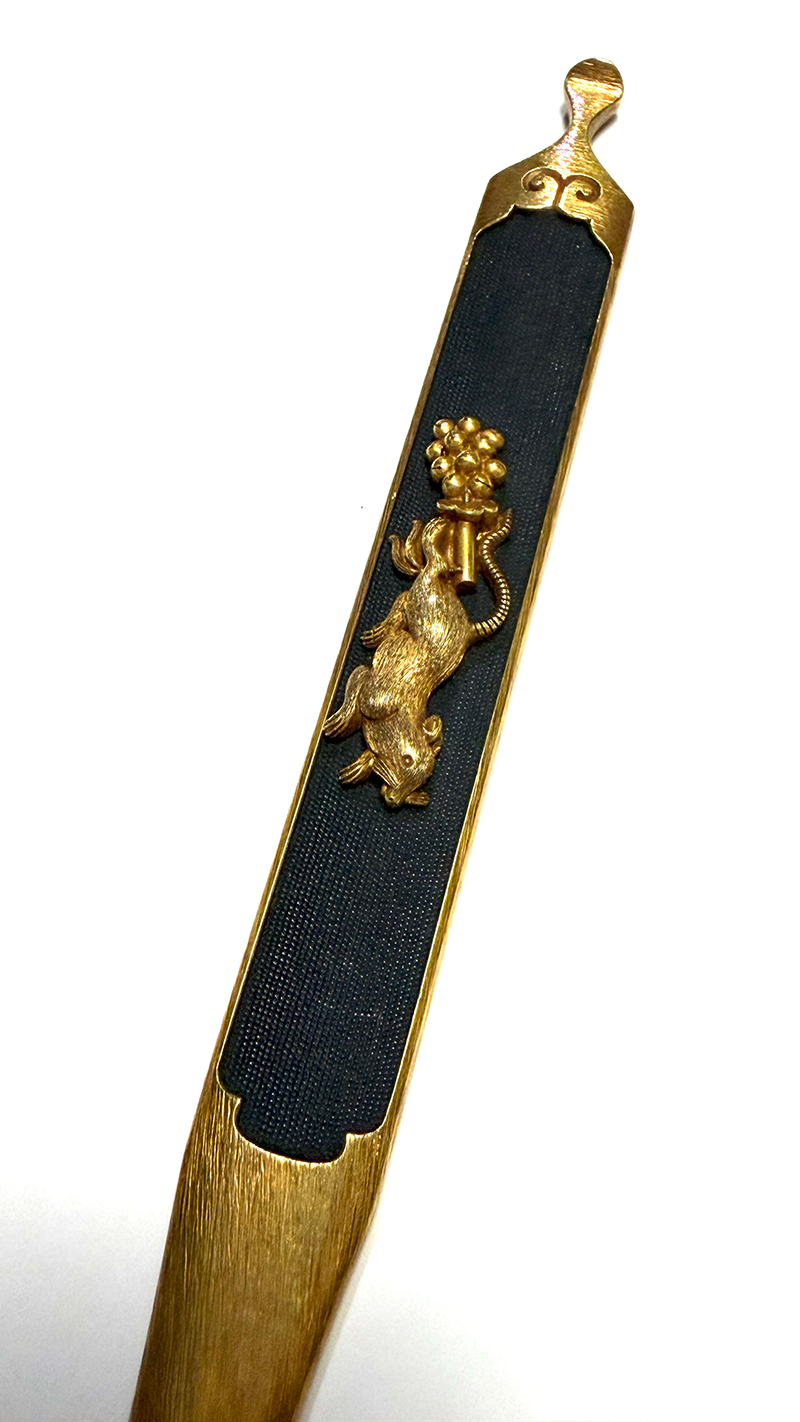
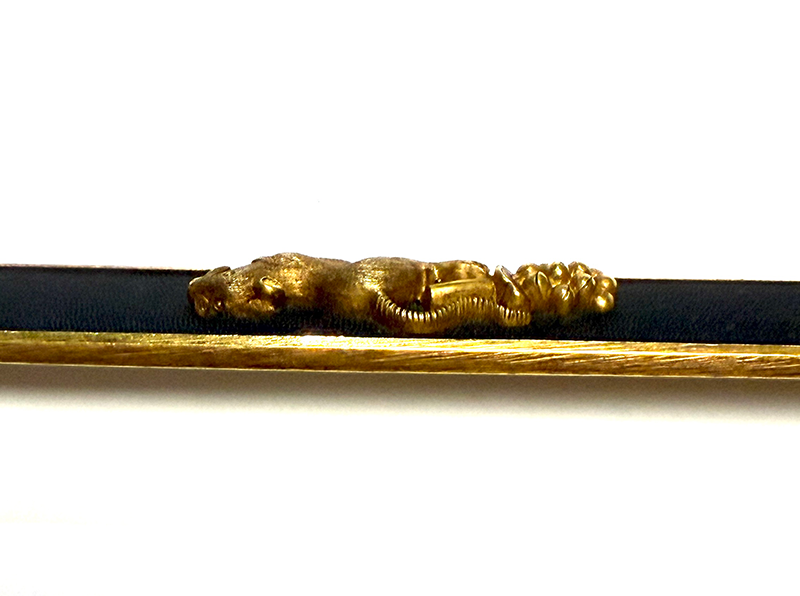
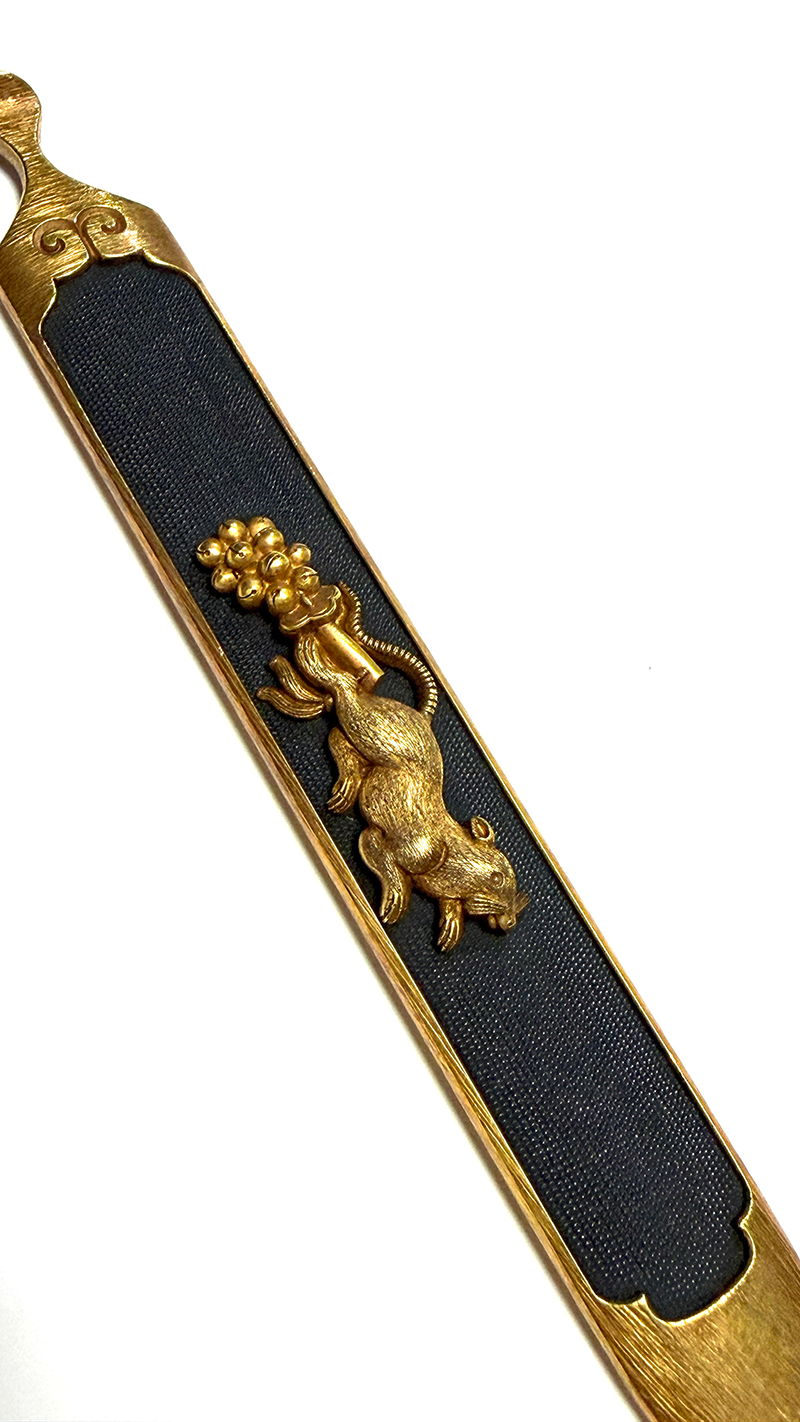
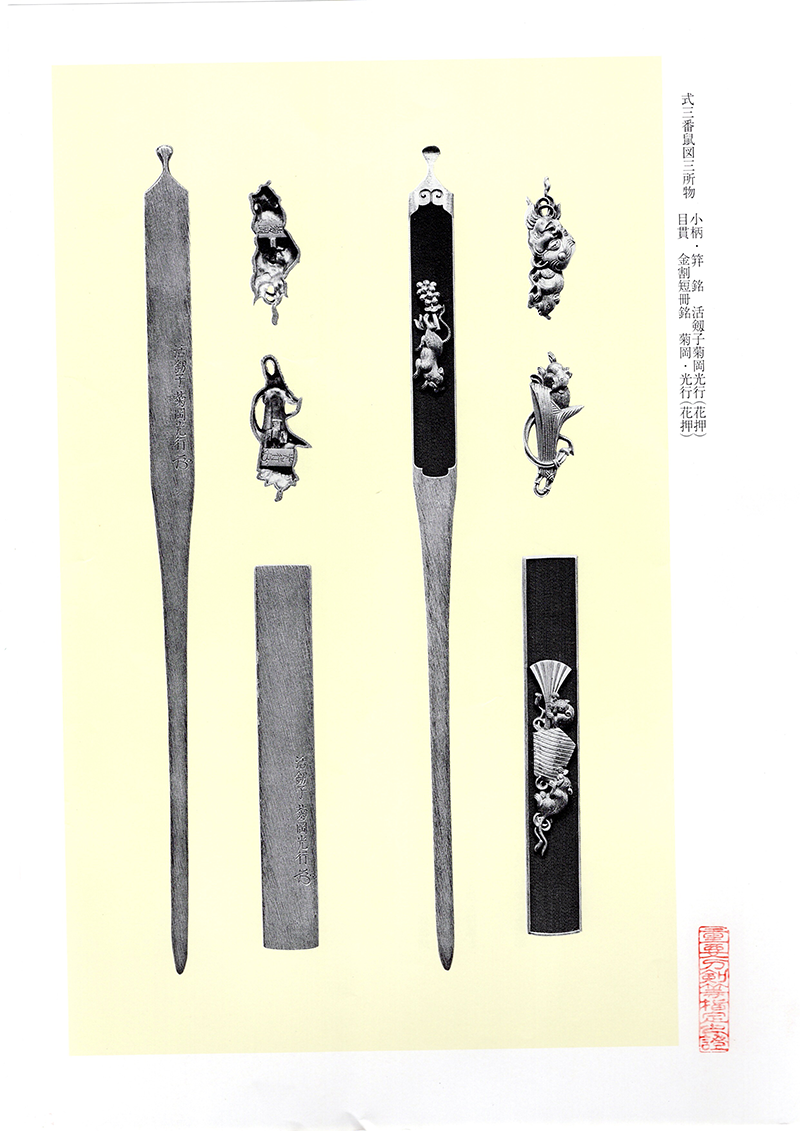
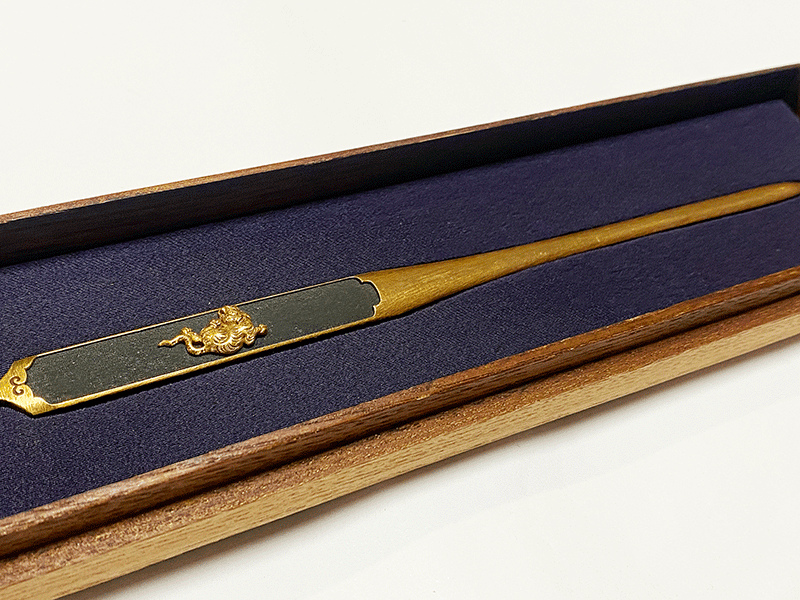
This is a Juyo Tosogu designated work by Kikuoka Mitsuyuki, a prominent metalworker of the Yokoya school and founder of the Kikuoka school. Born in Edo in 1750, Mitsuyuki was a pupil of Yanagawa Naomitsu and was also a renowned cultural figure and haiku master. The piece depicts mice playing with Noh props used in the Shikisanban (Okina) performance, symbolizing peace and abundant harvests.

NBTHK Setsumei

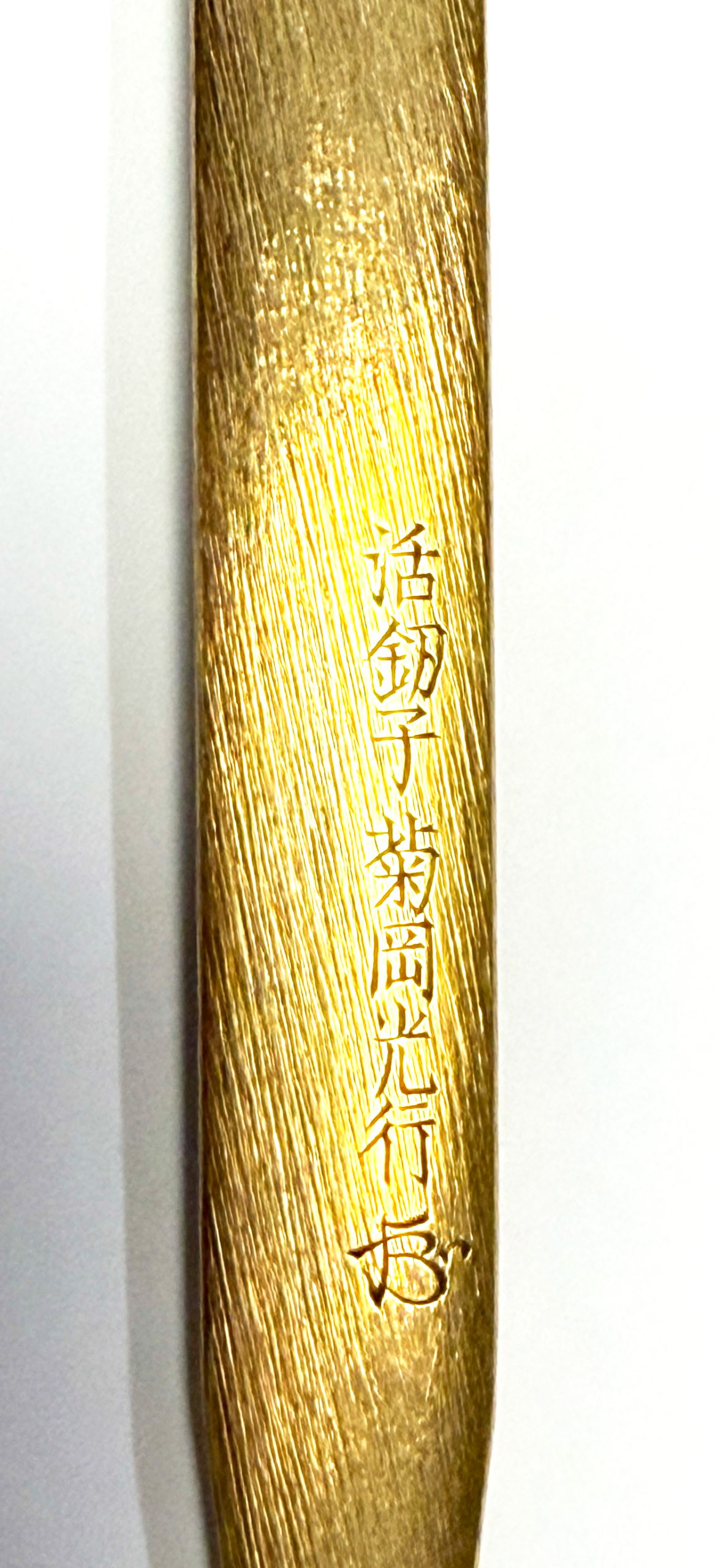
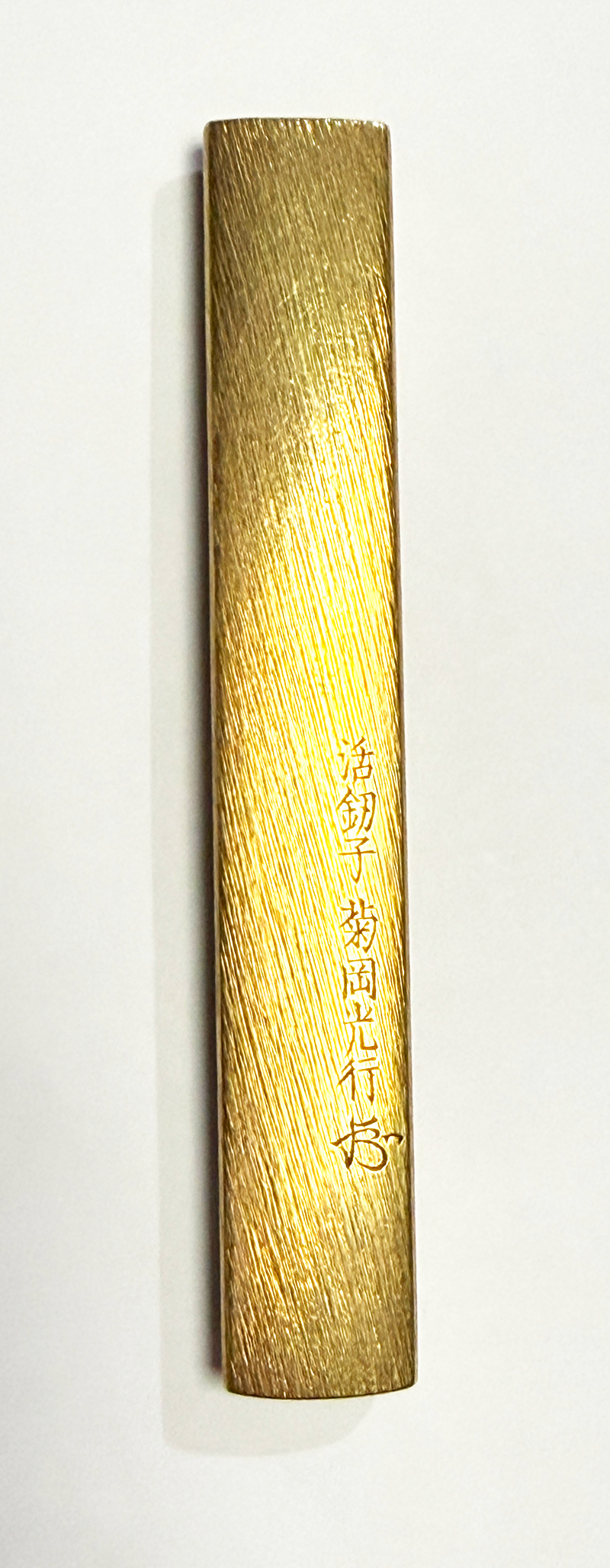
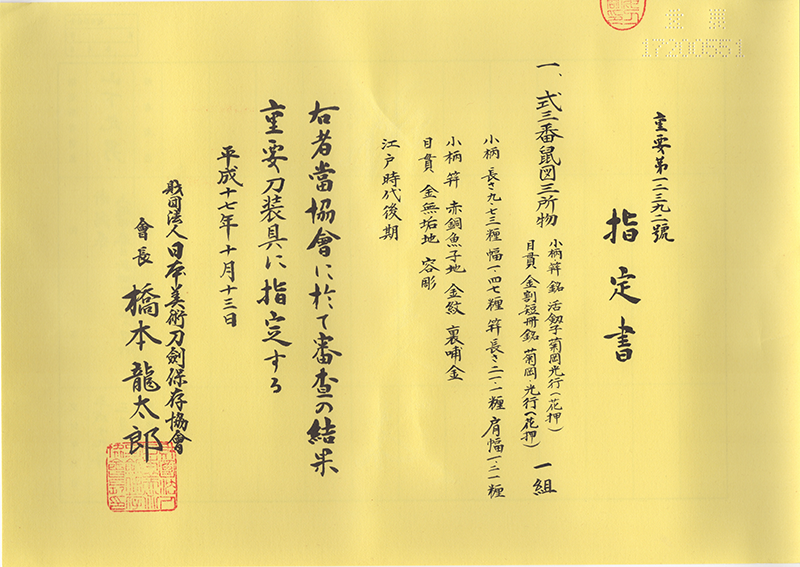
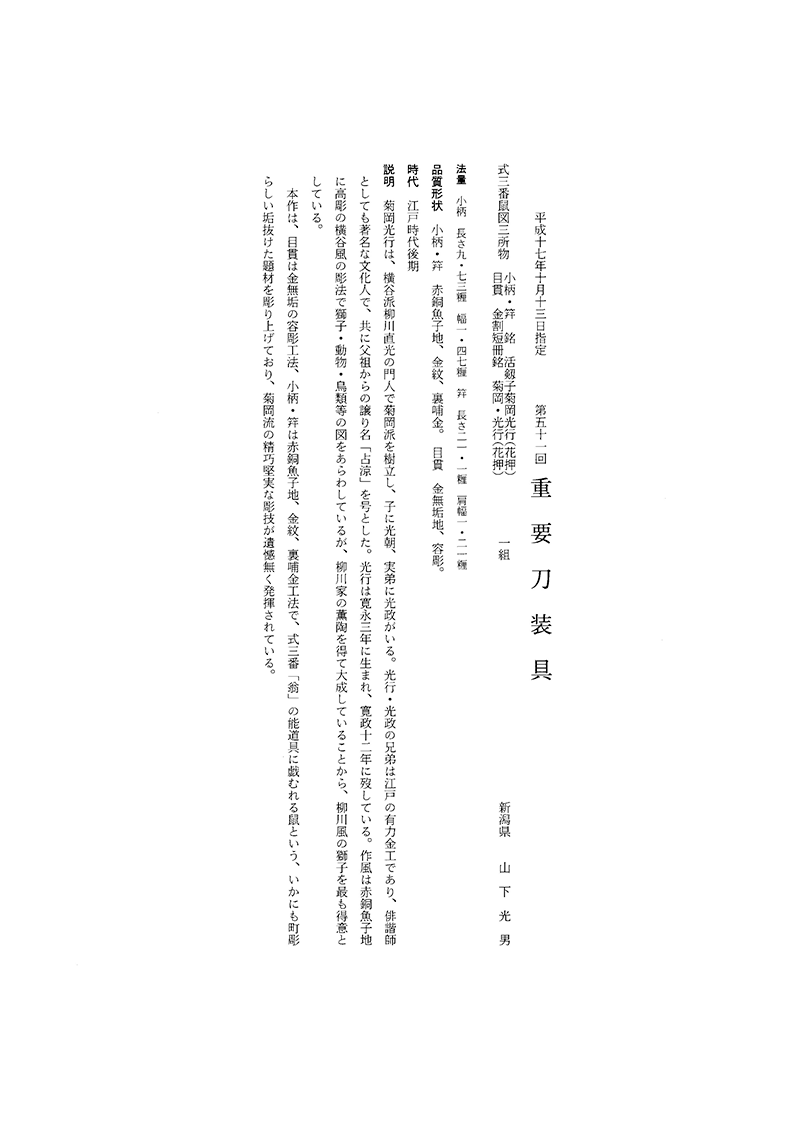
Jūyō-Tōsōgu, 51st Session — Designated October 13, 2005 Mitokoromono (kozuka, kogai, menuki), mei: Kikuoka Mitsuyuki (菊岡光行) Measurements - Kozuka: length 9.73 cm; width 0.47 cm - Kogai: length: (not stated in the source excerpt) Description Form: mitokoromono (set of three) comprising kozuka, kogai, and menuki Material: - Kozuka and kogai: shakudō nanako-ji, gold crests (kinmon), with gold backing (kin’ura) - Menuki: solid gold (kinmuku), carved in yōbori (rounded, sculptural carving) Design: “Mice at play with Noh implements for Shiki Sanban (‘Okina’)” (shiki sanban nezumi zu) Decoration: relief carving in the manner of the Yokoya tradition; gold ornament and gold-backed construction on the kozuka and kogai Signature: - Kogai signature: 「活剱子 菊岡光行(花押)」(Katsukenji Kikuoka Mitsuyuki, with kaō) - Gold-inlaid tanzaku-mei: 「菊岡・光行(花押)」(Kikuoka Mitsuyuki, with kaō) Artisan Kikuoka Mitsuyuki (菊岡光行), founder of the Kikuoka group, a pupil of Yanagawa Naomitsu of the Yokoya lineage. Era Late Edo period. Explanation Kikuoka Mitsuyuki was a disciple of Yanagawa Naomitsu of the Yokoya school and went on to establish the Kikuoka group. He had a son named Mitsutomo, and his younger brother (by birth) was Mitsumasa. The brothers Mitsuyuki and Mitsumasa were influential metalworkers in Edo; they were also well known as haikai poets and cultivated men of letters, and both adopted the inherited art-name (gō) “Senryō” passed down from their forebears. Mitsuyuki was born in Kan’ei 3 (1626) and died in Kansei 12 (1800). In his style he typically employed shakudō nanako-ji grounds and, using a Yokoya-derived manner of high-relief carving, produced subjects such as lions (shishi), animals, and birds. Having been thoroughly trained under the Yanagawa house, he attained maturity as an artist and was especially adept at lion subjects in the Yanagawa manner. In the present work, the menuki are executed in solid gold using the yōbori method, while the kozuka and kogai are made with shakudō nanako-ji, gold crests, and gold backing. The theme—a mouse playfully engaging with the Noh properties associated with Shiki Sanban (“Okina”)—is a polished, quintessentially machibori subject, and the Kikuoka school’s precise and steadfast carving skill is here displayed to its fullest extent.
NihontoWatch MonNihontoWatch
MarketEncyclopediaKantei
Fittings›Machibori›Yokoya›Yanagawa›Kikuoka›Mitsuyuki›Juyo Tosogu: Kikuoka Mitsuyuki
mitokoromonoJūyō
Kikuoka Mitsuyuki

Juyo Tosogu: Kikuoka Mitsuyuki

mei · Kikuoka · Edo

¥8,800,000
Visit seller website →
Kikuoka Mitsuyuki (光行) · Kikuoka · Edo2 works for sale →
MitokoromonoJūyō
Could you name the smith from the blade alone? Today’s kantei →
Kikuoka Mitsuyuki — 1 of 17
Kikuoka Mitsuyuki — 2 of 17
Kikuoka Mitsuyuki — 3 of 17
Kikuoka Mitsuyuki — 4 of 17
Kikuoka Mitsuyuki — 5 of 17
Kikuoka Mitsuyuki — 6 of 17
Kikuoka Mitsuyuki — 7 of 17
Kikuoka Mitsuyuki — 8 of 17
Kikuoka Mitsuyuki — 9 of 17
Kikuoka Mitsuyuki — 10 of 17
Kikuoka Mitsuyuki — 11 of 17
Kikuoka Mitsuyuki — 12 of 17
Kikuoka Mitsuyuki — 13 of 17
Kikuoka Mitsuyuki — 14 of 17
Kikuoka Mitsuyuki — 15 of 17
Kikuoka Mitsuyuki — 16 of 17
Kikuoka Mitsuyuki — 17 of 17
1 / 17
1 / 17
Kikuoka Mitsuyuki — 1 of 17Kikuoka Mitsuyuki — 2 of 17Kikuoka Mitsuyuki — 3 of 17Kikuoka Mitsuyuki — 4 of 17Kikuoka Mitsuyuki — 5 of 17Kikuoka Mitsuyuki — 6 of 17Kikuoka Mitsuyuki — 7 of 17Kikuoka Mitsuyuki — 8 of 17Kikuoka Mitsuyuki — 9 of 17Kikuoka Mitsuyuki — 10 of 17Kikuoka Mitsuyuki — 11 of 17Kikuoka Mitsuyuki — 12 of 17Kikuoka Mitsuyuki — 13 of 17Kikuoka Mitsuyuki — 14 of 17Kikuoka Mitsuyuki — 15 of 17Kikuoka Mitsuyuki — 16 of 17Kikuoka Mitsuyuki — 17 of 17
Kikuoka Mitsuyuki (光行) · Kikuoka · Edo2 works for sale →
MitokoromonoJūyō
Could you name the smith from the blade alone? Today’s kantei →
Measurements & details
Maker

Kikuoka Mitsuyuki

Era

Edo

Signature

Signed

Papers

Jūyō #51 (NBTHK)

Description

This is a Juyo Tosogu designated work by Kikuoka Mitsuyuki, a prominent metalworker of the Yokoya school and founder of the Kikuoka school. Born in Edo in 1750, Mitsuyuki was a pupil of Yanagawa Naomitsu and was also a renowned cultural figure and haiku master. The piece depicts mice playing with Noh props used in the Shikisanban (Okina) performance, symbolizing peace and abundant harvests.

NBTHK Zufu Commentary

Juyo #51

AI translation — may contain errors

-Tōsōgu, 51st Session — Designated October 13, 2005

(, , ), : Kikuoka Mitsuyuki (菊岡光行)

Measurements

  • : length 9.73 cm; width 0.47 cm
  • : length: (not stated in the source excerpt)

Description Form: (set of three) comprising , , and Material:

  • and : , gold crests (), with gold backing (’)
  • : solid gold (), carved in yōbori (rounded, sculptural carving) Design: “Mice at play with Noh implements for Shiki Sanban (‘Okina’)” (shiki sanban nezumi zu) Decoration: relief carving in the manner of the Yokoya tradition; gold ornament and gold-backed construction on the and Signature:
  • signature: 「活剱子 菊岡光行(花押)」(Katsukenji Kikuoka Mitsuyuki, with )
  • Gold-inlaid : 「菊岡・光行(花押)」(Kikuoka Mitsuyuki, with )

Artisan Kikuoka Mitsuyuki (菊岡光行), founder of the Kikuoka group, a pupil of Yanagawa Naomitsu of the Yokoya lineage.

Era Late period.

Explanation Kikuoka Mitsuyuki was a disciple of Yanagawa Naomitsu of the Yokoya school and went on to establish the Kikuoka group. He had a son named Mitsutomo, and his younger brother (by birth) was Mitsumasa. The brothers Mitsuyuki and Mitsumasa were influential metalworkers in ; they were also well known as haikai poets and cultivated men of letters, and both adopted the inherited art-name (gō) “Senryō” passed down from their forebears. Mitsuyuki was born in ’ei 3 (1626) and died in Kansei 12 (1800).

In his style he typically employed grounds and, using a Yokoya-derived manner of high-relief carving, produced subjects such as lions (shishi), animals, and birds. Having been thoroughly trained under the Yanagawa house, he attained maturity as an artist and was especially adept at lion subjects in the Yanagawa manner.

In the present work, the are executed in solid gold using the yōbori method, while the and are made with , gold crests, and gold backing. The theme—a mouse playfully engaging with the Noh properties associated with Shiki Sanban (“Okina”)—is a polished, quintessentially subject, and the Kikuoka school’s precise and steadfast carving skill is here displayed to its fullest extent.
About the maker

Mitsuyuki

光行

Machibori · around 1750-1800

2 pieces on the market now

›

Kikuoka Mitsuyuki was born in Kan'en 3 (1750) in Kandakajichō, Edo, and trained under Yanagawa Naomitsu of the Yokoya lineage. Having matured through the guidance of the Yanagawa house, he attained full accomplishment as an artist and went on to establish the Kikuoka school as its founder, creating an independent line characterized by what the NBTHK describes as a "careful and solidly executed" manner of working. His son was Mitsutomo, and his younger brother Mitsumasa; the brothers were influential metalworkers in Edo and were also well known as bunjin — men of letters active as haikai poets. Both adopted the inherited artistic sobriquet "Senryō," passed down from their forebears, and Mitsuyuki styled himself "third-generation Senryō." He employed several art names throughout his career, including Doppōsai, Saika-an, Katsukenji, and Suiminsha. Dated works bear inscriptions from Tenmei 1 (1781) and Kansei 9, and he died in Kansei 12 (1800) at the age of fifty-one.

Mitsuyuki's characteristic method employs shakudō nanako-ji grounds with gold crests (kinmon), gold backing (kin'ura), and Yokoya-style high-relief carving (takabori) enhanced with applied ornament (suemon) and polychrome metal coloring (iroe). His menuki are typically executed in solid gold (kinmuku) using rounded, sculptural carving (yōbori). Within this idiom, shishi were his greatest specialty — the NBTHK observes that his lion subjects "closely resemble what are termed 'Yokoya shishi' and 'Yanagawa shishi,'" and his level of technique is "recognized as comparable to that of Sōmin and Naomasa," with some works displaying "a level of skill approaching that of Sōmin." His menuki shishi are singled out as "not only in the manner of Sōmin but even more imposing than typical Yanagawa shishi, projecting a particularly bold and valiant presence." Beyond lions, he produced subjects including animals, birds, human figures, and Niō guardian deities, and he was adept at composing mitokoromono and nisomono sets in which each element receives individualized treatment — varying postures and compositions to avoid repetition and achieve what the examiners call "variation and motion."

Across the NBTHK setsumei, Mitsuyuki's work is consistently praised for its "precise and steadfast carving skill" displayed "to its fullest extent," and for compositions executed with "dignity" and a "robust and forceful quality." The examiners describe his workmanship as "careful and thorough throughout," noting that his finest pieces "fully demonstrate the high level of Mitsuyuki's technique." His position within the tradition is that of an artist who, having fully absorbed the training of the Yanagawa house, established a lineage that preserved the Yokoya–Yanagawa heritage while achieving independent artistic identity — producing works "composed with a notably dignified, elevated tone" that are deemed "worthy of admiration" and recognized as excellent representatives of the late Edo machibori tradition.

Historical importance

Where Mitsuyuki stands among comparable artisans: across all of nihontō, and within tradition, era, and period. The tiers (Foremost · Leading · Major · Notable) weigh official designations from the NBTHK and Japan's Agency for Cultural Affairs, together with historical honors of lasting repute such as the Sansaku and Meibutsu-chō.

随一
Foremost
屈指
Leading
有数
Major
著名
Notable

Select a lens to see how it's measured.

Designation record
14 designated works
Jūyō Bijutsuhin
1
Jūyō
13
2 works by Mitsuyuki on the market→
Mitsuyuki — full profileMachibori school

Study this maker →

About the school

Kikuoka

菊岡

Machibori · Edo

10 pieces on the market now

›

The Kikuoka school (Kikuoka-ha) was founded in Edo by Kikuoka Mitsuyuki (菊岡光行), a disciple of Yanagawa Naomitsu (柳川直光) of the Yokoya lineage. Born in Kan'en 3 (1750) in Kanda Kajimachi, Mitsuyuki trained thoroughly under the Yanagawa house and established an independent line that perpetuated the mainline machibori tradition. His younger brother Mitsumasa (菊岡光政, 1759--1824) likewise studied under Naomitsu and became a leading kinko in his own right. The two brothers were not only influential metalworkers but also celebrated bunjin and haikai poets, both adopting the inherited literary sobriquet Senryo (沾涼) passed down from their forebears. Mitsuyuki further used the art-name Katsukenshi (活剣子) and died in Kansei 12 (1800) at the age of fifty-one. Succession passed through his son Mitsutomo (光朝) as second generation, then to Mitsushige (菊岡光重), who had originally studied under Naomitsu before being adopted into the Kikuoka house as third-generation head. Mitsutoshi (菊岡光利), son of Mitsumasa, continued the principal line into the Bakumatsu era, dying in Bunkyu 3 (1863). A further generation is represented by Unsuiken Toshinobu[[c:1]], a pupil of Mitsutoshi, and by Jounsai Shigeyoshi (茂義), a retained craftsman of the Takamatsu domain who studied under Mitsushige.

The collective style of the Kikuoka school is rooted in the Yokoya-Yanagawa vocabulary and characterized by what the NBTHK consistently terms "precise and steadfast carving technique" (seiko kenjitsu na chogi). The canonical material treatment employs a shakudo nanako-ji[[c:2]] ground with gold crests (kinmon) and a gilt reverse (kin'ura), while menuki are typically executed in solid gold (kinmuku) using rounded sculptural carving (yobori). Carving methods follow the Yokoya manner: takabori (高彫) with colored-metal inlay (iro-e) and applied work (suemon), producing bold, volumetric compositions. '" Beyond lions, the repertoire embraced animals, birds, human figures, mythical beasts such as kirin (麒麟), and characteristically machibori themes drawn from literary and theatrical culture -- mice at play with the Noh properties of Shiki Sanban, Nio guardians modeled from life at Shinagawa Hoozan Kokoku-ji, dancing cranes, parent-and-child chickens, tigers, and auspicious early-spring imagery. Matching sets -- mitokoromono and sanshomono -- are the school's characteristic format, frequently bearing coordinated signatures on kozuka and kogai with split-tanzaku inscriptions (wari-tanzaku mei) on menuki. " The Kikuoka school occupies a distinguished position in the urban machibori lineage as the direct continuation of the Yokoya-Yanagawa mainstream. The NBTHK characterizes Mitsuyuki's manner as closely resembling that of Yokoya Somin (宗珉), noting that "some works display a level of skill approaching that of Somin" -- a comparison of the highest order. " Even the rare surviving works of Toshinobu are valued for confirming the "high level of his technique" within the Kikuoka idiom. Learn more →

6 recorded smiths21 designated works
Leading smiths
SmithEraDesignated
Mitsuyuki光行1750-180014
Yukinobu行信—0
Mitsutomo光朝—0
Mitsushige光重16701
Yukiyoshi行善—0
Explore the Kikuoka school →
NBTHK Certificate
Jūyō Tōken重要刀剣
Important Sword
›

A blade of top-grade workmanship and condition, formally judged to rank with a nationally recognized Important Art Object (Jūyō Bijutsuhin). Awarded only at the NBTHK’s competitive annual examination.

Of Japan’s roughly 2.5 million registered swords, only 12,357 (about 1 in 202) have ever attained Jūyō.

About the NBTHK›

The NBTHK (Nihon Bijutsu Tōken Hozon Kyōkai, the Society for the Preservation of Japanese Art Swords) is a public-interest incorporated foundation founded in 1948 and supervised by Japan’s Agency for Cultural Affairs (Bunkachō); it is based at the Japanese Sword Museum in Tokyo. Its expert panels physically examine each submitted work (shinsa) and issue a certificate (kanteishō) ranking it by artistic and historical merit. NBTHK papers are the most widely recognized standard of authentication for Japanese swords and fittings.

NBTHK official site→
Seller
I
Iida Koendo
Established 1880 · 146 yrs on the market
🇯🇵Ships from Japan
›
✓Verified dealeriidakoendo.com
Settles in JPY
✓Ships worldwide✓English supportWire transfer
Return policy

Customer-initiated returns accepted within two days of arrival; return shipping paid by customer and fees non-refundable. Returns/refunds unavailable for overseas deliveries.

View all of Iida Koendo’s listings→View this item on the dealer’s site→

More works by Kikuoka Mitsuyuki

View all →
Iida Koendo
Hozon
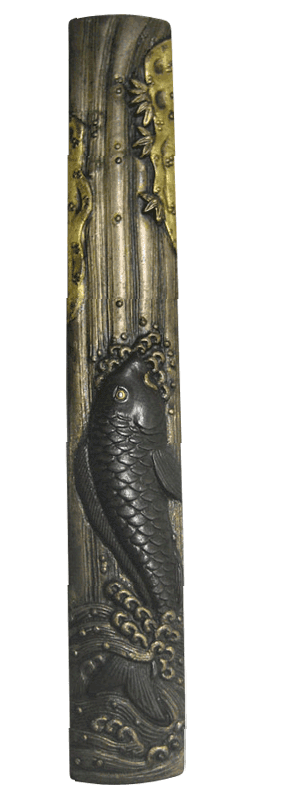
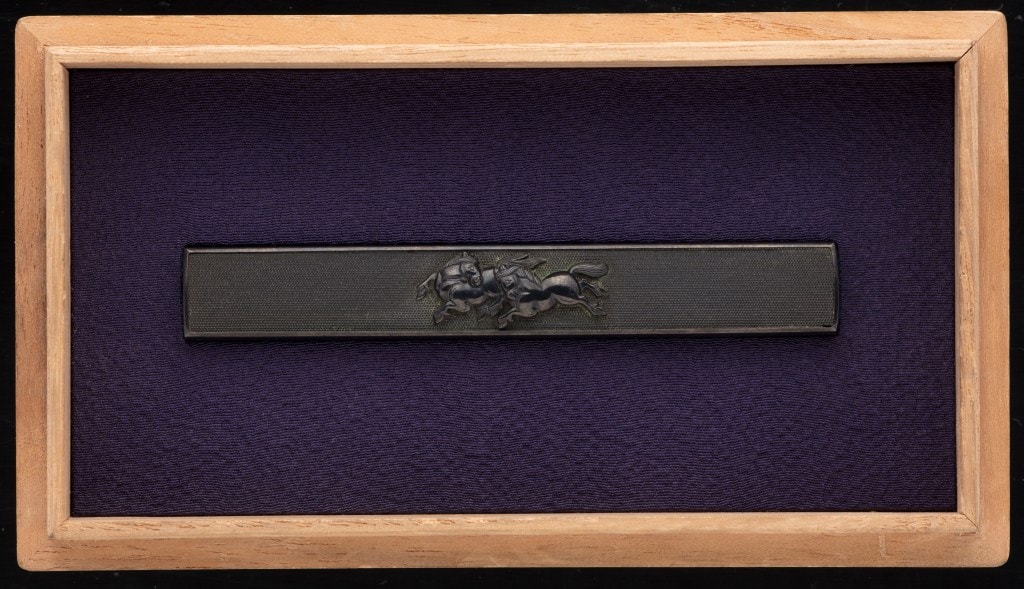
Hozon - by Kikuoka Mitsuyuki - Tosogu: Kikuoka MitsuyukiHozon - by Kikuoka Mitsuyuki - Tosogu: Kikuoka Mitsuyuki

Tosogu: Kikuoka Mitsuyuki

ByKikuoka Mitsuyuki
¥550,000

More from the Kikuoka school

View all →
Gallery Youyou
Hozon
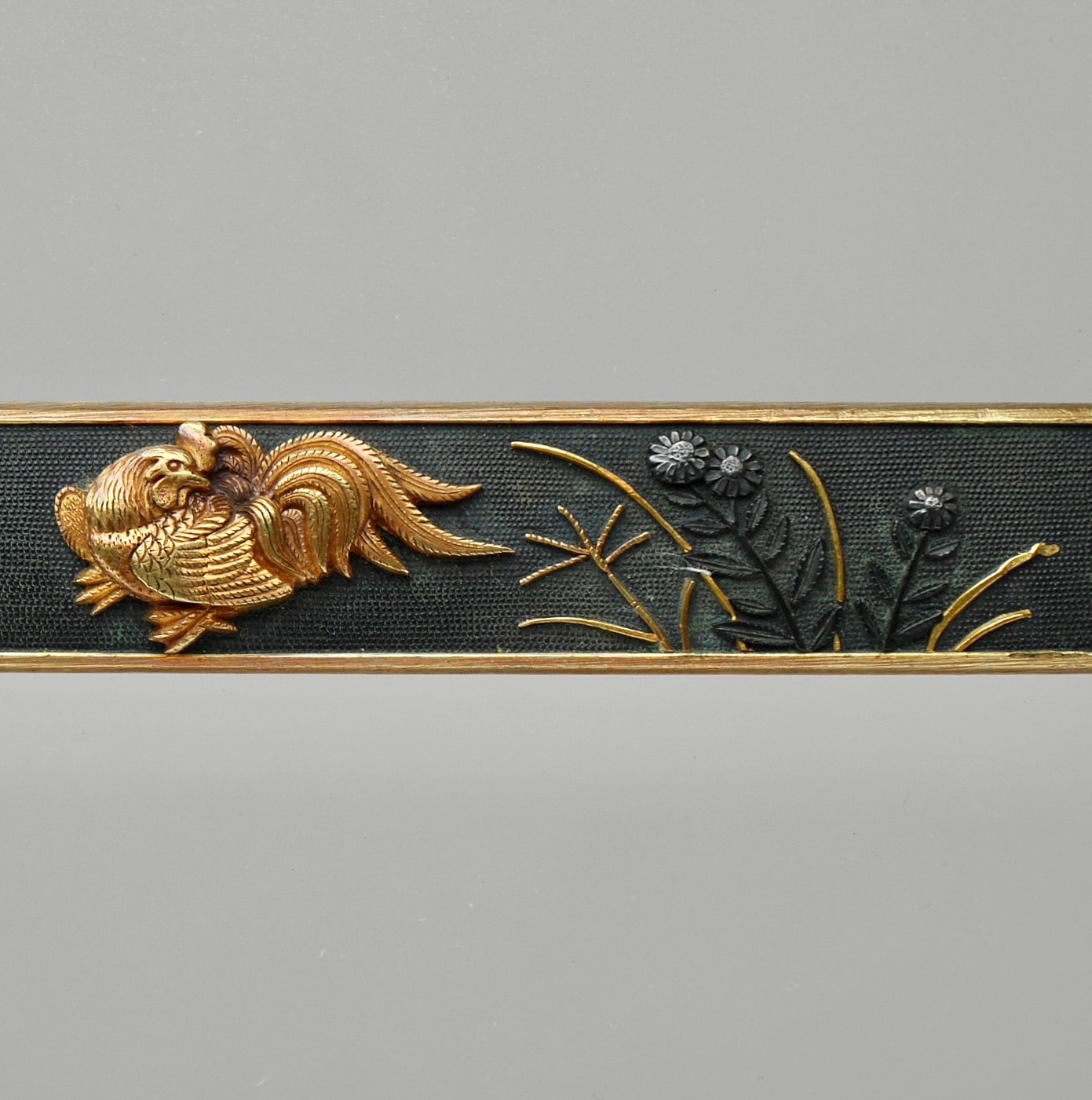
Kozuka - Hozon - by Kikuoka Yukinobu - Autumn Grass and Rooster DesignKozuka - Hozon - by Kikuoka Yukinobu - Autumn Grass and Rooster Design

Kozuka

ByKikuoka Yukinobu
¥660,000
Choshuya
Tokuho
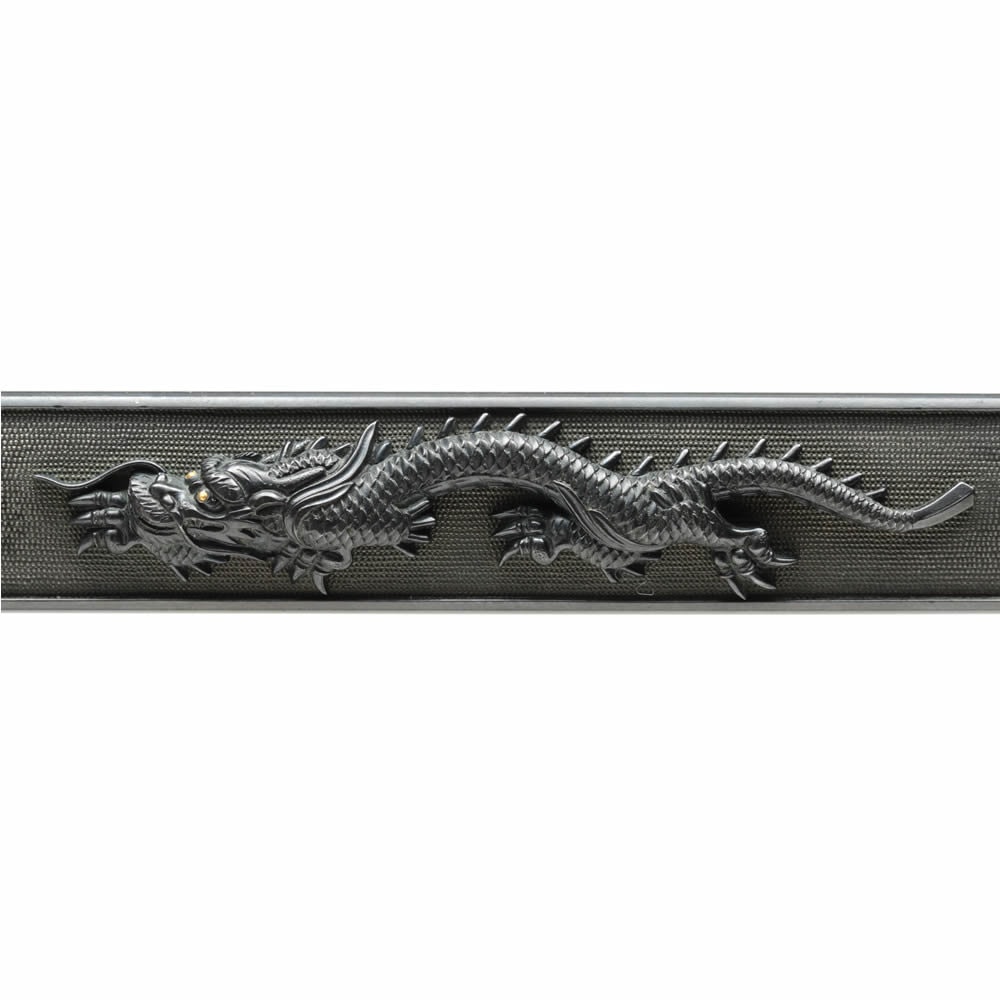
Kozuka - Tokuho - by Kikuoka Mitsumasa - Crawling Dragon Design - Signed Kikuoka Mitsumasa (Kao)Kozuka - Tokuho - by Kikuoka Mitsumasa - Crawling Dragon Design - Signed Kikuoka Mitsumasa (Kao)

Kozuka

ByKikuoka Mitsumasa
¥400,000
Katana Hattori
Kozuka - by Kikuoka Mitsumasa - Touryumon (Dragon Gate)Kozuka - by Kikuoka Mitsumasa - Touryumon (Dragon Gate)

Kozuka

ByKikuoka Mitsumasa
¥160,000
Legacy Swords
Hozon
Kozuka - Hozon - by Kikuoka School - Kozuka from the Kikuoka SchoolKozuka - Hozon - by Kikuoka School - Kozuka from the Kikuoka School

Kozuka

ByKikuoka School
¥2,450
Toushin
Fuchi-Kashira - by Kikuoka Toshinobu - Fuchi-Kashira: Unsuiken Toshinobu - Rain Dragon DesignFuchi-Kashira - by Kikuoka Toshinobu - Fuchi-Kashira: Unsuiken Toshinobu - Rain Dragon Design

Fuchi-Kashira

ByKikuoka Toshinobu
¥110,000
Toushin
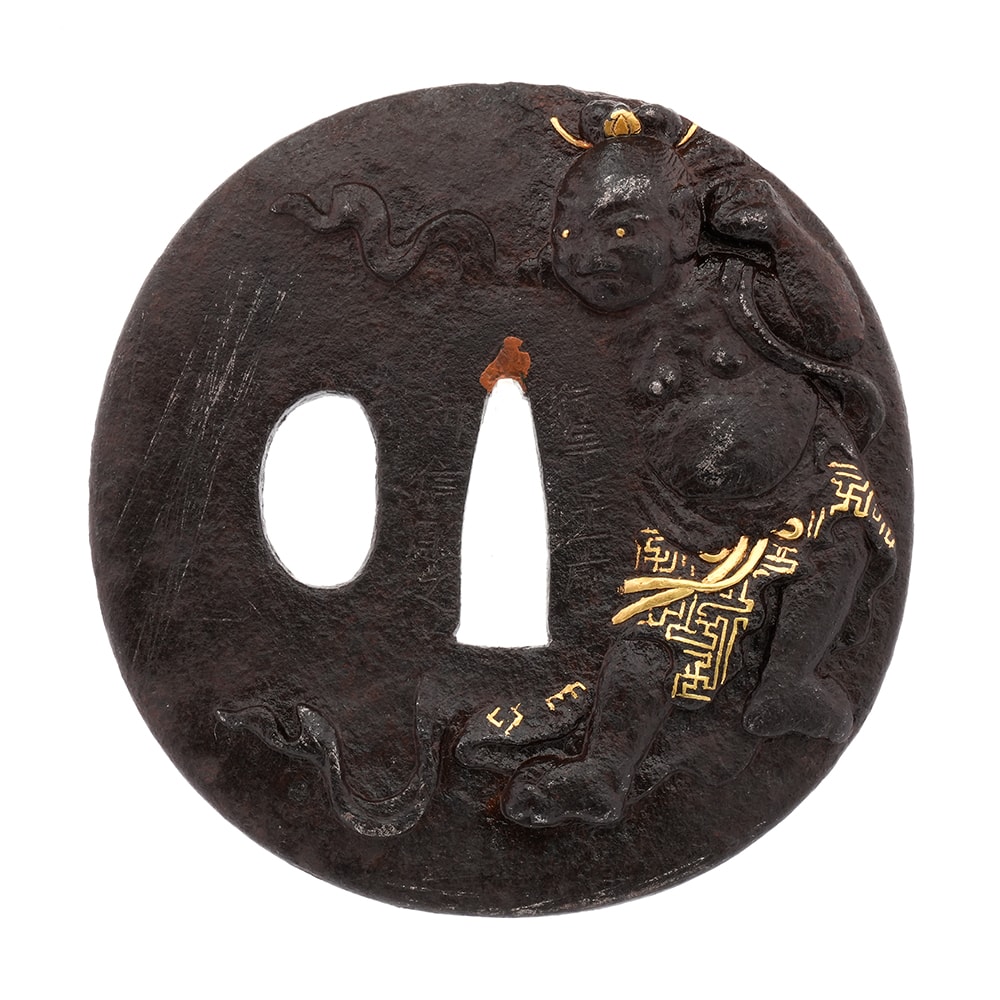
Tsuba - by Kikuoka Toshinobu - Nio Figure Tsuba, Carved by Toshinobu at 71 Years OldTsuba - by Kikuoka Toshinobu - Nio Figure Tsuba, Carved by Toshinobu at 71 Years Old

Tsuba

ByKikuoka Toshinobu
¥66,000
Shoubudou
Hozon
Menuki - Hozon - by Kikuoka Mitsutoshi - Kikuoka Mitsutoshi - Tiger and Leopard DesignMenuki - Hozon - by Kikuoka Mitsutoshi - Kikuoka Mitsutoshi - Tiger and Leopard Design

Menuki

ByKikuoka Mitsutoshi
¥550,000
Aoi Art
Tokuho
Kozuka - Tokuho - by Kikuoka School - Mumei (Kikuoka)Kozuka - Tokuho - by Kikuoka School - Mumei (Kikuoka)

Kozuka

ByKikuoka School
Ask

More from the Yanagawa school

View all →
Katanahanbai
Tokuho
Tsuba - Tokuho - by Yanagawa Naotoki - Parent and Chickens DesignTsuba - Tokuho - by Yanagawa Naotoki - Parent and Chickens Design

Tsuba

ByYanagawa Naotoki
¥1,600,000
Choshuya
Tokuho
Fuchi-Kashira - Tokuho - by Toryusai School - Fuchi-Kashira: Autumn Grass and Boar Design - Signed Kiryusai Uchida Toshinori (Kao)Fuchi-Kashira - Tokuho - by Toryusai School - Fuchi-Kashira: Autumn Grass and Boar Design - Signed Kiryusai Uchida Toshinori (Kao)

Fuchi-Kashira

ByToryusai School
¥250,000
Samurai Museum
Hozon
Kozuka - Hozon - by Ishiguro Masayoshi - Antique Kozuka for Samurai Sword with NBTHK Hozon Certificate (K-78)Kozuka - Hozon - by Ishiguro Masayoshi - Antique Kozuka for Samurai Sword with NBTHK Hozon Certificate (K-78)

Kozuka

ByIshiguro Masayoshi
¥480,000
Toushin
Hozon
Tsuba - Hozon - by Yanagawa School - Dragon Cloud Design Tsuba: Ren'ei Hori, TomozuruTsuba - Hozon - by Yanagawa School - Dragon Cloud Design Tsuba: Ren'ei Hori, Tomozuru

Tsuba

ByYanagawa School
¥297,000
Wakeidou
Hozon
Tsuba - Hozon - by Toryusai School - Shojusai Kagenori (Kao) - Saikan Senryo ZuTsuba - Hozon - by Toryusai School - Shojusai Kagenori (Kao) - Saikan Senryo Zu

Tsuba

ByToryusai School
¥800,000
Nihonto Australia
Mitokoromono - by Ishiguro Masayoshi - Ishiguro MasayoshiMitokoromono - by Ishiguro Masayoshi - Ishiguro Masayoshi

Mitokoromono

ByIshiguro Masayoshi
Ask
Aoi Art
Tokuho
Mitokoromono - Tokuho - by Ishiguro Masamori - Set of Tosogu: MasamoriMitokoromono - Tokuho - by Ishiguro Masamori - Set of Tosogu: Masamori

Mitokoromono

ByIshiguro Masamori
¥450,000
Sugie Art
Hozon
Tsuba - Hozon - by Yanagawa Naoyoshi - Hozon Tsuba by Sano Naoyoshi, Shakudo with Two Cranes DesignTsuba - Hozon - by Yanagawa Naoyoshi - Hozon Tsuba by Sano Naoyoshi, Shakudo with Two Cranes Design

Tsuba

ByYanagawa Naoyoshi
¥850,000

More from the Yokoya school

View all →
Touken Matsumoto
Jūyō
Fuchi-Kashira - Jūyō - by Iwamoto Konkan - Fuchi-Kashira: Thrush on a Hoe DesignFuchi-Kashira - Jūyō - by Iwamoto Konkan - Fuchi-Kashira: Thrush on a Hoe Design

Fuchi-Kashira

ByIwamoto Konkan
¥2,500,000
Samurai Nippon
Hozon
Fuchi-Kashira - Hozon - by Yokoya Genchin - Fuchigashira: Baku no ZuFuchi-Kashira - Hozon - by Yokoya Genchin - Fuchigashira: Baku no Zu

Fuchi-Kashira

ByYokoya Genchin
¥285,000
Ginza Seikodo
Tokuho
Kozuka - Tokuho - by Yokoya Somin - Somin - Depiction of Shoki (Zhong Kui)Kozuka - Tokuho - by Yokoya Somin - Somin - Depiction of Shoki (Zhong Kui)

Kozuka

ByYokoya Somin
¥1,500,000
Connoisseur Arms
Jūyō
Tsuba - Jūyō - by Iwamoto Konju - Juyo Daisho Tsuba Masterpiece by Iwamoto KonjuTsuba - Jūyō - by Iwamoto Konju - Juyo Daisho Tsuba Masterpiece by Iwamoto Konju

Tsuba

ByIwamoto Konju
Ask
Nihontocraft
Jūyō
Fuchi-Kashira - Jūyō - by Omori Teruhide - Omori Eishu (Teruhide)Fuchi-Kashira - Jūyō - by Omori Teruhide - Omori Eishu (Teruhide)

Fuchi-Kashira

ByOmori Teruhide
¥55,000
Gallery Youyou
Hozon
Fuchi-Kashira - Hozon - by Omori Terumasa - Fuchi-Kashira with Plum Tree DesignFuchi-Kashira - Hozon - by Omori Terumasa - Fuchi-Kashira with Plum Tree Design

Fuchi-Kashira

ByOmori Terumasa
¥450,000
Aoi Art
Jūyō
Fuchi-Kashira - Jūyō - by Iwamoto Konkan - Fuchikashira: Iwamoto KonkanFuchi-Kashira - Jūyō - by Iwamoto Konkan - Fuchikashira: Iwamoto Konkan

Fuchi-Kashira

ByIwamoto Konkan
¥2,500,000
Toukentakarado
Hozon
Fuchi-Kashira - Hozon - by Iwamoto Kanri - Fuchi Kashira: Iwamoto Hirotoshi (kaō) Chicken and Child DesignFuchi-Kashira - Hozon - by Iwamoto Kanri - Fuchi Kashira: Iwamoto Hirotoshi (kaō) Chicken and Child Design

Fuchi-Kashira

ByIwamoto Kanri
¥350,000

More from the Machibori tradition

View all →
Supein Nihonto
Koshirae - by Tsuchiya School - Wakizashi Koshirae with Tiger, Bamboo & Yasuchika Tsuba – Edo PeriodKoshirae - by Tsuchiya School - Wakizashi Koshirae with Tiger, Bamboo & Yasuchika Tsuba – Edo Period

Koshirae

ByTsuchiya School
¥3,900
Touken Komachi
Hozon
Tsuba - Hozon - by Hamano School - Wakizashi Koshirae with Tomiyuki Tsuba and Fuchi-Kashira, Black Lacquer SayaTsuba - Hozon - by Hamano School - Wakizashi Koshirae with Tomiyuki Tsuba and Fuchi-Kashira, Black Lacquer Saya

Tsuba

ByHamano School
¥800,000
Touken Matsumoto
Tokuho
Tsuba - Tokuho - by Mito Hirotoshi - Tsuba with Lin Hejing Design, Signed Ichijosai Hirotoshi (Kao)Tsuba - Tokuho - by Mito Hirotoshi - Tsuba with Lin Hejing Design, Signed Ichijosai Hirotoshi (Kao)

Tsuba

ByMito Hirotoshi
¥500,000
Choshuya
Tokuho
Fuchi-Kashira - Tokuho - by Otsuki Matsuo Gassan - Fuchigashira: Fox Wedding Motif, Signed Oko Gassan (Kongosai)Fuchi-Kashira - Tokuho - by Otsuki Matsuo Gassan - Fuchigashira: Fox Wedding Motif, Signed Oko Gassan (Kongosai)

Fuchi-Kashira

ByOtsuki Matsuo Gassan
¥700,000
Ayakashi
Tokuho
Kozuka - Tokuho - by Tsuchiya School - Pine and Moon Design by YoshichikaKozuka - Tokuho - by Tsuchiya School - Pine and Moon Design by Yoshichika

Kozuka

ByTsuchiya School
¥280,000
Samurai Nippon
Tokubetsu Kichō
Kozuka - Tokubetsu Kichō - by Otsuki Mitsuhiro - Waves and Plovers DesignKozuka - Tokubetsu Kichō - by Otsuki Mitsuhiro - Waves and Plovers Design

Kozuka

ByOtsuki Mitsuhiro
¥85,000
Toyuukai
Tokuho
Fuchi-Kashira - Tokuho - by Mito School - Kabuto Design Fuchi-Kashira, Mumei, Mito, Tokubetsu Hozon Tosogu CertificateFuchi-Kashira - Tokuho - by Mito School - Kabuto Design Fuchi-Kashira, Mumei, Mito, Tokubetsu Hozon Tosogu Certificate

Fuchi-Kashira

ByMito School
¥200,000
Connoisseur Arms
Jūyō
Tsuba - Jūyō - by Hamano Sekibun - Masterpiece by Yurakusai SekibunTsuba - Jūyō - by Hamano Sekibun - Masterpiece by Yurakusai Sekibun

Tsuba

ByHamano Sekibun
Ask

Swords

  • Katana
  • Wakizashi
  • Tantō
  • Tachi
  • Naginata
  • Yari
  • Japanese Swords
  • Samurai Swords

Fittings

  • Tsuba
  • Fuchi-Kashira
  • Kozuka
  • Menuki
  • Sword Guards (Tsuba)

Armor

  • Kabuto
  • Samurai Armor
  • All Samurai Armor

By Certification

  • Tokujū
  • Jūyō
  • Tokuho
  • Hozon

Resources

  • Dealer Directory
  • Artist Directory
  • The Daily Kantei
  • Glossary
  • Browse All
Nihontowatch© 2026
TermsPrivacyCookiesAbout

¥8,800,000

View on Iida Koendo
NihontoWatch MonNihontoWatch
Market
Encyclopedia
Kantei