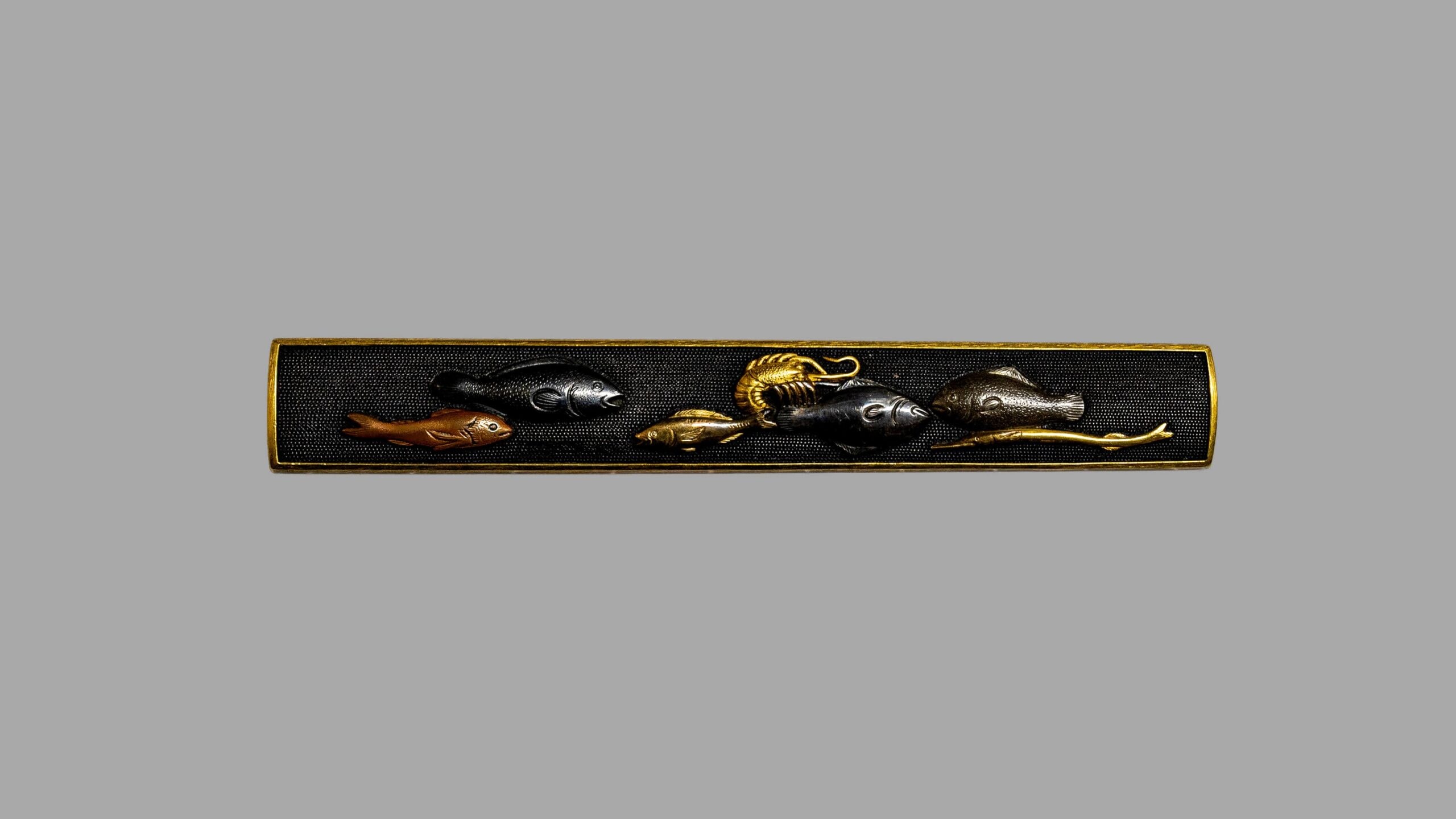
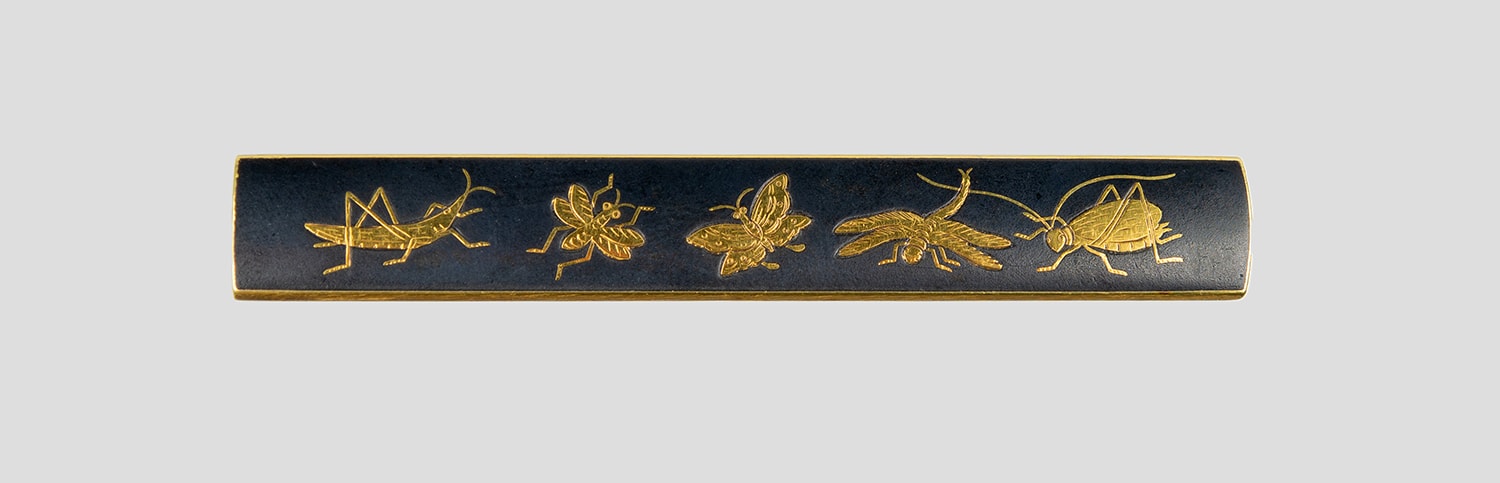
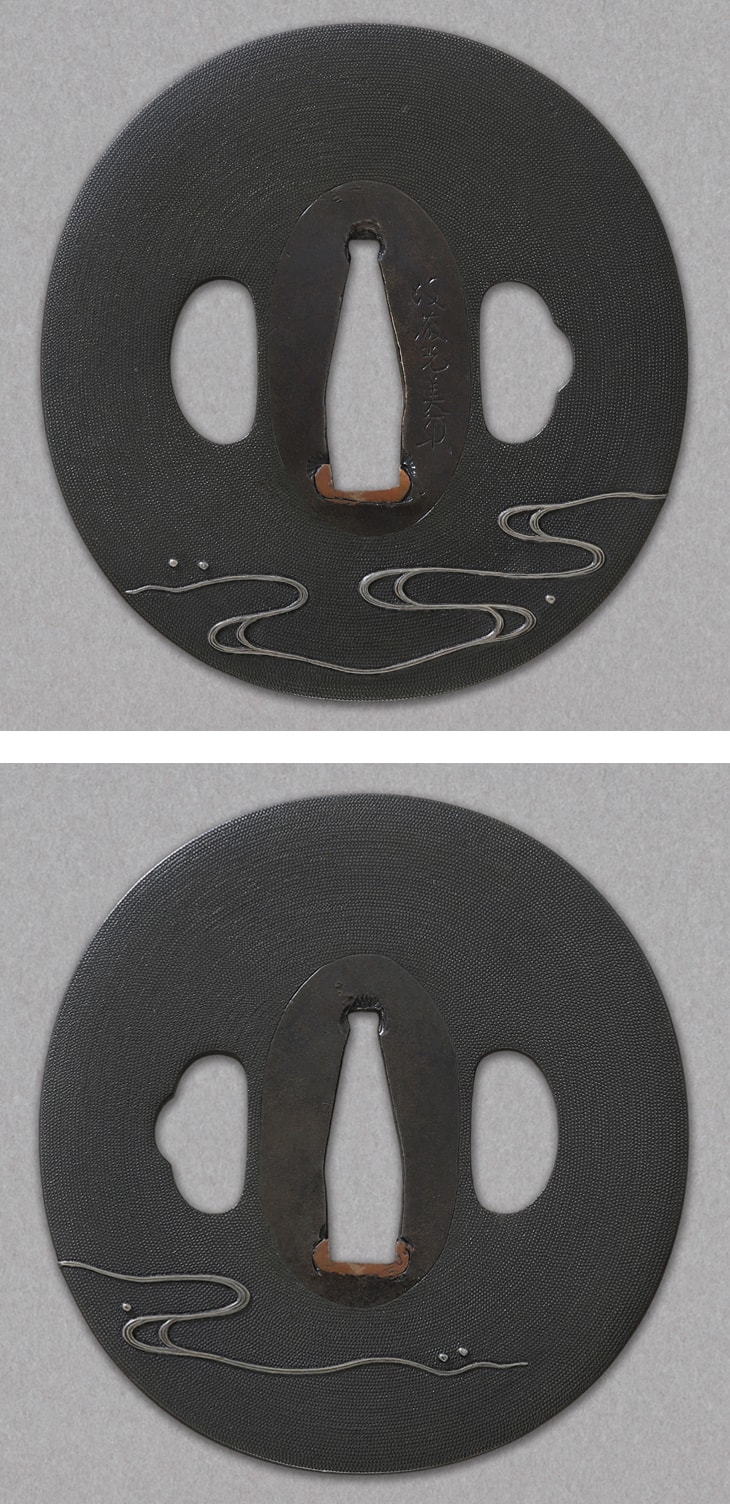
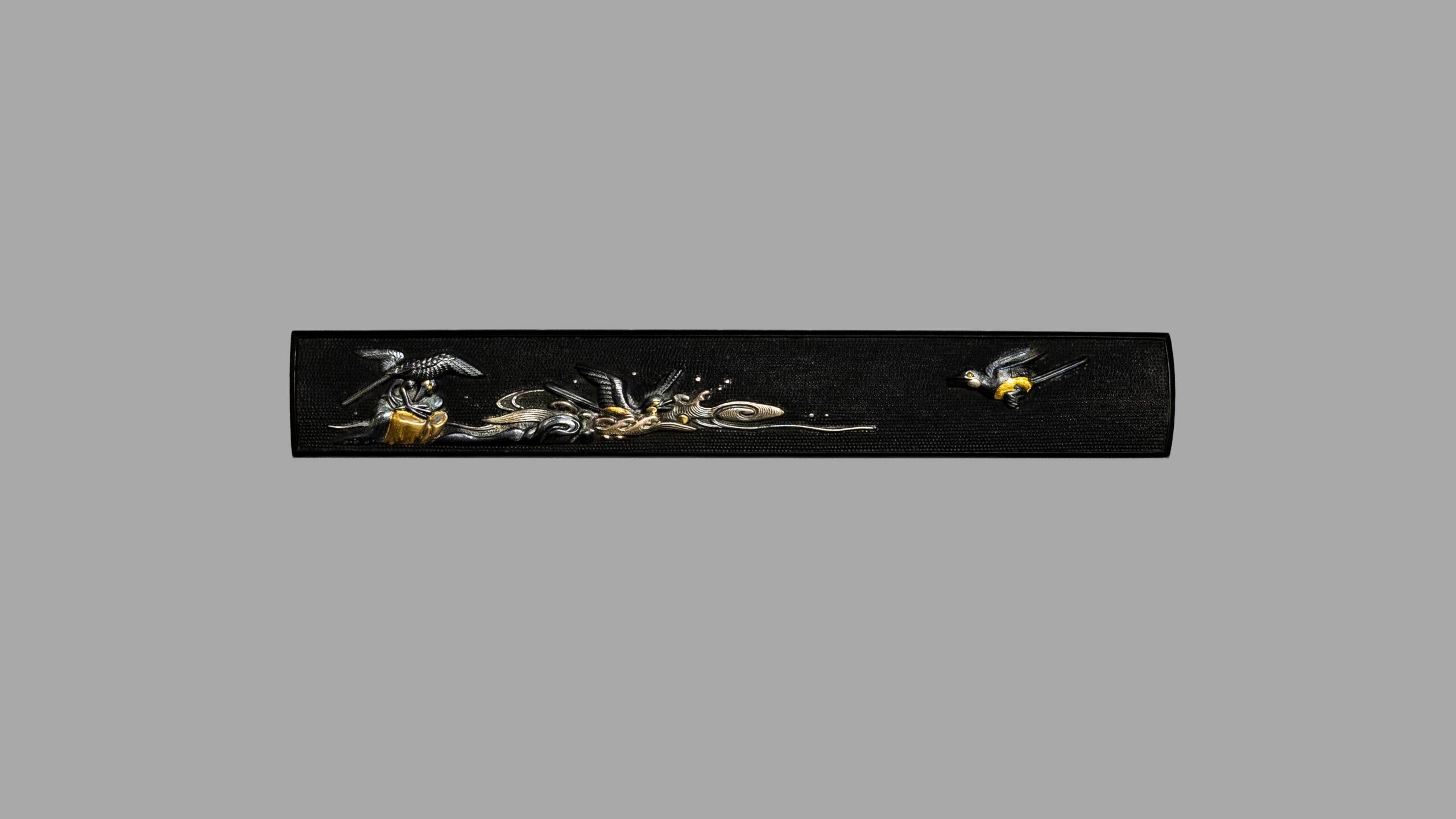
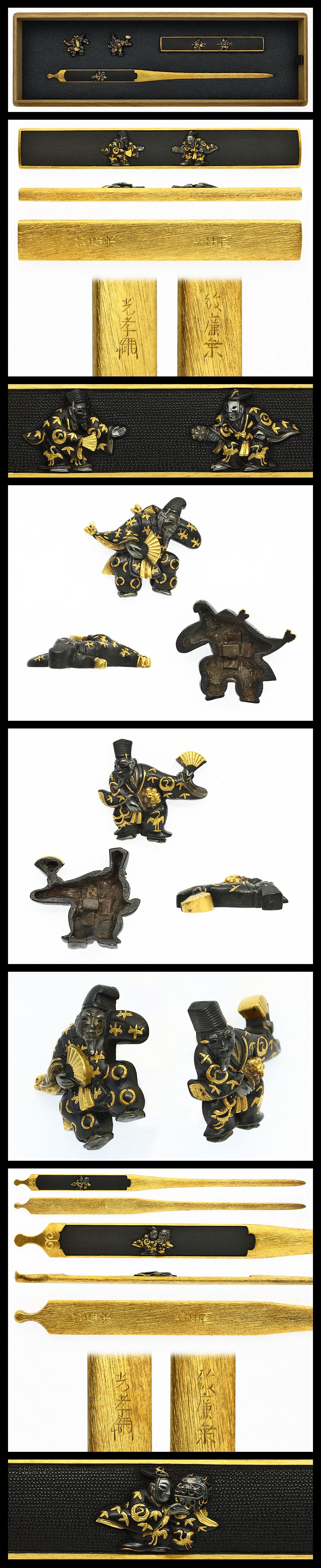
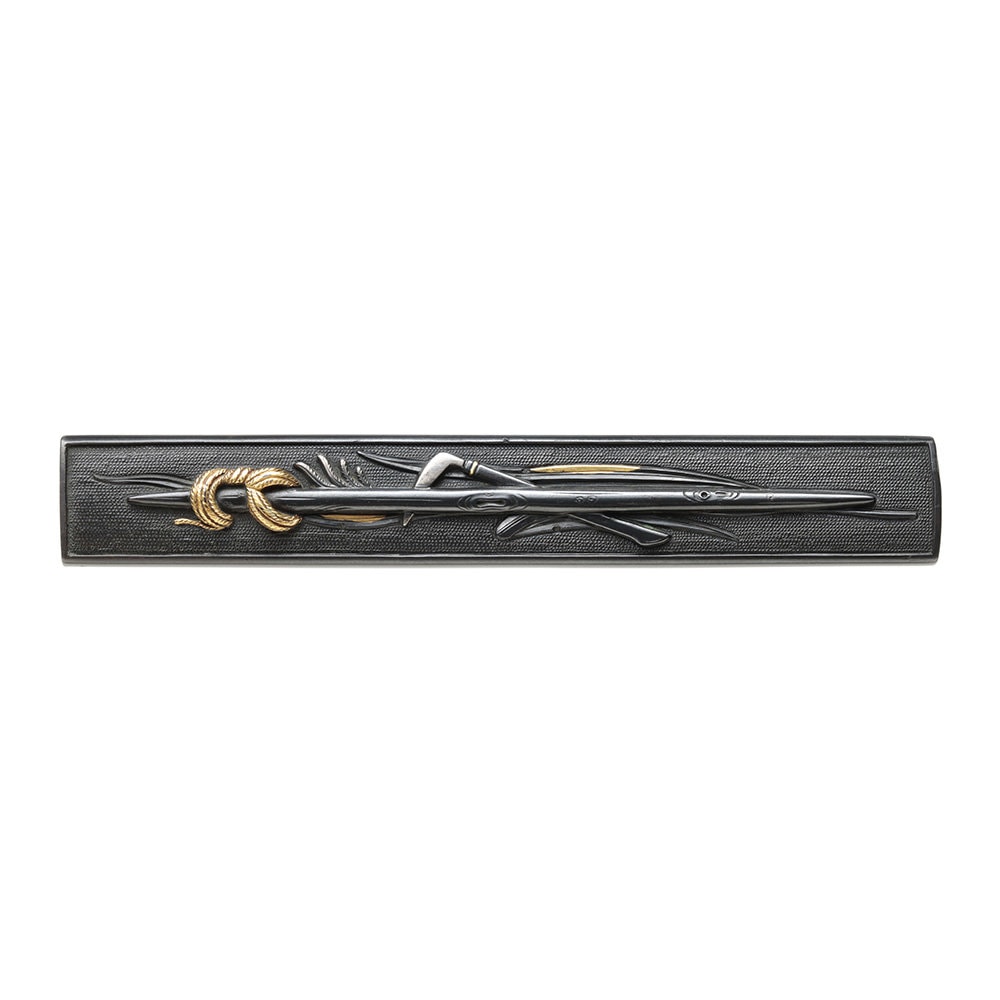
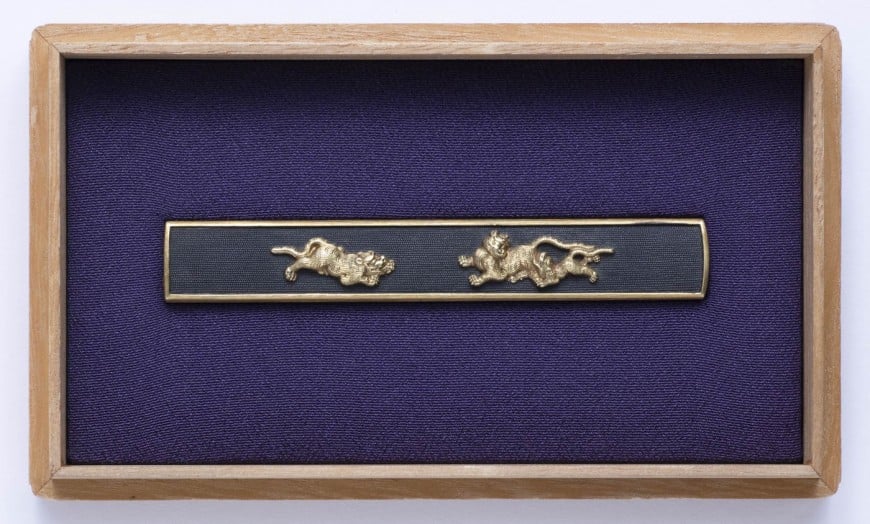
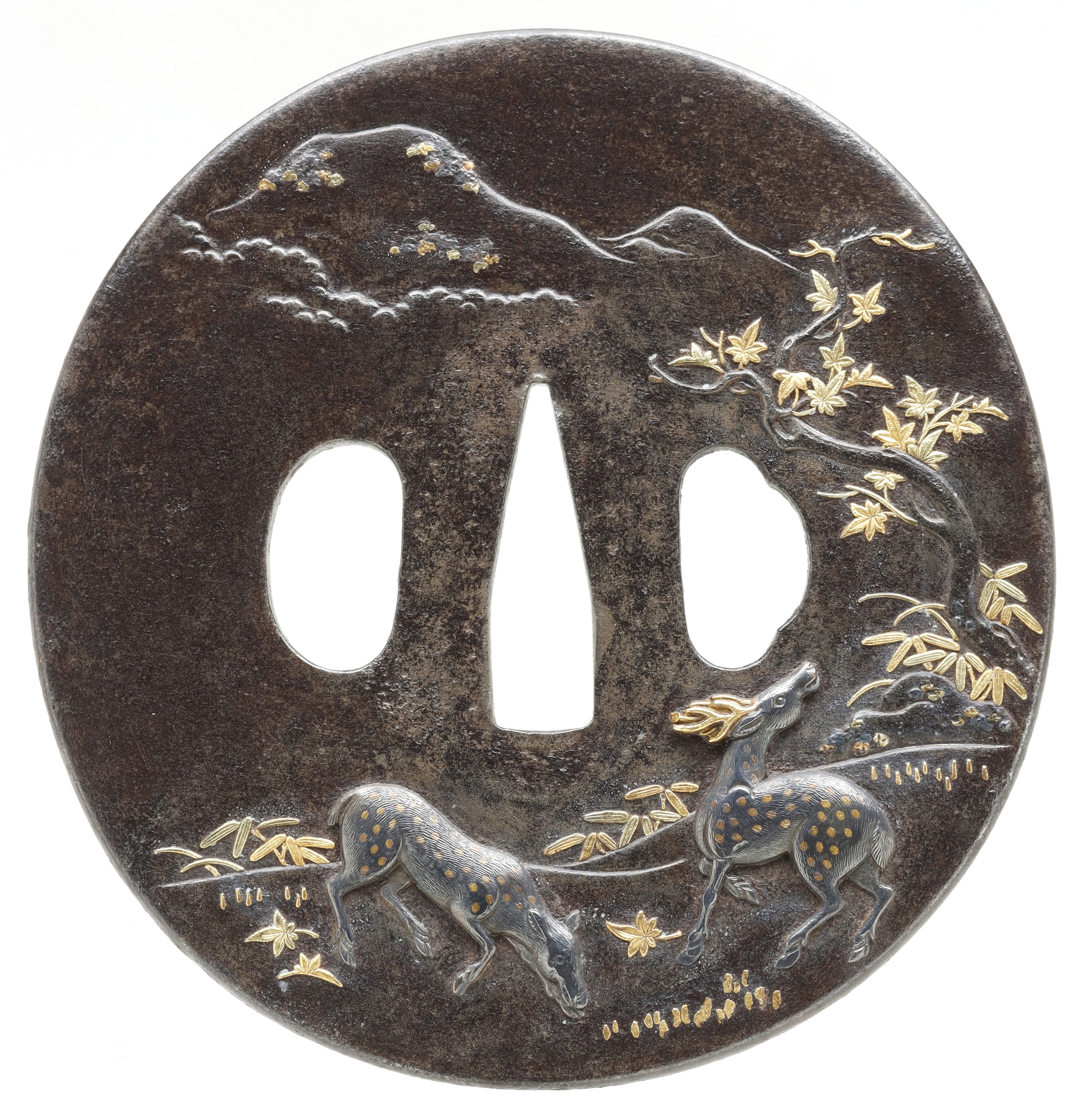
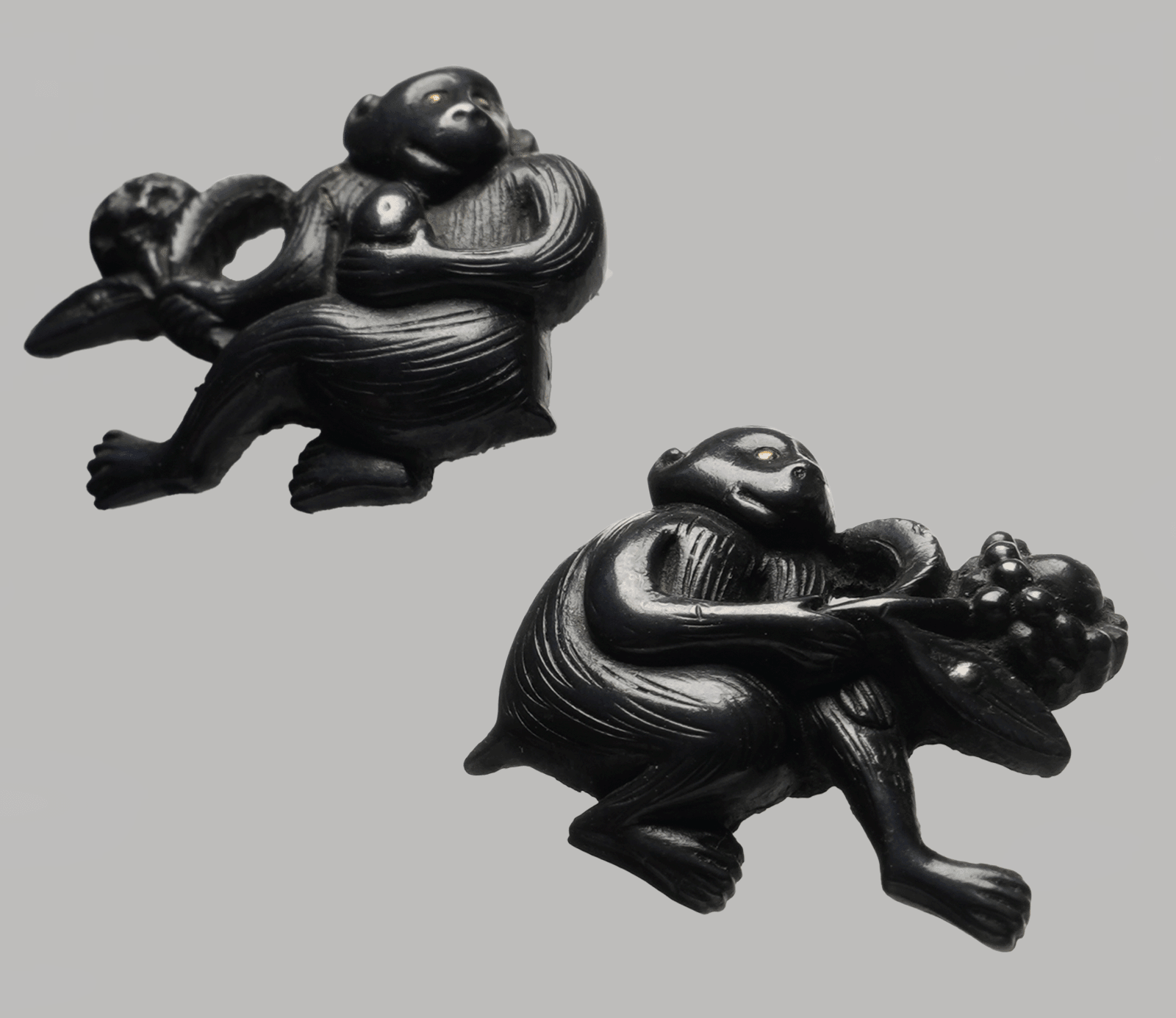
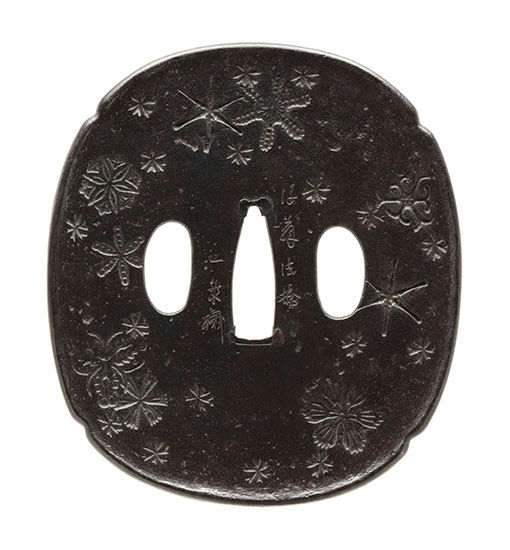
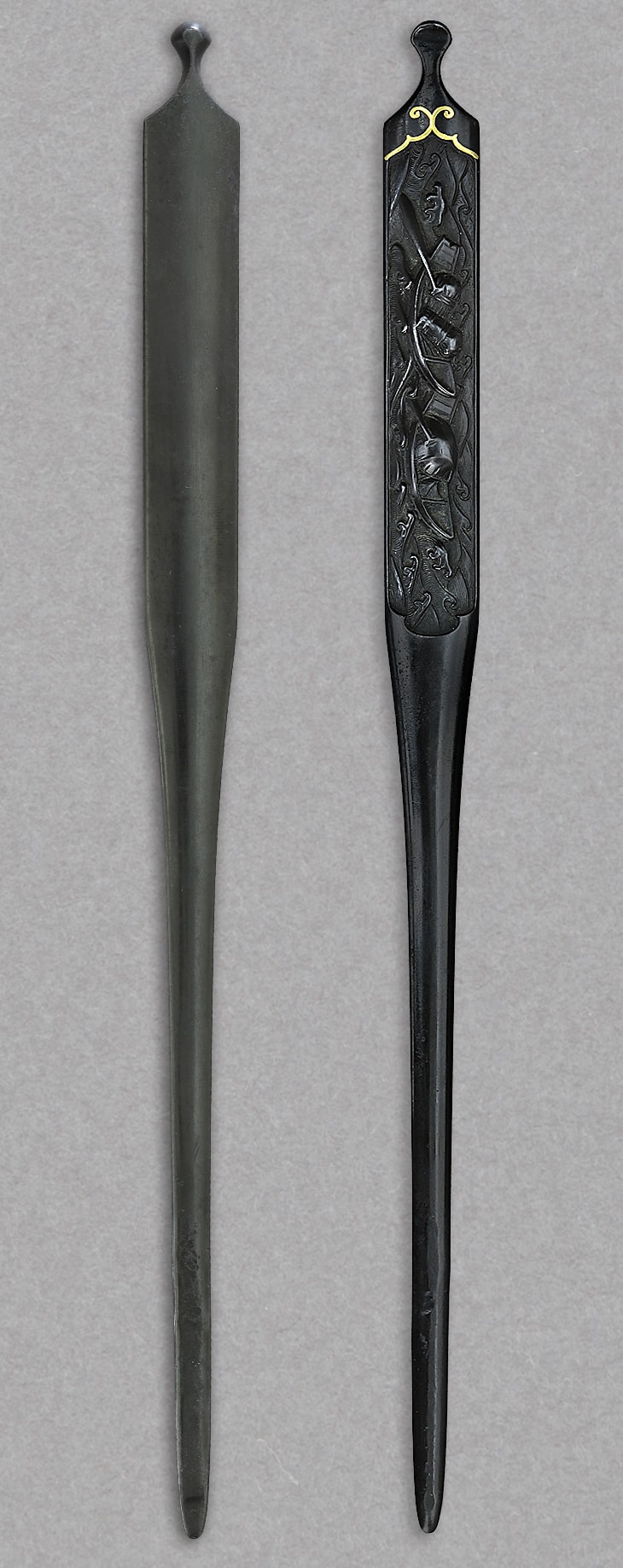
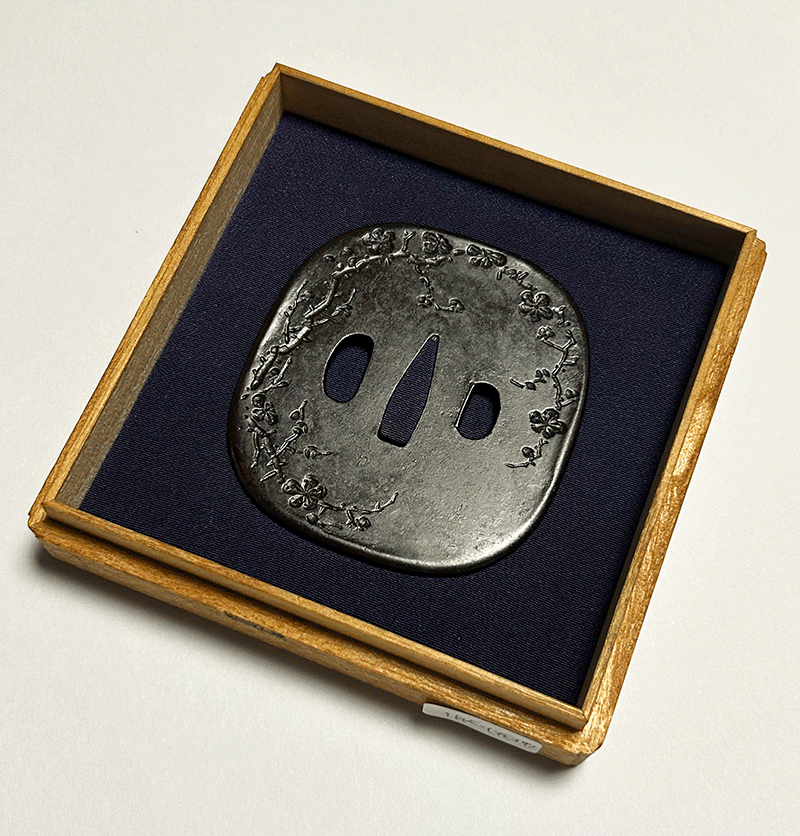
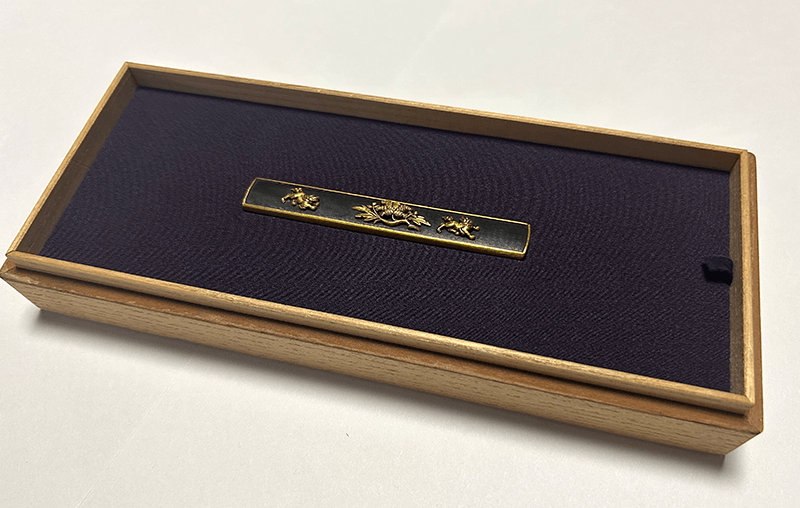
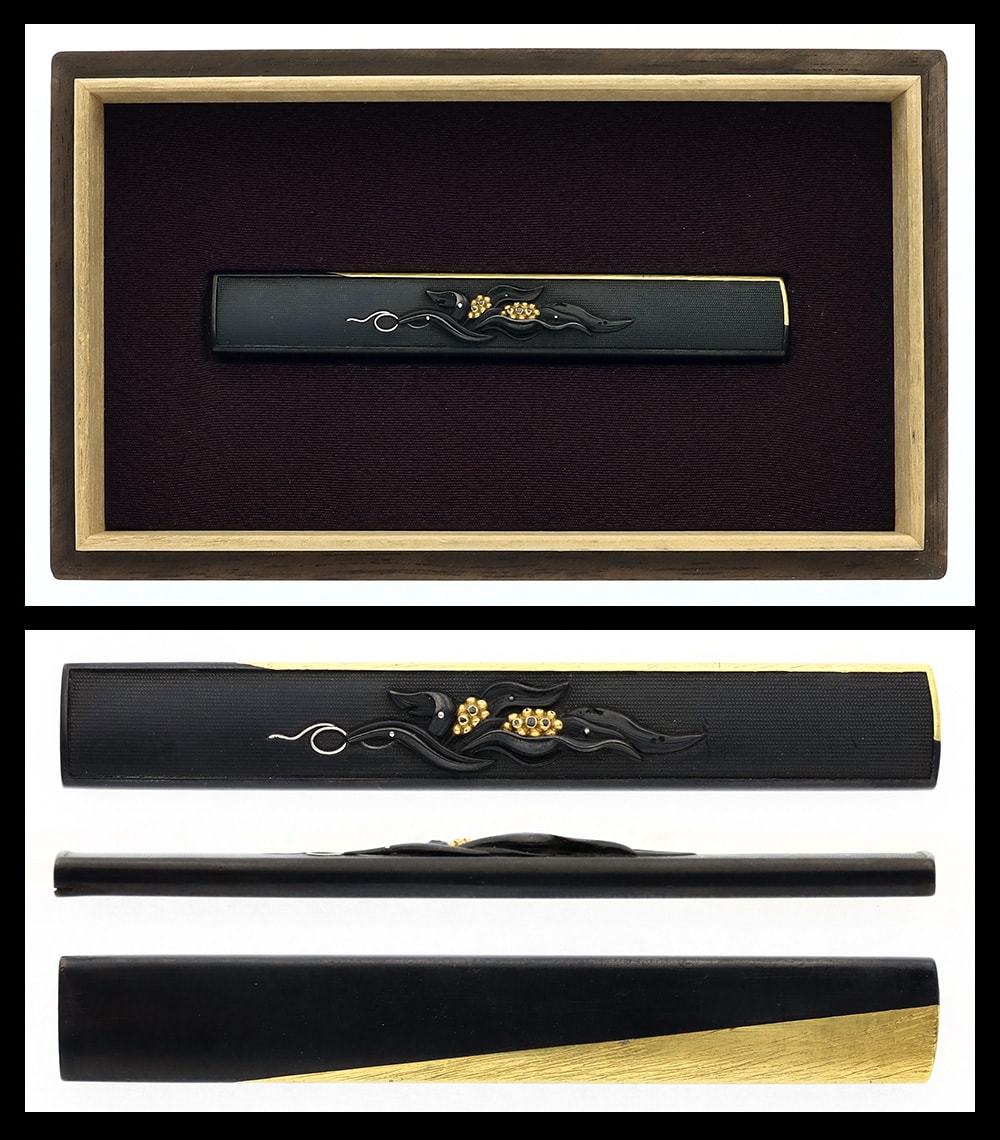
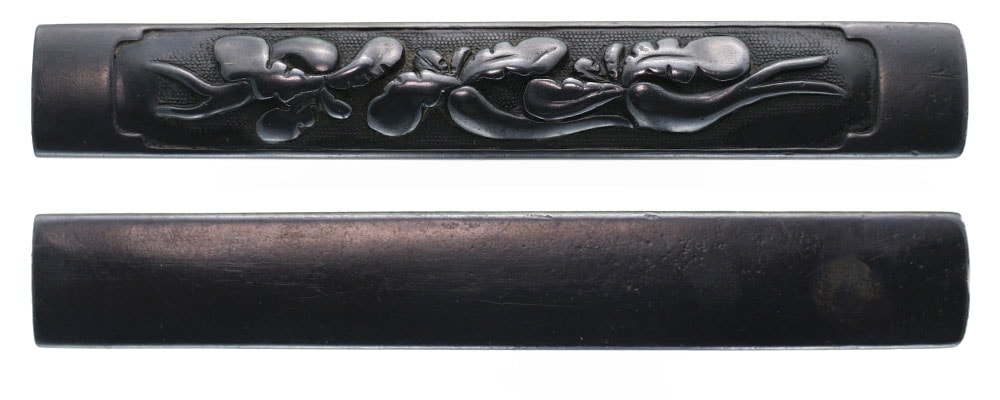
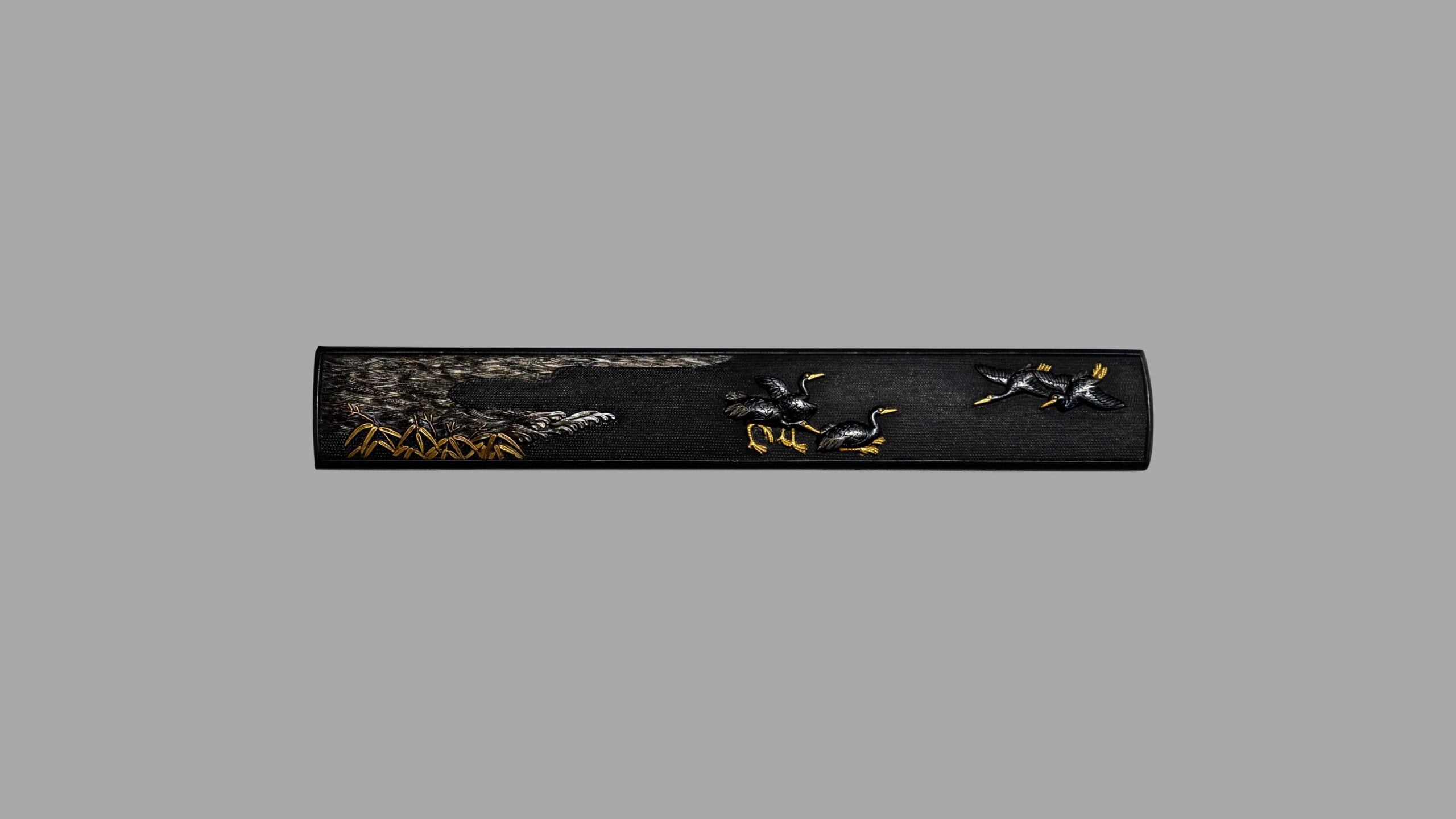
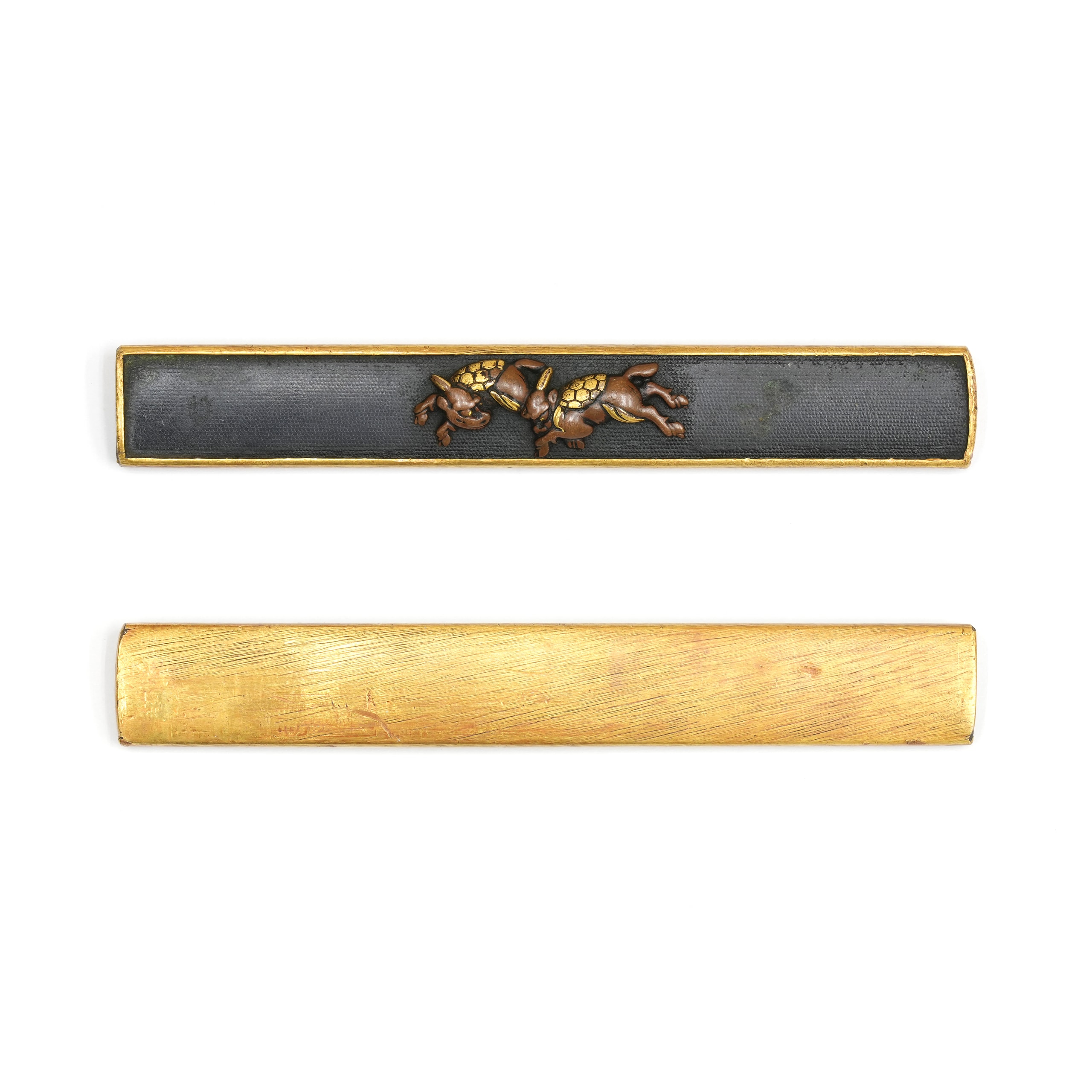
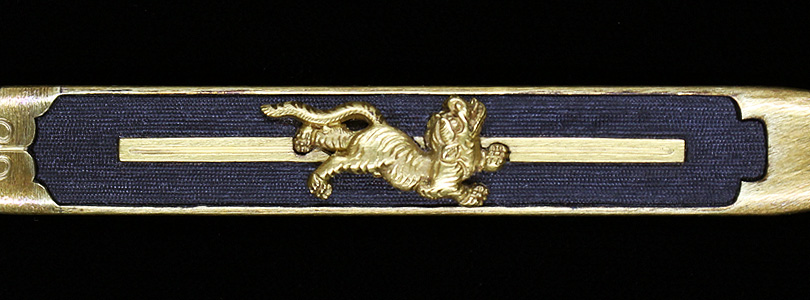
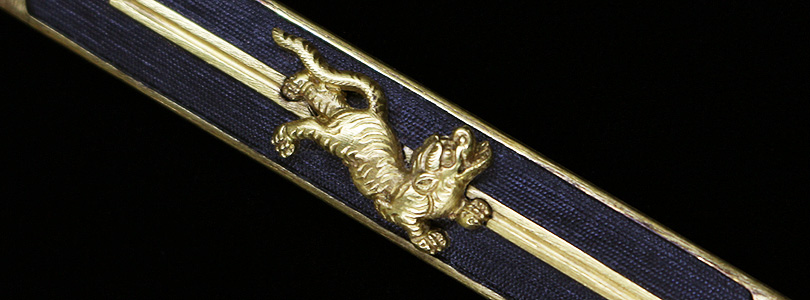
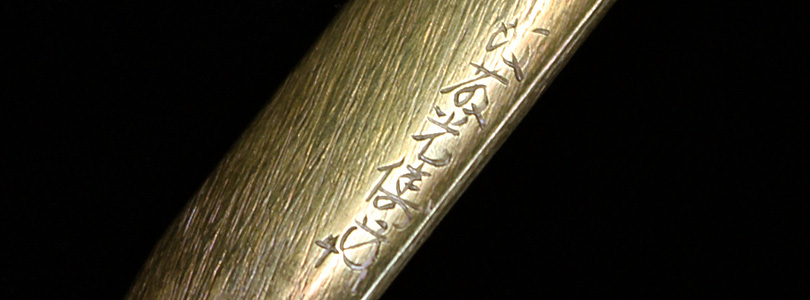
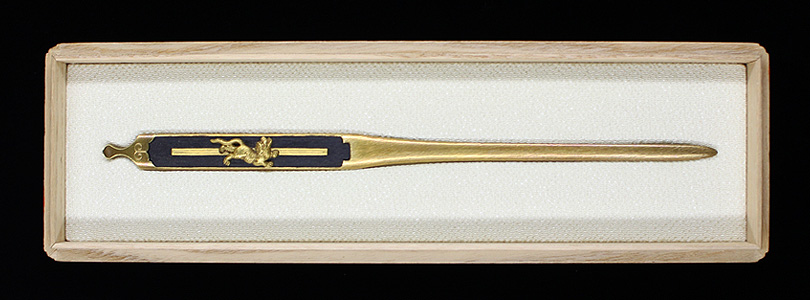
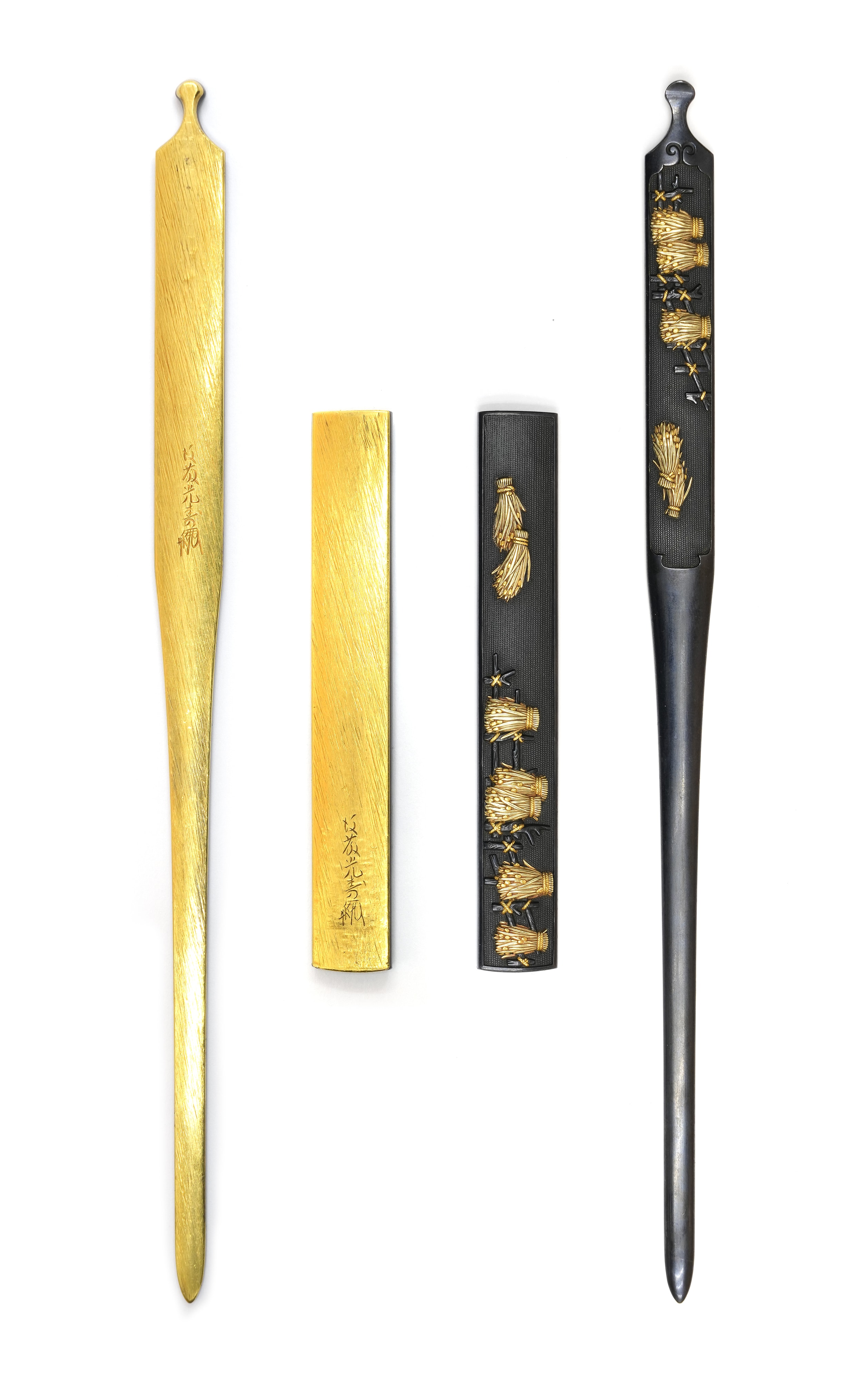
A kogai featuring a tiger design on hishizume wood, made by Goto Mitsuhisa during the Edo period. It comes with a Hozon certificate from the NBTHK and is stored in a fitted paulownia box. Mitsuhisa was the 11th generation of the Goto family, also known as Michinori.
 NihontoWatch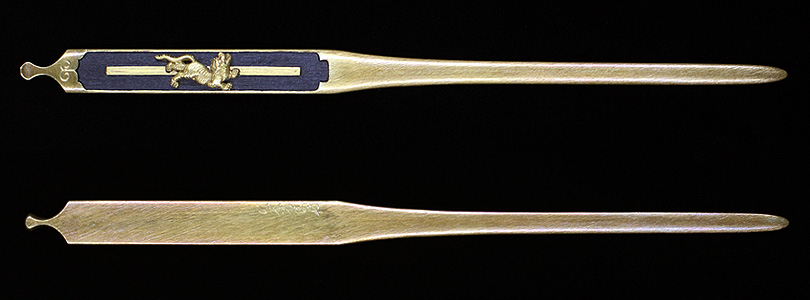
Goto Tsujo
Edo
Signed
Hozon (NBTHK)
Iebori · Yamashiro · around 1664-1721
3 pieces on the market now
Goto Tsujo Mitsutoshi was the third son of Sennjo Mitsuharu of the Goto Taroemon house, and a grandson of Kenjo, the seventh head of the mainline Goto house. Because Mitsuyoshi, the biological heir and eldest son of the tenth head Renjo, died young of illness, Mitsutoshi married Renjo's daughter and was adopted into the main line. In Genroku 10 (1697), upon Renjo's retirement, he succeeded as the eleventh head of the Goto soke. Born in Kanbun 4 (1664) with the childhood name Mitsuo and the common name Gennojo, he took Buddhist vows in Kyoho 5 (1720) and adopted the art name Tsujo, but fell ill and died on the twenty-seventh day of the twelfth month of the following year. For this reason, works bearing the Tsujo signature are limited to the final one year and eight months of his life, and surviving examples are extremely few, lending such pieces particular value as documentary material.
During Renjo's tenure the Goto mainline relocated from Kyoto to Edo and settled there permanently. In Mitsutoshi's generation, responding to the Genroku cultural milieu, the house absorbed the rising influence of machibori (town-carver workmanship), which was then gaining prominence. While maintaining the inherited traditions of iebori (the hereditary house style), Mitsutoshi incorporated fresh elements to meet contemporary taste, adding a new flavor atop established Goto standards. His chisel handling is characterized by broad, unhurried strokes possessed of a dignified tone, and the raised work is robustly built up with ample volume. His preferred materials are shakudo nanako-ji grounds with gold and silver iroe, and he made liberal use of kin'ura (gold-backed) reverse finishing and, on occasion, sokin (solid gold) construction of notable sumptuousness. Among his technical innovations, the left-right spreading compositional arrangement seen in his mitokoromono is said to have been first attempted by him, and he introduced novel surface treatments such as a nunome-like variant of ishime-ji texturing on rock elements. His menuki are characteristically thick-backed and convey a notable sense of weight owing to the generous use of gold.
Mitsutoshi's significance within the Goto lineage lies in his role as the pivotal figure who bridged the formal tradition of the house with the expressive spirit of the Genroku era. From his generation onward the Goto family began to produce sword fittings more proactively, including tsuba, which had appeared only sparingly since the time of the fifth head Tokujo. He also served as authenticator and assembler of works by the celebrated Upper Three Generations — the founder Yujo, the second head Sojo, and the third head Joshin — issuing origami that remain important documents of connoisseurship. His favored subjects include the Goto house specialties of edagiku (sprays of chrysanthemum) and hai-ryu (crawling dragon) alongside more inventive themes such as rusu moyo (absent-figure designs) evoking the Seven Lucky Gods, Edomae marine motifs, and narratives drawn from the Nijushi-ko (Twenty-four Filial Exemplars). Whether working in the restrained idiom of traditional Goto okimono subjects or in compositions that breathe the urbane refinement of the townspeople, his pieces achieve a refreshing effect while clearly demonstrating the elevated dignity of the Goto house.
Where Goto Tsujo stands among comparable artisans: across all of nihontō, and within tradition, era, and period. The tiers (Foremost · Leading · Major · Notable) weigh official designations from the NBTHK and Japan's Agency for Cultural Affairs, together with historical honors of lasting repute such as the Sansaku and Meibutsu-chō.
Select a lens to see how it's measured.
Iebori · Yamashiro
Phase: Goto Main Line後藤宗家· 1573–1900
325 pieces on the market now
| Smith | Era | Designated |
|---|---|---|
| Goto Joshin後藤乗真 | 1512-1562 | 68 |
| Goto Yujo後藤祐乗 | 1440-1512 | 41 |
| Goto Kenjo後藤顕乗 | 1586-1663 | 46 |
| Goto Sojo後藤宗乗 | 1461-1538 | 55 |
| Goto Eijo後藤栄乗 | 1577-1617 | 35 |
Certifies a genuine fitting worth preserving: a correct signature, or, if unsigned, an identifiable era and school, with recognized artistic and craft value.
The NBTHK (Nihon Bijutsu Tōken Hozon Kyōkai, the Society for the Preservation of Japanese Art Swords) is a public-interest incorporated foundation founded in 1948 and supervised by Japan’s Agency for Cultural Affairs (Bunkachō); it is based at the Japanese Sword Museum in Tokyo. Its expert panels physically examine each submitted work (shinsa) and issue a certificate (kanteishō) ranking it by artistic and historical merit. NBTHK papers are the most widely recognized standard of authentication for Japanese swords and fittings.
NBTHK official siteWe accept returns within 3 days counted from the item's arrival date. Items that have been altered cannot be handled. Return shipping is the customer's responsibility. If the destination is overseas, returns are as a rule not possible.
A kogai featuring a tiger design on hishizume wood, made by Goto Mitsuhisa during the Edo period. It comes with a Hozon certificate from the NBTHK and is stored in a fitted paulownia box. Mitsuhisa was the 11th generation of the Goto family, also known as Michinori.
NihontoWatchGoto Tsujo
Edo
Signed
Hozon (NBTHK)
Iebori · Yamashiro · around 1664-1721
3 pieces on the market now
Goto Tsujo Mitsutoshi was the third son of Sennjo Mitsuharu of the Goto Taroemon house, and a grandson of Kenjo, the seventh head of the mainline Goto house. Because Mitsuyoshi, the biological heir and eldest son of the tenth head Renjo, died young of illness, Mitsutoshi married Renjo's daughter and was adopted into the main line. In Genroku 10 (1697), upon Renjo's retirement, he succeeded as the eleventh head of the Goto soke. Born in Kanbun 4 (1664) with the childhood name Mitsuo and the common name Gennojo, he took Buddhist vows in Kyoho 5 (1720) and adopted the art name Tsujo, but fell ill and died on the twenty-seventh day of the twelfth month of the following year. For this reason, works bearing the Tsujo signature are limited to the final one year and eight months of his life, and surviving examples are extremely few, lending such pieces particular value as documentary material.
During Renjo's tenure the Goto mainline relocated from Kyoto to Edo and settled there permanently. In Mitsutoshi's generation, responding to the Genroku cultural milieu, the house absorbed the rising influence of machibori (town-carver workmanship), which was then gaining prominence. While maintaining the inherited traditions of iebori (the hereditary house style), Mitsutoshi incorporated fresh elements to meet contemporary taste, adding a new flavor atop established Goto standards. His chisel handling is characterized by broad, unhurried strokes possessed of a dignified tone, and the raised work is robustly built up with ample volume. His preferred materials are shakudo nanako-ji grounds with gold and silver iroe, and he made liberal use of kin'ura (gold-backed) reverse finishing and, on occasion, sokin (solid gold) construction of notable sumptuousness. Among his technical innovations, the left-right spreading compositional arrangement seen in his mitokoromono is said to have been first attempted by him, and he introduced novel surface treatments such as a nunome-like variant of ishime-ji texturing on rock elements. His menuki are characteristically thick-backed and convey a notable sense of weight owing to the generous use of gold.
Mitsutoshi's significance within the Goto lineage lies in his role as the pivotal figure who bridged the formal tradition of the house with the expressive spirit of the Genroku era. From his generation onward the Goto family began to produce sword fittings more proactively, including tsuba, which had appeared only sparingly since the time of the fifth head Tokujo. He also served as authenticator and assembler of works by the celebrated Upper Three Generations — the founder Yujo, the second head Sojo, and the third head Joshin — issuing origami that remain important documents of connoisseurship. His favored subjects include the Goto house specialties of edagiku (sprays of chrysanthemum) and hai-ryu (crawling dragon) alongside more inventive themes such as rusu moyo (absent-figure designs) evoking the Seven Lucky Gods, Edomae marine motifs, and narratives drawn from the Nijushi-ko (Twenty-four Filial Exemplars). Whether working in the restrained idiom of traditional Goto okimono subjects or in compositions that breathe the urbane refinement of the townspeople, his pieces achieve a refreshing effect while clearly demonstrating the elevated dignity of the Goto house.
Where Goto Tsujo stands among comparable artisans: across all of nihontō, and within tradition, era, and period. The tiers (Foremost · Leading · Major · Notable) weigh official designations from the NBTHK and Japan's Agency for Cultural Affairs, together with historical honors of lasting repute such as the Sansaku and Meibutsu-chō.
Select a lens to see how it's measured.
Iebori · Yamashiro
Phase: Goto Main Line後藤宗家· 1573–1900
325 pieces on the market now
| Smith | Era | Designated |
|---|---|---|
| Goto Joshin後藤乗真 | 1512-1562 | 68 |
| Goto Yujo後藤祐乗 | 1440-1512 | 41 |
| Goto Kenjo後藤顕乗 | 1586-1663 | 46 |
| Goto Sojo後藤宗乗 | 1461-1538 | 55 |
| Goto Eijo後藤栄乗 | 1577-1617 | 35 |
Certifies a genuine fitting worth preserving: a correct signature, or, if unsigned, an identifiable era and school, with recognized artistic and craft value.
The NBTHK (Nihon Bijutsu Tōken Hozon Kyōkai, the Society for the Preservation of Japanese Art Swords) is a public-interest incorporated foundation founded in 1948 and supervised by Japan’s Agency for Cultural Affairs (Bunkachō); it is based at the Japanese Sword Museum in Tokyo. Its expert panels physically examine each submitted work (shinsa) and issue a certificate (kanteishō) ranking it by artistic and historical merit. NBTHK papers are the most widely recognized standard of authentication for Japanese swords and fittings.
NBTHK official siteWe accept returns within 3 days counted from the item's arrival date. Items that have been altered cannot be handled. Return shipping is the customer's responsibility. If the destination is overseas, returns are as a rule not possible.
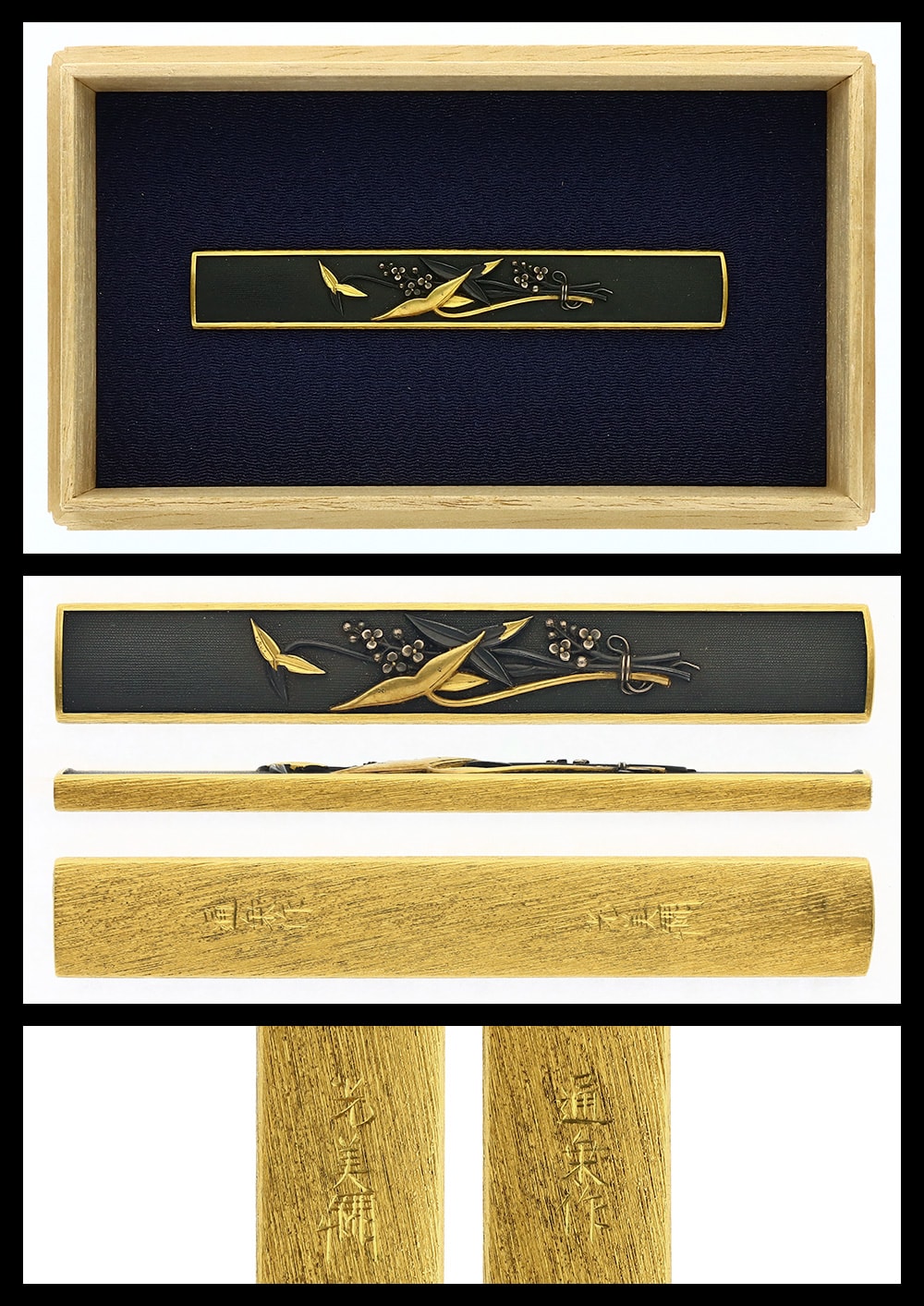
![Kozuka - Tokuho - by Goto Tsujo - Kozuka with Wild Horse Design, Signed Goto Mitsutoshi (Kao) [11th Generation]](/_next/image?url=https%3A%2F%2Fitbhfhyptogxcjbjfzwx.supabase.co%2Fstorage%2Fv1%2Fobject%2Fpublic%2Flisting-images%2Fchoshuya%2FL189258%2F00.jpg&w=2560&q=90)