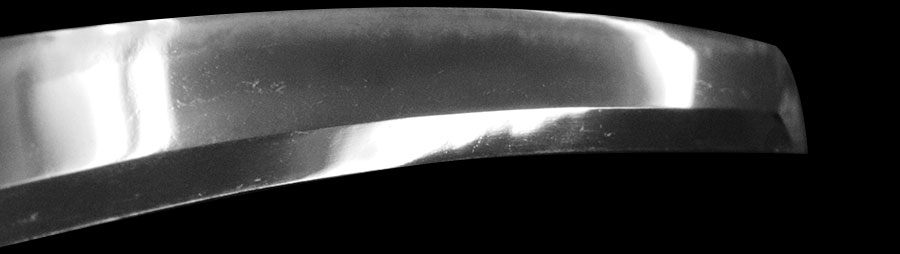
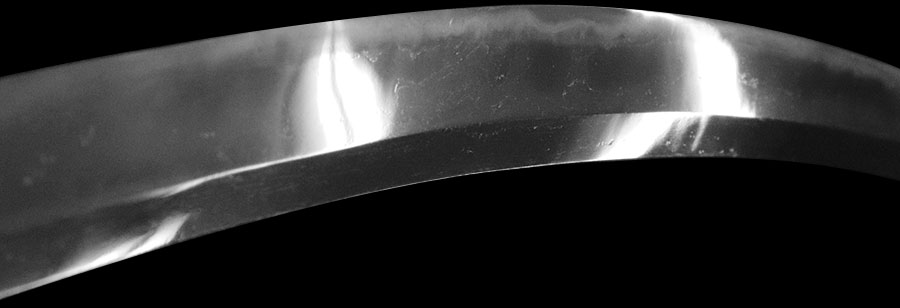
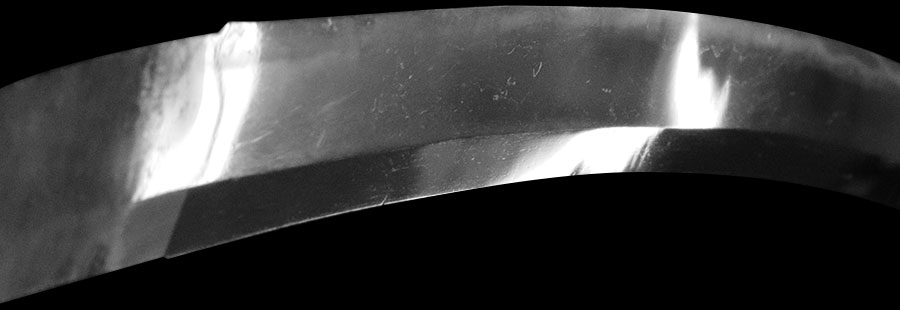
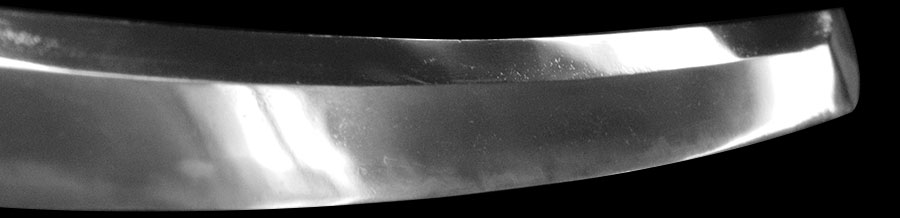
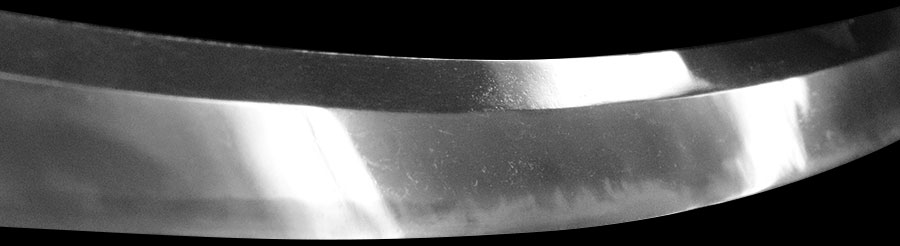
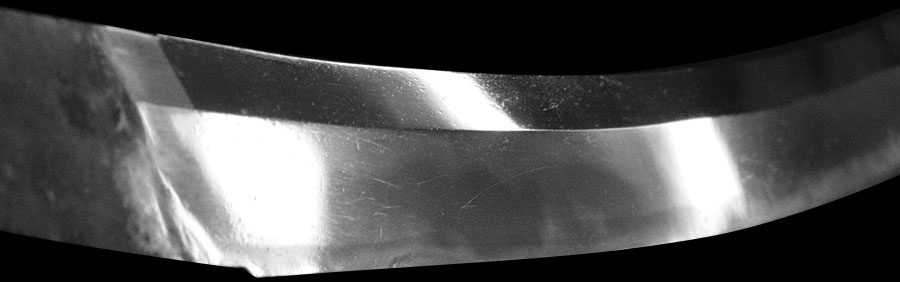
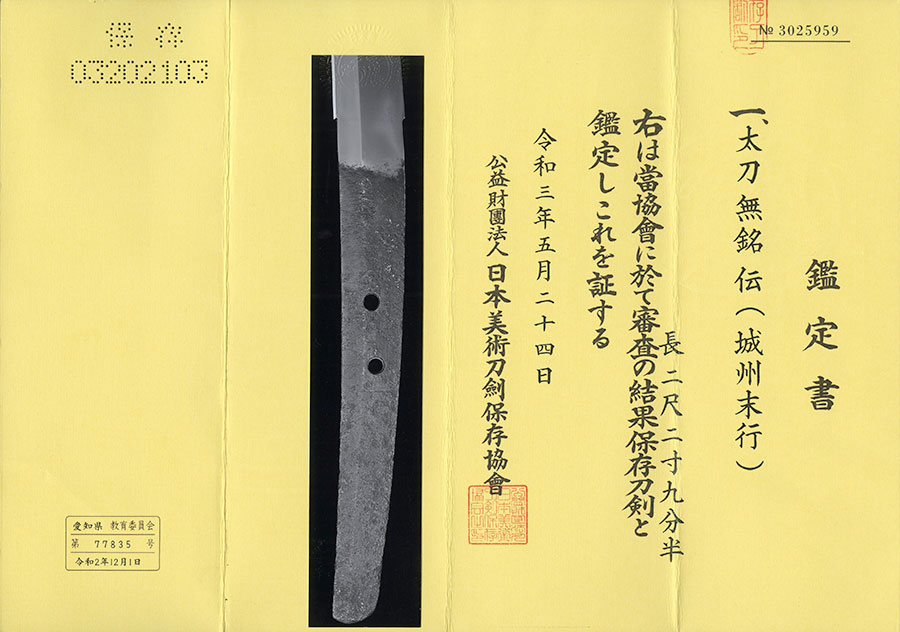
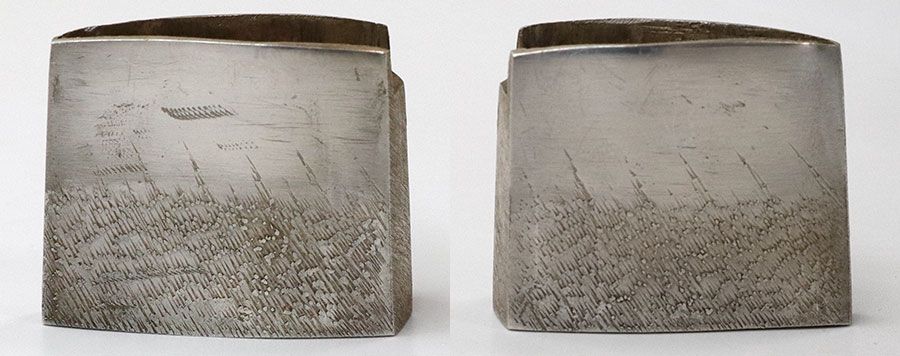
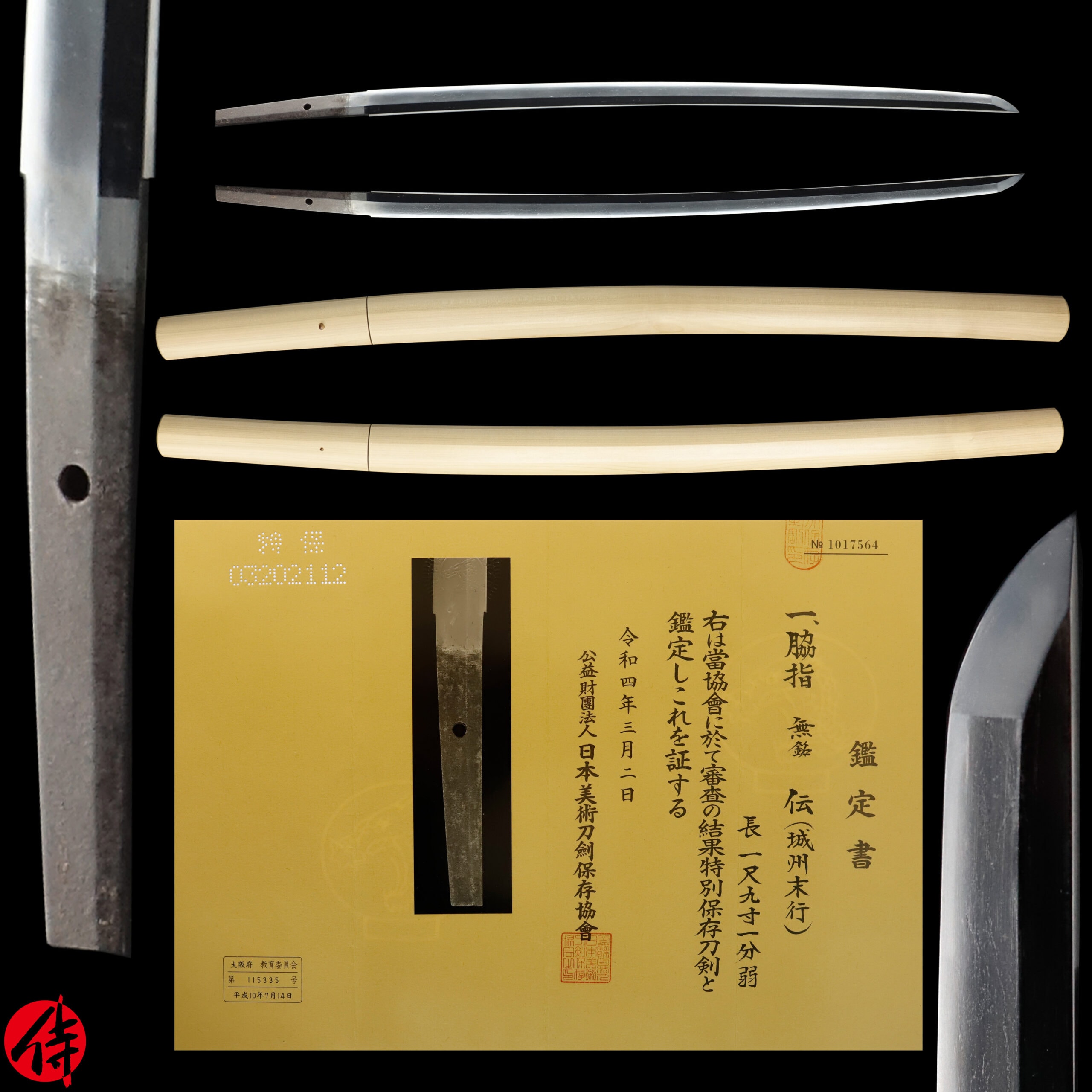
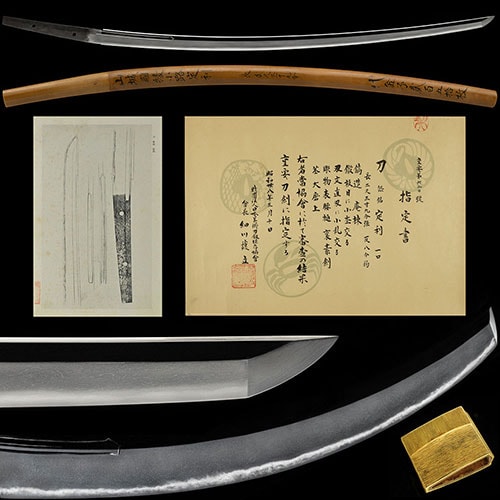
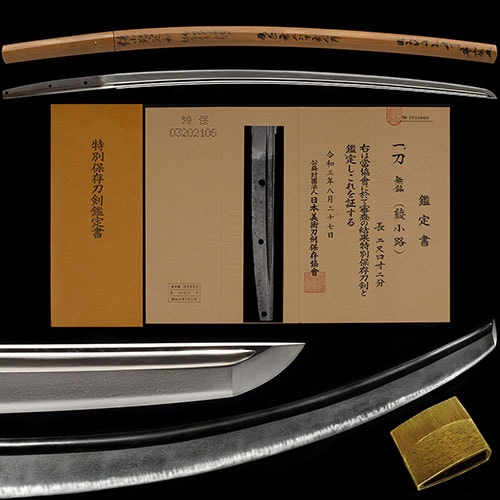
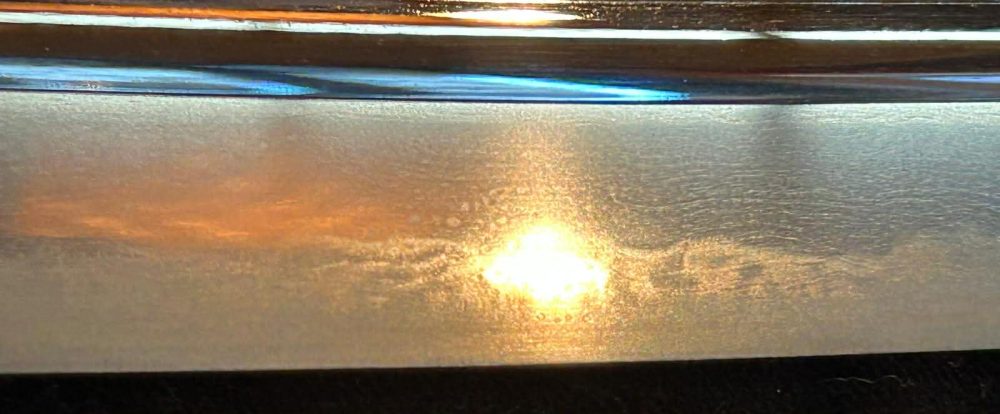
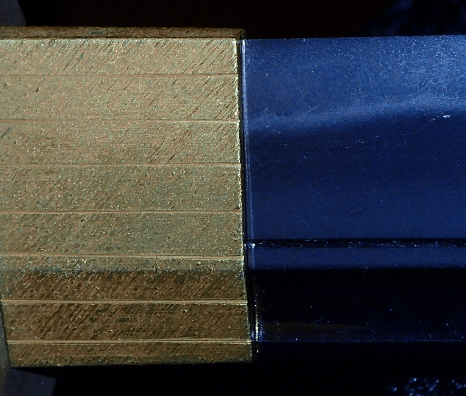
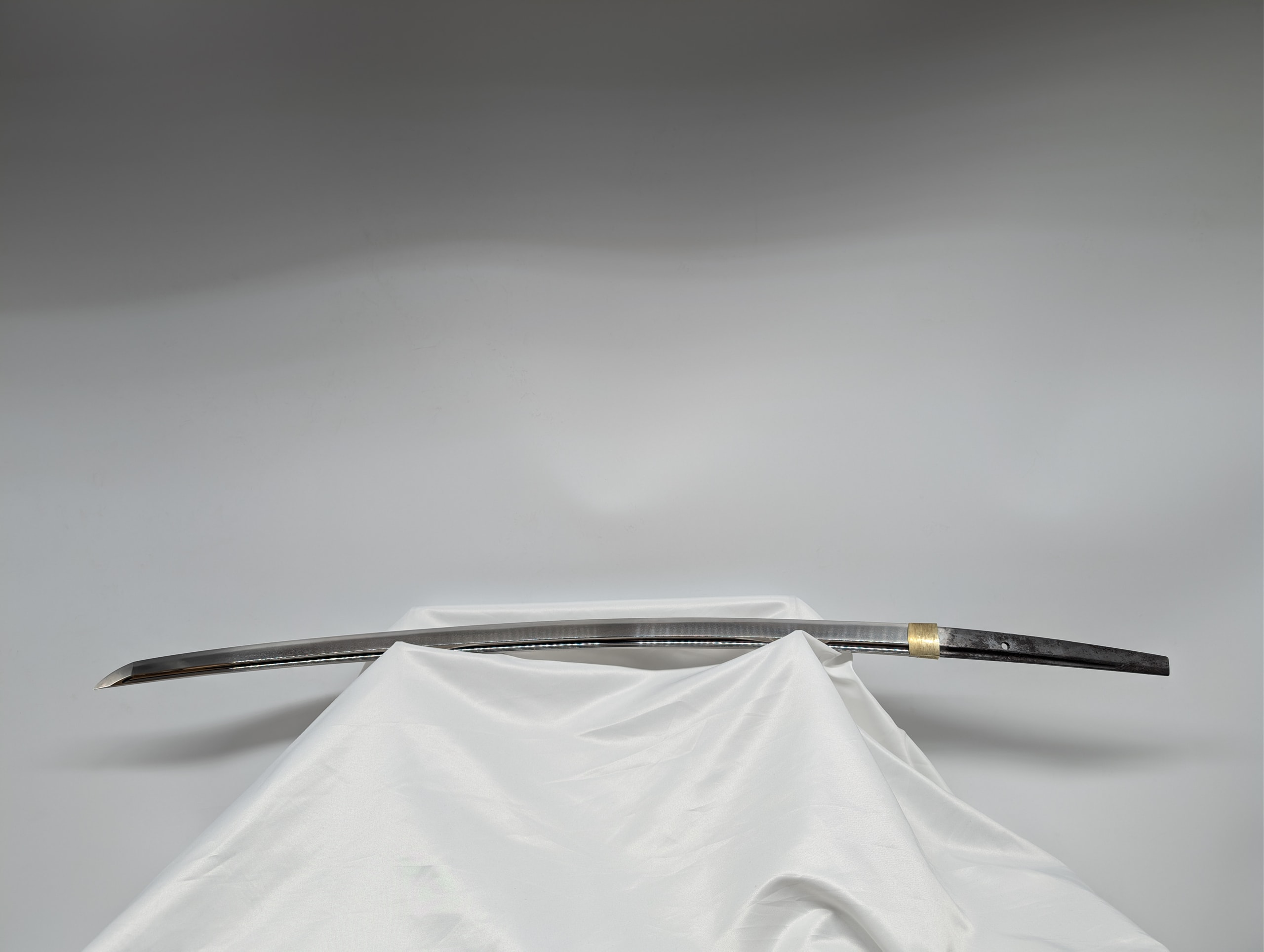
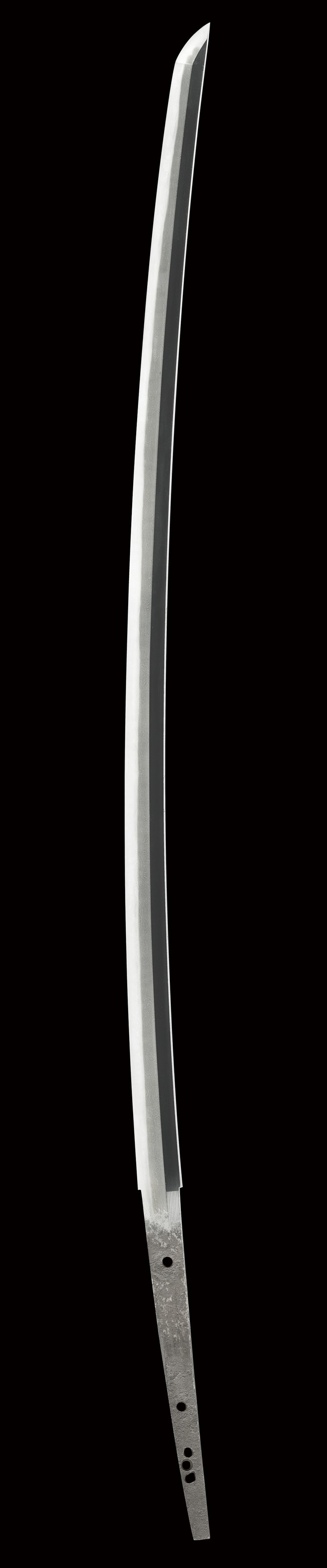
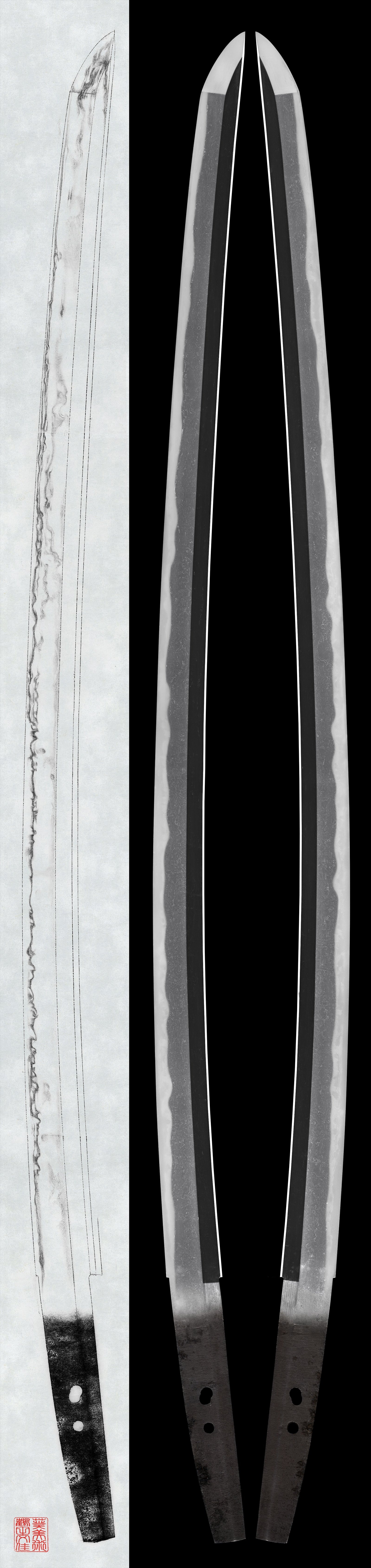
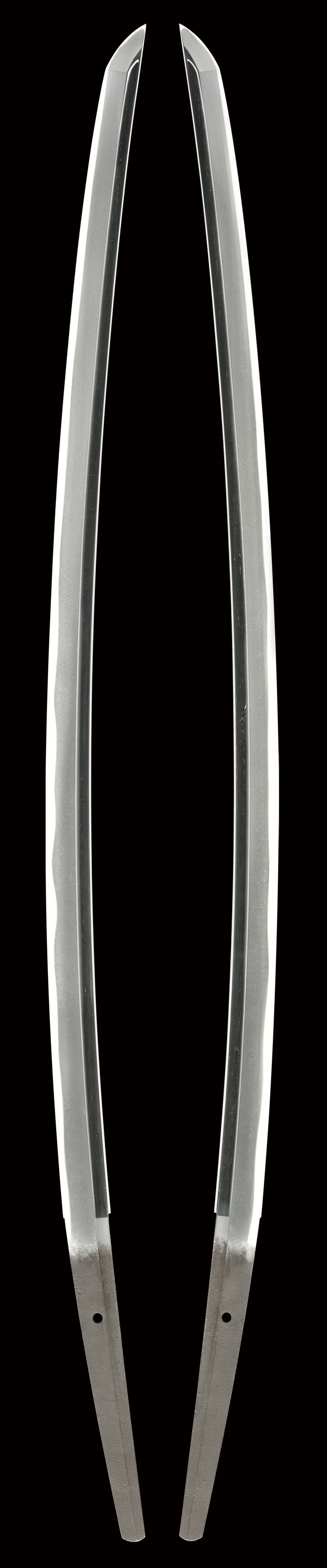
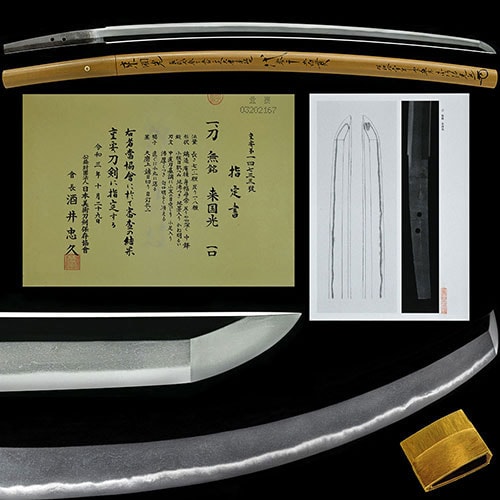
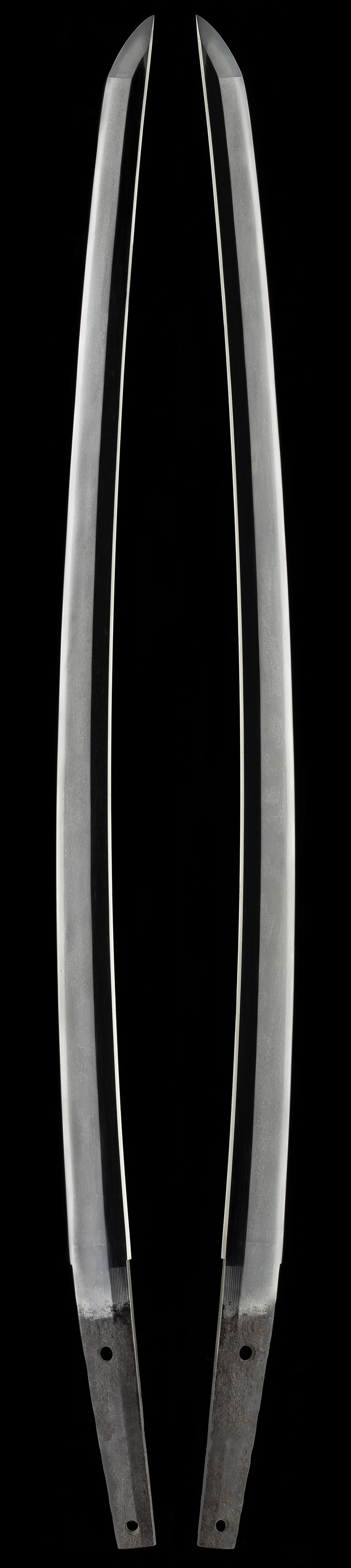
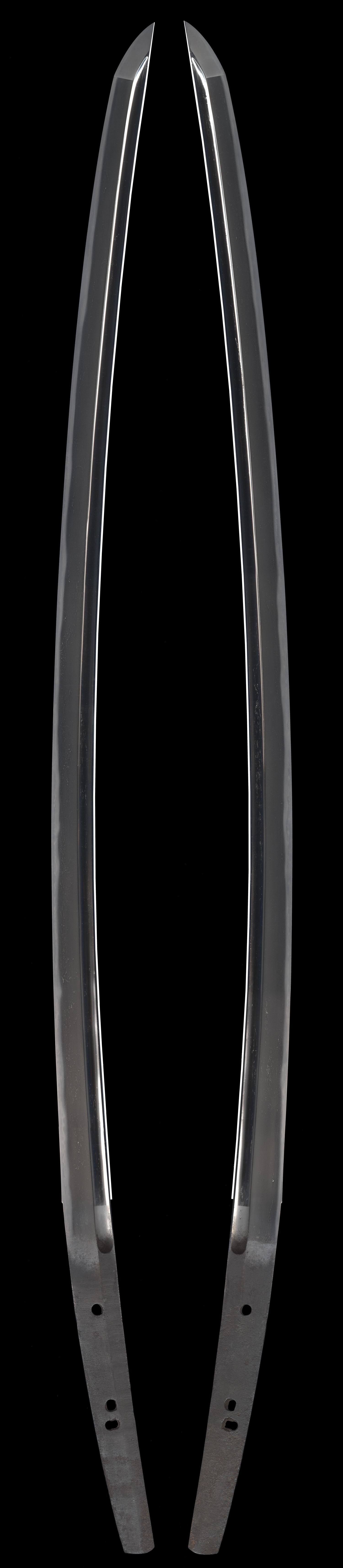
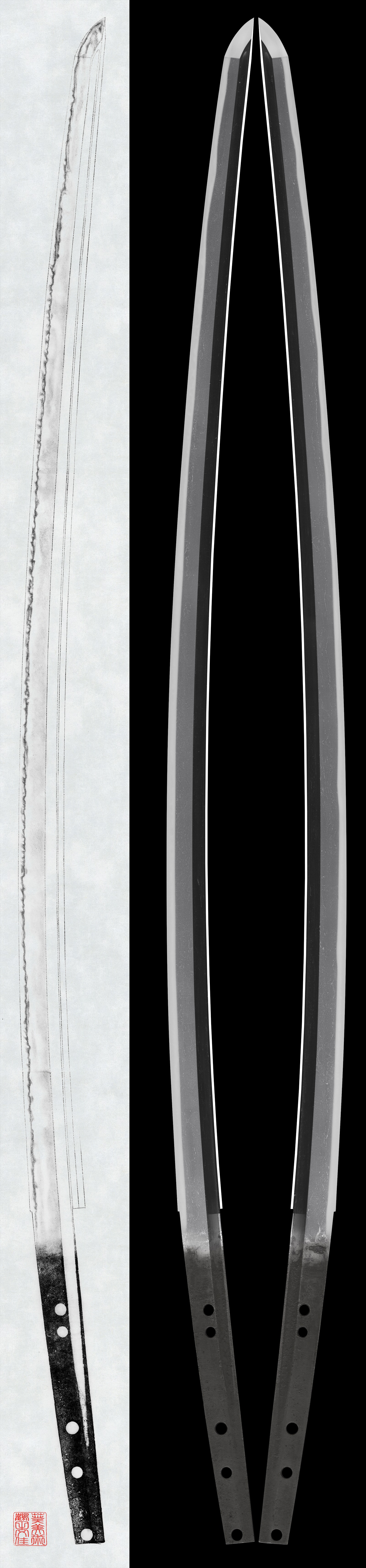
Yamashiro Kyo smiths were the swordsmiths of the capital of Kyoto, the center of Japan; they are the central figures of the sword world, and their works are culturally significant and precious. Starting from Sanjo Munechika in the Heian period, the lineage continued through the Gojo, Awataguchi, Ayanokoji, and Rai smiths. However, because of numerous wars within the Kinai region, few Yamashiro swords remain today, making any extant examples extremely valuable. This tachi is an ancient and precious work from around the Bunei era of the Kamakura period (1274) (748 years ago), exactly the time when the Mongol forces invaded Japan during the Bunei War. Because the workmanship is identical to the Joshu Ayanokoji Sueyuki held in the Itsukushima Shrine collection, it has been attributed (kiwame) as Joshu Ayanokoji Sueyuki, making it a very rare tachi. Originally a tachi of 2 shaku 4 sun, it has been suriage. It displays a refined sugata with a distinct difference between the motohaba and sakihaba and a deep sori that makes one want to bow in reverence. The jigane is ko-itame hada mixed with moku, with fine chikei appearing in the ji. From the moto to the saki, it displays a magnificent, faint nie-utsuri. The hamon consists of deep nioi-guchi resembling fallen light snow on the habuchi, with ko-choji, ko-midare, and ko-gunome mixed intricately together, perfectly exhibiting the greatest characteristics of the Ayanokoji school. Kamakura period Yamashiro tachi are almost non-existent and are extremely precious. On this occasion, an old sukisha (connoisseur) has entrusted this to us, saying they have enjoyed it sufficiently and wish to pass it on to the next generation at a low price. Therefore, while there are signs of age-related change, we are offering it at a specially discounted price. Please enjoy this precious tachi by Joshu Ayanokoji Sueyuki.
mumei · Heian · nagasa 69.8cm · sori 2.2cm


Yamashiro-den · Yamashiro · around 1303-1306
2 pieces on the market now
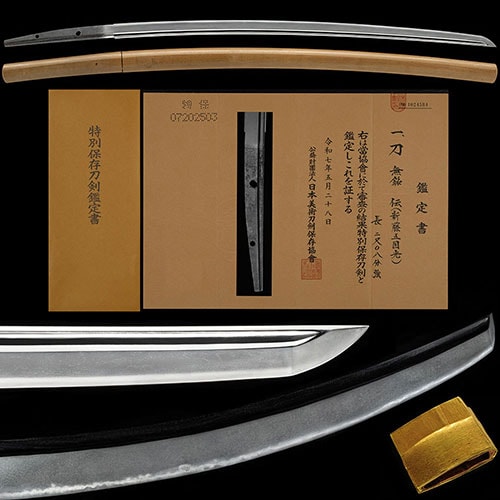
Working in the Kyoto Yamashiro tradition around the Kagen era of the late Kamakura period, Sueyuki (末行) belonged to the Ayanokoji group, the early Kyoto school whose style is represented by Sadatoshi. The NBTHK setsumei note that the name "Sueyuki" appears in the meikan across several unrelated lineages (Ayanokoji, Senjuin, Taima, Ko-Bizen, and Ko-Aoe), but the workmanship of these blades, in jigane, hamon, and signature manner, places this smith firmly within the Ayanokoji group. The references describe him as a follower of Ayanokoji Sadatoshi, and one setsumei connects the quality of the jiba and overall bearing to Sadayoshi of the same group, inheriting the classically archaic style of the line.
The forging is itame-hada, in places tending toward hada-dachi or mixed with mokume, o-itame, and a jifu-like grain; fine ji-nie adheres thickly, and a standing nie-utsuri (or jifu-utsuri) is a recurring feature typical of Kyo-mono. The hamon is founded on suguha-cho mixed with ko-midare, ko-gunome, ko-choji-like forms, and shallow notare, with ashi and yo entering and a bright nioiguchi. Nie covers the habuchi, which shows hotsure, small tobiyaki, and yubashiri that in places produce a nijuba-like impression, while kinsuji and sunagashi run as reliable hataraki. The boshi varies from straight with maru and slight hakikake to midare-komi tending toward yakizume. Sugata is an elegant tachi with high koshizori and remaining funbari.
For collectors, the decisive kantei points are the Kyo character of the work: the densely adhering fine ji-nie raising nie-utsuri, the reverse-slanting (saka-gakari, Kyo-saka-ashi) tendency of the irregularities toward the point, and the wazori-like curvature that separates this hand from Bizen and Bicchu production. Extant signed works are few, so the surviving two-character mei examples carry particular weight, and even the mumei ubu-tang tachi is valued as the piece that should most properly be appraised as Sueyuki. One signed tachi is traditionally said to have been formerly owned by the Mizoguchi family, lords of the Shibata domain.
Where Sueyuki stands among comparable artisans: across all of nihontō, and within tradition, era, and period. The tiers (Foremost · Leading · Major · Notable) weigh official designations from the NBTHK and Japan's Agency for Cultural Affairs, together with historical honors of lasting repute such as the Sansaku and Meibutsu-chō.
Select a lens to see how it's measured.
Yamashiro-den · Yamashiro
10 pieces on the market now
The Ayanokoji school (綾小路) takes its name from the swordsmiths who lived along Ayanokoji street in the Shijo quarter of Kyoto, and the published sources count it, with Awataguchi and Rai, among the three lineages of Yamashiro-den smiths of the Kamakura period. Learn more →
| Smith | Era | Designated |
|---|---|---|
| Sadatoshi定利 | 1232-1233 | 42 |
| Sueyuki末行 | 1303-1306 | 3 |
| Sadatoshi定利 | 1334-1338 | 0 |
| Kuninobu國信 | 1334-1338 | 0 |
| Sadanari定業 | 1278-1288 | 0 |
Certifies a genuine blade worth preserving: a signature confirmed correct, or, if unsigned, an era, province, and school that the NBTHK can reliably identify.
The NBTHK (Nihon Bijutsu Tōken Hozon Kyōkai, the Society for the Preservation of Japanese Art Swords) is a public-interest incorporated foundation founded in 1948 and supervised by Japan’s Agency for Cultural Affairs (Bunkachō); it is based at the Japanese Sword Museum in Tokyo. Its expert panels physically examine each submitted work (shinsa) and issue a certificate (kanteishō) ranking it by artistic and historical merit. NBTHK papers are the most widely recognized standard of authentication for Japanese swords and fittings.
NBTHK official siteFor returns due to customer circumstances, the cost is the customer's responsibility. For returns due to our mis-shipment or a defective item, we bear the cost.
Yamashiro Kyo smiths were the swordsmiths of the capital of Kyoto, the center of Japan; they are the central figures of the sword world, and their works are culturally significant and precious. Starting from Sanjo Munechika in the Heian period, the lineage continued through the Gojo, Awataguchi, Ayanokoji, and Rai smiths. However, because of numerous wars within the Kinai region, few Yamashiro swords remain today, making any extant examples extremely valuable. This tachi is an ancient and precious work from around the Bunei era of the Kamakura period (1274) (748 years ago), exactly the time when the Mongol forces invaded Japan during the Bunei War. Because the workmanship is identical to the Joshu Ayanokoji Sueyuki held in the Itsukushima Shrine collection, it has been attributed (kiwame) as Joshu Ayanokoji Sueyuki, making it a very rare tachi. Originally a tachi of 2 shaku 4 sun, it has been suriage. It displays a refined sugata with a distinct difference between the motohaba and sakihaba and a deep sori that makes one want to bow in reverence. The jigane is ko-itame hada mixed with moku, with fine chikei appearing in the ji. From the moto to the saki, it displays a magnificent, faint nie-utsuri. The hamon consists of deep nioi-guchi resembling fallen light snow on the habuchi, with ko-choji, ko-midare, and ko-gunome mixed intricately together, perfectly exhibiting the greatest characteristics of the Ayanokoji school. Kamakura period Yamashiro tachi are almost non-existent and are extremely precious. On this occasion, an old sukisha (connoisseur) has entrusted this to us, saying they have enjoyed it sufficiently and wish to pass it on to the next generation at a low price. Therefore, while there are signs of age-related change, we are offering it at a specially discounted price. Please enjoy this precious tachi by Joshu Ayanokoji Sueyuki.
mumei · Heian · nagasa 69.8cm · sori 2.2cm


Yamashiro-den · Yamashiro · around 1303-1306
2 pieces on the market now
Working in the Kyoto Yamashiro tradition around the Kagen era of the late Kamakura period, Sueyuki (末行) belonged to the Ayanokoji group, the early Kyoto school whose style is represented by Sadatoshi. The NBTHK setsumei note that the name "Sueyuki" appears in the meikan across several unrelated lineages (Ayanokoji, Senjuin, Taima, Ko-Bizen, and Ko-Aoe), but the workmanship of these blades, in jigane, hamon, and signature manner, places this smith firmly within the Ayanokoji group. The references describe him as a follower of Ayanokoji Sadatoshi, and one setsumei connects the quality of the jiba and overall bearing to Sadayoshi of the same group, inheriting the classically archaic style of the line.
The forging is itame-hada, in places tending toward hada-dachi or mixed with mokume, o-itame, and a jifu-like grain; fine ji-nie adheres thickly, and a standing nie-utsuri (or jifu-utsuri) is a recurring feature typical of Kyo-mono. The hamon is founded on suguha-cho mixed with ko-midare, ko-gunome, ko-choji-like forms, and shallow notare, with ashi and yo entering and a bright nioiguchi. Nie covers the habuchi, which shows hotsure, small tobiyaki, and yubashiri that in places produce a nijuba-like impression, while kinsuji and sunagashi run as reliable hataraki. The boshi varies from straight with maru and slight hakikake to midare-komi tending toward yakizume. Sugata is an elegant tachi with high koshizori and remaining funbari.
For collectors, the decisive kantei points are the Kyo character of the work: the densely adhering fine ji-nie raising nie-utsuri, the reverse-slanting (saka-gakari, Kyo-saka-ashi) tendency of the irregularities toward the point, and the wazori-like curvature that separates this hand from Bizen and Bicchu production. Extant signed works are few, so the surviving two-character mei examples carry particular weight, and even the mumei ubu-tang tachi is valued as the piece that should most properly be appraised as Sueyuki. One signed tachi is traditionally said to have been formerly owned by the Mizoguchi family, lords of the Shibata domain.
Where Sueyuki stands among comparable artisans: across all of nihontō, and within tradition, era, and period. The tiers (Foremost · Leading · Major · Notable) weigh official designations from the NBTHK and Japan's Agency for Cultural Affairs, together with historical honors of lasting repute such as the Sansaku and Meibutsu-chō.
Select a lens to see how it's measured.
Yamashiro-den · Yamashiro
10 pieces on the market now
The Ayanokoji school (綾小路) takes its name from the swordsmiths who lived along Ayanokoji street in the Shijo quarter of Kyoto, and the published sources count it, with Awataguchi and Rai, among the three lineages of Yamashiro-den smiths of the Kamakura period. Learn more →
| Smith | Era | Designated |
|---|---|---|
| Sadatoshi定利 | 1232-1233 | 42 |
| Sueyuki末行 | 1303-1306 | 3 |
| Sadatoshi定利 | 1334-1338 | 0 |
| Kuninobu國信 | 1334-1338 | 0 |
| Sadanari定業 | 1278-1288 | 0 |
Certifies a genuine blade worth preserving: a signature confirmed correct, or, if unsigned, an era, province, and school that the NBTHK can reliably identify.
The NBTHK (Nihon Bijutsu Tōken Hozon Kyōkai, the Society for the Preservation of Japanese Art Swords) is a public-interest incorporated foundation founded in 1948 and supervised by Japan’s Agency for Cultural Affairs (Bunkachō); it is based at the Japanese Sword Museum in Tokyo. Its expert panels physically examine each submitted work (shinsa) and issue a certificate (kanteishō) ranking it by artistic and historical merit. NBTHK papers are the most widely recognized standard of authentication for Japanese swords and fittings.
NBTHK official siteFor returns due to customer circumstances, the cost is the customer's responsibility. For returns due to our mis-shipment or a defective item, we bear the cost.