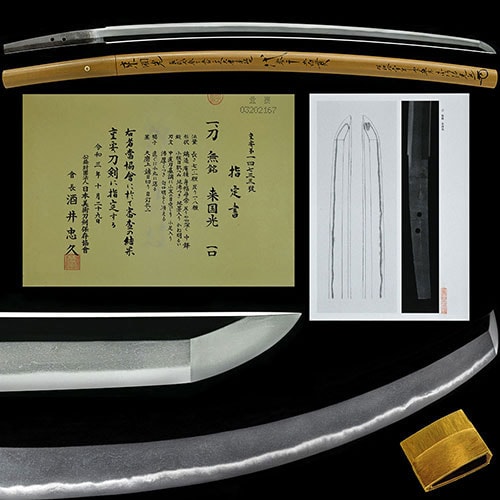
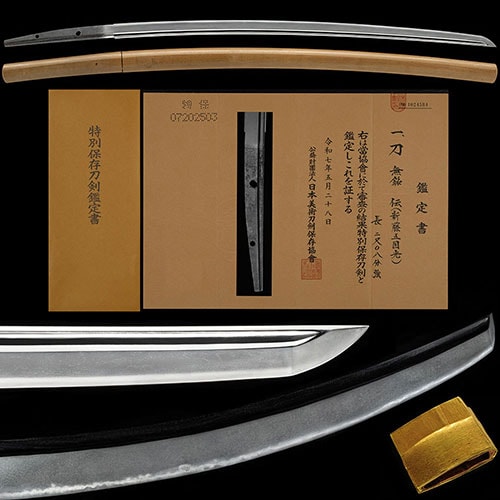
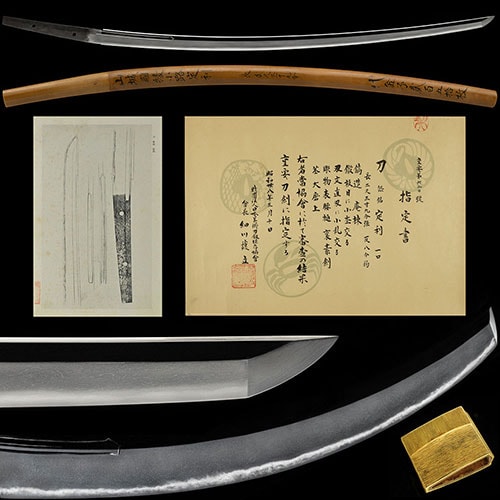
NihontoWatch MonNihontoWatchBETA
MarketEncyclopedia
NihontoWatch Mon

NihontoWatchBETA

Market
Encyclopedia
Overview·Kantei·Designations·Provenance·Blade Forms·Signatures·Lineage·School
OverviewKanteiDesignationsProvenanceBlade FormsSignaturesLineageSchool
  1. Schools
  2. Nobukuni
  3. Nobukuni

Nobukuni

信國

Tokujū
Vol. 26, No. 5 · Wakizashi

Nobukuni

信國

44 ranked works

ProvinceYamashiroEraOei (1394–1428)PeriodMuromachiSchoolNobukuniTraditionYamashiro-denGeneration4thFujishiroJo-jo sakuToko Taikan1,000(top 8%)TypeSwordsmithCodeNOB309
1Jūyō Bunkazai
1Jūyō Bijutsuhin
2Gyobutsu
1Tokubetsu Jūyō39Jūyō Tōken

Overview

On a dated the eighth month of Ōei 20 (1413), once held in the Ōshimazu family of Satsuma and now ranked , the signature reads Minamoto Saemon-no-jō , and within the character the interior is cut in reverse, the left-form by which this hand is known. This is the Ōei , the early- generation of the distinguished Kyoto house, conventionally counted as the third generation and represented above all by two named smiths, Minamoto Saemon-no-jō and Shikibu-no-jō . Because both inscribed Ōei dates, the published sources record that the pair are admired together as the Ōei . The house descends from Ryōkai, and tradition holds that its first generation studied under Sadamune and is counted among the Sadamune ; the Ōei smiths carry both inheritances at once, the refinement of Kyoto and the of . The published commentary opens its account plainly, that " was a distinguished Kyoto lineage of swordsmiths" (信国は京鍛冶の名門で) which flourished from the period through the .

The most consistent feature of the Ōei is not a single temper but the carving, and the published sources name it as such, that both Saemon-no-jō and Shikibu-no-jō are particularly adept at dense and powerful . and flaming , a worked in relief or in openwork within a , and , hata-, lotus pedestals, and sacred invocations such as cut into the groove appear again and again, layered and superimposed, and the commentary repeatedly judges them splendid. The signature is the second tell. Saemon-no-jō is read in part by the reversed interior of the character , a point the published record calls a major matter of connoisseurship, that "within the enclosing element of the character the interior is formed as the character left" (国」の字のクニ構えの中が左字になっている); the feature is traced from late , the Shitoku and Meitoku eras, and is common in Ōei. The family name is Minamoto, so the smith often called Genzaemon-no-jō is properly Minamoto Saemon-no-jō.

Beneath both manners lies one . It is an mixed with that flows toward the edge into , standing a little, with thick and frequent ; where the forging tightens it becomes a , and on one a faint and gather near the . Over that the temper divides in two. The first is a that keeps the fundamental Kyoto tradition, narrow to medium, bright in , with and entering, adhering, and fine and running through, the edge showing in places, the straight to a with a touch of . The published sources prize this straight temper as uncommon among of the period, and draw a careful comparison, that "Ōei too favours and frequently tempers , yet seems to show the stronger " (応永備前も直刃の作を好んで焼くがや).

The second manner is the -laden that carries the Sadamune inheritance forward. Across the line, the published record explains, two principal tempers descend, "a expressing the Kyoto tradition and a inheriting the Sadamune manner" (京物の伝統を示した直刃と貞宗風を受け継い); and it notes that from the late succession into the Ōei generation one can newly observe a further working range, that "a -ba dominated by can now be seen" (互の目主調の乱れ刃の作域を新たに見ることが). On these blades the mixes with and pointed , at times an angular and a -like element, and entering, well adhered, and throughout, and here and there and ; the enters and finishes in a or pointed return, at times . Most surviving works are and , slightly extended in proportion, with a few signed and dated the sources call extremely rare and precious, valued for their soundness and for the rarity of a signed .

What sets the Ōei apart is the meeting of these two inheritances in one Kyoto hand. The first generation, the published commentary records, was a pupil of Sadamune whose "workmanship displays a style that approaches that of his master Sadamune" (殆んど師貞宗に迫る作風); the Ōei smiths keep the strength in their while holding to the bright Yamashiro and the refined carving of the capital. His bright and lively activity, his standing with toward the edge, and above all his layered devotional distinguish him from the plainer utilitarian grooving of the smiths of his own day. The relationship of the two named smiths is left open: by tradition Saemon-no-jō is the elder and Shikibu-no-jō the younger brother, but the published sources note that read strictly the dated works unsettle the order, so the question is held over for future study.

For the collector the Ōei is a name of substance whose record is firmly held. Fujishiro grades him Jō-jō , and the Tōkō Taikan values him among the higher Kyoto smiths. He has no National Treasures; his record runs instead through two Important Cultural Properties, among them a Shikibu-no-jō dedicated to the shrine and preserved at Fujisan Hongū Sengen Taisha, together with one and the prewar Jūyō Bijutsuhin, and a pair of pieces in the Imperial Collection. His blades are preserved in shrines, museums and long-held collections grounded in their own provenance, the from the Ōshimazu of Satsuma, a Jūyō Bijutsuhin once held by Tokugawa Munetaka, and works recorded at Atsuta Jingū, Jingū, the Tokugawa Art Museum, the Mitsui Memorial Museum, the Sano Art Museum and the Kurokawa Institute of Ancient Cultures. Only a small number of his blades fall in the and tiers, so a signed Ōei comes to market only from time to time, and most that survive are and rather than the rare signed . A privately held example, sound in condition and carrying his dense carving and bright or his -rich , is a rewarding thing for a collector to encounter, and a document of how the Kyoto Sadamune line was carried into the .

Kantei

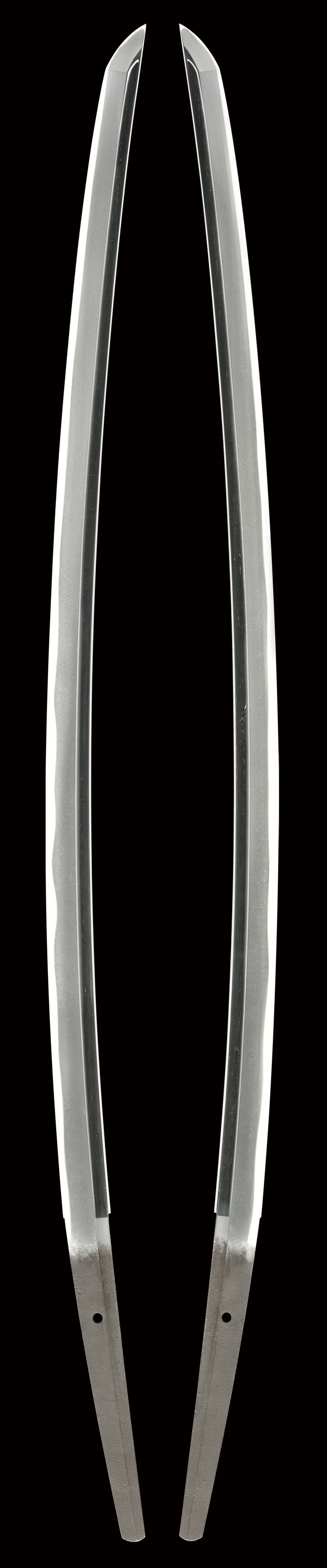
one Ōei Kyoto hand read across two tempers and a carving program: the Yamashiro suguha of the Kyō-mono tradition, the Sadamune-derived nie gunome-midare with ko-notare newly carried to a gunome-dominant manner, and the dense devotional horimono with the reversed-left kuni of Saemon-no-jō, all over a standing itame with masame toward the edge, thick ji-nie and chikei

This is the Ōei : the early- generation of the distinguished Kyoto house, conventionally counted as the third generation and represented above all by the two named smiths Minamoto Saemon-no-jō and Shikibu-no-jō , who both inscribed Ōei dates and are admired together as the Ōei . The line descends from Ryōkai and, by tradition, the first generation studied under Sadamune, counted among the Sadamune ; the Ōei smiths carry both inheritances. Their surviving work is mostly and , slightly extended in proportion, over a standing mixed with and flowing toward the edge, with thick and frequent . The comes in two principal manners: a that expresses the Kyoto tradition, bright in with , fine and ; and a -laden with , the Sadamune-derived register, into which this generation newly brought a -dominant irregular temper. The runs straight to a with , or enters pointed and turns back. Above all the house is known for dense and powerful , , , , hata- and sacred invocations, and for the signature tell by which Saemon-no-jō is read, the reversed left-form interior of the character .

Diagnostic discriminators

76% of his works · 2.6× vs the line's earlier suguha/notare base

unique vs Ōei Bizen suguha (calmer nie)

unique vs Bizen contemporaries (utilitarian hi only)

56% of his works · 2.8× vs tight ko-itame of refined Kyō-mono

Observation by phase

The Kyō-mono suguha (the Yamashiro inheritance)

One face of the Ōei is the that preserves the fundamental Kyoto tradition. On these blades, mostly and slightly extended in with , the temper is a narrow to medium , sometimes with a slight admixture of , bright in with and entering well, adhering, and fine and running through; the edge shows in places. The ground is a standing mixed with , flowing toward the edge into , with and, on the Compton , a and near the . The is straight with a and a touch of . The published sources call this uncommon among of the period and prize it: on the Saemon-no-jō the bright, lively with its dense double-sided carving is judged excellent overall, and on a they note that, while Ōei also favours , shows the stronger .

Sugata 姿
Jigane 地鉄
Hamon 刃文
Bōshi 帽子

The nie gunome-midare (the Sadamune-derived register)

The other face is the -laden that carries the Sadamune inheritance forward, and which the published sources single out as the working range newly opened by this generation, a -dominant irregular temper beyond the line's earlier and . Over the standing with and the temper is mixed with and pointed , sometimes with angular and a -like element, and entering, well adhered, with and throughout and, here and there, and . The enters , finishing in a or pointed return, at times . The signed in this manner are extremely rare and precious: one the sources can place only as not descending later than Ōei, valuing it for the rarity of a signed and for sound condition; another, a , they judge Ōei of good and . On the dated Shikibu-no-jō the strongly -laden is called characteristic of his hand.

Sugata 姿
Jigane 地鉄
Hamon 刃文
Bōshi 帽子

The horimono program and the signature tell

What most readily identifies the Ōei is not a single but the carving program and the signature. Both Saemon-no-jō and Shikibu-no-jō are particularly adept at dense, powerful : and flaming , in relief or in openwork within a , and , hata-, lotus pedestals, and sacred invocations such as carved into the groove. These are layered and superimposed, and the published sources repeatedly call them splendid, set off the blade though counted later additions on some pieces. The signature itself is a tell: Saemon-no-jō is read in part by the interior of the character being formed in reverse, the left-form, a feature the sources trace from late (Shitoku and Meitoku) and find common in Ōei. The names carry the family Minamoto, so Genzaemon-no-jō is properly Minamoto Saemon-no-jō; long signatures with court title and Minamoto are the fullest examples, the two-character the common form.

Scholarship

The published sources set out the Nobukuni chronology and its open problems: the first generation is placed in Enbun and Jōji, with a traditional Kenmu attribution for which no work survives; there were several same-named smiths; and among the Ōei smiths Saemon-no-jō and Shikibu-no-jō are by tradition elder and younger brother, but if the dated works are read strictly the upper limit shifts and the order is uncertain, so the relationship is left for future study.

On the signature, the published sources record that Saemon-no-jō is read in part by the reversed left-form interior of the character kuni, a feature seen from late Nanbokuchō, Shitoku and Meitoku, and common in Ōei; and that the family name is Minamoto, so the smith commonly called Genzaemon-no-jō is properly Minamoto Saemon-no-jō.

Designations

Kokuhō—
Jūyō Bunkazai1
Jūyō Bijutsuhin1
Gyobutsu2
Tokubetsu Jūyō1
Jūyō Tōken39

Elite Standing

0.19 across 44 designated works

Top 12% among smiths

Provenance

11 documented provenances across certified works by Nobukuni

Provenance Standing

10 works held in elite collections across 11 documented provenances

Top 6% among smiths

Raw score: 2.83 / 10

Blade Forms

Distribution across 44 ranked works

Signatures

Signature types across 44 ranked works

Currently Available

Lineage

Nobukuni
Students (7)
  1. 1.Nobukuni信國2 for sale33designated
  2. 2.Masanobu正信4designated
  3. 3.Nobukuni信國
  4. 4.Nobukuni信國
  5. 5.Sadamitsu定光
  6. 6.Nobukuni信國
  7. 7.Masanobu正信

Nobukuni School

Other artisans of the Nobukuni school

  1. 1.Nobukuni信國1 for sale69designated
  2. 2.Nobukuni信國2 for sale33designated
  3. 3.Yoshikane吉包2 for sale7designated
  4. 4.Shigekane重包1 for sale4designated
  5. 5.Masanobu正信4designated
  6. 6.Masakane正包1designated
  7. 7.Nobukuni信國1 for sale2designated
  8. 8.Yoshimasa吉政2 for sale2designated
  9. 9.Shigekuni重國1designated
  10. 10.Nobukuni信國2designated
  11. 11.Nobusada信貞2designated