In Shoo 2 (1289), Hatakeda Sanemori signed a tachi with the long inscription Bizen no kuni Osafune junin Sama no jo Sanemori tsukuru, adding the yotsume-bishi crest and, a rarity for him, a date. Dated works of the Kenji, Koan and Shoo eras (1275 to 1293) survive, and the published sources state plainly that "his period of activity is clear." He is held to be the son of Hatakeda Moriie, by other accounts his pupil or grandson; it is also suggested that he served as one of Moriie's daisaku smiths, which would explain the scarcity of his own signed blades. Neither Moriie nor Sanemori ever signed Hatakeda-ju, the residence in the mei always reading Osafune, so Hatakeda is understood as a hamlet within Osafune village. His dated pieces fall in precisely the years of Osafune Nagamitsu, and that position, between his father's flamboyance and the composure of the Osafune mainline, is the axis on which everything written about him turns.
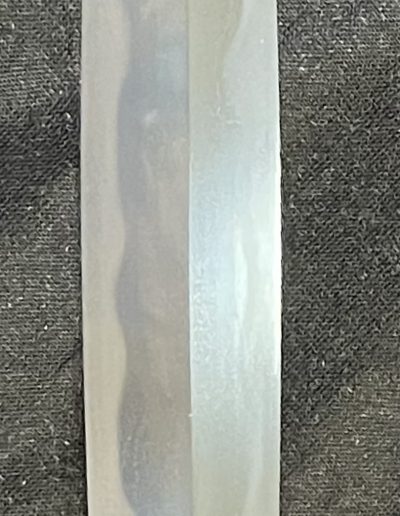
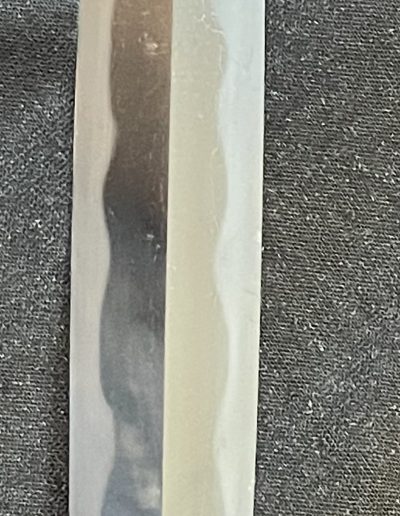
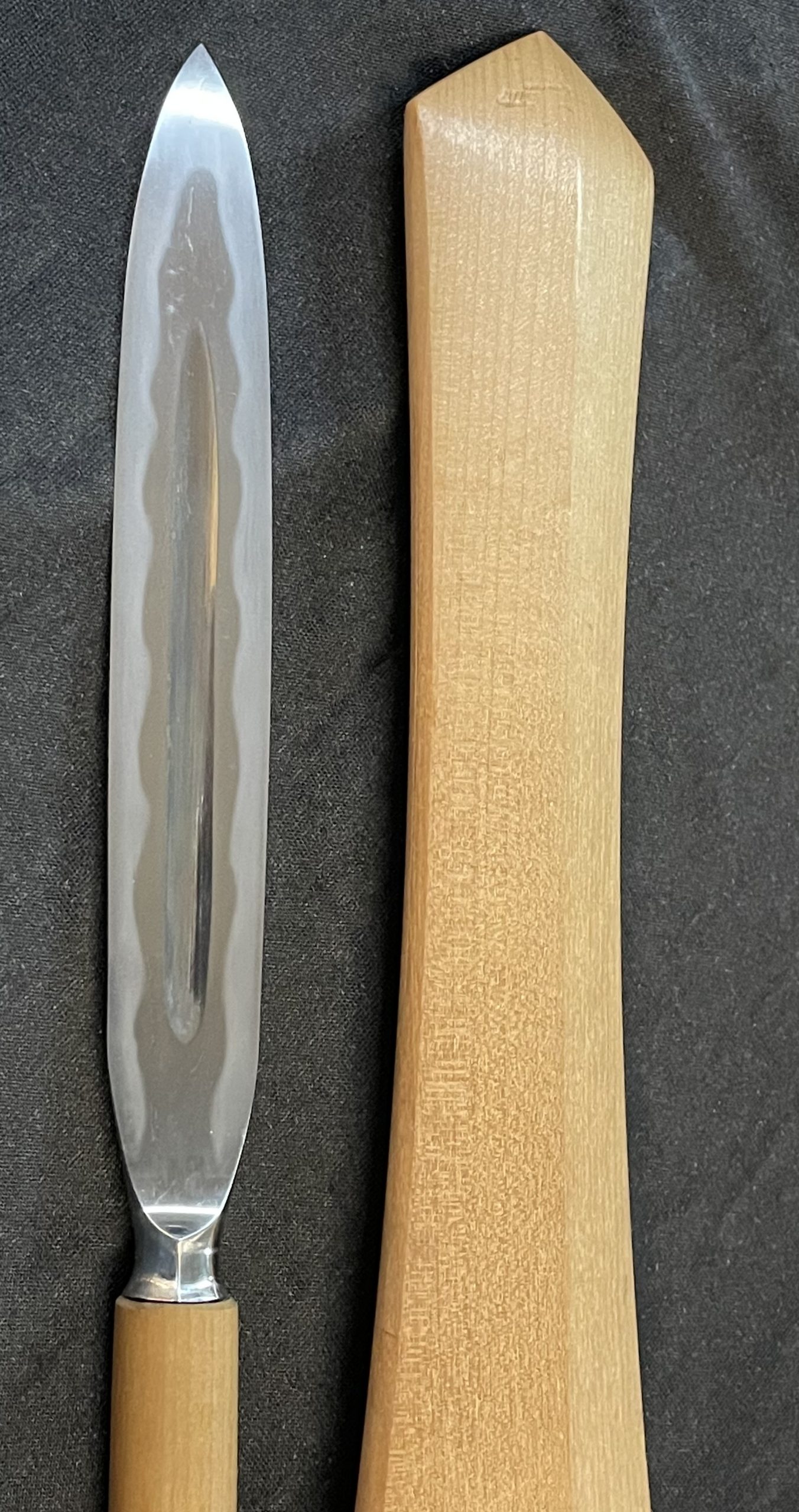
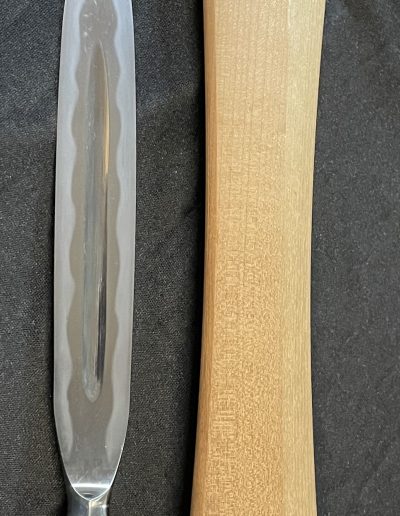
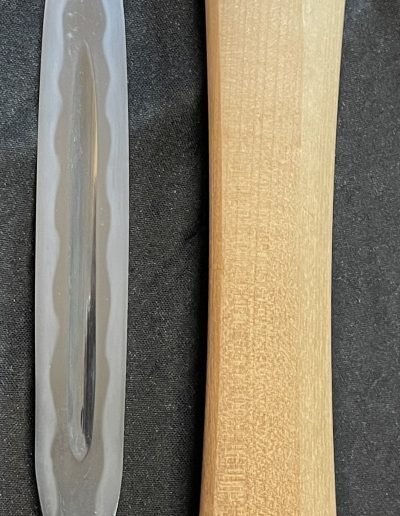
His prime manner is a choji-midare laced with kawazuko-choji, the pinched-waist tadpole choji in which, the published sources write, the Hatakeda smiths were "skilled as a specialty"[[c:1]]. What separates him from the father is scale. The NBTHK's standing formula for him, repeated in more than twenty of his texts, runs: "compared with Moriie, the midare generally tends toward a somewhat smaller pattern"[[c:2]]. The clusters sit a degree smaller, the rise and fall of the yakiba is less pronounced, and the tadpole heads often show plainest on the ura side. Gunome and togariba mix into the choji, ashi and yo enter richly, and the temper is nioi-primary with ko-nie, the nioiguchi described again and again as bright. Kinsuji and sunagashi work through the ha with small tobiyaki in places, and the boshi runs midare-komi or settles sugu in ko-maru, often with a pointed tendency and light hakikake.
The jigane carries the school's tell. He forges itame mixed with mokume that tends to stand, with fine thick ji-nie and chikei, under a vivid midare-utsuri; on the dated Shoo tachi the utsuri takes a mottled, jifu-utsuri-like state. The standing tendency is milder than in Moriie yet stronger than in the Osafune smiths. Beside it a second class of forging exists, a tightly knit ko-itame of great refinement; of one such blade, formerly of the Saijo Matsudaira family of Iyo, the NBTHK writes that it is "the finest among works attributed to this smith"[[c:3]]. A school point shows in the sugata as well: compared with Mitsutada and the Osafune smiths, the Hatakeda kissaki tends to extend, and his tachi keep a high koshizori with funbari.
The published sources sort his work into three manners: the flamboyant choji-midare, gunome mixed with choji, and a suguha-cho class, the latter two generally quieter than the father throughout. The mei divides along the same line. Most blades carry a two-character signature in one of two cuttings: the bold cutting yields flamboyant works resembling Moriie, while the small cutting is "generally close to Nagamitsu and Kagemitsu"[[c:4]]. The largest-signed and most flamboyantly tempered tachi he had seen, Honma Junji judged "without doubt the work of the first generation"[[c:5]]. Long signatures bearing the office title are rare and appear as both Sama no jo and Uma no jo; the Uma no jo tachi carries a chu-suguha with shallow notare, and of his rare signed ken the one in the Juyo record has a hoso-suguha with a yakizume boshi. Behind the two cuttings lies a deeper question: "it is thought there were two generations of the same name, but distinguishing them by the characters of the mei is at present difficult." The name itself demands care, for smiths signing Sanemori existed in Heian-period Hoki at Ohara and among the Kamakura-period Bitchu Aoe; the NBTHK notes that "their mei and workmanship of course differ in each case."
At his best the question is no longer his father but Osafune itself. The dated Shoo 2 tachi, the published sources write, "at first glance calls to mind a superior work of Nagamitsu"[[c:6]], and only the slightly standing jigane gives the Hatakeda line away. On rank the same sources are frank: "on the whole he does not reach Moriie, and the boshi especially falls short"[[c:7]]. Yet the same smaller pattern and gentler rise and fall that keep him below the father are what carry his quieter blades toward the Osafune masters. Unsigned attributions therefore rest on his own combination: the tadpole-laced choji over a slightly standing itame under vivid utsuri, the whole one degree calmer than Moriie. In one Tokubetsu Juyo case the appraisal was settled because the nakago shape closely matches his extant signed work. Surviving signed tachi are relatively few, and the published sources note that no tanto has been seen[[c:8]].
Fujishiro rates him Jo-jo saku, and sixty designated works stand on record. There are no National Treasures among them, but five blades are Important Cultural Properties, and the published sources also refer to one of his Important Cultural Properties handed down in the Asano family of Aki. Six are prewar Juyo Bijutsuhin, once held by collectors such as Kuroda Nagamichi and Kurokawa Fukusaburo. Five blades hold the Tokubetsu Juyo rank and forty-three the Juyo, forty-eight in the two tiers together. One more, a blade presented by the Mori family to the Emperor Meiji, is recorded in Honma's inventory of the Imperial collection. His blades passed through the Kishu Tokugawa family, the Shimazu of Satsuma, the Saijo Matsudaira of Iyo, and the Mori, Kuroda and Maeda houses. Of recorded whereabouts today, examples rest in collections including the Kyushu National Museum, the Hayashibara Museum of Art and the Kurokawa Research Institute, and the Important Cultural Properties include signed tachi at Takateru Shrine in Aomori and the Sano Art Museum in Shizuoka, and signed ken at Konda Hachimangu in Osaka and Kongobu-ji in Wakayama. For the collector he is more approachable than the great Osafune names yet still a smith of patience: most of what circulates is osuriage mumei, resting on the smaller-patterned tadpole choji, and such a blade appears only from time to time. A signed piece is another matter. The two-character tachi are few, the long-signed and dated works fewer still, and when one of the latter changes hands it is an event, carrying as it does the residence, the office title and the year in the smith's own hand.
 NihontoWatch