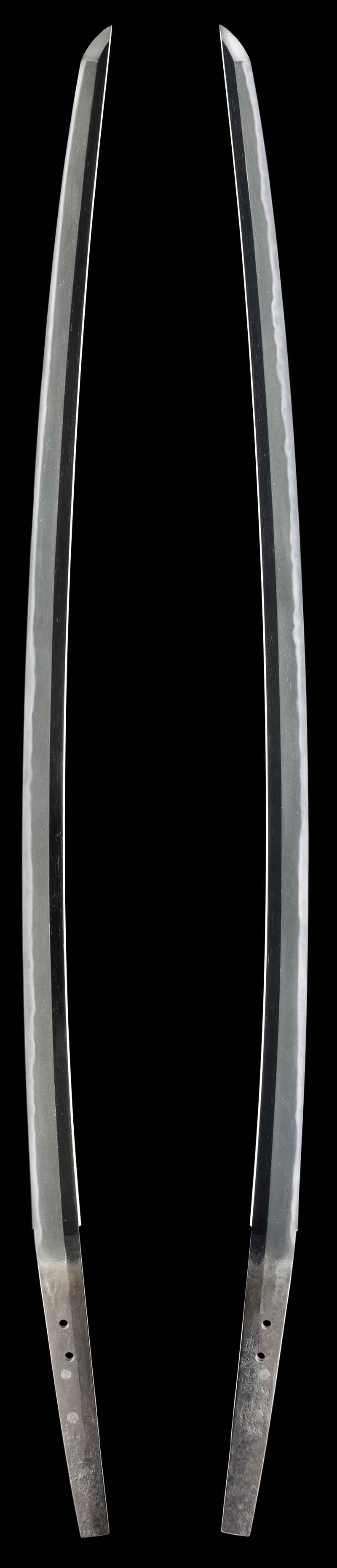
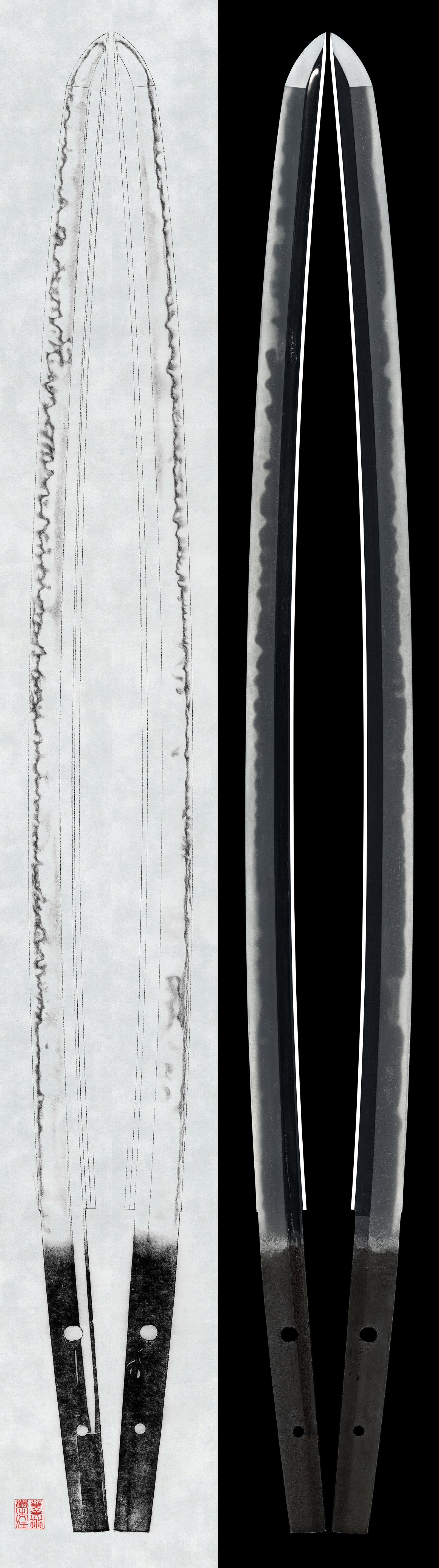
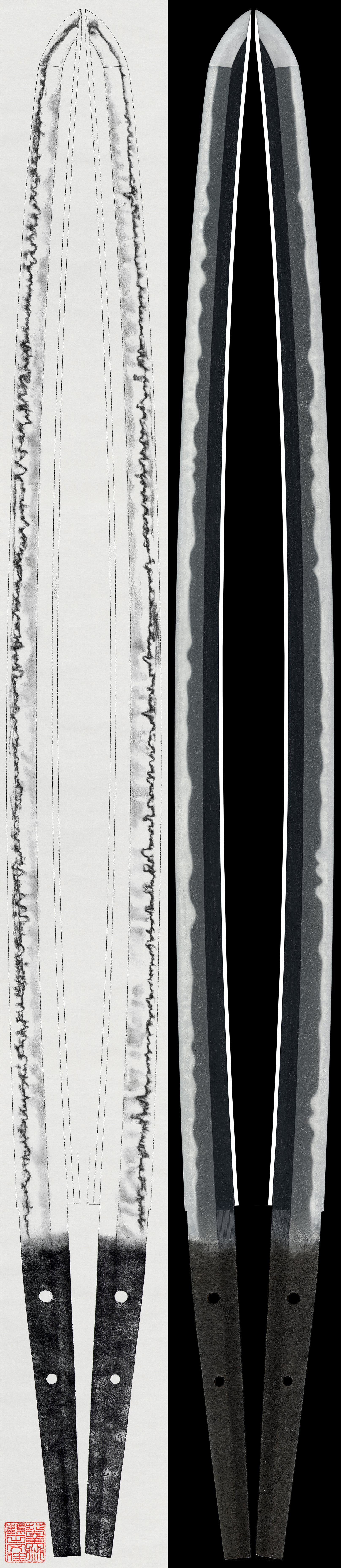
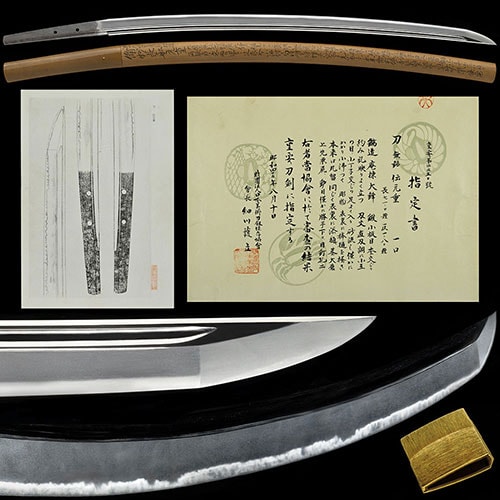
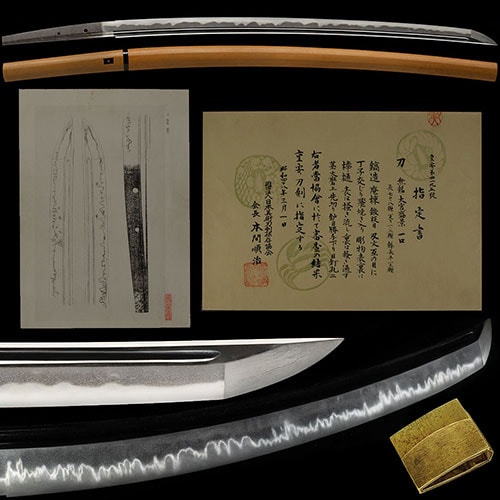
Morinaga of left a single firmly dated work, a inscribed Bishu ju Morinaga on the and Shohei 12 (1357), fifth month, on the , and that date fixes him in the generations of . The reference works compiled in the published record place him in the line of , recording him as the son of Morishige and, in one account, the grandson of the second-generation Moriie, the master who worked at the hamlet hard against village. Two generations are given under the name, the first set in the Shochu era of the 1320s and the second in Shohei, and the dated is read as the second of them. He signs in full, Bishu ju Morinaga, and his signed work is scarce; of the the published sources say plainly that among signed Morinaga such a piece is without parallel, 「守長の在銘のものは他に比類がない」.
What the published record names first about him is not a trait at all. His is a vigorous, exuberant laden with , a temper the sources describe as one that at first glance does not look like work, 「一見備前物とは思われない盛んな乱」. The pattern is a notare-based carrying , with only a little mixed in rather than the full clove the main line ran, and across it the gathers thickly, with flowing frequently and entering the . On one of the long blades coarse collects and a faint drifts above the ; on the dated the temper turns wet and breaks toward in places. The carries the restless energy, running into the temper as , then sweeping into and stopping in , and on the it thrusts up, points, and turns back long. It is this -covered, -toned , and not a clove-pattern, that the sources reach for when they place him.
The is the second half of the recognition. He forges an , often a large-pattern , that flows and tends to stand rather than closing into the dense of the masters, and across the standing grain adheres. The adds a faint standing in the , the bright reflection of old surviving inside a hand that otherwise reads as , while the open, flowing is the surface against which the heavy and the streaming are read. Where the wants a tight, lustrous to throw up its , Morinaga wants a more active steel, and the published sources mark both and as sound and the abundant, well-developed as the expression of the so-called Soden- style, 「所謂相伝備前の作風である」.
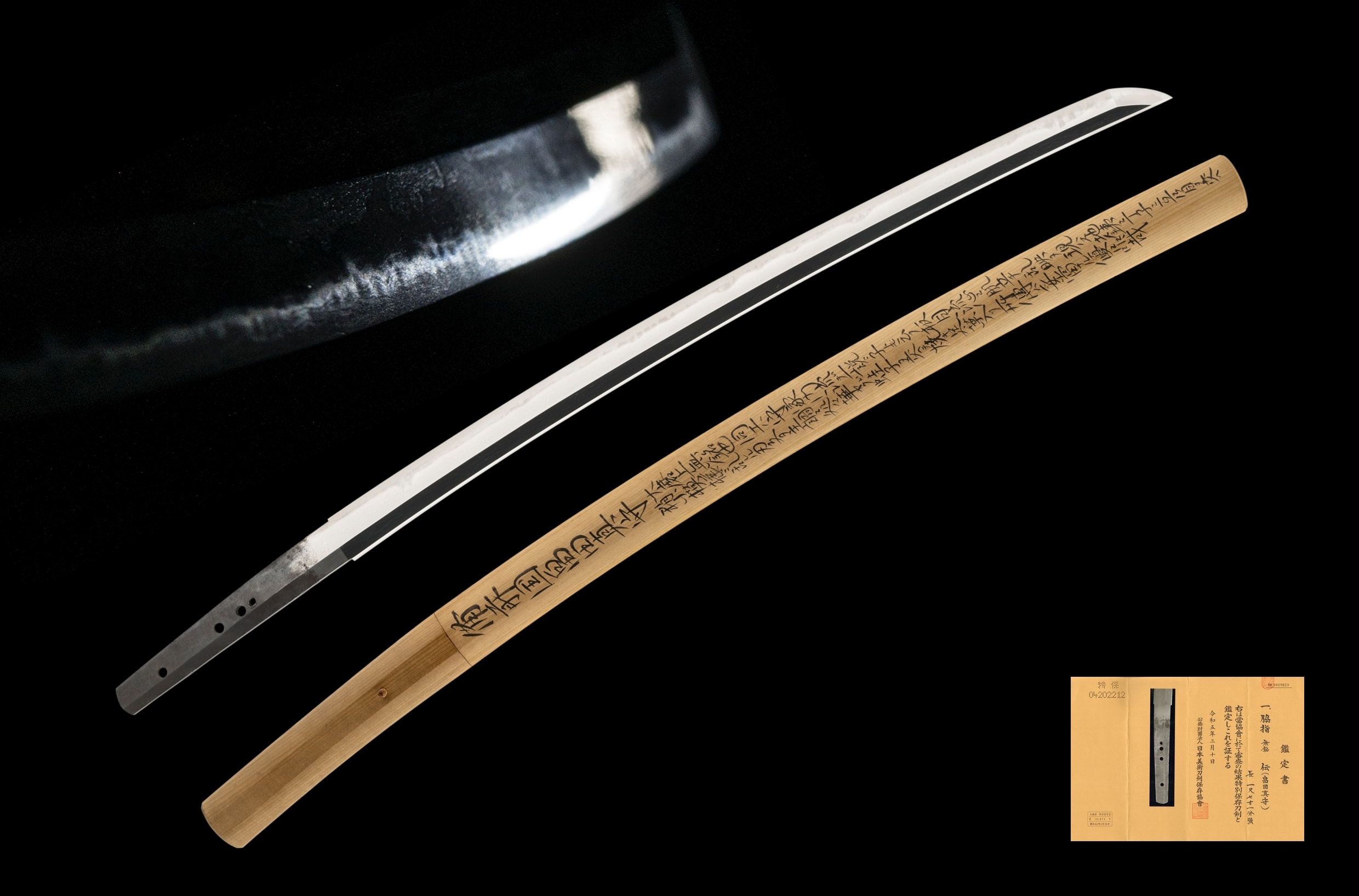
His surviving record sorts itself by shape more than by period, since the few dated and datable pieces all fall within the span. Most of what survives signed is , the long pole-arm blades shortened into and , or with the reduced, the shallow and the point run out to an , the long signature set toward the side of the tang near its end. So consistently do these appear that the published sources venture he may have been especially good at the , 「長巻が得意であったのかも知れない」, and add that, since the surviving works are not numerous, his stylistic characteristics cannot be set out in full detail. Against that group stands the one of Shohei 12, with , its long signature crossing the central and the date on the reverse, carved on the , an accomplished piece whose date the sources value as good reference material.
Where the published commentary reaches for a comparison it does not reach toward . The dated is read as according at first glance with the work of smiths such as Chogi, 「一見長義などの作に通じ」, the master whose own manner turned , and a separate entry, judging this connection from the work itself, sees a tie to the Chogi group. The earliest of the long blades carries the comparison further still: its -and-pointed is held to bring it close to the group associated with , the line at the heart of the -influenced mainstream. What sets Morinaga apart is therefore stated in his own grounded traits rather than borrowed from a rival school. The standing, flowing , the that covers and together, the and running through a -and-, and the that ends in are the features by which the published record knows him, the thread surviving as a flavor of inside an otherwise -toned hand.
Morinaga is a smith encountered chiefly through the designation record rather than through the market. Four of his works carry the rank across separate sessions, signed every one, among them the the sources call without parallel and the dated Shohei they prize as reference material; he holds no National Treasure or Important Cultural Property, and the standing of his name rests on that small body of fully signed blades. Recorded whereabouts are partial, but a Morinaga is held at the Shiogama shrine among the holdings tied to his name. For a private collector the picture follows from the scarcity the published sources themselves describe: with signed work so few, and that little concentrated in the upper designation tiers, a Morinaga is not a blade one expects to find offered, and a signed example coming to market is a rare event rather than a recurring opportunity. When one does appear it is most often a , the form he is held to have favored, carrying the long Bishu ju Morinaga signature and the -laden Soden- that the published record set down as the constant of his hand.